
| REPORT ATTRIBUTE | DETAILS |
|---|---|
| Historical Period | 2020-2023 |
| Base Year | 2024 |
| Forecast Period | 2025-2032 |
| United Arab Emirates (UAE) Internet Data Center (IDC) Market Size 2024 | USD 244.97 million |
| United Arab Emirates (UAE) Internet Data Center (IDC) Market, CAGR | 10.46% |
| United Arab Emirates (UAE) Internet Data Center (IDC) Market Size 2032 | USD 542.76 million |
Market Overview
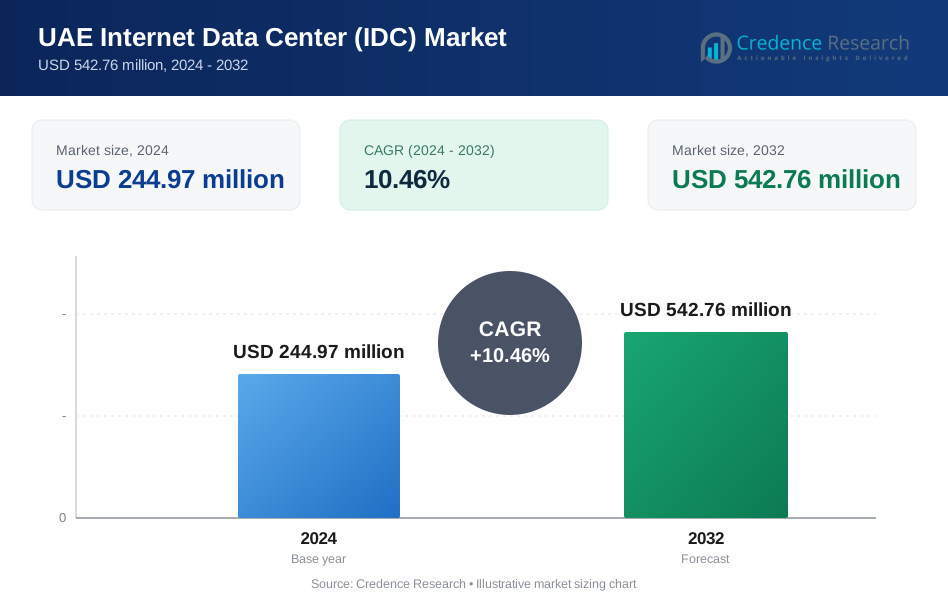
The United Arab Emirates (UAE) Internet Data Center (IDC)market size was valued at USD 244.97 million in 2024 and is anticipated to reach USD 542.76 million by 2032, at a CAGR of 10.46% during the forecast period (2024-2032).
The United Arab Emirates (UAE) Internet Data Center (IDC) market is expanding steadily due to the country's push toward digital transformation, cloud adoption, and smart infrastructure development. Rising demand for secure, low-latency data processing is driving enterprises to invest in local and edge data centers. Government initiatives like Smart Dubai and the UAE Digital Government Strategy are fueling infrastructure upgrades, while increased reliance on AI, IoT, and big data analytics boosts the need for scalable computing resources. The market also benefits from favorable regulatory support for data localization and sustainability. Operators are integrating renewable energy sources and modular designs to enhance energy efficiency and meet carbon neutrality goals. Growth in sectors such as e-commerce, banking, and digital media is amplifying the need for reliable data hosting and storage. These combined factors are positioning the UAE IDC market as a vital enabler of the nation’s broader digital economy vision.
The United Arab Emirates (UAE) Internet Data Center (IDC) market demonstrates strong geographical concentration in Dubai and Abu Dhabi due to advanced digital infrastructure, government initiatives, and high enterprise demand. Dubai leads in smart city implementation and cloud adoption, while Abu Dhabi invests heavily in public sector digitalization and AI integration. Emerging regions such as Sharjah, Ras Al Khaimah, and Fujairah are gaining traction with growing SME activity and demand for localized services. These regions are expanding edge computing capabilities to reduce latency and support regional connectivity. Key players in the UAE IDC market include Khazna Data Centers, Moro Hub, Gulf Data Hub, Equinix, and Etisalat. These companies are investing in hyperscale infrastructure, green data centers, and cloud-neutral facilities to meet the rising demand for secure, scalable, and energy-efficient solutions. Strategic collaborations and technology upgrades continue to shape their role in supporting the UAE’s broader digital economy transformation.
Market Insights
- The United Arab Emirates (UAE) Internet Data Center (IDC) market was valued at USD 244.97 million in 2024 and is projected to reach USD 542.76 million by 2032, growing at a CAGR of 10.46%.
- The global Internet Data Center (IDC) market was valued at USD 61,521.80 million in 2024 and is projected to reach USD 150,594.58 million by 2032, growing at a CAGR of 11.84% during the forecast period.
- Growing demand for cloud computing, digital transformation, and government-led smart city initiatives are key drivers accelerating infrastructure expansion in the UAE IDC market.
- The market is witnessing a shift toward hyperscale and edge data centers, supported by rising adoption of AI, IoT, and big data applications across various sectors.
- Companies like Khazna Data Centers, Moro Hub, Gulf Data Hub, Equinix, and Etisalat are strengthening their market presence by offering cloud-neutral, energy-efficient, and modular data center solutions.
- High capital expenditure, energy consumption, and complex regulatory requirements pose challenges for new entrants and limit rapid scalability of existing data center infrastructure.
- Dubai and Abu Dhabi lead the market due to advanced digital ecosystems, strong enterprise demand, and investment-friendly policies, while Sharjah and other emirates are developing gradually.
- Increased focus on sustainability, smart energy management, and local data hosting is shaping new investments, aligning the IDC market with the UAE’s long-term digital and environmental goals.
Report Scope
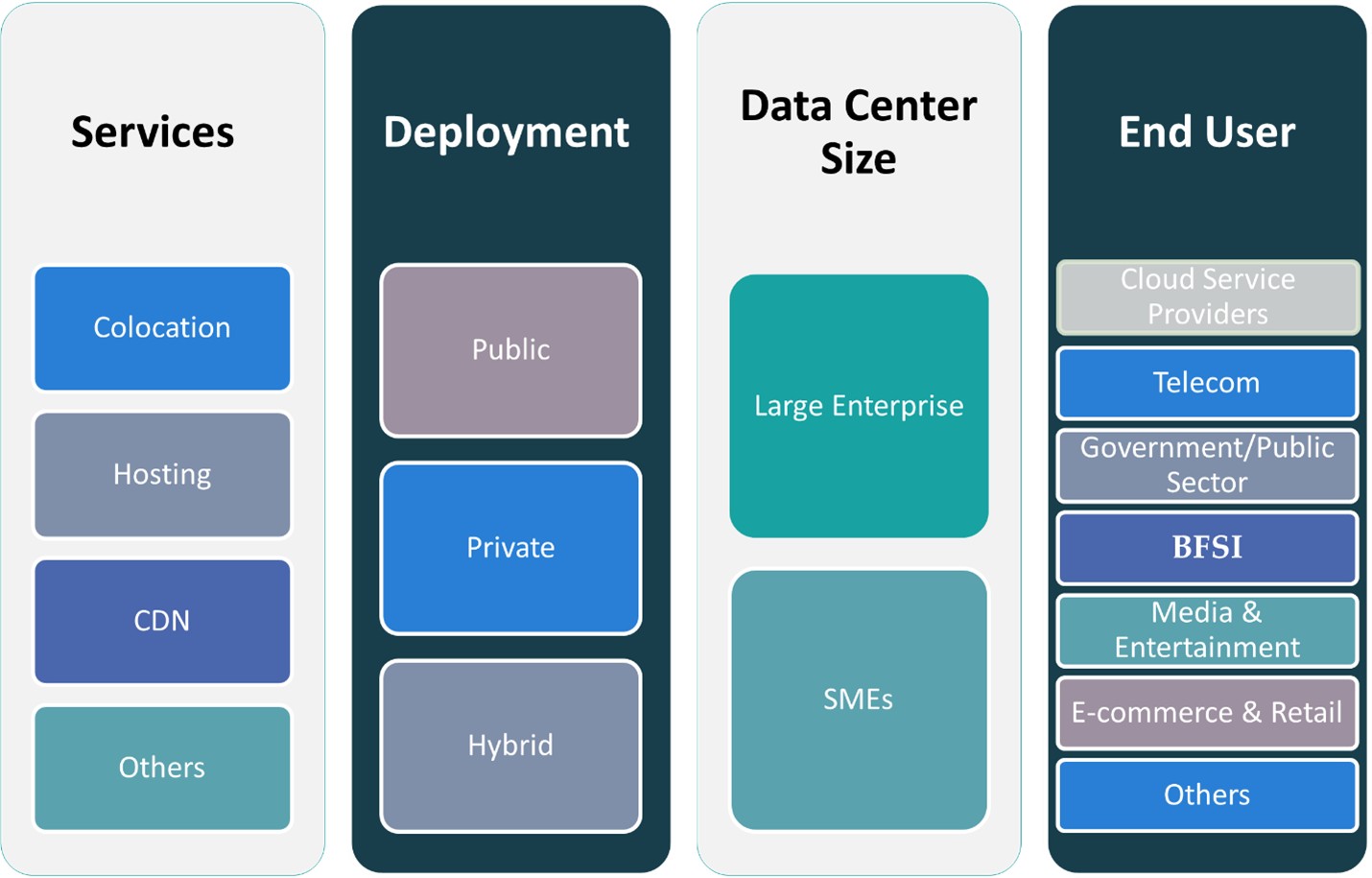
This report segments the United Arab Emirates (UAE) Internet Data Center (IDC) Market as follows:
Market Drivers
Strong Government Support for Digital Transformation
The United Arab Emirates (UAE) Internet Data Center (IDC) Market benefits from robust government initiatives aimed at advancing digital transformation. National strategies such as Smart Dubai and UAE Vision 2031 are actively promoting the development of smart cities and digital services. These initiatives require extensive data infrastructure, pushing demand for reliable and scalable data centers. Public sector investments in AI, cloud services, and big data create favorable conditions for private data center operators. The focus on e-governance and paperless services also increases reliance on localized data storage. Government-led incentives and regulatory support further encourage infrastructure growth and technological innovation.
- For instance, the UAE Digital Government Strategy 2025 focuses on embedding digital aspects into government operations, ensuring seamless integration of AI, cloud computing, and big data.
Growing E-commerce, Media, and Content Demand
The sharp rise in digital consumption is fueling the need for high-performance data centers. Online shopping, streaming services, and mobile applications are generating massive volumes of data requiring efficient processing and storage. Businesses in e-commerce and digital media rely on local data centers to deliver fast and uninterrupted services to end-users. This demand is pushing investment in edge computing and content delivery networks. It is also encouraging hybrid cloud models that support dynamic workloads. Consumer expectations for real-time access and data security continue to shape infrastructure development in this segment.
- For instance, the UAE data center market is witnessing a notable shift toward sustainable and energy-efficient solutions, with Moro Hub developing the world’s largest green data center in Dubai.
Rising Demand from Enterprise and Cloud Service Adoption
Widespread enterprise digitalization and cloud computing adoption are major growth drivers for the market. Businesses across sectors, including finance, healthcare, and retail, are migrating to cloud platforms, increasing demand for secure and flexible data centers. The market responds to this shift by expanding local capacity and introducing cloud-neutral facilities. Rapid growth in remote work and digital collaboration tools further accelerates enterprise reliance on IDC infrastructure. Companies prioritize data privacy, low-latency processing, and compliance with regional data regulations. The United Arab Emirates (UAE) Internet Data Center (IDC) Market is meeting these needs through strategic investments in capacity and redundancy.
Sustainability and Energy-Efficient Infrastructure Initiatives
Environmental goals and rising operational costs are prompting a shift toward energy-efficient and sustainable data center solutions. Operators are adopting modular designs and renewable energy sources to reduce carbon emissions and operating expenses. Cooling technologies and green certifications are becoming standard across new developments. The market aligns with the UAE’s broader sustainability agenda, which includes net-zero emission targets. Investors are increasingly favoring data center projects with built-in ESG compliance. It is creating competitive differentiation and long-term value for both providers and clients.
Market Trends
Emphasis on Green Data Center Design and Energy Efficiency
Sustainability has emerged as a major trend in data center development across the UAE. Operators are incorporating renewable energy sources, advanced cooling systems, and modular construction to minimize environmental impact. Demand for green-certified infrastructure is rising among both public and private sector clients. The market is adopting smart energy management systems to reduce power consumption and improve operational efficiency. It is reflecting the UAE’s broader commitment to carbon neutrality and sustainable development. These practices are helping operators gain regulatory advantages and meet global ESG benchmarks.
- For instance, Moro Hub has developed the world’s largest green data center in Dubai, located in the Mohammed bin Rashid Al Maktoum Solar Park.
Rising Adoption of AI, IoT, and Big Data Applications
The expansion of AI, IoT, and big data is reshaping the demands placed on data centers. These technologies require high computing power, efficient data handling, and low-latency performance. The market is evolving to support these needs with GPU-based servers, real-time analytics capabilities, and advanced data routing frameworks. It is also seeing stronger integration of automation and predictive maintenance tools to manage infrastructure loads. Businesses deploying smart technologies are prioritizing modern data centers capable of supporting dynamic workloads. The trend reinforces the strategic role of IDC facilities in enabling next-generation services across industries.
- For instance, the UAE is positioning itself as a leader in AI-driven data center infrastructure, with Digital Dubai implementing an AI-powered data center economy strategy.
Shift Toward Hyperscale and Edge Data Centers
Operators are moving toward hyperscale and edge data centers to address rising demand for speed, scalability, and data localization. These facilities support large-scale cloud operations and offer flexible capacity for enterprises with fluctuating needs. The United Arab Emirates (UAE) Internet Data Center (IDC) Market is aligning with this shift to serve latency-sensitive applications in fintech, healthcare, and streaming services. Edge data centers are enabling faster content delivery by placing computing power closer to end-users. This architecture supports the growing use of IoT and AI in urban environments. Businesses are choosing these models to improve performance and meet evolving customer expectations.
Growing Investments in Carrier-Neutral and Cloud-Neutral Facilities
Investors are focusing on developing carrier-neutral and cloud-neutral data centers that offer greater flexibility to tenants. These facilities allow businesses to choose from multiple network providers and cloud platforms without vendor lock-in. The trend supports hybrid and multi-cloud strategies favored by modern enterprises. The United Arab Emirates (UAE) Internet Data Center (IDC) Market is witnessing increased demand for such infrastructure to support business continuity and IT resilience. Carrier-neutral models also improve cross-connectivity between users, reducing downtime and enhancing redundancy. These features are attracting global hyperscalers and regional service providers.
Market Challenges Analysis
High Operational Costs and Infrastructure Investments
The development and operation of data centers in the UAE involve significant capital expenditure, posing a major challenge for new and mid-sized entrants. Land acquisition, power provisioning, cooling infrastructure, and regulatory compliance drive up overall project costs. The United Arab Emirates (UAE) Internet Data Center (IDC) Market faces pressure to balance these expenses while maintaining competitiveness. Energy consumption remains a critical factor, with cooling systems and continuous uptime requirements increasing operational costs. Companies must also invest in cybersecurity, disaster recovery, and data compliance systems, further straining budgets. These financial demands limit rapid market entry and expansion for smaller players.
- For instance, the UAE government has classified data centers as Critical National Infrastructure (CNI), reinforcing the need for robust security and operational investments.
Regulatory Compliance and Data Sovereignty Constraints
Strict data protection laws and local data residency requirements create complex compliance obligations for operators. Companies handling sensitive data must ensure full alignment with UAE’s federal and emirate-specific regulations. This increases the need for in-country data storage and strict governance policies, placing additional strain on technical and legal resources. It requires continuous monitoring of policy changes and alignment with evolving digital frameworks. The market must also address challenges tied to cross-border data transfer restrictions and regional security mandates. These regulatory demands can delay deployment timelines and affect global cloud providers operating within the region.
Market Opportunities
Expansion of Smart Cities and Digital Government Services
The UAE’s aggressive push toward smart city development and digital governance opens strong opportunities for data center growth. Projects such as Smart Dubai and digital transformation roadmaps in Abu Dhabi require high-performance computing infrastructure. The United Arab Emirates (UAE) Internet Data Center (IDC) Market can leverage this momentum by offering localized, secure, and scalable data hosting solutions. The demand for real-time data analytics, IoT integration, and AI-powered public services strengthens the need for advanced IDC infrastructure. Data centers that support cloud-native platforms and edge computing will benefit from government contracts and public-private collaborations. This alignment with national digital priorities ensures long-term growth prospects.
Rising Demand for Cloud, AI, and Content Delivery Services
Surging demand for cloud computing, AI workloads, and content streaming is creating new revenue streams for the IDC sector. Enterprises are accelerating cloud migration, while content providers need local edge capabilities to deliver seamless user experiences. The market is well-positioned to serve global hyperscalers and regional tech firms seeking low-latency, carrier-neutral infrastructure. It can attract new investments by supporting hybrid cloud environments, GPU-based computing, and scalable storage platforms. The growing population of tech-savvy consumers and businesses offers a ready customer base for next-generation services. These dynamics make the UAE a strategic hub for data center investment in the Middle East.
Market Segmentation Analysis:
By Services:
The United Arab Emirates (UAE) Internet Data Center (IDC) market is segmented by services, deployment, and data center size. Among services, colocation holds the largest share due to rising demand for scalable infrastructure, cost efficiency, and physical security. Hosting services follow closely, supported by strong growth in cloud-based applications across enterprises. The CDN segment is expanding with the surge in digital content, online gaming, and streaming platforms. Other service categories also see moderate traction, driven by specialized industry use cases.
By Deployment:
Based on deployment, the public segment leads due to widespread cloud adoption across government and commercial sectors. Enterprises prefer public models for their cost-effectiveness and ease of scalability. The private segment is gaining momentum among organizations with strict data control and compliance needs. Hybrid deployment is emerging as a strong alternative, offering flexibility and better workload distribution for businesses managing sensitive and dynamic data environments.
By Data Center Size:
By data center size, large enterprises dominate the market, driven by their need for high-performance computing, storage, and advanced security protocols. SMEs are entering the market gradually, encouraged by affordable colocation services and simplified cloud models. It supports business continuity and digital transformation efforts for smaller firms seeking to remain competitive in a digital-first economy.
Segments:
Based on Services:
- Colocation
- Hosting
- CDN
- Others
Based on Deployment:
- Public
- Private
- Hybrid
Based on Data Center Size:
- Large Enterprise
- SMEs
Based on End- User:
- Cloud Service Providers
- Telecom
- Government/Public Sector
- BFSI
- Media & Entertainment
- E-commerce & Retail
- Others
Based on the Geography:
- Abu Dhabi
- Dubai
- Sharjah
- Ajman
- Fujairah
- Ras Al Khaimah
- Umm Al Quwain
Regional Analysis
Dubai
Dubai holds the largest share of the UAE Internet Data Center (IDC) market, accounting for over 40% of the total revenue. The emirate leads in digital transformation and smart infrastructure, supported by initiatives such as Smart Dubai and the Dubai Data Strategy. It hosts multiple hyperscale and carrier-neutral data centers, attracting global cloud providers and regional enterprises. Dubai’s strategic location, advanced telecom infrastructure, and supportive business environment make it a preferred hub for digital services. It continues to witness investments in edge computing and AI-powered platforms to support demand across fintech, media, and retail sectors. The strong presence of free zones like Dubai Internet City enhances its role in regional data management and connectivity.
Abu Dhabi
Abu Dhabi follows as the second-largest contributor, representing around 30% of the market share. The capital’s investments in government digital services, artificial intelligence, and defense technologies create significant demand for secure and scalable data infrastructure. Projects under the Abu Dhabi Digital Authority drive public sector digitalization, increasing reliance on localized data storage. It is home to key innovation hubs and benefits from strong connectivity to global telecom networks. Colocation and hybrid cloud deployments are expanding rapidly to meet the needs of large enterprises and public entities. Abu Dhabi’s strategic alignment with national technology goals ensures long-term growth in its data center ecosystem.
Sharjah, Ajman, Ras Al Khaimah, Fujairah, and Umm Al Quwain
Sharjah, Ajman, Ras Al Khaimah, Fujairah, and Umm Al Quwain collectively account for the remaining 30% of the market. These emirates are witnessing gradual development in digital infrastructure, driven by SME growth and demand for local content delivery. Sharjah leads among them, offering cost-effective locations for secondary data centers and disaster recovery sites. It is supporting education and logistics sectors with growing cloud needs. The northern emirates are focusing on digital inclusion and regional cloud services to attract enterprise investment. The United Arab Emirates (UAE) Internet Data Center (IDC) market sees these areas as important for expanding edge capabilities and reducing latency across the country.
Key Player Analysis
- Khazna Data Centers
- Moro Hub
- Gulf Data Hub
- Equinix
- Etisalat
Competitive Analysis
The competitive landscape of the United Arab Emirates (UAE) Internet Data Center (IDC) market is shaped by key players such as Khazna Data Centers, Moro Hub, Gulf Data Hub, Equinix, and Etisalat. These companies play a central role in expanding the nation's digital infrastructure through advanced colocation, hosting, and cloud-neutral solutions. They focus on developing hyperscale and edge facilities that meet rising demands from enterprises, government bodies, and global cloud providers. These companies prioritize high-performance computing, advanced cooling systems, and energy-efficient operations to attract enterprise clients and global cloud platforms. Competition is driven by the ability to offer carrier-neutral and cloud-neutral environments, allowing businesses greater flexibility and resilience. Operators are also investing in modular and prefabricated designs to accelerate deployment timelines and reduce costs. Sustainability remains a key differentiator, with data center providers integrating renewable energy sources and smart energy management systems. Market leaders continuously upgrade their infrastructure to support AI, IoT, and big data applications. By aligning with national digital transformation goals and complying with data localization laws, these players reinforce their strategic importance in the UAE's evolving digital economy.
Recent Developments
- In 2025, Microsoft plans to invest about $80 billion in AI-enabled data centers, significantly increasing its investment from previous years. Over half of this investment will be directed towards the United States, supporting AI model training and the development of cloud-based applications globally. This investment is part of Microsoft's broader strategy to advance AI technology and infrastructure.
- In September 2023, Google, Microsoft, Schneider Electric, and Danfoss jointly unveiled a collaborative initiative known as the Net Zero Innovation Hub for Data Center. This groundbreaking project is developed in partnership with the Danish Data Center Industry. The proposed location for this innovative center is Fredericia, Denmark.
Market Concentration & Characteristics
The United Arab Emirates (UAE) Internet Data Center (IDC) Market is moderately concentrated, with a few dominant players operating large-scale facilities and driving most of the capacity growth. It is characterized by strong public-private collaboration, high infrastructure standards, and advanced technology adoption. The market focuses on colocation, cloud-neutral services, and high-density computing to support enterprise digital transformation. Operators compete based on energy efficiency, scalability, compliance with data localization laws, and service flexibility. Most facilities are concentrated in Dubai and Abu Dhabi, where connectivity, enterprise demand, and government support are highest. The market shows a strong preference for modular construction, green data centers, and integration with AI and IoT services. It continues to evolve with rising demand for edge computing and hybrid cloud deployments, making it a key enabler of the UAE’s broader digital economy objectives
Report Coverage
The research report offers an in-depth analysis based on Services, Deployment, Data Center Size, End-User and Geography. It details leading market players, providing an overview of their business, product offerings, investments, revenue streams, and key applications. Additionally, the report includes insights into the competitive environment, SWOT analysis, current market trends, as well as the primary drivers and constraints. Furthermore, it discusses various factors that have driven market expansion in recent years. The report also explores market dynamics, regulatory scenarios, and technological advancements that are shaping the industry. It assesses the impact of external factors and global economic changes on market growth. Lastly, it provides strategic recommendations for new entrants and established companies to navigate the complexities of the market.
Future Outlook
- The UAE IDC market is projected to experience significant growth, driven by increasing demand for digital services and infrastructure development.
- Government initiatives focusing on digital transformation and smart city projects are expected to bolster the expansion of data center facilities across the country.
- The adoption of cloud computing, artificial intelligence, and big data analytics is anticipated to escalate, necessitating enhanced data center capabilities.
- Investments in sustainable and energy-efficient data centers are likely to rise, aligning with the UAE's commitment to environmental sustainability.
- The emergence of edge computing is set to influence the development of decentralized data centers to support low-latency applications.
- The IDC market is expected to see increased participation from global cloud service providers, enhancing the country's position as a regional data hub.
- Regulatory frameworks focusing on data sovereignty and cybersecurity are projected to shape the operational strategies of data center operators.
- Technological advancements in cooling and power management systems are anticipated to improve operational efficiency in data centers.
- The demand for colocation and managed services is likely to grow, driven by businesses seeking scalable and cost-effective data solutions.
- Continuous innovation and strategic partnerships are expected to play a crucial role in the competitive landscape of the UAE IDC market.
Request a Free Sample
Fill in your details and we'll send you a free sample report.
- Sample data tables & charts
- Research methodology
Need a Custom Version of This Report?
Tailor the scope, geography, or segments to your exact requirements.
- Custom geography or segment scope
- Direct access to our analyst team
Frequently Asked Questions
What is the current size of the United Arab Emirates (UAE) Internet Data Center (IDC) market?
What factors are driving the growth of the United Arab Emirates (UAE) Internet Data Center (IDC) market?
What are some challenges faced by the United Arab Emirates (UAE) Internet Data Center (IDC) market?
Who are the major players in the United Arab Emirates (UAE) Internet Data Center (IDC) market?
Table of Content
Chapter 1. Report Introduction
- 1.1 Report Description & Purpose
- 1.1.1 Report Title & Market Definition
- 1.1.2 Unique Selling Propositions (USP) & Key Differentiators
- 1.1.3 Value Proposition for Stakeholders
- 1.2 Research Objectives
- 1.2.1 Market Sizing Objectives (Volume & Revenue)
- 1.2.2 Segmentation Objectives
- 1.2.3 Competitive Intelligence Objectives
- 1.2.4 Forecast & Scenario Objectives
- 1.3 Report Scope
- 1.3.1 UAE Internet Data Center (IDC) Scope – Types & Subtypes Covered
- 1.3.2 Geographic Scope – Regions & Countries Covered
- 1.3.3 Historical Period, Base Year & Forecast Period (2024; forecast to 2032)
- 1.3.4 Inclusions & Exclusions
- 1.4 HS Code & Classification Framework
- 1.5 Currency, Units & Pricing Basis
- 1.6 Target Stakeholders
- 1.7 Limitations & Assumptions
Chapter 2. Executive Summary
- 2.1 Global UAE Internet Data Center (IDC) Market Snapshot
- 2.1.1 Market Size – Historical (2024) & Forecast (2024-2032) (2024: USD 244.97 million → 2032: USD 542.76 million)
- 2.1.2 Volume & Revenue – Global Totals
- 2.1.3 Key Market Highlights – Top Five Facts
- 2.2 UAE Internet Data Center (IDC) Market Segmentation Snapshot
- 2.2.1 Market Split by Region – 2024 vs. 2032
- 2.3 Competitive Snapshot
- 2.3.1 Top 10 Players by Revenue Share – 2024
- 2.3.2 Top 10 Players by Volume Share – 2024
- 2.3.3 Recent Strategic Developments (18-Month Summary)
- 2.4 Key Investment Highlights & Strategic Conclusions
Chapter 3. UAE Internet Data Center (IDC) Market Dynamics & Industry Analysis
- 3.1 Market Overview & Context
- 3.1.1 UAE Internet Data Center (IDC) Market Position in the Broader Automotive Value Chain
- 3.1.2 OEM vs. Replacement Market Dynamics
- 3.1.3 Market Maturity & Development Stage by Region
- 3.2 UAE Internet Data Center (IDC) Market Drivers
- 3.3 UAE Internet Data Center (IDC) Market Restraints & Challenges
- 3.4 UAE Internet Data Center (IDC) Market Opportunities
- 3.5 Porter's Five Forces Analysis
- 3.5.1 Threat of New Entrants
- 3.5.2 Bargaining Power of Suppliers
- 3.5.3 Bargaining Power of Buyers
- 3.5.4 Threat of Substitutes
- 3.5.5 Competitive Rivalry – Intensity Assessment
- 3.6 UAE Internet Data Center (IDC) Value Chain Analysis
- 3.6.1 Upstream – Raw Material/Input Suppliers
- 3.6.1.1 Raw Material/Input 1
- 3.6.1.2 Raw Material/Input 2
- 3.6.1.3 Raw Material/Input 3
- 3.6.2 Midstream – Production/Manufacturing/Service Delivery
- 3.6.2.1 Production/Process Overview
- 3.6.2.2 Key Facility Locations & Capacity by Manufacturer
- 3.6.3 Downstream – Distribution & End Consumer
- 3.6.3.1 Primary Channel – B2B/OEM
- 3.6.3.2 Secondary Channels – Dealer, Retail, Online, Direct
- 3.6.4 Value Chain Profitability Analysis
- 3.6.1 Upstream – Raw Material/Input Suppliers
- 3.7 PESTEL Analysis
- 3.7.1 Political Factors
- 3.7.2 Economic Factors
- 3.7.3 Social Factors
- 3.7.4 Technological Factors
- 3.7.5 Environmental Factors
- 3.7.6 Legal Factors
- 3.8 UAE Internet Data Center (IDC) Supply Chain Analysis
- 3.8.1 Raw Material/Input Supply Risk Assessment
- 3.8.2 Manufacturing Concentration Risk (Geographic Exposure)
- 3.8.3 Trade Disruption Impact Analysis
- 3.9 Regulatory & Policy Landscape
Note: The regulatory and policy landscape section covers regulations based on their applicability to the market, UAE Internet Data Center (IDC) category, geography, and scope of the study. Only regulatory frameworks with a material impact on operations, compliance, trade, sustainability, or market access are analyzed in detail.
Chapter 4. Key Investment Pockets & Opportunity Analysis
- 4.1 UAE Internet Data Center (IDC) Market Attractiveness Analysis
- 4.1.1 By Region – Investment Attractiveness Matrix (Volume × CAGR)
- 4.2 Absolute Revenue Growth Opportunity
- 4.2.1 By Region – Absolute USD Growth Through 2032
- 4.3 Incremental Volume Opportunity
- 4.3.1 By Region – Incremental Volume Through 2032
- 4.3.2 Segment – Incremental Volume
- 4.4 Emerging Submarket Opportunity Deep Dive (Subject to Applicability)
- 4.5 Emerging Market Opportunity Scorecards
- 4.5.1 United States
- 4.5.2 Europe
- 4.5.3 Asia
- 4.5.4 Middle East & Africa
Note: Emerging Market Opportunity Scorecards will be included based on relevance and strategic importance. Regions listed are indicative and may vary depending on data availability and market dynamics.
Chapter 5. UAE Internet Data Center (IDC) Import-Export Analysis & Trade Flows
- 5.1 Global Trade Overview
- 5.1.1 Global Export Value by Country (2024)
- 5.1.2 Global Export Volume by Country (2024)
- 5.1.3 Global Import Value by Country (2024)
- 5.1.4 Global Import Volume by Country (2024)
- 5.1.5 Net Trade Balance by Country (2024)
- 5.2 Export Analysis – Segment
- 5.2.1 Type 1 (HS Code)
- 5.2.2 Type 2 (HS Code)
- 5.2.3 Type 3 (HS Code)
- 5.2.4 Type 4 (HS Code)
- 5.2.5 Type 5 (HS Code)
- 5.3 Import Analysis – Segment
- 5.3.1 Type 1 (HS Code)
- 5.3.2 Type 2 (HS Code)
- 5.3.3 Type 3 (HS Code)
- 5.3.4 Type 4 (HS Code)
- 5.3.5 Type 5 (HS Code)
- 5.4 Average Unit Trade Prices
- 5.4.1 Average Export Price – Segment & Country
- 5.4.2 Average Import Price – Segment & Source Country
- 5.4.3 Price Trends (2024)
- 5.5 Key Trade Route Analysis
- 5.5.1 Trade Route 1
- 5.5.2 Trade Route 2
- 5.5.3 Trade Route 3
- 5.5.4 Trade Route 4
- 5.5.5 Trade Route 5
- 5.6 Trade Policy Impact Assessment
- 5.6.1 US Anti-Dumping & Section 301 Tariffs
- 5.6.2 EU Customs Union Impact
- 5.6.3 Major Free Trade Agreements
- 5.6.4 USMCA Rules of Origin
Note: Trade policy analysis will be included only where relevant to the UAE Internet Data Center (IDC) market.
Chapter 6. Competitive Landscape & Company Benchmarking
- 6.1 UAE Internet Data Center (IDC) Market Concentration & Structure
- 6.1.1 Herfindahl-Hirschman Index (HHI) – vs. 2024
- 6.1.2 Tier 1, Tier 2 & Tier 3 Market Structure
- 6.1.3 Global, Regional & Local Player Dynamics
- 6.2 UAE Internet Data Center (IDC) Market Share Analysis – 2024
- 6.2.1 Global Revenue Share by Company
- 6.2.2 Global Volume Share by Company
- 6.2.3 Regional Revenue Share
- 6.2.4 Market Share Evolution ( vs. 2024)
- 6.2.5 OEM Segment Share by Company
- 6.2.6 Replacement Segment Share by Company
- 6.3 Production/Delivery Capacity & Facility Analysis
- 6.3.1 Global Installed Capacity
- 6.3.2 Capacity Utilization Rates
- 6.3.3 Production/Output Volume
- 6.3.4 Facility Locations & Capacity Map
- 6.3.5 Planned Capacity Additions
- 6.4 UAE Internet Data Center (IDC) Competitive Benchmarking Matrix
- 6.4.1 Revenue, Volume, CAGR & Profitability Comparison
- 6.4.2 Channel Revenue Mix
- 6.4.3 Geographic Revenue Exposure
- 6.4.4 R&D Intensity
- 6.4.5 Sustainability Maturity
- 6.5 Strategic Developments in UAE Internet Data Center (IDC) (Last 24 Months)
- 6.5.1 Mergers, Acquisitions & Divestments
- 6.5.2 New UAE Internet Data Center (IDC) Launches
- 6.5.3 Facility Expansions
- 6.5.4 Strategic Alliances, Joint Ventures & Partnerships
- 6.5.5 Distribution Expansion & Market Entry
- 6.5.6 Sustainability & ESG Initiatives
- 6.6 Competitive Strategy Mapping
- 6.6.1 Leader, Challenger, Follower & Niche Classification
- 6.6.2 Pricing Strategy Comparison
- 6.6.3 Channel Strategy Matrix
Note: Strategic developments are included based on their materiality and the availability of reliable information.
Chapter 7. Global UAE Internet Data Center (IDC) Market – By Distribution Channel
- 7.1 Segment Overview
- 7.1.1 Volume & Revenue Split by Channel (2024 & 2032)
- 7.1.2 Channel Mix Evolution (2024-2032)
Chapter 8. Regional Market Analysis – Global Overview
- 8.1 Global Regional Overview
- 8.1.1 Regional Volume Share
- 8.1.2 Regional Revenue Share
- 8.1.3 Regional Volume by Region
- 8.1.4 Regional Revenue by Region
- 8.1.5 Regional Forecast Through 2032
- 8.2 Cross-Regional Segment Analysis
- 8.2.1 By Distribution Channel
- 8.2.2 By Brand/Price Tier
Chapter 9. North America UAE Internet Data Center (IDC) Market
- 9.1 United States
- 9.2 Canada
- 9.3 Mexico
Chapter 10. Europe UAE Internet Data Center (IDC) Market
- 10.1 Germany
- 10.2 France
- 10.3 Italy
- 10.4 United Kingdom
- 10.5 Spain
- 10.6 Poland
- 10.7 Russia
- 10.8 Netherlands
- 10.9 Belgium
- 10.10 Sweden
- 10.11 Denmark
- 10.12 Norway
- 10.13 Rest of Europe
Chapter 11. Asia Pacific UAE Internet Data Center (IDC) Market
- 11.1 China
- 11.2 India
- 11.3 Japan
- 11.4 South Korea
- 11.5 Thailand
- 11.6 Indonesia
- 11.7 Vietnam
- 11.8 Malaysia
- 11.9 Australia
- 11.10 Rest of Asia Pacific
Chapter 12. Latin America UAE Internet Data Center (IDC) Market
- 12.1 Brazil
- 12.2 Argentina
- 12.3 Colombia
- 12.4 Chile
- 12.5 Rest of Latin America
Chapter 13. Middle East UAE Internet Data Center (IDC) Market
- 13.1 Saudi Arabia
- 13.2 United Arab Emirates
- 13.3 Turkey
- 13.4 Israel
- 13.5 Iran
- 13.6 Rest of the Middle East
Chapter 14. Africa UAE Internet Data Center (IDC) Market
- 14.1 South Africa
- 14.2 Egypt
- 14.3 Nigeria
- 14.4 Morocco
- 14.5 Rest of Africa
Chapter 15. UAE Internet Data Center (IDC) Company Profiles
- 15.1 [Company 01]
- 15.1.1 Company Overview
- 15.1.2 Key Management Personnel
- 15.1.3 Products & Services Portfolio
- 15.1.4 Financial Performance
- 15.1.5 Key Market Focus & Geographic Presence
- 15.1.6 Recent Developments & Strategic Initiatives
Note: The company profile list is preliminary and may change based on research findings, market developments, data availability, and client requirements.
Chapter 16. Appendices
- Appendix A – List of Abbreviations & Acronyms
- Appendix B – Industry Classification Code Reference – Full Series
- Appendix C – Production & Capacity Data Tables
- Appendix D – End-Use & Demand Base Tables
- Appendix E – Consumption & Replacement Rate Assumptions
- Appendix F – ASP Reference Tables
- Appendix G – Manufacturing & Facility Database
- Appendix H – Import-Export Data Tables
- Appendix I – Regulatory Summary Tables
- Appendix J – Primary Research Participant List (Anonymized)
- Appendix K – Primary Research Questionnaire Framework
- Appendix L – Data Sources & Bibliography
- Appendix M – Market Size Divergence & Source Comparison
Chapter 17. Research Methodology
- 17.1 Research Framework & Philosophy
- 17.2 Secondary Research – Sources, Hierarchy & Data Extraction
- 17.3 Data Modeling – Bottom-Up & Top-Down Market Sizing
- 17.4 Primary Research – Stakeholder Framework, LOI & Sample Sizes
- 17.5 Forecast Methodology – Regression, Scenario & Sensitivity Analysis
- 17.6 Quality Control – Four-Layer Validation Framework
- 17.7 Limitations & Standard Assumptions
- 17.8 Disclaimer
