
| REPORT ATTRIBUTE | DETAILS |
|---|---|
| Historical Period | 2020-2023 |
| Base Year | 2024 |
| Forecast Period | 2025-2032 |
| UAE Ice Cream Market Size 2024 | USD 306 million |
| UAE Ice Cream Market, CAGR | 7.3% |
| UAE Ice Cream Market Size 2032 | USD 537.674 million |
Market Overview:
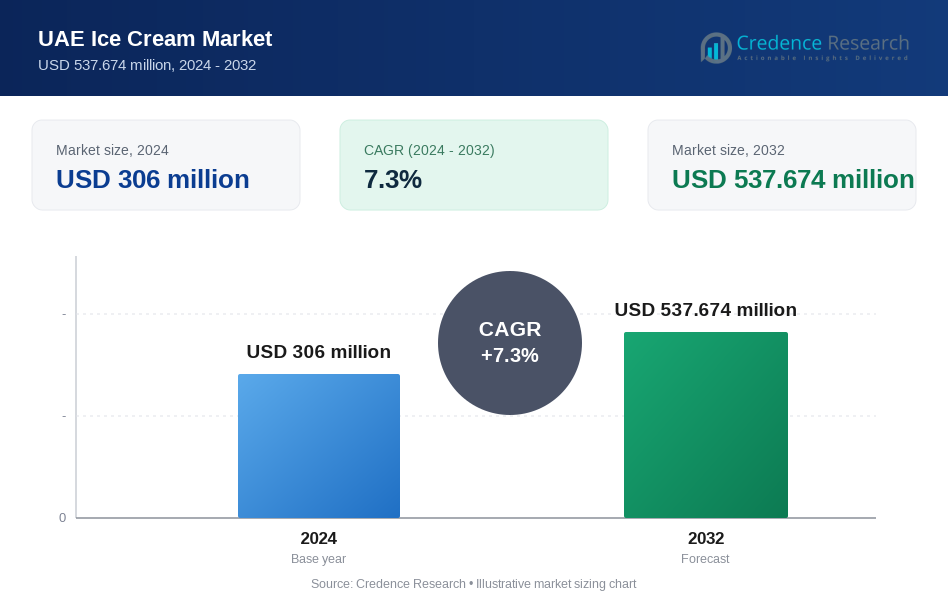
The UAE Ice Cream Market is projected to grow from USD 306 million in 2024 to an estimated USD 537.674 million by 2032, with a compound annual growth rate (CAGR) of 7.3% from 2024 to 2032.
Several factors contribute to the expansion of the UAE ice cream market. The nation's hot and arid climate significantly influences consumer behavior, making ice cream a preferred treat throughout the year. Additionally, the UAE's high purchasing power enables consumers to indulge in premium and artisanal ice cream offerings. The increasing influx of tourists further amplifies demand, as visitors seek local and international ice cream brands. Moreover, the growing health consciousness among consumers has led to a rise in demand for healthier alternatives, such as low-fat, dairy-free, and plant-based ice creams. Innovations in flavors and product formats also play a crucial role in attracting a broad consumer base. Furthermore, the rising trend of premiumization, driven by consumers seeking unique experiences and higher-quality ingredients, supports the market's growth. The introduction of novelty products such as ice cream cakes, and ice cream sandwiches, coupled with expanding retail offerings, continues to fuel demand.
Regionally, the UAE's ice cream market is concentrated in urban centers, with Abu Dhabi, Dubai, and Sharjah being the primary hubs of consumption. These cities boast a high density of retail outlets, including supermarkets, convenience stores, and specialty ice cream parlors, facilitating easy access for consumers. The dominance of impulse ice creams, particularly single-serve options, is notable, accounting for over 60% of the market share in 2024. The retail offline channel remains the predominant distribution avenue, capturing more than 90% of total sales. However, the rise of e-commerce and advancements in cold chain logistics are gradually reshaping the market landscape, offering consumers the convenience of home delivery without compromising product quality. The increasing integration of online platforms by major ice cream brands is expanding the consumer base beyond traditional channels, while the growth of foodservice establishments and innovative vending solutions further drives market expansion.
Market Insights:
- The UAE Ice Cream Market is projected to grow from USD 306 million in 2024 to USD 537.674 million by 2032, driven by rising consumer demand.
- The hot, arid climate plays a key role in the year-round demand for ice cream, especially during the summer months when temperatures exceed 40°C.
- High disposable incomes and a shift toward premium, artisanal ice cream products are fueling market expansion in the UAE, with consumers willing to invest in high-quality options.
- Health-conscious trends are prompting an increase in demand for low-fat, dairy-free, and plant-based ice cream, catering to the growing wellness-conscious population.
- Continuous innovation in flavors, product formats, and packaging is engaging consumers and sustaining growth in the market.
- Urban centers like Dubai, Abu Dhabi, and Sharjah dominate consumption, with a high density of retail outlets and specialty ice cream parlors.
- E-commerce and cold chain logistics are reshaping the market landscape, enabling convenient home delivery and expanding consumer reach.
Market Drivers:
Favorable Climate Drives Demand for Ice Cream in the UAE
The UAE's hot and arid climate plays a significant role in boosting demand for ice cream. With temperatures often exceeding 40°C during the summer months, consumers frequently seek refreshing and cooling treats. The nation’s year-round warm weather makes ice cream a popular dessert choice across all age groups. This consistent demand for chilled products contributes significantly to the growth of the UAE Ice Cream Market. As temperatures rise, more people indulge in frozen treats, whether at home, in restaurants, or from convenience stores. The weather conditions, coupled with a high standard of living, make ice cream an integral part of daily consumption in the UAE.
Rising Disposable Income and High Consumer Spending
The UAE boasts one of the highest per capita incomes globally, which has a direct impact on the demand for luxury and premium products, including ice cream. With an affluent population, consumers are willing to spend more on high-quality, artisanal, and exotic ice cream flavors. This trend has encouraged ice cream manufacturers to introduce premium products and indulgent offerings to meet the desires of consumers looking for more than just traditional ice cream. High disposable incomes enable UAE residents to afford these premium options, supporting growth in the premium segment of the market. The increase in consumer spending on non-essential products like ice cream highlights a shift toward more varied consumption habits, further driving the market’s development.
- For instance, Artisanal ice cream holds the largest share in terms of value within the UAE ice cream sector, reflecting consumers’ willingness to pay for quality and unique flavors
Growing Popularity of Health-Conscious Ice Cream Options
Health-conscious trends have led to an increasing demand for healthier ice cream alternatives in the UAE. Consumers are becoming more mindful of their dietary choices, prompting the rise of low-fat, dairy-free, and plant-based ice cream options. As more people focus on fitness and well-being, the market sees an increase in products that cater to dietary preferences and restrictions. Manufacturers are responding by innovating with low-sugar and calorie-conscious ice creams, which appeal to health-focused individuals. This shift toward healthier choices is enhancing the appeal of the UAE Ice Cream Market, making it more inclusive for those seeking to indulge without compromising their health goals.
- For instance,Igloo, a leading brand under IFFCO Group, has introduced its "Igloo Lite" range in the UAE, featuring low-fat ice creams with less than 3 grams of fat per 100ml and reduced sugar content, specifically targeting calorie-conscious consumers.
Innovation and Product Diversification Drive Consumer Interest
Innovation plays a crucial role in shaping the UAE Ice Cream Market, with manufacturers constantly introducing new flavors, packaging, and product formats to meet evolving consumer preferences. Unique ice cream offerings, such as ice cream cakes, frozen yogurt, and fusion desserts, continue to captivate consumers. Furthermore, the launch of limited-edition flavors and collaborations with popular brands generates excitement, further attracting customers. The introduction of on-the-go formats like ice cream bars and cups meets the growing need for convenience, especially among busy professionals and tourists. These product diversifications maintain consumer interest and sustain the growth of the market. Innovation keeps the ice cream experience fresh and engaging for customers, driving continued market expansion.
Market Trends:
Expansion of Premium Ice Cream Offerings in the UAE
The UAE Ice Cream Market has witnessed a notable shift towards premium and indulgent products. Consumers are increasingly inclined toward high-quality, artisanal, and exotic ice cream flavors, a trend supported by the growing demand for luxury items. Premium ice cream brands are capitalizing on the high disposable income of UAE residents, offering products that feature unique ingredients and intricate flavor profiles. This includes organic, locally sourced components, as well as gourmet options that focus on superior taste and texture. The increasing focus on premiumization has encouraged both local and international ice cream producers to diversify their product lines, positioning them as indulgent treats rather than just frozen desserts. These developments highlight the evolving consumer preferences in the UAE, where quality takes precedence over traditional offerings.
- For example, House of Pops, a UAE-based brand, has achieved a 100% natural ingredient formulation across its premium popsicle range, explicitly stating that its products are free from artificial colors, flavors, and preservatives, and contain less than 60 calories per serving.
Growth in Health-Conscious and Alternative Ice Cream Products
Health-consciousness continues to shape the UAE Ice Cream Market, with a significant rise in demand for healthier alternatives. Consumers are opting for ice creams that cater to dietary restrictions, such as low-fat, dairy-free, vegan, and sugar-free options. As the focus on wellness and fitness grows, so does the demand for frozen desserts that align with these lifestyles. Manufacturers are responding by innovating with plant-based ingredients, such as almond, coconut, and oat milk, to create indulgent yet healthier alternatives. These options appeal to a wide consumer base, from those seeking to manage their weight to individuals with lactose intolerance or vegan preferences. The growing availability of these products signals a deeper shift toward health and well-being in the ice cream segment.
- Häagen-Dazs launched the "Heaven" range as a lower-calorie, lower-fat ice cream line. Each 2/3-cup serving (about 150ml) contains 7–10g protein and 9–10g fat, which is higher than 5g fat per 100ml. The range uses ultra-filtered skim milk, not pea protein or stevia; sweeteners include cane sugar and tapioca syrup. For instance, the Peanut Butter Chip flavor has 10g protein and 10g fat per serving.
Rising Popularity of Convenient Ice Cream Formats in the UAE
The demand for convenient, on-the-go ice cream products continues to rise in the UAE, driven by busy urban lifestyles. Single-serve formats such as ice cream bars, cups, and cones are gaining popularity among consumers who prefer a quick, easy treat. These formats cater to a wide range of occasions, from casual snacks to indulgent moments during work breaks or while traveling. In response, manufacturers are introducing innovative packaging that enhances convenience without compromising the quality of the ice cream. Additionally, the rise of mobile apps and delivery services has further accelerated the demand for ready-to-eat ice cream products. This trend reflects the need for convenience in an increasingly fast-paced society.
Innovative Marketing Strategies and Celebrity Collaborations
The UAE Ice Cream Market has seen the rise of creative marketing strategies that attract consumers through brand collaborations, celebrity endorsements, and limited-edition product releases. Ice cream brands are leveraging partnerships with high-profile personalities to create buzz and excitement around their products. For example, collaborations with famous chefs or influencers have led to the launch of exclusive flavors that generate immediate consumer interest. These collaborations not only engage loyal customers but also capture the attention of new audiences seeking unique experiences. Such marketing tactics, paired with social media promotions, have played a key role in increasing brand visibility and consumer engagement, contributing to the market's dynamic growth.
Market Challenges Analysis:
Fluctuating Raw Material Costs and Supply Chain Disruptions
One of the significant challenges facing the UAE Ice Cream Market is the fluctuation in raw material costs. The price of essential ingredients such as dairy products, sugar, and flavorings can vary significantly, affecting production costs. These fluctuations are often driven by global supply chain disruptions, which can further impact availability and pricing. Ice cream manufacturers are particularly vulnerable to these changes due to the need for consistent quality and supply. As the market grows and consumer demand rises, the challenge of maintaining affordable production costs while ensuring product quality remains a key concern. Suppliers may also face difficulties in meeting the demand for specialized ingredients required for premium or healthier ice cream options, which adds another layer of complexity to the supply chain.
Intense Competition and Price Sensitivity
The UAE Ice Cream Market is highly competitive, with numerous local and international brands vying for consumer attention. As the market expands, price sensitivity among consumers becomes a challenge for ice cream manufacturers. While premium products attract affluent consumers, a large portion of the market remains sensitive to price, particularly in more price-conscious consumer segments. This forces companies to strike a balance between offering high-quality products and keeping their prices competitive. Moreover, the rise of private label ice cream products in supermarkets and convenience stores adds to the pressure on established brands to maintain their market share. To stay competitive, brands must continuously innovate while managing production costs effectively, which is a persistent challenge in the dynamic and growing market.
Market Opportunities:
Expansion of Health-Conscious and Plant-Based Ice Cream Segments
The increasing demand for health-conscious products presents a significant opportunity in the UAE Ice Cream Market. With a growing emphasis on wellness, consumers are seeking alternatives that align with their dietary preferences, such as low-fat, sugar-free, and plant-based ice creams. As the market for vegan and dairy-free options expands, manufacturers have the chance to diversify their product offerings to cater to this segment. Plant-based ice cream, made from ingredients like almond, oat, and coconut milk, is gaining popularity, particularly among health-conscious individuals and those with dietary restrictions. This shift toward healthier options allows brands to tap into a broader customer base, responding to the changing preferences of the UAE population.
Innovation in Premium and Customizable Ice Cream Products
The demand for unique, premium experiences provides a prime opportunity for growth in the UAE Ice Cream Market. Consumers increasingly look for innovative and customized offerings, such as exotic flavors, artisanal ingredients, and exclusive collaborations. This trend creates opportunities for brands to develop bespoke ice cream experiences that cater to luxury-seeking customers. Companies can capitalize on these preferences by offering personalized ice cream flavors, special editions, or themed desserts. By embracing these innovations, brands can attract high-end customers while positioning themselves as leaders in a dynamic and evolving market. The ability to provide tailored experiences will strengthen customer loyalty and drive long-term growth.
Market Segmentation Analysis:
The UAE Ice Cream Market is segmented across various categories, each contributing to its robust growth.
By Dairy-Based and Non-Dairy Based products, with dairy-based options holding a dominant share due to their traditional appeal. However, the growing demand for healthier and plant-based alternatives is driving the rise of non-dairy options.
- For instance, IFFCO Group’s Igloo brand does maintain a dominant position in the dairy-based segment and produces over 50 million liters of dairy ice cream annually at its Dubai facility.
By Product Category, impulse ice creams, such as cones, sticks, bars, and sandwiches, lead the market. These single-serve options appeal to consumers seeking quick, on-the-go indulgence. Take-home Ice Cream, in tubs and multi-packs, is popular among families and those purchasing for home consumption. The premium segment, Artisanal Ice Cream, is gaining traction as consumers increasingly seek high-quality, handcrafted, and local options.
By Packaging Size. Single-serve products dominate, offering convenience, while Family Pack and Bulk packaging cater to larger households and those seeking value.
- Example, for take-home categories, Häagen-Dazs, produced by General Mills, offers multi-pack tubs with a minimum butterfat content of 14% and protein content of up to 10 grams per 2/3 cup serving, as stated on official product labels.
By Packaging Type, Rigid Plastics are the most common, providing durability and ease of handling. However, Flexible Packaging and Paper & Board options are gaining popularity due to their eco-friendly appeal.
By Distribution Channels in the UAE Ice Cream Market include supermarkets and hypermarkets, which remain the leading retail avenues. Convenience Stores and Specialty Stores, such as ice cream parlors, capture a niche segment, while Online Retail is expanding, offering consumers increased access to home delivery options.
Segmentation:
By Product Type
- Dairy-Based
- Non-Dairy Based
By Product Category
- Impulse Ice Cream (cones, sticks, bars, sandwiches)
- Take-home Ice Cream (tubs, multi-packs)
- Artisanal Ice Cream (premium, handcrafted, local)
By Packaging Size
- Single Serve
- Family Pack
- Bulk
By Packaging Type
- Rigid Plastics
- Flexible Packaging
- Paper & Board
By Distribution Channel
- Supermarkets/Hypermarkets
- Convenience Stores
- Specialty Stores (ice cream parlors, dessert shops)
- Online Retail
- Dollar Stores
By Regional Segmentation
- Abu Dhabi
- Dubai
- Sharjah
- Ajman
- Umm Al-Quwain
- Fujairah
Regional Analysis:
Dubai and Abu Dhabi: Key Consumption Hubs in the UAE Ice Cream Market
Dubai and Abu Dhabi dominate the UAE Ice Cream Market due to their status as the economic and cultural hubs of the country. These cities account for the largest market share, with Dubai holding approximately 45% and Abu Dhabi contributing around 30%. Both cities have a high population density, a thriving tourism sector, and a diverse expatriate population, all of which contribute to the consistent demand for ice cream. The presence of numerous retail outlets, supermarkets, and specialty ice cream parlors makes it easy for consumers to access products. The growing number of premium and artisanal ice cream brands catering to the affluent population in these regions also boosts demand. The urban lifestyle and hot climate further enhance the popularity of ice cream, leading to significant market penetration in these regions.
Northern Emirates: Growing Demand and Emerging Market Opportunities
The Northern Emirates, including Sharjah, Ras Al Khaimah, and Fujairah, are witnessing increasing growth in the UAE Ice Cream Market. While these regions account for a smaller market share compared to Dubai and Abu Dhabi, they present emerging opportunities for expansion. Currently, the Northern Emirates hold about 20% of the market share, with an upward trend in demand for both traditional and innovative ice cream offerings. A growing middle-class population, increasing disposable incomes, and the rise of modern retail outlets contribute to this growth. These regions are also becoming more attractive to ice cream manufacturers looking to expand their geographic footprint beyond the major cities. Additionally, local consumer preferences for family-friendly and affordable ice cream options drive market growth in these areas.
Tourist-Heavy Areas and Expansion of Distribution Channels
Regions with high tourism traffic, such as Dubai and Ras Al Khaimah, contribute significantly to the UAE Ice Cream Market, particularly in terms of seasonal demand. Tourist destinations and resorts drive a notable share of ice cream sales, especially in hot months, contributing to a significant proportion of sales during peak tourist seasons. The market share from tourist-centric regions like these is around 25%. With the continued growth of the tourism sector and the development of retail channels such as food trucks, ice cream kiosks, and online platforms, the reach of ice cream brands continues to expand. By diversifying distribution channels and targeting both local residents and tourists, brands are tapping into new revenue streams. These regions are becoming increasingly important for ice cream companies looking to enhance their market presence and boost sales.
Key Player Analysis:
- Desert Chill Ice Cream LLC
- General Mills Inc. (Häagen-Dazs)
- IFFCO Group (Igloo)
- Mars, Incorporated
- Maras Turka LLC
- Mini Melts LLC
- Pure Ice Cream Co. LLC (Kwality)
- Galadari Ice Cream Company LLC (Baskin Robbins)
- Kahala Franchising, L.L.C (Cold Stone Creamery)
- Al Qubaisi Group (Gelato Divino)
Competitive Analysis:
The UAE Ice Cream Market is highly competitive, with both international and local brands vying for consumer attention. Key players include global giants such as Unilever (with brands like Magnum and Cornetto) and Nestlé, which have a significant market presence due to their established brands and widespread distribution networks. These companies focus on product innovation and premium offerings to cater to the growing demand for luxury and health-conscious ice cream. Local players like Al Ain Dairy and Baskin-Robbins also maintain strong positions, offering a mix of traditional and novel flavors tailored to regional tastes. Competition intensifies with the rise of artisanal brands and smaller players emphasizing unique, premium ingredients and customization. To stay competitive, companies are increasingly leveraging digital platforms and partnerships to enhance brand visibility, optimize distribution, and expand consumer reach. This competitive landscape is expected to drive continued innovation and customer-centric offerings in the market.
Recent Developments:
- In May 2025, Pure Ice Cream Co. LLC commenced construction on an AED 80 million production facility at Dubai Industrial City, which will become one of the UAE’s largest ice cream factories upon its launch in 2026. Alongside this expansion, Pure Ice Cream entered a production agreement with US-based Inspire Brands to manufacture Baskin-Robbins ice creams, aiming to export products to over 20 countries from Dubai.
Market Concentration & Characteristics:
The UAE Ice Cream Market is characterized by moderate concentration, with a few large international brands dominating the market alongside several strong regional players. Major players such as Unilever and Nestlé hold significant market share, thanks to their wide distribution networks and established brand presence. However, the market also sees increasing competition from local and niche brands, particularly those focusing on premium, artisanal, and health-conscious ice cream products. This dynamic fosters innovation, with companies continually introducing new flavors and unique offerings to cater to evolving consumer preferences. Despite the dominance of global brands, the market’s diversity allows for opportunities for smaller players and new entrants, especially in premium and specialized product segments. This balance of large, well-established players and smaller, innovative brands shapes the market's competitive landscape.
Report Coverage:
The research report offers an in-depth analysis based on Product Type, Product Category, Packaging Size, Packaging Type and Distribution Channel. It details leading market players, providing an overview of their business, product offerings, investments, revenue streams, and key applications. Additionally, the report includes insights into the competitive environment, SWOT analysis, current market trends, as well as the primary drivers and constraints. Furthermore, it discusses various factors that have driven market expansion in recent years. The report also explores market dynamics, regulatory scenarios, and technological advancements that are shaping the industry. It assesses the impact of external factors and global economic changes on market growth. Lastly, it provides strategic recommendations for new entrants and established companies to navigate the complexities of the market.
Future Outlook:
- The UAE Ice Cream Market is expected to continue growing due to the country’s year-round warm climate and increasing demand for frozen treats.
- Premium and artisanal ice creams will gain further traction as consumers seek unique and high-quality offerings.
- The rise of plant-based, dairy-free, and low-sugar ice creams will cater to the growing health-conscious population.
- The expansion of e-commerce and home delivery services will enhance consumer convenience and drive sales.
- Increasing tourism will further fuel demand, especially in Dubai and other major tourist destinations.
- Innovation in packaging, such as eco-friendly options, will resonate with environmentally aware consumers.
- Regional players will continue to expand their market share by offering locally inspired flavors and customizable options.
- Supermarkets and convenience stores will remain the primary distribution channels for ice cream sales.
- The demand for impulse ice cream products, particularly single-serve options, will maintain strong growth.
- Consumer interest in on-the-go formats, such as ice cream bars and cones, will persist, contributing to market expansion.
Request a Free Sample
Fill in your details and we'll send you a free sample report.
- Sample data tables & charts
- Research methodology
Market Dynamics
Favorable Climate and Year-Round Demand
The UAE's hot and arid climate, with temperatures often exceeding 40°C, drives consistent, year-round demand for ice cream as a preferred cooling treat across all age groups.
Rising Disposable Income and Premiumization
High per capita income in the UAE enables consumers to spend more on premium, artisanal, and exotic ice cream products, encouraging manufacturers to introduce high-quality and indulgent offerings.
Health-Conscious Consumer Trends
Increasing health awareness is fueling demand for low-fat, dairy-free, and plant-based ice creams, prompting manufacturers to innovate with healthier alternatives that cater to wellness-focused consumers.
Tourism and Urbanization
The influx of tourists and the concentration of population in urban centers like Dubai and Abu Dhabi significantly boost ice cream consumption, especially in retail and foodservice channels catering to both residents and visitors.
Innovation in Flavors, Formats, and Distribution
Continuous product innovation, including new flavors, convenient single-serve formats, and the expansion of e-commerce and home delivery, is engaging consumers and expanding the market's reach.
Need a Custom Version of This Report?
Tailor the scope, geography, or segments to your exact requirements.
- Custom geography or segment scope
- Direct access to our analyst team
Frequently Asked Questions
What is the current size of the UAE Ice Cream Market?
What factors are driving the growth of the UAE Ice Cream Market?
What are some challenges faced by the UAE Ice Cream Market?
Who are the major players in the UAE Ice Cream Market?
Table of Content
Chapter 1 Market Segmentation
- 1.1 Segmentation Framework
- 1.1.1 Product and Service Classification
- 1.1.2 Application and End-Use Classification
- 1.1.3 Technology and Solution Classification
- 1.1.4 Customer and Distribution Channel Classification
- 1.1.5 Geographic Segmentation
- 1.1.6 Market Segment Definitions and Boundaries
- 1.2 By Product Type
- 1.2.1 Dairy-Based
- 1.2.2 Non-Dairy Based
- 1.3 By Packaging Size
- 1.3.1 Single Serve
- 1.3.2 Family Pack
- 1.3.3 Bulk
- 1.4 By Product Category
- 1.4.1 Impulse Ice Cream (cones, sticks, bars, sandwiches)
- 1.4.2 Take-home Ice Cream (tubs, multi-packs)
- 1.4.3 Artisanal Ice Cream (premium, handcrafted, local)
Chapter 2 Introduction
- 2.1 Report Objectives and Scope
- 2.2 Product Definition and Industry Terminology
- 2.3 Market Inclusions and Exclusions
- 2.4 Research Process
- 2.4.1 Primary Research and Expert Interviews
- 2.4.2 Secondary Research and Source Review
- 2.4.3 Top-Down and Bottom-Up Estimation
- 2.4.4 Data Triangulation and Verification
- 2.5 Market Size Measurement Basis
- 2.5.1 2024: USD 306 million → 2032: USD 537.674 million
- 2.6 Historical and Forecast Reference Periods
- 2.6.1 Base Year: 2024
- 2.6.2 Forecast Period: 2024-2032
- 2.7 Research Assumptions and Limitations
Chapter 3 Executive Summary
- 3.1 Market Snapshot and Key Findings
- 3.2 Base-Year Market Size, 2024
- 3.3 Forecast Market Size, 2032
- 3.4 Revenue and Volume Growth Outlook
- 3.5 Key Demand and Supply Indicators
- 3.6 Leading Market Segments
- 3.7 Fastest-Growing Market Opportunities
- 3.8 Regional Performance Highlights
- 3.9 Technology and Industry Transformation
- 3.10 Competitive Landscape Summary
- 3.11 Analyst View and Strategic Implications
Chapter 4 UAE Ice Cream Market Trends and Developments
- 4.1 Historical Industry Development
- 4.2 Recent Market Trends and Developments
- 4.3 Demand and Customer Behavior Trends
- 4.4 Technology and Product Innovation
- 4.5 Artificial Intelligence, Automation and Digitalization
- 4.6 Local Manufacturing and Supply Chain Realignment
- 4.7 Industry Partnerships, Mergers and Acquisitions
- 4.8 Sustainability and Circular Economy Developments
- 4.9 Government and Private Sector Investment Trends
- 4.10 Emerging Business Models and Commercialization
- 4.11 Industry Developments and Announcements
Chapter 5 UAE Ice Cream Market Production, Supply and Demand Analysis
- 5.1 Demand Trend and Consumption Analysis
- 5.2 Demand Forecast, 2024-2032
- 5.3 Production and Output Trend
- 5.4 Production and Output Forecast, 2024-2032
- 5.5 Installed Capacity and Capacity Utilization
- 5.6 Company-Wise Production Plants and Statistics
- 5.6.1 Installed Production Capacity
- 5.6.2 Actual Production
- 5.6.3 Planned Capacity and Expansion Targets
- 5.7 Supply Chain Structure and Procurement Trends
- 5.8 Supply-Demand Gap and Bottlenecks
- 5.9 Import Dependence and Sourcing Structure
- 5.10 Contract Manufacturing and Outsourcing
- 5.11 Regional Supply and Demand Concentration
Chapter 6 UAE Ice Cream Market Pricing Analysis
- 6.1 Pricing Structure and Measurement
- 6.2 Historical Pricing Trends
- 6.3 Pricing Outlook, 2024-2032
- 6.4 Average Selling Price and Unit Economics
- 6.5 Pricing by Product and Market Segment
- 6.6 Geographic Pricing Differences
- 6.7 Key Input, Energy, Labor and Logistics Costs
- 6.8 Contract Pricing and Purchasing Models
- 6.9 Pricing Sensitivity and Competitive Positioning
- 6.10 Price, Margin and Profitability Implications
Chapter 7 UAE Ice Cream Market Dynamics
- 7.1 Market Growth Drivers
- 7.1.1 Demand-Side Drivers
- 7.1.2 Technology and Innovation Drivers
- 7.1.3 Infrastructure and Investment Drivers
- 7.1.4 Regulatory and Policy Drivers
- 7.2 Market Restraints
- 7.2.1 Cost and Affordability Constraints
- 7.2.2 Technology and Adoption Barriers
- 7.2.3 Supply Chain and Operational Constraints
- 7.3 Market Challenges
- 7.3.1 Competitive Pressure and Margin Erosion
- 7.3.2 Skills, Infrastructure and Implementation Gaps
- 7.4 Emerging Market Opportunities
- 7.5 Market Dynamics Impact and Time-Horizon Assessment
Chapter 8 UAE Ice Cream Value Chain Analysis
- 8.1 Industry Value Chain Overview
- 8.2 Upstream Suppliers and Critical Inputs
- 8.3 Technology and Component Providers
- 8.4 Manufacturing or Service Delivery
- 8.5 Distribution, Channel Partners and Integrators
- 8.6 Downstream Applications and End Users
- 8.7 Value Addition and Profit Pools
- 8.8 Vertical Integration and Outsourcing
- 8.9 Supplier Concentration and Risk
- 8.10 Supply Chain Localization and Resilience
Chapter 9 UAE Ice Cream Market Regulations and Policies
- 9.1 Relevant Laws, Standards and Compliance Frameworks
- 9.2 Product, Service, Safety and Quality Requirements
- 9.3 Government Policies, Incentives and Subsidies
- 9.4 Imports, Exports and Trade Barriers
- 9.5 Public Procurement and Local Content Requirements
- 9.6 Environmental and Sustainability Compliance
- 9.7 Upcoming Policy Changes and Market Implications
Chapter 10 UAE Ice Cream Market Hotspots and Opportunities
- 10.1 Market Opportunity Mapping and Growth Hotspots
- 10.2 High-Growth Applications and Customer Groups
- 10.3 Underserved Markets and White-Space Opportunities
- 10.4 Emerging Technology and Product Opportunities
- 10.5 New Capacity and Investment Hotspots
- 10.6 Market Entry and Expansion Opportunities
- 10.7 Distribution and Partnership Opportunities
- 10.8 Near-Term and Long-Term Commercial Potential
- 10.9 Opportunity Attractiveness and Execution Risks
Chapter 11 UAE Ice Cream Market Outlook, 2024-2032
- 11.1 Market Size and Analysis
- 11.1.1 Revenue (Market Measurement: 2024: USD 306 million → 2032: USD 537.674 million)
- 11.1.2 Market Volume and Quantity Sold
- 11.1.3 Historical Market Size
- 11.1.4 Base-Year Market Size, 2024
- 11.2 Market Forecast, 2024-2032
- 11.2.1 Revenue Forecast to 2032
- 11.2.2 Volume Forecast to 2032
- 11.2.3 CAGR and Year-on-Year Growth
- 11.2.4 Incremental Revenue Opportunity
- 11.3 Forecast Assumptions and Scenario Analysis
- 11.3.1 Base-Case Forecast
- 11.3.2 Optimistic and Conservative Scenarios
- 11.3.3 Technology, Pricing and Policy Sensitivities
- 11.4 Market Attractiveness and Growth Outlook
Chapter 12 UAE Ice Cream Market Segmentation and Outlook
- 12.1 Segmentation Summary and Market Shares, 2024
- 12.2 Largest and Fastest-Growing Segments
- 12.3 By Product Type - Market Size and Forecast, 2024-2032
- 12.3.1 Segment Definition and Scope
- 12.3.2 Historical Market Size
- 12.3.3 Revenue Forecast, 2024-2032
- 12.3.4 Volume Forecast, 2024-2032
- 12.3.5 Base-Year Market Share, 2024
- 12.3.6 Segment CAGR and Growth Drivers
- 12.3.7 Subsegment Market Size and Forecast
- 12.3.7.1 Dairy-Based
- 12.3.7.2 Non-Dairy Based
- 12.3.8 Subsegment Pricing and Adoption Trends
- 12.3.9 Leading Suppliers and Competition
- 12.3.10 Regional Demand and Opportunities
- 12.4 By Packaging Size - Market Size and Forecast, 2024-2032
- 12.4.1 Segment Definition and Scope
- 12.4.2 Historical Market Size
- 12.4.3 Revenue Forecast, 2024-2032
- 12.4.4 Volume Forecast, 2024-2032
- 12.4.5 Base-Year Market Share, 2024
- 12.4.6 Segment CAGR and Growth Drivers
- 12.4.7 Subsegment Market Size and Forecast
- 12.4.7.1 Single Serve
- 12.4.7.2 Family Pack
- 12.4.7.3 Bulk
- 12.4.8 Subsegment Pricing and Adoption Trends
- 12.4.9 Leading Suppliers and Competition
- 12.4.10 Regional Demand and Opportunities
- 12.5 By Product Category - Market Size and Forecast, 2024-2032
- 12.5.1 Segment Definition and Scope
- 12.5.2 Historical Market Size
- 12.5.3 Revenue Forecast, 2024-2032
- 12.5.4 Volume Forecast, 2024-2032
- 12.5.5 Base-Year Market Share, 2024
- 12.5.6 Segment CAGR and Growth Drivers
- 12.5.7 Subsegment Market Size and Forecast
- 12.5.7.1 Impulse Ice Cream (cones, sticks, bars, sandwiches)
- 12.5.7.2 Take-home Ice Cream (tubs, multi-packs)
- 12.5.7.3 Artisanal Ice Cream (premium, handcrafted, local)
- 12.5.8 Subsegment Pricing and Adoption Trends
- 12.5.9 Leading Suppliers and Competition
- 12.5.10 Regional Demand and Opportunities
- 12.6 Segment Growth Comparison
- 12.7 Segment Attractiveness and Priority Matrix
Chapter 13 UAE Ice Cream Geographic Market Outlook, 2024-2032
- 13.1 Domestic Market Distribution and Demand Clusters
- 13.2 State- or Province-Wise Market Size and Forecast, 2024-2032
- 13.3 City and Metropolitan Market Outlook
- 13.4 Industrial, Manufacturing and Commercial Clusters
- 13.5 Geographic Concentration of Key End Users
- 13.6 Local Pricing and Purchasing Differences
- 13.7 Domestic Production Facilities and Capacity Map
- 13.8 Local Infrastructure and Project Pipeline
- 13.9 State-Level Policy and Incentive Differences
- 13.10 Subnational Investment Hotspots and Opportunities
- 13.11 Distribution and Logistics Networks
- 13.12 Domestic Competitive Footprint
Chapter 14 UAE Ice Cream Technology, Innovation and Sustainability Outlook
- 14.1 Technology Landscape and Maturity
- 14.2 Product, Process and Service Innovation
- 14.3 AI, Automation and Digital Tools in the Industry
- 14.4 Technology Adoption and Performance Benchmarking
- 14.5 Innovation Pipeline and R&D Investment
- 14.6 Patent and Intellectual Property Trends
- 14.7 Energy Efficiency and Resource Management
- 14.8 Sustainability, Recycling and Circularity
- 14.9 Technology Roadmap, 2024-2032
- 14.10 Risks of Obsolescence and Technology Substitution
Chapter 15 UAE Ice Cream Market Key Strategic Imperatives
- 15.1 Growth and Market Entry Priorities
- 15.2 High-Return Products and Segments
- 15.3 Pricing, Profitability and Cost Optimization
- 15.4 Technology Investment and Product Differentiation
- 15.5 Supply Chain Localization and Resilience
- 15.6 Distribution and Customer Acquisition
- 15.7 Partnership, Acquisition and Capacity Strategy
- 15.8 Regional Expansion Priorities
- 15.9 Short-, Medium- and Long-Term Actions
Chapter 16 Competition Outlook
- 16.1 Industry Competition Characteristics
- 16.2 Market Structure and Concentration
- 16.3 Market Share and Competitive Positioning, 2024
- 16.4 Company-Wise Revenue and Product Benchmarking
- 16.5 Production and Service Capacity Benchmarking
- 16.6 Technology, Pricing and Differentiation
- 16.7 Regional Footprint and Distribution Strength
- 16.8 Mergers, Acquisitions and Strategic Alliances
- 16.9 New Entrants and Competitive Threats
- 16.10 Porter's Five Forces and Industry Attractiveness
- 16.11 Competitive Outlook, 2024-2032
Chapter 17 Company Profiles
- 17.1 Company Coverage and Selection Criteria
- 17.2 Unilever (Magnum, Cornetto)
- 17.2.1 Business Description
- 17.2.2 Company Ownership and Geographic Presence
- 17.2.3 Product and Service Portfolio
- 17.2.4 Manufacturing and Operating Footprint
- 17.2.5 Production Capacity and Expansion Plans
- 17.2.6 Financial Performance and Investment
- 17.2.7 Market Share and Competitive Position
- 17.2.8 Technology and Innovation Capabilities
- 17.2.9 Strategic Alliances or Partnerships
- 17.2.10 Recent Developments
- 17.2.11 Growth Strategy and Outlook
- 17.3 Nestlé
- 17.4 General Mills Inc. (Häagen-Dazs)
- 17.5 IFFCO Group (Igloo)
- 17.6 Galadari Ice Cream Company LLC (Baskin Robbins)
- 17.7 Pure Ice Cream Co. LLC (Kwality)
- 17.8 Mars, Incorporated
- 17.9 Kahala Franchising, L.L.C (Cold Stone Creamery)
- 17.10 Al Qubaisi Group (Gelato Divino)
- 17.11 House of Pops
- 17.12 Other Relevant Market Participants
Note: Every listed company is profiled on the structure shown under the first company. The company list is preliminary and may change based on research findings, market developments, data availability and client requirements.
Chapter 18 Disclaimer
- 18.1 Research and Forecast Disclaimer
- 18.2 Data Source and Estimation Limitations
Note: The depth of individual sections depends on data availability for this market. Volume, capacity, trade and other unit-based metrics are included where applicable.

