
AEP, X-energy and Amazon Plan 960 MW Small Modular Reactor Project in Indiana
American Electric Power and X-energy have signed a joint development agreement to study a proposed 960-megawatt small modular reactor plant at a retired coal plant site in Sullivan County, Indiana, with Amazon funding part of the development work and lining up as the intended buyer of the power. The companies announced the agreement on Oct. 19, 2026, in releases issued from Columbus, Ohio, and Rockville, Maryland. The project would use 12 of X-energy's Xe-100 reactors at the site of the former Breed Generating Station and remains in a feasibility phase, with no construction start until a final investment decision.
Key developments
- AEP and X-energy signed a joint development agreement to evaluate a 960 MW advanced nuclear plant in Sullivan County, Indiana.
- The initial design calls for 12 Xe-100 units of 80 MW each, arranged in groups of four, with output connected directly to the grid.
- Amazon is supporting development through a funding agreement and intends to buy the power under a long-term contract that would cover the facility's costs and operations for the contract term.
- The site is the former coal-fueled Breed Generating Station, an AEP-owned brownfield property; Amazon said a built plant would support more than 1,000 construction jobs and more than 100 permanent jobs.
- X-energy described the project as the second deployment under its Amazon collaboration, which targets more than 5 GW of new U.S. nuclear capacity by 2039.
How the technology works
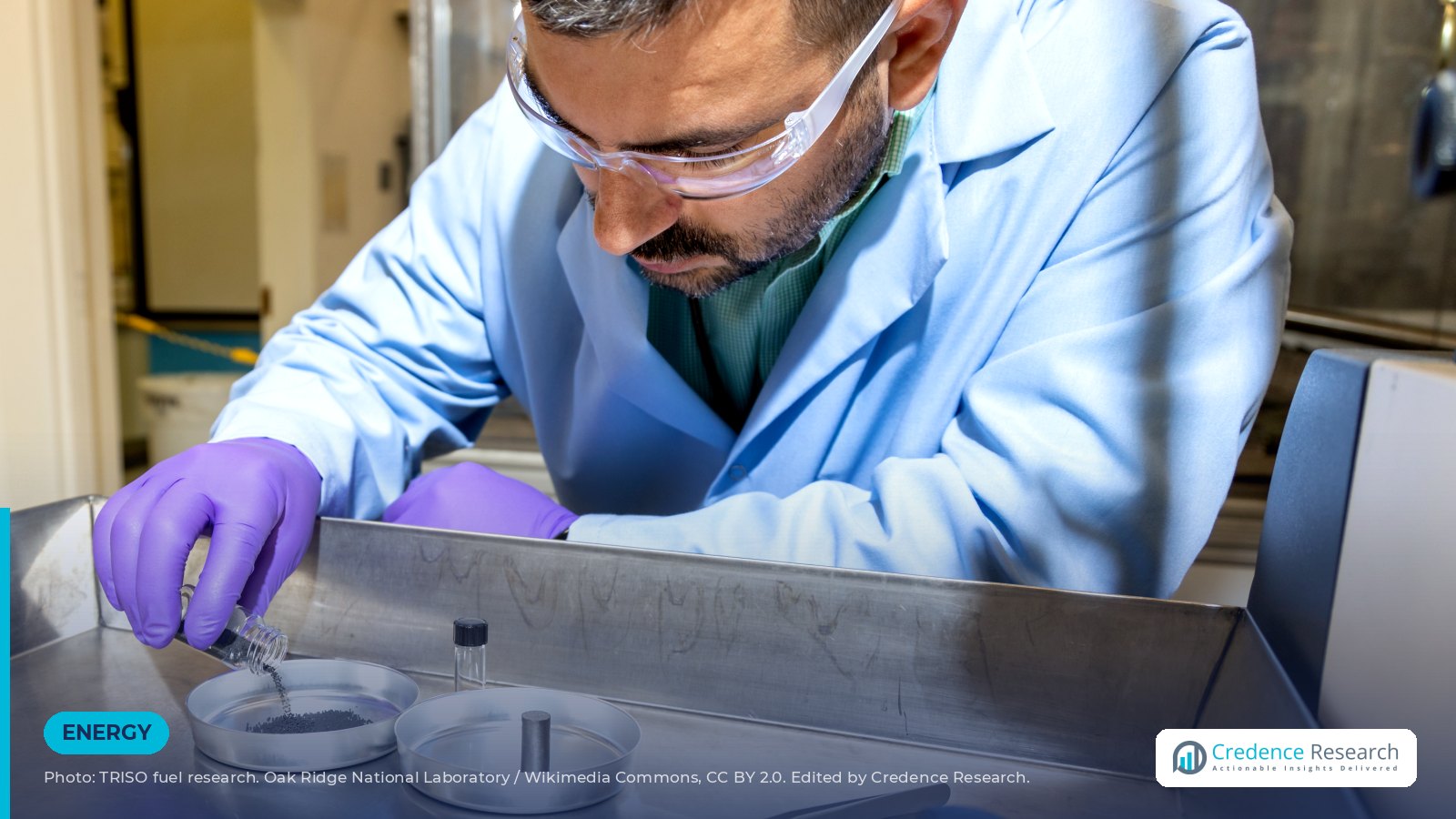
The Xe-100 is a high-temperature, helium-cooled reactor that X-energy rates at 80 MW of electricity per unit. It runs on TRISO fuel, in which uranium kernels are wrapped in layers of carbon and ceramic coatings designed to retain fission products at very high temperatures. X-energy pitches the modular design as a way to scale a plant by adding units rather than building a single large reactor, and the Indiana plan follows that approach with three blocks of four reactors.
The Sullivan County proposal is the third announced U.S. Xe-100 project and the fourth worldwide, according to X-energy, within a commercial pipeline the company puts at about 11.5 GW. The first U.S. deployment, a four-unit plant for Dow on the Texas Gulf Coast, is in the final phases of Nuclear Regulatory Commission review under the Department of Energy's Advanced Reactor Demonstration Program. The first project under the Amazon collaboration is the Cascade Advanced Energy Facility with Energy Northwest in Washington state.
Industry implications
The agreement adds a large investor-owned utility to the short list of U.S. operators preparing for advanced reactors. AEP's Indiana Michigan Power unit has run a nuclear plant for more than 50 years, according to Amazon, which gives the project an operator with licensing and plant management experience. That matters for a reactor class that has yet to complete a commercial build in the United States.
The deal structure also reflects how utilities are trying to keep the risk of new nuclear away from existing ratepayers. AEP said the development and funding agreements were built to protect customers and investors financially, and Amazon said it would pay its full costs without shifting them to others. AEP chief executive Bill Fehrman said the agreements carry the capital protections and financial safeguards the company considers essential for any nuclear project. Large technology buyers paying for development and contracting the output is becoming a template for firm, low-carbon supply aimed at data center demand.
For Amazon, the project fits a wider push to secure power for cloud and AI infrastructure. Josh Weissman, Amazon's vice president of data center infrastructure capacity delivery, tied the effort to the company's goal of net-zero carbon operations by 2040 and said it targets nearly a gigawatt of carbon-free power.
Competitive and supply chain implications
A 12-unit plant would be one of the larger single-site commitments for any SMR design, and it strengthens X-energy's position against rival advanced reactor developers competing for hyperscaler-backed projects. Amazon has been a central backer of the company: it led X-energy's 2024 Series C-1 financing, which closed at $700 million and supported reactor design, licensing and the first phase of the TRISO-X fuel facility in Oak Ridge, Tennessee. X-energy listed on Nasdaq under the ticker XE earlier this year.
The supply chain is the practical constraint. X-energy has lined up suppliers for long-lead parts, including Doosan Enerbility for main power system components, Toyo Tanso and SGL Carbon for graphite, and a March 2026 memorandum with Japan's IHI to explore commercial-scale manufacturing of nuclear-grade components. Fuel availability is equally important, since TRISO fuel requires dedicated fabrication capacity. Each new multi-unit project raises the volume these suppliers must plan for, and the timing of their capacity additions is likely to shape when plants such as the Indiana project can move forward.
Regional implications
Indiana has positioned itself to host small reactors. X-energy said Gov. Mike Braun and the General Assembly have enacted policies since 2025 to support SMR deployment, including tax credits and a state advanced nuclear community program. AEP said Sullivan County recently joined the state's Advanced Nuclear Ready Communities Program. Braun said the project could bring well-paying jobs to Sullivan County and strengthen the state's grid.
Reusing a retired coal site lets the companies build on land already used for power generation, in a community familiar with power plants. AEP said a completed plant could expand the local tax base and operate for more than 60 years. The proposal also lands in a service territory where AEP is adding new supply for large loads, alongside a separate 702 MW fuel cell project with Google that the utility has announced.
Credence Research analysis
The agreement is a development commitment, not a construction decision, and the absence of a schedule is telling. No dates were given for the feasibility study, licensing filings or operation, and the companies said the project would move to construction only after a final investment decision. The more meaningful signal is the financing design: a buyer that funds development and contracts output at cost-covering terms removes the main reason regulated utilities have avoided new nuclear. If that model holds through licensing, it could be repeated across other utility territories with retired fossil sites.
Execution risk is concentrated in licensing and manufacturing. X-energy's first plant is still finishing NRC review, so the Indiana project will depend on how that review and the first build perform. Amazon's goal of more than 5 GW by 2039 implies dozens of Xe-100 units, which puts sustained pressure on fuel fabrication, graphite and reactor component supply. Progress at the Dow and Cascade projects will be the best early indicator of whether the Indiana timeline can firm up.
What comes next
- Feasibility and site evaluation work at the former Breed Generating Station under the joint development agreement.
- Engagement with local leaders, residents and regulators, which the companies said will continue as the project advances.
- Negotiation of the long-term power purchase contract through which Amazon intends to buy the plant's output.
- A final investment decision, required before any construction or commercial operation.
- NRC licensing steps for the site, informed by the ongoing review of X-energy's Texas project for Dow.
Sources
- X-energy: X-energy, Amazon, American Electric Power Partner to Bring SMR Project to Indiana
- AEP: AEP Partners with Amazon and X-energy to Explore Advanced Nuclear Energy in Indiana
- Amazon: Nuclear energy project targeting nearly 1 gigawatt of carbon-free energy for Indiana
- X-energy: X-energy, IHI Corporation Partner to Advance U.S.-Japan SMR Supply Chain Development
Image: TRISO nuclear fuel research, by Oak Ridge National Laboratory via Wikimedia Commons, CC BY 2.0. Cropped and edited by Credence Research.

About the Author

Senior News Editor at Credence Research Inc