
Japan Acrylic Emulsions Market Overview:
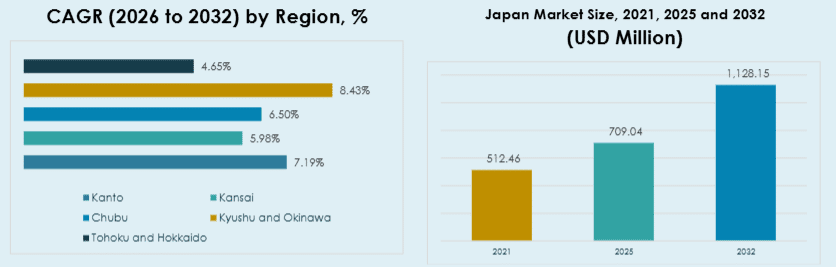
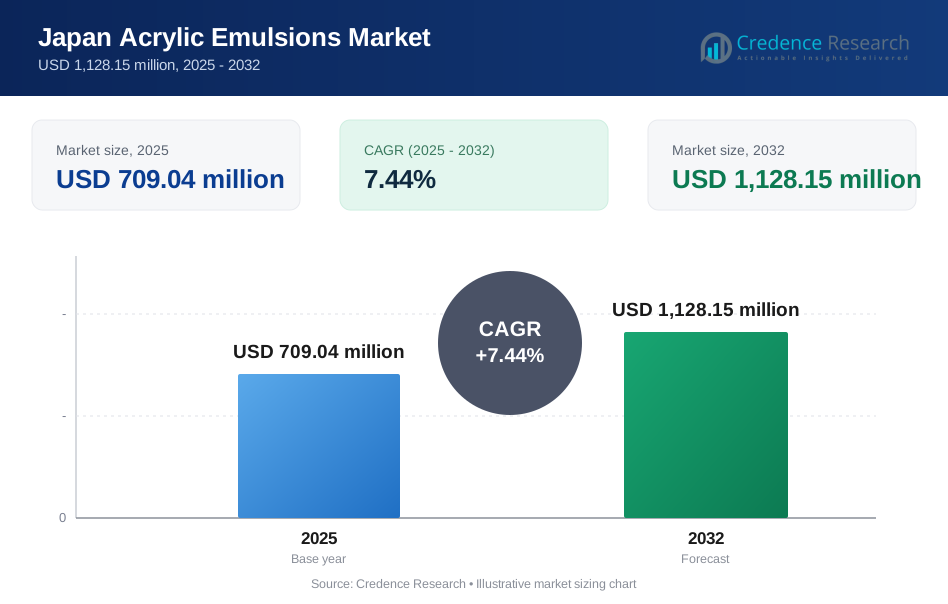
The Japan acrylic emulsions market size was valued at USD 512.46 million in 2021 and reached USD 709.04 million in 2025. It is anticipated to reach USD 1,128.15 million by 2032, growing at a CAGR of 7.44% during the forecast period.
| REPORT ATTRIBUTE | DETAILS |
|---|---|
| Historical Period | 2020-2024 |
| Base Year | 2025 |
| Forecast Period | 2026-2032 |
| Japan Acrylic Emulsions Market Size 2025 | USD 709.04 million |
| Japan Acrylic Emulsions Market, CAGR | 7.44% |
| Japan Acrylic Emulsions Market Size 2032 | USD 1,128.15 million |
Japan Acrylic Emulsions Market Insights
- The Japan acrylic emulsions market was valued at USD 512.46 million in 2021 and USD 709.04 million in 2025. It is projected to reach USD 1,128.15 million by 2032, growing at a CAGR of 7.44%.
- Market growth is supported by rising demand for low-VOC, water-based coatings, stronger renovation activity, infrastructure maintenance and wider use of acrylic emulsions in adhesives, sealants and construction chemicals.
- Water-based acrylic emulsions led the technology segment with 72.4% share, while paints and coatings dominated the application segment with 41.8% share due to strong use in architectural and industrial coatings.
- Pure acrylic emulsions held 34.6% share by type, building and construction accounted for 38.5% share by end user, and direct sales led the sales channel segment with 54.2% share.
Japan Acrylic Emulsions Market Segment Insights
By type
By type, pure acrylic emulsions dominated the Japan acrylic emulsions market with 34.6% share in 2025, supported by strong use in premium architectural coatings, industrial paints and high-performance binders. Styrene acrylic and vinyl acrylic emulsions gained traction where cost efficiency, scrub resistance and adhesion balance remained critical. Acrylic copolymer emulsions served specialized formulations requiring durability, flexibility and improved film formation. Demand benefited from Japan’s focus on low-VOC coatings, renovation activity, advanced polymer modification and supplier investment in application-specific products for coatings, adhesives and construction chemistry.
By application
By application, paints and coatings led the market with 41.8% share in 2025, driven by residential repainting, infrastructure maintenance, industrial coating demand and stricter environmental requirements for water-based formulations. Adhesives and sealants followed, supported by packaging, construction and automotive assembly applications that require bonding strength and processing efficiency. In the end-user segment, building and construction held the leading 38.5% share due to steady demand for exterior coatings, waterproofing systems, tile adhesives and repair mortars. Automotive, packaging, textile, paper and industrial manufacturing applications further supported diversified consumption.
By technology
By technology, water-based acrylic emulsions dominated with 72.4% share in 2025, supported by Japan’s regulatory preference for low-VOC, low-odor and environmentally safer coating systems. Solvent-based emulsions retained demand in selected industrial uses where chemical resistance and performance under harsh conditions remained important, while hybrid acrylic emulsions expanded in premium applications requiring improved durability and adhesion. By sales channel, direct sales accounted for 54.2% share, driven by long-term supply agreements with coating manufacturers, adhesive producers and construction chemical formulators. Distributors and wholesalers supported broader regional access and smaller-volume customers.
Key market drivers
Rising preference for low-VOC and water-based coating systems
Japan’s tightening environmental expectations continue to support demand for acrylic emulsions used in water-based coatings, adhesives and construction chemical formulations. Manufacturers increasingly replace solvent-heavy binders with acrylic emulsion systems to reduce odor, improve indoor air quality and meet sustainability targets across architectural and industrial applications. The Japan acrylic emulsions market benefits from this shift because pure acrylic and acrylic copolymer emulsions offer strong film formation, weather resistance, color retention and formulation flexibility without heavy reliance on volatile solvents. Paint producers also favor these materials for premium interior and exterior coatings where regulatory compliance and consumer safety influence purchasing decisions.
Japan’s Ministry of the Environment has maintained VOC emission inventory initiatives, while leading coating companies in Japan continue to optimize product composition toward water-based and solvent-free paints to reduce VOC volatilization.
Strong renovation, repair and infrastructure maintenance activity
Renovation and building maintenance remain major demand generators for acrylic emulsions in Japan, particularly across exterior coatings, waterproofing membranes, sealants, tile adhesives, primers and repair mortars. Aging residential and nonresidential building stock requires periodic repainting, surface protection and structural maintenance, creating steady consumption for durable emulsion-based products. The Japan acrylic emulsions market gains from this activity because acrylic binders improve adhesion, crack resistance, alkali resistance and weatherability in construction formulations. Commercial buildings, factories, public facilities and residential properties increasingly require coatings that support energy efficiency, surface protection and longer maintenance cycles.
MLIT-linked construction statistics show that Japan’s building renovation and renewal activity remains significant, with nonresidential renovation and repair work forming a large share of project demand in recent fiscal-year data.
Expanding use in automotive, packaging and industrial manufacturing applications
Japan’s advanced manufacturing base supports acrylic emulsion demand beyond architectural coatings, especially in automotive coatings, pressure-sensitive adhesives, packaging coatings, textile finishes and industrial surface treatment applications. Automotive manufacturers require coatings and adhesive systems that improve surface durability, corrosion protection, flexibility and lightweight assembly performance. Packaging producers use acrylic emulsion-based coatings and adhesives to enhance printability, sealing strength and product appearance while supporting lower-emission processing. The Japan acrylic emulsions market benefits from this diversified demand because industrial customers seek consistent quality, technical customization and compatibility with automated production systems.
JAMA reported that Japan produced 8.23 million motor vehicles in 2024, highlighting the country’s large automotive manufacturing base and its continued need for high-performance coatings, adhesives and sealants.
Key trends and opportunities
Growing demand for high-performance pure acrylic and copolymer formulations
Pure acrylic and acrylic copolymer emulsions are gaining preference in Japan as formulators seek improved durability, UV resistance, adhesion and long-term color stability. This trend creates opportunities for suppliers that can offer tailored binders for premium architectural coatings, elastomeric coatings, industrial finishes and construction chemicals. Customers increasingly evaluate acrylic emulsions based on lifecycle performance rather than only initial formulation cost, particularly in exterior applications exposed to humidity, temperature variation and pollution. It supports higher-value product development because advanced emulsions help coatings resist chalking, cracking and discoloration. Suppliers can strengthen their position by offering technical support, formulation testing and customized performance grades for Japanese coating manufacturers. Companies that invest in low-VOC, weather-resistant and multifunctional emulsion chemistries are well positioned to capture demand from premium and specialty applications.
Rising opportunity in hybrid acrylic emulsion technologies
Hybrid acrylic emulsions present a strong opportunity in Japan as end users demand multifunctional products that combine adhesion, toughness, flexibility and chemical resistance. These systems allow formulators to blend acrylic performance with other polymer properties, making them suitable for premium coatings, sealants, adhesives and industrial applications. Hybrid technologies can address performance gaps in conventional water-based systems, especially where customers need improved scrub resistance, substrate compatibility and durability under demanding conditions. The Japan acrylic emulsions market can benefit from this shift because manufacturers are moving toward specialized formulations that reduce solvent use while maintaining high performance. Suppliers that develop hybrid emulsions for construction repair, automotive components, packaging coatings and textile finishing can capture higher margins. Growth opportunities remain strongest for companies that combine local technical service with application-specific product development.
Stronger role of direct sales and technical collaboration
Direct sales are becoming more important as large coating, adhesive and construction chemical manufacturers seek reliable supply, consistent product quality and formulation-level support. Acrylic emulsions often require technical adjustment based on viscosity, particle size, glass transition temperature, adhesion profile and compatibility with additives. This creates opportunities for suppliers that work closely with customers during product development, pilot testing and commercial scale-up. In Japan, customers often value long-term supplier relationships, quality assurance and responsive technical service, making direct engagement a competitive advantage. Distributors remain important for smaller customers and regional access, but direct sales support higher-value accounts and customized product grades. The Japan acrylic emulsions market can gain from this trend as manufacturers strengthen customer retention through joint formulation work, application testing and supply agreements with key industrial buyers.
Key market challenges
Raw material volatility and margin pressure
Raw material price volatility remains a major challenge for acrylic emulsion producers in Japan. Key inputs such as acrylic acid, acrylates, styrene, vinyl acetate, surfactants and specialty additives remain exposed to changes in crude oil, energy costs, logistics conditions and global chemical supply-demand balances. These fluctuations can pressure manufacturer margins, especially when customers resist frequent price revisions. Smaller formulators may face greater difficulty absorbing cost increases because they often lack long-term procurement contracts or backward integration. The Japan acrylic emulsions market also faces import dependency for selected feedstocks and additives, which can increase exposure to currency movement and regional supply disruptions. Producers must manage this challenge through diversified sourcing, inventory planning, value-based pricing and development of higher-performance products that justify premium positioning. Companies with strong procurement networks and stable supplier relationships remain better positioned to protect profitability.
Mature domestic demand and strict performance expectations
Japan’s mature construction and manufacturing environment can limit rapid volume expansion, creating pressure on acrylic emulsion suppliers to compete through performance, quality and technical differentiation. Demand from new construction may remain uneven due to demographic pressures, labor constraints and cautious capital spending. At the same time, Japanese customers maintain strict expectations for consistency, durability, environmental compliance and application performance. This raises barriers for new entrants and low-cost suppliers that lack local technical capabilities. The Japan acrylic emulsions market must also respond to end-user requirements for low odor, low VOCs, weather resistance, stain resistance and compatibility with advanced coating systems. Suppliers that fail to meet these standards may face qualification delays or limited adoption. Competitive pressure can intensify when domestic and global producers target the same premium customers, making innovation, reliability and after-sales support essential for long-term growth.
Regional Analysis
- Kanto is projected to grow at a CAGR of 7.19% from 2026 to 2032, supported by strong demand from construction, industrial coatings, adhesives and specialty formulations. The region benefits from Tokyo’s large commercial base, advanced manufacturing presence and steady renovation activity. Acrylic emulsions gain wider use in water-based paints, sealants and construction chemicals as manufacturers prioritize low-VOC and high-performance formulations.
- Kansai is expected to expand at a CAGR of 5.98% from 2026 to 2032. Growth is supported by demand from Osaka, Kyoto and Hyogo, where construction chemicals, paints, packaging and industrial manufacturing applications remain important. The region’s established chemical and materials ecosystem supports steady consumption of acrylic emulsions across coatings, adhesives and surface treatment products.
- Chubu is forecast to grow at a CAGR of 6.50% from 2026 to 2032. The region’s strong automotive and manufacturing base drives demand for acrylic emulsions in industrial coatings, adhesives, sealants and performance finishes. Aichi and nearby industrial hubs support continued adoption of durable, low-VOC and application-specific acrylic emulsion systems.
- Kyushu and Okinawa are projected to record the fastest growth, with a CAGR of 8.43% from 2026 to 2032. Infrastructure development, residential construction, tourism-related facility upgrades and coastal maintenance activity support regional demand. Acrylic emulsions gain traction in exterior coatings, waterproofing systems and construction chemicals designed for humid and coastal environments.
- Tohoku and Hokkaido are expected to grow at a CAGR of 4.65% from 2026 to 2032. Demand is supported by infrastructure repair, residential maintenance and use of weather-resistant coatings in cold-climate conditions. Acrylic emulsions remain important in exterior paints, sealants and waterproofing materials that require durability under seasonal temperature variation.
Japan Acrylic Emulsions Market Segmentations:
By Type
- Pure acrylic emulsions
- Styrene acrylic emulsions
- Vinyl acrylic emulsions
- Acrylic copolymer emulsions
- Others
By Application
- Paints and coatings
- Adhesives and sealants
- Paper coatings
- Textiles and nonwovens
- Construction chemicals
- Others
By End User
- Building and construction
- Automotive
- Packaging
- Textile
- Paper and printing
- Industrial manufacturing
- Others
By Technology
- Water-based acrylic emulsions
- Solvent-based acrylic emulsions
- Hybrid acrylic emulsions
By Sales Channel
- Direct sales
- Distributors and wholesalers
- Online sales
By Region
- Kanto
- Kansai
- Chubu
- Kyushu
- Tohoku
- Chugoku
- Shikoku
- Hokkaido
Key Players
- DIC Corporation
- Nippon Shokubai Co. Ltd.
- Sumitomo Chemical Co. Ltd.
- Arkema S.A.
- BASF SE
- Dow Inc.
- Synthomer plc
- Celanese Corporation
- Wacker Chemie AG
- Lubrizol Corporation
- Allnex Group
- Asahi Kasei Corporation
- Toagosei Co. Ltd.
Recent Developments
- In February 2026, DIC Corporation showcased resin innovations through Sun Chemical and DIC at PaintIndia 2026, including acrylic resins and acrylic polyols for automotive, industrial, architectural, wood, plastic and glass coating applications. The development strengthened DIC’s positioning in high-performance acrylic coating materials and supported demand for durable, adhesion-focused and application-specific acrylic resin technologies.
- In November 2024, Nippon Shokubai Co. Ltd. reported progress in bio-acrylic acid development through multiple routes and expanded certified mass-balance supply initiatives. The development supported the acrylic emulsions value chain by improving the sustainability profile of upstream acrylic raw materials used in polymers, dispersants, binders and coating formulations.
- In March 2025, Sumitomo Chemical Co. Ltd. announced the sale of chemically recycled PMMA acrylic resin produced from recycled MMA monomer. The material gained adoption in electronics and automotive applications, strengthening circular acrylic material development and supporting sustainability-led innovation across Japan-linked acrylic resin supply chains.
- In January 2025, Arkema S.A. launched ENCOR bio-based waterborne dispersions for textile printing and finishing applications. The product line offered lower-carbon binder technology and reinforced Arkema’s focus on sustainable waterborne dispersion systems used in textiles, nonwovens, coatings and specialty formulation markets.
- In February 2024, BASF SE announced that BASF Japan’s Rokuromi site in Yokkaichi received the 2023 Energy Conservation Grand Prize. The site manufactures Acronal acrylic dispersions for architectural coatings and adhesives and Joncryl acrylic polymers for printing inks and packaging, strengthening BASF’s Japan-based acrylic dispersion production and sustainability positioning.
- In May 2025, Dow Inc. received recognition for waterborne and acrylic-related coating technologies, including a protective peelable acrylic coating and DURATRACK WH-155 Hybrid Emulsion for traffic marking paints. The development highlighted Dow’s focus on low-VOC, water-based and hybrid emulsion technologies for construction, infrastructure and industrial coating applications.
Report Coverage
The research report offers an in-depth analysis based on Type, Application, End user, Technology and Geography. It details leading market players, providing an overview of their business, product offerings, investments, revenue streams, and key applications. Additionally, the report includes insights into the competitive environment, SWOT analysis, current market trends, as well as the primary drivers and constraints. Furthermore, it discusses various factors that have driven market expansion in recent years. The report also explores market dynamics, regulatory scenarios, and technological advancements that are shaping the industry. It assesses the impact of external factors and global economic changes on market growth. Lastly, it provides strategic recommendations for new entrants and established companies to navigate the complexities of the market.
Future Outlook
- Demand for water-based acrylic emulsions will continue to rise as manufacturers prioritize low-VOC and sustainable coating systems.
- Pure acrylic and acrylic copolymer emulsions will gain stronger adoption in premium architectural and industrial coatings.
- Construction repair, renovation and infrastructure maintenance will support steady consumption across coatings, sealants and waterproofing products.
- Automotive and industrial manufacturing applications will drive demand for high-performance acrylic emulsions with durability and adhesion benefits.
- Hybrid acrylic emulsion technologies will create new opportunities in specialty coatings, adhesives and construction chemicals.
- Suppliers will focus on customized formulations to meet Japan’s strict performance, safety and environmental requirements.
- Direct sales channels will remain important as large buyers seek technical support, consistent supply and long-term vendor partnerships.
- Raw material price volatility will encourage producers to improve sourcing strategies and develop higher-value product grades.
- Regional demand will expand faster in emerging industrial and infrastructure-driven areas such as Kyushu, Okinawa, Tohoku and Hokkaido.
- Competitive intensity will increase as domestic and global players invest in sustainable, low-odor and application-specific acrylic emulsion solutions.
Request a Free Sample
Fill in your details and we'll send you a free sample report.
- Sample data tables & charts
- Research methodology
Need a Custom Version of This Report?
Tailor the scope, geography, or segments to your exact requirements.
- Custom geography or segment scope
- Direct access to our analyst team
Frequently Asked Questions
What is the current market size for Japan acrylic emulsions market, and what is its projected size in 2032?
At what Compound Annual Growth Rate is the Japan acrylic emulsions market projected to grow between 2024 and 2032?
Which Japan acrylic emulsions market segment held the largest share in 2024?
What are the primary factors fueling the growth of the Japan acrylic emulsions market?
Who are the leading companies in the Japan acrylic emulsions market?
Which region commanded the largest share of the Japan acrylic emulsions market in 2024?
Table of Content
Chapter 1. Report Introduction
- 1.1 Report Description & Purpose
- 1.1.1 Report Title & Market Definition
- 1.1.2 Unique Selling Propositions (USP) & Key Differentiators
- 1.1.3 Value Proposition for Stakeholders
- 1.2 Research Objectives
- 1.2.1 Market Sizing Objectives (Volume & Revenue)
- 1.2.2 Segmentation Objectives
- 1.2.3 Competitive Intelligence Objectives
- 1.2.4 Forecast & Scenario Objectives
- 1.3 Report Scope
- 1.3.1 Japan Acrylic Emulsions Scope – Types & Subtypes Covered
- 1.3.2 Geographic Scope – Regions & Countries Covered
- 1.3.3 Historical Period, Base Year & Forecast Period (2025; forecast to 2032)
- 1.3.4 Inclusions & Exclusions
- 1.4 HS Code & Classification Framework
- 1.5 Currency, Units & Pricing Basis
- 1.6 Target Stakeholders
- 1.7 Limitations & Assumptions
Chapter 2. Executive Summary
- 2.1 Global Japan Acrylic Emulsions Market Snapshot
- 2.1.1 Market Size – Historical (2025) & Forecast (2025-2032) (2025: USD 709.04 million → 2032: USD 1,128.15 million)
- 2.1.2 Volume & Revenue – Global Totals
- 2.1.3 Key Market Highlights – Top Five Facts
- 2.2 Japan Acrylic Emulsions Market Segmentation Snapshot
- 2.2.1 Market Split by Region – 2025 vs. 2032
- 2.3 Competitive Snapshot
- 2.3.1 Top 10 Players by Revenue Share – 2025
- 2.3.2 Top 10 Players by Volume Share – 2025
- 2.3.3 Recent Strategic Developments (18-Month Summary)
- 2.4 Key Investment Highlights & Strategic Conclusions
Chapter 3. Japan Acrylic Emulsions Market Dynamics & Industry Analysis
- 3.1 Market Overview & Context
- 3.1.1 Japan Acrylic Emulsions Market Position in the Broader Automotive Value Chain
- 3.1.2 OEM vs. Replacement Market Dynamics
- 3.1.3 Market Maturity & Development Stage by Region
- 3.2 Japan Acrylic Emulsions Market Drivers
- 3.3 Japan Acrylic Emulsions Market Restraints & Challenges
- 3.4 Japan Acrylic Emulsions Market Opportunities
- 3.5 Porter's Five Forces Analysis
- 3.5.1 Threat of New Entrants
- 3.5.2 Bargaining Power of Suppliers
- 3.5.3 Bargaining Power of Buyers
- 3.5.4 Threat of Substitutes
- 3.5.5 Competitive Rivalry – Intensity Assessment
- 3.6 Japan Acrylic Emulsions Value Chain Analysis
- 3.6.1 Upstream – Raw Material/Input Suppliers
- 3.6.1.1 Raw Material/Input 1
- 3.6.1.2 Raw Material/Input 2
- 3.6.1.3 Raw Material/Input 3
- 3.6.2 Midstream – Production/Manufacturing/Service Delivery
- 3.6.2.1 Production/Process Overview
- 3.6.2.2 Key Facility Locations & Capacity by Manufacturer
- 3.6.3 Downstream – Distribution & End Consumer
- 3.6.3.1 Primary Channel – B2B/OEM
- 3.6.3.2 Secondary Channels – Dealer, Retail, Online, Direct
- 3.6.4 Value Chain Profitability Analysis
- 3.6.1 Upstream – Raw Material/Input Suppliers
- 3.7 PESTEL Analysis
- 3.7.1 Political Factors
- 3.7.2 Economic Factors
- 3.7.3 Social Factors
- 3.7.4 Technological Factors
- 3.7.5 Environmental Factors
- 3.7.6 Legal Factors
- 3.8 Japan Acrylic Emulsions Supply Chain Analysis
- 3.8.1 Raw Material/Input Supply Risk Assessment
- 3.8.2 Manufacturing Concentration Risk (Geographic Exposure)
- 3.8.3 Trade Disruption Impact Analysis
- 3.9 Regulatory & Policy Landscape
Note: The regulatory and policy landscape section covers regulations based on their applicability to the market, Japan Acrylic Emulsions category, geography, and scope of the study. Only regulatory frameworks with a material impact on operations, compliance, trade, sustainability, or market access are analyzed in detail.
Chapter 4. Key Investment Pockets & Opportunity Analysis
- 4.1 Japan Acrylic Emulsions Market Attractiveness Analysis
- 4.1.1 By Region – Investment Attractiveness Matrix (Volume × CAGR)
- 4.2 Absolute Revenue Growth Opportunity
- 4.2.1 By Region – Absolute USD Growth Through 2032
- 4.3 Incremental Volume Opportunity
- 4.3.1 By Region – Incremental Volume Through 2032
- 4.3.2 Segment – Incremental Volume
- 4.4 Emerging Submarket Opportunity Deep Dive (Subject to Applicability)
- 4.5 Emerging Market Opportunity Scorecards
- 4.5.1 United States
- 4.5.2 Europe
- 4.5.3 Asia
- 4.5.4 Middle East & Africa
Note: Emerging Market Opportunity Scorecards will be included based on relevance and strategic importance. Regions listed are indicative and may vary depending on data availability and market dynamics.
Chapter 5. Japan Acrylic Emulsions Import-Export Analysis & Trade Flows
- 5.1 Global Trade Overview
- 5.1.1 Global Export Value by Country (2025)
- 5.1.2 Global Export Volume by Country (2025)
- 5.1.3 Global Import Value by Country (2025)
- 5.1.4 Global Import Volume by Country (2025)
- 5.1.5 Net Trade Balance by Country (2025)
- 5.2 Export Analysis – Segment
- 5.2.1 Type 1 (HS Code)
- 5.2.2 Type 2 (HS Code)
- 5.2.3 Type 3 (HS Code)
- 5.2.4 Type 4 (HS Code)
- 5.2.5 Type 5 (HS Code)
- 5.3 Import Analysis – Segment
- 5.3.1 Type 1 (HS Code)
- 5.3.2 Type 2 (HS Code)
- 5.3.3 Type 3 (HS Code)
- 5.3.4 Type 4 (HS Code)
- 5.3.5 Type 5 (HS Code)
- 5.4 Average Unit Trade Prices
- 5.4.1 Average Export Price – Segment & Country
- 5.4.2 Average Import Price – Segment & Source Country
- 5.4.3 Price Trends (2025)
- 5.5 Key Trade Route Analysis
- 5.5.1 Trade Route 1
- 5.5.2 Trade Route 2
- 5.5.3 Trade Route 3
- 5.5.4 Trade Route 4
- 5.5.5 Trade Route 5
- 5.6 Trade Policy Impact Assessment
- 5.6.1 US Anti-Dumping & Section 301 Tariffs
- 5.6.2 EU Customs Union Impact
- 5.6.3 Major Free Trade Agreements
- 5.6.4 USMCA Rules of Origin
Note: Trade policy analysis will be included only where relevant to the Japan Acrylic Emulsions market.
Chapter 6. Competitive Landscape & Company Benchmarking
- 6.1 Japan Acrylic Emulsions Market Concentration & Structure
- 6.1.1 Herfindahl-Hirschman Index (HHI) – vs. 2025
- 6.1.2 Tier 1, Tier 2 & Tier 3 Market Structure
- 6.1.3 Global, Regional & Local Player Dynamics
- 6.2 Japan Acrylic Emulsions Market Share Analysis – 2025
- 6.2.1 Global Revenue Share by Company
- 6.2.2 Global Volume Share by Company
- 6.2.3 Regional Revenue Share
- 6.2.4 Market Share Evolution ( vs. 2025)
- 6.2.5 OEM Segment Share by Company
- 6.2.6 Replacement Segment Share by Company
- 6.3 Production/Delivery Capacity & Facility Analysis
- 6.3.1 Global Installed Capacity
- 6.3.2 Capacity Utilization Rates
- 6.3.3 Production/Output Volume
- 6.3.4 Facility Locations & Capacity Map
- 6.3.5 Planned Capacity Additions
- 6.4 Japan Acrylic Emulsions Competitive Benchmarking Matrix
- 6.4.1 Revenue, Volume, CAGR & Profitability Comparison
- 6.4.2 Channel Revenue Mix
- 6.4.3 Geographic Revenue Exposure
- 6.4.4 R&D Intensity
- 6.4.5 Sustainability Maturity
- 6.5 Strategic Developments in Japan Acrylic Emulsions (Last 24 Months)
- 6.5.1 Mergers, Acquisitions & Divestments
- 6.5.2 New Japan Acrylic Emulsions Launches
- 6.5.3 Facility Expansions
- 6.5.4 Strategic Alliances, Joint Ventures & Partnerships
- 6.5.5 Distribution Expansion & Market Entry
- 6.5.6 Sustainability & ESG Initiatives
- 6.6 Competitive Strategy Mapping
- 6.6.1 Leader, Challenger, Follower & Niche Classification
- 6.6.2 Pricing Strategy Comparison
- 6.6.3 Channel Strategy Matrix
Note: Strategic developments are included based on their materiality and the availability of reliable information.
Chapter 7. Global Japan Acrylic Emulsions Market – By Distribution Channel
- 7.1 Segment Overview
- 7.1.1 Volume & Revenue Split by Channel (2025 & 2032)
- 7.1.2 Channel Mix Evolution (2025-2032)
Chapter 8. Regional Market Analysis – Global Overview
- 8.1 Global Regional Overview
- 8.1.1 Regional Volume Share
- 8.1.2 Regional Revenue Share
- 8.1.3 Regional Volume by Region
- 8.1.4 Regional Revenue by Region
- 8.1.5 Regional Forecast Through 2032
- 8.2 Cross-Regional Segment Analysis
- 8.2.1 By Distribution Channel
- 8.2.2 By Brand/Price Tier
Chapter 9. North America Japan Acrylic Emulsions Market
- 9.1 United States
- 9.2 Canada
- 9.3 Mexico
Chapter 10. Europe Japan Acrylic Emulsions Market
- 10.1 Germany
- 10.2 France
- 10.3 Italy
- 10.4 United Kingdom
- 10.5 Spain
- 10.6 Poland
- 10.7 Russia
- 10.8 Netherlands
- 10.9 Belgium
- 10.10 Sweden
- 10.11 Denmark
- 10.12 Norway
- 10.13 Rest of Europe
Chapter 11. Asia Pacific Japan Acrylic Emulsions Market
- 11.1 China
- 11.2 India
- 11.3 Japan
- 11.4 South Korea
- 11.5 Thailand
- 11.6 Indonesia
- 11.7 Vietnam
- 11.8 Malaysia
- 11.9 Australia
- 11.10 Rest of Asia Pacific
Chapter 12. Latin America Japan Acrylic Emulsions Market
- 12.1 Brazil
- 12.2 Argentina
- 12.3 Colombia
- 12.4 Chile
- 12.5 Rest of Latin America
Chapter 13. Middle East Japan Acrylic Emulsions Market
- 13.1 Saudi Arabia
- 13.2 United Arab Emirates
- 13.3 Turkey
- 13.4 Israel
- 13.5 Iran
- 13.6 Rest of the Middle East
Chapter 14. Africa Japan Acrylic Emulsions Market
- 14.1 South Africa
- 14.2 Egypt
- 14.3 Nigeria
- 14.4 Morocco
- 14.5 Rest of Africa
Chapter 15. Japan Acrylic Emulsions Company Profiles
- 15.1 [Company 01]
- 15.1.1 Company Overview
- 15.1.2 Key Management Personnel
- 15.1.3 Products & Services Portfolio
- 15.1.4 Financial Performance
- 15.1.5 Key Market Focus & Geographic Presence
- 15.1.6 Recent Developments & Strategic Initiatives
Note: The company profile list is preliminary and may change based on research findings, market developments, data availability, and client requirements.
Chapter 16. Appendices
- Appendix A – List of Abbreviations & Acronyms
- Appendix B – Industry Classification Code Reference – Full Series
- Appendix C – Production & Capacity Data Tables
- Appendix D – End-Use & Demand Base Tables
- Appendix E – Consumption & Replacement Rate Assumptions
- Appendix F – ASP Reference Tables
- Appendix G – Manufacturing & Facility Database
- Appendix H – Import-Export Data Tables
- Appendix I – Regulatory Summary Tables
- Appendix J – Primary Research Participant List (Anonymized)
- Appendix K – Primary Research Questionnaire Framework
- Appendix L – Data Sources & Bibliography
- Appendix M – Market Size Divergence & Source Comparison
Chapter 17. Research Methodology
- 17.1 Research Framework & Philosophy
- 17.2 Secondary Research – Sources, Hierarchy & Data Extraction
- 17.3 Data Modeling – Bottom-Up & Top-Down Market Sizing
- 17.4 Primary Research – Stakeholder Framework, LOI & Sample Sizes
- 17.5 Forecast Methodology – Regression, Scenario & Sensitivity Analysis
- 17.6 Quality Control – Four-Layer Validation Framework
- 17.7 Limitations & Standard Assumptions
- 17.8 Disclaimer
