
| REPORT ATTRIBUTE | DETAILS |
|---|---|
| Historical Period | 2020-2023 |
| Base Year | 2024 |
| Forecast Period | 2025-2032 |
| Anti Slip Coated Paper Market Size 2024 | USD 1,271.46 million |
| Anti Slip Coated Paper Market, CAGR | 6.47% |
| Anti Slip Coated Paper Market Size 2032 | USD 2,176.08 million |
Market Overview:
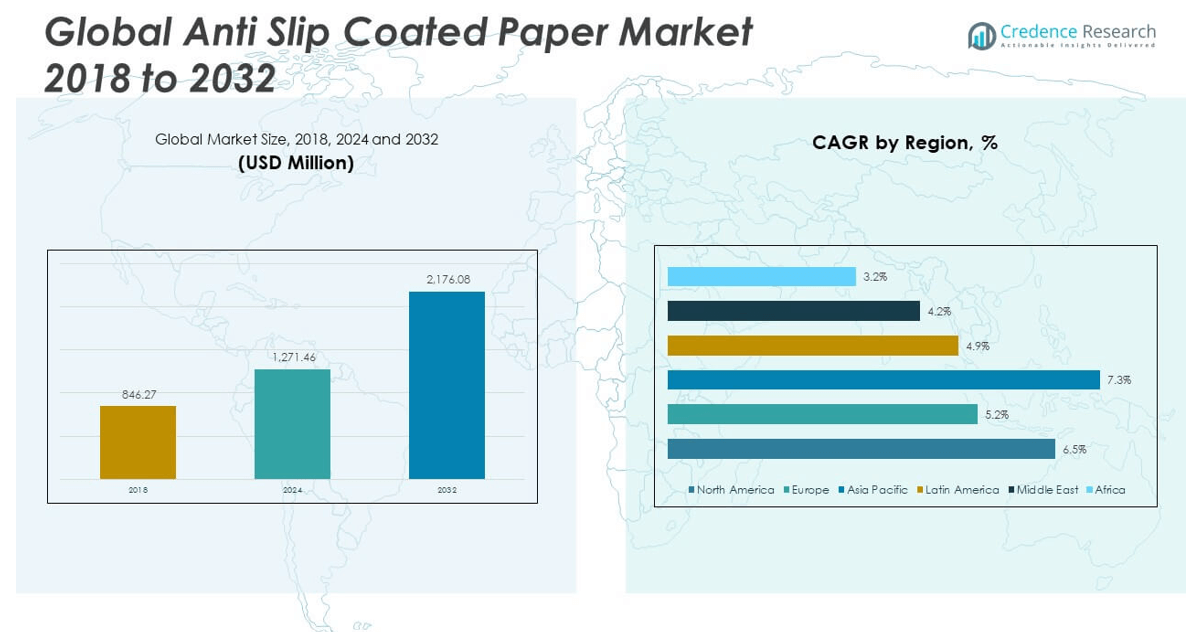
The Global Anti Slip Coated Paper Market size was valued at USD 846.27 million in 2018 to USD 1,271.46 million in 2024 and is anticipated to reach USD 2,176.08 million by 2032, at a CAGR of 6.47% during the forecast period.
One of the primary drivers accelerating the adoption of anti-slip coated paper is the growing emphasis on workplace safety and efficient logistics handling. With companies increasingly prioritizing the reduction of transport-related damages and ensuring compliance with occupational health regulations, anti-slip solutions have become a key operational component. Additionally, the boom in e-commerce and online retail logistics has dramatically increased the need for secure palletization, especially for high-volume, fragile, or perishable goods. The anti-slip coating enhances friction between layers, minimizing movement and improving load integrity during shipment. Environmental sustainability further propels market growth, as industries seek to replace plastic-based stabilizing materials with biodegradable alternatives. Anti-slip coated paper, being recyclable and often made from sustainable sources, aligns well with global packaging sustainability goals.
Regionally, the Asia-Pacific region dominates the global anti-slip coated paper market, accounting for the largest revenue and volume share due to rapid industrialization, a booming e-commerce sector, and a strong presence of manufacturing hubs in countries like China, India, and Vietnam. The region benefits from an expanding logistics infrastructure and rising export activity, which contribute to increasing demand for effective and eco-friendly packaging solutions. North America follows as a key contributor, characterized by a mature packaging industry, robust safety regulations, and high standards in supply chain optimization. The region is also experiencing the fastest growth, driven by widespread adoption in retail, pharmaceuticals, and FMCG sectors. Europe maintains a solid position in the global market, supported by stringent environmental regulations and a strong shift toward sustainable packaging practices. Meanwhile, Latin America and the Middle East & Africa are witnessing steady growth, backed by increasing urbanization, improvements in trade networks, and the gradual modernization of warehousing and transportation systems.
Market Insights:
- The Global Anti Slip Coated Paper Market reached USD 1,271.46 million in 2024 and is projected to grow to USD 2,176.08 million by 2032, reflecting a CAGR of 6.47% driven by rising safety demands in logistics and eco-conscious packaging reforms.
- Workplace safety regulations and the need to minimize product damage in storage and transit are increasing the adoption of anti-slip coated paper in industrial and commercial supply chains.
- The booming e-commerce and retail sectors are fueling demand for secure palletization solutions, with anti-slip coatings reducing product movement during shipping and enhancing consumer delivery experience.
- Sustainability initiatives are encouraging industries to shift from plastic-based stabilizers to recyclable, biodegradable alternatives like anti-slip coated paper, supported by water-based and solvent-free coating technologies.
- Ongoing product innovation is improving coating performance for moisture resistance, temperature tolerance, and friction control, making the paper suitable for sensitive goods across diverse industries.
- Moisture sensitivity and inconsistent performance in variable climates present operational challenges, particularly in refrigerated storage and regions with high humidity.
- Asia-Pacific leads the global market with the highest revenue and volume share, followed by fast-growing North America and sustainability-focused Europe; Latin America, the Middle East, and Africa are emerging markets with growing adoption.
Market Drivers:
Emphasis on Load Stability and Packaging Safety in Logistics and Warehousing
The Global Anti Slip Coated Paper Market benefits from increasing demand for reliable load stabilization in logistics and warehouse environments. Industries prioritize safe handling and efficient stacking of pallets, particularly for fragile or high-value products. Anti-slip coated paper enhances surface friction between layers, preventing displacement during storage or transit. This improves operational efficiency and reduces the risk of damage during distribution. The market aligns with logistics providers seeking cost-effective materials that meet safety regulations without increasing packaging complexity. It continues to gain traction as companies replace plastic-based separators with recyclable paper-based solutions.
Surge in E-Commerce and Retail Distribution Networks
The rapid expansion of e-commerce and retail supply chains drives the adoption of anti-slip coated paper across multiple distribution channels. Online retailers require stable and secure packaging solutions to protect goods during last-mile delivery. The material proves effective in preventing product shifting during movement across automated fulfillment centers and delivery networks. The Global Anti Slip Coated Paper Market responds to this shift by offering high-performance coatings tailored to meet the packaging needs of electronic devices, cosmetics, and consumer goods. Brands increasingly select anti-slip paper to enhance customer experience by minimizing product damage. It supports retail strategies focused on reliability and operational consistency.
Sustainability Objectives Driving Demand for Recyclable and Eco-Friendly Materials
Environmental considerations shape procurement decisions across packaging sectors, encouraging the shift toward biodegradable and recyclable materials. Anti-slip coated paper meets these expectations by providing an eco-friendly alternative to plastic films and chemical-based slip sheets. The Global Anti Slip Coated Paper Market is supported by companies looking to achieve their sustainability targets while maintaining load stability. It offers manufacturers an opportunity to reduce carbon footprints and demonstrate environmental responsibility. The use of water-based and solvent-free coatings further strengthens its position in green packaging strategies. Regulatory mandates promoting sustainable packaging continue to influence demand positively.
- For example, one Palcut customer replaced 1.2 million corrugated cardboard sheets annually with anti-slip sheets from a reel, halving packaging consumption from 332 tonnes to 166 tonnes per year and reducing CO₂ emissions by 66 tonnes. The switch decreased the number of required pallets in storage from 76 to 11 and cut full-load lorry deliveries from 51 to just 8 per year.
Product Innovation and Technical Advancements in Coating Solutions
Manufacturers invest in research and development to enhance the performance characteristics of anti-slip coated paper, making it suitable for a wider range of applications. Innovations include coatings that deliver high friction coefficients, moisture resistance, and durability under variable temperatures. The Global Anti Slip Coated Paper Market gains momentum through the introduction of customizable grades tailored to industry-specific load types. It attracts interest from sectors such as food and beverage, automotive, and pharmaceuticals, where controlled stacking is critical. Technological improvements allow for consistent performance while reducing material usage. These developments contribute to expanding the product’s commercial appeal and functional relevance.
- For example, ChemPoint’s LUDOX® CL-P and CL-X coatings increase slip angles by 10-15°, enhancing friction retention and moisture resistance on paper and cardboard substrates. These coatings also improve print quality by acting as dye acceptors.
Market Trends:
Integration of Anti Slip Coated Paper into Automated Packaging and Robotics Systems
Automated packaging and robotics systems are gaining importance in modern warehouses and distribution centers. The Global Anti Slip Coated Paper Market is witnessing integration with these technologies due to its compatibility with robotic palletizers and high-speed conveyors. It performs efficiently under automated handling conditions by maintaining consistent friction and preventing material slippage. Companies value its ability to operate seamlessly within fully or semi-automated systems without disrupting throughput. The consistency of coating application allows for predictable results, making it suitable for programmed stacking sequences. It supports process standardization in smart logistics environments.
Adoption in Premium and Specialty Product Packaging for Enhanced Branding and Protection
Brands are turning to anti slip coated paper for premium and specialty product packaging that demands both protection and presentation. The Global Anti Slip Coated Paper Market is expanding into sectors such as luxury goods, electronics, and beverages, where secure packaging supports brand perception and reduces product returns. It provides an opportunity for businesses to align protective functions with sustainable aesthetics by offering clean, print-friendly surfaces. Custom printing options allow integration of logos, instructions, or branding elements without compromising the paper’s frictional properties. This dual functionality appeals to marketing teams and logistics managers alike. It offers an elevated packaging experience while enhancing supply chain safety.
- For instance, Aurora Process’s Antim® anti-slip paper offers a slip angle exceeding 50° (TAPPI 815 standard), ensuring product stability even under challenging conditions. The paper is available in reels or pre-cut sheets and supports custom printing, enabling integration of branding elements without compromising frictional performance.
Growing Preference for Lightweight and Cost-Efficient Load Stabilization Materials
Cost pressures are driving demand for materials that reduce packaging weight while maintaining performance. The Global Anti Slip Coated Paper Market addresses this requirement by offering lightweight alternatives to wooden separators, plastic sheets, and rigid stabilizers. It reduces shipping costs and material handling time without sacrificing load integrity. Companies in FMCG, foodservice, and industrial supply chains are increasingly shifting to this paper for cost-effective palletization. The lightweight design also contributes to lower emissions during transport, aligning with supply chain optimization goals. It supports budget-conscious operations without compromising packaging quality.
Increased Use in Cold Chain and Temperature-Sensitive Logistics Applications
Cold chain logistics require materials that retain functionality under refrigeration or freezing conditions. The Global Anti Slip Coated Paper Market is expanding its application in temperature-sensitive environments, such as food, pharmaceuticals, and biotechnology sectors. It resists moisture absorption and preserves its anti-slip characteristics under fluctuating temperatures. Specialized coatings help maintain product stability even in chilled and humid conditions. It ensures safe palletization from production through last-mile delivery in regulated supply chains. Companies value this reliability in environments where condensation, temperature shifts, and hygiene standards demand robust packaging solutions.
- For example, Products like Delfort’s thinbarrier 302 specialty paper achieve a moisture vapor transmission rate (MVTR) of less than 10 (at 23°C, 85% RH), preventing moisture ingress and preserving product quality. The paper also boasts an oxygen transmission rate (OTR) below 30, critical for preserving the freshness of food and pharmaceuticals.
Market Challenges Analysis:
High Sensitivity to Moisture and Environmental Conditions Reduces Product Reliability
The Global Anti Slip Coated Paper Market faces a persistent challenge from the material’s sensitivity to moisture and extreme environmental conditions. Exposure to high humidity or condensation can reduce the frictional properties of the coating, making it less effective in stabilizing loads. It becomes a concern in regions with variable climates or in applications requiring refrigeration and outdoor storage. Manufacturers must invest in specialized coatings or protective treatments to maintain performance, which can increase production costs. Inconsistent performance in fluctuating environments limits its adoption across certain logistics sectors. It creates the need for constant monitoring and additional packaging layers, impacting operational efficiency and sustainability goals.
Limited Awareness and Product Differentiation in Emerging Economies Restricts Market Penetration
In emerging markets, limited awareness of anti-slip coated paper and its advantages continues to hinder growth. The Global Anti Slip Coated Paper Market struggles to gain traction in regions where traditional materials like plastic films, wooden separators, or non-coated paper dominate due to cost familiarity. It often competes with cheaper, less sustainable alternatives that lack comparable performance. Inadequate knowledge among local distributors and supply chain operators slows the transition to eco-friendly packaging solutions. The lack of standardized specifications and inconsistent product availability also affects buyer confidence. It forces suppliers to invest heavily in education, sampling, and demonstration to influence purchasing decisions in these untapped markets.
Market Opportunities:
Expansion into Emerging Economies with Rapid Logistics and Retail Infrastructure Development
Emerging markets in Asia, Africa, and Latin America present untapped growth opportunities for the Global Anti Slip Coated Paper Market. These regions are witnessing rapid development in logistics, warehousing, and organized retail sectors. It can benefit from rising demand for safer, cost-effective, and eco-friendly packaging solutions that support pallet stability during transportation. Government-led initiatives to improve supply chain efficiency and reduce product loss create a favorable business environment. Manufacturers that invest in regional distribution networks and localized product variants can strengthen their presence. It opens new revenue channels while contributing to packaging standardization in high-growth economies.
Product Diversification through Technological Innovation and Custom Coating Solutions
Growing demand for application-specific performance opens avenues for technological advancement in the Global Anti Slip Coated Paper Market. Industries require customized coatings tailored to temperature, moisture, or weight-specific conditions. It encourages innovation in material formulations, including high-friction, water-resistant, and food-safe variants. Companies focusing on R&D and product line extension can differentiate their offerings and address niche market needs. Digital printing compatibility and sustainability certifications further enhance product appeal. It positions anti-slip coated paper as a versatile packaging material with potential for cross-sector adoption.
Market Segmentation Analysis:
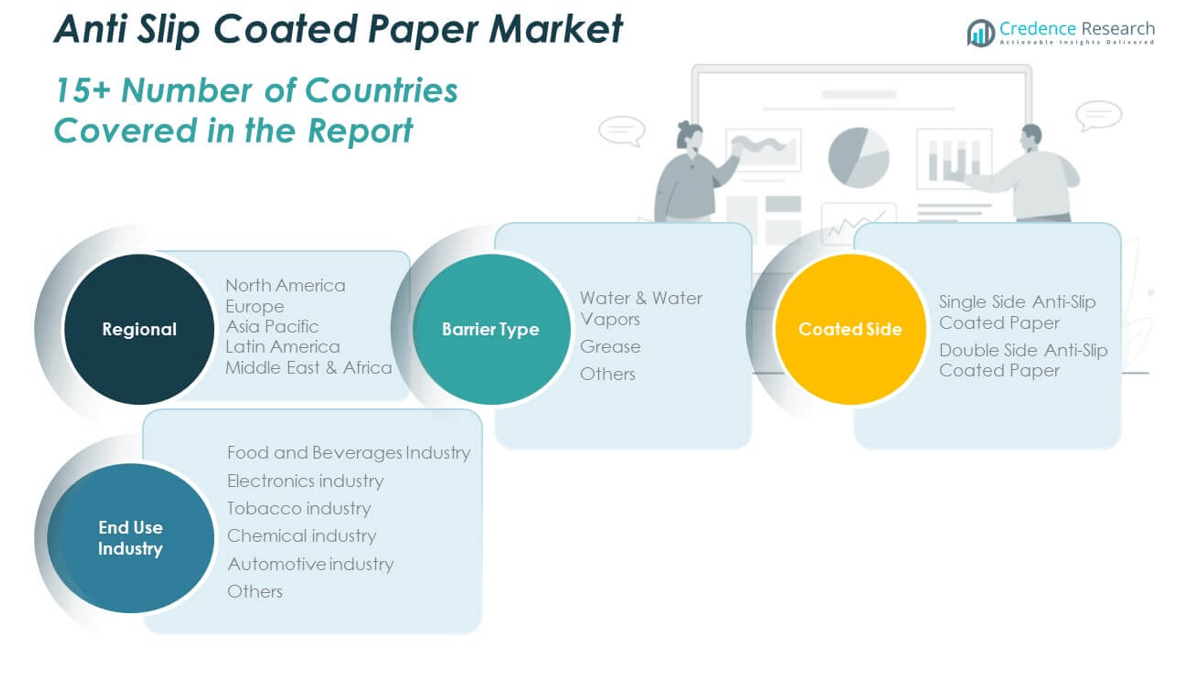
The Global Anti Slip Coated Paper Market is segmented by barrier type, coated side, and end-use industry, each contributing uniquely to its growth.
By barrier type, the water & water vapors segment holds the largest share due to its widespread use in food and beverage packaging. It offers reliable protection against moisture, supporting product integrity during transit. The grease barrier segment caters primarily to processed food and industrial applications, while the others segment includes specialty coatings for niche needs.
- For example, Mondi’s FunctionalBarrier Paper Ultimateis an ultra-high barrier paper-based packaging solution specifically designed for food products such as dried foods and powdered milk.
By coated side, single side anti-slip coated paper dominates market demand due to its cost-effectiveness and sufficient performance for most packaging applications. It is widely used in pallet interleaving, carton stacking, and export packaging. Double side coated variants serve sectors requiring enhanced friction on both surfaces, such as automated warehouse systems and slippery load types.
By end-use industry, the food and beverages industry leads adoption due to stringent hygiene standards and demand for safe transport. The electronics industry follows, driven by the need to prevent damage to sensitive components. The chemical and automotive sectors also use anti-slip paper to stabilize heavy or hazardous materials. The others segment covers logistics, retail, and household applications.
- For example, Delfort’s thinbarrier 302is a high-performance barrier paper developed for flexible food packaging, offering protection against moisture, drying out, and loss of aroma. It is used by food industry clients for heat-sealing and cold-sealing applications, ensuring that food products maintain quality and shelf life during transport.
Segmentation:
By Barrier Type:
- Water & Water Vapors
- Grease
- Others
By Coated Side:
- Single Side Anti-Slip Coated Paper
- Double Side Anti-Slip Coated Paper
By End-Use Industry:
- Food and Beverages Industry
- Electronics Industry
- Chemical Industry
- Automotive Industry
- Others
By Region:
- North America
- U.S.
- Canada
- Mexico
- Europe
- Germany
- France
- U.K.
- Italy
- Spain
- Rest of Europe
- Asia Pacific
- China
- Japan
- India
- South Korea
- South-east Asia
- Rest of Asia Pacific
- Latin America
- Brazil
- Argentina
- Rest of Latin America
- Middle East & Africa
- GCC Countries
- South Africa
- Rest of the Middle East and Africa
Regional Analysis:
The North America Anti Slip Coated Paper Market size was valued at USD 251.72 million in 2018 to USD 372.43 million in 2024 and is anticipated to reach USD 640.02 million by 2032, at a CAGR of 6.5% during the forecast period. North America holds a 27% share in the Global Anti Slip Coated Paper Market, supported by strong logistics infrastructure and widespread automation in warehousing. It benefits from robust demand across the food and beverage, pharmaceuticals, and retail sectors. Businesses in the region prioritize workplace safety and load stability, creating consistent demand for coated paper materials. It also gains traction due to increasing sustainability commitments, replacing plastic sheets with recyclable alternatives. The U.S. leads regional adoption with significant investment in eco-packaging and smart logistics. Market players focus on performance innovation and compliance with safety regulations to maintain competitive advantage.
The Europe Anti Slip Coated Paper Market size was valued at USD 158.63 million in 2018 to USD 225.33 million in 2024 and is anticipated to reach USD 350.83 million by 2032, at a CAGR of 5.2% during the forecast period. Europe accounts for 16% of the Global Anti Slip Coated Paper Market, driven by strong environmental policies and packaging standards. It emphasizes recyclable and biodegradable materials, favoring the widespread use of coated paper for pallet stabilization. Key industries such as automotive, consumer goods, and food exports support steady adoption across the region. Germany, France, and Italy lead in innovation and usage across supply chains. It benefits from regulatory frameworks such as the EU Packaging and Packaging Waste Directive that promote sustainable alternatives. Producers in the region focus on expanding capacity and offering customizable solutions to meet regional specifications.
The Asia Pacific Anti Slip Coated Paper Market size was valued at USD 359.01 million in 2018 to USD 559.91 million in 2024 and is anticipated to reach USD 1,018.41 million by 2032, at a CAGR of 7.3% during the forecast period. Asia Pacific dominates the Global Anti Slip Coated Paper Market with a 41% share, led by rapid industrialization and the growth of export-driven manufacturing sectors. China, India, Japan, and Southeast Asia drive demand due to expanding logistics networks and rising e-commerce activity. It sees strong adoption across food processing, electronics, and consumer goods packaging. Manufacturers in the region increasingly integrate coated paper into automated supply chains to enhance efficiency and safety. It also benefits from rising awareness of eco-friendly packaging materials and government-led sustainability initiatives. Regional growth is supported by domestic production capabilities and cost-competitive solutions.
The Latin America Anti Slip Coated Paper Market size was valued at USD 40.91 million in 2018 to USD 60.72 million in 2024 and is anticipated to reach USD 92.26 million by 2032, at a CAGR of 4.9% during the forecast period. Latin America holds 5% of the Global Anti Slip Coated Paper Market, fueled by the expansion of retail, agriculture exports, and light manufacturing sectors. Countries like Brazil, Mexico, and Chile represent key demand centers where improving logistics and warehousing systems create growth potential. It finds application in stabilizing bulk packaging, especially in perishable and FMCG supply chains. Regional players are adopting anti-slip coated paper as a low-cost safety enhancement that supports packaging compliance. It faces some barriers from low-cost traditional materials but continues to grow with increased focus on packaging efficiency. Local suppliers are strengthening distribution partnerships to broaden product availability.
The Middle East Anti Slip Coated Paper Market size was valued at USD 23.99 million in 2018 to USD 32.98 million in 2024 and is anticipated to reach USD 47.74 million by 2032, at a CAGR of 4.2% during the forecast period. The Middle East represents 3% of the Global Anti Slip Coated Paper Market, supported by growing infrastructure development and a shift toward efficient material handling practices. It is driven by rising activity in the retail, construction materials, and industrial goods sectors. The region sees increased demand for secure and sustainable transport packaging solutions, particularly for inter-Gulf trade. Saudi Arabia and the UAE lead the market with expanding logistics zones and warehouse automation. It is gradually replacing plastic stabilizers in large-scale supply chains to align with national sustainability goals. Government-led economic diversification efforts continue to support market development.
The Africa Anti Slip Coated Paper Market size was valued at USD 12.00 million in 2018 to USD 20.09 million in 2024 and is anticipated to reach USD 26.81 million by 2032, at a CAGR of 3.2% during the forecast period. Africa contributes 2% to the Global Anti Slip Coated Paper Market, with demand emerging from agriculture, food exports, and regional trade corridors. It sees growing interest in affordable, recyclable packaging materials that enhance transportation safety. Countries such as South Africa, Kenya, and Nigeria show potential due to improving logistics and retail infrastructure. It remains in the early adoption phase, with limited awareness among small and medium enterprises. Supply chain modernization and international trade standards create opportunities for coated paper usage. Manufacturers aim to increase market penetration through education, local partnerships, and cost-effective product lines.
Key Player Analysis:
- Smurfit Kappa Group
- Mondi Group
- International Paper Company
- DS Smith Plc
- Nippon Paper Industries Co., Ltd.
- Packaging Corporation of America
- Dura-Fibre
- Sierra Coating Technologies
- Specialty Coating & Laminating
Competitive Analysis:
The Global Anti Slip Coated Paper Market features a moderately fragmented competitive landscape, with key players focusing on product innovation, regional expansion, and sustainability-driven solutions. It includes both multinational corporations and regional manufacturers that compete on coating quality, friction performance, recyclability, and cost efficiency. Companies are investing in advanced coating technologies and tailored solutions for industry-specific applications such as pharmaceuticals, electronics, and food packaging. Strategic partnerships with logistics providers and packaging converters help expand market reach and improve supply chain integration. Leading firms prioritize compliance with environmental regulations and offer biodegradable or water-based coated variants to strengthen their market position. It also witnesses growing competition from emerging players in Asia-Pacific that offer cost-effective alternatives with scalable production capacity. Competitive intensity remains high, with continuous efforts to differentiate through material quality, customer service, and reliability under automated handling conditions.
Recent Developments:
- In April 2025, Mondi completed the acquisition of Schumacher Packaging’s Western Europe operations, significantly expanding its packaging portfolio and adding over 1 billion square meters of additional capacity. This acquisition strengthens Mondi’s presence in Western Europe and enhances its ability to offer sustainable corrugated and solid board solutions for eCommerce and FMCG sectors.
- In March 2025, BillerudKorsnäs AB introduced ConFlex® HeatSeal, a recyclable, heat-sealable paper designed to replace plastic-based flexible packaging. It targets industries seeking sustainable, seal-integrity solutions and supports recycling compliance
- In January 2025, International Paper completed the acquisition of DS Smith in a deal worth £5.8 billion, creating a global leader in sustainable packaging with a strong presence in Europe, the Middle East, Africa, and North America.
- In June 2024, Smurfit Kappa Group completed a major merger with WestRock, forming Smurfit Westrock. This transaction, valued at $13.5 billion, created one of the world’s largest sustainable packaging companies, enhancing its global reach and product diversity.
Market Concentration & Characteristics:
The Global Anti Slip Coated Paper Market exhibits moderate market concentration, with a mix of established international players and agile regional manufacturers operating across diverse geographies. It remains highly application-driven, with demand varying by end-use sectors such as food and beverage, industrial goods, and e-commerce logistics. The market favors suppliers offering customizable coating technologies, sustainable sourcing, and compatibility with automated handling systems. It shows strong alignment with global trends in eco-friendly packaging and supply chain optimization. While large players dominate high-volume contracts, local firms often lead in niche applications due to flexible pricing and regional availability. The market’s characteristics reflect a balance between innovation, regulatory compliance, and responsiveness to evolving packaging needs.
Report Coverage:
The research report offers an in-depth analysis based on barrier type, coated side, and end-use industry. It details leading market players, providing an overview of their business, product offerings, investments, revenue streams, and key applications. Additionally, the report includes insights into the competitive environment, SWOT analysis, current market trends, as well as the primary drivers and constraints. Furthermore, it discusses various factors that have driven market expansion in recent years. The report also explores market dynamics, regulatory scenarios, and technological advancements that are shaping the industry. It assesses the impact of external factors and global economic changes on market growth. Lastly, it provides strategic recommendations for new entrants and established companies to navigate the complexities of the market.
Future Outlook:
- Growing demand for sustainable packaging will increase the adoption of recyclable anti-slip coated paper across industries.
- Expansion of e-commerce logistics will drive higher usage in secure palletization and transit protection.
- Advances in coating technology will enable development of moisture-resistant and temperature-tolerant variants.
- Automation in warehousing will create demand for consistent, machine-compatible anti-slip materials.
- Emerging markets in Asia, Africa, and Latin America will offer new revenue streams for regional manufacturers.
- Regulatory focus on plastic reduction will support the replacement of synthetic stabilizers with coated paper.
- Custom printing capabilities will enhance branding opportunities in retail and premium packaging.
- Growth in cold chain logistics will expand use cases for anti-slip paper in pharmaceuticals and perishables.
- Strategic partnerships with packaging integrators will improve product reach and customer retention.
- Continuous innovation in lightweight designs will help reduce shipping costs and environmental impact.

Request a Free Sample
Fill in your details and we'll send you a free sample report.
- Sample data tables & charts
- Research methodology
Market Dynamics
Emphasis on Load Stability and Packaging Safety
Industries are prioritizing safe handling and efficient stacking of pallets, especially for fragile or high-value products. Anti-slip coated paper enhances surface friction, preventing displacement during storage or transit and reducing product damage.
Surge in E-Commerce and Retail Distribution
The rapid growth of e-commerce and retail supply chains increases the need for secure palletization and stable packaging. Anti-slip coated paper is widely adopted to prevent product shifting during automated fulfillment and last-mile delivery, improving customer satisfaction.
Sustainability Objectives and Regulatory Pressure
Environmental regulations and corporate sustainability goals are driving the shift from plastic-based stabilizers to recyclable, biodegradable anti-slip coated paper. Water-based and solvent-free coatings further support green packaging initiatives.
Product Innovation and Technical Advancements
Manufacturers are investing in R&D to develop coatings with higher friction, moisture resistance, and temperature tolerance, expanding the applicability of anti-slip coated paper to sensitive and diverse industry needs.
Expansion of Automated Warehousing and Logistics
The integration of anti-slip coated paper with automated packaging and robotics systems in modern warehouses supports consistent friction and reliable performance, making it a preferred choice for machine-compatible, high-throughput logistics environments.
Need a Custom Version of This Report?
Tailor the scope, geography, or segments to your exact requirements.
- Custom geography or segment scope
- Direct access to our analyst team
Frequently Asked Questions
What is the current size of the Global Anti Slip Coated Paper Market?
What are the key segments within the Global Anti Slip Coated Paper Market?
What are some challenges faced by the Global Anti Slip Coated Paper Market?
Who are the major players in the Global Anti Slip Coated Paper Market?
Table of Content
Chapter 1 Market Segmentation
- 1.1 Segmentation Framework
- 1.1.1 Product and Service Classification
- 1.1.2 Application and End-Use Classification
- 1.1.3 Technology and Solution Classification
- 1.1.4 Customer and Distribution Channel Classification
- 1.1.5 Geographic Segmentation
- 1.1.6 Market Segment Definitions and Boundaries
- 1.2 By Coated Side
- 1.2.1 Single Side Anti-Slip Coated Paper
- 1.2.2 Double Side Anti-Slip Coated Paper
- 1.3 By Barrier Type
- 1.3.1 Water & Water Vapors
- 1.3.2 Grease
- 1.3.3 Others
- 1.4 By End-Use Industry
- 1.4.1 Food and Beverages Industry
- 1.4.2 Electronics Industry
- 1.4.3 Chemical Industry
- 1.4.4 Automotive Industry
- 1.4.5 Others
Chapter 2 Introduction
- 2.1 Report Objectives and Scope
- 2.2 Product Definition and Industry Terminology
- 2.3 Market Inclusions and Exclusions
- 2.4 Research Process
- 2.4.1 Primary Research and Expert Interviews
- 2.4.2 Secondary Research and Source Review
- 2.4.3 Top-Down and Bottom-Up Estimation
- 2.4.4 Data Triangulation and Verification
- 2.5 Market Size Measurement Basis
- 2.5.1 2024: USD 1,271.46 million → 2032: USD 2,176.08 million
- 2.6 Historical and Forecast Reference Periods
- 2.6.1 Base Year: 2024
- 2.6.2 Forecast Period: 2024-2032
- 2.7 Research Assumptions and Limitations
Chapter 3 Executive Summary
- 3.1 Market Snapshot and Key Findings
- 3.2 Base-Year Market Size, 2024
- 3.3 Forecast Market Size, 2032
- 3.4 Revenue and Volume Growth Outlook
- 3.5 Key Demand and Supply Indicators
- 3.6 Leading Market Segments
- 3.7 Fastest-Growing Market Opportunities
- 3.8 Regional Performance Highlights
- 3.9 Technology and Industry Transformation
- 3.10 Competitive Landscape Summary
- 3.11 Analyst View and Strategic Implications
Chapter 4 Global Anti-Slip Coated Paper Market Trends and Developments
- 4.1 Historical Industry Development
- 4.2 Recent Market Trends and Developments
- 4.3 Demand and Customer Behavior Trends
- 4.4 Technology and Product Innovation
- 4.5 Artificial Intelligence, Automation and Digitalization
- 4.6 Local Manufacturing and Supply Chain Realignment
- 4.7 Industry Partnerships, Mergers and Acquisitions
- 4.8 Sustainability and Circular Economy Developments
- 4.9 Government and Private Sector Investment Trends
- 4.10 Emerging Business Models and Commercialization
- 4.11 Industry Developments and Announcements
Chapter 5 Global Anti-Slip Coated Paper Market Production, Supply and Demand Analysis
- 5.1 Demand Trend and Consumption Analysis
- 5.2 Demand Forecast, 2024-2032
- 5.3 Production and Output Trend
- 5.4 Production and Output Forecast, 2024-2032
- 5.5 Installed Capacity and Capacity Utilization
- 5.6 Company-Wise Production Plants and Statistics
- 5.6.1 Installed Production Capacity
- 5.6.2 Actual Production
- 5.6.3 Planned Capacity and Expansion Targets
- 5.7 Supply Chain Structure and Procurement Trends
- 5.8 Supply-Demand Gap and Bottlenecks
- 5.9 Import Dependence and Sourcing Structure
- 5.10 Contract Manufacturing and Outsourcing
- 5.11 Regional Supply and Demand Concentration
Chapter 6 Global Anti-Slip Coated Paper Market Pricing Analysis
- 6.1 Pricing Structure and Measurement
- 6.2 Historical Pricing Trends
- 6.3 Pricing Outlook, 2024-2032
- 6.4 Average Selling Price and Unit Economics
- 6.5 Pricing by Product and Market Segment
- 6.6 Geographic Pricing Differences
- 6.7 Key Input, Energy, Labor and Logistics Costs
- 6.8 Contract Pricing and Purchasing Models
- 6.9 Pricing Sensitivity and Competitive Positioning
- 6.10 Price, Margin and Profitability Implications
Chapter 7 Global Anti-Slip Coated Paper Market Dynamics
- 7.1 Market Growth Drivers
- 7.1.1 Demand-Side Drivers
- 7.1.2 Technology and Innovation Drivers
- 7.1.3 Infrastructure and Investment Drivers
- 7.1.4 Regulatory and Policy Drivers
- 7.2 Market Restraints
- 7.2.1 Cost and Affordability Constraints
- 7.2.2 Technology and Adoption Barriers
- 7.2.3 Supply Chain and Operational Constraints
- 7.3 Market Challenges
- 7.3.1 Competitive Pressure and Margin Erosion
- 7.3.2 Skills, Infrastructure and Implementation Gaps
- 7.4 Emerging Market Opportunities
- 7.5 Market Dynamics Impact and Time-Horizon Assessment
Chapter 8 Global Anti-Slip Coated Paper Value Chain Analysis
- 8.1 Industry Value Chain Overview
- 8.2 Upstream Suppliers and Critical Inputs
- 8.3 Technology and Component Providers
- 8.4 Manufacturing or Service Delivery
- 8.5 Distribution, Channel Partners and Integrators
- 8.6 Downstream Applications and End Users
- 8.7 Value Addition and Profit Pools
- 8.8 Vertical Integration and Outsourcing
- 8.9 Supplier Concentration and Risk
- 8.10 Supply Chain Localization and Resilience
Chapter 9 Global Anti-Slip Coated Paper Market Regulations and Policies
- 9.1 Relevant Laws, Standards and Compliance Frameworks
- 9.2 Product, Service, Safety and Quality Requirements
- 9.3 Government Policies, Incentives and Subsidies
- 9.4 Imports, Exports and Trade Barriers
- 9.5 Public Procurement and Local Content Requirements
- 9.6 Environmental and Sustainability Compliance
- 9.7 Upcoming Policy Changes and Market Implications
Chapter 10 Global Anti-Slip Coated Paper Market Hotspots and Opportunities
- 10.1 Market Opportunity Mapping and Growth Hotspots
- 10.2 High-Growth Applications and Customer Groups
- 10.3 Underserved Markets and White-Space Opportunities
- 10.4 Emerging Technology and Product Opportunities
- 10.5 New Capacity and Investment Hotspots
- 10.6 Market Entry and Expansion Opportunities
- 10.7 Distribution and Partnership Opportunities
- 10.8 Near-Term and Long-Term Commercial Potential
- 10.9 Opportunity Attractiveness and Execution Risks
Chapter 11 Global Anti-Slip Coated Paper Market Outlook, 2024-2032
- 11.1 Market Size and Analysis
- 11.1.1 Revenue (Market Measurement: 2024: USD 1,271.46 million → 2032: USD 2,176.08 million)
- 11.1.2 Market Volume and Quantity Sold
- 11.1.3 Historical Market Size
- 11.1.4 Base-Year Market Size, 2024
- 11.2 Market Forecast, 2024-2032
- 11.2.1 Revenue Forecast to 2032
- 11.2.2 Volume Forecast to 2032
- 11.2.3 CAGR and Year-on-Year Growth
- 11.2.4 Incremental Revenue Opportunity
- 11.3 Forecast Assumptions and Scenario Analysis
- 11.3.1 Base-Case Forecast
- 11.3.2 Optimistic and Conservative Scenarios
- 11.3.3 Technology, Pricing and Policy Sensitivities
- 11.4 Market Attractiveness and Growth Outlook
Chapter 12 Global Anti-Slip Coated Paper Market Segmentation and Outlook
- 12.1 Segmentation Summary and Market Shares, 2024
- 12.2 Largest and Fastest-Growing Segments
- 12.3 By Coated Side - Market Size and Forecast, 2024-2032
- 12.3.1 Segment Definition and Scope
- 12.3.2 Historical Market Size
- 12.3.3 Revenue Forecast, 2024-2032
- 12.3.4 Volume Forecast, 2024-2032
- 12.3.5 Base-Year Market Share, 2024
- 12.3.6 Segment CAGR and Growth Drivers
- 12.3.7 Subsegment Market Size and Forecast
- 12.3.7.1 Single Side Anti-Slip Coated Paper
- 12.3.7.2 Double Side Anti-Slip Coated Paper
- 12.3.8 Subsegment Pricing and Adoption Trends
- 12.3.9 Leading Suppliers and Competition
- 12.3.10 Regional Demand and Opportunities
- 12.4 By Barrier Type - Market Size and Forecast, 2024-2032
- 12.4.1 Segment Definition and Scope
- 12.4.2 Historical Market Size
- 12.4.3 Revenue Forecast, 2024-2032
- 12.4.4 Volume Forecast, 2024-2032
- 12.4.5 Base-Year Market Share, 2024
- 12.4.6 Segment CAGR and Growth Drivers
- 12.4.7 Subsegment Market Size and Forecast
- 12.4.7.1 Water & Water Vapors
- 12.4.7.2 Grease
- 12.4.7.3 Others
- 12.4.8 Subsegment Pricing and Adoption Trends
- 12.4.9 Leading Suppliers and Competition
- 12.4.10 Regional Demand and Opportunities
- 12.5 By End-Use Industry - Market Size and Forecast, 2024-2032
- 12.5.1 Segment Definition and Scope
- 12.5.2 Historical Market Size
- 12.5.3 Revenue Forecast, 2024-2032
- 12.5.4 Volume Forecast, 2024-2032
- 12.5.5 Base-Year Market Share, 2024
- 12.5.6 Segment CAGR and Growth Drivers
- 12.5.7 Subsegment Market Size and Forecast
- 12.5.7.1 Food and Beverages Industry
- 12.5.7.2 Electronics Industry
- 12.5.7.3 Chemical Industry
- 12.5.7.4 Automotive Industry
- 12.5.7.5 Others
- 12.5.8 Subsegment Pricing and Adoption Trends
- 12.5.9 Leading Suppliers and Competition
- 12.5.10 Regional Demand and Opportunities
- 12.6 Segment Growth Comparison
- 12.7 Segment Attractiveness and Priority Matrix
Chapter 13 Global Anti-Slip Coated Paper End-Use and Application Market Outlook
- 13.1 End-Use Industry and Customer Demand Structure
- 13.2 Leading Applications and Customer Groups
- 13.3 End-Use Market Size, Share and Forecast
- 13.4 Major End-Use Industry Deep Dives
- 13.4.1 Customer Requirements and Use Cases
- 13.4.2 Demand and Replacement Cycles
- 13.4.3 Technical and Regulatory Considerations
- 13.4.4 Purchasing and Procurement Models
- 13.4.5 Leading Vendors and Distribution Channels
- 13.4.6 Forecast and Commercial Opportunities
- 13.5 Emerging Applications and Cross-Segment Demand
- 13.6 End-Use Industry Investment Priorities
Chapter 14 Global Anti-Slip Coated Paper Geographic Market Outlook, 2024-2032
- 14.1 Regional Market Size and Share, 2024
- 14.2 Regional Market Forecast, 2024-2032
- 14.3 Regional Pricing, Production and Demand Differences
- 14.4 North America
- 14.4.1 United States
- 14.4.2 Canada
- 14.4.3 Mexico
- 14.5 Europe
- 14.5.1 Germany
- 14.5.2 France
- 14.5.3 Italy
- 14.5.4 United Kingdom
- 14.5.5 Spain
- 14.5.6 Poland
- 14.5.7 Russia
- 14.5.8 Netherlands
- 14.5.9 Belgium
- 14.5.10 Sweden
- 14.5.11 Denmark
- 14.5.12 Norway
- 14.5.13 Rest of Europe
- 14.6 Asia Pacific
- 14.6.1 China
- 14.6.2 India
- 14.6.3 Japan
- 14.6.4 South Korea
- 14.6.5 Thailand
- 14.6.6 Indonesia
- 14.6.7 Vietnam
- 14.6.8 Malaysia
- 14.6.9 Australia
- 14.6.10 Rest of Asia Pacific
- 14.7 Latin America
- 14.7.1 Brazil
- 14.7.2 Argentina
- 14.7.3 Colombia
- 14.7.4 Chile
- 14.7.5 Rest of Latin America
- 14.8 Middle East
- 14.8.1 Saudi Arabia
- 14.8.2 United Arab Emirates
- 14.8.3 Turkey
- 14.8.4 Israel
- 14.8.5 Iran
- 14.8.6 Rest of the Middle East
- 14.9 Africa
- 14.9.1 South Africa
- 14.9.2 Egypt
- 14.9.3 Nigeria
- 14.9.4 Morocco
- 14.9.5 Rest of Africa
- 14.10 Regional Investment, Policy and Supply Chain Differences
- 14.11 Regional Competitive Landscape
- 14.12 Geographic Growth Hotspots
Chapter 15 Global Anti-Slip Coated Paper Technology, Innovation and Sustainability Outlook
- 15.1 Technology Landscape and Maturity
- 15.2 Product, Process and Service Innovation
- 15.3 AI, Automation and Digital Tools in the Industry
- 15.4 Technology Adoption and Performance Benchmarking
- 15.5 Innovation Pipeline and R&D Investment
- 15.6 Patent and Intellectual Property Trends
- 15.7 Energy Efficiency and Resource Management
- 15.8 Sustainability, Recycling and Circularity
- 15.9 Technology Roadmap, 2024-2032
- 15.10 Risks of Obsolescence and Technology Substitution
Chapter 16 Global Anti-Slip Coated Paper Market Key Strategic Imperatives
- 16.1 Growth and Market Entry Priorities
- 16.2 High-Return Products and Segments
- 16.3 Pricing, Profitability and Cost Optimization
- 16.4 Technology Investment and Product Differentiation
- 16.5 Supply Chain Localization and Resilience
- 16.6 Distribution and Customer Acquisition
- 16.7 Partnership, Acquisition and Capacity Strategy
- 16.8 Regional Expansion Priorities
- 16.9 Short-, Medium- and Long-Term Actions
Chapter 17 Competition Outlook
- 17.1 Industry Competition Characteristics
- 17.2 Market Structure and Concentration
- 17.3 Market Share and Competitive Positioning, 2024
- 17.4 Company-Wise Revenue and Product Benchmarking
- 17.5 Production and Service Capacity Benchmarking
- 17.6 Technology, Pricing and Differentiation
- 17.7 Regional Footprint and Distribution Strength
- 17.8 Mergers, Acquisitions and Strategic Alliances
- 17.9 New Entrants and Competitive Threats
- 17.10 Porter's Five Forces and Industry Attractiveness
- 17.11 Competitive Outlook, 2024-2032
Chapter 18 Company Profiles
- 18.1 Company Coverage and Selection Criteria
- 18.2 Smurfit Kappa Group
- 18.2.1 Business Description
- 18.2.2 Company Ownership and Geographic Presence
- 18.2.3 Product and Service Portfolio
- 18.2.4 Manufacturing and Operating Footprint
- 18.2.5 Production Capacity and Expansion Plans
- 18.2.6 Financial Performance and Investment
- 18.2.7 Market Share and Competitive Position
- 18.2.8 Technology and Innovation Capabilities
- 18.2.9 Strategic Alliances or Partnerships
- 18.2.10 Recent Developments
- 18.2.11 Growth Strategy and Outlook
- 18.3 Mondi Group
- 18.4 International Paper Company
- 18.5 DS Smith Plc
- 18.6 Nippon Paper Industries Co., Ltd.
- 18.7 Packaging Corporation of America
- 18.8 Dura-Fibre
- 18.9 Sierra Coating Technologies
- 18.10 Specialty Coating & Laminating
- 18.11 BillerudKorsnäs AB
- 18.12 Other Relevant Market Participants
Note: Every listed company is profiled on the structure shown under the first company. The company list is preliminary and may change based on research findings, market developments, data availability and client requirements.
Chapter 19 Disclaimer
- 19.1 Research and Forecast Disclaimer
- 19.2 Data Source and Estimation Limitations
Note: The depth of individual sections depends on data availability for this market. Volume, capacity, trade and other unit-based metrics are included where applicable.

