Market Overview
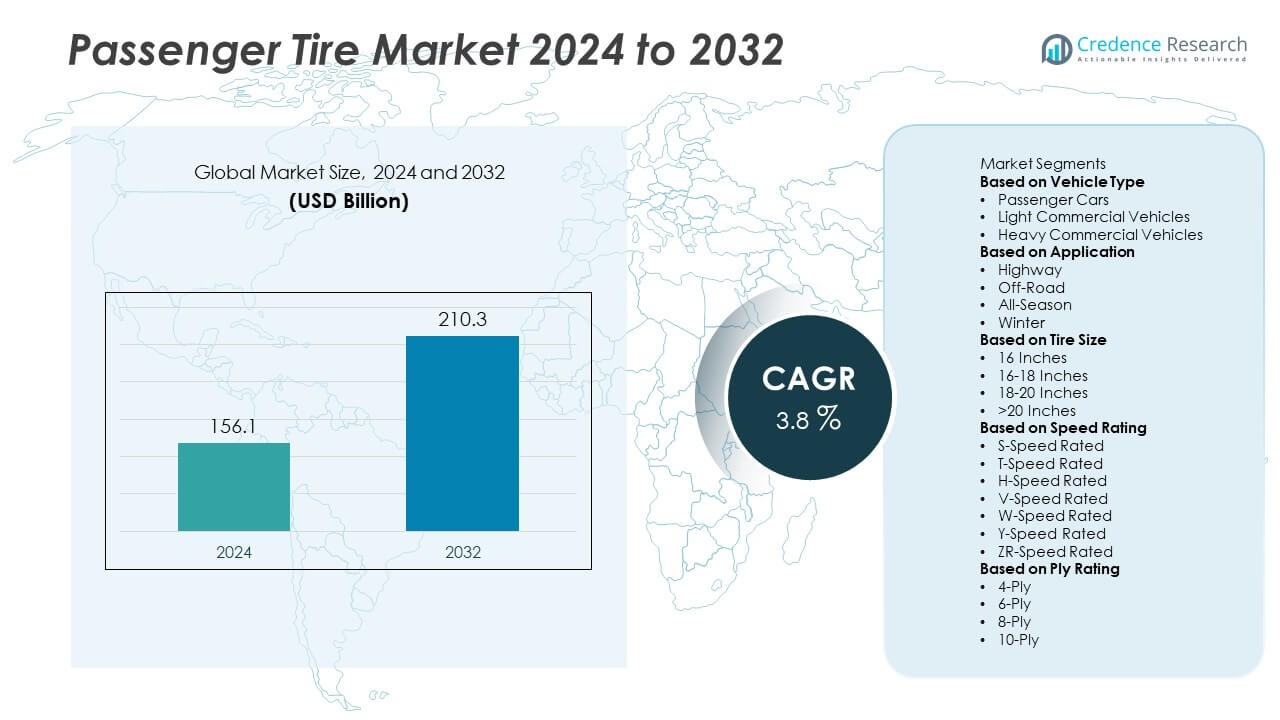
The Passenger Tire Market was valued at USD 156.1 billion in 2024 and is projected to reach USD 210.3 billion by 2032, expanding at a CAGR of 3.8% during the forecast period.
| REPORT ATTRIBUTE | DETAILS |
|---|---|
| Historical Period | 2020-2024 |
| Base Year | 2024 |
| Forecast Period | 2025-2032 |
| Passenger Tire Market Size 2024 | USD 156.1 Billion |
| Passenger Tire Market, CAGR | 3.8% |
| Passenger Tire Market Size 2032 | USD 210.3 Billion |
The Passenger Tire Market grows on the back of rising vehicle ownership, expanding urbanization, and increasing consumer preference for personal mobility. It benefits from strong replacement demand, supported by higher awareness of safety and maintenance practices.. It gains momentum from sustainability initiatives promoting eco-friendly materials and fuel-efficient products.
The Passenger Tire Market shows strong regional presence with diverse growth drivers across key geographies. Asia-Pacific leads with rising vehicle ownership in China, India, and Southeast Asia, supported by rapid urbanization and expanding middle-class populations. North America demonstrates consistent demand for replacement tires driven by high commuting distances and consumer preference for SUVs and crossovers. Europe emphasizes sustainability and innovation, with demand for winter and premium tires influenced by strict regulations and luxury car adoption. Latin America and the Middle East & Africa present steady opportunities fueled by infrastructure development and increasing aftermarket demand, though affordability remains central in these regions. Prominent companies shaping the competitive landscape include Michelin, Bridgestone Corporation, Continental AG, and The Goodyear Tire & Rubber Company, all of which continue to strengthen their portfolios through innovation, distribution networks, and strategic collaborations, ensuring wide product accessibility across global markets.
Market Insights
- The Passenger Tire Market was valued at USD 156.1 billion in 2024 and is projected to reach USD 210.3 billion by 2032, expanding at a CAGR of 3.8% during the forecast period.
- Growth is fueled by rising vehicle ownership, rapid urbanization, and increasing consumer preference for personal mobility across both developed and emerging economies.
- Trends highlight the shift toward fuel-efficient, low rolling resistance tires, the adoption of smart tire technologies with embedded sensors, and higher demand for all-season and premium performance tires.
- Leading players such as Michelin, Bridgestone Corporation, Continental AG, and The Goodyear Tire & Rubber Company invest in innovation, sustainability, and partnerships to strengthen their competitive edge.
- Market restraints include volatile raw material prices, supply chain disruptions, and compliance costs linked to stringent environmental and safety regulations worldwide.
- Asia-Pacific records the strongest growth momentum supported by expanding middle-class populations and vehicle sales, while Europe emphasizes premium tires and sustainability, and North America maintains steady demand from SUVs and replacements.
- Latin America and the Middle East & Africa provide emerging opportunities through aftermarket expansion and infrastructure growth, though affordability and distribution remain critical to long-term success.
Market Drivers
Rising Vehicle Ownership and Mobility Demand
The Passenger Tire Market benefits from a steady increase in global vehicle ownership driven by expanding middle-class populations and rapid urbanization. It gains momentum from rising consumer preference for personal mobility over shared transport. Strong demand in emerging economies fuels replacement and new tire sales. It reflects higher disposable incomes and supportive financing options that make vehicle purchases more accessible. It also aligns with infrastructure development projects that expand road networks and encourage long-distance travel. This factor strengthens consistent demand for diverse tire categories across regions.
- For instance, Bridgestone supplied over 25 million passenger tires annually to the North American market in 2023, supporting demand from SUVs and crossovers, which remain top-selling vehicle categories in the region.
Advancements in Tire Technology and Performance
It experiences growth from continuous innovation in tire design, materials, and manufacturing processes. The adoption of advanced tread patterns, silica-based compounds, and run-flat technologies enhances durability, fuel efficiency, and safety. Increasing focus on low rolling resistance tires supports regulatory compliance with emission norms. It benefits from the rising adoption of all-season and performance tires that appeal to consumer expectations for versatility and comfort. Companies invest in smart tire technology that enables pressure monitoring and predictive maintenance, adding value to customers. This driver positions innovation as a central force in shaping competitive differentiation.
- For instance, Continental introduced its ContiSense and ContiAdapt technologies with sensors capable of monitoring tread depth and temperature, tested across more than 100,000 kilometers of road trials to improve predictive maintenance efficiency.
Strong Replacement Demand and Aftermarket Expansion
It secures significant revenue from the large replacement segment, which outpaces sales of original equipment tires. High road usage, variable driving conditions, and consumer preference for enhanced performance encourage frequent replacements. Growth in e-commerce platforms accelerates aftermarket accessibility and widens consumer reach. It also reflects heightened awareness of tire safety and periodic maintenance. Rising penetration of branded tire service centers improves trust and brand loyalty. These factors sustain recurring demand cycles across developed and developing economies.
Sustainability Goals and Regulatory Compliance
It grows under the influence of global sustainability agendas and stringent regulatory frameworks. Governments encourage adoption of fuel-efficient tires to reduce carbon emissions. Rising environmental awareness pushes manufacturers to invest in eco-friendly materials and recycling initiatives. It also responds to labeling regulations that emphasize energy efficiency, noise levels, and wet grip performance. Companies align their strategies with circular economy practices to enhance market acceptance. This driver highlights the importance of balancing performance with environmental responsibility to meet evolving consumer expectations.
Market Trends
Growing Preference for Fuel-Efficient and Low Rolling Resistance Tires
The Passenger Tire Market reflects a strong trend toward tires that enhance fuel efficiency and reduce emissions. It aligns with stricter environmental regulations and consumer awareness of sustainability. Low rolling resistance tires gain traction due to their ability to optimize fuel consumption and extend vehicle performance. It supports automakers in meeting emission targets while addressing consumer demand for cost savings. This trend encourages tire manufacturers to invest in advanced materials and tread designs. The shift underscores efficiency as a leading factor influencing purchase decisions across regions.
- For instance, Michelin’s Energy Saver tire line reduced rolling resistance by up to 20%, which allowed drivers to save nearly 80 liters of fuel over a distance of 45,000 kilometers, based on real-world performance testing.
Expansion of Smart and Connected Tire Solutions
It demonstrates momentum in the adoption of smart tire technologies that improve safety and predictive maintenance. Tire pressure monitoring systems and embedded sensors provide real-time performance data to drivers and fleet operators. The trend expands opportunities for connectivity in both passenger vehicles and mobility services. It highlights growing interest in digital integration that improves convenience and operational efficiency. Manufacturers focus on leveraging data analytics to strengthen product value. This evolution positions connected tires as an important trend shaping future market dynamics.
- For instance, Goodyear tested its intelligent tire prototype on more than 3,000 vehicles across 67 million kilometers of fleet operations, proving that data-driven insights from tire sensors can extend tire life by up to 30% while improving safety outcomes.
Rising Popularity of All-Season and High-Performance Tires
It sees higher demand for all-season and high-performance tires that offer versatility and durability. Consumers seek products that deliver strong grip, comfort, and stability across varying road conditions. This trend strengthens the appeal of premium tire segments that combine innovation with performance. It responds to growing adoption of SUVs and luxury cars where demand for advanced tires remains high. The trend also expands aftermarket opportunities, as consumers increasingly choose specialized products for replacements. Companies emphasize R&D to align with changing preferences for safety and driving comfort.
Shift Toward Sustainable Materials and Circular Economy Practices
It records rising interest in eco-friendly tires designed with recyclable and renewable materials. Manufacturers focus on reducing reliance on synthetic rubber and promoting bio-based alternatives. This trend supports alignment with global sustainability goals and circular economy initiatives. It also encourages investment in recycling infrastructure to reduce tire waste. Companies highlight environmental performance through transparent labeling and certifications. This direction establishes sustainability as a defining trend influencing long-term market strategies.
Market Challenges Analysis
Volatility in Raw Material Prices and Supply Chain Disruptions
The Passenger Tire Market faces persistent challenges from fluctuations in raw material costs, particularly natural rubber, synthetic rubber, and crude oil derivatives. It struggles when unpredictable pricing erodes manufacturer margins and raises consumer prices. Supply chain disruptions triggered by geopolitical tensions, trade restrictions, and shipping delays intensify the challenge. It often requires companies to adopt flexible sourcing strategies and manage inventory risks. Rising transportation costs and uneven global distribution networks complicate timely product availability. These factors create uncertainty in production planning and weaken profitability for industry participants.
Environmental Regulations and Competitive Pressures
It encounters mounting challenges from stringent environmental regulations that demand significant investment in research, eco-friendly materials, and compliance measures. Tire manufacturers must adapt to labeling standards that emphasize rolling resistance, noise levels, and wet grip performance. It also faces competitive pressures as new entrants and regional players introduce lower-cost alternatives. Global leaders must balance innovation with affordability to maintain consumer loyalty. Rapid technological changes and shifting consumer expectations place constant pressure on product development cycles. These conditions highlight regulatory compliance and cost competitiveness as significant hurdles shaping market performance.
Market Opportunities
Expansion in Emerging Economies and Aftermarket Potential
The Passenger Tire Market creates significant opportunities through rising demand in emerging economies where vehicle ownership continues to grow. It benefits from increasing urbanization, rising disposable incomes, and government investment in road infrastructure. Expanding middle-class populations in Asia-Pacific, Latin America, and Africa strengthen new vehicle sales and replacement tire demand. It also gains opportunities from a growing aftermarket segment supported by digital sales channels and expanding tire service networks. Rising consumer preference for premium and performance tires further boosts revenue potential in these markets. Companies that build strong distribution partnerships in these regions stand to capture sustainable growth.
Innovation in Sustainable and Smart Tire Technologies
It offers strong opportunities through innovation in sustainable tire manufacturing and connected mobility solutions. Growing focus on eco-friendly materials, recyclable compounds, and bio-based alternatives enhances brand positioning with environmentally conscious consumers. It also aligns with regulatory initiatives promoting fuel-efficient and low-emission technologies. Advancements in smart tire solutions, including real-time monitoring and predictive analytics, present new revenue streams for manufacturers. The integration of intelligent tire systems with electric and autonomous vehicles expands possibilities for premium product segments. These innovations highlight the role of technology and sustainability as key enablers of long-term opportunity.
Market Segmentation Analysis:
By Vehicle Type
The Passenger Tire Market demonstrates clear segmentation by vehicle type, covering sedans, hatchbacks, SUVs, and crossovers. It records high demand from SUVs and crossovers, which dominate due to their rising global adoption and consumer preference for safety, comfort, and utility. Sedans continue to hold a considerable share, supported by steady demand in urban markets where fuel efficiency and affordability matter. Hatchbacks gain traction in emerging economies where compact vehicles remain cost-effective for daily commuting. It also reflects premiumization in luxury cars that drives specialized demand for performance-oriented tires. This segment highlights diverse consumer preferences and underlines the need for tailored tire solutions across vehicle categories.
- For instance, Bridgestone supplied more than 12 million tires for SUV models globally in 2023, while Pirelli reported that over 55% of its premium tire sales were linked to high-performance luxury cars such as BMW and Mercedes-Benz.
By Application
It shows strong variation by application, primarily divided into OEM and replacement segments. The replacement segment leads growth, driven by rising awareness of tire maintenance, safety standards, and the impact of road conditions. It benefits from higher replacement cycles in regions with poor road infrastructure, while developed markets witness demand for premium replacement products. OEM demand remains consistent, supported by growth in new vehicle sales and technological integration of advanced tire systems. It gains strength from collaborations between automakers and tire manufacturers to develop customized solutions. This segment emphasizes the recurring nature of aftermarket sales as a critical revenue stream.
- For instance, Goodyear reported supplying nearly 5 million original equipment tires to Ford and General Motors in North America in 2022, while Michelin’s replacement tire division serviced more than 200 million units globally across passenger vehicles during the same year.
By Tire Size
It exhibits strong differentiation by tire size, with 13–15 inches, 16–18 inches, and above 18 inches categories. Smaller sizes remain popular in compact and mid-sized vehicles where affordability drives adoption, particularly in Asia-Pacific. The 16–18-inch segment records growing demand from sedans and mid-size SUVs, balancing comfort, performance, and cost. It also shows rapid growth in above 18 inches, reflecting the rising penetration of premium SUVs, crossovers, and luxury cars. Consumers seek larger tires that deliver better grip, durability, and advanced performance features. This segment reflects the influence of vehicle design evolution and consumer preference for high-performance driving experiences.
Segments:
Based on Vehicle Type
- Passenger Cars
- Light Commercial Vehicles
- Heavy Commercial Vehicles
Based on Application
- Highway
- Off-Road
- All-Season
- Winter
Based on Tire Size
- 16 Inches
- 16-18 Inches
- 18-20 Inches
- >20 Inches
Based on Speed Rating
- S-Speed Rated
- T-Speed Rated
- H-Speed Rated
- V-Speed Rated
- W-Speed Rated
- Y-Speed Rated
- ZR-Speed Rated
Based on Ply Rating
- 4-Ply
- 6-Ply
- 8-Ply
- 10-Ply
Based on the Geography:
- North America
- U.S.
- Canada
- Mexico
- Europe
- UK
- France
- Germany
- Italy
- Spain
- Russia
- Belgium
- Netherlands
- Austria
- Sweden
- Poland
- Denmark
- Switzerland
- Rest of Europe
- Asia Pacific
- China
- Japan
- South Korea
- India
- Australia
- Thailand
- Indonesia
- Vietnam
- Malaysia
- Philippines
- Taiwan
- Rest of Asia Pacific
- Latin America
- Brazil
- Argentina
- Peru
- Chile
- Colombia
- Rest of Latin America
- Middle East
- UAE
- KSA
- Israel
- Turkey
- Iran
- Rest of Middle East
- Africa
- Egypt
- Nigeria
- Algeria
- Morocco
- Rest of Africa
Regional Analysis
North America
North America accounts for nearly 21% of the global Passenger Tire Market share, supported by a strong demand base in the United States and Canada. It benefits from high vehicle ownership levels and steady replacement cycles driven by long-distance commuting patterns. The region reflects strong adoption of SUVs and light trucks, which require larger and more durable passenger tires. It also shows a preference for all-season and high-performance tires that address varied climatic conditions. Regulatory frameworks encouraging fuel efficiency and safety standards strengthen demand for advanced tire technologies. Manufacturers invest heavily in research and distribution networks to maintain competitiveness in this mature yet evolving market.
Europe
Europe contributes about 25% of the Passenger Tire Market share, making it one of the leading regions globally. It demonstrates robust demand driven by stringent regulations on fuel efficiency, noise levels, and carbon emissions. The region emphasizes premium and performance-oriented tires, aligning with the dominance of luxury and high-performance vehicles. It also reflects strong demand for winter tires in northern and central countries where harsh weather necessitates seasonal replacements. Replacement demand remains dominant, supported by well-established service networks and high consumer awareness of tire safety. It positions Europe as a market where innovation, sustainability, and regulatory compliance define growth trajectories.
Asia-Pacific
Asia-Pacific leads the global Passenger Tire Market with an estimated 42% market share, supported by rapid vehicle ownership growth in China, India, and Southeast Asia. It benefits from expanding middle-class populations, urbanization, and rising disposable incomes, which drive demand for both new vehicles and replacement tires. The region records strong traction in compact cars and hatchbacks, while SUVs gain momentum in urban centers. It also shows significant demand for affordable tires, though premium and performance categories are expanding among upper-income groups. Strong manufacturing presence, cost advantages, and infrastructure expansion make Asia-Pacific the most dynamic regional contributor. Tire companies invest in local production and partnerships to capture long-term growth in this high-potential market.
Latin America
Latin America holds about 6% of the Passenger Tire Market share, driven primarily by Brazil, Mexico, and Argentina. It reflects steady demand for replacement tires due to varied road conditions and high levels of wear and tear. It also shows strong adoption of affordable passenger tires, with premium tire penetration still limited to higher-income urban markets. The region faces challenges from economic volatility and import dependency, yet it remains attractive for global tire makers due to its sizable vehicle population. Demand growth is reinforced by expanding e-commerce platforms that improve aftermarket access. This market segment highlights opportunities in building strong distribution channels and offering cost-effective solutions.
Middle East & Africa
The Middle East & Africa region accounts for nearly 6% of the Passenger Tire Market share, characterized by diverse consumer preferences across subregions. It benefits from rising vehicle ownership in Gulf countries where premium and performance tires dominate due to luxury car adoption. In contrast, African markets show demand for affordable and durable tires that withstand challenging road conditions. It reflects increasing importance of replacement demand, particularly in markets with high import penetration. Infrastructure projects and urbanization encourage rising vehicle use, which supports steady tire demand. Tire companies that tailor products to local needs capture opportunities in this growing region.
Key Player Analysis
- Yokohama Rubber
- Pirelli C. S.p.A
- Giti Tire
- Bridgestone Corporation
- Sumitomo Rubber Industries
- Michelin
- Toyo
- Continental AG
- The Goodyear Tire Rubber Company
- Nexen Tire Corporation
Competitive Analysis
The Passenger Tire Market features intense competition among global leaders including Michelin, Bridgestone Corporation, Continental AG, The Goodyear Tire & Rubber Company, Pirelli C. S.p.A, Yokohama Rubber, Sumitomo Rubber Industries, Toyo, Nexen Tire Corporation, and Giti Tire, which collectively shape the industry through innovation, sustainability initiatives, and extensive distribution networks. The market is defined by advanced tire technologies emphasizing fuel efficiency, smart connectivity, and eco-friendly materials, alongside investments in intelligent tire solutions and premium performance products. Growing demand for electric vehicle-compatible tires and digital services adds new avenues for differentiation, while high-performance and luxury segments remain significant growth areas. Regional expansion in Asia-Pacific, affordability in emerging markets, and strong partnerships with automakers enhance competitiveness. Continuous R&D efforts ensure a balance between innovation, sustainability, and cost-effectiveness, reflecting the diverse needs of global consumers and sustaining long-term market growth.
Recent Developments
- In June 2025, Yokohama Rubber began supplying ADVAN FLEVA V701 tires as original equipment for Toyota’s new Corolla Cross GR SPORT, slated for launch from August 2025.
- In June 2025, Pirelli C. S.p.A released a limited-edition reissue of the first-ever P Zero for the Lancia Delta S4 Stradale, enhancing handling and braking performance.
- In March 2025, Yokohama Rubber unveiled its 2025 motorsports activity plan, emphasizing participation in global motorsports, using higher ratios of renewable and recycled materials in ADVAN racing tires, and promoting sustainable production at its Mishima Plant.
- In March 2025, Pirelli C. S.p.A launched the fifth-generation P Zero tire, featuring AI-driven virtual development and improved handling, braking, and wet grip performance across sizes from 18 to 23 inches.
Report Coverage
The research report offers an in-depth analysis based on Vehicle Type, Application, Tire Size, Speed Rating, Ply Rating and Geography. It details leading market players, providing an overview of their business, product offerings, investments, revenue streams, and key applications. Additionally, the report includes insights into the competitive environment, SWOT analysis, current market trends, as well as the primary drivers and constraints. Furthermore, it discusses various factors that have driven market expansion in recent years. The report also explores market dynamics, regulatory scenarios, and technological advancements that are shaping the industry. It assesses the impact of external factors and global economic changes on market growth. Lastly, it provides strategic recommendations for new entrants and established companies to navigate the complexities of the market.
Future Outlook
- It will benefit from ongoing rise in vehicle ownership and expanding urban mobility trends.
- It will shift toward fuel-efficient and low rolling resistance tire designs to meet regulatory and consumer demands.
- It will adopt smart and connected tire technologies to enable predictive maintenance and real-time performance monitoring.
- It will move toward greater use of eco-friendly and bio-based materials driven by sustainability goals.
- It will see growth in premium tires that deliver high comfort, performance, and safety.
- It will expand in emerging markets where middle-class populations and road infrastructure continue to grow.
- It will expand aftermarket services and digital sales channels to improve customer reach and service convenience.
- It will face tighter environmental and safety regulations requiring more innovation and certification.
- It will encourage collaboration between automakers and tire manufacturers on integrated solutions for electric and autonomous vehicles.
- It will sustain competitive pressure, driving R&D investment to balance performance, cost, and sustainability.

Request a Free Sample
Fill in your details and we'll send you a free sample report.
- Sample data tables & charts
- Research methodology
Market Dynamics
Rising Vehicle Ownership and Urbanization
Expanding middle-class populations and rapid urbanization in emerging economies are increasing vehicle ownership, which directly boosts demand for passenger tires both for new vehicles and replacements.
Advancements in Tire Technology and Performance
Continuous innovation in tire materials, tread patterns, and smart technologies such as embedded sensors enhances durability, safety, and fuel efficiency, making advanced tires more attractive to consumers and supporting market growth.
Strong Replacement Demand and Aftermarket Expansion
Frequent tire replacements due to high road usage, variable driving conditions, and increased consumer awareness of safety and maintenance drive recurring sales, with aftermarket channels and branded service centers expanding accessibility.
Sustainability Goals and Regulatory Compliance
Stricter environmental regulations and consumer demand for eco-friendly products are pushing manufacturers to develop fuel-efficient, low rolling resistance, and recyclable tires, aligning with global sustainability initiatives and opening new market opportunities.
Growth in Premium and High-Performance Tire Segments
Rising adoption of SUVs, crossovers, and luxury vehicles is fueling demand for premium, all-season, and high-performance tires, which offer enhanced comfort, safety, and driving experience, thus increasing market value.
Need a Custom Version of This Report?
Tailor the scope, geography, or segments to your exact requirements.
- Custom geography or segment scope
- Direct access to our analyst team
Frequently Asked Questions
What is the current market size for Passenger Tire, and what is its projected size in 2032?
At what Compound Annual Growth Rate is the Passenger Tire market projected to grow between 2025 and 2032?
Which Passenger Tire market segment held the largest share in 2024?
What are the primary factors fueling the growth of the Passenger Tire market?
Who are the leading companies in the Passenger Tire market?
Which region commanded the largest share of the Passenger Tire market in 2024?
Table of Content
Chapter 1 Market Segmentation
- 1.1 Segmentation Framework
- 1.1.1 Product and Service Classification
- 1.1.2 Application and End-Use Classification
- 1.1.3 Technology and Solution Classification
- 1.1.4 Customer and Distribution Channel Classification
- 1.1.5 Geographic Segmentation
- 1.1.6 Market Segment Definitions and Boundaries
- 1.2 By Tire Size
- 1.2.1 16 Inches
- 1.2.2 16-18 Inches
- 1.2.3 18-20 Inches
- 1.2.4 >20 Inches
- 1.3 By Application
- 1.3.1 Highway
- 1.3.2 Off-Road
- 1.3.3 All-Season
- 1.3.4 Winter
- 1.4 By Speed Rating
- 1.4.1 S-Speed Rated
- 1.4.2 T-Speed Rated
- 1.4.3 H-Speed Rated
- 1.4.4 V-Speed Rated
- 1.4.5 W-Speed Rated
- 1.4.6 Y-Speed Rated
- 1.4.7 ZR-Speed Rated
- 1.5 By Vehicle Type
- 1.5.1 Passenger Cars
- 1.5.2 Light Commercial Vehicles
- 1.5.3 Heavy Commercial Vehicles
Chapter 2 Introduction
- 2.1 Report Objectives and Scope
- 2.2 Product Definition and Industry Terminology
- 2.3 Market Inclusions and Exclusions
- 2.4 Research Process
- 2.4.1 Primary Research and Expert Interviews
- 2.4.2 Secondary Research and Source Review
- 2.4.3 Top-Down and Bottom-Up Estimation
- 2.4.4 Data Triangulation and Verification
- 2.5 Market Size Measurement Basis
- 2.5.1 2024: USD 156.1 billion → 2032: USD 210.3 billion
- 2.6 Historical and Forecast Reference Periods
- 2.6.1 Base Year: 2024
- 2.6.2 Forecast Period: 2024-2032
- 2.7 Research Assumptions and Limitations
Chapter 3 Executive Summary
- 3.1 Market Snapshot and Key Findings
- 3.2 Base-Year Market Size, 2024
- 3.3 Forecast Market Size, 2032
- 3.4 Revenue and Volume Growth Outlook
- 3.5 Key Demand and Supply Indicators
- 3.6 Leading Market Segments
- 3.7 Fastest-Growing Market Opportunities
- 3.8 Regional Performance Highlights
- 3.9 Technology and Industry Transformation
- 3.10 Competitive Landscape Summary
- 3.11 Analyst View and Strategic Implications
Chapter 4 Global Passenger Tire Market Trends and Developments
- 4.1 Historical Industry Development
- 4.2 Recent Market Trends and Developments
- 4.3 Demand and Customer Behavior Trends
- 4.4 Technology and Product Innovation
- 4.5 Artificial Intelligence, Automation and Digitalization
- 4.6 Local Manufacturing and Supply Chain Realignment
- 4.7 Industry Partnerships, Mergers and Acquisitions
- 4.8 Sustainability and Circular Economy Developments
- 4.9 Government and Private Sector Investment Trends
- 4.10 Emerging Business Models and Commercialization
- 4.11 Industry Developments and Announcements
Chapter 5 Global Passenger Tire Market Production, Supply and Demand Analysis
- 5.1 Demand Trend and Consumption Analysis
- 5.2 Demand Forecast, 2024-2032
- 5.3 Production and Output Trend
- 5.4 Production and Output Forecast, 2024-2032
- 5.5 Installed Capacity and Capacity Utilization
- 5.6 Company-Wise Production Plants and Statistics
- 5.6.1 Installed Production Capacity
- 5.6.2 Actual Production
- 5.6.3 Planned Capacity and Expansion Targets
- 5.7 Supply Chain Structure and Procurement Trends
- 5.8 Supply-Demand Gap and Bottlenecks
- 5.9 Import Dependence and Sourcing Structure
- 5.10 Contract Manufacturing and Outsourcing
- 5.11 Regional Supply and Demand Concentration
Chapter 6 Global Passenger Tire Market Pricing Analysis
- 6.1 Pricing Structure and Measurement
- 6.2 Historical Pricing Trends
- 6.3 Pricing Outlook, 2024-2032
- 6.4 Average Selling Price and Unit Economics
- 6.5 Pricing by Product and Market Segment
- 6.6 Geographic Pricing Differences
- 6.7 Key Input, Energy, Labor and Logistics Costs
- 6.8 Contract Pricing and Purchasing Models
- 6.9 Pricing Sensitivity and Competitive Positioning
- 6.10 Price, Margin and Profitability Implications
Chapter 7 Global Passenger Tire Market Dynamics
- 7.1 Market Growth Drivers
- 7.1.1 Demand-Side Drivers
- 7.1.2 Technology and Innovation Drivers
- 7.1.3 Infrastructure and Investment Drivers
- 7.1.4 Regulatory and Policy Drivers
- 7.2 Market Restraints
- 7.2.1 Cost and Affordability Constraints
- 7.2.2 Technology and Adoption Barriers
- 7.2.3 Supply Chain and Operational Constraints
- 7.3 Market Challenges
- 7.3.1 Competitive Pressure and Margin Erosion
- 7.3.2 Skills, Infrastructure and Implementation Gaps
- 7.4 Emerging Market Opportunities
- 7.5 Market Dynamics Impact and Time-Horizon Assessment
Chapter 8 Global Passenger Tire Value Chain Analysis
- 8.1 Industry Value Chain Overview
- 8.2 Upstream Suppliers and Critical Inputs
- 8.3 Technology and Component Providers
- 8.4 Manufacturing or Service Delivery
- 8.5 Distribution, Channel Partners and Integrators
- 8.6 Downstream Applications and End Users
- 8.7 Value Addition and Profit Pools
- 8.8 Vertical Integration and Outsourcing
- 8.9 Supplier Concentration and Risk
- 8.10 Supply Chain Localization and Resilience
Chapter 9 Global Passenger Tire Market Regulations and Policies
- 9.1 Relevant Laws, Standards and Compliance Frameworks
- 9.2 Product, Service, Safety and Quality Requirements
- 9.3 Government Policies, Incentives and Subsidies
- 9.4 Imports, Exports and Trade Barriers
- 9.5 Public Procurement and Local Content Requirements
- 9.6 Environmental and Sustainability Compliance
- 9.7 Upcoming Policy Changes and Market Implications
Chapter 10 Global Passenger Tire Market Hotspots and Opportunities
- 10.1 Market Opportunity Mapping and Growth Hotspots
- 10.2 High-Growth Applications and Customer Groups
- 10.3 Underserved Markets and White-Space Opportunities
- 10.4 Emerging Technology and Product Opportunities
- 10.5 New Capacity and Investment Hotspots
- 10.6 Market Entry and Expansion Opportunities
- 10.7 Distribution and Partnership Opportunities
- 10.8 Near-Term and Long-Term Commercial Potential
- 10.9 Opportunity Attractiveness and Execution Risks
Chapter 11 Global Passenger Tire Market Outlook, 2024-2032
- 11.1 Market Size and Analysis
- 11.1.1 Revenue (Market Measurement: 2024: USD 156.1 billion → 2032: USD 210.3 billion)
- 11.1.2 Market Volume and Quantity Sold
- 11.1.3 Historical Market Size
- 11.1.4 Base-Year Market Size, 2024
- 11.2 Market Forecast, 2024-2032
- 11.2.1 Revenue Forecast to 2032
- 11.2.2 Volume Forecast to 2032
- 11.2.3 CAGR and Year-on-Year Growth
- 11.2.4 Incremental Revenue Opportunity
- 11.3 Forecast Assumptions and Scenario Analysis
- 11.3.1 Base-Case Forecast
- 11.3.2 Optimistic and Conservative Scenarios
- 11.3.3 Technology, Pricing and Policy Sensitivities
- 11.4 Market Attractiveness and Growth Outlook
Chapter 12 Global Passenger Tire Market Segmentation and Outlook
- 12.1 Segmentation Summary and Market Shares, 2024
- 12.2 Largest and Fastest-Growing Segments
- 12.3 By Tire Size - Market Size and Forecast, 2024-2032
- 12.3.1 Segment Definition and Scope
- 12.3.2 Historical Market Size
- 12.3.3 Revenue Forecast, 2024-2032
- 12.3.4 Volume Forecast, 2024-2032
- 12.3.5 Base-Year Market Share, 2024
- 12.3.6 Segment CAGR and Growth Drivers
- 12.3.7 Subsegment Market Size and Forecast
- 12.3.7.1 16 Inches
- 12.3.7.2 16-18 Inches
- 12.3.7.3 18-20 Inches
- 12.3.7.4 >20 Inches
- 12.3.8 Subsegment Pricing and Adoption Trends
- 12.3.9 Leading Suppliers and Competition
- 12.3.10 Regional Demand and Opportunities
- 12.4 By Application - Market Size and Forecast, 2024-2032
- 12.4.1 Segment Definition and Scope
- 12.4.2 Historical Market Size
- 12.4.3 Revenue Forecast, 2024-2032
- 12.4.4 Volume Forecast, 2024-2032
- 12.4.5 Base-Year Market Share, 2024
- 12.4.6 Segment CAGR and Growth Drivers
- 12.4.7 Subsegment Market Size and Forecast
- 12.4.7.1 Highway
- 12.4.7.2 Off-Road
- 12.4.7.3 All-Season
- 12.4.7.4 Winter
- 12.4.8 Subsegment Pricing and Adoption Trends
- 12.4.9 Leading Suppliers and Competition
- 12.4.10 Regional Demand and Opportunities
- 12.5 By Speed Rating - Market Size and Forecast, 2024-2032
- 12.5.1 Segment Definition and Scope
- 12.5.2 Historical Market Size
- 12.5.3 Revenue Forecast, 2024-2032
- 12.5.4 Volume Forecast, 2024-2032
- 12.5.5 Base-Year Market Share, 2024
- 12.5.6 Segment CAGR and Growth Drivers
- 12.5.7 Subsegment Market Size and Forecast
- 12.5.7.1 S-Speed Rated
- 12.5.7.2 T-Speed Rated
- 12.5.7.3 H-Speed Rated
- 12.5.7.4 V-Speed Rated
- 12.5.7.5 W-Speed Rated
- 12.5.7.6 Y-Speed Rated
- 12.5.7.7 ZR-Speed Rated
- 12.5.8 Subsegment Pricing and Adoption Trends
- 12.5.9 Leading Suppliers and Competition
- 12.5.10 Regional Demand and Opportunities
- 12.6 By Vehicle Type - Market Size and Forecast, 2024-2032
- 12.6.1 Segment Definition and Scope
- 12.6.2 Historical Market Size
- 12.6.3 Revenue Forecast, 2024-2032
- 12.6.4 Volume Forecast, 2024-2032
- 12.6.5 Base-Year Market Share, 2024
- 12.6.6 Segment CAGR and Growth Drivers
- 12.6.7 Subsegment Market Size and Forecast
- 12.6.7.1 Passenger Cars
- 12.6.7.2 Light Commercial Vehicles
- 12.6.7.3 Heavy Commercial Vehicles
- 12.6.8 Subsegment Pricing and Adoption Trends
- 12.6.9 Leading Suppliers and Competition
- 12.6.10 Regional Demand and Opportunities
- 12.7 Segment Growth Comparison
- 12.8 Segment Attractiveness and Priority Matrix
Chapter 13 Global Passenger Tire End-Use and Application Market Outlook
- 13.1 End-Use Industry and Customer Demand Structure
- 13.2 Leading Applications and Customer Groups
- 13.3 End-Use Market Size, Share and Forecast
- 13.4 Major End-Use Industry Deep Dives
- 13.4.1 Customer Requirements and Use Cases
- 13.4.2 Demand and Replacement Cycles
- 13.4.3 Technical and Regulatory Considerations
- 13.4.4 Purchasing and Procurement Models
- 13.4.5 Leading Vendors and Distribution Channels
- 13.4.6 Forecast and Commercial Opportunities
- 13.5 Emerging Applications and Cross-Segment Demand
- 13.6 End-Use Industry Investment Priorities
Chapter 14 Global Passenger Tire Geographic Market Outlook, 2024-2032
- 14.1 Regional Market Size and Share, 2024
- 14.2 Regional Market Forecast, 2024-2032
- 14.3 Regional Pricing, Production and Demand Differences
- 14.4 North America
- 14.4.1 United States
- 14.4.2 Canada
- 14.4.3 Mexico
- 14.5 Europe
- 14.5.1 Germany
- 14.5.2 France
- 14.5.3 Italy
- 14.5.4 United Kingdom
- 14.5.5 Spain
- 14.5.6 Poland
- 14.5.7 Russia
- 14.5.8 Netherlands
- 14.5.9 Belgium
- 14.5.10 Sweden
- 14.5.11 Denmark
- 14.5.12 Norway
- 14.5.13 Rest of Europe
- 14.6 Asia Pacific
- 14.6.1 China
- 14.6.2 India
- 14.6.3 Japan
- 14.6.4 South Korea
- 14.6.5 Thailand
- 14.6.6 Indonesia
- 14.6.7 Vietnam
- 14.6.8 Malaysia
- 14.6.9 Australia
- 14.6.10 Rest of Asia Pacific
- 14.7 Latin America
- 14.7.1 Brazil
- 14.7.2 Argentina
- 14.7.3 Colombia
- 14.7.4 Chile
- 14.7.5 Rest of Latin America
- 14.8 Middle East
- 14.8.1 Saudi Arabia
- 14.8.2 United Arab Emirates
- 14.8.3 Turkey
- 14.8.4 Israel
- 14.8.5 Iran
- 14.8.6 Rest of the Middle East
- 14.9 Africa
- 14.9.1 South Africa
- 14.9.2 Egypt
- 14.9.3 Nigeria
- 14.9.4 Morocco
- 14.9.5 Rest of Africa
- 14.10 Regional Investment, Policy and Supply Chain Differences
- 14.11 Regional Competitive Landscape
- 14.12 Geographic Growth Hotspots
Chapter 15 Global Passenger Tire Technology, Innovation and Sustainability Outlook
- 15.1 Technology Landscape and Maturity
- 15.2 Product, Process and Service Innovation
- 15.3 AI, Automation and Digital Tools in the Industry
- 15.4 Technology Adoption and Performance Benchmarking
- 15.5 Innovation Pipeline and R&D Investment
- 15.6 Patent and Intellectual Property Trends
- 15.7 Energy Efficiency and Resource Management
- 15.8 Sustainability, Recycling and Circularity
- 15.9 Technology Roadmap, 2024-2032
- 15.10 Risks of Obsolescence and Technology Substitution
Chapter 16 Global Passenger Tire Market Key Strategic Imperatives
- 16.1 Growth and Market Entry Priorities
- 16.2 High-Return Products and Segments
- 16.3 Pricing, Profitability and Cost Optimization
- 16.4 Technology Investment and Product Differentiation
- 16.5 Supply Chain Localization and Resilience
- 16.6 Distribution and Customer Acquisition
- 16.7 Partnership, Acquisition and Capacity Strategy
- 16.8 Regional Expansion Priorities
- 16.9 Short-, Medium- and Long-Term Actions
Chapter 17 Competition Outlook
- 17.1 Industry Competition Characteristics
- 17.2 Market Structure and Concentration
- 17.3 Market Share and Competitive Positioning, 2024
- 17.4 Company-Wise Revenue and Product Benchmarking
- 17.5 Production and Service Capacity Benchmarking
- 17.6 Technology, Pricing and Differentiation
- 17.7 Regional Footprint and Distribution Strength
- 17.8 Mergers, Acquisitions and Strategic Alliances
- 17.9 New Entrants and Competitive Threats
- 17.10 Porter's Five Forces and Industry Attractiveness
- 17.11 Competitive Outlook, 2024-2032
Chapter 18 Company Profiles
- 18.1 Company Coverage and Selection Criteria
- 18.2 Michelin
- 18.2.1 Business Description
- 18.2.2 Company Ownership and Geographic Presence
- 18.2.3 Product and Service Portfolio
- 18.2.4 Manufacturing and Operating Footprint
- 18.2.5 Production Capacity and Expansion Plans
- 18.2.6 Financial Performance and Investment
- 18.2.7 Market Share and Competitive Position
- 18.2.8 Technology and Innovation Capabilities
- 18.2.9 Strategic Alliances or Partnerships
- 18.2.10 Recent Developments
- 18.2.11 Growth Strategy and Outlook
- 18.3 Bridgestone Corporation
- 18.4 Continental AG
- 18.5 The Goodyear Tire & Rubber Company
- 18.6 Pirelli C. S.p.A
- 18.7 Yokohama Rubber
- 18.8 Sumitomo Rubber Industries
- 18.9 Toyo
- 18.10 Nexen Tire Corporation
- 18.11 Giti Tire
- 18.12 Other Relevant Market Participants
Note: Every listed company is profiled on the structure shown under the first company. The company list is preliminary and may change based on research findings, market developments, data availability and client requirements.
Chapter 19 Disclaimer
- 19.1 Research and Forecast Disclaimer
- 19.2 Data Source and Estimation Limitations
Note: The depth of individual sections depends on data availability for this market. Volume, capacity, trade and other unit-based metrics are included where applicable.