
Market Overview
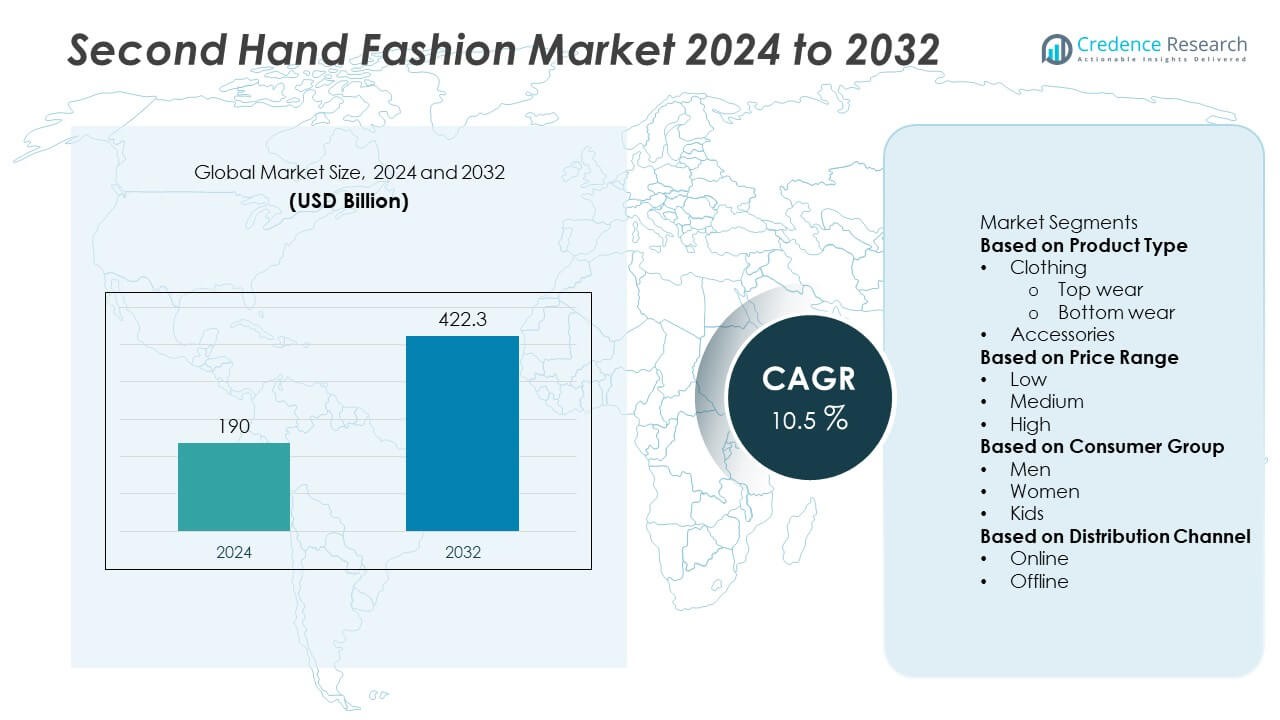
The Second-Hand Fashion Market was valued at USD 190 billion in 2024 and is projected to reach USD 422.3 billion by 2032, expanding at a CAGR of 10.5% during the forecast period.
| REPORT ATTRIBUTE | DETAILS |
|---|---|
| Historical Period | 2020-2024 |
| Base Year | 2024 |
| Forecast Period | 2025-2032 |
| Second-Hand Fashion Market Size 2024 | USD 190 Billion |
| Second-Hand Fashion Market, CAGR | 10.5% |
| Second-Hand Fashion Market Size 2032 | USD 422.3 Billion |
The Second-Hand Fashion Market grows through strong drivers such as rising consumer preference for sustainable apparel, increasing affordability concerns, and growing awareness of fashion’s environmental impact. It gains support from younger demographics, particularly millennials and Gen Z, who embrace pre-owned clothing as both a style choice and a conscious lifestyle decision.
The Second-Hand Fashion Market demonstrates diverse growth across global regions, shaped by consumer behavior, digital adoption, and cultural acceptance of resale practices. North America leads with established resale platforms and strong participation from Gen Z and millennials, while Europe emphasizes sustainability and circular economy initiatives supported by high demand for vintage and luxury resale. Asia-Pacific emerges as a dynamic region with rapid adoption of peer-to-peer platforms and strong consumer interest in authenticated designer goods, particularly in Japan and China. Latin America and the Middle East & Africa show steady momentum, with affordability and mobile-first commerce driving expansion in resale fashion. Key players shaping the market include eBay, a pioneer in online resale with global reach, Poshmark, known for community-driven fashion exchanges, The RealReal, specializing in authenticated luxury resale, and GoodwillFinds eCommerce, which leverages its nonprofit roots to expand access to affordable second-hand clothing and accessories.
Market Insights
- The Second-Hand Fashion Market was valued at USD 190 billion in 2024 and is projected to reach USD 422.3 billion by 2032, expanding at a CAGR of 10.5%.
- The market grows through drivers such as increasing sustainability awareness, rising affordability concerns, and strong adoption among millennials and Gen Z seeking eco-conscious and cost-effective fashion options.
- Key trends include the rapid growth of digital resale platforms, integration of authentication technologies to ensure product credibility, and expansion of luxury resale categories with strong demand for pre-owned designer items.
- Competitive intensity remains high, with major players such as eBay, Poshmark, Grailed, and Beyond Retro investing in digital platforms, social commerce features, and partnerships to enhance consumer engagement and market reach.
- The market faces restraints from counterfeit risks, inconsistent quality standards, and cultural barriers in emerging regions where new purchases remain preferred over pre-owned clothing.
- Regional dynamics show North America leading with established digital platforms, Europe emphasizing sustainability and circular economy practices, Asia-Pacific emerging as the fastest-growing region with mobile-first resale adoption, and Latin America along with the Middle East & Africa showing steady progress through affordability-driven demand.
- Growing collaborations between brands and resale platforms, along with consumer preference for circular fashion models, reinforce the market’s long-term potential while positioning resale as a central pillar of the future fashion industry.
Market Drivers
Rising Consumer Preference for Sustainable and Affordable Fashion
The Second-Hand Fashion Market grows strongly due to increasing consumer interest in sustainability and cost savings. Shoppers seek environmentally conscious alternatives to fast fashion, which accelerates demand for pre-owned clothing and accessories. It appeals to price-sensitive consumers who value branded products at lower prices. Younger demographics, particularly millennials and Gen Z, lead adoption through resale apps and online platforms. Growing awareness of fashion’s environmental footprint strengthens the shift toward second-hand choices. The emphasis on affordability and eco-consciousness positions resale fashion as a mainstream trend.
- For instance, ThredUp reported processing more than 172 million unique second-hand items in 2023 through its resale platform, preventing an estimated 2.2 billion pounds of CO₂ emissions from entering the atmosphere.
Expansion of Digital Platforms and Online Resale Marketplaces
The Second-Hand Fashion Market advances with the rapid growth of e-commerce platforms dedicated to resale. It benefits from online marketplaces that provide accessibility, convenience, and transparency in transactions. Mobile apps enable users to buy, sell, and authenticate pre-owned products with ease. Artificial intelligence tools improve product matching, pricing accuracy, and fraud detection, enhancing user trust. Social media integration supports community-driven resale and brand collaborations. The digital infrastructure accelerates growth by making resale fashion widely accessible across regions.
- For instance, Poshmark reported in 2024 that its community exceeded 150 million users globally, with more than 300 million items listed on its platform, reinforcing the scale and accessibility of digital resale networks.
Increased Brand Participation and Retailer Engagement in Resale Models
The Second-Hand Fashion Market strengthens as global fashion retailers and luxury brands enter the resale segment. It aligns with brand strategies to extend product lifecycles and meet sustainability commitments. Companies launch dedicated resale programs and collaborate with digital platforms to capture consumer demand. Retailers expand their revenue streams while enhancing customer loyalty through trade-in and buy-back schemes. Partnerships improve authenticity guarantees and increase trust in high-value second-hand goods. The involvement of established brands reinforces the credibility of resale fashion globally.
Shifting Lifestyle Trends and Growing Awareness of Circular Economy
The Second-Hand Fashion Market benefits from lifestyle changes that prioritize conscious consumption and minimalism. It gains traction as consumers embrace circular economy principles and reject wasteful fashion habits. Governments and non-profit organizations promote textile recycling and reuse, encouraging broader acceptance of second-hand products. Changing consumer values emphasize durability, uniqueness, and personal style over constant new purchases. The resale market also appeals to collectors seeking vintage and limited-edition pieces. This cultural shift underpins long-term adoption and positions resale as a central component of the modern fashion ecosystem.
Market Trends
Growing Integration of Technology and Authentication Tools
The Second-Hand Fashion Market evolves through the integration of artificial intelligence, blockchain, and RFID technologies to enhance product authenticity. It relies on advanced digital tools to track item origin, verify condition, and reduce counterfeit risks. AI-driven pricing solutions also improve market transparency and buyer confidence. Authentication services add value to luxury resale by ensuring trust in pre-owned designer goods. Retailers and platforms invest heavily in these technologies to strengthen consumer loyalty. The combination of technology and security measures accelerates growth in both online and offline resale channels.
- For instance, The RealReal employs more than 200 in-house gemologists, horologists, and luxury brand authenticators, and in 2023 authenticated over 28 million items, significantly strengthening consumer trust through technology-enabled processes.
Expansion of Luxury Resale and Premium Fashion Segments
The Second-Hand Fashion Market witnesses strong momentum in luxury resale as demand for high-end pre-owned items rises globally. It benefits from consumers who view second-hand luxury as a way to access premium products at lower costs. Major platforms establish dedicated luxury segments with strict authenticity standards. Designer handbags, shoes, and accessories lead the premium resale category. Retailers partner with brands to introduce certified pre-owned programs that add credibility. The rising acceptance of pre-owned luxury strengthens the value proposition of resale fashion.
- For instance, Vestiaire Collective reported in 2023 that it added more than 3 million new luxury listings in a single year, with over 23,000 designer brands represented, reflecting the rapid scale of premium resale demand worldwide.
Shift Toward Circular Economy and Sustainable Consumption Models
The Second-Hand Fashion Market grows with increasing alignment to circular economy practices that emphasize reuse and reduced waste. It supports sustainable consumption by extending product lifecycles and lowering textile waste generation. Governments and advocacy groups promote initiatives to recycle or repurpose fashion products. Retailers highlight resale as part of their environmental responsibility strategies. Consumer demand for sustainable choices drives retailers to integrate buy-back and trade-in programs. The trend positions resale fashion as a core component of global sustainability efforts.
Rising Popularity of Peer-to-Peer and Social Commerce Platforms
The Second-Hand Fashion Market expands with the popularity of peer-to-peer platforms and social commerce models. It enables individuals to sell directly to consumers, creating strong community-driven ecosystems. Social media platforms integrate resale features, allowing influencers and micro-sellers to reach niche audiences. The convenience of mobile apps supports rapid growth among younger demographics. Community engagement enhances brand trust and increases participation in resale ecosystems. This trend reflects a cultural shift where resale becomes not only a purchasing choice but also a lifestyle statement.
Market Challenges Analysis
Concerns Over Product Authenticity and Quality Control
The Second-Hand Fashion Market faces persistent challenges related to authenticity and product quality. Counterfeit goods remain a major concern, particularly in the luxury resale segment where high-value items attract fraudulent activities. It must invest in advanced authentication technologies and expert verification services to maintain consumer trust. Variability in product condition also reduces confidence among buyers, especially when purchasing online without physical inspection. Platforms and retailers struggle to standardize grading systems that define wear, durability, and usability. These issues highlight the need for consistent quality assurance mechanisms across the resale industry.
Regulatory Barriers and Limited Consumer Awareness in Emerging Regions
The Second-Hand Fashion Market encounters obstacles from inconsistent regulatory frameworks governing resale practices. Taxation policies, cross-border trade restrictions, and intellectual property concerns complicate operations for global platforms. It also struggles with limited awareness in developing markets where cultural preferences favor new purchases over pre-owned goods. Weak infrastructure for collection, sorting, and redistribution creates inefficiencies in scaling second-hand fashion. Logistics challenges further slow growth in regions with underdeveloped e-commerce ecosystems. Addressing regulatory clarity and consumer education remains essential for expanding resale penetration into untapped markets.
Market Opportunities
Expansion of Digital Platforms and Global Resale Ecosystems
The Second-Hand Fashion Market creates strong opportunities through the rapid expansion of digital platforms that connect buyers and sellers globally. It benefits from e-commerce integration, mobile apps, and AI-powered solutions that enhance accessibility and transparency. Cross-border trade opens access to diverse fashion inventories, strengthening demand in both developed and emerging markets. Social commerce models expand visibility by leveraging influencers and peer-to-peer networks. Established retailers collaborate with resale platforms to create hybrid ecosystems that enhance customer reach. The continued digitalization of resale processes positions the market for accelerated growth.
Growing Alignment with Sustainability and Circular Economy Initiatives
The Second-Hand Fashion Market gains opportunities from increasing alignment with sustainability goals and circular economy principles. It supports environmental strategies by extending product lifecycles and reducing textile waste. Governments and global organizations promote reuse initiatives, creating favorable conditions for resale adoption. Brands explore certified pre-owned programs that build consumer trust while enhancing loyalty. Rising demand for eco-conscious choices encourages investment in trade-in schemes and textile recycling. These initiatives strengthen the long-term outlook for resale fashion by aligning it with global sustainability priorities.
Market Segmentation Analysis:
By Product Type
The Second-Hand Fashion Market categorizes products into apparel, footwear, accessories, and luxury goods. Apparel remains the largest segment, driven by strong demand for branded clothing and the rising popularity of vintage and retro styles. It includes casual wear, formal wear, and outerwear, all of which find a broad customer base across demographics. Footwear records steady growth due to consumer interest in limited-edition sneakers and premium shoes that retain resale value. Accessories such as handbags, belts, and jewelry attract consumers seeking affordable luxury items. Luxury goods represent a high-growth segment, supported by rising trust in authentication services and increasing preference for sustainable consumption of designer products.
- For instance, StockX reported processing over 12 million transactions in 2023, with sneakers accounting for more than 70% of sales, reflecting the strong role of footwear in the resale ecosystem.
By Price Range
The Second-Hand Fashion Market divides offerings into low-range, mid-range, and premium segments. Low-range products appeal to price-conscious consumers, particularly in emerging markets where affordability drives adoption. Mid-range items attract mainstream buyers who seek both value and quality, with strong traction from branded apparel and footwear. Premium resale dominates in developed economies where authenticated luxury handbags, watches, and couture pieces command high demand. It benefits from platforms that specialize in certified pre-owned fashion, creating confidence for consumers investing in high-value items. Growth across price segments reflects the market’s ability to cater to diverse income groups while reinforcing sustainability goals.
- For instance, The RealReal reported that its average order value exceeded USD 500 in 2023, with luxury handbags from brands like Chanel and Louis Vuitton representing more than 40,000 authenticated items sold annually.
By Consumer Group
The Second-Hand Fashion Market segments consumers into men, women, and children, with women forming the largest group due to their high demand for clothing, footwear, and accessories. It gains significant traction among women who value variety, brand appeal, and affordability. Men’s participation in resale fashion is expanding, supported by rising interest in premium sneakers, casualwear, and streetwear brands. Children’s fashion also shows potential, with parents turning to resale platforms to purchase quality clothing at reduced prices, addressing both affordability and sustainability concerns. Growing involvement from younger demographics, particularly millennials and Gen Z, reinforces adoption across all consumer groups. Platforms and retailers increasingly target these segments with tailored marketing, curated collections, and technology-enabled shopping experiences.
Segments:
Based on Product Type
- Clothing
- Top wear
- Bottom wear
- Accessories
Based on Price Range
- Low
- Medium
- High
Based on Consumer Group
- Men
- Women
- Kids
Based on Distribution Channel
- Online
- Offline
Based on the Geography:
- North America
- U.S.
- Canada
- Mexico
- Europe
- UK
- France
- Germany
- Italy
- Spain
- Russia
- Belgium
- Netherlands
- Austria
- Sweden
- Poland
- Denmark
- Switzerland
- Rest of Europe
- Asia Pacific
- China
- Japan
- South Korea
- India
- Australia
- Thailand
- Indonesia
- Vietnam
- Malaysia
- Philippines
- Taiwan
- Rest of Asia Pacific
- Latin America
- Brazil
- Argentina
- Peru
- Chile
- Colombia
- Rest of Latin America
- Middle East
- UAE
- KSA
- Israel
- Turkey
- Iran
- Rest of Middle East
- Africa
- Egypt
- Nigeria
- Algeria
- Morocco
- Rest of Africa
Regional Analysis
North America
North America accounts for 35% of the Second-Hand Fashion Market in 2024, driven by a mature resale ecosystem and growing consumer awareness of sustainable fashion. The United States leads the region with established players such as ThredUp, Poshmark, and The RealReal, which provide extensive online resale networks. It benefits from high adoption among millennials and Gen Z, who embrace resale fashion as a mainstream shopping option. Canada supports growth with rising e-commerce penetration and growing interest in second-hand luxury items. The presence of authentication services boosts consumer trust in premium resale, particularly for luxury handbags and footwear. Strong digital infrastructure and widespread mobile app usage make North America a leader in resale innovation and technology adoption.
Europe
Europe holds 28% of the Second-Hand Fashion Market in 2024, supported by strong sustainability movements and regulatory initiatives promoting circular economy practices. Countries such as France, Germany, and the United Kingdom lead with high adoption of resale platforms and second-hand boutiques. It benefits from cultural acceptance of vintage fashion, reinforced by government-backed campaigns for textile recycling and waste reduction. The region also demonstrates strong growth in premium resale, with authenticated luxury goods experiencing high demand. Fashion-conscious consumers prioritize both affordability and sustainability, driving repeat usage of online marketplaces. Europe’s alignment with environmental policies and consumer activism sustains its position as one of the largest global markets for resale fashion.
Asia-Pacific
Asia-Pacific represents 22% of the Second-Hand Fashion Market in 2024, driven by a mix of affordability needs and growing sustainability awareness. China, Japan, and India play a central role in driving adoption, with consumers increasingly embracing pre-owned clothing and footwear. It benefits from strong growth in online retail and social commerce platforms that enable peer-to-peer resale. Japan demonstrates mature consumer acceptance of second-hand luxury, with stores specializing in authenticated designer products. India and Southeast Asia show rapid expansion, supported by young demographics, rising disposable incomes, and increasing awareness of sustainable consumption. Mobile-first shopping patterns strengthen resale penetration, positioning Asia-Pacific as the fastest-growing regional market.
Latin America
Latin America contributes 9% of the Second-Hand Fashion Market in 2024, with Brazil and Mexico leading adoption. It grows steadily as consumers seek affordable alternatives to fast fashion amid economic fluctuations. Local resale platforms expand rapidly, supported by strong social media usage and community-driven peer-to-peer sales. The region shows rising interest in children’s resale fashion, addressing affordability for families while promoting sustainability. Challenges remain in logistics and regulatory frameworks, but digital platforms help overcome infrastructure gaps. Latin America’s growing middle class and evolving consumer preferences create long-term potential for the resale industry.
Middle East & Africa
The Middle East and Africa account for 6% of the Second-Hand Fashion Market in 2024, supported by increasing digital adoption and gradual lifestyle shifts. The United Arab Emirates and Saudi Arabia lead in luxury resale, where authenticated premium goods attract strong demand from affluent consumers. South Africa and Nigeria highlight growth potential in affordable resale categories, driven by younger demographics. It faces challenges from cultural barriers that favor new purchases, yet shifting attitudes toward sustainability support gradual expansion. Online platforms gain traction as internet penetration and mobile commerce strengthen across the region. Long-term growth is expected through collaborations between global resale players and regional e-commerce providers.
Key Player Analysis
- Goodfair
- Buffalo Exchange
- Poshmark
- Grailed
- GoodwillFinds eCommerce
- 2nd Street USA
- Beyond Retro
- Chikatex
- eBay
- A&E Used Clothing
Competitive Analysis
The competitive landscape of the Second-Hand Fashion Market is defined by leading players such as eBay, Poshmark, Grailed, Goodfair, GoodwillFinds eCommerce, 2nd Street USA, Buffalo Exchange, Beyond Retro, Chikatex, and A&E Used Clothing, which drive growth through scale, digital innovation, and sustainability-focused strategies. Global platforms leverage large user bases, authentication services, and AI-driven personalization to strengthen consumer trust, while peer-to-peer models and social commerce enhance community engagement. Sustainability remains central, with companies promoting circular economy practices by extending product lifecycles and reducing textile waste, while vintage-focused retailers offer curated in-store experiences that attract younger consumers seeking individuality. Nonprofit-driven resale extends affordability and social impact online, and regional players diversify supply through bulk resale and emerging market penetration. Investments in mobile platforms, logistics optimization, and digital infrastructure improve customer accessibility, while collaborations with brands and influencers expand visibility and consumer appeal. Competitive intensity remains strong, with success dependent on balancing affordability, innovation, and sustainability to meet the evolving demand for stylish yet responsible pre-owned fashion worldwide.
Recent Developments
- In July 2025, Beyond Retro launched its largest upcycled collection to , using clothing diverted from landfill to craft the entire. This move highlights its leadership in sustainable vintage retail.
- In July 2025, Poshmark formed a partnership with Klarna, allowing U.S. consumers to quickly list eligible items on Poshmark from their purchase histories via Klarna-a streamlined path from purchase to resale.
- In April 2025, GoodwillFinds eCommerce shut down its online marketplace, ceasing order processing in March and redirecting users to ShopGoodwill.com for auction-style listings.
- In February 2025, Poshmark rolled out its Smart List AI, an AI-driven tool that creates product listings using sellers' photos, automating details like brand, style.
Report Coverage
The research report offers an in-depth analysis based on Product Type, Price Range, Consumer Group, Distribution Channel and Geography. It details leading market players, providing an overview of their business, product offerings, investments, revenue streams, and key applications. Additionally, the report includes insights into the competitive environment, SWOT analysis, current market trends, as well as the primary drivers and constraints. Furthermore, it discusses various factors that have driven market expansion in recent years. The report also explores market dynamics, regulatory scenarios, and technological advancements that are shaping the industry. It assesses the impact of external factors and global economic changes on market growth. Lastly, it provides strategic recommendations for new entrants and established companies to navigate the complexities of the market.
Future Outlook
- Global demand for sustainable apparel sustains growth in the resale sector.
- Technology enables improved authentication and transparency across platforms.
- Luxury resale expands further through certified pre-owned programs.
- Social commerce and peer-to-peer models drive community engagement and sales.
- Mobile and e-commerce platforms broaden access in emerging and underserved regions.
- Brand-supported resale initiatives integrate second-hand into retail strategies.
- AI tools enhance pricing accuracy, logistics efficiency, and personalized recommendations.
- Circular economy policies encourage increased resale and textile reuse.
- Partnerships between physical stores and online platforms boost omnichannel presence.
- Growth in men’s and children’s resale segments diversifies overall market participation.

Request a Free Sample
Fill in your details and we'll send you a free sample report.
- Sample data tables & charts
- Research methodology
Market Dynamics
Rising Consumer Preference for Sustainable and Affordable Fashion
Consumers, especially millennials and Gen Z, are increasingly seeking eco-friendly and cost-effective alternatives to fast fashion, driving demand for second-hand apparel and accessories. This shift is reinforced by growing awareness of fashion’s environmental impact and the appeal of branded products at lower prices.
Expansion of Digital Platforms and Online Resale Marketplaces
The proliferation of dedicated resale platforms and mobile apps has made buying and selling pre-owned fashion more accessible, convenient, and transparent. Enhanced digital infrastructure, AI-powered tools, and social commerce features are accelerating market growth and broadening participation across regions.
Increased Brand Participation and Retailer Engagement in Resale Models
Major fashion retailers and luxury brands are launching resale programs and collaborating with digital platforms to extend product lifecycles and meet sustainability commitments. These initiatives boost consumer trust, expand revenue streams, and reinforce the credibility of second-hand fashion.
Shift Toward Circular Economy and Sustainable Consumption
Changing consumer values favor conscious consumption, minimalism, and circular economy principles, leading to greater acceptance of resale and textile reuse. Government and NGO initiatives promoting recycling and sustainability further support the adoption of second-hand fashion.
Growing Integration of Technology and Authentication Tools
The use of AI, blockchain, and authentication services enhances product credibility and reduces counterfeit risks, particularly in the luxury segment. These technological advancements increase buyer confidence and support the expansion of premium resale categories.
Need a Custom Version of This Report?
Tailor the scope, geography, or segments to your exact requirements.
- Custom geography or segment scope
- Direct access to our analyst team
Frequently Asked Questions
What is the current market size for Second-Hand Fashion, and what is its projected size in 2032?
At what Compound Annual Growth Rate is the Second-Hand Fashion market projected to grow between 2025 and 2032?
Which Second-Hand Fashion market segment held the largest share in 2024?
What are the primary factors fueling the growth of the Second-Hand Fashion market?
Who are the leading companies in the Second-Hand Fashion market?
Which region commanded the largest share of the Second-Hand Fashion market in 2024?
Table of Content
Chapter 1 Market Segmentation
- 1.1 Segmentation Framework
- 1.1.1 Product and Service Classification
- 1.1.2 Application and End-Use Classification
- 1.1.3 Technology and Solution Classification
- 1.1.4 Customer and Distribution Channel Classification
- 1.1.5 Geographic Segmentation
- 1.1.6 Market Segment Definitions and Boundaries
- 1.2 By Price Range
- 1.2.1 Low
- 1.2.2 Medium
- 1.2.3 High
- 1.3 By Product Type
- 1.3.1 Clothing (Top wear, Bottom wear)
- 1.3.2 Footwear
- 1.3.3 Accessories
- 1.3.4 Luxury Goods
- 1.4 By Consumer Group
- 1.4.1 Men
- 1.4.2 Women
- 1.4.3 Kids
Chapter 2 Introduction
- 2.1 Report Objectives and Scope
- 2.2 Product Definition and Industry Terminology
- 2.3 Market Inclusions and Exclusions
- 2.4 Research Process
- 2.4.1 Primary Research and Expert Interviews
- 2.4.2 Secondary Research and Source Review
- 2.4.3 Top-Down and Bottom-Up Estimation
- 2.4.4 Data Triangulation and Verification
- 2.5 Market Size Measurement Basis
- 2.5.1 2024: USD 190 billion → 2032: USD 422.3 billion
- 2.6 Historical and Forecast Reference Periods
- 2.6.1 Base Year: 2024
- 2.6.2 Forecast Period: 2024-2032
- 2.7 Research Assumptions and Limitations
Chapter 3 Executive Summary
- 3.1 Market Snapshot and Key Findings
- 3.2 Base-Year Market Size, 2024
- 3.3 Forecast Market Size, 2032
- 3.4 Revenue and Volume Growth Outlook
- 3.5 Key Demand and Supply Indicators
- 3.6 Leading Market Segments
- 3.7 Fastest-Growing Market Opportunities
- 3.8 Regional Performance Highlights
- 3.9 Technology and Industry Transformation
- 3.10 Competitive Landscape Summary
- 3.11 Analyst View and Strategic Implications
Chapter 4 Global Second-Hand Fashion Market Trends and Developments
- 4.1 Historical Industry Development
- 4.2 Recent Market Trends and Developments
- 4.3 Demand and Customer Behavior Trends
- 4.4 Technology and Product Innovation
- 4.5 Artificial Intelligence, Automation and Digitalization
- 4.6 Local Manufacturing and Supply Chain Realignment
- 4.7 Industry Partnerships, Mergers and Acquisitions
- 4.8 Sustainability and Circular Economy Developments
- 4.9 Government and Private Sector Investment Trends
- 4.10 Emerging Business Models and Commercialization
- 4.11 Industry Developments and Announcements
Chapter 5 Global Second-Hand Fashion Market Production, Supply and Demand Analysis
- 5.1 Demand Trend and Consumption Analysis
- 5.2 Demand Forecast, 2024-2032
- 5.3 Production and Output Trend
- 5.4 Production and Output Forecast, 2024-2032
- 5.5 Installed Capacity and Capacity Utilization
- 5.6 Company-Wise Production Plants and Statistics
- 5.6.1 Installed Production Capacity
- 5.6.2 Actual Production
- 5.6.3 Planned Capacity and Expansion Targets
- 5.7 Supply Chain Structure and Procurement Trends
- 5.8 Supply-Demand Gap and Bottlenecks
- 5.9 Import Dependence and Sourcing Structure
- 5.10 Contract Manufacturing and Outsourcing
- 5.11 Regional Supply and Demand Concentration
Chapter 6 Global Second-Hand Fashion Market Pricing Analysis
- 6.1 Pricing Structure and Measurement
- 6.2 Historical Pricing Trends
- 6.3 Pricing Outlook, 2024-2032
- 6.4 Average Selling Price and Unit Economics
- 6.5 Pricing by Product and Market Segment
- 6.6 Geographic Pricing Differences
- 6.7 Key Input, Energy, Labor and Logistics Costs
- 6.8 Contract Pricing and Purchasing Models
- 6.9 Pricing Sensitivity and Competitive Positioning
- 6.10 Price, Margin and Profitability Implications
Chapter 7 Global Second-Hand Fashion Market Dynamics
- 7.1 Market Growth Drivers
- 7.1.1 Demand-Side Drivers
- 7.1.2 Technology and Innovation Drivers
- 7.1.3 Infrastructure and Investment Drivers
- 7.1.4 Regulatory and Policy Drivers
- 7.2 Market Restraints
- 7.2.1 Cost and Affordability Constraints
- 7.2.2 Technology and Adoption Barriers
- 7.2.3 Supply Chain and Operational Constraints
- 7.3 Market Challenges
- 7.3.1 Competitive Pressure and Margin Erosion
- 7.3.2 Skills, Infrastructure and Implementation Gaps
- 7.4 Emerging Market Opportunities
- 7.5 Market Dynamics Impact and Time-Horizon Assessment
Chapter 8 Global Second-Hand Fashion Value Chain Analysis
- 8.1 Industry Value Chain Overview
- 8.2 Upstream Suppliers and Critical Inputs
- 8.3 Technology and Component Providers
- 8.4 Manufacturing or Service Delivery
- 8.5 Distribution, Channel Partners and Integrators
- 8.6 Downstream Applications and End Users
- 8.7 Value Addition and Profit Pools
- 8.8 Vertical Integration and Outsourcing
- 8.9 Supplier Concentration and Risk
- 8.10 Supply Chain Localization and Resilience
Chapter 9 Global Second-Hand Fashion Market Regulations and Policies
- 9.1 Relevant Laws, Standards and Compliance Frameworks
- 9.2 Product, Service, Safety and Quality Requirements
- 9.3 Government Policies, Incentives and Subsidies
- 9.4 Imports, Exports and Trade Barriers
- 9.5 Public Procurement and Local Content Requirements
- 9.6 Environmental and Sustainability Compliance
- 9.7 Upcoming Policy Changes and Market Implications
Chapter 10 Global Second-Hand Fashion Market Hotspots and Opportunities
- 10.1 Market Opportunity Mapping and Growth Hotspots
- 10.2 High-Growth Applications and Customer Groups
- 10.3 Underserved Markets and White-Space Opportunities
- 10.4 Emerging Technology and Product Opportunities
- 10.5 New Capacity and Investment Hotspots
- 10.6 Market Entry and Expansion Opportunities
- 10.7 Distribution and Partnership Opportunities
- 10.8 Near-Term and Long-Term Commercial Potential
- 10.9 Opportunity Attractiveness and Execution Risks
Chapter 11 Global Second-Hand Fashion Market Outlook, 2024-2032
- 11.1 Market Size and Analysis
- 11.1.1 Revenue (Market Measurement: 2024: USD 190 billion → 2032: USD 422.3 billion)
- 11.1.2 Market Volume and Quantity Sold
- 11.1.3 Historical Market Size
- 11.1.4 Base-Year Market Size, 2024
- 11.2 Market Forecast, 2024-2032
- 11.2.1 Revenue Forecast to 2032
- 11.2.2 Volume Forecast to 2032
- 11.2.3 CAGR and Year-on-Year Growth
- 11.2.4 Incremental Revenue Opportunity
- 11.3 Forecast Assumptions and Scenario Analysis
- 11.3.1 Base-Case Forecast
- 11.3.2 Optimistic and Conservative Scenarios
- 11.3.3 Technology, Pricing and Policy Sensitivities
- 11.4 Market Attractiveness and Growth Outlook
Chapter 12 Global Second-Hand Fashion Market Segmentation and Outlook
- 12.1 Segmentation Summary and Market Shares, 2024
- 12.2 Largest and Fastest-Growing Segments
- 12.3 By Price Range - Market Size and Forecast, 2024-2032
- 12.3.1 Segment Definition and Scope
- 12.3.2 Historical Market Size
- 12.3.3 Revenue Forecast, 2024-2032
- 12.3.4 Volume Forecast, 2024-2032
- 12.3.5 Base-Year Market Share, 2024
- 12.3.6 Segment CAGR and Growth Drivers
- 12.3.7 Subsegment Market Size and Forecast
- 12.3.7.1 Low
- 12.3.7.2 Medium
- 12.3.7.3 High
- 12.3.8 Subsegment Pricing and Adoption Trends
- 12.3.9 Leading Suppliers and Competition
- 12.3.10 Regional Demand and Opportunities
- 12.4 By Product Type - Market Size and Forecast, 2024-2032
- 12.4.1 Segment Definition and Scope
- 12.4.2 Historical Market Size
- 12.4.3 Revenue Forecast, 2024-2032
- 12.4.4 Volume Forecast, 2024-2032
- 12.4.5 Base-Year Market Share, 2024
- 12.4.6 Segment CAGR and Growth Drivers
- 12.4.7 Subsegment Market Size and Forecast
- 12.4.7.1 Clothing (Top wear, Bottom wear)
- 12.4.7.2 Footwear
- 12.4.7.3 Accessories
- 12.4.7.4 Luxury Goods
- 12.4.8 Subsegment Pricing and Adoption Trends
- 12.4.9 Leading Suppliers and Competition
- 12.4.10 Regional Demand and Opportunities
- 12.5 By Consumer Group - Market Size and Forecast, 2024-2032
- 12.5.1 Segment Definition and Scope
- 12.5.2 Historical Market Size
- 12.5.3 Revenue Forecast, 2024-2032
- 12.5.4 Volume Forecast, 2024-2032
- 12.5.5 Base-Year Market Share, 2024
- 12.5.6 Segment CAGR and Growth Drivers
- 12.5.7 Subsegment Market Size and Forecast
- 12.5.7.1 Men
- 12.5.7.2 Women
- 12.5.7.3 Kids
- 12.5.8 Subsegment Pricing and Adoption Trends
- 12.5.9 Leading Suppliers and Competition
- 12.5.10 Regional Demand and Opportunities
- 12.6 Segment Growth Comparison
- 12.7 Segment Attractiveness and Priority Matrix
Chapter 13 Global Second-Hand Fashion Geographic Market Outlook, 2024-2032
- 13.1 Regional Market Size and Share, 2024
- 13.2 Regional Market Forecast, 2024-2032
- 13.3 Regional Pricing, Production and Demand Differences
- 13.4 North America
- 13.4.1 United States
- 13.4.2 Canada
- 13.4.3 Mexico
- 13.5 Europe
- 13.5.1 Germany
- 13.5.2 France
- 13.5.3 Italy
- 13.5.4 United Kingdom
- 13.5.5 Spain
- 13.5.6 Poland
- 13.5.7 Russia
- 13.5.8 Netherlands
- 13.5.9 Belgium
- 13.5.10 Sweden
- 13.5.11 Denmark
- 13.5.12 Norway
- 13.5.13 Rest of Europe
- 13.6 Asia Pacific
- 13.6.1 China
- 13.6.2 India
- 13.6.3 Japan
- 13.6.4 South Korea
- 13.6.5 Thailand
- 13.6.6 Indonesia
- 13.6.7 Vietnam
- 13.6.8 Malaysia
- 13.6.9 Australia
- 13.6.10 Rest of Asia Pacific
- 13.7 Latin America
- 13.7.1 Brazil
- 13.7.2 Argentina
- 13.7.3 Colombia
- 13.7.4 Chile
- 13.7.5 Rest of Latin America
- 13.8 Middle East
- 13.8.1 Saudi Arabia
- 13.8.2 United Arab Emirates
- 13.8.3 Turkey
- 13.8.4 Israel
- 13.8.5 Iran
- 13.8.6 Rest of the Middle East
- 13.9 Africa
- 13.9.1 South Africa
- 13.9.2 Egypt
- 13.9.3 Nigeria
- 13.9.4 Morocco
- 13.9.5 Rest of Africa
- 13.10 Regional Investment, Policy and Supply Chain Differences
- 13.11 Regional Competitive Landscape
- 13.12 Geographic Growth Hotspots
Chapter 14 Global Second-Hand Fashion Technology, Innovation and Sustainability Outlook
- 14.1 Technology Landscape and Maturity
- 14.2 Product, Process and Service Innovation
- 14.3 AI, Automation and Digital Tools in the Industry
- 14.4 Technology Adoption and Performance Benchmarking
- 14.5 Innovation Pipeline and R&D Investment
- 14.6 Patent and Intellectual Property Trends
- 14.7 Energy Efficiency and Resource Management
- 14.8 Sustainability, Recycling and Circularity
- 14.9 Technology Roadmap, 2024-2032
- 14.10 Risks of Obsolescence and Technology Substitution
Chapter 15 Global Second-Hand Fashion Market Key Strategic Imperatives
- 15.1 Growth and Market Entry Priorities
- 15.2 High-Return Products and Segments
- 15.3 Pricing, Profitability and Cost Optimization
- 15.4 Technology Investment and Product Differentiation
- 15.5 Supply Chain Localization and Resilience
- 15.6 Distribution and Customer Acquisition
- 15.7 Partnership, Acquisition and Capacity Strategy
- 15.8 Regional Expansion Priorities
- 15.9 Short-, Medium- and Long-Term Actions
Chapter 16 Competition Outlook
- 16.1 Industry Competition Characteristics
- 16.2 Market Structure and Concentration
- 16.3 Market Share and Competitive Positioning, 2024
- 16.4 Company-Wise Revenue and Product Benchmarking
- 16.5 Production and Service Capacity Benchmarking
- 16.6 Technology, Pricing and Differentiation
- 16.7 Regional Footprint and Distribution Strength
- 16.8 Mergers, Acquisitions and Strategic Alliances
- 16.9 New Entrants and Competitive Threats
- 16.10 Porter's Five Forces and Industry Attractiveness
- 16.11 Competitive Outlook, 2024-2032
Chapter 17 Company Profiles
- 17.1 Company Coverage and Selection Criteria
- 17.2 eBay
- 17.2.1 Business Description
- 17.2.2 Company Ownership and Geographic Presence
- 17.2.3 Product and Service Portfolio
- 17.2.4 Manufacturing and Operating Footprint
- 17.2.5 Production Capacity and Expansion Plans
- 17.2.6 Financial Performance and Investment
- 17.2.7 Market Share and Competitive Position
- 17.2.8 Technology and Innovation Capabilities
- 17.2.9 Strategic Alliances or Partnerships
- 17.2.10 Recent Developments
- 17.2.11 Growth Strategy and Outlook
- 17.3 Poshmark
- 17.4 The RealReal
- 17.5 ThredUp
- 17.6 GoodwillFinds eCommerce
- 17.7 Grailed
- 17.8 Beyond Retro
- 17.9 Buffalo Exchange
- 17.10 2nd Street USA
- 17.11 Vestiaire Collective
- 17.12 Other Relevant Market Participants
Note: Every listed company is profiled on the structure shown under the first company. The company list is preliminary and may change based on research findings, market developments, data availability and client requirements.
Chapter 18 Disclaimer
- 18.1 Research and Forecast Disclaimer
- 18.2 Data Source and Estimation Limitations
Note: The depth of individual sections depends on data availability for this market. Volume, capacity, trade and other unit-based metrics are included where applicable.

