Market Overview:
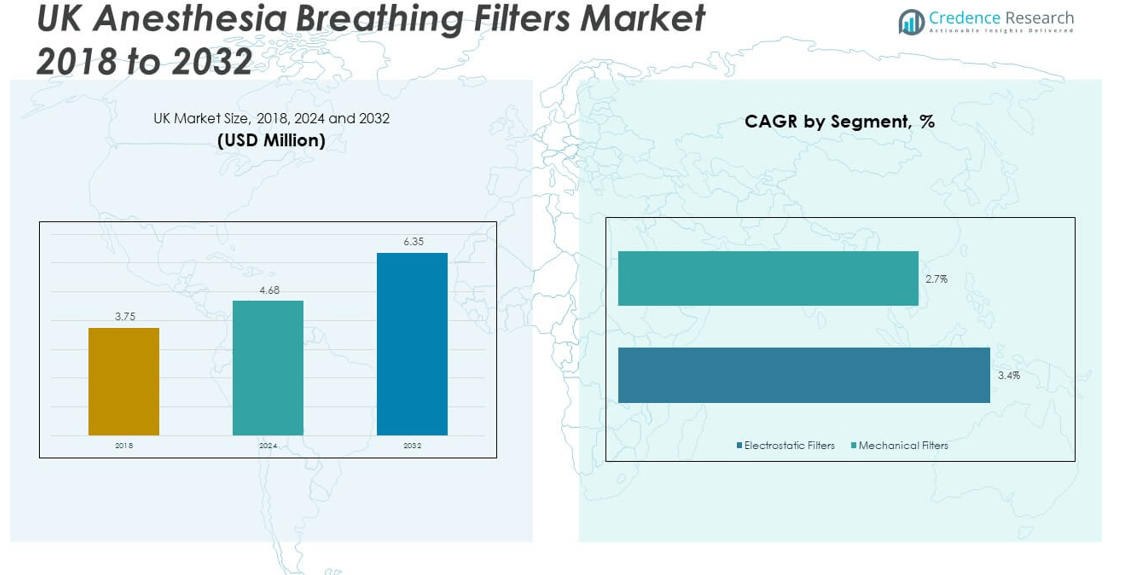
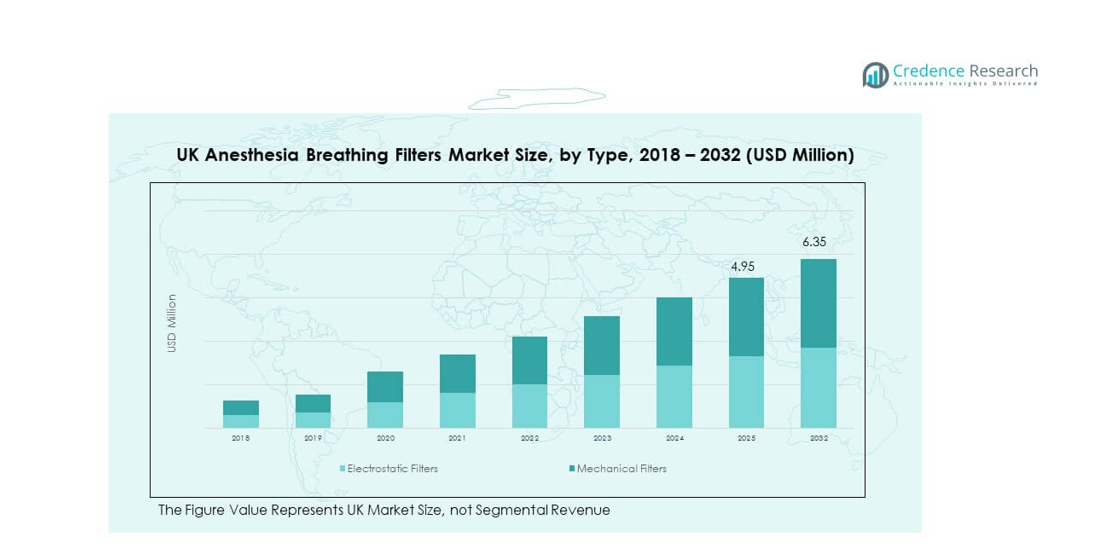
The UK Anesthesia Breathing Filters Market size was valued at USD 3.75 million in 2018 to USD 4.68 million in 2024 and is anticipated to reach USD 6.35 million by 2032, at a CAGR of 3.60% during the forecast period.
| REPORT ATTRIBUTE | DETAILS |
|---|---|
| Historical Period | 2020-2023 |
| Base Year | 2024 |
| Forecast Period | 2025-2032 |
| UK Anesthesia Breathing Filters Market Size 2024 | USD 4.68 million |
| UK Anesthesia Breathing Filters Market, CAGR | 3.60% |
| UK Anesthesia Breathing Filters Market Size 2032 | USD 6.35 million |
Growth in the market is driven by a combination of factors including the rising prevalence of respiratory disorders, greater awareness of infection control, and the demand for single-use medical consumables. Hospitals and clinics prioritize reliable filters to enhance patient safety, reduce cross-contamination, and comply with strict regulatory frameworks. Technological innovations in filter design, alongside healthcare investments, also support sustained adoption of high-performance products across different patient groups.
From a regional perspective, Europe remains the leading market due to its advanced healthcare infrastructure and high surgical volumes, with the UK playing a significant role in driving adoption. North America follows closely, supported by strong regulatory standards and demand for advanced medical devices. Asia Pacific emerges as a fast-growing market as healthcare access improves and surgical procedures rise in countries with expanding healthcare infrastructure. Latin America, the Middle East, and Africa show gradual growth, largely driven by investments in modern hospital facilities and rising awareness of infection control measures.
Market Insights:
- The UK Anesthesia Breathing Filters Market was USD 3.75 million in 2018, reached USD 4.68 million in 2024, and is projected to hit USD 6.35 million by 2032, growing at a CAGR of 3.60%.
- Europe led with 40% share in 2024 due to advanced healthcare infrastructure, followed by North America at 30% supported by strict infection control protocols, and Asia Pacific at 20% fueled by rising healthcare access.
- Asia Pacific is the fastest-growing region with 20% share, driven by expanding surgical procedures, increasing medical tourism, and investments in hospital modernization.
- Electrostatic filters held the largest segment share at around 62% in 2024, reflecting their high efficiency in blocking bacteria and viruses.
- Mechanical filters accounted for about 38% in 2024, serving hospitals that prioritize durable and cost-effective solutions in anesthesia delivery.
Market Drivers:
Rising Surgical Procedures and Hospital Admissions:
The UK Anesthesia Breathing Filters Market benefits from the steady rise in surgeries. An increase in aging populations with chronic conditions drives surgical demand. Hospitals invest in anesthesia breathing filters to improve safety and reduce infection risks. It ensures that operating rooms maintain strict compliance with infection control standards. Healthcare facilities prioritize reliable filters for patient well-being. The growth in ambulatory surgical centers further enhances usage rates. An expanding base of trained anesthesiologists encourages wider product application. This dynamic strengthens consistent market demand across healthcare facilities.
- For instance, official NHS England data, not the Royal College of Surgeons, confirmed the elective waiting list was 7.36 million patient pathways in June 2025. This figure is part of ongoing efforts by the NHS to reduce waiting times, following a recent rise in the backlog after several months of decline. However, the 18-week waiting time target for elective treatment has not been consistently met for nearly a decade.
Growing Burden of Respiratory and Infectious Diseases:
The rising incidence of respiratory disorders is a major driver for the UK Anesthesia Breathing Filters Market. Chronic illnesses such as asthma, COPD, and bronchitis demand effective ventilation support during anesthesia. Patients with weak respiratory systems are more vulnerable to infections during surgery. Breathing filters play a key role in reducing microbial transmission. Hospitals adopt advanced filter designs to prevent complications. Healthcare authorities emphasize infection control as a mandatory requirement. With respiratory diseases increasing, healthcare systems prioritize robust filtration. The trend firmly strengthens demand for anesthesia breathing filters.
- For instance, Hospital admissions for chronic lower respiratory diseases have increased significantly in England and Wales, with verified data showing a 57.5% rise in admission rates from 1999 to 2020, particularly impacting the elderly population. COPD and asthma are major contributors to these admissions.
Strong Emphasis on Infection Control Protocols:
The UK Anesthesia Breathing Filters Market is supported by strict infection control guidelines. Healthcare systems prioritize measures that reduce hospital-acquired infections. Filters block pathogens and prevent contamination between patients and equipment. It supports clinical compliance across operating theaters. Regulatory bodies stress safe practices in anesthesia delivery. Hospitals and clinics must adhere to sterilization and hygiene protocols. This creates sustained demand for disposable and high-efficiency filters. The healthcare industry’s commitment to safety strengthens continuous adoption of breathing filters.
Advancements in Filter Technology:
Technological progress drives adoption in the UK Anesthesia Breathing Filters Market. Manufacturers introduce filters with improved bacterial and viral filtration efficiency. Compact and ergonomic designs support ease of use in surgical environments. Disposable filter models ensure high safety standards with reduced risk of reuse. Integration with ventilators enhances performance in critical care settings. The rise of single-use medical supplies boosts innovation. Filter technology also focuses on patient comfort and low breathing resistance. This emphasis on advancement fuels demand across hospitals and clinics.
Market Trends:
Shift Toward Disposable Filters:
The UK Anesthesia Breathing Filters Market shows a trend toward disposable solutions. Hospitals prefer single-use filters to eliminate cross-contamination risks. It aligns with strict hygiene policies in modern healthcare. Disposable products reduce maintenance and sterilization needs. The convenience of immediate replacement encourages wider adoption. Manufacturers focus on eco-friendly disposables to match sustainability goals. Demand for quick-turnover surgical environments strengthens this trend. Disposable filters dominate usage patterns in UK healthcare systems.
- For instance, Infection control guidelines for NHS and UK hospitals emphasize the use of effective breathing filters during anesthesia to prevent cross-contamination, supported by national evidence-based guidelines developed by clinical specialists and infection control researchers.
Growing Integration with Advanced Anesthesia Machines:
The UK Anesthesia Breathing Filters Market trends toward integration with advanced anesthesia machines. Modern systems require compatible filters for optimized performance. Healthcare facilities upgrade their equipment to match new standards. Filters designed for seamless machine integration are in demand. Companies innovate with low-resistance and high-efficiency designs. It enhances patient comfort during surgical procedures. Integration supports reduced operating costs for hospitals. This trend strengthens filter adoption across surgical settings.
- For instance, UK hospital practice favors disposable anesthesia breathing filters to reduce infection risks and ensure compliance with strict hygiene protocols, verified by studies on anesthesia breathing system reuse policies and NHS recommendations.
Rising Demand in Ambulatory Surgical Centers:
Ambulatory centers drive new adoption trends in the UK Anesthesia Breathing Filters Market. Shorter recovery times and increased outpatient surgeries expand filter needs. Filters support infection control in day-care surgical units. Growth of minimally invasive procedures encourages consistent filter usage. It ensures patient safety outside traditional hospitals. Lower cost and faster turnover increase the role of ambulatory facilities. Manufacturers target this segment with compact and easy-to-use designs. The trend supports wider penetration of breathing filters.
Sustainability and Eco-Friendly Product Innovations:
The UK Anesthesia Breathing Filters Market is impacted by sustainability trends. Healthcare systems focus on reducing medical waste. Manufacturers design filters with biodegradable or recyclable components. Hospitals aim to balance hygiene and environmental responsibility. Regulatory frameworks encourage sustainable procurement. Innovation in eco-friendly disposables aligns with these goals. Companies gain competitive advantage through green product strategies. It ensures compliance with evolving procurement standards. Sustainability drives future adoption across UK healthcare.
Market Challenges Analysis:
High Costs and Procurement Constraints:
The UK Anesthesia Breathing Filters Market faces cost challenges for hospitals and clinics. Disposable filters increase recurring procurement expenses. Smaller healthcare facilities struggle with budget allocation. Rising raw material costs further pressure manufacturers. Fluctuations in supply chain dynamics create uncertainty. Hospitals face difficulty balancing affordability with safety. It limits adoption in resource-constrained settings. Price sensitivity remains a challenge for long-term growth.
Regulatory and Waste Management Issues:
The UK Anesthesia Breathing Filters Market experiences challenges from regulatory compliance. Strict safety standards require constant innovation from manufacturers. Hospitals must manage high volumes of disposable waste. Waste disposal adds costs and environmental pressure. Compliance with healthcare safety rules increases operational burden. Companies must ensure certifications for filter efficiency. Failure to meet regulatory standards limits market access. It challenges sustained product supply and adoption rates.
Market Opportunities:
Expansion of Ambulatory and Outpatient Facilities:
The UK Anesthesia Breathing Filters Market holds opportunities in ambulatory growth. Day-care surgical facilities expand across the UK. Filters meet infection control needs in short-stay operations. Manufacturers develop lightweight and cost-efficient models. Hospitals benefit from improved surgical turnover. Outpatient surgery growth ensures broader adoption of filters. Targeting this sector creates strong revenue opportunities. It strengthens future market presence for suppliers.
Increasing Focus on Technological Upgrades:
The UK Anesthesia Breathing Filters Market offers opportunities in advanced technology. Manufacturers can focus on smart filters with monitoring capabilities. Innovations in low-resistance designs enhance patient comfort. Eco-friendly filters appeal to sustainability-driven hospitals. Digital integration with anesthesia machines increases efficiency. Hospitals seek solutions that balance safety and cost. Companies focusing on R&D gain competitive advantage. Technology-centered strategies shape future expansion.
Market Segmentation Analysis:
Type Segment
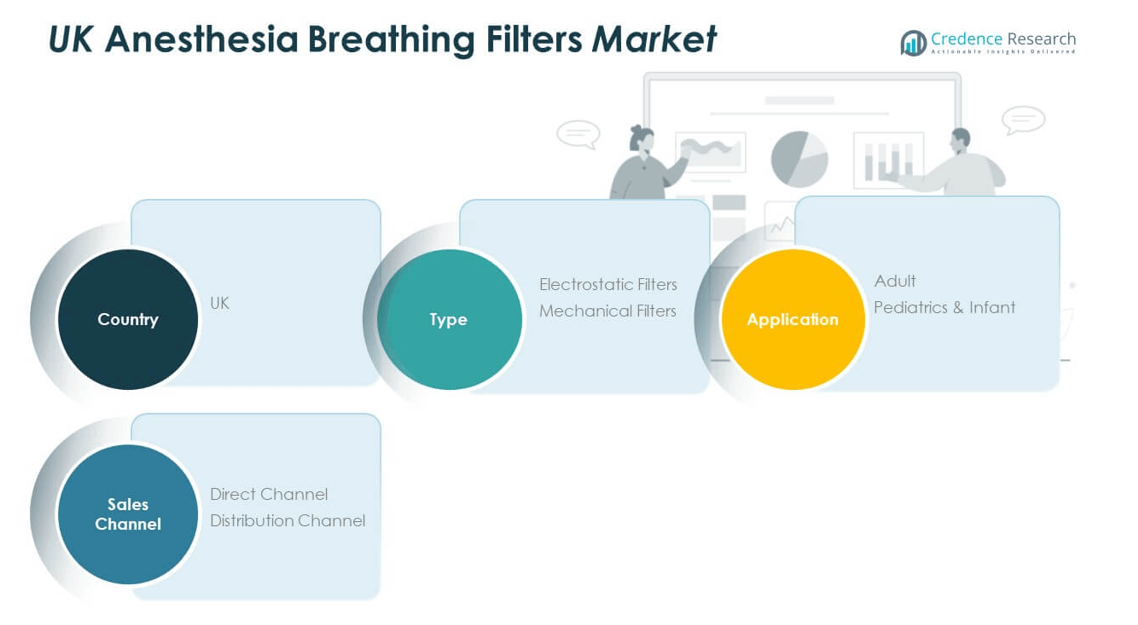
The UK Anesthesia Breathing Filters Market by type includes electrostatic and mechanical filters. Electrostatic filters dominate adoption due to strong viral and bacterial filtration performance. Mechanical filters remain relevant in specialized hospital environments where durability is valued.
- For instance, Integration of advanced anesthesia machines with compatible breathing filters is verified by descriptions of modern anesthesia workstations with automated controls used in UK hospitals, supporting improved surgical outcomes.
Application Segment
The market is segmented into adult and pediatric & infant applications. Adult patients form the largest segment owing to the higher frequency of surgical procedures in this group. Pediatric and infant segments expand steadily due to specialized neonatal care units.
- For instance, the efficacy of electrostatic versus mechanical filters is documented. Pleated hydrophobic mechanical filters are proven to have superior fluid resistance and, critically, maintain or exceed the viral and bacterial filtration efficiency of electrostatic filters, especially in humid conditions, which has been verified by numerous published studies on filter performance. While electrostatic filters are also used for viral and bacterial filtration, their efficiency can be significantly compromised by moisture.
Sales Channel Segment
Sales channels include direct and distributor-led models. Direct channels dominate as hospitals prefer long-term agreements with suppliers. Distributor networks still play a key role for smaller facilities and ambulatory centers. The structure supports balanced supply in the market.
Segmentation:
By Type
- Electrostatic Filters
- Mechanical Filters
By Application
- Adult
- Pediatrics & Infant
By Sales Channel
- Direct Channel
- Sales Channel
By Country
- UK-specific analysis
Regional Analysis:
England
The UK Anesthesia Breathing Filters Market is led by England, which accounted for nearly 65% of the market share in 2024. Strong demand is supported by advanced healthcare infrastructure, higher surgical volumes, and centralized NHS procurement. London, Manchester, and Birmingham drive major adoption through specialized hospitals and teaching centers. The shift toward disposable filters aligns with strict infection control standards. Private healthcare providers strengthen demand by preferring high-efficiency consumables. England’s continued investment in modernizing hospital facilities reinforces its dominant position. It remains the largest contributor to the market due to scale and clinical focus.
Scotland
Scotland represents around 20% of the UK Anesthesia Breathing Filters Market in 2024, driven by a strong emphasis on infection prevention and centralized NHS Scotland policies. Hospitals in Glasgow, Edinburgh, and Aberdeen account for the majority of usage. Investment in surgical facilities and expansion of specialist units fuel adoption. Disposable filters are widely used in operating theaters to meet safety requirements. Smaller rural hospitals adopt filters at a slower pace due to limited budgets, but government programs are improving accessibility. Scotland’s share reflects stable and policy-driven demand. It remains an important regional contributor with steady growth momentum.
Wales and Northern Ireland
Wales contributes roughly 10%, while Northern Ireland holds about 5% of the UK Anesthesia Breathing Filters Market in 2024. Cardiff and Swansea are the main centers of demand in Wales, supported by NHS Wales initiatives on infection control. Northern Ireland’s adoption is led by Belfast hospitals, where surgical activity is highest. Smaller hospitals in both regions face procurement challenges, slowing penetration in rural areas. Public healthcare initiatives are gradually expanding disposable filter access. Together, these regions reflect smaller but significant shares in the national market. It highlights untapped opportunities for suppliers offering cost-effective solutions and localized support.
Key Player Analysis:
- ICU Medical
- Philips Respironics
- A-M Systems
- Mercury Medical
- Armstrong Medical
- Winnomed
- Sunmed
- Vitalograph
- Cytiva (Pall)
- GE Healthcare
- AirLife (SunMed)
- Medtronic
- Teleflex
Competitive Analysis:
The UK Anesthesia Breathing Filters Market features a competitive environment shaped by global and regional players. ICU Medical, Philips Respironics, and Medtronic hold strong positions with wide product portfolios and distribution networks. Regional companies like Armstrong Medical strengthen domestic supply. Firms compete through innovation in disposable filters, infection control solutions, and integration with anesthesia machines. It remains a moderately fragmented market, with leading companies focusing on R&D and sustainability to gain competitive advantage. Strategic partnerships and acquisitions help players expand presence across the UK healthcare sector.
Recent Developments:
- In April 2025, ICU Medical introduced a new category of precision IV pumps with the FDA clearance of its Plum Solo precision IV pump, a single-channel complement to the dual-channel Plum Duo. The updated Plum Duo pump and LifeShield infusion safety software also received clearance, completing the initial launch of the ICU Medical IV Performance Platform. These precision IV pumps provide ±3% accuracy in real-world conditions and address infusion delivery variability, offering reliable infusion documentation for clinicians.
- In June 2025, Philips Respironics expanded its longstanding partnership with Medtronic through a new multi-year agreement aimed at enhancing access to advanced patient monitoring technologies. The collaboration integrates Medtronic’s monitoring brands into Philips' systems and bundles essential consumables with the monitors to streamline procurement for healthcare providers, with an initial focus on the North American market and plans for global expansion.
- In March 2025, AMD completed the acquisition of ZT Systems, a leading provider of AI and compute infrastructure, aiming to accelerate the deployment of AMD-powered AI systems at scale.
- In June 2025, Mercury Medical partnered exclusively with Flat Medical to distribute the EpiFaith Smart Syringe in the U.S. anesthesia market. This innovative syringe provides an objective visual indicator for epidural space identification, thereby enhancing safety and accuracy during epidural procedures. Mercury Medical leverages its nationwide sales network to bring this safety technology to clinicians.
Report Coverage:
The research report offers an in-depth analysis based on product type, application, and sales channel. It details leading market players, providing an overview of their business, product offerings, investments, revenue streams, and key applications. Additionally, the report includes insights into the competitive environment, SWOT analysis, current market trends, as well as the primary drivers and constraints. Furthermore, it discusses various factors that have driven market expansion in recent years. The report also explores market dynamics, regulatory scenarios, and technological advancements that are shaping the industry. It assesses the impact of external factors and global economic changes on market growth. Lastly, it provides strategic recommendations for new entrants and established companies to navigate the complexities of the market.
Future Outlook:
- Rising demand from aging populations.
- Strong focus on infection prevention.
- Increased adoption of disposable filters.
- Higher investments in hospital infrastructure.
- Growing outpatient surgical facilities.
- Technological advancements in filter design.
- Sustainability-driven procurement preferences.
- Strong competition among domestic and global players.
- Expansion of pediatric and neonatal care.
- Consistent role of regulatory compliance in shaping adoption.

Request a Free Sample
Fill in your details and we'll send you a free sample report.
- Sample data tables & charts
- Research methodology
Market Dynamics
Rising Surgical Procedures and Hospital Admissions
The increasing number of surgeries and hospital admissions in the UK, particularly among aging populations with chronic conditions, is driving demand for anesthesia breathing filters to ensure patient safety and infection control in operating rooms.
Growing Burden of Respiratory and Infectious Diseases
A higher incidence of respiratory disorders such as asthma and COPD increases the need for effective filtration during anesthesia, as these patients are more vulnerable to infections and complications during surgical procedures.
Strong Emphasis on Infection Control Protocols
Strict regulatory guidelines and hospital policies in the UK require the use of high-efficiency breathing filters to prevent cross-contamination and hospital-acquired infections, supporting consistent market growth.
Advancements in Filter Technology
Ongoing innovations in filter design, including improved bacterial and viral filtration efficiency and integration with modern anesthesia machines, are encouraging healthcare providers to upgrade to newer, high-performance products.
Shift Toward Disposable and Eco-Friendly Filters
The trend toward single-use, disposable filters is driven by the need to eliminate cross-contamination risks and align with sustainability goals, leading to increased adoption in both hospitals and ambulatory surgical centers.
Need a Custom Version of This Report?
Tailor the scope, geography, or segments to your exact requirements.
- Custom geography or segment scope
- Direct access to our analyst team
Frequently Asked Questions
What is the current market size for UK Anesthesia Breathing Filters Market, and what is its projected size in 2032?
At what Compound Annual Growth Rate is the UK Anesthesia Breathing Filters Market projected to grow between 2025 and 2032?
What are the primary factors fueling the growth of the UK Anesthesia Breathing Filters Market?
Who are the leading companies in the UK Anesthesia Breathing Filters Market?
Table of Content
Chapter 1 Market Segmentation
- 1.1 Segmentation Framework
- 1.1.1 Product and Service Classification
- 1.1.2 Application and End-Use Classification
- 1.1.3 Technology and Solution Classification
- 1.1.4 Customer and Distribution Channel Classification
- 1.1.5 Geographic Segmentation
- 1.1.6 Market Segment Definitions and Boundaries
- 1.2 By Type
- 1.2.1 Electrostatic Filters
- 1.2.2 Mechanical Filters
- 1.3 By Application
- 1.3.1 Adult
- 1.3.2 Pediatrics & Infant
- 1.4 By Region (UK)
- 1.4.1 England
- 1.4.2 Scotland
- 1.4.3 Wales
- 1.4.4 Northern Ireland
- 1.5 By Sales Channel
- 1.5.1 Direct Channel
- 1.5.2 Distributor Channel
Chapter 2 Introduction
- 2.1 Report Objectives and Scope
- 2.2 Product Definition and Industry Terminology
- 2.3 Market Inclusions and Exclusions
- 2.4 Research Process
- 2.4.1 Primary Research and Expert Interviews
- 2.4.2 Secondary Research and Source Review
- 2.4.3 Top-Down and Bottom-Up Estimation
- 2.4.4 Data Triangulation and Verification
- 2.5 Market Size Measurement Basis
- 2.5.1 2018: USD 3.75 million → 2032: USD 6.35 million
- 2.6 Historical and Forecast Reference Periods
- 2.6.1 Base Year: 2018
- 2.6.2 Forecast Period: 2018-2032
- 2.7 Research Assumptions and Limitations
Chapter 3 Executive Summary
- 3.1 Market Snapshot and Key Findings
- 3.2 Base-Year Market Size, 2018
- 3.3 Forecast Market Size, 2032
- 3.4 Revenue and Volume Growth Outlook
- 3.5 Key Demand and Supply Indicators
- 3.6 Leading Market Segments
- 3.7 Fastest-Growing Market Opportunities
- 3.8 Regional Performance Highlights
- 3.9 Technology and Industry Transformation
- 3.10 Competitive Landscape Summary
- 3.11 Analyst View and Strategic Implications
Chapter 4 UK Anesthesia Breathing Filters Market Trends and Developments
- 4.1 Historical Industry Development
- 4.2 Recent Market Trends and Developments
- 4.3 Demand and Customer Behavior Trends
- 4.4 Technology and Product Innovation
- 4.5 Artificial Intelligence, Automation and Digitalization
- 4.6 Local Manufacturing and Supply Chain Realignment
- 4.7 Industry Partnerships, Mergers and Acquisitions
- 4.8 Sustainability and Circular Economy Developments
- 4.9 Government and Private Sector Investment Trends
- 4.10 Emerging Business Models and Commercialization
- 4.11 Industry Developments and Announcements
Chapter 5 UK Anesthesia Breathing Filters Market Production, Supply and Demand Analysis
- 5.1 Demand Trend and Consumption Analysis
- 5.2 Demand Forecast, 2018-2032
- 5.3 Production and Output Trend
- 5.4 Production and Output Forecast, 2018-2032
- 5.5 Installed Capacity and Capacity Utilization
- 5.6 Company-Wise Production Plants and Statistics
- 5.6.1 Installed Production Capacity
- 5.6.2 Actual Production
- 5.6.3 Planned Capacity and Expansion Targets
- 5.7 Supply Chain Structure and Procurement Trends
- 5.8 Supply-Demand Gap and Bottlenecks
- 5.9 Import Dependence and Sourcing Structure
- 5.10 Contract Manufacturing and Outsourcing
- 5.11 Regional Supply and Demand Concentration
Chapter 6 UK Anesthesia Breathing Filters Market Pricing Analysis
- 6.1 Pricing Structure and Measurement
- 6.2 Historical Pricing Trends
- 6.3 Pricing Outlook, 2018-2032
- 6.4 Average Selling Price and Unit Economics
- 6.5 Pricing by Product and Market Segment
- 6.6 Geographic Pricing Differences
- 6.7 Key Input, Energy, Labor and Logistics Costs
- 6.8 Contract Pricing and Purchasing Models
- 6.9 Pricing Sensitivity and Competitive Positioning
- 6.10 Price, Margin and Profitability Implications
Chapter 7 UK Anesthesia Breathing Filters Market Dynamics
- 7.1 Market Growth Drivers
- 7.1.1 Demand-Side Drivers
- 7.1.2 Technology and Innovation Drivers
- 7.1.3 Infrastructure and Investment Drivers
- 7.1.4 Regulatory and Policy Drivers
- 7.2 Market Restraints
- 7.2.1 Cost and Affordability Constraints
- 7.2.2 Technology and Adoption Barriers
- 7.2.3 Supply Chain and Operational Constraints
- 7.3 Market Challenges
- 7.3.1 Competitive Pressure and Margin Erosion
- 7.3.2 Skills, Infrastructure and Implementation Gaps
- 7.4 Emerging Market Opportunities
- 7.5 Market Dynamics Impact and Time-Horizon Assessment
Chapter 8 UK Anesthesia Breathing Filters Value Chain Analysis
- 8.1 Industry Value Chain Overview
- 8.2 Upstream Suppliers and Critical Inputs
- 8.3 Technology and Component Providers
- 8.4 Manufacturing or Service Delivery
- 8.5 Distribution, Channel Partners and Integrators
- 8.6 Downstream Applications and End Users
- 8.7 Value Addition and Profit Pools
- 8.8 Vertical Integration and Outsourcing
- 8.9 Supplier Concentration and Risk
- 8.10 Supply Chain Localization and Resilience
Chapter 9 UK Anesthesia Breathing Filters Market Regulations and Policies
- 9.1 Relevant Laws, Standards and Compliance Frameworks
- 9.2 Product, Service, Safety and Quality Requirements
- 9.3 Government Policies, Incentives and Subsidies
- 9.4 Imports, Exports and Trade Barriers
- 9.5 Public Procurement and Local Content Requirements
- 9.6 Environmental and Sustainability Compliance
- 9.7 Upcoming Policy Changes and Market Implications
Chapter 10 UK Anesthesia Breathing Filters Market Hotspots and Opportunities
- 10.1 Market Opportunity Mapping and Growth Hotspots
- 10.2 High-Growth Applications and Customer Groups
- 10.3 Underserved Markets and White-Space Opportunities
- 10.4 Emerging Technology and Product Opportunities
- 10.5 New Capacity and Investment Hotspots
- 10.6 Market Entry and Expansion Opportunities
- 10.7 Distribution and Partnership Opportunities
- 10.8 Near-Term and Long-Term Commercial Potential
- 10.9 Opportunity Attractiveness and Execution Risks
Chapter 11 UK Anesthesia Breathing Filters Market Outlook, 2018-2032
- 11.1 Market Size and Analysis
- 11.1.1 Revenue (Market Measurement: 2018: USD 3.75 million → 2032: USD 6.35 million)
- 11.1.2 Market Volume and Quantity Sold
- 11.1.3 Historical Market Size
- 11.1.4 Base-Year Market Size, 2018
- 11.2 Market Forecast, 2018-2032
- 11.2.1 Revenue Forecast to 2032
- 11.2.2 Volume Forecast to 2032
- 11.2.3 CAGR and Year-on-Year Growth
- 11.2.4 Incremental Revenue Opportunity
- 11.3 Forecast Assumptions and Scenario Analysis
- 11.3.1 Base-Case Forecast
- 11.3.2 Optimistic and Conservative Scenarios
- 11.3.3 Technology, Pricing and Policy Sensitivities
- 11.4 Market Attractiveness and Growth Outlook
Chapter 12 UK Anesthesia Breathing Filters Market Segmentation and Outlook
- 12.1 Segmentation Summary and Market Shares, 2018
- 12.2 Largest and Fastest-Growing Segments
- 12.3 By Type - Market Size and Forecast, 2018-2032
- 12.3.1 Segment Definition and Scope
- 12.3.2 Historical Market Size
- 12.3.3 Revenue Forecast, 2018-2032
- 12.3.4 Volume Forecast, 2018-2032
- 12.3.5 Base-Year Market Share, 2018
- 12.3.6 Segment CAGR and Growth Drivers
- 12.3.7 Subsegment Market Size and Forecast
- 12.3.7.1 Electrostatic Filters
- 12.3.7.2 Mechanical Filters
- 12.3.8 Subsegment Pricing and Adoption Trends
- 12.3.9 Leading Suppliers and Competition
- 12.3.10 Regional Demand and Opportunities
- 12.4 By Application - Market Size and Forecast, 2018-2032
- 12.4.1 Segment Definition and Scope
- 12.4.2 Historical Market Size
- 12.4.3 Revenue Forecast, 2018-2032
- 12.4.4 Volume Forecast, 2018-2032
- 12.4.5 Base-Year Market Share, 2018
- 12.4.6 Segment CAGR and Growth Drivers
- 12.4.7 Subsegment Market Size and Forecast
- 12.4.7.1 Adult
- 12.4.7.2 Pediatrics & Infant
- 12.4.8 Subsegment Pricing and Adoption Trends
- 12.4.9 Leading Suppliers and Competition
- 12.4.10 Regional Demand and Opportunities
- 12.5 By Region (UK) - Market Size and Forecast, 2018-2032
- 12.5.1 Segment Definition and Scope
- 12.5.2 Historical Market Size
- 12.5.3 Revenue Forecast, 2018-2032
- 12.5.4 Volume Forecast, 2018-2032
- 12.5.5 Base-Year Market Share, 2018
- 12.5.6 Segment CAGR and Growth Drivers
- 12.5.7 Subsegment Market Size and Forecast
- 12.5.7.1 England
- 12.5.7.2 Scotland
- 12.5.7.3 Wales
- 12.5.7.4 Northern Ireland
- 12.5.8 Subsegment Pricing and Adoption Trends
- 12.5.9 Leading Suppliers and Competition
- 12.5.10 Regional Demand and Opportunities
- 12.6 By Sales Channel - Market Size and Forecast, 2018-2032
- 12.6.1 Segment Definition and Scope
- 12.6.2 Historical Market Size
- 12.6.3 Revenue Forecast, 2018-2032
- 12.6.4 Volume Forecast, 2018-2032
- 12.6.5 Base-Year Market Share, 2018
- 12.6.6 Segment CAGR and Growth Drivers
- 12.6.7 Subsegment Market Size and Forecast
- 12.6.7.1 Direct Channel
- 12.6.7.2 Distributor Channel
- 12.6.8 Subsegment Pricing and Adoption Trends
- 12.6.9 Leading Suppliers and Competition
- 12.6.10 Regional Demand and Opportunities
- 12.7 Segment Growth Comparison
- 12.8 Segment Attractiveness and Priority Matrix
Chapter 13 UK Anesthesia Breathing Filters End-Use and Application Market Outlook
- 13.1 End-Use Industry and Customer Demand Structure
- 13.2 Leading Applications and Customer Groups
- 13.3 End-Use Market Size, Share and Forecast
- 13.4 Major End-Use Industry Deep Dives
- 13.4.1 Customer Requirements and Use Cases
- 13.4.2 Demand and Replacement Cycles
- 13.4.3 Technical and Regulatory Considerations
- 13.4.4 Purchasing and Procurement Models
- 13.4.5 Leading Vendors and Distribution Channels
- 13.4.6 Forecast and Commercial Opportunities
- 13.5 Emerging Applications and Cross-Segment Demand
- 13.6 End-Use Industry Investment Priorities
Chapter 14 UK Anesthesia Breathing Filters Geographic Market Outlook, 2018-2032
- 14.1 Domestic Market Distribution and Demand Clusters
- 14.2 State- or Province-Wise Market Size and Forecast, 2018-2032
- 14.3 City and Metropolitan Market Outlook
- 14.4 Industrial, Manufacturing and Commercial Clusters
- 14.5 Geographic Concentration of Key End Users
- 14.6 Local Pricing and Purchasing Differences
- 14.7 Domestic Production Facilities and Capacity Map
- 14.8 Local Infrastructure and Project Pipeline
- 14.9 State-Level Policy and Incentive Differences
- 14.10 Subnational Investment Hotspots and Opportunities
- 14.11 Distribution and Logistics Networks
- 14.12 Domestic Competitive Footprint
Chapter 15 UK Anesthesia Breathing Filters Technology, Innovation and Sustainability Outlook
- 15.1 Technology Landscape and Maturity
- 15.2 Product, Process and Service Innovation
- 15.3 AI, Automation and Digital Tools in the Industry
- 15.4 Technology Adoption and Performance Benchmarking
- 15.5 Innovation Pipeline and R&D Investment
- 15.6 Patent and Intellectual Property Trends
- 15.7 Energy Efficiency and Resource Management
- 15.8 Sustainability, Recycling and Circularity
- 15.9 Technology Roadmap, 2018-2032
- 15.10 Risks of Obsolescence and Technology Substitution
Chapter 16 UK Anesthesia Breathing Filters Market Key Strategic Imperatives
- 16.1 Growth and Market Entry Priorities
- 16.2 High-Return Products and Segments
- 16.3 Pricing, Profitability and Cost Optimization
- 16.4 Technology Investment and Product Differentiation
- 16.5 Supply Chain Localization and Resilience
- 16.6 Distribution and Customer Acquisition
- 16.7 Partnership, Acquisition and Capacity Strategy
- 16.8 Regional Expansion Priorities
- 16.9 Short-, Medium- and Long-Term Actions
Chapter 17 Competition Outlook
- 17.1 Industry Competition Characteristics
- 17.2 Market Structure and Concentration
- 17.3 Market Share and Competitive Positioning, 2018
- 17.4 Company-Wise Revenue and Product Benchmarking
- 17.5 Production and Service Capacity Benchmarking
- 17.6 Technology, Pricing and Differentiation
- 17.7 Regional Footprint and Distribution Strength
- 17.8 Mergers, Acquisitions and Strategic Alliances
- 17.9 New Entrants and Competitive Threats
- 17.10 Porter's Five Forces and Industry Attractiveness
- 17.11 Competitive Outlook, 2018-2032
Chapter 18 Company Profiles
- 18.1 Company Coverage and Selection Criteria
- 18.2 ICU Medical
- 18.2.1 Business Description
- 18.2.2 Company Ownership and Geographic Presence
- 18.2.3 Product and Service Portfolio
- 18.2.4 Manufacturing and Operating Footprint
- 18.2.5 Production Capacity and Expansion Plans
- 18.2.6 Financial Performance and Investment
- 18.2.7 Market Share and Competitive Position
- 18.2.8 Technology and Innovation Capabilities
- 18.2.9 Strategic Alliances or Partnerships
- 18.2.10 Recent Developments
- 18.2.11 Growth Strategy and Outlook
- 18.3 Philips Respironics
- 18.4 A-M Systems
- 18.5 Mercury Medical
- 18.6 Armstrong Medical
- 18.7 Winnomed
- 18.8 Sunmed
- 18.9 Vitalograph
- 18.10 Cytiva (Pall)
- 18.11 Medtronic
- 18.12 Other Relevant Market Participants
Note: Every listed company is profiled on the structure shown under the first company. The company list is preliminary and may change based on research findings, market developments, data availability and client requirements.
Chapter 19 Disclaimer
- 19.1 Research and Forecast Disclaimer
- 19.2 Data Source and Estimation Limitations
Note: The depth of individual sections depends on data availability for this market. Volume, capacity, trade and other unit-based metrics are included where applicable.