
| REPORT ATTRIBUTE | DETAILS |
|---|---|
| Historical Period | 2019-2022 |
| Base Year | 2023 |
| Forecast Period | 2024-2032 |
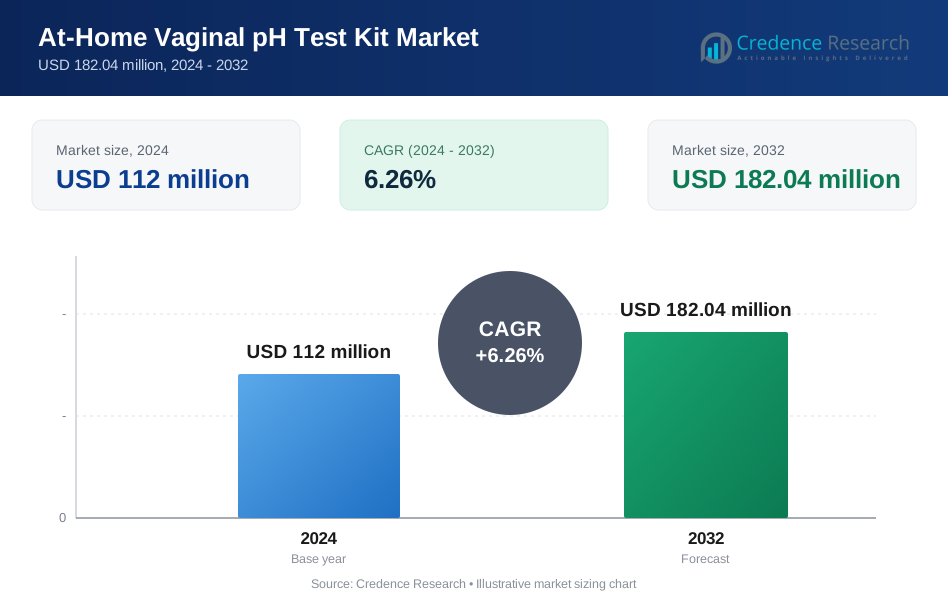
| At-Home Vaginal pH Test Kit Market Size 2024 | USD 112 million |
| At-Home Vaginal pH Test Kit Market, CAGR | 6.26% |
| At-Home Vaginal pH Test Kit Market Size 2032 | USD 182.04 million |
Market Overview
The At-Home Vaginal pH Test Kit Market is projected to grow from USD 112 million in 2024 to USD 182.04 million by 2032, registering a compound annual growth rate (CAGR) of 6.26% during the forecast period.
The growth of the At-Home Vaginal pH Test Kit Market is driven by increasing awareness about women’s health and the rising prevalence of vaginal infections, which has heightened the demand for convenient, non-invasive diagnostic solutions. The growing focus on personal healthcare management, coupled with advancements in at-home diagnostic technologies, has significantly expanded the accessibility and accuracy of these test kits. Additionally, the increasing adoption of digital health platforms has enabled enhanced product education and accessibility through e-commerce channels, boosting market penetration. The demand is further fueled by the trend of proactive healthcare, as women increasingly prefer monitoring their health independently, reducing dependency on clinical visits. Manufacturers are leveraging innovations in test accuracy, user-friendliness, and eco-friendly packaging to cater to evolving consumer preferences. Furthermore, growing awareness campaigns by healthcare providers and organizations to promote vaginal health are expected to drive sustained market growth during the forecast period.
The At-Home Vaginal pH Test Kit Market exhibits notable geographical diversity, with North America holding the largest market share due to high consumer awareness, advanced healthcare infrastructure, and strong adoption of self-diagnostic tools. Europe follows closely, driven by proactive healthcare management and supportive government initiatives. Meanwhile, the Asia-Pacific region is the fastest-growing market, fueled by rising disposable income, urbanization, and expanding e-commerce platforms. Key players driving innovation and market expansion include Abbott Laboratories, OraSure Technologies, Inc., Everlywell, LetsGetChecked, iHealth Labs Inc., Clearblue (SPD Swiss Precision Diagnostics GmbH), Bionime Corporation, ACON Laboratories, Inc., Siemens Healthineers, and Lucira Health. These companies focus on developing user-friendly, accurate test kits and leveraging digital platforms to improve accessibility and consumer engagement, contributing to sustained market growth worldwide.
Market Drivers:
Rising Awareness of Women's Health:
The increasing awareness regarding women's health is a significant driver of the At-Home Vaginal pH Test Kit Market. With a growing focus on addressing vaginal health issues such as bacterial vaginosis, yeast infections, and other imbalances, women are proactively seeking solutions to monitor their health. Campaigns by healthcare organizations and government initiatives emphasizing preventive care have contributed to the rising adoption of at-home diagnostic tools. For instance, initiatives by the World Health Organization (WHO) and local health departments have raised awareness about the importance of monitoring vaginal health. This trend aligns with the broader movement toward self-care, empowering women to identify potential health concerns early and seek timely medical intervention.
Convenience and Accessibility of At-Home Testing:
The convenience and accessibility of at-home vaginal pH test kits have played a pivotal role in their market growth. These kits eliminate the need for frequent clinical visits, offering women a private and hassle-free alternative for monitoring their vaginal health. The growing adoption of e-commerce platforms has further enhanced the availability of these products, making it easier for consumers to access and purchase them. For instance, platforms like Amazon and Walmart have made it convenient for women to purchase at-home vaginal pH test kits online, ensuring quick and discreet delivery. As busy lifestyles and increased health consciousness drive demand for user-friendly solutions, manufacturers are focusing on developing intuitive, easy-to-use test kits.
Technological Advancements in Diagnostic Tools:
Advancements in diagnostic technology have significantly improved the accuracy and reliability of at-home vaginal pH test kits. Innovations in materials, such as highly sensitive test strips and digital integrations, have enhanced product effectiveness, ensuring more accurate results. These technological improvements have increased consumer confidence in at-home testing solutions, fostering wider acceptance. For instance, companies like Advagenix and LetGetChecked have developed advanced test kits that integrate digital platforms for better result interpretation and guidance. Additionally, the integration of digital health platforms has enabled users to interpret results more effectively and access guidance, further boosting product adoption.
Growing Focus on Proactive Healthcare:
The shift toward proactive healthcare is a key factor driving the demand for at-home vaginal pH test kits. Consumers are increasingly prioritizing early detection and prevention of health issues, aligning with the broader trend of personalized healthcare management. For instance, the rise of telehealth services has made it easier for women to discuss them at-home test results with healthcare providers and receive timely advice. As women seek more control over their health, the adoption of these test kits is expected to continue growing, contributing to market expansion.
Market Trends:
Integration of Digital Health Technologies:
A prominent trend in the At-Home Vaginal pH Test Kit Market is the integration of digital health technologies. Manufacturers are incorporating smartphone compatibility and app-based solutions to enhance user experience. These technologies allow users to track their test results, receive personalized health insights, and access educational content on vaginal health. For instance, companies like myLAB Box and LetsGetChecked offer smartphone-compatible test kits that integrate with digital health platforms to provide personalized health insights and educational content. The combination of diagnostic tools with digital platforms is driving consumer engagement and improving health management, making these kits more appealing to tech-savvy users.
Increased Focus on Eco-Friendly Packaging:
Sustainability is becoming a key consideration in the market, with companies shifting toward eco-friendly packaging for them at-home vaginal pH test kits. As consumers become more environmentally conscious, brands are adopting biodegradable materials and reducing plastic usage to align with consumer preferences. For instance, brands like Sustain Natural and The Honey Pot Company are known for using eco-friendly packaging in their feminine health products, appealing to environmentally conscious consumers. This trend not only addresses environmental concerns but also helps companies build a positive brand image, fostering customer loyalty in a competitive market.
Expansion of Distribution Channels:
The expansion of online retail and direct-to-consumer channels has significantly impacted the market. E-commerce platforms have made it easier for consumers to access a wide range of at-home vaginal pH test kits, often with detailed product descriptions and user reviews. Additionally, subscription-based services are emerging, offering consumers convenience and consistent product availability. For instance, companies like Everlywell offer subscription-based services for them at-home test kits, ensuring regular delivery and convenience for users. This trend reflects the increasing importance of seamless purchasing experiences in driving product adoption.
Growing Consumer Awareness Campaigns:
The rise of consumer education campaigns focused on vaginal health is another critical trend shaping the market. Healthcare organizations, influencers, and manufacturers are leveraging social media platforms and other digital channels to spread awareness about the importance of monitoring vaginal pH levels. For instance, campaigns by the American Sexual Health Association and educational content from influencers on platforms like Instagram have raised awareness about the importance of vaginal health and the benefits of at-home testing. These initiatives aim to dispel misconceptions, reduce stigma, and encourage proactive health management, thereby driving greater adoption of at-home test kits.
Market Challenges Analysis:
Limited Awareness and Misconceptions:
A significant challenge in the At-Home Vaginal pH Test Kit Market is the limited awareness and persistent misconceptions about vaginal health among certain demographics. Despite growing educational campaigns, a considerable portion of the target audience remains unaware of the benefits of monitoring vaginal pH levels and the availability of at-home test kits. Cultural taboos and stigmas surrounding vaginal health discussions further hinder market penetration, particularly in conservative regions where open conversations about such topics are often avoided. Many potential consumers also misunderstand the purpose of these test kits, believing them to be replacements for medical consultations, which can lead to misuse or misinterpretation of results. The lack of access to accurate information exacerbates these issues, leaving individuals hesitant to invest in such products. Addressing these gaps through targeted awareness programs, culturally sensitive communication strategies, and comprehensive product education remains critical to overcoming this barrier and expanding market reach.
Accuracy Concerns and Regulatory Hurdles:
Accuracy concerns associated with at-home vaginal pH test kits present another challenge to market growth. While advancements in diagnostic technologies have improved product reliability, skepticism persists among consumers and healthcare professionals regarding the precision of at-home testing compared to clinical alternatives. These doubts can limit adoption, especially among those who prioritize clinical-grade accuracy for health monitoring and view home-based kits as potentially unreliable. Additionally, stringent regulatory requirements for medical devices can delay product approvals and market entry, particularly in regions with complex compliance standards and variable enforcement practices. Meeting these regulatory expectations often demands significant investment in research, testing, and certification processes, which can pose financial and operational challenges for manufacturers, especially smaller companies. To build trust and ensure compliance, companies must focus on improving product accuracy, collaborating with healthcare professionals for validation, and engaging in transparent communication with both consumers and regulatory bodies. This approach can help address concerns while fostering confidence in the safety and efficacy of these kits.
Market Segmentation Analysis:
By Distribution Channel
The At-Home Vaginal pH Test Kit Market is segmented by distribution channel into online platforms, pharmacies, retail stores, and others. Online platforms dominate this segment, driven by the convenience of e-commerce and the availability of a wide range of options with detailed product descriptions and customer reviews. The rise in direct-to-consumer models has further boosted online sales, supported by discreet packaging and home delivery services. Pharmacies remain a significant channel, as they offer access to healthcare professionals for guidance and recommendations. Retail stores, including supermarkets and drugstores, also contribute to the market, particularly in urban areas where foot traffic is high. However, the growing preference for digital shopping and subscription-based models is gradually shifting the market dynamics toward online channels.
By Geography
Geographically, the At-Home Vaginal pH Test Kit Market is segmented into North America, Europe, Asia-Pacific, Latin America, and the Middle East & Africa. North America leads the market due to high consumer awareness, advanced healthcare infrastructure, and widespread adoption of at-home diagnostic tools. Europe follows closely, driven by proactive healthcare management and government initiatives promoting women’s health. The Asia-Pacific region is experiencing rapid growth, fueled by increasing awareness, urbanization, and expanding e-commerce networks. Meanwhile, Latin America and the Middle East & Africa show steady growth, although cultural barriers and limited access to healthcare resources pose challenges in these regions. Expanding distribution networks and targeted awareness campaigns are expected to enhance market penetration in these areas.
Segments:
Based on Distribution Channel
- Retail Pharmacy
- Hospital Pharmacy
- Online Pharmacy
- Fertilization Centers
Based on the Geography:
- North America
- U.S.
- Canada
- Mexico
- Europe
- Germany
- France
- U.K.
- Italy
- Spain
- Rest of Europe
- Asia Pacific
- China
- Japan
- India
- South Korea
- South-east Asia
- Rest of Asia Pacific
- Latin America
- Brazil
- Argentina
- Rest of Latin America
- Middle East & Africa
- GCC Countries
- South Africa
- Rest of the Middle East and Africa
Regional Analysis:
North America
North America dominates the At-Home Vaginal pH Test Kit Market, holding a significant share of 35% in 2024, and this leadership is projected to continue throughout the forecast period. This dominance is driven by high consumer awareness, advanced healthcare infrastructure, and the widespread acceptance of self-diagnostic tools among women. The United States plays a pivotal role in this market, owing to its proactive healthcare management practices, a growing emphasis on preventive health, and the increasing preference for privacy and convenience in monitoring vaginal health. Furthermore, the presence of well-established manufacturers offering innovative and accurate test kits boosts consumer trust and adoption. Robust e-commerce platforms in the region further enhance product accessibility by enabling seamless online purchases with discreet delivery options. Additionally, partnerships between healthcare providers and test kit manufacturers have improved awareness and confidence among consumers. In addition to the U.S., Canada also contributes to regional growth through rising healthcare expenditure, favorable government policies, and campaigns to promote preventive care. The combination of these factors has firmly positioned North America as the most lucrative region for manufacturers of at-home vaginal pH test kits, offering opportunities for innovation and expansion.
Europe
Europe holds the second-largest market share in the At-Home Vaginal pH Test Kit Market, driven by several key factors. Firstly, increasing healthcare expenditures across the region are enabling more investments in women's health initiatives and diagnostic solutions. Governments and private healthcare providers are allocating substantial funds to improve healthcare infrastructure and accessibility, which in turn supports the growth of home diagnostic products. Secondly, regulatory support plays a crucial role in the market's expansion. European regulatory bodies, such as the European Medicines Agency (EMA), are actively working to streamline the approval processes for new diagnostic kits. This regulatory environment fosters innovation and ensures that high-quality products reach the market efficiently. Lastly, there is a growing demand for home diagnostic solutions among consumers. With rising health awareness and a preference for convenient, over-the-counter testing options, more women are turning to at-home vaginal pH test kits. These kits offer a quick and easy way to monitor vaginal health, detect infections early, and maintain overall well-being without the need for frequent doctor visits.
Asia-Pacific
The Asia-Pacific region is emerging as the fastest-growing market for at-home vaginal pH test kits, projected to account for over 25% of the global share by 2032. This growth is driven by increasing urbanization, rising disposable income, and growing awareness among women about the importance of vaginal health. Countries such as China, India, and Japan are leading this surge, supported by their expanding e-commerce networks and the growing penetration of digital healthcare platforms. These platforms not only improve product accessibility but also educate consumers about the benefits of proactive health management, driving further adoption. Moreover, the region’s middle-class population is increasingly adopting affordable and user-friendly healthcare solutions, including at-home diagnostic kits. While cultural stigmas and limited access in rural areas present challenges, governments and healthcare organizations are actively working to address these barriers through targeted awareness campaigns and infrastructure development. The entry of international players with localized strategies is also boosting adoption, further solidifying the region’s growth potential. As a result, the Asia-Pacific market is expected to witness robust growth, becoming a key focus area for global manufacturers aiming to expand their footprint.
Key Player Analysis:
- Siemens Healthineers
- OraSure Technologies, Inc.
- Bionime Corporation
- Lucira Health
- Clearblue (SPD Swiss Precision Diagnostics GmbH)
- LetsGetChecked
- ACON Laboratories, Inc.
- Abbott Laboratories
- iHealth Labs Inc.
- Everlywell
Competitive Analysis:
The At-Home Vaginal pH Test Kit Market is marked by intense competition, with leading players such as Abbott Laboratories, OraSure Technologies, Inc., Everlywell, LetsGetChecked, iHealth Labs Inc., Clearblue (SPD Swiss Precision Diagnostics GmbH), Bionime Corporation, ACON Laboratories, Inc., Siemens Healthineers, and Lucira Health driving market dynamics. These companies compete on parameters such as product innovation, accuracy, ease of use, and integration with digital health platforms. For instance, Everlywell offers test kits that integrate seamlessly with their digital health platform, providing users with personalized health insights and recommendations. They focus on expanding their customer base through strategic partnerships, acquisitions, and robust e-commerce channels, ensuring enhanced accessibility and consumer engagement. Additionally, investments in R&D to develop advanced diagnostic solutions and eco-friendly packaging are key strategies employed by these players to differentiate themselves in the competitive landscape. Regional expansions and tailored marketing campaigns further bolster their competitive edge, enabling them to cater to diverse consumer needs and preferences globally.
Recent Developments:
- In October 2024, LetsGetChecked, a leading global healthcare solutions provider, announced its acquisition of Truepill, a renowned digital pharmacy platform. This strategic acquisition strengthens LetsGetChecked’s ability to collaborate with healthcare partners—including employers, health plans, providers, and life sciences—to deliver superior care and improve health outcomes across diverse populations.
- In 2023, Daye, a women's health startup, introduced a diagnostic tampon designed for at-home testing of various vaginal health issues, including infections and potential fertility problems. This innovative kit allows users to wear the tampon and mail it back for analysis, with results typically available within 5 to 10 days.
- In October 2024, Hertility Health, a women's health start-up, secured funding from notable investors, including actress Emma Watson. The company offers at-home hormone health and fertility testing, aiming to reduce diagnostic times for conditions like endometriosis.
- In August 2024, Checkable launched its vPH Diagnostic Test Kit, enabling users to conveniently test their vaginal pH levels at home.
Market Concentration & Characteristics:
The At-Home Vaginal pH Test Kit Market exhibits a moderately concentrated structure, with a mix of well-established global players and emerging companies driving innovation and competition. Market leaders maintain their dominance through extensive product portfolios, strong brand recognition, and robust distribution networks, particularly in developed regions such as North America and Europe. Emerging players are focusing on niche markets, affordable solutions, and technological advancements to capture market share. The market is characterized by increasing consumer demand for convenient, non-invasive diagnostic tools and a growing preference for digital health integration, such as app-based tracking and interpretation. Additionally, the shift toward sustainability, with the adoption of eco-friendly packaging, reflects evolving consumer preferences. Competitive dynamics are further shaped by partnerships, acquisitions, and targeted awareness campaigns, as companies strive to expand their reach across diverse geographic and demographic segments, catering to the rising demand for personalized healthcare solutions.
Report Coverage:
The research report offers an in-depth analysis based on Distribution Channel and Geography. It details leading market players, providing an overview of their business, product offerings, investments, revenue streams, and key applications. Additionally, the report includes insights into the competitive environment, SWOT analysis, current market trends, as well as the primary drivers and constraints. Furthermore, it discusses various factors that have driven market expansion in recent years. The report also explores market dynamics, regulatory scenarios, and technological advancements that are shaping the industry. It assesses the impact of external factors and global economic changes on market growth. Lastly, it provides strategic recommendations for new entrants and established companies to navigate the complexities of the market.
Future Outlook:
- The market is expected to grow significantly due to rising awareness about women’s health and the importance of monitoring vaginal pH levels.
- Increasing demand for non-invasive and convenient at-home diagnostic tools will drive product adoption globally.
- Integration of digital health platforms, including smartphone compatibility and app-based tracking, will enhance user engagement and accessibility.
- North America is projected to maintain its dominance, while Asia-Pacific is anticipated to grow at the fastest rate due to increasing awareness and expanding e-commerce platforms.
- Companies are likely to focus on product innovation, such as improved accuracy and user-friendliness, to gain a competitive edge.
- Expanding distribution networks, particularly in underserved regions, will play a crucial role in market growth.
- Sustainability initiatives, including eco-friendly packaging, will align with consumer preferences and strengthen brand positioning.
- Collaboration with healthcare providers and organizations will boost consumer trust and market penetration.
- Technological advancements will continue to drive the development of more reliable and effective at-home test kits.
- Increasing emphasis on preventive healthcare and early diagnosis will remain key factors supporting market expansion.
Request a Free Sample
Fill in your details and we'll send you a free sample report.
- Sample data tables & charts
- Research methodology
Need a Custom Version of This Report?
Tailor the scope, geography, or segments to your exact requirements.
- Custom geography or segment scope
- Direct access to our analyst team
Frequently Asked Questions
What is the current size of the At-Home Vaginal pH Test Kit Market?
What factors are driving the growth of the At-Home Vaginal pH Test Kit Market?
What are some challenges faced by the At-Home Vaginal pH Test Kit Market?
Who are the major players in the At-Home Vaginal pH Test Kit Market?
Table of Content
Chapter 1. Report Introduction
- 1.1 Report Description & Purpose
- 1.1.1 Report Title & Market Definition
- 1.1.2 Unique Selling Propositions (USP) & Key Differentiators
- 1.1.3 Value Proposition for Stakeholders
- 1.2 Research Objectives
- 1.2.1 Market Sizing Objectives (Volume & Revenue)
- 1.2.2 Segmentation Objectives
- 1.2.3 Competitive Intelligence Objectives
- 1.2.4 Forecast & Scenario Objectives
- 1.3 Report Scope
- 1.3.1 At-Home Vaginal pH Test Kit Scope – Types & Subtypes Covered
- 1.3.2 Geographic Scope – Regions & Countries Covered
- 1.3.3 Historical Period, Base Year & Forecast Period (2024; forecast to 2032)
- 1.3.4 Inclusions & Exclusions
- 1.4 HS Code & Classification Framework
- 1.5 Currency, Units & Pricing Basis
- 1.6 Target Stakeholders
- 1.7 Limitations & Assumptions
Chapter 2. Executive Summary
- 2.1 Global At-Home Vaginal pH Test Kit Market Snapshot
- 2.1.1 Market Size – Historical (2024) & Forecast (2024-2032) (2024: USD 112 million → 2032: USD 182.04 million)
- 2.1.2 Volume & Revenue – Global Totals
- 2.1.3 Key Market Highlights – Top Five Facts
- 2.2 At-Home Vaginal pH Test Kit Market Segmentation Snapshot
- 2.2.1 Market Split by Region – 2024 vs. 2032
- 2.3 Competitive Snapshot
- 2.3.1 Top 10 Players by Revenue Share – 2024
- 2.3.2 Top 10 Players by Volume Share – 2024
- 2.3.3 Recent Strategic Developments (18-Month Summary)
- 2.4 Key Investment Highlights & Strategic Conclusions
Chapter 3. At-Home Vaginal pH Test Kit Market Dynamics & Industry Analysis
- 3.1 Market Overview & Context
- 3.1.1 At-Home Vaginal pH Test Kit Market Position in the Broader Automotive Value Chain
- 3.1.2 OEM vs. Replacement Market Dynamics
- 3.1.3 Market Maturity & Development Stage by Region
- 3.2 At-Home Vaginal pH Test Kit Market Drivers
- 3.3 At-Home Vaginal pH Test Kit Market Restraints & Challenges
- 3.4 At-Home Vaginal pH Test Kit Market Opportunities
- 3.5 Porter's Five Forces Analysis
- 3.5.1 Threat of New Entrants
- 3.5.2 Bargaining Power of Suppliers
- 3.5.3 Bargaining Power of Buyers
- 3.5.4 Threat of Substitutes
- 3.5.5 Competitive Rivalry – Intensity Assessment
- 3.6 At-Home Vaginal pH Test Kit Value Chain Analysis
- 3.6.1 Upstream – Raw Material/Input Suppliers
- 3.6.1.1 Raw Material/Input 1
- 3.6.1.2 Raw Material/Input 2
- 3.6.1.3 Raw Material/Input 3
- 3.6.2 Midstream – Production/Manufacturing/Service Delivery
- 3.6.2.1 Production/Process Overview
- 3.6.2.2 Key Facility Locations & Capacity by Manufacturer
- 3.6.3 Downstream – Distribution & End Consumer
- 3.6.3.1 Primary Channel – B2B/OEM
- 3.6.3.2 Secondary Channels – Dealer, Retail, Online, Direct
- 3.6.4 Value Chain Profitability Analysis
- 3.6.1 Upstream – Raw Material/Input Suppliers
- 3.7 PESTEL Analysis
- 3.7.1 Political Factors
- 3.7.2 Economic Factors
- 3.7.3 Social Factors
- 3.7.4 Technological Factors
- 3.7.5 Environmental Factors
- 3.7.6 Legal Factors
- 3.8 At-Home Vaginal pH Test Kit Supply Chain Analysis
- 3.8.1 Raw Material/Input Supply Risk Assessment
- 3.8.2 Manufacturing Concentration Risk (Geographic Exposure)
- 3.8.3 Trade Disruption Impact Analysis
- 3.9 Regulatory & Policy Landscape
Note: The regulatory and policy landscape section covers regulations based on their applicability to the market, At-Home Vaginal pH Test Kit category, geography, and scope of the study. Only regulatory frameworks with a material impact on operations, compliance, trade, sustainability, or market access are analyzed in detail.
Chapter 4. Key Investment Pockets & Opportunity Analysis
- 4.1 At-Home Vaginal pH Test Kit Market Attractiveness Analysis
- 4.1.1 By Region – Investment Attractiveness Matrix (Volume × CAGR)
- 4.2 Absolute Revenue Growth Opportunity
- 4.2.1 By Region – Absolute USD Growth Through 2032
- 4.3 Incremental Volume Opportunity
- 4.3.1 By Region – Incremental Volume Through 2032
- 4.3.2 Segment – Incremental Volume
- 4.4 Emerging Submarket Opportunity Deep Dive (Subject to Applicability)
- 4.5 Emerging Market Opportunity Scorecards
- 4.5.1 United States
- 4.5.2 Europe
- 4.5.3 Asia
- 4.5.4 Middle East & Africa
Note: Emerging Market Opportunity Scorecards will be included based on relevance and strategic importance. Regions listed are indicative and may vary depending on data availability and market dynamics.
Chapter 5. At-Home Vaginal pH Test Kit Import-Export Analysis & Trade Flows
- 5.1 Global Trade Overview
- 5.1.1 Global Export Value by Country (2024)
- 5.1.2 Global Export Volume by Country (2024)
- 5.1.3 Global Import Value by Country (2024)
- 5.1.4 Global Import Volume by Country (2024)
- 5.1.5 Net Trade Balance by Country (2024)
- 5.2 Export Analysis – Segment
- 5.2.1 Type 1 (HS Code)
- 5.2.2 Type 2 (HS Code)
- 5.2.3 Type 3 (HS Code)
- 5.2.4 Type 4 (HS Code)
- 5.2.5 Type 5 (HS Code)
- 5.3 Import Analysis – Segment
- 5.3.1 Type 1 (HS Code)
- 5.3.2 Type 2 (HS Code)
- 5.3.3 Type 3 (HS Code)
- 5.3.4 Type 4 (HS Code)
- 5.3.5 Type 5 (HS Code)
- 5.4 Average Unit Trade Prices
- 5.4.1 Average Export Price – Segment & Country
- 5.4.2 Average Import Price – Segment & Source Country
- 5.4.3 Price Trends (2024)
- 5.5 Key Trade Route Analysis
- 5.5.1 Trade Route 1
- 5.5.2 Trade Route 2
- 5.5.3 Trade Route 3
- 5.5.4 Trade Route 4
- 5.5.5 Trade Route 5
- 5.6 Trade Policy Impact Assessment
- 5.6.1 US Anti-Dumping & Section 301 Tariffs
- 5.6.2 EU Customs Union Impact
- 5.6.3 Major Free Trade Agreements
- 5.6.4 USMCA Rules of Origin
Note: Trade policy analysis will be included only where relevant to the At-Home Vaginal pH Test Kit market.
Chapter 6. Competitive Landscape & Company Benchmarking
- 6.1 At-Home Vaginal pH Test Kit Market Concentration & Structure
- 6.1.1 Herfindahl-Hirschman Index (HHI) – vs. 2024
- 6.1.2 Tier 1, Tier 2 & Tier 3 Market Structure
- 6.1.3 Global, Regional & Local Player Dynamics
- 6.2 At-Home Vaginal pH Test Kit Market Share Analysis – 2024
- 6.2.1 Global Revenue Share by Company
- 6.2.2 Global Volume Share by Company
- 6.2.3 Regional Revenue Share
- 6.2.4 Market Share Evolution ( vs. 2024)
- 6.2.5 OEM Segment Share by Company
- 6.2.6 Replacement Segment Share by Company
- 6.3 Production/Delivery Capacity & Facility Analysis
- 6.3.1 Global Installed Capacity
- 6.3.2 Capacity Utilization Rates
- 6.3.3 Production/Output Volume
- 6.3.4 Facility Locations & Capacity Map
- 6.3.5 Planned Capacity Additions
- 6.4 At-Home Vaginal pH Test Kit Competitive Benchmarking Matrix
- 6.4.1 Revenue, Volume, CAGR & Profitability Comparison
- 6.4.2 Channel Revenue Mix
- 6.4.3 Geographic Revenue Exposure
- 6.4.4 R&D Intensity
- 6.4.5 Sustainability Maturity
- 6.5 Strategic Developments in At-Home Vaginal pH Test Kit (Last 24 Months)
- 6.5.1 Mergers, Acquisitions & Divestments
- 6.5.2 New At-Home Vaginal pH Test Kit Launches
- 6.5.3 Facility Expansions
- 6.5.4 Strategic Alliances, Joint Ventures & Partnerships
- 6.5.5 Distribution Expansion & Market Entry
- 6.5.6 Sustainability & ESG Initiatives
- 6.6 Competitive Strategy Mapping
- 6.6.1 Leader, Challenger, Follower & Niche Classification
- 6.6.2 Pricing Strategy Comparison
- 6.6.3 Channel Strategy Matrix
Note: Strategic developments are included based on their materiality and the availability of reliable information.
Chapter 7. Global At-Home Vaginal pH Test Kit Market – By Distribution Channel
- 7.1 Segment Overview
- 7.1.1 Volume & Revenue Split by Channel (2024 & 2032)
- 7.1.2 Channel Mix Evolution (2024-2032)
Chapter 8. Regional Market Analysis – Global Overview
- 8.1 Global Regional Overview
- 8.1.1 Regional Volume Share
- 8.1.2 Regional Revenue Share
- 8.1.3 Regional Volume by Region
- 8.1.4 Regional Revenue by Region
- 8.1.5 Regional Forecast Through 2032
- 8.2 Cross-Regional Segment Analysis
- 8.2.1 By Distribution Channel
- 8.2.2 By Brand/Price Tier
Chapter 9. North America At-Home Vaginal pH Test Kit Market
- 9.1 United States
- 9.2 Canada
- 9.3 Mexico
Chapter 10. Europe At-Home Vaginal pH Test Kit Market
- 10.1 Germany
- 10.2 France
- 10.3 Italy
- 10.4 United Kingdom
- 10.5 Spain
- 10.6 Poland
- 10.7 Russia
- 10.8 Netherlands
- 10.9 Belgium
- 10.10 Sweden
- 10.11 Denmark
- 10.12 Norway
- 10.13 Rest of Europe
Chapter 11. Asia Pacific At-Home Vaginal pH Test Kit Market
- 11.1 China
- 11.2 India
- 11.3 Japan
- 11.4 South Korea
- 11.5 Thailand
- 11.6 Indonesia
- 11.7 Vietnam
- 11.8 Malaysia
- 11.9 Australia
- 11.10 Rest of Asia Pacific
Chapter 12. Latin America At-Home Vaginal pH Test Kit Market
- 12.1 Brazil
- 12.2 Argentina
- 12.3 Colombia
- 12.4 Chile
- 12.5 Rest of Latin America
Chapter 13. Middle East At-Home Vaginal pH Test Kit Market
- 13.1 Saudi Arabia
- 13.2 United Arab Emirates
- 13.3 Turkey
- 13.4 Israel
- 13.5 Iran
- 13.6 Rest of the Middle East
Chapter 14. Africa At-Home Vaginal pH Test Kit Market
- 14.1 South Africa
- 14.2 Egypt
- 14.3 Nigeria
- 14.4 Morocco
- 14.5 Rest of Africa
Chapter 15. At-Home Vaginal pH Test Kit Company Profiles
- 15.1 [Company 01]
- 15.1.1 Company Overview
- 15.1.2 Key Management Personnel
- 15.1.3 Products & Services Portfolio
- 15.1.4 Financial Performance
- 15.1.5 Key Market Focus & Geographic Presence
- 15.1.6 Recent Developments & Strategic Initiatives
Note: The company profile list is preliminary and may change based on research findings, market developments, data availability, and client requirements.
Chapter 16. Appendices
- Appendix A – List of Abbreviations & Acronyms
- Appendix B – Industry Classification Code Reference – Full Series
- Appendix C – Production & Capacity Data Tables
- Appendix D – End-Use & Demand Base Tables
- Appendix E – Consumption & Replacement Rate Assumptions
- Appendix F – ASP Reference Tables
- Appendix G – Manufacturing & Facility Database
- Appendix H – Import-Export Data Tables
- Appendix I – Regulatory Summary Tables
- Appendix J – Primary Research Participant List (Anonymized)
- Appendix K – Primary Research Questionnaire Framework
- Appendix L – Data Sources & Bibliography
- Appendix M – Market Size Divergence & Source Comparison
Chapter 17. Research Methodology
- 17.1 Research Framework & Philosophy
- 17.2 Secondary Research – Sources, Hierarchy & Data Extraction
- 17.3 Data Modeling – Bottom-Up & Top-Down Market Sizing
- 17.4 Primary Research – Stakeholder Framework, LOI & Sample Sizes
- 17.5 Forecast Methodology – Regression, Scenario & Sensitivity Analysis
- 17.6 Quality Control – Four-Layer Validation Framework
- 17.7 Limitations & Standard Assumptions
- 17.8 Disclaimer
