
Market Overview:
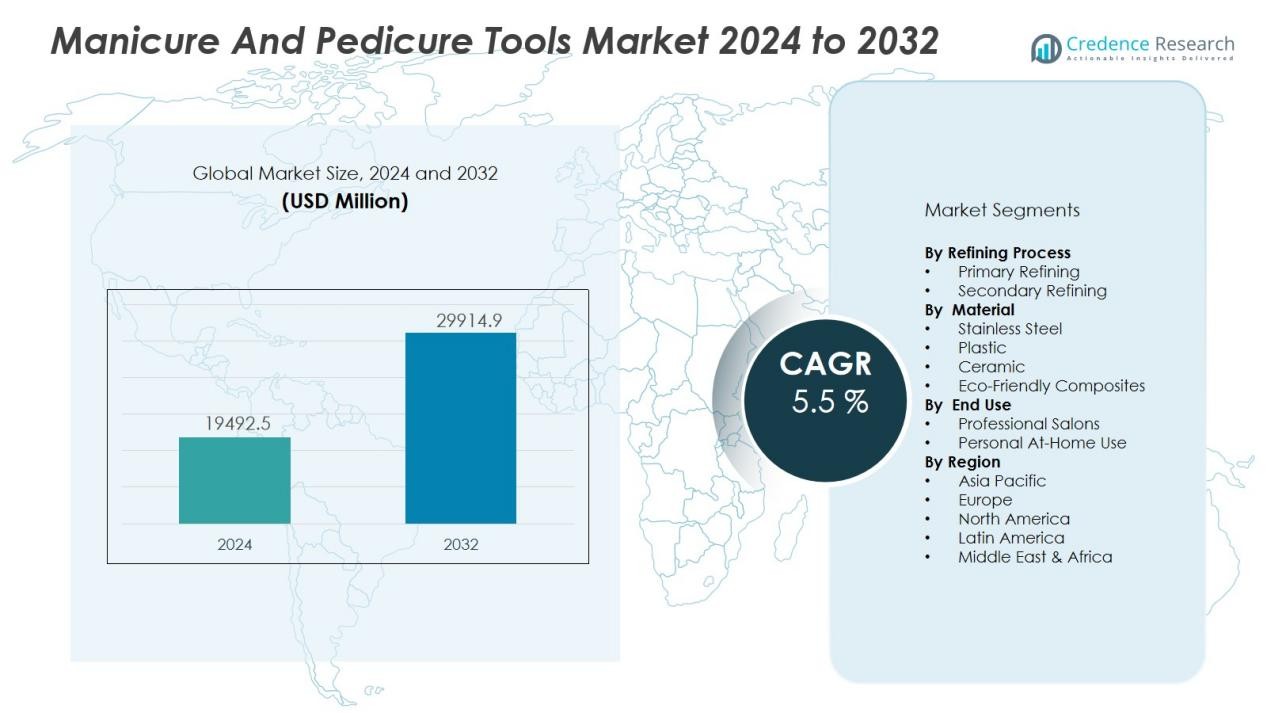
The manicure and pedicure tools market size was valued at USD 19492.5 million in 2024 and is anticipated to reach USD 29914.9 million by 2032, at a CAGR of 5.5 % during the forecast period (2024-2032).
| REPORT ATTRIBUTE | DETAILS |
|---|---|
| Historical Period | 2020-2024 |
| Base Year | 2024 |
| Forecast Period | 2025-2032 |
| Manicure And Pedicure Tools Market Size 2024 | USD 19492.5 Million |
| Manicure And Pedicure Tools Market, CAGR | 5.5 % |
| Manicure And Pedicure Tools Market Size 2032 | USD 29914.9 Million |
Growth is fueled by multiple drivers, including the rising popularity of nail art, increasing demand for professional salon services, and the expanding availability of affordable at-home kits. The influence of social media trends and endorsements from beauty influencers also significantly boosts product visibility and adoption. Moreover, continuous innovation in ergonomic and durable tools, coupled with the use of sustainable and skin-friendly materials, strengthens market demand. E-commerce platforms are further accelerating accessibility by offering a wide range of grooming products across price categories.
Regionally, North America and Europe hold significant shares due to high consumer spending on premium grooming products and a well-established salon industry. Asia-Pacific is expected to register the fastest growth, supported by a rapidly expanding middle-class population, urbanization, and strong adoption of Western beauty trends in markets such as China, India, and South Korea. The Middle East & Africa and Latin America also present promising opportunities, driven by rising disposable incomes and growing interest in beauty and wellness services.
Market Insights:
- The manicure and pedicure tools market was valued at USD 19,492.5 million in 2024 and is projected to reach USD 29,914.9 million by 2032, supported by a CAGR of 5.5% during 2024–2032.
- Rising focus on personal grooming and hygiene is driving steady demand, with nail care becoming a reflection of self-care, confidence, and lifestyle choices.
- Professional salons fuel consistent adoption of advanced, durable tools, supported by rising disposable incomes and increasing consumer preference for premium nail services.
- At-home grooming kits are gaining momentum, with affordable and accessible toolsets expanding across e-commerce platforms and catering to diverse consumer segments.
- The market faces challenges from counterfeit and low-cost products, which affect consumer trust and limit the penetration of premium offerings.
- North America holds 32% market share and Europe 27% market share, while Asia-Pacific is growing fastest with 29% market share due to urbanization, rising incomes, and Western beauty trends.
- Latin America with 7% share and Middle East & Africa with 5% share represent smaller but high-potential markets, shaped by expanding salon services and increasing grooming awareness.
Market Drivers:
Rising Focus on Personal Grooming and Self-Care:
The manicure and pedicure tools market is expanding as consumers increasingly prioritize personal grooming as part of their lifestyle. Growing awareness of hygiene and nail health drives demand for reliable and effective tools. It benefits from a shift in perception where grooming is not limited to beauty but also reflects self-care and confidence. The rising influence of beauty trends in both men and women further strengthens this demand.
Increasing Popularity of Professional Nail Services:
The growing number of salons and spas offering specialized nail services plays a vital role in driving the manicure and pedicure tools market. Consumers seek high-quality, long-lasting results, which requires advanced tools and equipment. Rising disposable incomes allow more people to access premium nail care services. It creates consistent demand for professional-grade tools across urban and semi-urban markets.
- For instance, Accio developed customizable nail care kits designed for professional salons, offering over 20 interchangeable tool heads per kit, resulting in a reported 30% increase in tool durability based on salon feedback during a 6-month continuous use trial.
Expansion of At-Home Grooming Solutions:
The manicure and pedicure tools market gains momentum from the surge in at-home grooming practices. Consumers prefer convenient and cost-effective alternatives to frequent salon visits. Affordable toolkits available through online platforms make it easier for individuals to maintain nail care routines at home. It supports steady sales across diverse customer segments, including students, working professionals, and homemakers.
- For instance, Emjoi’s Micro-Pedi device uses a micro-mineral roller that spins at 30 times per second to buff away callused skin in seconds.
Influence of Social Media and Fashion Trends:
The rise of nail art and beauty influencers has significantly impacted the manicure and pedicure tools market. Social media platforms showcase creative designs and highlight the importance of using quality tools for professional results. Fashion-conscious consumers adopt these trends quickly, fueling demand for innovative products. It encourages manufacturers to develop ergonomic, durable, and stylish tools that align with evolving preferences.
Market Trends:
Growing Demand for Innovative and Ergonomic Tools:
The manicure and pedicure tools market is witnessing a strong shift toward advanced, ergonomic, and user-friendly designs. Consumers prefer tools that provide comfort, precision, and durability, encouraging manufacturers to invest in innovative materials such as stainless steel, ceramic, and eco-friendly composites. It benefits from rising awareness of hygiene, where easy-to-clean and long-lasting tools are favored. Professional salons demand high-performance instruments, while individuals seek compact kits suitable for at-home use. The integration of electric and battery-powered devices is also gaining popularity, providing faster and more efficient results compared to traditional tools. E-commerce platforms further accelerate access by showcasing product comparisons and customer reviews that highlight quality and performance.
- For instance, Beurer GmbH launched its MP 42 electric manicure and pedicure set equipped with 7 high-grade sapphire attachments and achieved sales of over 25,000 units in Germany within its first year of release.
Influence of Sustainability and Fashion-Driven Nail Care:
The manicure and pedicure tools market aligns with sustainability trends as eco-conscious consumers seek products made from recyclable, non-toxic, and environmentally safe materials. Brands focus on packaging innovation and green certifications to attract this growing consumer segment. It also evolves under the influence of fashion-driven nail art trends, where tools designed for precision and creativity gain traction. Social media plays a critical role in shaping consumer preferences by showcasing emerging nail designs and do-it-yourself tutorials. Nail fashion has become a form of self-expression, and consumers actively look for versatile tools that support these styles. Rising demand from younger demographics ensures consistent innovation and broader acceptance of premium, fashion-oriented grooming products.
- For instance, Londontown’s kur Nail Treatment line, which is formulated without formaldehyde and other harsh chemicals, garnered over 750 five-star reviews on major U.S. e-commerce platforms within three months of launch.
Market Challenges Analysis:
Presence of Low-Cost and Counterfeit Products:
The manicure and pedicure tools market faces a significant challenge from the availability of low-cost and counterfeit products. Many unbranded items enter the market at cheaper prices, reducing profit margins for established brands. It creates trust issues among consumers who often struggle to differentiate between authentic and fake tools. Substandard products may compromise hygiene and safety, discouraging repeat purchases. This trend affects brand reputation and slows the adoption of premium offerings. Strong regulatory frameworks and consumer education are necessary to limit the impact of such products.
Limited Awareness in Emerging Markets:
The manicure and pedicure tools market also struggles with limited awareness in developing regions where grooming is not yet a priority for large segments of the population. Many consumers still view nail care as a luxury rather than a routine necessity. It restricts demand outside urban centers, leaving rural areas underpenetrated. Lack of access to quality retail channels further widens this gap. Price sensitivity in these markets makes it difficult for premium products to scale. Targeted marketing campaigns and affordable toolkits are essential to overcome these barriers and drive wider adoption.
Market Opportunities:
Expansion Through At-Home Grooming Kits and Digital Channels:
The manicure and pedicure tools market presents strong opportunities through the rising demand for at-home grooming kits. Consumers seek affordable, convenient, and reliable solutions that replicate salon-quality results. E-commerce platforms and direct-to-consumer channels give brands the ability to reach a wider audience with tailored offerings. It benefits from subscription models and bundled kits that encourage repeat purchases and brand loyalty. Online tutorials and influencer marketing create further growth potential by educating consumers on tool usage and creative nail styles. Companies that leverage digital engagement and personalized recommendations stand to capture significant market share.
Rising Adoption of Sustainable and Premium Products:
The manicure and pedicure tools market also gains opportunities from the growing shift toward sustainable and premium grooming solutions. Consumers are increasingly attracted to eco-friendly, recyclable, and ethically produced tools. It creates scope for brands to differentiate through innovation in materials and packaging. Premium product lines designed for comfort, hygiene, and durability find strong acceptance among professional salons and high-income groups. Younger demographics view nail care as a form of self-expression, fueling interest in multifunctional and stylish tools. Expansion into emerging economies with affordable yet sustainable offerings can further unlock untapped growth potential.
Market Segmentation Analysis:
By Product Type:
The manicure and pedicure tools market is segmented into clippers, scissors, cuticle pushers, nail files, buffers, and electric tools. Clippers and scissors dominate due to their essential role in basic nail care. Nail files and buffers hold strong demand among both professionals and home users, driven by the popularity of nail art and smooth finishing. Electric tools are gaining traction as they provide efficiency and precision, particularly in salon services. It reflects consumer preference for tools that combine durability with convenience.
By Material:
The market includes stainless steel, plastic, and others such as ceramic and eco-friendly composites. Stainless steel tools lead due to their strength, hygiene, and long lifespan, making them preferred by salons and professionals. Plastic tools remain popular in affordable at-home kits, supported by their lightweight and cost-effective nature. Eco-friendly materials are emerging as a growth segment, aligning with sustainability trends and consumer awareness of safe, recyclable options. It creates new opportunities for premium brands to differentiate.
- For instance, Dyson introduced its Supersonic Professional hair dryer, now used in more than 10,000 salons globally, offering heat-control technology that protects hair while improving drying precision.
By End Use:
The market is divided into professional salons and personal at-home use. Professional salons generate significant demand for high-quality, precision-based tools that ensure safety and efficiency in services. Personal use is expanding rapidly with the rising popularity of affordable kits available through e-commerce. It highlights the shift toward convenience and self-care among consumers who prefer maintaining grooming routines at home. Both segments together reinforce steady growth and diversification in the industry.
- For instance, the L’Oréal Professionnel SteamPod 3.0 features floating plates with 99 micro-holes that deliver 2.4 grams of steam per minute to straighten hair while reducing heat damage.
Segmentations:
By Product Type:
- Clippers
- Scissors
- Cuticle Pushers
- Nail Files
- Buffers
- Electric Tools
By Material:
- Stainless Steel
- Plastic
- Ceramic
- Eco-Friendly Composites
By End Use:
- Professional Salons
- Personal At-Home Use
- North America
- U.S.
- Canada
- Mexico
- Europe
- Germany
- France
- U.K.
- Italy
- Spain
- Rest of Europe
- Asia Pacific
- China
- Japan
- India
- South Korea
- South-east Asia
- Rest of Asia Pacific
- Latin America
- Brazil
- Argentina
- Rest of Latin America
- Middle East & Africa
- GCC Countries
- South Africa
- Rest of the Middle East and Africa
Regional Analysis:
North America and Europe:
North America holds 32% market share, while Europe accounts for 27% market share, reflecting their dominance in the global landscape. Both regions benefit from high consumer spending on premium grooming products and the presence of well-established salon networks. The manicure and pedicure tools market in these regions is further supported by strong brand loyalty and a preference for advanced, durable tools. It is reinforced by rising adoption of electric and automated devices that enhance convenience and efficiency. Regulatory standards promoting hygiene and safety also influence purchasing decisions, favoring branded products. Professional salons and individual consumers in these regions continue to drive steady demand for innovative solutions.
Asia-Pacific:
Asia-Pacific holds 29% market share, driven by expanding middle-class populations and rising beauty consciousness in countries such as China, India, and South Korea. Urbanization and higher disposable incomes contribute to stronger adoption of grooming routines. The manicure and pedicure tools market in this region is supported by the growing popularity of nail art and Western beauty trends. It benefits from a surge in e-commerce platforms that make diverse products easily accessible. Social media and influencer-driven trends accelerate awareness and create demand across younger demographics. With large untapped rural markets, the region offers significant potential for both affordable and premium product categories.
Latin America and Middle East & Africa:
Latin America holds 7% market share, while the Middle East & Africa account for 5% market share, reflecting smaller but growing contributions. These regions experience rising disposable incomes and increasing awareness of personal grooming. The manicure and pedicure tools market here is shaped by urban consumer segments that prioritize self-care and beauty. It is also driven by the expansion of salon chains and local beauty service providers. Limited product penetration outside major cities creates opportunities for affordable and accessible toolkits. Brands that focus on localized marketing strategies and distribution networks can strengthen their position in these high-potential markets.
Key Player Analysis:
- Beautify Beauties
- CND (Creative Nail Design)
- Beurer
- Deborah Lippmann
- Harperton
- Fancii-
- KISS Products
- OPI
- Mehaz Professional
- Revlon
- Sephora Collection
- Sally Hansen
- Trim
Competitive Analysis:
The manicure and pedicure tools market is competitive, with global and regional players focusing on innovation, product quality, and distribution reach. Key companies include Beautify Beauties, CND (Creative Nail Design), Beurer, Deborah Lippmann, Harperton, Fancii, KISS Products, OPI, and Mehaz Professional. It is characterized by product diversification, with brands offering both professional-grade and at-home grooming solutions. Leading players invest in durable, ergonomic, and stylish designs to capture evolving consumer preferences. E-commerce platforms strengthen brand visibility and allow smaller players to compete with established names. Strategic partnerships with salons, influencer collaborations, and sustainability initiatives are common tactics used to build consumer loyalty. Competitive differentiation relies heavily on innovation, branding, and the ability to deliver value across premium and affordable segments.
Recent Developments:
- In July 2025, OPI introduced its At-Home Gel collection, expanding the brand’s consumer offerings with salon-quality, easy-application gel nail products designed for DIY use.
- March 2025: Trim-Tex completed the acquisition of Plastic Components Inc., thereby expanding its portfolio to include exterior-grade PVC profiles as of February 28, 2025
Market Concentration & Characteristics:
The manicure and pedicure tools market is moderately fragmented, with a mix of global brands and regional players competing across premium and mass-market segments. It is characterized by continuous product innovation, focus on ergonomic designs, and increasing adoption of eco-friendly materials to meet changing consumer preferences. Competition intensifies through e-commerce platforms where brands differentiate on quality, durability, and price positioning. Professional salons demand high-performance tools, while at-home users prefer affordable kits with multifunctional features. Rising influence of social media and beauty trends creates strong opportunities for niche and fashion-driven offerings. The market shows steady growth potential, supported by expanding distribution networks and increasing awareness of personal grooming worldwide.
Report Coverage:
The research report offers an in-depth analysis based on Product Type, Material, End Use and Region. It details leading Market players, providing an overview of their business, product offerings, investments, revenue streams, and key applications. Additionally, the report includes insights into the competitive environment, SWOT analysis, current Market trends, as well as the primary drivers and constraints. Furthermore, it discusses various factors that have driven Market expansion in recent years. The report also explores Market dynamics, regulatory scenarios, and technological advancements that are shaping the industry. It assesses the impact of external factors and global economic changes on Market growth. Lastly, it provides strategic recommendations for new entrants and established companies to navigate the complexities of the Market.
Future Outlook:
- The manicure and pedicure tools market will expand steadily, supported by rising consumer focus on self-care and personal grooming.
- Demand for multifunctional and ergonomic tools will strengthen as consumers seek comfort and efficiency in nail care routines.
- Professional salons will continue to invest in premium, durable tools to deliver high-quality services and meet evolving client expectations.
- At-home grooming kits will gain wider adoption, driven by affordability, convenience, and accessibility through digital retail channels.
- Sustainability will remain a key growth driver, with brands emphasizing recyclable materials, eco-friendly packaging, and ethical sourcing.
- Social media and influencer-led trends will shape consumer preferences, fueling demand for innovative nail art tools and accessories.
- Electric and battery-powered devices will register increasing popularity, providing faster and more precise results than manual alternatives.
- Emerging markets in Asia-Pacific, Latin America, and the Middle East will offer significant opportunities through urbanization and rising disposable incomes.
- Competitive differentiation will depend on product quality, brand reputation, and the ability to offer value-added kits tailored to diverse consumer needs.
- The industry will remain dynamic, with continuous innovation and strategic collaborations enhancing accessibility and global penetration.

Request a Free Sample
Fill in your details and we'll send you a free sample report.
- Sample data tables & charts
- Research methodology
Market Dynamics
Rising Focus on Personal Grooming and Self-Care
Consumers are increasingly prioritizing personal grooming and hygiene, viewing nail care as an essential aspect of self-care and confidence. This shift in perception is driving steady demand for reliable and effective manicure and pedicure tools across diverse demographics.
Increasing Popularity of Professional Nail Services
The proliferation of salons and spas offering specialized nail services is fueling demand for advanced, durable tools. Higher disposable incomes and a preference for premium nail care experiences are leading to consistent adoption of professional-grade tools in urban and semi-urban markets.
Expansion of At-Home Grooming Solutions
Affordable and accessible at-home manicure and pedicure kits are gaining traction, especially through e-commerce platforms. Consumers seeking convenience and cost-effectiveness are increasingly maintaining nail care routines at home, broadening the market’s customer base.
Influence of Social Media and Fashion Trends
Social media platforms and beauty influencers are amplifying the popularity of nail art and creative designs, highlighting the importance of quality tools for professional results. This trend encourages rapid adoption of innovative and stylish products, especially among younger consumers.
Innovation in Ergonomic and Sustainable Tools
Continuous advancements in ergonomic design, durable materials, and eco-friendly solutions are attracting both professional and personal users. The growing preference for sustainable, skin-friendly, and easy-to-clean tools is strengthening market demand and enabling brands to differentiate their offerings.
Need a Custom Version of This Report?
Tailor the scope, geography, or segments to your exact requirements.
- Custom geography or segment scope
- Direct access to our analyst team
Frequently Asked Questions
What is the current market size for the manicure and pedicure tools market, and what is its projected size in 2032?
At what Compound Annual Growth Rate is the manicure and pedicure tools market projected to grow between 2024 and 2032?
Which manicure and pedicure tools market segment held the largest share in 2024?
What are the primary factors fueling the growth of the manicure and pedicure tools market?
Who are the leading companies in the manicure and pedicure tools market?
Which region commanded the largest share of the manicure and pedicure tools market in 2024?
Table of Content
Chapter 1 Market Segmentation
- 1.1 Segmentation Framework
- 1.1.1 Product and Service Classification
- 1.1.2 Application and End-Use Classification
- 1.1.3 Technology and Solution Classification
- 1.1.4 Customer and Distribution Channel Classification
- 1.1.5 Geographic Segmentation
- 1.1.6 Market Segment Definitions and Boundaries
- 1.2 By End Use
- 1.2.1 Professional Salons
- 1.2.2 Personal At-Home Use
- 1.3 By Material
- 1.3.1 Stainless Steel
- 1.3.2 Plastic
- 1.3.3 Ceramic
- 1.3.4 Eco-Friendly Composites
- 1.4 By Product Type
- 1.4.1 Clippers
- 1.4.2 Scissors
- 1.4.3 Cuticle Pushers
- 1.4.4 Nail Files
- 1.4.5 Buffers
- 1.4.6 Electric Tools
Chapter 2 Introduction
- 2.1 Report Objectives and Scope
- 2.2 Product Definition and Industry Terminology
- 2.3 Market Inclusions and Exclusions
- 2.4 Research Process
- 2.4.1 Primary Research and Expert Interviews
- 2.4.2 Secondary Research and Source Review
- 2.4.3 Top-Down and Bottom-Up Estimation
- 2.4.4 Data Triangulation and Verification
- 2.5 Market Size Measurement Basis
- 2.5.1 2024: USD 19,492.5 million → 2032: USD 29,914.9 million
- 2.6 Historical and Forecast Reference Periods
- 2.6.1 Base Year: 2024
- 2.6.2 Forecast Period: 2024-2032
- 2.7 Research Assumptions and Limitations
Chapter 3 Executive Summary
- 3.1 Market Snapshot and Key Findings
- 3.2 Base-Year Market Size, 2024
- 3.3 Forecast Market Size, 2032
- 3.4 Revenue and Volume Growth Outlook
- 3.5 Key Demand and Supply Indicators
- 3.6 Leading Market Segments
- 3.7 Fastest-Growing Market Opportunities
- 3.8 Regional Performance Highlights
- 3.9 Technology and Industry Transformation
- 3.10 Competitive Landscape Summary
- 3.11 Analyst View and Strategic Implications
Chapter 4 Global Manicure And Pedicure Tools Market Trends and Developments
- 4.1 Historical Industry Development
- 4.2 Recent Market Trends and Developments
- 4.3 Demand and Customer Behavior Trends
- 4.4 Technology and Product Innovation
- 4.5 Artificial Intelligence, Automation and Digitalization
- 4.6 Local Manufacturing and Supply Chain Realignment
- 4.7 Industry Partnerships, Mergers and Acquisitions
- 4.8 Sustainability and Circular Economy Developments
- 4.9 Government and Private Sector Investment Trends
- 4.10 Emerging Business Models and Commercialization
- 4.11 Industry Developments and Announcements
Chapter 5 Global Manicure And Pedicure Tools Market Production, Supply and Demand Analysis
- 5.1 Demand Trend and Consumption Analysis
- 5.2 Demand Forecast, 2024-2032
- 5.3 Production and Output Trend
- 5.4 Production and Output Forecast, 2024-2032
- 5.5 Installed Capacity and Capacity Utilization
- 5.6 Company-Wise Production Plants and Statistics
- 5.6.1 Installed Production Capacity
- 5.6.2 Actual Production
- 5.6.3 Planned Capacity and Expansion Targets
- 5.7 Supply Chain Structure and Procurement Trends
- 5.8 Supply-Demand Gap and Bottlenecks
- 5.9 Import Dependence and Sourcing Structure
- 5.10 Contract Manufacturing and Outsourcing
- 5.11 Regional Supply and Demand Concentration
Chapter 6 Global Manicure And Pedicure Tools Market Pricing Analysis
- 6.1 Pricing Structure and Measurement
- 6.2 Historical Pricing Trends
- 6.3 Pricing Outlook, 2024-2032
- 6.4 Average Selling Price and Unit Economics
- 6.5 Pricing by Product and Market Segment
- 6.6 Geographic Pricing Differences
- 6.7 Key Input, Energy, Labor and Logistics Costs
- 6.8 Contract Pricing and Purchasing Models
- 6.9 Pricing Sensitivity and Competitive Positioning
- 6.10 Price, Margin and Profitability Implications
Chapter 7 Global Manicure And Pedicure Tools Market Dynamics
- 7.1 Market Growth Drivers
- 7.1.1 Demand-Side Drivers
- 7.1.2 Technology and Innovation Drivers
- 7.1.3 Infrastructure and Investment Drivers
- 7.1.4 Regulatory and Policy Drivers
- 7.2 Market Restraints
- 7.2.1 Cost and Affordability Constraints
- 7.2.2 Technology and Adoption Barriers
- 7.2.3 Supply Chain and Operational Constraints
- 7.3 Market Challenges
- 7.3.1 Competitive Pressure and Margin Erosion
- 7.3.2 Skills, Infrastructure and Implementation Gaps
- 7.4 Emerging Market Opportunities
- 7.5 Market Dynamics Impact and Time-Horizon Assessment
Chapter 8 Global Manicure And Pedicure Tools Value Chain Analysis
- 8.1 Industry Value Chain Overview
- 8.2 Upstream Suppliers and Critical Inputs
- 8.3 Technology and Component Providers
- 8.4 Manufacturing or Service Delivery
- 8.5 Distribution, Channel Partners and Integrators
- 8.6 Downstream Applications and End Users
- 8.7 Value Addition and Profit Pools
- 8.8 Vertical Integration and Outsourcing
- 8.9 Supplier Concentration and Risk
- 8.10 Supply Chain Localization and Resilience
Chapter 9 Global Manicure And Pedicure Tools Market Regulations and Policies
- 9.1 Relevant Laws, Standards and Compliance Frameworks
- 9.2 Product, Service, Safety and Quality Requirements
- 9.3 Government Policies, Incentives and Subsidies
- 9.4 Imports, Exports and Trade Barriers
- 9.5 Public Procurement and Local Content Requirements
- 9.6 Environmental and Sustainability Compliance
- 9.7 Upcoming Policy Changes and Market Implications
Chapter 10 Global Manicure And Pedicure Tools Market Hotspots and Opportunities
- 10.1 Market Opportunity Mapping and Growth Hotspots
- 10.2 High-Growth Applications and Customer Groups
- 10.3 Underserved Markets and White-Space Opportunities
- 10.4 Emerging Technology and Product Opportunities
- 10.5 New Capacity and Investment Hotspots
- 10.6 Market Entry and Expansion Opportunities
- 10.7 Distribution and Partnership Opportunities
- 10.8 Near-Term and Long-Term Commercial Potential
- 10.9 Opportunity Attractiveness and Execution Risks
Chapter 11 Global Manicure And Pedicure Tools Market Outlook, 2024-2032
- 11.1 Market Size and Analysis
- 11.1.1 Revenue (Market Measurement: 2024: USD 19,492.5 million → 2032: USD 29,914.9 million)
- 11.1.2 Market Volume and Quantity Sold
- 11.1.3 Historical Market Size
- 11.1.4 Base-Year Market Size, 2024
- 11.2 Market Forecast, 2024-2032
- 11.2.1 Revenue Forecast to 2032
- 11.2.2 Volume Forecast to 2032
- 11.2.3 CAGR and Year-on-Year Growth
- 11.2.4 Incremental Revenue Opportunity
- 11.3 Forecast Assumptions and Scenario Analysis
- 11.3.1 Base-Case Forecast
- 11.3.2 Optimistic and Conservative Scenarios
- 11.3.3 Technology, Pricing and Policy Sensitivities
- 11.4 Market Attractiveness and Growth Outlook
Chapter 12 Global Manicure And Pedicure Tools Market Segmentation and Outlook
- 12.1 Segmentation Summary and Market Shares, 2024
- 12.2 Largest and Fastest-Growing Segments
- 12.3 By End Use - Market Size and Forecast, 2024-2032
- 12.3.1 Segment Definition and Scope
- 12.3.2 Historical Market Size
- 12.3.3 Revenue Forecast, 2024-2032
- 12.3.4 Volume Forecast, 2024-2032
- 12.3.5 Base-Year Market Share, 2024
- 12.3.6 Segment CAGR and Growth Drivers
- 12.3.7 Subsegment Market Size and Forecast
- 12.3.7.1 Professional Salons
- 12.3.7.2 Personal At-Home Use
- 12.3.8 Subsegment Pricing and Adoption Trends
- 12.3.9 Leading Suppliers and Competition
- 12.3.10 Regional Demand and Opportunities
- 12.4 By Material - Market Size and Forecast, 2024-2032
- 12.4.1 Segment Definition and Scope
- 12.4.2 Historical Market Size
- 12.4.3 Revenue Forecast, 2024-2032
- 12.4.4 Volume Forecast, 2024-2032
- 12.4.5 Base-Year Market Share, 2024
- 12.4.6 Segment CAGR and Growth Drivers
- 12.4.7 Subsegment Market Size and Forecast
- 12.4.7.1 Stainless Steel
- 12.4.7.2 Plastic
- 12.4.7.3 Ceramic
- 12.4.7.4 Eco-Friendly Composites
- 12.4.8 Subsegment Pricing and Adoption Trends
- 12.4.9 Leading Suppliers and Competition
- 12.4.10 Regional Demand and Opportunities
- 12.5 By Product Type - Market Size and Forecast, 2024-2032
- 12.5.1 Segment Definition and Scope
- 12.5.2 Historical Market Size
- 12.5.3 Revenue Forecast, 2024-2032
- 12.5.4 Volume Forecast, 2024-2032
- 12.5.5 Base-Year Market Share, 2024
- 12.5.6 Segment CAGR and Growth Drivers
- 12.5.7 Subsegment Market Size and Forecast
- 12.5.7.1 Clippers
- 12.5.7.2 Scissors
- 12.5.7.3 Cuticle Pushers
- 12.5.7.4 Nail Files
- 12.5.7.5 Buffers
- 12.5.7.6 Electric Tools
- 12.5.8 Subsegment Pricing and Adoption Trends
- 12.5.9 Leading Suppliers and Competition
- 12.5.10 Regional Demand and Opportunities
- 12.6 Segment Growth Comparison
- 12.7 Segment Attractiveness and Priority Matrix
Chapter 13 Global Manicure And Pedicure Tools End-Use and Application Market Outlook
- 13.1 End-Use Industry and Customer Demand Structure
- 13.2 Leading Applications and Customer Groups
- 13.3 End-Use Market Size, Share and Forecast
- 13.4 Major End-Use Industry Deep Dives
- 13.4.1 Customer Requirements and Use Cases
- 13.4.2 Demand and Replacement Cycles
- 13.4.3 Technical and Regulatory Considerations
- 13.4.4 Purchasing and Procurement Models
- 13.4.5 Leading Vendors and Distribution Channels
- 13.4.6 Forecast and Commercial Opportunities
- 13.5 Emerging Applications and Cross-Segment Demand
- 13.6 End-Use Industry Investment Priorities
Chapter 14 Global Manicure And Pedicure Tools Geographic Market Outlook, 2024-2032
- 14.1 Regional Market Size and Share, 2024
- 14.2 Regional Market Forecast, 2024-2032
- 14.3 Regional Pricing, Production and Demand Differences
- 14.4 North America
- 14.4.1 United States
- 14.4.2 Canada
- 14.4.3 Mexico
- 14.5 Europe
- 14.5.1 Germany
- 14.5.2 France
- 14.5.3 Italy
- 14.5.4 United Kingdom
- 14.5.5 Spain
- 14.5.6 Poland
- 14.5.7 Russia
- 14.5.8 Netherlands
- 14.5.9 Belgium
- 14.5.10 Sweden
- 14.5.11 Denmark
- 14.5.12 Norway
- 14.5.13 Rest of Europe
- 14.6 Asia Pacific
- 14.6.1 China
- 14.6.2 India
- 14.6.3 Japan
- 14.6.4 South Korea
- 14.6.5 Thailand
- 14.6.6 Indonesia
- 14.6.7 Vietnam
- 14.6.8 Malaysia
- 14.6.9 Australia
- 14.6.10 Rest of Asia Pacific
- 14.7 Latin America
- 14.7.1 Brazil
- 14.7.2 Argentina
- 14.7.3 Colombia
- 14.7.4 Chile
- 14.7.5 Rest of Latin America
- 14.8 Middle East
- 14.8.1 Saudi Arabia
- 14.8.2 United Arab Emirates
- 14.8.3 Turkey
- 14.8.4 Israel
- 14.8.5 Iran
- 14.8.6 Rest of the Middle East
- 14.9 Africa
- 14.9.1 South Africa
- 14.9.2 Egypt
- 14.9.3 Nigeria
- 14.9.4 Morocco
- 14.9.5 Rest of Africa
- 14.10 Regional Investment, Policy and Supply Chain Differences
- 14.11 Regional Competitive Landscape
- 14.12 Geographic Growth Hotspots
Chapter 15 Global Manicure And Pedicure Tools Technology, Innovation and Sustainability Outlook
- 15.1 Technology Landscape and Maturity
- 15.2 Product, Process and Service Innovation
- 15.3 AI, Automation and Digital Tools in the Industry
- 15.4 Technology Adoption and Performance Benchmarking
- 15.5 Innovation Pipeline and R&D Investment
- 15.6 Patent and Intellectual Property Trends
- 15.7 Energy Efficiency and Resource Management
- 15.8 Sustainability, Recycling and Circularity
- 15.9 Technology Roadmap, 2024-2032
- 15.10 Risks of Obsolescence and Technology Substitution
Chapter 16 Global Manicure And Pedicure Tools Market Key Strategic Imperatives
- 16.1 Growth and Market Entry Priorities
- 16.2 High-Return Products and Segments
- 16.3 Pricing, Profitability and Cost Optimization
- 16.4 Technology Investment and Product Differentiation
- 16.5 Supply Chain Localization and Resilience
- 16.6 Distribution and Customer Acquisition
- 16.7 Partnership, Acquisition and Capacity Strategy
- 16.8 Regional Expansion Priorities
- 16.9 Short-, Medium- and Long-Term Actions
Chapter 17 Competition Outlook
- 17.1 Industry Competition Characteristics
- 17.2 Market Structure and Concentration
- 17.3 Market Share and Competitive Positioning, 2024
- 17.4 Company-Wise Revenue and Product Benchmarking
- 17.5 Production and Service Capacity Benchmarking
- 17.6 Technology, Pricing and Differentiation
- 17.7 Regional Footprint and Distribution Strength
- 17.8 Mergers, Acquisitions and Strategic Alliances
- 17.9 New Entrants and Competitive Threats
- 17.10 Porter's Five Forces and Industry Attractiveness
- 17.11 Competitive Outlook, 2024-2032
Chapter 18 Company Profiles
- 18.1 Company Coverage and Selection Criteria
- 18.2 Beautify Beauties
- 18.2.1 Business Description
- 18.2.2 Company Ownership and Geographic Presence
- 18.2.3 Product and Service Portfolio
- 18.2.4 Manufacturing and Operating Footprint
- 18.2.5 Production Capacity and Expansion Plans
- 18.2.6 Financial Performance and Investment
- 18.2.7 Market Share and Competitive Position
- 18.2.8 Technology and Innovation Capabilities
- 18.2.9 Strategic Alliances or Partnerships
- 18.2.10 Recent Developments
- 18.2.11 Growth Strategy and Outlook
- 18.3 CND (Creative Nail Design)
- 18.4 Beurer
- 18.5 Deborah Lippmann
- 18.6 Harperton
- 18.7 Fancii
- 18.8 KISS Products
- 18.9 OPI
- 18.10 Mehaz Professional
- 18.11 Revlon
- 18.12 Other Relevant Market Participants
Note: Every listed company is profiled on the structure shown under the first company. The company list is preliminary and may change based on research findings, market developments, data availability and client requirements.
Chapter 19 Disclaimer
- 19.1 Research and Forecast Disclaimer
- 19.2 Data Source and Estimation Limitations
Note: The depth of individual sections depends on data availability for this market. Volume, capacity, trade and other unit-based metrics are included where applicable.

