
Automatic and Smart Pet Feeder Market Overview:
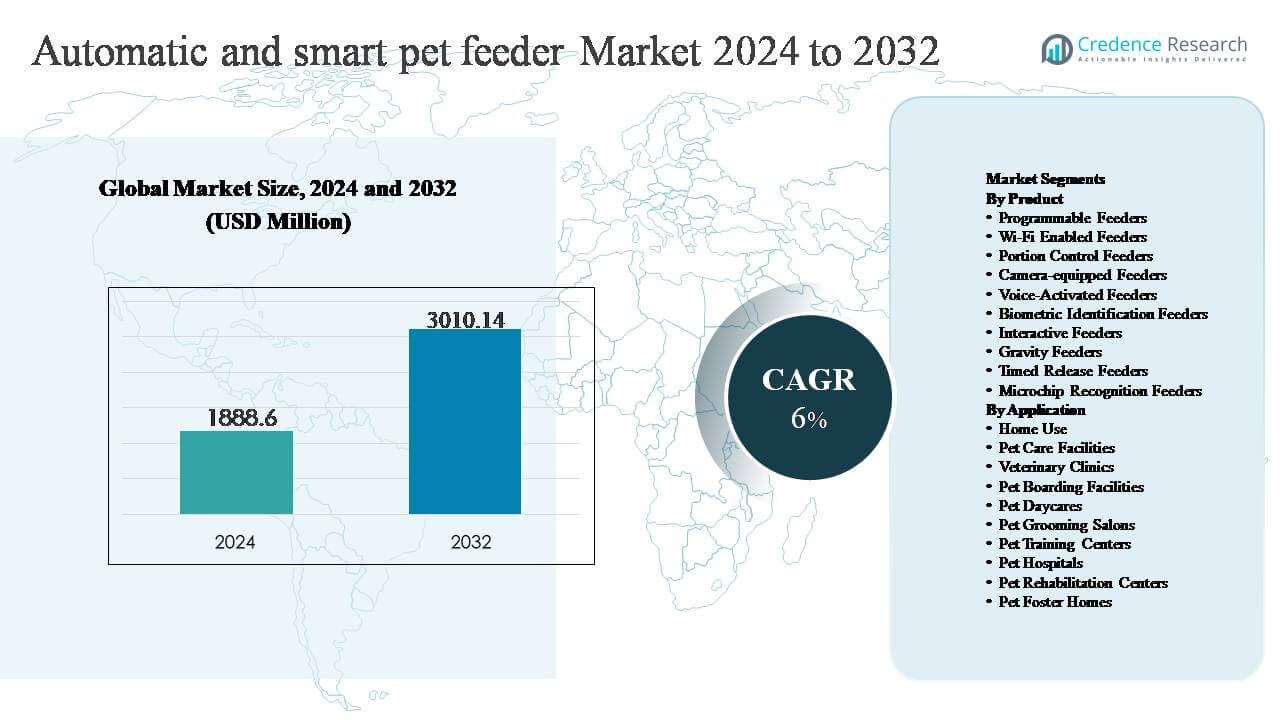
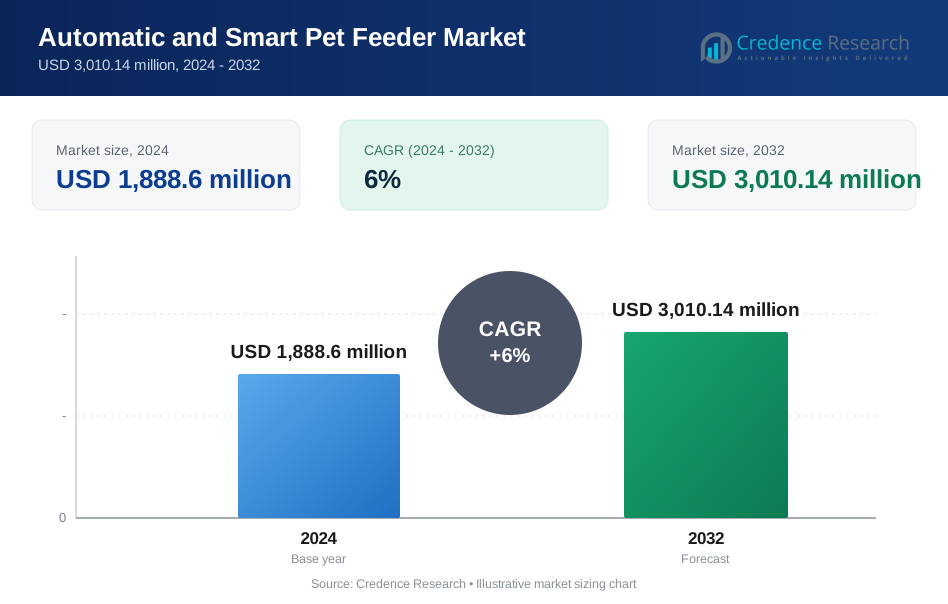
The automatic and smart pet feeder market is witnessing steady expansion, driven by the growing humanization of pets and increasing reliance on technology to simplify pet care routines. The market was valued at USD 1,888.6 million in 2024 and is anticipated to reach USD 3,010.14 million by 2032, growing at a CAGR of 6% during the forecast period.
| REPORT ATTRIBUTE | DETAILS |
|---|---|
| Historical Period | 2020-2023 |
| Base Year | 2024 |
| Forecast Period | 2025-2032 |
| Automatic and Smart Pet Feeder Market Size 2024 | USD 1,888.6 million |
| Automatic and Smart Pet Feeder Market , CAGR | 6% |
| Automatic and Smart Pet Feeder Market Size 2032 | USD 3,010.14 million |
Automatic and Smart Pet Feeder Market Insights
- Growing pet humanization and busy lifestyles act as primary market drivers, accelerating demand for programmable, Wi-Fi enabled, and portion control feeders that ensure feeding consistency, dietary accuracy, and remote management convenience for pet owners.
- Market trends highlight rapid adoption of smart, app-connected feeders with cameras and voice interaction, while Wi-Fi enabled feeders dominate the product segment, and home use remains the leading application segment due to individual consumer demand.
- Competitive analysis indicates a moderately fragmented landscape, where players compete through feature innovation, smart home integration, pricing strategies, and strong online distribution, with e-commerce platforms capturing a major share of sales.
- Regionally, North America leads with ~38% market share, followed by Europe at ~27% and Asia Pacific at ~23%, while Latin America and Middle East & Africa together account for the remaining share, reflecting gradual adoption and price sensitivity.
Automatic and Smart Pet Feeder Market Segmentation Analysis:
By Product:
By product, Wi-Fi enabled feeders represent the dominant sub-segment, accounting for the largest share of the automatic and smart pet feeder market. Their leadership is driven by strong demand for remote feeding control, real-time monitoring, and mobile app integration, which align well with the needs of tech-savvy pet owners. Features such as scheduling, portion adjustment, feeding alerts, and data tracking enhance convenience and reliability. Camera-equipped and portion control feeders follow closely, supported by health monitoring needs. In contrast, gravity and timed release feeders maintain steady demand due to affordability and simplicity.
- For instance, the PetSafe Smart Feed Automatic Dog and Cat Feeder supports scheduling of up to 12 meals per day, allows portion adjustments in 1/8-cup increments, and connects via a dedicated mobile app that sends push notifications after each feeding event.
By Application:
By application, home use dominates the market with a clear majority share, supported by rising pet ownership, urban lifestyles, and growing preference for automated pet care solutions. Individual pet owners increasingly adopt smart feeders to ensure consistent feeding schedules, manage portion sizes, and maintain pet health during work hours or travel. Pet boarding facilities and veterinary clinics form the next key segments, driven by the need for operational efficiency and feeding accuracy. However, adoption in pet daycares and rehabilitation centers remains comparatively niche due to higher customization requirements.
- For instance, Sure Petcare’s SureFeed Microchip Pet Feeder is used in professional settings to manage multi-pet environments by identifying animals via ISO-standard microchips operating at 134.2 kHz, ensuring only the intended pet accesses the food bowl.
By Distribution:
By distribution, e-commerce platforms and online retailers constitute the dominant sub-segment, capturing the highest market share due to broad product availability, competitive pricing, and detailed feature comparisons. Consumers favor online channels for access to advanced smart feeder models, user reviews, and doorstep delivery. Pet specialty stores remain important for premium and advisory-led purchases, particularly for first-time buyers. Mass merchandisers and pet supply chains contribute to volume sales, while veterinary clinics and specialty boutiques primarily support targeted, trust-based purchasing behavior.
Key Growth Drivers
Rising Pet Humanization and Premium Pet Care Spending
The increasing humanization of pets remains a primary growth driver for the automatic and smart pet feeder market. Pet owners increasingly view pets as family members, leading to higher spending on products that support health, comfort, and routine management. This behavioral shift drives demand for automated feeding solutions that ensure consistency, portion accuracy, and dietary discipline. Smart feeders help address common issues such as irregular feeding times and overfeeding, which are linked to obesity and metabolic disorders in pets. As disposable incomes rise, especially in urban households, consumers show greater willingness to invest in technologically advanced pet care devices that enhance convenience and peace of mind. This trend is particularly strong among millennials and dual-income households that prioritize premium, time-saving solutions for pet management.
- For instance, WOpet’s Wi-Fi–enabled feeders allow portion settings starting at 5 grams per serving, enabling precise calorie management for pets with weight-control or metabolic needs.
Growing Adoption of Smart Home and IoT Technologies
The rapid adoption of smart home ecosystems significantly accelerates demand for Wi-Fi-enabled and app-connected pet feeders. Consumers increasingly prefer devices that integrate seamlessly with smartphones, voice assistants, and centralized smart home platforms. Smart feeders offer remote monitoring, feeding history analytics, and real-time alerts, aligning well with digital lifestyle preferences. The expansion of IoT infrastructure and improved wireless connectivity have reduced technical barriers, making smart feeders more reliable and user-friendly. As households become more accustomed to connected devices, smart pet feeders benefit from cross-category adoption, transitioning from optional accessories to essential components of modern pet care ecosystems.
- For instance, Xiaomi’s Smart Pet Feeder integrates with the Mi Home platform and supports 4 GHz Wi-Fi connectivity, enabling remote scheduling and access to time-stamped feeding records through a single mobile dashboard alongside other smart home devices.
Increasing Work Commitments and Urban Lifestyles
Changing work patterns and urbanization strongly influence the adoption of automatic and smart pet feeders. Longer working hours, frequent travel, and hybrid work models create challenges in maintaining consistent feeding routines. Automated feeders address this gap by ensuring timely meal delivery without manual intervention. This reliability reduces pet anxiety and supports better digestion and behavioral stability. Urban living, often characterized by smaller households and limited pet supervision, further reinforces the need for automation. As city populations grow and pet ownership expands in apartments and condominiums, demand for space-efficient, programmable feeding solutions continues to rise steadily.
Key Trends & Opportunities
Integration of AI, Cameras, and Advanced Monitoring Features
A key trend shaping the market is the integration of artificial intelligence, cameras, and interactive features into smart pet feeders. Camera-equipped models with motion detection, night vision, and two-way audio enable real-time interaction and feeding verification. AI-driven analytics allow feeders to adapt portion sizes based on feeding behavior and historical data, improving dietary management. These innovations create opportunities for premium product positioning and subscription-based services such as cloud video storage and health insights. As pet owners seek greater visibility and control over pet well-being, manufacturers that invest in intelligent, data-driven features gain strong competitive advantages.
- For instance, The Furbo 360° Dog Camera is an interactive treat dispenser equipped with a 1080p full-HD camera, a 360-degree rotating view, and color night vision. These features allow owners to remotely toss treats, engage in two-way audio, and monitor their pets even in total darkness."
Expansion Across Professional Pet Care and Institutional Applications
Beyond home use, smart pet feeders are gaining traction in professional pet care environments such as boarding facilities, veterinary clinics, and pet hospitals. These settings require precision, consistency, and labor efficiency, making automated feeding systems increasingly attractive. Smart feeders help reduce manual workload, minimize feeding errors, and support dietary compliance for pets with medical needs. This trend presents opportunities for manufacturers to develop commercial-grade, multi-pet feeding systems tailored to institutional requirements. Customizable feeders with biometric or microchip recognition capabilities are particularly well suited for professional adoption.
- For instance, The PortionPro Rx, an automatic feeder used in veterinary-supervised feeding programs, provides precise portion control for weight management and prescription diet compliance. Rather than single-kibble increments, it dispenses food in 1/8-cup volume increments for daily totals up to 3 cups, and 1/4-cup increments for totals between 3 and 6 cups.
Key Challenges
High Initial Costs and Price Sensitivity
Despite growing demand, high upfront costs remain a significant challenge for market expansion, particularly in price-sensitive regions. Advanced smart feeders equipped with cameras, AI, and connectivity features are often priced at a premium, limiting adoption among budget-conscious consumers. While gravity and basic programmable feeders offer lower-cost alternatives, they lack advanced functionality. This price gap restricts market penetration beyond affluent households. Manufacturers face pressure to balance feature innovation with affordability while maintaining product quality and reliability. Failure to address pricing concerns may slow adoption in emerging markets and mass consumer segments.
Technical Reliability, Connectivity, and Maintenance Concerns
Technical issues related to connectivity, software reliability, and maintenance pose ongoing challenges for smart pet feeder adoption. Dependence on stable internet connections can lead to feeding disruptions during network outages or app malfunctions, raising concerns about reliability. Battery dependency, mechanical failures, and software bugs further impact user trust. Additionally, some pet owners express concerns about data privacy and long-term device durability. To overcome these challenges, manufacturers must prioritize robust hardware design, fail-safe feeding mechanisms, and responsive customer support to ensure consistent performance and build long-term consumer confidence.
Regional Analysis
North America
North America holds the largest share of the automatic and smart pet feeder market, accounting for approximately 38% of global revenue. The region benefits from high pet ownership rates, strong spending on premium pet care products, and early adoption of smart home and IoT technologies. The United States dominates regional demand, supported by busy lifestyles, high awareness of pet health management, and widespread use of app-connected devices. Consumers show strong preference for Wi-Fi-enabled and camera-equipped feeders. Established e-commerce infrastructure and strong presence of leading pet tech brands further reinforce North America’s leadership position.
Europe
Europe represents around 27% of the global automatic and smart pet feeder market, driven by rising pet humanization and demand for premium, design-oriented pet products. Countries such as Germany, the United Kingdom, and France lead adoption, supported by high disposable incomes and growing focus on pet wellness and portion control. European consumers favor smart feeders that emphasize reliability, data security, and sustainable product design. Regulatory emphasis on animal welfare also supports adoption in veterinary clinics and pet care facilities. The region shows balanced growth across both home use and professional applications.
Asia Pacific
Asia Pacific accounts for approximately 23% of the market and is the fastest-growing regional segment. Rapid urbanization, rising middle-class incomes, and increasing pet adoption in countries such as China, Japan, South Korea, and Australia are key growth drivers. Busy urban lifestyles and smaller household sizes accelerate demand for automated feeding solutions. Tech-savvy consumers show growing interest in app-enabled and interactive feeders. Expanding e-commerce platforms and improving digital connectivity further support market penetration, positioning Asia Pacific as a critical growth engine over the forecast period.
Latin America
Latin America holds an estimated 7% share of the automatic and smart pet feeder market. Growth is supported by increasing pet ownership and gradual adoption of modern pet care practices in countries such as Brazil, Mexico, and Argentina. While price sensitivity remains a factor, demand for programmable and portion control feeders is rising among urban consumers. Online retail channels are playing an increasingly important role in improving product accessibility. However, adoption of advanced smart feeders remains limited compared to developed regions, with affordability and awareness acting as key constraints.
Middle East & Africa
The Middle East & Africa region accounts for roughly 5% of the global market. Demand is primarily concentrated in urban centers within the UAE, Saudi Arabia, and South Africa, where pet ownership and premium pet care spending are gradually increasing. Adoption is driven mainly by expatriate populations and higher-income households seeking convenience-oriented pet solutions. Basic automatic and timed release feeders dominate sales, while smart feeder adoption remains nascent. Limited awareness, lower penetration of smart home ecosystems, and uneven distribution infrastructure continue to restrain broader market expansion.
Automatic and Smart Pet Feeder Market Segmentations:
By Product
- Programmable Feeders
- Wi-Fi Enabled Feeders
- Portion Control Feeders
- Camera-equipped Feeders
- Voice-Activated Feeders
- Biometric Identification Feeders
- Interactive Feeders
- Gravity Feeders
- Timed Release Feeders
- Microchip Recognition Feeders
By Application
- Home Use
- Pet Care Facilities
- Veterinary Clinics
- Pet Boarding Facilities
- Pet Daycares
- Pet Grooming Salons
- Pet Training Centers
- Pet Hospitals
- Pet Rehabilitation Centers
- Pet Foster Homes
By Distribution
- Online Retailers
- Pet Specialty Stores
- Veterinary Clinics
- Mass Merchandisers
- Pet Supply Chains
- Department Stores
- Home Improvement Stores
- E-commerce Platforms
- Specialty Pet Boutiques
By Geography
- North America
- U.S.
- Canada
- Mexico
- Europe
- Germany
- France
- U.K.
- Italy
- Spain
- Rest of Europe
- Asia Pacific
- China
- Japan
- India
- South Korea
- South-east Asia
- Rest of Asia Pacific
- Latin America
- Brazil
- Argentina
- Rest of Latin America
- Middle East & Africa
- GCC Countries
- South Africa
- Rest of the Middle East and Africa
Competitive e Landscape
The competitive landscape of the automatic and smart pet feeder market is moderately fragmented, characterized by the presence of established pet care brands, consumer electronics companies, and emerging smart pet technology specialists. Market participants compete primarily on product innovation, connectivity features, reliability, and brand trust. Leading players focus on integrating Wi-Fi connectivity, mobile app control, cameras, voice interaction, and precise portion management to differentiate offerings. Strategic priorities include continuous product upgrades, expansion of e-commerce distribution, and penetration into professional pet care settings. Companies also emphasize user-friendly interfaces and compatibility with smart home ecosystems to enhance customer retention. In addition, manufacturers increasingly invest in durable materials, fail-safe feeding mechanisms, and data security to address consumer concerns. Competitive intensity is further shaped by pricing strategies, after-sales support, and global market expansion, with brands leveraging partnerships, private labeling, and regional distributors to strengthen market presence and scale.
Key Player Analysis
- Tuya Global Inc.
- Arf Pets, Inc.
- Shenzhen E-lirking Net Tech Co., Ltd.
- Doskocil Manufacturing Co. Inc.
- Qpets Inc.
- JnB Innovation SAS
- C and A Marketing Inc.
- Encaya Corp.
- Blueroad RE s.r.o.
- PetKeen
Recent Developments
- In Aug 2025, Tuya introduced the Graffiti Intelligent Pet Feeder solution, a smart feeding platform that integrates remote control, precise weighing, and multi-pet recognition capabilities, aimed at accelerating OEM partners’ deployment of connected pet feeders. This represents Tuya’s deeper push into consumer IoT pet applications leveraging its global smart home platform.
- In April 2024, Petlibro, a pet technology startup that creates automated food and water dispensers for cats, introduced its inaugural refrigerated smart feeder on Thursday. The newly launched “Polar Wet Food Feeder” by the company is designed to address a common issue faced by pet owners: maintaining the freshness of their cat's wet food when they are not at home. Polar features three sections and can accommodate a maximum of 22.2 ounces of food, enabling owners to leave for as long as 72 hours without requiring a pet sitter.
Report Coverage
The research report offers an in-depth analysis based on Product, Application, Distribution and Geography. It details leading market players, providing an overview of their business, product offerings, investments, revenue streams, and key applications. Additionally, the report includes insights into the competitive environment, SWOT analysis, current market trends, as well as the primary drivers and constraints. Furthermore, it discusses various factors that have driven market expansion in recent years. The report also explores market dynamics, regulatory scenarios, and technological advancements that are shaping the industry. It assesses the impact of external factors and global economic changes on market growth. Lastly, it provides strategic recommendations for new entrants and established companies to navigate the complexities of the market.
Request a Free Sample
Fill in your details and we'll send you a free sample report.
- Sample data tables & charts
- Research methodology
Need a Custom Version of This Report?
Tailor the scope, geography, or segments to your exact requirements.
- Custom geography or segment scope
- Direct access to our analyst team
Frequently Asked Questions
What is the current market size for the Automatic and Smart Pet Feeder market, and what is its projected size in 2032?
At what Compound Annual Growth Rate is the Automatic and Smart Pet Feeder market projected to grow between 2024 and 2032?
Which Automatic and Smart Pet Feeder segment held the largest share in 2024?
What are the primary factors fueling the growth of the Automatic and Smart Pet Feeder market?
Who are the leading companies in the Automatic and Smart Pet Feeder market?
Which region commanded the largest share of the Automatic and Smart Pet Feeder market in 2024?
Table of Content
Chapter 1. Report Introduction
- 1.1 Report Description & Purpose
- 1.1.1 Report Title & Market Definition
- 1.1.2 Unique Selling Propositions (USP) & Key Differentiators
- 1.1.3 Value Proposition for Stakeholders
- 1.2 Research Objectives
- 1.2.1 Market Sizing Objectives (Volume & Revenue)
- 1.2.2 Segmentation Objectives
- 1.2.3 Competitive Intelligence Objectives
- 1.2.4 Forecast & Scenario Objectives
- 1.3 Report Scope
- 1.3.1 Automatic and Smart Pet Feeder Scope – Types & Subtypes Covered
- 1.3.2 Geographic Scope – Regions & Countries Covered
- 1.3.3 Historical Period, Base Year & Forecast Period (2024; forecast to 2032)
- 1.3.4 Inclusions & Exclusions
- 1.4 HS Code & Classification Framework
- 1.5 Currency, Units & Pricing Basis
- 1.6 Target Stakeholders
- 1.7 Limitations & Assumptions
Chapter 2. Executive Summary
- 2.1 Global Automatic and Smart Pet Feeder Market Snapshot
- 2.1.1 Market Size – Historical (2024) & Forecast (2024-2032) (2024: USD 1,888.6 million → 2032: USD 3,010.14 million)
- 2.1.2 Volume & Revenue – Global Totals
- 2.1.3 Key Market Highlights – Top Five Facts
- 2.2 Automatic and Smart Pet Feeder Market Segmentation Snapshot
- 2.2.1 Market Split by Region – 2024 vs. 2032
- 2.3 Competitive Snapshot
- 2.3.1 Top 10 Players by Revenue Share – 2024
- 2.3.2 Top 10 Players by Volume Share – 2024
- 2.3.3 Recent Strategic Developments (18-Month Summary)
- 2.4 Key Investment Highlights & Strategic Conclusions
Chapter 3. Automatic and Smart Pet Feeder Market Dynamics & Industry Analysis
- 3.1 Market Overview & Context
- 3.1.1 Automatic and Smart Pet Feeder Market Position in the Broader Automotive Value Chain
- 3.1.2 OEM vs. Replacement Market Dynamics
- 3.1.3 Market Maturity & Development Stage by Region
- 3.2 Automatic and Smart Pet Feeder Market Drivers
- 3.3 Automatic and Smart Pet Feeder Market Restraints & Challenges
- 3.4 Automatic and Smart Pet Feeder Market Opportunities
- 3.5 Porter's Five Forces Analysis
- 3.5.1 Threat of New Entrants
- 3.5.2 Bargaining Power of Suppliers
- 3.5.3 Bargaining Power of Buyers
- 3.5.4 Threat of Substitutes
- 3.5.5 Competitive Rivalry – Intensity Assessment
- 3.6 Automatic and Smart Pet Feeder Value Chain Analysis
- 3.6.1 Upstream – Raw Material/Input Suppliers
- 3.6.1.1 Raw Material/Input 1
- 3.6.1.2 Raw Material/Input 2
- 3.6.1.3 Raw Material/Input 3
- 3.6.2 Midstream – Production/Manufacturing/Service Delivery
- 3.6.2.1 Production/Process Overview
- 3.6.2.2 Key Facility Locations & Capacity by Manufacturer
- 3.6.3 Downstream – Distribution & End Consumer
- 3.6.3.1 Primary Channel – B2B/OEM
- 3.6.3.2 Secondary Channels – Dealer, Retail, Online, Direct
- 3.6.4 Value Chain Profitability Analysis
- 3.6.1 Upstream – Raw Material/Input Suppliers
- 3.7 PESTEL Analysis
- 3.7.1 Political Factors
- 3.7.2 Economic Factors
- 3.7.3 Social Factors
- 3.7.4 Technological Factors
- 3.7.5 Environmental Factors
- 3.7.6 Legal Factors
- 3.8 Automatic and Smart Pet Feeder Supply Chain Analysis
- 3.8.1 Raw Material/Input Supply Risk Assessment
- 3.8.2 Manufacturing Concentration Risk (Geographic Exposure)
- 3.8.3 Trade Disruption Impact Analysis
- 3.9 Regulatory & Policy Landscape
Note: The regulatory and policy landscape section covers regulations based on their applicability to the market, Automatic and Smart Pet Feeder category, geography, and scope of the study. Only regulatory frameworks with a material impact on operations, compliance, trade, sustainability, or market access are analyzed in detail.
Chapter 4. Key Investment Pockets & Opportunity Analysis
- 4.1 Automatic and Smart Pet Feeder Market Attractiveness Analysis
- 4.1.1 By Region – Investment Attractiveness Matrix (Volume × CAGR)
- 4.2 Absolute Revenue Growth Opportunity
- 4.2.1 By Region – Absolute USD Growth Through 2032
- 4.3 Incremental Volume Opportunity
- 4.3.1 By Region – Incremental Volume Through 2032
- 4.3.2 Segment – Incremental Volume
- 4.4 Emerging Submarket Opportunity Deep Dive (Subject to Applicability)
- 4.5 Emerging Market Opportunity Scorecards
- 4.5.1 United States
- 4.5.2 Europe
- 4.5.3 Asia
- 4.5.4 Middle East & Africa
Note: Emerging Market Opportunity Scorecards will be included based on relevance and strategic importance. Regions listed are indicative and may vary depending on data availability and market dynamics.
Chapter 5. Automatic and Smart Pet Feeder Import-Export Analysis & Trade Flows
- 5.1 Global Trade Overview
- 5.1.1 Global Export Value by Country (2024)
- 5.1.2 Global Export Volume by Country (2024)
- 5.1.3 Global Import Value by Country (2024)
- 5.1.4 Global Import Volume by Country (2024)
- 5.1.5 Net Trade Balance by Country (2024)
- 5.2 Export Analysis – Segment
- 5.2.1 Type 1 (HS Code)
- 5.2.2 Type 2 (HS Code)
- 5.2.3 Type 3 (HS Code)
- 5.2.4 Type 4 (HS Code)
- 5.2.5 Type 5 (HS Code)
- 5.3 Import Analysis – Segment
- 5.3.1 Type 1 (HS Code)
- 5.3.2 Type 2 (HS Code)
- 5.3.3 Type 3 (HS Code)
- 5.3.4 Type 4 (HS Code)
- 5.3.5 Type 5 (HS Code)
- 5.4 Average Unit Trade Prices
- 5.4.1 Average Export Price – Segment & Country
- 5.4.2 Average Import Price – Segment & Source Country
- 5.4.3 Price Trends (2024)
- 5.5 Key Trade Route Analysis
- 5.5.1 Trade Route 1
- 5.5.2 Trade Route 2
- 5.5.3 Trade Route 3
- 5.5.4 Trade Route 4
- 5.5.5 Trade Route 5
- 5.6 Trade Policy Impact Assessment
- 5.6.1 US Anti-Dumping & Section 301 Tariffs
- 5.6.2 EU Customs Union Impact
- 5.6.3 Major Free Trade Agreements
- 5.6.4 USMCA Rules of Origin
Note: Trade policy analysis will be included only where relevant to the Automatic and Smart Pet Feeder market.
Chapter 6. Competitive Landscape & Company Benchmarking
- 6.1 Automatic and Smart Pet Feeder Market Concentration & Structure
- 6.1.1 Herfindahl-Hirschman Index (HHI) – vs. 2024
- 6.1.2 Tier 1, Tier 2 & Tier 3 Market Structure
- 6.1.3 Global, Regional & Local Player Dynamics
- 6.2 Automatic and Smart Pet Feeder Market Share Analysis – 2024
- 6.2.1 Global Revenue Share by Company
- 6.2.2 Global Volume Share by Company
- 6.2.3 Regional Revenue Share
- 6.2.4 Market Share Evolution ( vs. 2024)
- 6.2.5 OEM Segment Share by Company
- 6.2.6 Replacement Segment Share by Company
- 6.3 Production/Delivery Capacity & Facility Analysis
- 6.3.1 Global Installed Capacity
- 6.3.2 Capacity Utilization Rates
- 6.3.3 Production/Output Volume
- 6.3.4 Facility Locations & Capacity Map
- 6.3.5 Planned Capacity Additions
- 6.4 Automatic and Smart Pet Feeder Competitive Benchmarking Matrix
- 6.4.1 Revenue, Volume, CAGR & Profitability Comparison
- 6.4.2 Channel Revenue Mix
- 6.4.3 Geographic Revenue Exposure
- 6.4.4 R&D Intensity
- 6.4.5 Sustainability Maturity
- 6.5 Strategic Developments in Automatic and Smart Pet Feeder (Last 24 Months)
- 6.5.1 Mergers, Acquisitions & Divestments
- 6.5.2 New Automatic and Smart Pet Feeder Launches
- 6.5.3 Facility Expansions
- 6.5.4 Strategic Alliances, Joint Ventures & Partnerships
- 6.5.5 Distribution Expansion & Market Entry
- 6.5.6 Sustainability & ESG Initiatives
- 6.6 Competitive Strategy Mapping
- 6.6.1 Leader, Challenger, Follower & Niche Classification
- 6.6.2 Pricing Strategy Comparison
- 6.6.3 Channel Strategy Matrix
Note: Strategic developments are included based on their materiality and the availability of reliable information.
Chapter 7. Global Automatic and Smart Pet Feeder Market – By Distribution Channel
- 7.1 Segment Overview
- 7.1.1 Volume & Revenue Split by Channel (2024 & 2032)
- 7.1.2 Channel Mix Evolution (2024-2032)
Chapter 8. Regional Market Analysis – Global Overview
- 8.1 Global Regional Overview
- 8.1.1 Regional Volume Share
- 8.1.2 Regional Revenue Share
- 8.1.3 Regional Volume by Region
- 8.1.4 Regional Revenue by Region
- 8.1.5 Regional Forecast Through 2032
- 8.2 Cross-Regional Segment Analysis
- 8.2.1 By Distribution Channel
- 8.2.2 By Brand/Price Tier
Chapter 9. North America Automatic and Smart Pet Feeder Market
- 9.1 United States
- 9.2 Canada
- 9.3 Mexico
Chapter 10. Europe Automatic and Smart Pet Feeder Market
- 10.1 Germany
- 10.2 France
- 10.3 Italy
- 10.4 United Kingdom
- 10.5 Spain
- 10.6 Poland
- 10.7 Russia
- 10.8 Netherlands
- 10.9 Belgium
- 10.10 Sweden
- 10.11 Denmark
- 10.12 Norway
- 10.13 Rest of Europe
Chapter 11. Asia Pacific Automatic and Smart Pet Feeder Market
- 11.1 China
- 11.2 India
- 11.3 Japan
- 11.4 South Korea
- 11.5 Thailand
- 11.6 Indonesia
- 11.7 Vietnam
- 11.8 Malaysia
- 11.9 Australia
- 11.10 Rest of Asia Pacific
Chapter 12. Latin America Automatic and Smart Pet Feeder Market
- 12.1 Brazil
- 12.2 Argentina
- 12.3 Colombia
- 12.4 Chile
- 12.5 Rest of Latin America
Chapter 13. Middle East Automatic and Smart Pet Feeder Market
- 13.1 Saudi Arabia
- 13.2 United Arab Emirates
- 13.3 Turkey
- 13.4 Israel
- 13.5 Iran
- 13.6 Rest of the Middle East
Chapter 14. Africa Automatic and Smart Pet Feeder Market
- 14.1 South Africa
- 14.2 Egypt
- 14.3 Nigeria
- 14.4 Morocco
- 14.5 Rest of Africa
Chapter 15. Automatic and Smart Pet Feeder Company Profiles
- 15.1 [Company 01]
- 15.1.1 Company Overview
- 15.1.2 Key Management Personnel
- 15.1.3 Products & Services Portfolio
- 15.1.4 Financial Performance
- 15.1.5 Key Market Focus & Geographic Presence
- 15.1.6 Recent Developments & Strategic Initiatives
Note: The company profile list is preliminary and may change based on research findings, market developments, data availability, and client requirements.
Chapter 16. Appendices
- Appendix A – List of Abbreviations & Acronyms
- Appendix B – Industry Classification Code Reference – Full Series
- Appendix C – Production & Capacity Data Tables
- Appendix D – End-Use & Demand Base Tables
- Appendix E – Consumption & Replacement Rate Assumptions
- Appendix F – ASP Reference Tables
- Appendix G – Manufacturing & Facility Database
- Appendix H – Import-Export Data Tables
- Appendix I – Regulatory Summary Tables
- Appendix J – Primary Research Participant List (Anonymized)
- Appendix K – Primary Research Questionnaire Framework
- Appendix L – Data Sources & Bibliography
- Appendix M – Market Size Divergence & Source Comparison
Chapter 17. Research Methodology
- 17.1 Research Framework & Philosophy
- 17.2 Secondary Research – Sources, Hierarchy & Data Extraction
- 17.3 Data Modeling – Bottom-Up & Top-Down Market Sizing
- 17.4 Primary Research – Stakeholder Framework, LOI & Sample Sizes
- 17.5 Forecast Methodology – Regression, Scenario & Sensitivity Analysis
- 17.6 Quality Control – Four-Layer Validation Framework
- 17.7 Limitations & Standard Assumptions
- 17.8 Disclaimer
