
Agarwood Chips Market Overview:
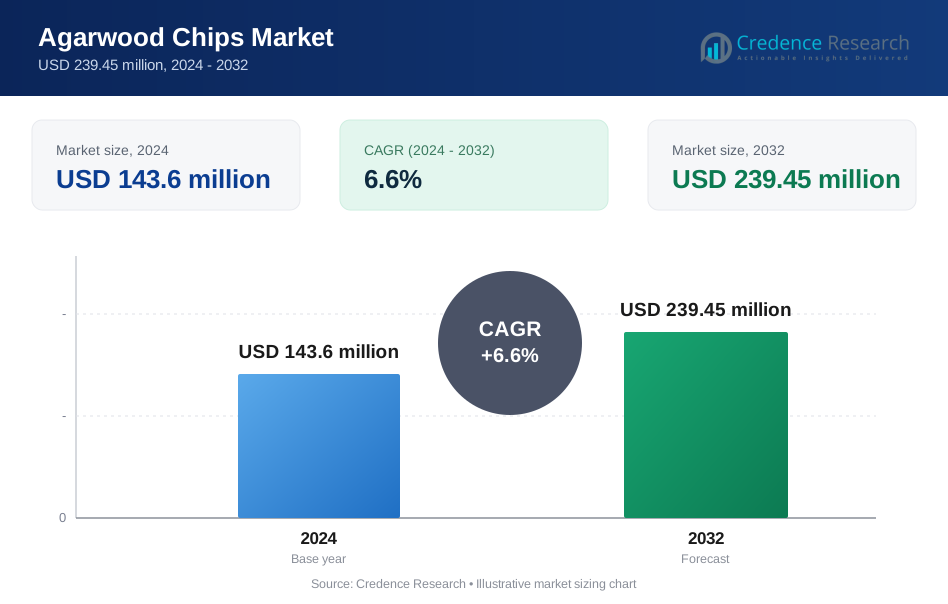
The agarwood chips market was valued at USD 143.6 million in 2024 and is projected to reach USD 239.45 million by 2032, expanding at a compound annual growth rate (CAGR) of 6.6% over the forecast period.
| REPORT ATTRIBUTE | DETAILS |
|---|---|
| Historical Period | 2020-2024 |
| Base Year | 2025 |
| Forecast Period | 2026-2032 |
| Agarwood Chips Market Size 2024 | USD 143.6 million |
| Agarwood Chips Market, CAGR | 6.6% |
| Agarwood Chips Market Size 2032 | USD 239.45 million |
Agarwood Chips Market Insights
- Market growth is primarily driven by strong religious, cultural, and ceremonial usage in Asia and the Middle East, alongside rising adoption in wellness and aromatherapy practices, with incense sticks accounting for nearly 48% of total demand due to frequent and large-volume consumption.
- Key trends include a shift toward plantation-grown agarwood, premiumization based on origin and resin content, and growing online retail penetration, while conventional agarwood chips dominate with around 65% segment share due to availability and cost efficiency.
- The competitive landscape is moderately fragmented, with players focusing on vertical integration, sustainable sourcing, quality grading, and export-oriented supply chains to differentiate offerings and secure long-term buyers.
- Regionally, Asia Pacific leads with about 58% market share, followed by the Middle East & Africa at 22%, while Europe, North America, and Latin America collectively contribute the remaining share through niche fragrance and wellness demand.
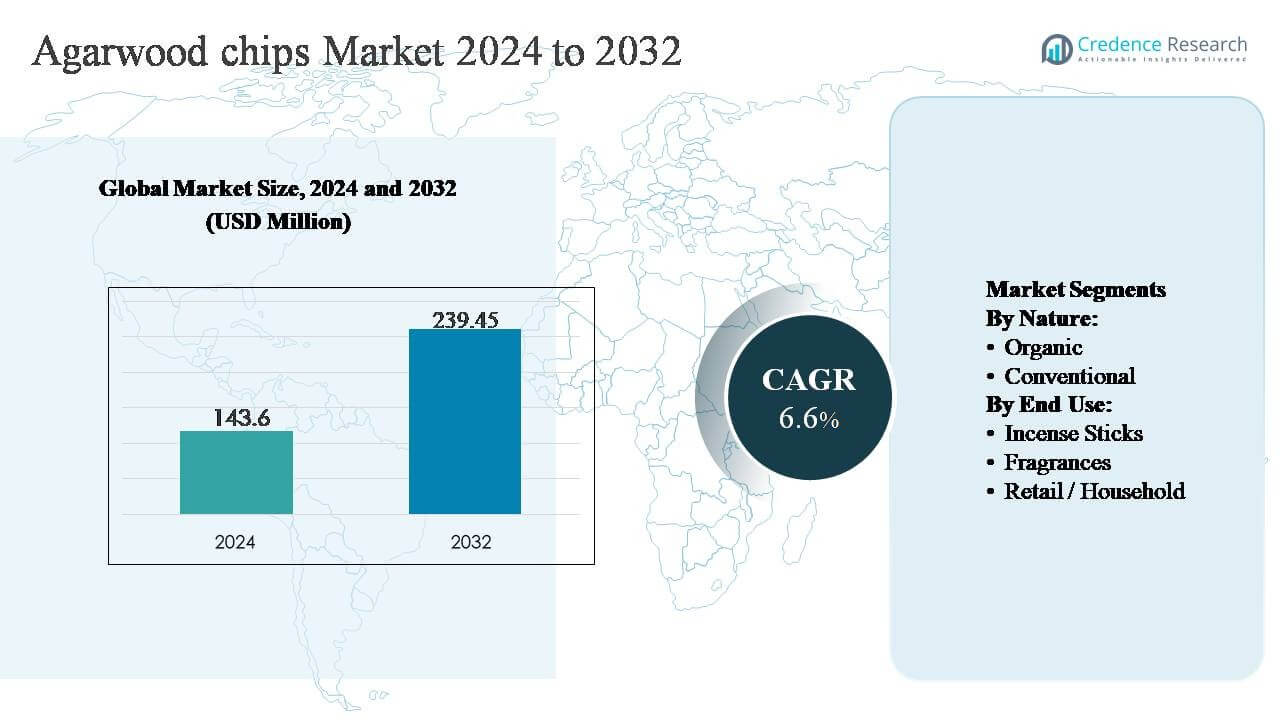
Agarwood Chips Market Segmentation Analysis:
By Nature:
By nature, conventional agarwood chips dominate the market, accounting for an estimated around 65% market share in 2024. This dominance is driven by wider availability, lower production costs, and consistent quality derived from established plantation-grown Aquilaria trees and controlled inoculation methods. Conventional chips are extensively used in bulk incense manufacturing and commercial fragrance blending, where supply reliability is critical. Organic agarwood chips, while gaining traction, remain a niche segment due to limited certified cultivation areas, longer maturation cycles, and higher prices, primarily serving premium artisanal incense makers and luxury fragrance houses.
- For instance, Asia Plantation Capital has publicly documented the use of artificial inoculation techniques on plantation-grown Aquilaria malaccensis trees where resin induction cycles are typically completed within 18-24 months, compared with significantly longer timelines in wild trees.
By End Use:
By end use, incense sticks represent the dominant sub-segment, holding approximately 48% of the agarwood chips market share. Strong cultural and religious usage across Asia, particularly in temples, households, and ceremonial practices, underpins sustained demand. Agarwood chips are preferred for their deep, long-lasting aroma and slow-burning characteristics in premium incense. Fragrances form the second-largest segment, driven by niche perfumery and attar production, while retail/household consumption continues to expand steadily through aromatherapy, home fumigation, and wellness-driven lifestyle applications.
- For instance, Hoang Giang Agarwood Ltd. operates large-scale hydro-distillation units where milled, fermented agarwood powder is processed over a continuous 50-hour extraction cycle to yield highly concentrated, premium agarwood oil. This process nets an exceptionally low yield percentage, reflecting the material’s extreme potency, scarcity, and value in luxury perfumery formulations.
Key Growth Drivers
Rising Demand from Religious, Cultural, and Ceremonial Practices
Agarwood chips continue to witness strong demand due to their deep-rooted significance in religious and cultural rituals, particularly across Asia and the Middle East. They are widely used in temples, mosques, and households for incense burning during prayers, festivals, and spiritual ceremonies. The preference for natural, long-lasting aromas over synthetic incense supports sustained consumption. In countries such as India, China, Japan, and Southeast Asia, population growth combined with revival of traditional practices reinforces demand stability. Moreover, ceremonial gifting of agarwood products during weddings and religious events further contributes to volume growth, making ritualistic usage a foundational demand pillar for the market.
- For instance,Binh Nghia Agarwood Co., Ltd. specializes in producing premium, 100% organic Vietnamese agarwood products, including hand-selected chips and oud-based incense designed for spiritual rituals and traditional gifting.
Expansion of Premium Fragrance and Perfumery Applications
The increasing use of agarwood chips in premium and niche fragrance formulations is a key growth driver. Natural agarwood aroma is highly valued in artisanal perfumes, attars, and luxury scent blends due to its complex woody, balsamic, and smoky profile. Perfumers favor chips as a raw material for distillation and infusion processes, particularly in high-end fragrance houses targeting exclusivity. Rising disposable incomes and consumer willingness to pay for authentic, natural ingredients are accelerating adoption. This driver is reinforced by global trends favoring natural and heritage-based fragrances over synthetic alternatives, positioning agarwood chips as a critical ingredient in luxury scent creation.
Growth of Wellness, Aromatherapy, and Lifestyle Consumption
The global shift toward wellness-oriented lifestyles is significantly boosting agarwood chip demand beyond traditional uses. Consumers increasingly use agarwood for meditation, stress relief, mindfulness, and indoor air purification practices. Its perceived calming and grounding properties align well with aromatherapy and holistic wellness routines. Retail availability through specialty stores and online platforms has improved access for household consumers. This expanding lifestyle usage diversifies demand sources and reduces dependence on religious consumption alone. As wellness practices gain global acceptance, agarwood chips benefit from broader demographic reach and more frequent usage cycles.
Key Trends & Opportunities
Shift Toward Plantation-Grown and Sustainably Sourced Agarwood
Sustainability concerns and regulatory controls on wild agarwood harvesting are driving a clear shift toward plantation-grown sources. Controlled cultivation and inoculation techniques allow producers to achieve consistent resin formation while complying with conservation requirements. This trend creates opportunities for scalable production, traceable supply chains, and improved quality grading. Buyers increasingly prefer responsibly sourced agarwood, especially in export markets, encouraging investments in certified plantations. As sustainable sourcing becomes a purchasing criterion, companies that integrate traceability and ethical cultivation practices gain competitive advantage.
- For instance, KAB Industries has transitioned a significant portion of its raw material intake to plantation-grown agarwood, operating controlled inoculation programs where resin induction points are drilled at 10-15 centimeter intervals along the trunk to ensure uniform resin distribution and minimize tree stress.
Premiumization and Product Differentiation
A growing trend toward premiumization is reshaping the agarwood chips market. Consumers and commercial buyers increasingly differentiate chips based on origin, resin density, aroma profile, and aging characteristics. This creates opportunities for value-added segmentation, such as single-origin chips, aged batches, and artisanal cuts. Premium positioning enables higher margins and brand loyalty, particularly in fragrance and gifting applications. Packaging innovations and storytelling around origin and craftsmanship further enhance perceived value, allowing suppliers to move beyond commodity pricing models.
- For instance,Ori Oud Asia utilizes single-origin agarwood sourced from sustainably managed plantation plots. The resinous wood is manually processed into precision-cut chips often refined into small, uniform sizes and graded based on resin density to ensure a consistent aromatic profile. This specialized selection process enables predictable fragrance performance during incense heating and high-quality oil extraction."
Expansion of E-Commerce and Direct-to-Consumer Channels
Digital platforms are emerging as an important growth opportunity for agarwood chip sales. Online channels enable small producers and specialty suppliers to reach global customers directly, bypassing traditional intermediaries. E-commerce supports education-driven selling, where aroma profiles, usage guidance, and origin details influence purchasing decisions. This trend improves market accessibility for retail and household users while supporting premium and customized offerings. As cross-border online trade expands, digital distribution is expected to play a growing role in market penetration.
Key Challenges
Supply Constraints and High Raw Material Costs
Limited availability of mature agarwood and long cultivation cycles present a major challenge for the market. Resin formation takes several years, and yields vary significantly depending on tree species and inoculation methods. These factors contribute to high and volatile raw material costs, affecting price stability. Supply constraints also limit the ability of producers to scale rapidly in response to rising demand. For small manufacturers and incense producers, inconsistent supply can disrupt production planning and margins, making supply-side management a critical challenge.
Regulatory Restrictions and Quality Authentication Issues
Strict international regulations governing agarwood trade, combined with varying national enforcement standards, create compliance challenges. Documentation requirements and export restrictions increase operational complexity and costs. Additionally, the market faces quality authentication issues, including adulteration and mislabeling of agarwood chips. Variability in grading standards makes it difficult for buyers to assess authenticity and value. These challenges impact buyer confidence, particularly in export markets, and place pressure on producers to invest in traceability, certification, and quality assurance systems.
Regional Analysis
Asia Pacific:
Asia Pacific dominates the agarwood chips market, accounting for approximately 58% of global market share in 2024. The region’s leadership is driven by deep-rooted cultural, religious, and medicinal use of agarwood across countries such as China, India, Japan, Vietnam, Thailand, and Indonesia. Strong demand from temples, households, and incense manufacturers sustains high consumption volumes. Additionally, Asia Pacific is the primary cultivation and processing hub, benefiting from favorable climatic conditions and established Aquilaria plantations. The presence of traditional fragrance industries and expanding wellness practices further reinforce the region’s market dominance.
Middle East & Africa:
The Middle East & Africa region holds an estimated 22% market share, supported by strong cultural affinity for agarwood, locally known as oud. Agarwood chips are extensively used in religious rituals, home fumigation, and luxury fragrance preparation across Saudi Arabia, the UAE, Oman, and Kuwait. High disposable incomes and preference for premium natural aromas sustain demand for high-quality chips. The region also serves as a major trading and redistribution hub for agarwood products. Africa’s share remains limited but is gradually expanding through re-export activities and growing niche fragrance consumption.
Europe:
Europe accounts for around 8% of the global agarwood chips market, driven primarily by niche applications in luxury perfumery, aromatherapy, and wellness. Countries such as France, Italy, and Germany lead regional consumption, supported by strong fragrance manufacturing capabilities and demand for natural raw materials. Agarwood chips are mainly used for distillation and artisanal scent blending rather than religious purposes. Increasing consumer preference for exotic, sustainable, and traceable ingredients is encouraging adoption. Although volumes remain moderate, Europe represents a high-value market with strong growth potential in premium fragrance and lifestyle segments.
North America:
North America represents approximately 7% of the global market share, with demand concentrated in the United States and Canada. Consumption is largely driven by aromatherapy, meditation practices, alternative wellness, and niche fragrance applications. Growing awareness of natural incense and stress-relief products supports gradual market expansion. Agarwood chips are primarily sold through specialty retailers and online platforms, catering to wellness-focused consumers. While cultural usage is limited compared to Asia, rising interest in holistic lifestyles and premium home fragrance products positions North America as a steadily growing regional market.
Latin America:
Latin America holds about 5% of the global agarwood chips market, with demand emerging mainly from wellness, spiritual practices, and boutique fragrance applications. Countries such as Brazil and Mexico contribute the largest shares, supported by expanding aromatherapy adoption and interest in natural incense products. Religious use remains limited, but household and lifestyle consumption is gradually increasing. The market is still in an early growth phase, constrained by limited awareness and higher import costs. However, rising exposure to global wellness trends is expected to support incremental demand growth across the region.
Agarwood Chips Market Segmentations:
By Nature:
- Organic
- Conventional
By End Use:
- Incense Sticks
- Fragrances
- Retail / Household
By Geography
- North America
- U.S.
- Canada
- Mexico
- Europe
- Germany
- France
- U.K.
- Italy
- Spain
- Rest of Europe
- Asia Pacific
- China
- Japan
- India
- South Korea
- South-east Asia
- Rest of Asia Pacific
- Latin America
- Brazil
- Argentina
- Rest of Latin America
- Middle East & Africa
- GCC Countries
- South Africa
- Rest of the Middle East and Africa
Competitive Landscape
The competitive landscape of the agarwood chips market is moderately fragmented, characterized by a mix of plantation operators, processors, traders, and specialty fragrance suppliers competing on quality, origin, and aroma profile. Leading players focus on securing stable raw material supply through controlled Aquilaria plantations and long-term grower partnerships to mitigate availability risks. Product differentiation is primarily driven by resin content, geographic origin, aging, and grading standards, with premium suppliers targeting incense manufacturers and luxury fragrance houses. Companies increasingly invest in traceability, sustainable sourcing practices, and compliance with international trade regulations to strengthen market credibility. Smaller artisanal producers compete through niche positioning, offering single-origin or handcrafted chips. Strategic alliances with distributors and expanding direct-to-consumer channels are common approaches to enhance market reach and capture higher margins.
Key Player Analysis
- Asia Plantation Capital Pte Ltd.
- ASSAM AROMAS
- Aalam Ul Oud
- Binh Nghia Agarwood Co., Ltd.
- Duy Hai Agarwood
- Grandawood Agarwood Australia
- Hoang Giang Agarwood Ltd.
- KAB Industries
- Ori Oud Asia
- Sadaharitha Plantations Limited
Recent Developments
- In December 01, 2025, Grandawood published a blog post on agarwood essential oil production part of their Agarwood Oud Society news section. This signals continued educational content and product positioning focused on aromatics and value-added agarwood derivatives which often relate to chips raw materials.
Report Coverage
The research report offers an in-depth analysis based on Nature, End-Use and Geography. It details leading market players, providing an overview of their business, product offerings, investments, revenue streams, and key applications. Additionally, the report includes insights into the competitive environment, SWOT analysis, current market trends, as well as the primary drivers and constraints. Furthermore, it discusses various factors that have driven market expansion in recent years. The report also explores market dynamics, regulatory scenarios, and technological advancements that are shaping the industry. It assesses the impact of external factors and global economic changes on market growth. Lastly, it provides strategic recommendations for new entrants and established companies to navigate the complexities of the market.
Request a Free Sample
Fill in your details and we'll send you a free sample report.
- Sample data tables & charts
- Research methodology
Need a Custom Version of This Report?
Tailor the scope, geography, or segments to your exact requirements.
- Custom geography or segment scope
- Direct access to our analyst team
Frequently Asked Questions
What is the current market size for Agarwood chips, and what is its projected size in 2032?
At what Compound Annual Growth Rate is the Agarwood chips market projected to grow between 2024 and 2032?
Which Agarwood chips segment held the largest share in 2024?
What are the primary factors fueling the growth of the Agarwood chips market?
Who are the leading companies in the Agarwood chips market?
Which region commanded the largest share of the Agarwood chips market in 2024?
Table of Content
Chapter 1. Report Introduction
- 1.1 Report Description & Purpose
- 1.1.1 Report Title & Market Definition
- 1.1.2 Unique Selling Propositions (USP) & Key Differentiators
- 1.1.3 Value Proposition for Stakeholders
- 1.2 Research Objectives
- 1.2.1 Market Sizing Objectives (Volume & Revenue)
- 1.2.2 Segmentation Objectives
- 1.2.3 Competitive Intelligence Objectives
- 1.2.4 Forecast & Scenario Objectives
- 1.3 Report Scope
- 1.3.1 Agarwood Chips Scope – Types & Subtypes Covered
- 1.3.2 Geographic Scope – Regions & Countries Covered
- 1.3.3 Historical Period, Base Year & Forecast Period (2024; forecast to 2032)
- 1.3.4 Inclusions & Exclusions
- 1.4 HS Code & Classification Framework
- 1.5 Currency, Units & Pricing Basis
- 1.6 Target Stakeholders
- 1.7 Limitations & Assumptions
Chapter 2. Executive Summary
- 2.1 Global Agarwood Chips Market Snapshot
- 2.1.1 Market Size – Historical (2024) & Forecast (2024-2032) (2024: USD 143.6 million → 2032: USD 239.45 million)
- 2.1.2 Volume & Revenue – Global Totals
- 2.1.3 Key Market Highlights – Top Five Facts
- 2.2 Agarwood Chips Market Segmentation Snapshot
- 2.2.1 Market Split by Region – 2024 vs. 2032
- 2.3 Competitive Snapshot
- 2.3.1 Top 10 Players by Revenue Share – 2024
- 2.3.2 Top 10 Players by Volume Share – 2024
- 2.3.3 Recent Strategic Developments (18-Month Summary)
- 2.4 Key Investment Highlights & Strategic Conclusions
Chapter 3. Agarwood Chips Market Dynamics & Industry Analysis
- 3.1 Market Overview & Context
- 3.1.1 Agarwood Chips Market Position in the Broader Automotive Value Chain
- 3.1.2 OEM vs. Replacement Market Dynamics
- 3.1.3 Market Maturity & Development Stage by Region
- 3.2 Agarwood Chips Market Drivers
- 3.3 Agarwood Chips Market Restraints & Challenges
- 3.4 Agarwood Chips Market Opportunities
- 3.5 Porter's Five Forces Analysis
- 3.5.1 Threat of New Entrants
- 3.5.2 Bargaining Power of Suppliers
- 3.5.3 Bargaining Power of Buyers
- 3.5.4 Threat of Substitutes
- 3.5.5 Competitive Rivalry – Intensity Assessment
- 3.6 Agarwood Chips Value Chain Analysis
- 3.6.1 Upstream – Raw Material/Input Suppliers
- 3.6.1.1 Raw Material/Input 1
- 3.6.1.2 Raw Material/Input 2
- 3.6.1.3 Raw Material/Input 3
- 3.6.2 Midstream – Production/Manufacturing/Service Delivery
- 3.6.2.1 Production/Process Overview
- 3.6.2.2 Key Facility Locations & Capacity by Manufacturer
- 3.6.3 Downstream – Distribution & End Consumer
- 3.6.3.1 Primary Channel – B2B/OEM
- 3.6.3.2 Secondary Channels – Dealer, Retail, Online, Direct
- 3.6.4 Value Chain Profitability Analysis
- 3.6.1 Upstream – Raw Material/Input Suppliers
- 3.7 PESTEL Analysis
- 3.7.1 Political Factors
- 3.7.2 Economic Factors
- 3.7.3 Social Factors
- 3.7.4 Technological Factors
- 3.7.5 Environmental Factors
- 3.7.6 Legal Factors
- 3.8 Agarwood Chips Supply Chain Analysis
- 3.8.1 Raw Material/Input Supply Risk Assessment
- 3.8.2 Manufacturing Concentration Risk (Geographic Exposure)
- 3.8.3 Trade Disruption Impact Analysis
- 3.9 Regulatory & Policy Landscape
Note: The regulatory and policy landscape section covers regulations based on their applicability to the market, Agarwood Chips category, geography, and scope of the study. Only regulatory frameworks with a material impact on operations, compliance, trade, sustainability, or market access are analyzed in detail.
Chapter 4. Key Investment Pockets & Opportunity Analysis
- 4.1 Agarwood Chips Market Attractiveness Analysis
- 4.1.1 By Region – Investment Attractiveness Matrix (Volume × CAGR)
- 4.2 Absolute Revenue Growth Opportunity
- 4.2.1 By Region – Absolute USD Growth Through 2032
- 4.3 Incremental Volume Opportunity
- 4.3.1 By Region – Incremental Volume Through 2032
- 4.3.2 Segment – Incremental Volume
- 4.4 Emerging Submarket Opportunity Deep Dive (Subject to Applicability)
- 4.5 Emerging Market Opportunity Scorecards
- 4.5.1 United States
- 4.5.2 Europe
- 4.5.3 Asia
- 4.5.4 Middle East & Africa
Note: Emerging Market Opportunity Scorecards will be included based on relevance and strategic importance. Regions listed are indicative and may vary depending on data availability and market dynamics.
Chapter 5. Agarwood Chips Import-Export Analysis & Trade Flows
- 5.1 Global Trade Overview
- 5.1.1 Global Export Value by Country (2024)
- 5.1.2 Global Export Volume by Country (2024)
- 5.1.3 Global Import Value by Country (2024)
- 5.1.4 Global Import Volume by Country (2024)
- 5.1.5 Net Trade Balance by Country (2024)
- 5.2 Export Analysis – Segment
- 5.2.1 Type 1 (HS Code)
- 5.2.2 Type 2 (HS Code)
- 5.2.3 Type 3 (HS Code)
- 5.2.4 Type 4 (HS Code)
- 5.2.5 Type 5 (HS Code)
- 5.3 Import Analysis – Segment
- 5.3.1 Type 1 (HS Code)
- 5.3.2 Type 2 (HS Code)
- 5.3.3 Type 3 (HS Code)
- 5.3.4 Type 4 (HS Code)
- 5.3.5 Type 5 (HS Code)
- 5.4 Average Unit Trade Prices
- 5.4.1 Average Export Price – Segment & Country
- 5.4.2 Average Import Price – Segment & Source Country
- 5.4.3 Price Trends (2024)
- 5.5 Key Trade Route Analysis
- 5.5.1 Trade Route 1
- 5.5.2 Trade Route 2
- 5.5.3 Trade Route 3
- 5.5.4 Trade Route 4
- 5.5.5 Trade Route 5
- 5.6 Trade Policy Impact Assessment
- 5.6.1 US Anti-Dumping & Section 301 Tariffs
- 5.6.2 EU Customs Union Impact
- 5.6.3 Major Free Trade Agreements
- 5.6.4 USMCA Rules of Origin
Note: Trade policy analysis will be included only where relevant to the Agarwood Chips market.
Chapter 6. Competitive Landscape & Company Benchmarking
- 6.1 Agarwood Chips Market Concentration & Structure
- 6.1.1 Herfindahl-Hirschman Index (HHI) – vs. 2024
- 6.1.2 Tier 1, Tier 2 & Tier 3 Market Structure
- 6.1.3 Global, Regional & Local Player Dynamics
- 6.2 Agarwood Chips Market Share Analysis – 2024
- 6.2.1 Global Revenue Share by Company
- 6.2.2 Global Volume Share by Company
- 6.2.3 Regional Revenue Share
- 6.2.4 Market Share Evolution ( vs. 2024)
- 6.2.5 OEM Segment Share by Company
- 6.2.6 Replacement Segment Share by Company
- 6.3 Production/Delivery Capacity & Facility Analysis
- 6.3.1 Global Installed Capacity
- 6.3.2 Capacity Utilization Rates
- 6.3.3 Production/Output Volume
- 6.3.4 Facility Locations & Capacity Map
- 6.3.5 Planned Capacity Additions
- 6.4 Agarwood Chips Competitive Benchmarking Matrix
- 6.4.1 Revenue, Volume, CAGR & Profitability Comparison
- 6.4.2 Channel Revenue Mix
- 6.4.3 Geographic Revenue Exposure
- 6.4.4 R&D Intensity
- 6.4.5 Sustainability Maturity
- 6.5 Strategic Developments in Agarwood Chips (Last 24 Months)
- 6.5.1 Mergers, Acquisitions & Divestments
- 6.5.2 New Agarwood Chips Launches
- 6.5.3 Facility Expansions
- 6.5.4 Strategic Alliances, Joint Ventures & Partnerships
- 6.5.5 Distribution Expansion & Market Entry
- 6.5.6 Sustainability & ESG Initiatives
- 6.6 Competitive Strategy Mapping
- 6.6.1 Leader, Challenger, Follower & Niche Classification
- 6.6.2 Pricing Strategy Comparison
- 6.6.3 Channel Strategy Matrix
Note: Strategic developments are included based on their materiality and the availability of reliable information.
Chapter 7. Global Agarwood Chips Market – By Distribution Channel
- 7.1 Segment Overview
- 7.1.1 Volume & Revenue Split by Channel (2024 & 2032)
- 7.1.2 Channel Mix Evolution (2024-2032)
Chapter 8. Regional Market Analysis – Global Overview
- 8.1 Global Regional Overview
- 8.1.1 Regional Volume Share
- 8.1.2 Regional Revenue Share
- 8.1.3 Regional Volume by Region
- 8.1.4 Regional Revenue by Region
- 8.1.5 Regional Forecast Through 2032
- 8.2 Cross-Regional Segment Analysis
- 8.2.1 By Distribution Channel
- 8.2.2 By Brand/Price Tier
Chapter 9. North America Agarwood Chips Market
- 9.1 United States
- 9.2 Canada
- 9.3 Mexico
Chapter 10. Europe Agarwood Chips Market
- 10.1 Germany
- 10.2 France
- 10.3 Italy
- 10.4 United Kingdom
- 10.5 Spain
- 10.6 Poland
- 10.7 Russia
- 10.8 Netherlands
- 10.9 Belgium
- 10.10 Sweden
- 10.11 Denmark
- 10.12 Norway
- 10.13 Rest of Europe
Chapter 11. Asia Pacific Agarwood Chips Market
- 11.1 China
- 11.2 India
- 11.3 Japan
- 11.4 South Korea
- 11.5 Thailand
- 11.6 Indonesia
- 11.7 Vietnam
- 11.8 Malaysia
- 11.9 Australia
- 11.10 Rest of Asia Pacific
Chapter 12. Latin America Agarwood Chips Market
- 12.1 Brazil
- 12.2 Argentina
- 12.3 Colombia
- 12.4 Chile
- 12.5 Rest of Latin America
Chapter 13. Middle East Agarwood Chips Market
- 13.1 Saudi Arabia
- 13.2 United Arab Emirates
- 13.3 Turkey
- 13.4 Israel
- 13.5 Iran
- 13.6 Rest of the Middle East
Chapter 14. Africa Agarwood Chips Market
- 14.1 South Africa
- 14.2 Egypt
- 14.3 Nigeria
- 14.4 Morocco
- 14.5 Rest of Africa
Chapter 15. Agarwood Chips Company Profiles
- 15.1 [Company 01]
- 15.1.1 Company Overview
- 15.1.2 Key Management Personnel
- 15.1.3 Products & Services Portfolio
- 15.1.4 Financial Performance
- 15.1.5 Key Market Focus & Geographic Presence
- 15.1.6 Recent Developments & Strategic Initiatives
Note: The company profile list is preliminary and may change based on research findings, market developments, data availability, and client requirements.
Chapter 16. Appendices
- Appendix A – List of Abbreviations & Acronyms
- Appendix B – Industry Classification Code Reference – Full Series
- Appendix C – Production & Capacity Data Tables
- Appendix D – End-Use & Demand Base Tables
- Appendix E – Consumption & Replacement Rate Assumptions
- Appendix F – ASP Reference Tables
- Appendix G – Manufacturing & Facility Database
- Appendix H – Import-Export Data Tables
- Appendix I – Regulatory Summary Tables
- Appendix J – Primary Research Participant List (Anonymized)
- Appendix K – Primary Research Questionnaire Framework
- Appendix L – Data Sources & Bibliography
- Appendix M – Market Size Divergence & Source Comparison
Chapter 17. Research Methodology
- 17.1 Research Framework & Philosophy
- 17.2 Secondary Research – Sources, Hierarchy & Data Extraction
- 17.3 Data Modeling – Bottom-Up & Top-Down Market Sizing
- 17.4 Primary Research – Stakeholder Framework, LOI & Sample Sizes
- 17.5 Forecast Methodology – Regression, Scenario & Sensitivity Analysis
- 17.6 Quality Control – Four-Layer Validation Framework
- 17.7 Limitations & Standard Assumptions
- 17.8 Disclaimer
