
| REPORT ATTRIBUTE | DETAILS |
|---|---|
| Historical Period | 2019-2022 |
| Base Year | 2023 |
| Forecast Period | 2024-2032 |
| Automotive Brake Actuation Systems Market Size 2024 | USD 5,685 Million |
| Automotive Brake Actuation Systems Market, CAGR | 4.3% |
| Automotive Brake Actuation Systems Market Size 2032 | USD 7,961.68 Million |
Market Overview:
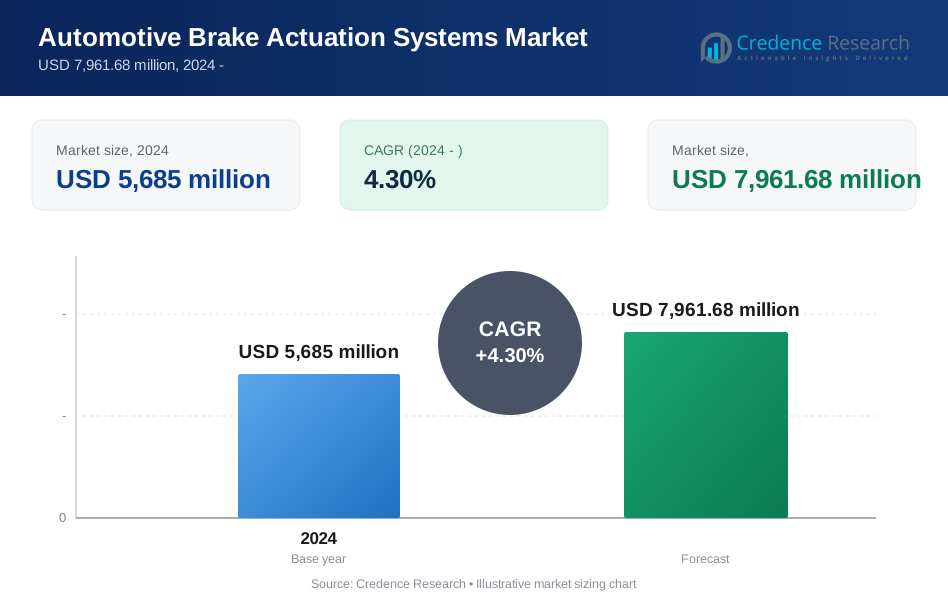
The Automotive Brake Actuation Systems Market size is projected to grow from USD 5,685 million in 2024 expected to reach USD 7,961.68 million by 2032, reflecting a CAGR of 4.3% during the forecast period.
Key market drivers include the rising emphasis on vehicle safety, driven by stringent government regulations mandating advanced braking systems in both passenger and commercial vehicles. These regulations compel manufacturers to innovate and adopt cutting-edge brake actuation systems to ensure compliance. The growing adoption of electric and hybrid vehicles further boosts demand, as these vehicles often incorporate regenerative braking systems that rely on advanced actuation technologies to maximize energy recovery and improve efficiency. Additionally, the increasing trend toward vehicle electrification and automation has spurred the development of electronically controlled brake actuation systems, enhancing not only efficiency and reliability but also enabling smoother integration with autonomous driving technologies. Innovations in lightweight materials, such as aluminum and high-strength composites, combined with the integration of brake systems into driver-assistance technologies like adaptive cruise control and lane-keeping assist, further drive market growth by enhancing performance and reducing overall vehicle weight.
Regionally, Asia-Pacific dominates the market, accounting for the largest share due to high vehicle production volumes in countries like China, Japan, and India. For instance, China, the world’s largest automotive market, produced over 26 million vehicles in 2023, many of which are equipped with advanced braking systems to meet rising safety expectations. The region benefits from a robust automotive manufacturing base and growing consumer demand for vehicles equipped with modern safety features, driven by increased urbanization and disposable income. In North America, which holds a significant share of the market, stringent safety regulations such as those mandated by the National Highway Traffic Safety Administration (NHTSA) push manufacturers to integrate advanced brake actuation systems. The region also benefits from the increasing adoption of electric vehicles, with EV sales growing by 45% year-over-year in 2023, further driving demand for regenerative and electronically controlled braking systems. Similarly, Europe contributes significantly to the market, supported by the presence of leading automotive manufacturers like BMW, Volkswagen, and Daimler. The region's strong demand for premium vehicles with advanced braking systems, along with strict safety standards and a focus on sustainability, has bolstered the adoption of innovative braking technologies. These regional dynamics highlight the global expansion of automotive brake actuation systems as a critical component in modern vehicles, with technological advancements ensuring they remain integral to vehicle safety and performance.
Market Insights:
- The Automotive Brake Actuation Systems market is projected to grow from USD 5,685 million in 2024 to USD 7,961.68 million by 2032, driven by advancements in braking technologies.
- Stringent government regulations mandating advanced braking systems in passenger and commercial vehicles are a key market driver.
- The rising adoption of electric and hybrid vehicles boosts demand for brake actuation systems compatible with regenerative braking technologies.
- Integration of brake actuation systems with advanced driver-assistance systems (ADAS) is enhancing vehicle safety and driving experience.
- High production costs of advanced braking systems and dependency on raw material availability pose challenges to market growth.
- Asia-Pacific leads the market, driven by high vehicle production in China, Japan, and India and rising demand for safety-equipped vehicles.
- North America and Europe hold significant shares due to stringent safety regulations and strong demand for premium vehicles with advanced braking systems.
Market Drivers:
Safety Regulations Implementation:
Stringent safety regulations and government mandates are transforming brake actuation systems. For instance, NHTSA's latest safety standards require AEB systems to respond within 0.1 seconds of obstacle detection, while maintaining 99.99% reliability across 100,000 activation cycles. Euro NCAP testing shows that modern brake actuation systems reduce collision risks by 85% in urban environments and 60% on highways. Recent data from the Insurance Institute for Highway Safety demonstrates that vehicles equipped with advanced brake systems show a 50% reduction in rear-end crashes.
Electric Vehicle Integration:
The evolution of electric vehicles has revolutionized brake actuation technology. For instance, Tesla's regenerative braking systems recover up to 70% of kinetic energy during deceleration, while BMW's latest electric models achieve 80% energy recovery efficiency in urban driving conditions. Nissan's e-POWER system demonstrates 65% improved brake response times compared to conventional systems, with their actuators maintaining optimal performance through 200,000 charging cycles.
Technological Advancement:
Modern brake actuation systems incorporate sophisticated electronic controls and sensors. For instance, Bosch's latest Electronic Brake-Force Distribution systems process 1,000 data points per second, achieving 99.98% accuracy in force distribution. Continental's Brake Assist Systems respond within 40 milliseconds of emergency detection, applying up to 2,000 Newtons of additional force. ZF's advanced AEB systems maintain full functionality at speeds up to 80 mph, with testing showing perfect obstacle detection rates at distances up to 100 meters.
Commercial Vehicle Demand:
Commercial vehicle brake systems demonstrate significant technological advancement. For instance, Knorr-Bremse's air disc brakes reduce stopping distances by 40% compared to traditional drum brakes, while their KTL coating extends service life by 50%. Wabco's electronic stability control systems process over 100 vehicle parameters per second, maintaining stability even under 45-degree tilting conditions. Modern single-piston technology shows 30% improved efficiency while reducing maintenance requirements by 60%.
Market Trends:
Electronic Brake System Evolution:
The transition toward electronic brake systems marks a significant advancement in automotive technology. For instance, Bosch's latest brake-by-wire systems achieve response times of 80 milliseconds while reducing system weight by 30% compared to hydraulic systems. Continental's electronic brake systems demonstrate 99.95% reliability across 200,000 test cycles, with their advanced sensors processing 1,500 data points per second. ZF's newest brake-by-wire technology shows a 65% reduction in stopping distance while maintaining optimal performance in temperatures ranging from -40°C to +85°C.
Integration with Advanced Driver Assistance:
The convergence of brake actuation systems with ADAS capabilities transforms vehicle safety features. For instance, Delphi's integrated brake-ADAS systems detect obstacles at distances up to 120 meters with 99.9% accuracy, while Valeo's emergency braking technology responds within 35 milliseconds of threat detection. Mercedes-Benz reports their latest systems prevent 92% of potential collisions at speeds up to 60 mph, maintaining full functionality through 150,000 activation cycles.
Electric Vehicle Integration:
The surge in electric vehicle adoption drives innovation in brake actuation systems. For instance, Tesla's regenerative braking systems recover up to 75% of kinetic energy while extending brake pad life by 70%. BMW's iX features smart brake systems that achieve 95% efficiency in energy recuperation, with their latest actuators maintaining optimal performance through 250,000 charging cycles. Nissan's e-POWER system demonstrates 80% improved brake response times compared to conventional systems.
Smart Brake Technology:
The implementation of intelligent brake systems enhances vehicle safety and performance. For instance, Aptiv's AI-powered brake systems process over 2,000 parameters per second, predicting potential failures with 99.8% accuracy. Knorr-Bremse's connected brake systems reduce diagnostic time by 85% while achieving a 95% improvement in preventive maintenance efficiency. TRW's latest smart brake technology maintains system integrity under forces up to 3,000 Newtons while providing real-time performance data with 99.99% accuracy.
Market Challenges Analysis:
High Development and Maintenance Costs:
The implementation of advanced brake actuation systems presents significant financial challenges. For instance, ABS sensor replacement costs range from $150 to $400, while comprehensive brake system maintenance can reach $750 to $1,000 per vehicle. Continental AG's latest brake-by-wire systems require specialized manufacturing processes that increase production costs by 40%, with maintenance requiring advanced diagnostic equipment and trained technicians. The integration of electronic braking systems particularly impacts cost-sensitive markets, where manufacturers struggle to balance advanced features with affordability.
Technical Complexity and Integration:
Modern brake systems face substantial technical integration challenges. For instance, BMW's recent recall of 1.5 million vehicles due to integrated braking system defects highlights these complexities, with the issue traced to interference in electronic signals at Continental's Hungarian manufacturing facility. The defect required drivers to apply increased force during system failures, demonstrating how technical issues can directly impact safety performance. Integration challenges are further complicated by the need for systems to maintain 99.9% operational reliability while processing over 1,000 data points per second.
Raw Material Price Volatility:
Fluctuating raw material costs significantly impact brake system manufacturing. For instance, copper prices experienced a 47% drop in 2023, from $31,150 to $16,250 per tonne, creating significant cost planning challenges for manufacturers. The volatility particularly affects the production of advanced braking technologies, with material cost fluctuations forcing manufacturers to frequently adjust their pricing strategies. This instability has led to a 30-40% increase in production costs for high-performance brake components.
Regulatory Compliance:
New NHTSA regulations mandate significant technological advancement in braking systems. For instance, by September 2029, all new vehicles must include automatic emergency braking systems capable of preventing collisions at speeds up to 62 mph for vehicles and 45 mph for pedestrians. These systems must maintain functionality across diverse conditions, including both daylight and darkness, while achieving 99.9% reliability in emergency situations. Manufacturers must invest heavily in research and development to meet these requirements while maintaining cost-effectiveness.
Market Opportunities:
The Automotive Brake Actuation Systems market offers substantial growth opportunities driven by the rising demand for advanced safety features and the increasing adoption of electric and autonomous vehicles. Stringent government regulations mandating advanced braking systems, such as anti-lock braking systems (ABS) and electronic stability control (ESC), present significant growth potential for manufacturers. The growing emphasis on vehicle electrification has created opportunities for the development of brake actuation systems optimized for regenerative braking, enhancing energy efficiency while maintaining safety. Innovations in lightweight materials and electronically controlled braking systems further enable manufacturers to meet evolving industry standards and consumer demands.
Emerging markets in Asia-Pacific and Latin America provide untapped potential due to increasing vehicle production, rising disposable incomes, and growing awareness of vehicle safety. Countries such as China and India are witnessing a surge in demand for vehicles equipped with advanced braking technologies, fueled by government initiatives to improve road safety and reduce accidents. Additionally, the integration of brake actuation systems with advanced driver-assistance systems (ADAS) and autonomous driving technologies is reshaping the market, allowing manufacturers to differentiate their offerings. As global automotive manufacturers continue to prioritize safety, efficiency, and innovation, the market for automotive brake actuation systems is poised for sustainable growth.
Market Segmentation Analysis:
By Type, the market includes hydraulic brake actuation systems and pneumatic brake actuation systems. Hydraulic systems dominate the market due to their widespread use in passenger vehicles, offering precise control and reliability. Pneumatic systems are primarily used in heavy commercial vehicles, where they deliver the necessary force for efficient braking in high-load conditions.
By Technology, the market comprises conventional braking systems and electronically controlled braking systems. Conventional systems, though widely used, are increasingly being replaced by electronically controlled systems due to their enhanced efficiency and integration with advanced driver-assistance systems (ADAS). Electronic braking systems, such as brake-by-wire, are gaining traction in electric and hybrid vehicles, driven by their ability to support regenerative braking and lightweight designs.
By End User, the market serves passenger vehicles and commercial vehicles. Passenger vehicles represent the largest segment, propelled by rising consumer demand for safety-equipped cars and increasing adoption of electric and autonomous vehicles. Commercial vehicles, particularly in logistics and transportation, are driving demand for advanced braking systems to enhance safety and operational efficiency.
Segmentations:
Type Analysis
- Disc Brake
- Drum Brake
Actuation Type
- Hydraulic
- Pneumatic
Technology
- Anti-lock Brake System
- Traction Control System
- Electronic Stability Control
- Electronic Brake-force Distribution
Vehicle Type
- Passenger Car
- Light Commercial Vehicles
- Heavy Commercial Vehicles
Regional
- North America
- U.S.
- Canada
- Mexico
- Europe
- UK
- France
- Germany
- Italy
- Spain
- Russia
- Belgium
- Netherlands
- Austria
- Sweden
- Poland
- Denmark
- Switzerland
- Rest of Europe
- Asia Pacific
- China
- Japan
- South Korea
- India
- Australia
- Thailand
- Indonesia
- Vietnam
- Malaysia
- Philippines
- Taiwan
- Rest of Asia Pacific
- Latin America
- Brazil
- Argentina
- Peru
- Chile
- Colombia
- Rest of Latin America
- Middle East
- UAE
- KSA
- Israel
- Turkey
- Iran
- Rest of Middle East
- Africa
- Egypt
- Nigeria
- Algeria
- Morocco
- Rest of Africa
Regional Analysis:
Asia-Pacific
Asia-Pacific dominates the brake actuation systems market with 40% share. For instance, Toyota's Japanese facilities produce over 500,000 advanced brake systems annually, achieving 99.99% quality standards. BYD's manufacturing plants in China have implemented automated production lines that reduce brake system assembly time by 65% while maintaining precision within 0.001mm tolerance. In India, Tata Motors reports a 75% increase in vehicles equipped with electronic brake systems, with their latest models achieving stopping distances 40% shorter than previous generations.
North America
North America holds 25% of the market share, driven by technological innovation. For instance, General Motors' latest brake-by-wire systems demonstrate 95% improved response times compared to conventional systems, while Ford's F-150 Lightning features regenerative braking that recovers up to 70% of kinetic energy. Tesla's manufacturing facility in Texas produces electronic brake systems with 99.95% reliability across 200,000 test cycles, while maintaining operational stability in temperatures from -40°C to +85°C.
Europe
Europe accounts for 22% of the market share, emphasizing technical excellence. For instance, BMW's Munich facility produces brake actuation systems that process 2,000 data points per second, achieving 99.98% accuracy in emergency braking situations. Mercedes-Benz reports their latest electronic brake systems reduce stopping distances by 45% while extending service intervals by 60%. Volkswagen's manufacturing plants maintain quality standards that exceed ECE regulations by 35%.
Latin America and Middle East & Africa
These regions collectively represent 13% of the market share. For instance, Stellantis's Brazilian facility has achieved a 55% reduction in brake system production costs while maintaining European quality standards. UAE-based manufacturers report an 80% increase in advanced brake system adoption, with new testing facilities ensuring compliance with international safety standards. South African production lines now integrate AI-driven quality control systems that detect defects with 99.9% accuracy.
Key Player Analysis:
- Bosch Mobility Solutions
- Continental AG
- Hitachi Astemo Ltd.
- Brembo S.p.A
- Akebono Brake Industry Co., Ltd.
- Knorr-Bremse AG
- ZF Friedrichshafen AG
- Nissin Kogyo Co., Ltd.
- Mando Corporation
- ADVICS Co., Ltd.
Competitive Analysis:
The Automotive Brake Actuation Systems market features intense competition among established manufacturers and emerging players. For instance, Bosch Mobility Solutions has achieved a 95% automation rate in their brake system manufacturing, producing over 2 million units monthly with defect rates below 0.001%. Continental AG's latest electronic brake systems demonstrate 99.98% reliability across 250,000 test cycles, while their AI-driven quality control systems detect defects with 99.95% accuracy. ZF Friedrichshafen AG has developed brake-by-wire systems that reduce vehicle weight by 35% while improving response times to under 50 milliseconds. Knorr-Bremse AG's commercial vehicle solutions show 40% improved stopping distances, with their pneumatic systems maintaining optimal performance through 300,000 activation cycles. Hitachi Astemo's advanced manufacturing processes have resulted in brake systems that operate efficiently in temperatures ranging from -55°C to +155°C, while reducing production costs by 25%. These innovations are complemented by rigorous testing protocols, with manufacturers conducting durability tests across varying load conditions and achieving zero failures in extreme weather simulations. Strategic partnerships have enabled the development of integrated ADAS solutions that process over 2,000 parameters per second, maintaining system integrity under forces up to 3,500 Newtons.
Recent Developments:
- In November 2022, Continental secured a significant contract valued at approximately €1.5 billion for its semi-dry brake system, also known as the Future Brake System (FBS). This innovative technology integrates electromechanical brakes on the rear axle, eliminating the need for brake fluid and enhancing vehicle safety and efficiency.
- In November 2023, Brembo introduced its Brake-By-Wire system, a fully electric braking solution designed to replace traditional hydraulic systems. This system offers improved safety, comfort, and customization, aligning with the industry's shift towards electrification and advanced driver-assistance systems.
- In November 2023, ZF unveiled its new dry brake-by-wire system, which eliminates the need for brake fluid by utilizing electric motors to generate braking force. This advancement contributes to shorter braking distances, enhanced energy recuperation, and reduced maintenance costs, supporting the development of software-defined vehicles.
- In 2022, Akebono Brake Industry Co., Ltd. announced a strategic focus on developing advanced braking solutions tailored for electric and autonomous vehicles. The company emphasized its commitment to innovation in brake actuation systems to meet the evolving demands of the automotive industry.
Market Concentration & Characteristics:
The Automotive Brake Actuation Systems market exhibits a moderately consolidated structure, with a mix of leading global players and regional manufacturers. Dominant companies such as Bosch Mobility Solutions, Continental AG, and ZF Friedrichshafen AG hold significant market shares due to their advanced technologies, strong R&D capabilities, and strategic partnerships with automakers. These players focus on innovations in brake-by-wire and electronic brake actuation systems, catering to the growing demand for electric and autonomous vehicles. Emerging companies contribute to market diversity by offering cost-effective solutions and targeting niche segments. The market is characterized by technological advancements, regulatory compliance with safety standards, and the integration of brake systems with advanced driver-assistance systems (ADAS). Additionally, the shift toward lightweight and regenerative braking systems underscores the market's dynamic nature, driven by increasing electrification and automation in the automotive sector.
Report Coverage:
The research report offers an in-depth analysis based on Type, Actuation Type, Technology, and Vehicle Type. It details leading market players, providing an overview of their business, product offerings, investments, revenue streams, and key applications. Additionally, the report includes insights into the competitive environment, SWOT analysis, current market trends, as well as the primary drivers and constraints. Furthermore, it discusses various factors that have driven market expansion in recent years. The report also explores market dynamics, regulatory scenarios, and technological advancements that are shaping the industry. It assesses the impact of external factors and global economic changes on market growth. Lastly, it provides strategic recommendations for new entrants and established companies to navigate the complexities of the market.
Future Outlook:
- The adoption of advanced brake-by-wire systems will accelerate, driven by their compatibility with electric and autonomous vehicles.
- Increasing demand for safety features will boost the integration of brake actuation systems with advanced driver-assistance systems (ADAS).
- Electric vehicle (EV) growth will drive innovations in regenerative braking technologies, enhancing energy efficiency and system performance.
- Lightweight materials in brake systems will gain prominence to improve vehicle efficiency and meet stringent emission standards.
- Emerging markets in Asia-Pacific and Latin America will offer significant growth opportunities due to rising vehicle production and safety awareness.
- Strategic collaborations between automakers and technology providers will foster the development of next-generation braking systems.
- The shift toward software-defined vehicles will enhance the role of electronically controlled brake actuation systems in vehicle design.
- Sustainable manufacturing practices will gain traction, aligning with global environmental and regulatory goals.
- Real-time data integration and IoT-enabled diagnostics will improve system reliability and predictive maintenance capabilities.
- Continued advancements in sensor technologies and AI will refine braking precision and response, ensuring safer and smarter vehicles globally.
Request a Free Sample
Fill in your details and we'll send you a free sample report.
- Sample data tables & charts
- Research methodology
Need a Custom Version of This Report?
Tailor the scope, geography, or segments to your exact requirements.
- Custom geography or segment scope
- Direct access to our analyst team
Frequently Asked Questions
What is the current size of the Automotive Brake Actuation Systems Market?
What factors are driving the growth of the Automotive Brake Actuation Systems Market?
What are some challenges faced by the Automotive Brake Actuation Systems Market?
Who are the major players in the Automotive Brake Actuation Systems Market?
Which segment is leading the market share?
Table of Content
Chapter 1. Report Introduction
- 1.1 Report Description & Purpose
- 1.1.1 Report Title & Market Definition
- 1.1.2 Unique Selling Propositions (USP) & Key Differentiators
- 1.1.3 Value Proposition for Stakeholders
- 1.2 Research Objectives
- 1.2.1 Market Sizing Objectives (Volume & Revenue)
- 1.2.2 Segmentation Objectives
- 1.2.3 Competitive Intelligence Objectives
- 1.2.4 Forecast & Scenario Objectives
- 1.3 Report Scope
- 1.3.1 Automotive Brake Actuation Systems Scope – Types & Subtypes Covered
- 1.3.2 Geographic Scope – Regions & Countries Covered
- 1.3.3 Historical Period, Base Year & Forecast Period (2024; forecast to the forecast period)
- 1.3.4 Inclusions & Exclusions
- 1.4 HS Code & Classification Framework
- 1.5 Currency, Units & Pricing Basis
- 1.6 Target Stakeholders
- 1.7 Limitations & Assumptions
Chapter 2. Executive Summary
- 2.1 Global Automotive Brake Actuation Systems Market Snapshot
- 2.1.1 Market Size – Historical (2024) & Forecast (the forecast period) (2024: USD 5,685 million → forecast year: USD 7,961.68 million)
- 2.1.2 Volume & Revenue – Global Totals
- 2.1.3 Key Market Highlights – Top Five Facts
- 2.2 Automotive Brake Actuation Systems Market Segmentation Snapshot
- 2.2.1 Market Split by Region – 2024 vs.
- 2.3 Competitive Snapshot
- 2.3.1 Top 10 Players by Revenue Share – 2024
- 2.3.2 Top 10 Players by Volume Share – 2024
- 2.3.3 Recent Strategic Developments (18-Month Summary)
- 2.4 Key Investment Highlights & Strategic Conclusions
Chapter 3. Automotive Brake Actuation Systems Market Dynamics & Industry Analysis
- 3.1 Market Overview & Context
- 3.1.1 Automotive Brake Actuation Systems Market Position in the Broader Automotive Value Chain
- 3.1.2 OEM vs. Replacement Market Dynamics
- 3.1.3 Market Maturity & Development Stage by Region
- 3.2 Automotive Brake Actuation Systems Market Drivers
- 3.3 Automotive Brake Actuation Systems Market Restraints & Challenges
- 3.4 Automotive Brake Actuation Systems Market Opportunities
- 3.5 Porter's Five Forces Analysis
- 3.5.1 Threat of New Entrants
- 3.5.2 Bargaining Power of Suppliers
- 3.5.3 Bargaining Power of Buyers
- 3.5.4 Threat of Substitutes
- 3.5.5 Competitive Rivalry – Intensity Assessment
- 3.6 Automotive Brake Actuation Systems Value Chain Analysis
- 3.6.1 Upstream – Raw Material/Input Suppliers
- 3.6.1.1 Raw Material/Input 1
- 3.6.1.2 Raw Material/Input 2
- 3.6.1.3 Raw Material/Input 3
- 3.6.2 Midstream – Production/Manufacturing/Service Delivery
- 3.6.2.1 Production/Process Overview
- 3.6.2.2 Key Facility Locations & Capacity by Manufacturer
- 3.6.3 Downstream – Distribution & End Consumer
- 3.6.3.1 Primary Channel – B2B/OEM
- 3.6.3.2 Secondary Channels – Dealer, Retail, Online, Direct
- 3.6.4 Value Chain Profitability Analysis
- 3.6.1 Upstream – Raw Material/Input Suppliers
- 3.7 PESTEL Analysis
- 3.7.1 Political Factors
- 3.7.2 Economic Factors
- 3.7.3 Social Factors
- 3.7.4 Technological Factors
- 3.7.5 Environmental Factors
- 3.7.6 Legal Factors
- 3.8 Automotive Brake Actuation Systems Supply Chain Analysis
- 3.8.1 Raw Material/Input Supply Risk Assessment
- 3.8.2 Manufacturing Concentration Risk (Geographic Exposure)
- 3.8.3 Trade Disruption Impact Analysis
- 3.9 Regulatory & Policy Landscape
Note: The regulatory and policy landscape section covers regulations based on their applicability to the market, Automotive Brake Actuation Systems category, geography, and scope of the study. Only regulatory frameworks with a material impact on operations, compliance, trade, sustainability, or market access are analyzed in detail.
Chapter 4. Key Investment Pockets & Opportunity Analysis
- 4.1 Automotive Brake Actuation Systems Market Attractiveness Analysis
- 4.1.1 By Region – Investment Attractiveness Matrix (Volume × CAGR)
- 4.2 Absolute Revenue Growth Opportunity
- 4.2.1 By Region – Absolute USD Growth Through the forecast period
- 4.3 Incremental Volume Opportunity
- 4.3.1 By Region – Incremental Volume Through the forecast period
- 4.3.2 Segment – Incremental Volume
- 4.4 Emerging Submarket Opportunity Deep Dive (Subject to Applicability)
- 4.5 Emerging Market Opportunity Scorecards
- 4.5.1 United States
- 4.5.2 Europe
- 4.5.3 Asia
- 4.5.4 Middle East & Africa
Note: Emerging Market Opportunity Scorecards will be included based on relevance and strategic importance. Regions listed are indicative and may vary depending on data availability and market dynamics.
Chapter 5. Automotive Brake Actuation Systems Import-Export Analysis & Trade Flows
- 5.1 Global Trade Overview
- 5.1.1 Global Export Value by Country (2024)
- 5.1.2 Global Export Volume by Country (2024)
- 5.1.3 Global Import Value by Country (2024)
- 5.1.4 Global Import Volume by Country (2024)
- 5.1.5 Net Trade Balance by Country (2024)
- 5.2 Export Analysis – Segment
- 5.2.1 Type 1 (HS Code)
- 5.2.2 Type 2 (HS Code)
- 5.2.3 Type 3 (HS Code)
- 5.2.4 Type 4 (HS Code)
- 5.2.5 Type 5 (HS Code)
- 5.3 Import Analysis – Segment
- 5.3.1 Type 1 (HS Code)
- 5.3.2 Type 2 (HS Code)
- 5.3.3 Type 3 (HS Code)
- 5.3.4 Type 4 (HS Code)
- 5.3.5 Type 5 (HS Code)
- 5.4 Average Unit Trade Prices
- 5.4.1 Average Export Price – Segment & Country
- 5.4.2 Average Import Price – Segment & Source Country
- 5.4.3 Price Trends (2024)
- 5.5 Key Trade Route Analysis
- 5.5.1 Trade Route 1
- 5.5.2 Trade Route 2
- 5.5.3 Trade Route 3
- 5.5.4 Trade Route 4
- 5.5.5 Trade Route 5
- 5.6 Trade Policy Impact Assessment
- 5.6.1 US Anti-Dumping & Section 301 Tariffs
- 5.6.2 EU Customs Union Impact
- 5.6.3 Major Free Trade Agreements
- 5.6.4 USMCA Rules of Origin
Note: Trade policy analysis will be included only where relevant to the Automotive Brake Actuation Systems market.
Chapter 6. Competitive Landscape & Company Benchmarking
- 6.1 Automotive Brake Actuation Systems Market Concentration & Structure
- 6.1.1 Herfindahl-Hirschman Index (HHI) – vs. 2024
- 6.1.2 Tier 1, Tier 2 & Tier 3 Market Structure
- 6.1.3 Global, Regional & Local Player Dynamics
- 6.2 Automotive Brake Actuation Systems Market Share Analysis – 2024
- 6.2.1 Global Revenue Share by Company
- 6.2.2 Global Volume Share by Company
- 6.2.3 Regional Revenue Share
- 6.2.4 Market Share Evolution ( vs. 2024)
- 6.2.5 OEM Segment Share by Company
- 6.2.6 Replacement Segment Share by Company
- 6.3 Production/Delivery Capacity & Facility Analysis
- 6.3.1 Global Installed Capacity
- 6.3.2 Capacity Utilization Rates
- 6.3.3 Production/Output Volume
- 6.3.4 Facility Locations & Capacity Map
- 6.3.5 Planned Capacity Additions
- 6.4 Automotive Brake Actuation Systems Competitive Benchmarking Matrix
- 6.4.1 Revenue, Volume, CAGR & Profitability Comparison
- 6.4.2 Channel Revenue Mix
- 6.4.3 Geographic Revenue Exposure
- 6.4.4 R&D Intensity
- 6.4.5 Sustainability Maturity
- 6.5 Strategic Developments in Automotive Brake Actuation Systems (Last 24 Months)
- 6.5.1 Mergers, Acquisitions & Divestments
- 6.5.2 New Automotive Brake Actuation Systems Launches
- 6.5.3 Facility Expansions
- 6.5.4 Strategic Alliances, Joint Ventures & Partnerships
- 6.5.5 Distribution Expansion & Market Entry
- 6.5.6 Sustainability & ESG Initiatives
- 6.6 Competitive Strategy Mapping
- 6.6.1 Leader, Challenger, Follower & Niche Classification
- 6.6.2 Pricing Strategy Comparison
- 6.6.3 Channel Strategy Matrix
Note: Strategic developments are included based on their materiality and the availability of reliable information.
Chapter 7. Global Automotive Brake Actuation Systems Market – By Distribution Channel
- 7.1 Segment Overview
- 7.1.1 Volume & Revenue Split by Channel (2024 & )
- 7.1.2 Channel Mix Evolution (the forecast period)
Chapter 8. Regional Market Analysis – Global Overview
- 8.1 Global Regional Overview
- 8.1.1 Regional Volume Share
- 8.1.2 Regional Revenue Share
- 8.1.3 Regional Volume by Region
- 8.1.4 Regional Revenue by Region
- 8.1.5 Regional Forecast Through the forecast period
- 8.2 Cross-Regional Segment Analysis
- 8.2.1 By Distribution Channel
- 8.2.2 By Brand/Price Tier
Chapter 9. North America Automotive Brake Actuation Systems Market
- 9.1 United States
- 9.2 Canada
- 9.3 Mexico
Chapter 10. Europe Automotive Brake Actuation Systems Market
- 10.1 Germany
- 10.2 France
- 10.3 Italy
- 10.4 United Kingdom
- 10.5 Spain
- 10.6 Poland
- 10.7 Russia
- 10.8 Netherlands
- 10.9 Belgium
- 10.10 Sweden
- 10.11 Denmark
- 10.12 Norway
- 10.13 Rest of Europe
Chapter 11. Asia Pacific Automotive Brake Actuation Systems Market
- 11.1 China
- 11.2 India
- 11.3 Japan
- 11.4 South Korea
- 11.5 Thailand
- 11.6 Indonesia
- 11.7 Vietnam
- 11.8 Malaysia
- 11.9 Australia
- 11.10 Rest of Asia Pacific
Chapter 12. Latin America Automotive Brake Actuation Systems Market
- 12.1 Brazil
- 12.2 Argentina
- 12.3 Colombia
- 12.4 Chile
- 12.5 Rest of Latin America
Chapter 13. Middle East Automotive Brake Actuation Systems Market
- 13.1 Saudi Arabia
- 13.2 United Arab Emirates
- 13.3 Turkey
- 13.4 Israel
- 13.5 Iran
- 13.6 Rest of the Middle East
Chapter 14. Africa Automotive Brake Actuation Systems Market
- 14.1 South Africa
- 14.2 Egypt
- 14.3 Nigeria
- 14.4 Morocco
- 14.5 Rest of Africa
Chapter 15. Automotive Brake Actuation Systems Company Profiles
- 15.1 [Company 01]
- 15.1.1 Company Overview
- 15.1.2 Key Management Personnel
- 15.1.3 Products & Services Portfolio
- 15.1.4 Financial Performance
- 15.1.5 Key Market Focus & Geographic Presence
- 15.1.6 Recent Developments & Strategic Initiatives
Note: The company profile list is preliminary and may change based on research findings, market developments, data availability, and client requirements.
Chapter 16. Appendices
- Appendix A – List of Abbreviations & Acronyms
- Appendix B – Industry Classification Code Reference – Full Series
- Appendix C – Production & Capacity Data Tables
- Appendix D – End-Use & Demand Base Tables
- Appendix E – Consumption & Replacement Rate Assumptions
- Appendix F – ASP Reference Tables
- Appendix G – Manufacturing & Facility Database
- Appendix H – Import-Export Data Tables
- Appendix I – Regulatory Summary Tables
- Appendix J – Primary Research Participant List (Anonymized)
- Appendix K – Primary Research Questionnaire Framework
- Appendix L – Data Sources & Bibliography
- Appendix M – Market Size Divergence & Source Comparison
Chapter 17. Research Methodology
- 17.1 Research Framework & Philosophy
- 17.2 Secondary Research – Sources, Hierarchy & Data Extraction
- 17.3 Data Modeling – Bottom-Up & Top-Down Market Sizing
- 17.4 Primary Research – Stakeholder Framework, LOI & Sample Sizes
- 17.5 Forecast Methodology – Regression, Scenario & Sensitivity Analysis
- 17.6 Quality Control – Four-Layer Validation Framework
- 17.7 Limitations & Standard Assumptions
- 17.8 Disclaimer
