| REPORT ATTRIBUTE | DETAILS |
|---|---|
| Historical Period | 2020-2023 |
| Base Year | 2024 |
| Forecast Period | 2025-2032 |
| Automotive Door Guards MarketSize 2024 | USD 442.77 million |
| Automotive Door Guards Market, CAGR | 6.15% |
| Automotive Door Guards Market Size 2032 | USD 738.72 million |
Market Overview:
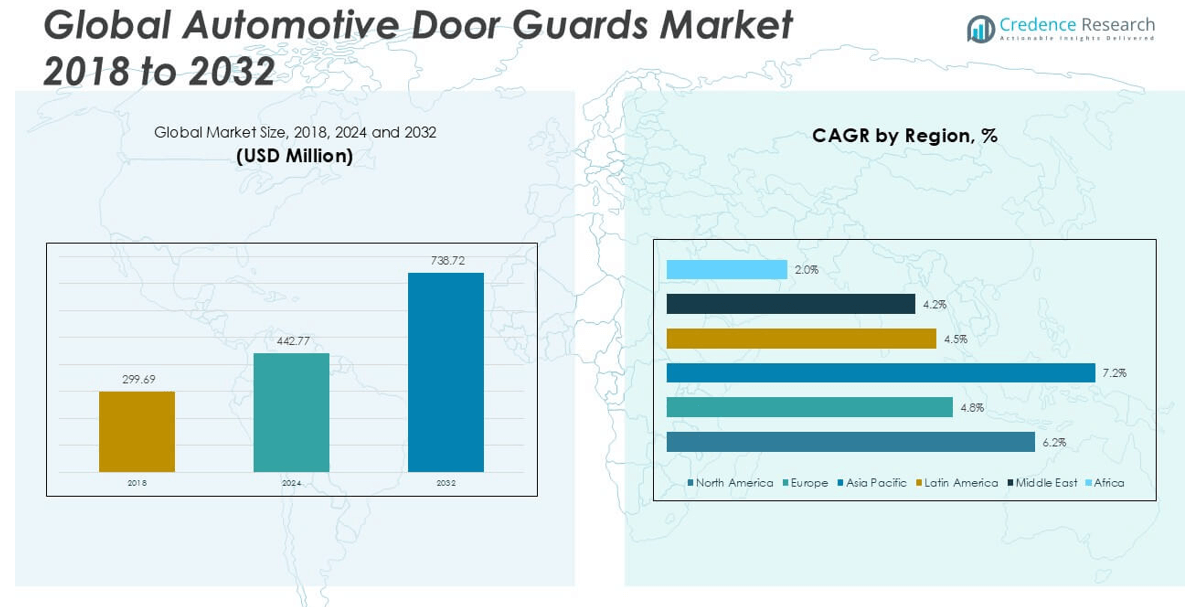
The Automotive Door Guards Market size was valued at USD 299.69 million in 2018, grew to USD 442.77 million in 2024, and is anticipated to reach USD 738.72 million by 2032, at a CAGR of 6.15% during the forecast period.
The Automotive Door Guards market features several key players, including TS Tech Co., Ltd., Calsonic Kansei Corp, Toyo Seat Co., Ltd., Autoneum, Yanfeng Automotive Interiors, Compagnie Plastic Omnium, DuPont, Magna International Inc., Inergy Automotive Systems LLC, and Toyota Boshoku Corporation. These companies lead the market through innovation in lightweight materials, strategic partnerships, and a strong presence in both OEM and aftermarket channels. Asia Pacific is the dominant regional market, accounting for 31.6% of the global share in 2018, driven by high vehicle production and rising consumer demand in China and India. North America follows with a 41.2% share, reflecting its mature automotive ecosystem and high demand for vehicle protection accessories.
Market Insights
- The Automotive Door Guards market was valued at USD 299.69 million in 2018, reached USD 442.77 million in 2024, and is projected to reach USD 738.72 million by 2032, growing at a CAGR of 6.15% during the forecast period.
- Growing vehicle production and ownership, especially in emerging markets, is a primary driver, increasing demand for protective and aesthetic accessories like door guards.
- Market trends highlight a shift toward lightweight materials such as plastic composites and aluminum, aligning with fuel efficiency goals and EV adoption.
- The market is highly competitive with major players like DuPont, Magna International Inc., Yanfeng Automotive Interiors, and TS Tech Co., Ltd., focusing on product innovation and OEM partnerships.
- Asia Pacific holds the highest regional share at 31.6%, followed by North America at 41.2%, while the Passenger Car segment leads in vehicle type due to high personal vehicle usage.
Market Segmentation Analysis:
By Vehicle Type:
In the Automotive Door Guards market, the Passenger Car segment holds the largest market share, driven by the global surge in personal vehicle ownership and growing consumer demand for enhanced vehicle aesthetics and protection. Increased production of sedans and hatchbacks, especially in emerging economies, has amplified the need for cost-effective and durable door guard solutions. Light Commercial Vehicles (LCVs) and Heavy Commercial Vehicles (HCVs) follow, with rising adoption in fleet and logistics operations. Battery Electric Vehicles (BEVs) and Hybrid Electric Vehicles (HEVs) are witnessing increasing demand due to the global shift toward sustainable transportation, further contributing to market expansion.
- For instance, Toyota Motor Corporation reported production of over 10,438,000 vehicles globally in FY2023, including a significant share of sedans and hybrids such as the Prius, which drive the need for protective accessories like door guards across key markets.
By Material Type
Among material types, Plastic Composites dominate the Automotive Door Guards market owing to their lightweight nature, cost efficiency, and high resistance to corrosion and impact. These materials offer design flexibility and are widely used in both premium and economy vehicles. Steel retains a significant market share due to its durability and structural strength, particularly in heavy-duty applications. Aluminum is gaining traction as a preferred material in electric and hybrid vehicles due to its weight reduction benefits, which help improve fuel efficiency and vehicle performance. Growing emphasis on material innovation continues to drive demand across all categories.
- For instance, BASF produced approximately 2.3 million metric tons of performance materials in 2023, including advanced plastic composites like Ultramid® and Ultradur®, which are extensively used in automotive components, including door protection systems for manufacturers such as BMW and Daimler.
By Application
The Front Side Door application segment leads the market, accounting for the highest revenue share, as front doors are most exposed to external impact and commonly accessed by drivers and passengers. Automakers and aftermarket suppliers prioritize protective components for front doors to reduce repair costs and enhance vehicle aesthetics. The Rear Side Doors segment also sees steady growth, particularly in multi-passenger vehicles and urban mobility solutions, where full-body protection is crucial. Increased consumer focus on vehicle safety and rising awareness of minor impact protection continue to bolster demand across both application segments.
Market Overview
Rising Vehicle Ownership and Automotive Production
The global increase in vehicle ownership, particularly in emerging economies, is a major growth driver for the automotive door guards market. Rapid urbanization, improved living standards, and expanding middle-class populations have fueled demand for passenger and light commercial vehicles. This growing automotive fleet requires enhanced protection solutions, such as door guards, to prevent damage from frequent use and parking incidents. As automotive production scales up to meet this demand, OEMs and aftermarket players are investing in durable and aesthetically appealing door guard products, supporting consistent market expansion.
- For instance, Hyundai Motor Company reported global sales of 4,216,680 vehicles in 2023, marking a significant year-over-year increase in production output, especially in high-demand regions such as India and Southeast Asia, where door protection accessories are commonly added to new vehicle purchases.
Growing Emphasis on Vehicle Safety and Aesthetics
Consumers are increasingly prioritizing vehicle safety and appearance, encouraging manufacturers to integrate protective accessories like door guards. These components help prevent dents, scratches, and corrosion from door impacts, improving the long-term durability and resale value of vehicles. In addition to protection, automotive door guards now serve aesthetic functions, available in varied materials, colors, and finishes. This dual-purpose utility is prompting both OEMs and aftermarket providers to innovate and expand their product lines, meeting rising consumer expectations and driving market growth across vehicle segments.
- For instance, 3M reported that its Automotive & Aerospace Solutions Division achieved $5.9 billion in revenue in 2023, supported by demand for high-performance films and trim products, including vehicle door edge protection films, which are used by major OEMs to enhance both safety and design appeal.
Expansion of Electric and Hybrid Vehicle Segment
The shift toward sustainable mobility has led to a rapid rise in the production and sales of electric and hybrid vehicles. Manufacturers in this space focus on lightweight and energy-efficient materials, aligning well with plastic composite and aluminum door guards. These materials not only help in enhancing vehicle performance but also support the energy efficiency goals of electric vehicles. As global governments continue to implement policies favoring EV adoption, the demand for specialized automotive door guards tailored for these next-generation vehicles is expected to increase steadily.
Key Trends and Opportunities
Adoption of Lightweight and Sustainable Materials
A key trend shaping the automotive door guards market is the growing use of lightweight and eco-friendly materials such as plastic composites and aluminum. These materials contribute to fuel efficiency and align with evolving regulatory standards related to emissions. Market players are investing in material research to develop recyclable and biodegradable options, creating opportunities for sustainable innovation. The demand for advanced materials is particularly high in electric and hybrid vehicles, offering suppliers a chance to cater to the evolving needs of OEMs focused on green mobility solutions.
- For instance, Covestro produced approximately 1,346 kilotons of high-performance plastics and specialty materials in 2023, including polycarbonate-based solutions used in automotive exterior applications, and has committed to achieving 60% of its products with circular content or alternative raw materials by 2030, supporting lightweight and sustainable component innovation for EV platforms.
Expansion of Aftermarket Sales Channels
The aftermarket segment presents significant opportunities for growth, especially in developing regions where cost-effective vehicle maintenance is prioritized. As vehicle lifespans extend and ownership increases, consumers are more inclined to invest in affordable protective accessories like door guards. E-commerce platforms and specialized auto-accessory retailers are making these products more accessible, offering a wide variety of designs and materials. Customization trends, combined with the ease of online purchasing, are expected to boost aftermarket demand further and expand the market beyond traditional OEM sales channels.
- For instance, Bosch Automotive Aftermarket division generated €4.8 billion in sales in 2023, supported by its digital expansion strategy and global reach across more than 150 countries, enabling widespread distribution of automotive accessories, including door protection components through both online and retail channels.
Key Challenges
Volatile Raw Material Prices
Fluctuating prices of raw materials, particularly metals and high-grade plastics, pose a challenge for manufacturers in maintaining cost efficiency and stable profit margins. The automotive industry’s reliance on global supply chains makes it vulnerable to geopolitical issues, trade tariffs, and supply disruptions. Such volatility affects production planning and pricing strategies, especially for small and mid-sized suppliers. To mitigate these impacts, companies must invest in diversified sourcing and explore alternative materials, though these steps often involve additional R&D expenses and lead time.
Intense Market Competition and Price Sensitivity
The automotive door guards market faces intense competition from both organized and unorganized players, especially in cost-sensitive regions. Numerous local manufacturers offer low-cost alternatives, leading to price wars and margin pressure for branded companies. Additionally, consumer preference for cheaper aftermarket solutions can limit premium product sales. To stay competitive, companies must differentiate through innovation, quality, and brand positioning while also addressing regional pricing expectations-posing a complex challenge in both mature and emerging markets.
Limited Consumer Awareness in Developing Regions
In several developing countries, awareness regarding the benefits of automotive door guards remains relatively low, especially among entry-level vehicle owners. Many consumers perceive door guards as optional or cosmetic accessories rather than essential protective components. This lack of awareness restricts potential market penetration. OEMs and accessory brands need to invest in targeted marketing and education campaigns to shift consumer perception and highlight the long-term cost savings and functional advantages offered by door guards.
Regional Analysis
North America
North America held a significant share of 41.2% in the global automotive door guards market in 2018, with a market size of USD 124.77 million. The region reached USD 182.33 million in 2024 and is projected to hit USD 305.10 million by 2032, growing at a CAGR of 6.2%. Strong vehicle ownership rates, high disposable income, and a well-established automotive aftermarket contribute to market growth. The U.S. dominates regional demand due to its extensive passenger vehicle fleet and consumer preference for vehicle customization and protection accessories, making North America a major contributor to global revenue.
Europe
Europe accounted for 17.7% of the global automotive door guards market in 2018, with a market value of USD 53.15 million. It rose to USD 73.99 million in 2024 and is forecast to reach USD 111.63 million by 2032, expanding at a CAGR of 4.8%. The region's growth is supported by strict vehicle safety standards and the popularity of premium vehicles that often integrate high-quality door guards. Germany, France, and the UK are leading contributors, driven by advanced manufacturing and a well-established OEM presence. However, market expansion is moderate due to already high automotive penetration.
Asia Pacific
Asia Pacific led the global automotive door guards market in 2018 with a 31.6% share, amounting to USD 94.81 million. The region surged to USD 147.21 million in 2024 and is expected to grow to USD 266.03 million by 2032, at a robust CAGR of 7.2%. Rapid urbanization, rising middle-class incomes, and increasing automobile production in China, India, and Southeast Asia are key growth drivers. OEM expansions and demand for cost-effective protection solutions in high-traffic urban environments make Asia Pacific the fastest-growing region and a strategic focus for global manufacturers.
Latin America
Latin America represented 4.7% of the global automotive door guards market in 2018, with a value of USD 14.16 million. It rose to USD 20.65 million in 2024 and is projected to reach USD 30.50 million by 2032, growing at a CAGR of 4.5%. Growth is supported by increasing vehicle ownership and the development of the automotive aftermarket in Brazil and Mexico. Consumers in the region are becoming more aware of protective accessories as vehicle investments rise. However, economic volatility and import dependency remain challenges that moderate the pace of growth.
Middle East
The Middle East held a 3.1% market share in 2018 with a valuation of USD 9.39 million. It reached USD 12.81 million in 2024 and is forecast to attain USD 18.42 million by 2032, expanding at a CAGR of 4.2%. The market benefits from rising demand for passenger vehicles and increasing customization trends, particularly in the UAE and Saudi Arabia. A growing focus on luxury and SUV segments enhances the demand for durable door protection accessories. However, fluctuations in oil prices and regional instability could limit more aggressive market expansion.
Africa
Africa accounted for the smallest share in 2018 at 1.1%, with a market size of USD 3.42 million. It grew to USD 5.76 million in 2024 and is expected to reach USD 7.05 million by 2032, growing at a modest CAGR of 2.0%. The market remains nascent due to limited vehicle ownership and underdeveloped automotive infrastructure. However, urbanization and gradual economic development in countries like South Africa and Nigeria present long-term growth potential. Awareness campaigns and affordability of aftermarket solutions could stimulate demand in the coming years, albeit at a slower pace compared to other regions.
Market Segmentations:
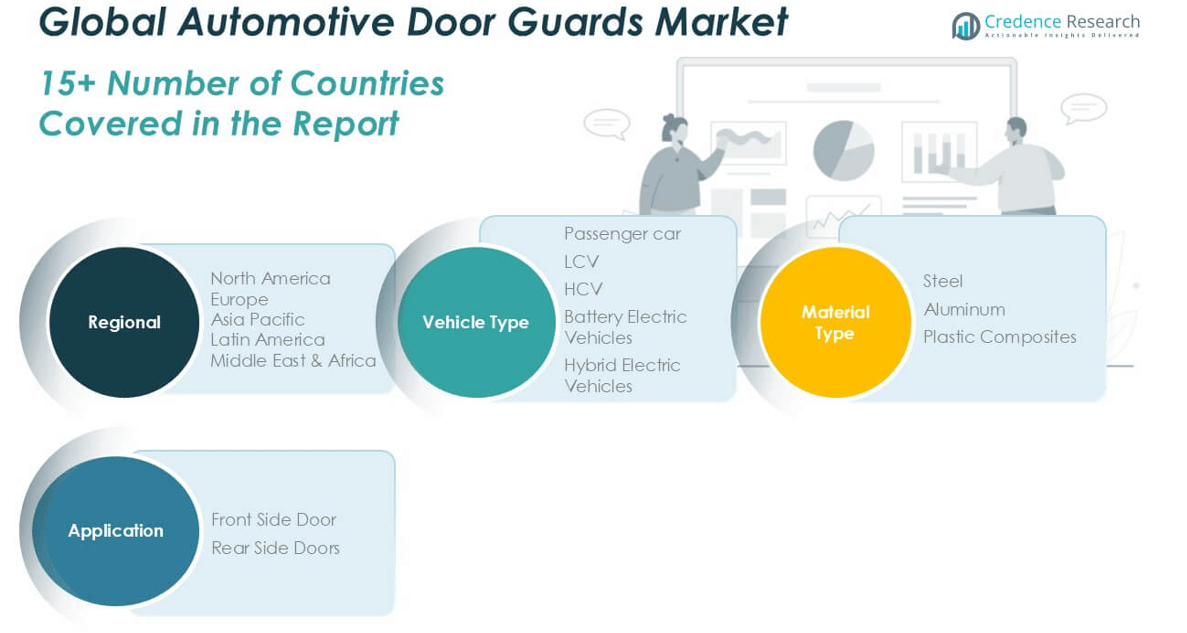
By Vehicle Type:
- Passenger Car
- Light Commercial Vehicle (LCV)
- Heavy Commercial Vehicle (HCV)
- Battery Electric Vehicles (BEVs)
- Hybrid Electric Vehicles (HEVs)
By Material Type:
- Steel
- Aluminum
- Plastic Composites
By Application:
- Front Side Door
- Rear Side Doors
By Geography:
- North America
- U.S.
- Canada
- Mexico
- Europe
- Germany
- France
- U.K.
- Italy
- Spain
- Rest of Europe
- Asia Pacific
- China
- Japan
- India
- South Korea
- South-east Asia
- Rest of Asia Pacific
- Latin America
- Brazil
- Argentina
- Rest of Latin America
- Middle East & Africa
- GCC Countries
- South Africa
- Rest of the Middle East and Africa
Competitive Landscape
The competitive landscape of the Automotive Door Guards market is characterized by the presence of several established global and regional players competing on product innovation, material advancement, and pricing strategies. Leading companies such as TS Tech Co., Ltd., Magna International Inc., DuPont, and Toyota Boshoku Corporation focus on developing lightweight, durable, and visually appealing door guards to meet evolving OEM and aftermarket demands. These players are leveraging strategic partnerships, mergers, and acquisitions to strengthen their global footprint and diversify product portfolios. Innovation in plastic composites and aluminum-based materials has become a key differentiator as manufacturers seek to align with sustainability and fuel efficiency goals. Additionally, companies like Yanfeng Automotive Interiors and Plastic Omnium are expanding their capabilities through investments in R&D and automation. Intense competition, especially from low-cost manufacturers in Asia, compels leading firms to balance product quality and cost-effectiveness while maintaining brand recognition and customer loyalty in a highly fragmented market.
Key Player Analysis
- TS Tech Co., Ltd.
- Calsonic Kansei Corp
- Toyo Seat Co., Ltd.
- Autoneum
- Yanfeng Automotive Interiors
- Compagnie Plastic Omnium
- DuPont
- Magna International Inc.
- Inergy Automotive Systems LLC
- Toyota Boshoku Corporation
Recent Developments
- In 2025, Toyo Seat continued its involvement in the automotive industry by producing door trims and plastic molding components through its group companies. However, there were no specific new product launches or technological advancements reported for door guards specifically. Toyo Seat's focus remained on its core areas of automotive seating and interior components.
- In March 2025, Autoneum expanded its sustainable product line for commercial vehicles, focusing on lightweight, recyclable interior and exterior trim components made from polyester. While not specifically called "door guards," these innovations in trim materials enhance impact protection and noise reduction, contributing to the overall door protection of modern vehicles according to Autoneum.
- In 2025, DuPont continues to be a key supplier of advanced materials for automotive interiors, with a focus on door panels. Their solutions prioritize anti-squeak performance, durability, and comfort, contributing to quieter and more robust door trims and guards. While no specific new product launches for door panels were identified, DuPont continues to innovate in materials for door protection.
- In September 2024, Yanfeng announced the closure of a U.S. interior trim facility, but simultaneously emphasized their continued focus on innovation in door panels and interior systems. This includes developing flexible designs and new materials for both premium and mainstream vehicles. Furthermore, the company is actively investing in collaborations to advance smart and customizable interior solutions.
Market Concentration & Characteristics
The Automotive Door Guards Market displays a moderately fragmented structure with a mix of global and regional players competing across OEM and aftermarket channels. It is characterized by strong price competition, especially in developing regions where cost sensitivity influences consumer choices. Leading companies focus on product innovation, material advancement, and alignment with evolving vehicle design trends to maintain competitiveness. Plastic composites dominate due to their lightweight, cost-effective, and corrosion-resistant properties. The market exhibits high customization demand, driven by consumer preference for both protection and visual enhancement. OEM partnerships and R&D investments define the competitive edge of established players. Entry barriers remain moderate, with manufacturing ease and low capital requirements enabling new entrants, particularly in Asia. The aftermarket segment continues to grow due to rising vehicle maintenance needs and extended ownership periods. Regional concentration is high in Asia Pacific and North America, which together account for a majority of global demand, supported by high vehicle production and ownership rates.
Report Coverage
The research report offers an in-depth analysis based on Type, Application, End-User and Geography. It details leading market players, providing an overview of their business, product offerings, investments, revenue streams, and key applications. Additionally, the report includes insights into the competitive environment, SWOT analysis, current market trends, as well as the primary drivers and constraints. Furthermore, it discusses various factors that have driven market expansion in recent years. The report also explores market dynamics, regulatory scenarios, and technological advancements that are shaping the industry. It assesses the impact of external factors and global economic changes on market growth. Lastly, it provides strategic recommendations for new entrants and established companies to navigate the complexities of the market.
Future Outlook
- The market is expected to grow steadily, driven by increasing vehicle production and ownership worldwide.
- Demand for lightweight and durable materials will continue to rise, especially in electric and hybrid vehicles.
- OEMs will increasingly integrate door guards as standard features in new vehicle models.
- The aftermarket segment will expand due to longer vehicle life cycles and growing consumer interest in customization.
- Asia Pacific will maintain its lead as the fastest-growing region due to rising automotive manufacturing and urbanization.
- North America will see consistent demand supported by a mature aftermarket and high vehicle penetration.
- Sustainability concerns will encourage manufacturers to adopt recyclable and eco-friendly materials.
- Technological advancements will lead to the development of multifunctional and sensor-integrated door guards.
- Competitive pricing and product differentiation will remain critical to gaining market share.
- Strategic collaborations and regional expansions will help key players strengthen their global presence.

Request a Free Sample
Fill in your details and we'll send you a free sample report.
- Sample data tables & charts
- Research methodology
Market Dynamics
Rising Global Vehicle Production and Ownership
Increasing vehicle production and ownership, particularly in emerging economies, is driving demand for automotive door guards as consumers seek to protect their vehicles from everyday impacts and parking-related damage.
Shift Toward Lightweight and Advanced Materials
Automotive manufacturers are increasingly adopting lightweight materials such as plastic composites and aluminum for door guards to improve fuel efficiency and align with the needs of electric and hybrid vehicles, boosting market growth.
Expansion of Electric and Hybrid Vehicle Segment
The growing production and adoption of electric and hybrid vehicles is fueling demand for specialized, lightweight, and energy-efficient door guard solutions, as these vehicles require components that support overall efficiency and sustainability goals.
Growth of Aftermarket Sales Channels
The expansion of e-commerce and specialized auto-accessory retailers is making door guards more accessible, especially in developing regions, encouraging consumers to invest in affordable protective accessories and driving aftermarket segment growth.
Increasing Consumer Focus on Vehicle Safety and Aesthetics
Consumers are placing greater emphasis on both the safety and appearance of their vehicles, prompting OEMs and aftermarket suppliers to innovate with door guards that offer both protection and aesthetic enhancement, further stimulating market demand.
Need a Custom Version of This Report?
Tailor the scope, geography, or segments to your exact requirements.
- Custom geography or segment scope
- Direct access to our analyst team
Frequently Asked Questions
What is the current size of the Automotive Door Guards Market?
What are the key segments within the Automotive Door Guards Market?
What are some challenges faced by the Automotive Door Guards Market?
Who are the major players in the Automotive Door Guards Market?
Table of Content
Chapter 1 Market Segmentation
- 1.1 Segmentation Framework
- 1.1.1 Product and Service Classification
- 1.1.2 Application and End-Use Classification
- 1.1.3 Technology and Solution Classification
- 1.1.4 Customer and Distribution Channel Classification
- 1.1.5 Geographic Segmentation
- 1.1.6 Market Segment Definitions and Boundaries
- 1.2 By Application
- 1.2.1 Front Side Door
- 1.2.2 Rear Side Doors
- 1.3 By Vehicle Type
- 1.3.1 Passenger Car
- 1.3.2 Light Commercial Vehicle (LCV)
- 1.3.3 Heavy Commercial Vehicle (HCV)
- 1.3.4 Battery Electric Vehicles (BEVs)
- 1.3.5 Hybrid Electric Vehicles (HEVs)
- 1.4 By Material Type
- 1.4.1 Steel
- 1.4.2 Aluminum
- 1.4.3 Plastic Composites
Chapter 2 Introduction
- 2.1 Report Objectives and Scope
- 2.2 Product Definition and Industry Terminology
- 2.3 Market Inclusions and Exclusions
- 2.4 Research Process
- 2.4.1 Primary Research and Expert Interviews
- 2.4.2 Secondary Research and Source Review
- 2.4.3 Top-Down and Bottom-Up Estimation
- 2.4.4 Data Triangulation and Verification
- 2.5 Market Size Measurement Basis
- 2.5.1 2024: USD 442.77 million → 2032: USD 738.72 million
- 2.6 Historical and Forecast Reference Periods
- 2.6.1 Base Year: 2024
- 2.6.2 Forecast Period: 2024-2032
- 2.7 Research Assumptions and Limitations
Chapter 3 Executive Summary
- 3.1 Market Snapshot and Key Findings
- 3.2 Base-Year Market Size, 2024
- 3.3 Forecast Market Size, 2032
- 3.4 Revenue and Volume Growth Outlook
- 3.5 Key Demand and Supply Indicators
- 3.6 Leading Market Segments
- 3.7 Fastest-Growing Market Opportunities
- 3.8 Regional Performance Highlights
- 3.9 Technology and Industry Transformation
- 3.10 Competitive Landscape Summary
- 3.11 Analyst View and Strategic Implications
Chapter 4 Global Automotive Door Guards Market Trends and Developments
- 4.1 Historical Industry Development
- 4.2 Recent Market Trends and Developments
- 4.3 Demand and Customer Behavior Trends
- 4.4 Technology and Product Innovation
- 4.5 Artificial Intelligence, Automation and Digitalization
- 4.6 Local Manufacturing and Supply Chain Realignment
- 4.7 Industry Partnerships, Mergers and Acquisitions
- 4.8 Sustainability and Circular Economy Developments
- 4.9 Government and Private Sector Investment Trends
- 4.10 Emerging Business Models and Commercialization
- 4.11 Industry Developments and Announcements
Chapter 5 Global Automotive Door Guards Market Production, Supply and Demand Analysis
- 5.1 Demand Trend and Consumption Analysis
- 5.2 Demand Forecast, 2024-2032
- 5.3 Production and Output Trend
- 5.4 Production and Output Forecast, 2024-2032
- 5.5 Installed Capacity and Capacity Utilization
- 5.6 Company-Wise Production Plants and Statistics
- 5.6.1 Installed Production Capacity
- 5.6.2 Actual Production
- 5.6.3 Planned Capacity and Expansion Targets
- 5.7 Supply Chain Structure and Procurement Trends
- 5.8 Supply-Demand Gap and Bottlenecks
- 5.9 Import Dependence and Sourcing Structure
- 5.10 Contract Manufacturing and Outsourcing
- 5.11 Regional Supply and Demand Concentration
Chapter 6 Global Automotive Door Guards Market Pricing Analysis
- 6.1 Pricing Structure and Measurement
- 6.2 Historical Pricing Trends
- 6.3 Pricing Outlook, 2024-2032
- 6.4 Average Selling Price and Unit Economics
- 6.5 Pricing by Product and Market Segment
- 6.6 Geographic Pricing Differences
- 6.7 Key Input, Energy, Labor and Logistics Costs
- 6.8 Contract Pricing and Purchasing Models
- 6.9 Pricing Sensitivity and Competitive Positioning
- 6.10 Price, Margin and Profitability Implications
Chapter 7 Global Automotive Door Guards Market Dynamics
- 7.1 Market Growth Drivers
- 7.1.1 Demand-Side Drivers
- 7.1.2 Technology and Innovation Drivers
- 7.1.3 Infrastructure and Investment Drivers
- 7.1.4 Regulatory and Policy Drivers
- 7.2 Market Restraints
- 7.2.1 Cost and Affordability Constraints
- 7.2.2 Technology and Adoption Barriers
- 7.2.3 Supply Chain and Operational Constraints
- 7.3 Market Challenges
- 7.3.1 Competitive Pressure and Margin Erosion
- 7.3.2 Skills, Infrastructure and Implementation Gaps
- 7.4 Emerging Market Opportunities
- 7.5 Market Dynamics Impact and Time-Horizon Assessment
Chapter 8 Global Automotive Door Guards Value Chain Analysis
- 8.1 Industry Value Chain Overview
- 8.2 Upstream Suppliers and Critical Inputs
- 8.3 Technology and Component Providers
- 8.4 Manufacturing or Service Delivery
- 8.5 Distribution, Channel Partners and Integrators
- 8.6 Downstream Applications and End Users
- 8.7 Value Addition and Profit Pools
- 8.8 Vertical Integration and Outsourcing
- 8.9 Supplier Concentration and Risk
- 8.10 Supply Chain Localization and Resilience
Chapter 9 Global Automotive Door Guards Market Regulations and Policies
- 9.1 Relevant Laws, Standards and Compliance Frameworks
- 9.2 Product, Service, Safety and Quality Requirements
- 9.3 Government Policies, Incentives and Subsidies
- 9.4 Imports, Exports and Trade Barriers
- 9.5 Public Procurement and Local Content Requirements
- 9.6 Environmental and Sustainability Compliance
- 9.7 Upcoming Policy Changes and Market Implications
Chapter 10 Global Automotive Door Guards Market Hotspots and Opportunities
- 10.1 Market Opportunity Mapping and Growth Hotspots
- 10.2 High-Growth Applications and Customer Groups
- 10.3 Underserved Markets and White-Space Opportunities
- 10.4 Emerging Technology and Product Opportunities
- 10.5 New Capacity and Investment Hotspots
- 10.6 Market Entry and Expansion Opportunities
- 10.7 Distribution and Partnership Opportunities
- 10.8 Near-Term and Long-Term Commercial Potential
- 10.9 Opportunity Attractiveness and Execution Risks
Chapter 11 Global Automotive Door Guards Market Outlook, 2024-2032
- 11.1 Market Size and Analysis
- 11.1.1 Revenue (Market Measurement: 2024: USD 442.77 million → 2032: USD 738.72 million)
- 11.1.2 Market Volume and Quantity Sold
- 11.1.3 Historical Market Size
- 11.1.4 Base-Year Market Size, 2024
- 11.2 Market Forecast, 2024-2032
- 11.2.1 Revenue Forecast to 2032
- 11.2.2 Volume Forecast to 2032
- 11.2.3 CAGR and Year-on-Year Growth
- 11.2.4 Incremental Revenue Opportunity
- 11.3 Forecast Assumptions and Scenario Analysis
- 11.3.1 Base-Case Forecast
- 11.3.2 Optimistic and Conservative Scenarios
- 11.3.3 Technology, Pricing and Policy Sensitivities
- 11.4 Market Attractiveness and Growth Outlook
Chapter 12 Global Automotive Door Guards Market Segmentation and Outlook
- 12.1 Segmentation Summary and Market Shares, 2024
- 12.2 Largest and Fastest-Growing Segments
- 12.3 By Application - Market Size and Forecast, 2024-2032
- 12.3.1 Segment Definition and Scope
- 12.3.2 Historical Market Size
- 12.3.3 Revenue Forecast, 2024-2032
- 12.3.4 Volume Forecast, 2024-2032
- 12.3.5 Base-Year Market Share, 2024
- 12.3.6 Segment CAGR and Growth Drivers
- 12.3.7 Subsegment Market Size and Forecast
- 12.3.7.1 Front Side Door
- 12.3.7.2 Rear Side Doors
- 12.3.8 Subsegment Pricing and Adoption Trends
- 12.3.9 Leading Suppliers and Competition
- 12.3.10 Regional Demand and Opportunities
- 12.4 By Vehicle Type - Market Size and Forecast, 2024-2032
- 12.4.1 Segment Definition and Scope
- 12.4.2 Historical Market Size
- 12.4.3 Revenue Forecast, 2024-2032
- 12.4.4 Volume Forecast, 2024-2032
- 12.4.5 Base-Year Market Share, 2024
- 12.4.6 Segment CAGR and Growth Drivers
- 12.4.7 Subsegment Market Size and Forecast
- 12.4.7.1 Passenger Car
- 12.4.7.2 Light Commercial Vehicle (LCV)
- 12.4.7.3 Heavy Commercial Vehicle (HCV)
- 12.4.7.4 Battery Electric Vehicles (BEVs)
- 12.4.7.5 Hybrid Electric Vehicles (HEVs)
- 12.4.8 Subsegment Pricing and Adoption Trends
- 12.4.9 Leading Suppliers and Competition
- 12.4.10 Regional Demand and Opportunities
- 12.5 By Material Type - Market Size and Forecast, 2024-2032
- 12.5.1 Segment Definition and Scope
- 12.5.2 Historical Market Size
- 12.5.3 Revenue Forecast, 2024-2032
- 12.5.4 Volume Forecast, 2024-2032
- 12.5.5 Base-Year Market Share, 2024
- 12.5.6 Segment CAGR and Growth Drivers
- 12.5.7 Subsegment Market Size and Forecast
- 12.5.7.1 Steel
- 12.5.7.2 Aluminum
- 12.5.7.3 Plastic Composites
- 12.5.8 Subsegment Pricing and Adoption Trends
- 12.5.9 Leading Suppliers and Competition
- 12.5.10 Regional Demand and Opportunities
- 12.6 Segment Growth Comparison
- 12.7 Segment Attractiveness and Priority Matrix
Chapter 13 Global Automotive Door Guards End-Use and Application Market Outlook
- 13.1 End-Use Industry and Customer Demand Structure
- 13.2 Leading Applications and Customer Groups
- 13.3 End-Use Market Size, Share and Forecast
- 13.4 Major End-Use Industry Deep Dives
- 13.4.1 Customer Requirements and Use Cases
- 13.4.2 Demand and Replacement Cycles
- 13.4.3 Technical and Regulatory Considerations
- 13.4.4 Purchasing and Procurement Models
- 13.4.5 Leading Vendors and Distribution Channels
- 13.4.6 Forecast and Commercial Opportunities
- 13.5 Emerging Applications and Cross-Segment Demand
- 13.6 End-Use Industry Investment Priorities
Chapter 14 Global Automotive Door Guards Geographic Market Outlook, 2024-2032
- 14.1 Regional Market Size and Share, 2024
- 14.2 Regional Market Forecast, 2024-2032
- 14.3 Regional Pricing, Production and Demand Differences
- 14.4 North America
- 14.4.1 United States
- 14.4.2 Canada
- 14.4.3 Mexico
- 14.5 Europe
- 14.5.1 Germany
- 14.5.2 France
- 14.5.3 Italy
- 14.5.4 United Kingdom
- 14.5.5 Spain
- 14.5.6 Poland
- 14.5.7 Russia
- 14.5.8 Netherlands
- 14.5.9 Belgium
- 14.5.10 Sweden
- 14.5.11 Denmark
- 14.5.12 Norway
- 14.5.13 Rest of Europe
- 14.6 Asia Pacific
- 14.6.1 China
- 14.6.2 India
- 14.6.3 Japan
- 14.6.4 South Korea
- 14.6.5 Thailand
- 14.6.6 Indonesia
- 14.6.7 Vietnam
- 14.6.8 Malaysia
- 14.6.9 Australia
- 14.6.10 Rest of Asia Pacific
- 14.7 Latin America
- 14.7.1 Brazil
- 14.7.2 Argentina
- 14.7.3 Colombia
- 14.7.4 Chile
- 14.7.5 Rest of Latin America
- 14.8 Middle East
- 14.8.1 Saudi Arabia
- 14.8.2 United Arab Emirates
- 14.8.3 Turkey
- 14.8.4 Israel
- 14.8.5 Iran
- 14.8.6 Rest of the Middle East
- 14.9 Africa
- 14.9.1 South Africa
- 14.9.2 Egypt
- 14.9.3 Nigeria
- 14.9.4 Morocco
- 14.9.5 Rest of Africa
- 14.10 Regional Investment, Policy and Supply Chain Differences
- 14.11 Regional Competitive Landscape
- 14.12 Geographic Growth Hotspots
Chapter 15 Global Automotive Door Guards Technology, Innovation and Sustainability Outlook
- 15.1 Technology Landscape and Maturity
- 15.2 Product, Process and Service Innovation
- 15.3 AI, Automation and Digital Tools in the Industry
- 15.4 Technology Adoption and Performance Benchmarking
- 15.5 Innovation Pipeline and R&D Investment
- 15.6 Patent and Intellectual Property Trends
- 15.7 Energy Efficiency and Resource Management
- 15.8 Sustainability, Recycling and Circularity
- 15.9 Technology Roadmap, 2024-2032
- 15.10 Risks of Obsolescence and Technology Substitution
Chapter 16 Global Automotive Door Guards Market Key Strategic Imperatives
- 16.1 Growth and Market Entry Priorities
- 16.2 High-Return Products and Segments
- 16.3 Pricing, Profitability and Cost Optimization
- 16.4 Technology Investment and Product Differentiation
- 16.5 Supply Chain Localization and Resilience
- 16.6 Distribution and Customer Acquisition
- 16.7 Partnership, Acquisition and Capacity Strategy
- 16.8 Regional Expansion Priorities
- 16.9 Short-, Medium- and Long-Term Actions
Chapter 17 Competition Outlook
- 17.1 Industry Competition Characteristics
- 17.2 Market Structure and Concentration
- 17.3 Market Share and Competitive Positioning, 2024
- 17.4 Company-Wise Revenue and Product Benchmarking
- 17.5 Production and Service Capacity Benchmarking
- 17.6 Technology, Pricing and Differentiation
- 17.7 Regional Footprint and Distribution Strength
- 17.8 Mergers, Acquisitions and Strategic Alliances
- 17.9 New Entrants and Competitive Threats
- 17.10 Porter's Five Forces and Industry Attractiveness
- 17.11 Competitive Outlook, 2024-2032
Chapter 18 Company Profiles
- 18.1 Company Coverage and Selection Criteria
- 18.2 TS Tech Co., Ltd.
- 18.2.1 Business Description
- 18.2.2 Company Ownership and Geographic Presence
- 18.2.3 Product and Service Portfolio
- 18.2.4 Manufacturing and Operating Footprint
- 18.2.5 Production Capacity and Expansion Plans
- 18.2.6 Financial Performance and Investment
- 18.2.7 Market Share and Competitive Position
- 18.2.8 Technology and Innovation Capabilities
- 18.2.9 Strategic Alliances or Partnerships
- 18.2.10 Recent Developments
- 18.2.11 Growth Strategy and Outlook
- 18.3 Calsonic Kansei Corp
- 18.4 Toyo Seat Co., Ltd.
- 18.5 Autoneum
- 18.6 Yanfeng Automotive Interiors
- 18.7 Compagnie Plastic Omnium
- 18.8 DuPont
- 18.9 Magna International Inc.
- 18.10 Inergy Automotive Systems LLC
- 18.11 Toyota Boshoku Corporation
- 18.12 Other Relevant Market Participants
Note: Every listed company is profiled on the structure shown under the first company. The company list is preliminary and may change based on research findings, market developments, data availability and client requirements.
Chapter 19 Disclaimer
- 19.1 Research and Forecast Disclaimer
- 19.2 Data Source and Estimation Limitations
Note: The depth of individual sections depends on data availability for this market. Volume, capacity, trade and other unit-based metrics are included where applicable.