
| REPORT ATTRIBUTE | DETAILS |
|---|---|
| Historical Period | 2020-2023 |
| Base Year | 2024 |
| Forecast Period | 2025-2032 |
| Beef Bouillon Market Size 2024 | USD 2,516.53 million |
| Beef Bouillon Market, CAGR | 3.91% |
| Beef Bouillon Market Size 2032 | USD 3,498.80 million |
Market Overview
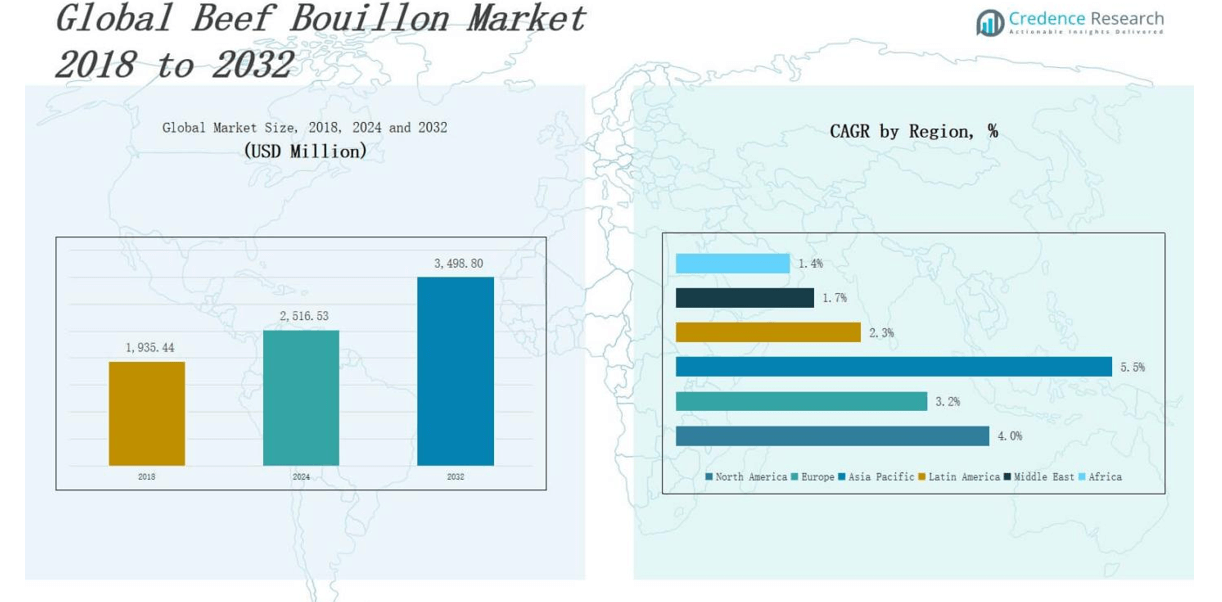
The Beef Bouillon Market size was valued at USD 1,935.44 million in 2018 to USD 2,516.53 million in 2024 and is anticipated to reach USD 3,498.80 million by 2032, at a CAGR of 3.91 % during the forecast period.
The Beef Bouillon Market is experiencing steady growth driven by rising consumer demand for convenient, flavorful cooking solutions amid increasingly busy lifestyles. The market benefits from the growing popularity of ready-to-cook and processed foods, as beef bouillon serves as a key flavor enhancer in soups, stews, sauces, and marinades. Health-conscious consumers are also propelling demand for low-sodium, organic, and clean-label formulations, prompting manufacturers to innovate with natural ingredients and preservative-free offerings. The increasing global influence of Western cuisine, particularly in emerging economies, is expanding the market's footprint. Additionally, e-commerce platforms are facilitating wider product accessibility and brand visibility. Market players are investing in sustainable packaging and ethical sourcing of raw materials to align with consumer expectations. The trend toward premiumization, with gourmet and artisanal bouillon products gaining traction, further strengthens growth. Continued innovation in product formats, such as liquid concentrates and paste forms, enhances convenience and shelf stability, bolstering the overall appeal of beef bouillon across diverse culinary applications.
The Beef Bouillon Market spans key regions including North America, Europe, Asia Pacific, Latin America, the Middle East, and Africa. North America leads in market share due to high consumption of processed and convenience foods, while Europe maintains steady growth with strong demand for natural and premium bouillon. Asia Pacific shows the fastest growth, driven by urbanization and expanding retail access. Latin America and the Middle East exhibit moderate growth, influenced by evolving culinary preferences. Africa holds a smaller share but offers potential through increasing packaged food adoption. The market features prominent global players such as Nestlé, Unilever, McCormick & Company, and Maggi, alongside regional players like Emilia Foods, Omasownfoods, and Annes Dumplings. These companies compete through innovation, clean-label offerings, and regional flavor adaptations to strengthen market presence and cater to diverse consumer preferences across these geographic segments.
Market Insights
- The Beef Bouillon Market was valued at USD 1,935.44 million in 2018 and is projected to reach USD 3,498.80 million by 2032, growing at a CAGR of 3.91% due to rising demand for flavorful and convenient cooking solutions.
- Increasing preference for clean-label, low-sodium, and organic bouillon products is driving innovation, with brands focusing on natural ingredients and health-oriented formulations.
- Product diversification into formats like liquid concentrates, pastes, and single-serve pods is enhancing usability, shelf life, and appeal across both home and foodservice applications.
- North America leads the market with USD 1,025.98 million in 2024 revenue, driven by advanced retail networks and high demand for processed and ready-to-cook meals.
- Asia Pacific is the fastest-growing region, expected to reach USD 840.11 million by 2032, supported by urbanization, rising incomes, and growing influence of Western cuisine.
- Europe remains stable with USD 722.54 million in 2024 revenue, supported by traditional cooking cultures, strong food safety regulations, and growth in premium, eco-conscious offerings.
- Key players such as Nestlé, Unilever, McCormick & Company, and Maggi are competing with regional brands by focusing on clean-label innovation, regional flavor profiles, and sustainable packaging.
Market Drivers
Rising Demand for Convenient and Flavorful Cooking Solutions
The Beef Bouillon Market is being driven by increasing consumer preference for quick, easy-to-prepare meals that do not compromise on taste. Busy lifestyles and limited time for home cooking have pushed demand for bouillon products that simplify meal preparation. It serves as a convenient option to enhance flavor in soups, sauces, and stews. Consumers are seeking products that deliver depth of flavor with minimal effort. Ready-to-cook and semi-prepared foods continue to gain traction globally. Beef bouillon complements this trend by offering long shelf life and easy usability.
Shift Toward Health-Conscious and Clean-Label Products
The market is witnessing a strong push toward health-oriented formulations, with growing awareness around sodium intake, artificial additives, and preservatives. Consumers are increasingly choosing bouillon options that feature organic, low-sodium, and non-GMO ingredients. The Beef Bouillon Market has responded with innovations that prioritize clean-label standards. It is seeing new product launches that emphasize natural beef extracts and reduced chemical content. Brands are leveraging this shift to attract discerning, health-conscious buyers. The clean-label movement is redefining product expectations across packaged food categories.
- For instance, Watson’s Seasoning Blends introduced vegan beef bouillon flavors made with organic, preservative-free ingredients and plastic-free packaging.
Influence of Global Culinary Trends and Cultural Integration
Globalization of food preferences and rising interest in international cuisine are expanding the Beef Bouillon Market’s reach. Consumers in non-traditional regions are incorporating bouillon into local dishes, fueling steady growth. It supports culinary experimentation by providing authentic, robust flavors suited to diverse cooking styles. Western-style meal kits and recipes continue to introduce bouillon to wider audiences. Foodservice sectors and home cooks alike adopt bouillon for versatility. This cross-cultural adoption strengthens its market position beyond core regions.
- For instance, in Ethiopia, Knorr fortified its stock cubes with zinc and vitamin A to address local micronutrient deficiencies, specifically supporting the preparation of national dishes like shiro wat, a chickpea stew consumed widely across the country.
Innovation in Product Formats and Packaging Solutions
The market is being propelled by product innovation, particularly in the development of new formats such as liquid bouillon, pastes, and single-serve pods. These formats offer increased convenience, precise dosing, and improved storage. The Beef Bouillon Market is seeing strong investment in packaging technology that enhances shelf life while reducing environmental impact. It appeals to both retail and foodservice buyers with modern, easy-to-use designs. Manufacturers are aligning with sustainability goals without compromising product integrity. Innovation remains key to differentiation in a competitive space.
Market Trends
Growing Consumer Interest in Natural and Organic Bouillon Products
Health-conscious consumers are shaping purchasing decisions by favoring natural, organic, and minimally processed food products. In response, brands in the Beef Bouillon Market are expanding their portfolios to include cleaner labels and fewer artificial ingredients. It has led to a visible shift toward bouillon products made with natural beef extracts, herbs, and spices. Retailers are giving more shelf space to organic offerings. The focus on wellness and transparency continues to influence formulation. Ingredient origin and product traceability remain central to brand positioning.
- For instance, in the U.S., Pacific Foods launched an organic beef broth that highlights traceable sourcing and non-GMO certification, catering to consumers seeking transparency and minimal processing.
Increasing Popularity of Premium and Gourmet Bouillon Varieties
Premiumization is transforming traditional bouillon into a more refined product category, with consumers seeking gourmet flavors and elevated culinary experiences. The Beef Bouillon Market is embracing this trend by introducing specialty blends, artisan techniques, and high-quality ingredients. It is expanding into new segments such as chef-inspired lines and ethnic flavor profiles. Consumers are willing to pay more for rich, authentic taste. The rise of food enthusiasts and home chefs is fueling interest in complex, restaurant-style flavor bases. Product differentiation is driving brand loyalty in this premium space.
E-commerce Expansion and Direct-to-Consumer Engagement
Online retail has become a critical distribution channel, offering brands broader reach and targeted marketing capabilities. The Beef Bouillon Market is capitalizing on e-commerce to boost visibility and accessibility across regions. It allows manufacturers to introduce new products quickly and gather real-time feedback. Subscription models and bundle packs are gaining popularity for convenience. Digital platforms support storytelling around sourcing, nutrition, and sustainability. Brands are using data-driven insights to tailor offerings and enhance customer engagement.
Sustainability and Ethical Sourcing Gaining Prominence
Consumers are increasingly demanding environmentally responsible packaging and ethically sourced ingredients. The Beef Bouillon Market is aligning with these values by investing in sustainable production practices and recyclable materials. It reflects growing awareness of climate impact and animal welfare among buyers. Companies are highlighting certifications and traceability to build consumer trust. Sustainability is influencing both product development and marketing strategies. This trend is expected to deepen as global environmental standards become stricter and more transparent.
- For instance, Denver Bone Broth partners exclusively with suppliers committed to regenerative agriculture and utilizes leftover bones and scraps to create broth, reducing food waste and supporting a closed-loop production system.
Market Challenges Analysis
Health Concerns and Regulatory Pressures Impacting Product Formulation
Rising consumer awareness about sodium intake and artificial additives presents a major challenge for the Beef Bouillon Market. Regulatory agencies are tightening standards on nutritional content, compelling manufacturers to reformulate products. It must strike a balance between maintaining flavor and meeting health criteria. Reduced-sodium variants often struggle to deliver the same depth, affecting consumer satisfaction. Reformulation also increases production costs and complicates supply chains. Strict labeling and compliance requirements vary across markets, making global distribution more complex.
Volatility in Raw Material Costs and Supply Chain Disruptions
Fluctuating prices of beef and other core ingredients create cost instability for producers. The Beef Bouillon Market depends heavily on a consistent and high-quality supply of raw materials. It faces pressure from disruptions caused by disease outbreaks, livestock shortages, or geopolitical trade restrictions. These risks can delay production, raise costs, and reduce profit margins. Smaller manufacturers find it particularly difficult to absorb such volatility. Ensuring transparency and ethical sourcing adds another layer of operational complexity in a competitive market.
Market Opportunities
Expansion into Emerging Markets with Evolving Culinary Preferences
Rising urbanization, growing disposable incomes, and exposure to global cuisines are creating strong demand for packaged flavoring products in emerging economies. The Beef Bouillon Market has a significant opportunity to tap into regions where Western cooking styles are gaining traction. It can grow by introducing region-specific flavor profiles and adapting packaging sizes to local consumption habits. Urban households seek convenient solutions for home-cooked meals, making bouillon a suitable choice. Strategic entry through modern retail and e-commerce platforms can accelerate market penetration. Localization of marketing and product innovation will be key to success.
Product Diversification and Functional Health Positioning
Expanding the product range to include health-focused bouillon offerings presents strong growth potential. The Beef Bouillon Market can leverage consumer interest in fortified foods by introducing products with added vitamins, minerals, or functional ingredients. It can position bouillon as both a flavor enhancer and a source of nutritional benefit. Demand for clean-label, low-sodium, and organic variants continues to rise across developed and developing markets. Offering innovative formats such as single-serve sachets or liquid pods also opens up new consumer segments. Investing in R&D for functional differentiation will help brands stand out.
Market Segmentation Analysis:
By Type
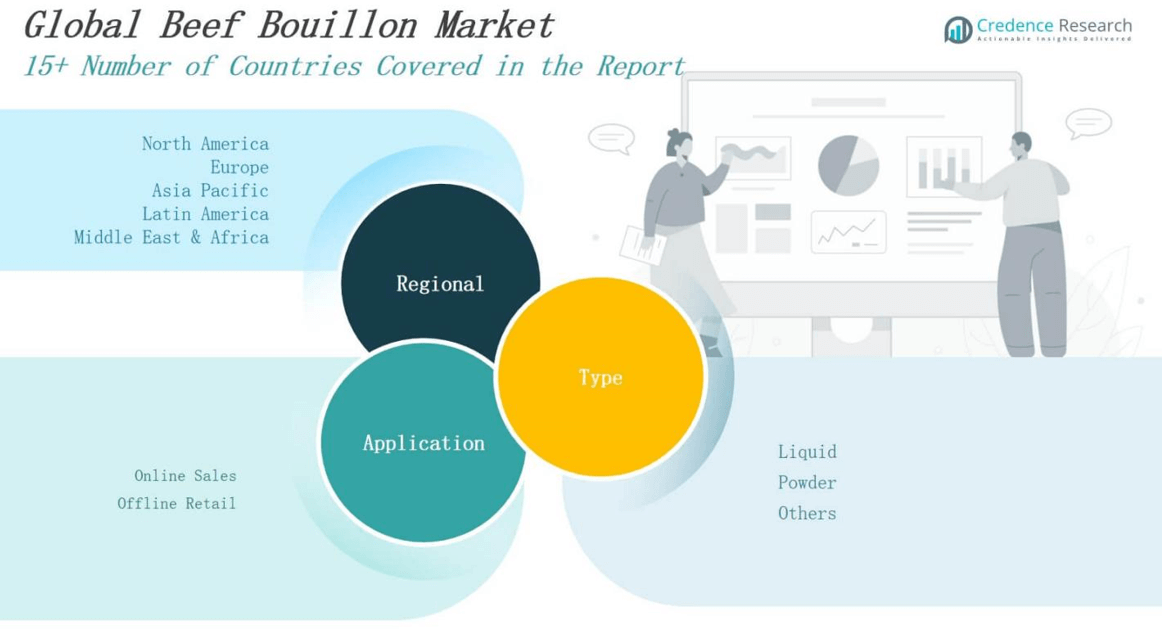
The Beef Bouillon Market is segmented into liquid, powder, and others. Powdered bouillon holds a significant share due to its long shelf life, ease of storage, and wide use in household and foodservice applications. It offers versatility in portion control and flavor customization. Liquid bouillon is gaining traction, especially in premium and gourmet cooking, where consumers prefer richer taste and convenience. It appeals to health-conscious buyers looking for cleaner labels and fewer preservatives. The "others" segment includes bouillon cubes and concentrates, which continue to attract budget-conscious consumers in price-sensitive regions. The market benefits from ongoing product innovation across all forms.
- For instance, Knorr’s Beef Bouillon Powder is widely distributed in over 90 countries and is favored by chefs for its ability to dissolve quickly and provide consistent flavor.
By Application
The Beef Bouillon Market is divided into online sales and offline retail. Offline retail remains dominant, driven by widespread availability in supermarkets, grocery chains, and specialty stores. It provides consumers the advantage of immediate purchase and familiar brand recognition. Online sales are expanding rapidly, supported by the rise of e-commerce platforms, changing buying behavior, and direct-to-consumer strategies. It enables brands to reach niche audiences, offer product variety, and promote value-added packages. Subscription-based services and health-focused marketing campaigns are helping boost online engagement. The dual-channel presence allows brands to maximize their reach and revenue potential.
- For instance, Campbell Soup Company distributes its broth and bouillon products through major supermarket chains across North America, ensuring customers can easily purchase their preferred products during routine shopping trips.
Segments:
Based on Type
- Liquid
- Powder
- Others
Based on Application
- Online Sales
- Offline Retail
Based on Region
- North America
- U.S.
- Canada
- Mexico
- Europe
- Germany
- France
- U.K.
- Italy
- Spain
- Rest of Europe
- Asia Pacific
- China
- Japan
- India
- South Korea
- South-east Asia
- Rest of Asia Pacific
- Latin America
- Brazil
- Argentina
- Rest of Latin America
- Middle East & Africa
- GCC Countries
- South Africa
- Rest of the Middle East and Africa
Regional Analysis
North America
The North America Beef Bouillon Market size was valued at USD 797.85 million in 2018 to USD 1,025.98 million in 2024 and is anticipated to reach USD 1,430.64 million by 2032, at a CAGR of 4.0% during the forecast period. North America holds the largest market share, driven by high consumer demand for convenience foods and well-established retail infrastructure. The U.S. leads the region with strong product innovation and widespread brand recognition. It benefits from a mature food processing industry and growing preference for clean-label and organic bouillon products. Rising health consciousness is pushing manufacturers to launch low-sodium and preservative-free options. The region’s advanced distribution network supports both online and offline sales growth.
Europe
The Europe Beef Bouillon Market size was valued at USD 575.49 million in 2018 to USD 722.54 million in 2024 and is anticipated to reach USD 948.59 million by 2032, at a CAGR of 3.2% during the forecast period. Europe maintains a steady market position with strong culinary traditions and a large base of home cooks. Countries like Germany, France, and the UK show consistent demand for bouillon products in various forms. It benefits from a preference for natural ingredients and strict food safety regulations, which favor premium formulations. Private label products are expanding rapidly through discount and specialty retail chains. The growing trend toward sustainable and eco-friendly packaging is shaping product offerings in this region.
Asia Pacific
The Asia Pacific Beef Bouillon Market size was valued at USD 380.01 million in 2018 to USD 534.70 million in 2024 and is anticipated to reach USD 840.11 million by 2032, at a CAGR of 5.5% during the forecast period. Asia Pacific is the fastest-growing region, driven by urbanization, rising disposable income, and growing exposure to Western cuisine. Markets such as China, India, and Southeast Asia are embracing bouillon products in both traditional and modern cooking. It benefits from increasing demand for convenient meal solutions and the rapid expansion of modern retail and e-commerce platforms. Localized flavors and small pack sizes are helping brands penetrate diverse markets. The region offers significant growth potential for both global and domestic players.
Latin America
The Latin America Beef Bouillon Market size was valued at USD 91.62 million in 2018 to USD 117.65 million in 2024 and is anticipated to reach USD 144.83 million by 2032, at a CAGR of 2.3% during the forecast period. Latin America presents modest growth, supported by traditional cooking habits and increased adoption of packaged food products. Brazil and Argentina lead regional consumption with strong demand from households and foodservice sectors. It is gradually shifting toward value-added and healthier formulations. Brand loyalty and price sensitivity influence consumer choices across the region. Retailers are expanding product availability through both urban and rural distribution networks.
Middle East
The Middle East Beef Bouillon Market size was valued at USD 54.85 million in 2018 to USD 65.26 million in 2024 and is anticipated to reach USD 76.74 million by 2032, at a CAGR of 1.7% during the forecast period. The Middle East shows slow but stable growth, with increasing demand for quick and flavorful meal preparation options. Countries like the UAE and Saudi Arabia are adopting more Western-style convenience foods. It faces challenges related to cultural preferences and dietary restrictions. Growth in retail modernization and foodservice expansion supports market development. Innovation in halal-certified bouillon products is expected to enhance future demand.
Africa
The Africa Beef Bouillon Market size was valued at USD 35.62 million in 2018 to USD 50.40 million in 2024 and is anticipated to reach USD 57.89 million by 2032, at a CAGR of 1.4% during the forecast period. Africa holds a small share of the global market but is gradually expanding with increased urbanization and retail access. Nigeria and South Africa are key contributors, supported by rising awareness of packaged food options. It remains highly price-sensitive, favoring cube and powdered bouillon formats. Market growth depends on infrastructure improvements and wider brand penetration. Opportunities lie in adapting offerings to local taste preferences and price points.
Key Player Analysis
- Nestlé
- Unilever
- McCormick & Company
- Maggi (Nestlé brand)
- OXO
- McClancy Foods & Flavors
- Omasownfoods
- Carolina Ingredients
- Emilia Foods Srl
- Everson Spice Co
- Annes Dumplings.
Competitive Analysis
The Beef Bouillon Market is highly competitive, led by established global players such as Nestlé, Unilever, and McCormick & Company. These companies dominate through strong brand portfolios, wide distribution networks, and continuous product innovation. It sees active participation from regional players like Emilia Foods and Omasownfoods, who focus on niche flavors and local preferences. Private labels are gaining traction in price-sensitive markets. Companies are investing in cleaner formulations, sustainable packaging, and digital marketing to enhance market presence. Strategic collaborations, product diversification, and geographic expansion remain key competitive strategies. Multinational brands leverage their scale to introduce premium and health-conscious variants across diverse markets. Competition is intensifying with the rise of e-commerce and growing demand for natural, organic, and functional food products. Players differentiate through ingredient quality, convenience-focused formats, and localized flavor offerings. The market continues to evolve, rewarding innovation, agility, and responsiveness to consumer preferences across both traditional and emerging markets.
Recent Developments
- In October 2023, Hormel Foods launched HERB‑OX® Cold Water Dissolve Beef Bouillon, a first-of-its-kind product that dissolves without the need for boiling, offering enhanced convenience for consumers.
- In July 2025, Italian brand Bauer introduced a Mediterranean-style Beef Bouillon cube at the Summer Fancy Food Show in New York, featuring natural ingredients and instant granules with FDA certification for the U.S. market.
- In September 2024, Knorr Canada launched an innovative culinary activation called The Bouillon Room, partnering with DJ duo Loud Luxury and chef Eric Chong to host a live event in Toronto where meal preparation was synchronized with musical performances, spotlighting Knorr bouillon cubes in a rich multi-sensory experience.
Market Concentration & Characteristics
The Beef Bouillon Market exhibits moderate to high market concentration, with a few multinational companies dominating global sales through strong brand recognition, extensive distribution networks, and diverse product portfolios. Nestlé, Unilever, and McCormick & Company are leading players, leveraging economies of scale and continuous product innovation. The market features clear brand loyalty, particularly in developed regions, while emerging markets show growing acceptance of private labels and regional brands. It reflects characteristics of a mature yet evolving industry, where consumer preferences are shifting toward clean-label, low-sodium, and organic products. Innovation in product formats, such as pastes and liquid concentrates, is a key differentiator. The market is price-sensitive in developing regions, while premiumization trends shape growth in developed economies. E-commerce channels are expanding access and competition, encouraging new entrants and regional players to target niche segments. The Beef Bouillon Market balances stability in established markets with expansion opportunities in high-growth regions.
Report Coverage
The research report offers an in-depth analysis based on Type, Application and Region. It details leading market players, providing an overview of their business, product offerings, investments, revenue streams, and key applications. Additionally, the report includes insights into the competitive environment, SWOT analysis, current market trends, as well as the primary drivers and constraints. Furthermore, it discusses various factors that have driven market expansion in recent years. The report also explores market dynamics, regulatory scenarios, and technological advancements that are shaping the industry. It assesses the impact of external factors and global economic changes on market growth. Lastly, it provides strategic recommendations for new entrants and established companies to navigate the complexities of the market.
Future Outlook
- Consumer demand for convenient and flavorful cooking aids will continue to drive steady growth in the beef bouillon market.
- Brands will expand their clean-label and low-sodium offerings to meet rising health-conscious preferences.
- Product innovation will focus on liquid concentrates, single-serve formats, and functional ingredients.
- E-commerce platforms will play a larger role in product visibility, sales, and customer engagement.
- Premium and gourmet beef bouillon variants will attract discerning home cooks and food enthusiasts.
- Companies will invest in sustainable packaging and ethical sourcing to align with consumer expectations.
- Regional flavor adaptations will help brands penetrate emerging markets with diverse culinary habits.
- Private label and local brands will gain ground in price-sensitive markets through value-driven offerings.
- Foodservice demand for consistent, shelf-stable flavor bases will support volume growth across sectors.
- Strategic partnerships and new product launches will remain central to competitive positioning and market expansion.

Request a Free Sample
Fill in your details and we'll send you a free sample report.
- Sample data tables & charts
- Research methodology
Need a Custom Version of This Report?
Tailor the scope, geography, or segments to your exact requirements.
- Custom geography or segment scope
- Direct access to our analyst team
Frequently Asked Questions
What is the current size of the Beef Bouillon Market?
What are the key segments within the Beef Bouillon Market?
What are some challenges faced by the Beef Bouillon Market?
Who are the major players in the Beef Bouillon Market?
Table of Content
Chapter 1. Report Introduction
- 1.1 Report Description & Purpose
- 1.1.1 Report Title & Market Definition
- 1.1.2 Unique Selling Propositions (USP) & Key Differentiators
- 1.1.3 Value Proposition for Stakeholders
- 1.2 Research Objectives
- 1.2.1 Market Sizing Objectives (Volume & Revenue) (Volume Where Applicable)
- 1.2.2 Segmentation Objectives
- 1.2.3 Competitive Intelligence Objectives
- 1.2.4 Forecast & Scenario Objectives
- 1.3 Report Scope
- 1.3.1 Beef Bouillon Scope – Segments & Subsegments Covered
- 1.3.2 Geographic Scope – Regions & Countries Covered
- 1.3.3 Historical Period, Base Year & Forecast Period (2024; forecast to 2032)
- 1.3.4 Inclusions & Exclusions
- 1.4 Industry Classification & Applicable Codes
- 1.5 Currency, Measurement Units & Valuation Basis
- 1.6 Target Stakeholders
- 1.7 Limitations & Assumptions
Chapter 2. Executive Summary
- 2.1 Global Beef Bouillon Market Snapshot
- 2.1.1 Market Size – Historical (2024) & Forecast (2024-2032) (2024: USD 2,516.53 million → 2032: USD 3,498.80 million)
- 2.1.2 Volume & Revenue – Global Totals (Volume Where Applicable)
- 2.1.3 Key Market Highlights – Top Five Facts
- 2.2 Beef Bouillon Market Segmentation Snapshot
- 2.2.1 Market Split by Region – 2024 vs. 2032
- 2.3 Competitive Snapshot
- 2.3.1 Top 10 Players by Revenue Share – 2024
- 2.3.2 Top 10 Players by Volume Share – 2024 (Volume Where Applicable)
- 2.3.3 Recent Strategic Developments (18-Month Summary)
- 2.4 Key Investment Highlights & Strategic Conclusions
Chapter 3. Beef Bouillon Market Dynamics & Industry Analysis
- 3.1 Market Overview & Context
- 3.1.1 Beef Bouillon Market Position in the Broader Industry Value Chain
- 3.1.2 Demand Structure & Purchasing Dynamics
- 3.1.3 Market Maturity & Development Stage by Region
- 3.2 Beef Bouillon Market Drivers
- 3.3 Beef Bouillon Market Restraints & Challenges
- 3.4 Beef Bouillon Market Opportunities
- 3.5 Porter's Five Forces Analysis
- 3.5.1 Threat of New Entrants
- 3.5.2 Bargaining Power of Suppliers
- 3.5.3 Bargaining Power of Buyers
- 3.5.4 Threat of Substitutes
- 3.5.5 Competitive Rivalry – Intensity Assessment
- 3.6 Beef Bouillon Value Chain Analysis
- 3.6.1 Upstream – Key Inputs, Resources & Suppliers
- 3.6.1.1 Key Input/Resource 1
- 3.6.1.2 Key Input/Resource 2
- 3.6.1.3 Key Input/Resource 3
- 3.6.2 Midstream – Core Operations & Value Creation
- 3.6.2.1 Operating Model & Process Overview
- 3.6.2.2 Key Operating Locations & Capabilities by Company
- 3.6.3 Downstream – Market Channels & End Users
- 3.6.3.1 Direct Sales & Customer Engagement Channels
- 3.6.3.2 Indirect Sales, Intermediaries & Partner Channels
- 3.6.4 Value Chain Profitability Analysis
- 3.6.1 Upstream – Key Inputs, Resources & Suppliers
- 3.7 PESTEL Analysis
- 3.7.1 Political Factors
- 3.7.2 Economic Factors
- 3.7.3 Social Factors
- 3.7.4 Technological Factors
- 3.7.5 Environmental Factors
- 3.7.6 Legal Factors
- 3.8 Beef Bouillon Supply Chain Analysis
- 3.8.1 Critical Input & Resource Availability Risk Assessment
- 3.8.2 Supplier & Operational Concentration Risk (Geographic Exposure)
- 3.8.3 Supply & Service Disruption Impact Analysis
- 3.9 Regulatory & Policy Landscape
Note: The regulatory and policy landscape section covers regulations based on their applicability to the market, Beef Bouillon category, geography, and scope of the study. Only regulatory frameworks with a material impact on operations, compliance, trade, sustainability, or market access are analyzed in detail.
Chapter 4. Key Investment Pockets & Opportunity Analysis
- 4.1 Beef Bouillon Market Attractiveness Analysis
- 4.1.1 By Region – Investment Attractiveness Matrix (Market Size × CAGR)
- 4.2 Absolute Revenue Growth Opportunity
- 4.2.1 By Region – Absolute Revenue Growth Through 2032
- 4.3 Incremental Demand Opportunity
- 4.3.1 By Region – Incremental Demand Through 2032
- 4.3.2 Segment – Incremental Demand
- 4.4 Emerging Submarket Opportunity Deep Dive (Subject to Applicability)
- 4.5 Priority Market Opportunity Scorecards
- 4.5.1 United States
- 4.5.2 Europe
- 4.5.3 Asia
- 4.5.4 Middle East & Africa
Note: Priority market opportunity scorecards reflect the geographic scope and strategic relevance of the study. Listed markets are indicative and may be adapted to the industry.
Chapter 5. Beef Bouillon Cross-Border Trade & Market Access Analysis
- 5.1 International Trade & Cross-Border Activity Overview
- 5.1.1 Global Export Value by Country (2024)
- 5.1.2 Global Export Volume by Country (2024) (Volume Where Applicable)
- 5.1.3 Global Import Value by Country (2024)
- 5.1.4 Global Import Volume by Country (2024) (Volume Where Applicable)
- 5.1.5 Net Trade Balance by Country (2024)
- 5.2 Export Analysis – Segment
- 5.2.1 Category 1 (Applicable Classification Code)
- 5.2.2 Category 2 (Applicable Classification Code)
- 5.2.3 Category 3 (Applicable Classification Code)
- 5.2.4 Category 4 (Applicable Classification Code)
- 5.2.5 Category 5 (Applicable Classification Code)
- 5.3 Import Analysis – Segment
- 5.3.1 Category 1 (Applicable Classification Code)
- 5.3.2 Category 2 (Applicable Classification Code)
- 5.3.3 Category 3 (Applicable Classification Code)
- 5.3.4 Category 4 (Applicable Classification Code)
- 5.3.5 Category 5 (Applicable Classification Code)
- 5.4 Cross-Border Pricing & Transaction Benchmarks
- 5.4.1 Export Pricing – Segment & Country
- 5.4.2 Import Pricing – Segment & Source Country
- 5.4.3 Price Trends (2024)
- 5.5 Key Cross-Border Trade & Delivery Routes
- 5.5.1 Cross-Border Trade/Delivery Route 1
- 5.5.2 Cross-Border Trade/Delivery Route 2
- 5.5.3 Cross-Border Trade/Delivery Route 3
- 5.5.4 Cross-Border Trade/Delivery Route 4
- 5.5.5 Cross-Border Trade/Delivery Route 5
- 5.6 Trade Policy & Market Access Impact Assessment
- 5.6.1 Tariff & Non-Tariff Barriers
- 5.6.2 Regional Trade & Economic Integration Frameworks
- 5.6.3 Bilateral & Multilateral Trade Agreements
- 5.6.4 Cross-Border Operating, Licensing & Localization Requirements
Note: This chapter applies where cross-border trade or delivery is relevant to Beef Bouillon. Goods, services, and digital offerings are assessed using applicable classifications and transaction measures. Import-export volumes, trade balances, and route analyses are included only where meaningful to the market.
Chapter 6. Competitive Landscape & Company Benchmarking
- 6.1 Beef Bouillon Market Concentration & Structure
- 6.1.1 Herfindahl-Hirschman Index (HHI) – the historical period vs. 2024
- 6.1.2 Leading, Mid-Sized & Emerging Player Structure
- 6.1.3 Global, Regional & Local Player Dynamics
- 6.2 Beef Bouillon Market Share Analysis – 2024
- 6.2.1 Global Revenue Share by Company
- 6.2.2 Global Volume Share by Company (Volume Where Applicable)
- 6.2.3 Regional Revenue Share
- 6.2.4 Market Share Evolution (the historical period vs. 2024)
- 6.2.5 Company Market Share by Key Segment
- 6.2.6 Company Market Share by Customer Group
- 6.3 Operating Scale, Capacity & Infrastructure Analysis
- 6.3.1 Global Operating Scale & Supply Capacity
- 6.3.2 Resource Utilization & Operating Efficiency
- 6.3.3 Output, Service Delivery & Activity Metrics
- 6.3.4 Operating Footprint & Infrastructure Map
- 6.3.5 Planned Operational & Capacity Expansion
- 6.4 Beef Bouillon Competitive Benchmarking Matrix
- 6.4.1 Revenue, Growth, Profitability & Operating Metric Comparison
- 6.4.2 Channel Revenue Mix
- 6.4.3 Geographic Revenue Exposure
- 6.4.4 R&D Intensity
- 6.4.5 Sustainability Maturity
- 6.5 Strategic Developments in Beef Bouillon (Last 24 Months)
- 6.5.1 Mergers, Acquisitions & Divestments
- 6.5.2 New Products, Services & Solutions in Beef Bouillon
- 6.5.3 Operational & Infrastructure Expansions
- 6.5.4 Strategic Alliances, Joint Ventures & Partnerships
- 6.5.5 Distribution Expansion & Market Entry
- 6.5.6 Sustainability & ESG Initiatives
- 6.6 Competitive Strategy Mapping
- 6.6.1 Leader, Challenger, Follower & Niche Classification
- 6.6.2 Pricing Strategy Comparison
- 6.6.3 Channel Strategy Matrix
Note: Strategic developments are included based on their materiality and the availability of reliable information.
Chapter 7. Global Beef Bouillon Market – By Sales & Delivery Channel
- 7.1 Segment Overview
- 7.1.1 Volume & Revenue Split by Channel (2024 & 2032) (Volume Where Applicable)
- 7.1.2 Channel Mix Evolution (2024-2032)
Chapter 8. Regional Market Analysis – Global Overview
- 8.1 Global Regional Overview
- 8.1.1 Regional Volume Share (Volume Where Applicable)
- 8.1.2 Regional Revenue Share
- 8.1.3 Regional Volume by Region (Volume Where Applicable)
- 8.1.4 Regional Revenue by Region
- 8.1.5 Regional Forecast Through 2032
- 8.2 Cross-Regional Segment Analysis
- 8.2.1 By Sales & Delivery Channel
- 8.2.2 By Competitive Positioning & Price Tier
Chapter 9. North America Beef Bouillon Market
- 9.1 United States
- 9.2 Canada
- 9.3 Mexico
Chapter 10. Europe Beef Bouillon Market
- 10.1 Germany
- 10.2 France
- 10.3 Italy
- 10.4 United Kingdom
- 10.5 Spain
- 10.6 Poland
- 10.7 Russia
- 10.8 Netherlands
- 10.9 Belgium
- 10.10 Sweden
- 10.11 Denmark
- 10.12 Norway
- 10.13 Rest of Europe
Chapter 11. Asia Pacific Beef Bouillon Market
- 11.1 China
- 11.2 India
- 11.3 Japan
- 11.4 South Korea
- 11.5 Thailand
- 11.6 Indonesia
- 11.7 Vietnam
- 11.8 Malaysia
- 11.9 Australia
- 11.10 Rest of Asia Pacific
Chapter 12. Latin America Beef Bouillon Market
- 12.1 Brazil
- 12.2 Argentina
- 12.3 Colombia
- 12.4 Chile
- 12.5 Rest of Latin America
Chapter 13. Middle East Beef Bouillon Market
- 13.1 Saudi Arabia
- 13.2 United Arab Emirates
- 13.3 Turkey
- 13.4 Israel
- 13.5 Iran
- 13.6 Rest of the Middle East
Chapter 14. Africa Beef Bouillon Market
- 14.1 South Africa
- 14.2 Egypt
- 14.3 Nigeria
- 14.4 Morocco
- 14.5 Rest of Africa
Chapter 15. Beef Bouillon Company Profiles
- 15.1 [Company 01]
- 15.1.1 Company Overview
- 15.1.2 Key Management Personnel
- 15.1.3 Products & Services Portfolio
- 15.1.4 Financial Performance
- 15.1.5 Key Market Focus & Geographic Presence
- 15.1.6 Recent Developments & Strategic Initiatives
Note: The company profile list is preliminary and may change based on research findings, market developments, data availability, and client requirements.
Chapter 16. Appendices
- Appendix A – List of Abbreviations & Acronyms
- Appendix B – Industry Classification Code Reference – Full Series
- Appendix C – Supply, Output & Operating Capacity Data Tables
- Appendix D – End-Use & Demand Base Tables
- Appendix E – Demand, Adoption & Usage Assumptions
- Appendix F – Pricing & Revenue Metric Reference Tables
- Appendix G – Company Operations & Infrastructure Database
- Appendix H – Cross-Border Trade & Activity Data Tables (Where Applicable)
- Appendix I – Regulatory Summary Tables
- Appendix J – Primary Research Participant List (Anonymized)
- Appendix K – Primary Research Questionnaire Framework
- Appendix L – Data Sources & Bibliography
- Appendix M – Market Size Divergence & Source Comparison
Chapter 17. Research Methodology
- 17.1 Research Framework & Philosophy
- 17.2 Secondary Research – Sources, Hierarchy & Data Extraction
- 17.3 Data Modeling – Bottom-Up & Top-Down Market Sizing
- 17.4 Primary Research – Stakeholder Framework, LOI & Sample Sizes
- 17.5 Forecast Methodology – Regression, Scenario & Sensitivity Analysis
- 17.6 Quality Control – Four-Layer Validation Framework
- 17.7 Limitations & Standard Assumptions
- 17.8 Disclaimer
