Market Overview:
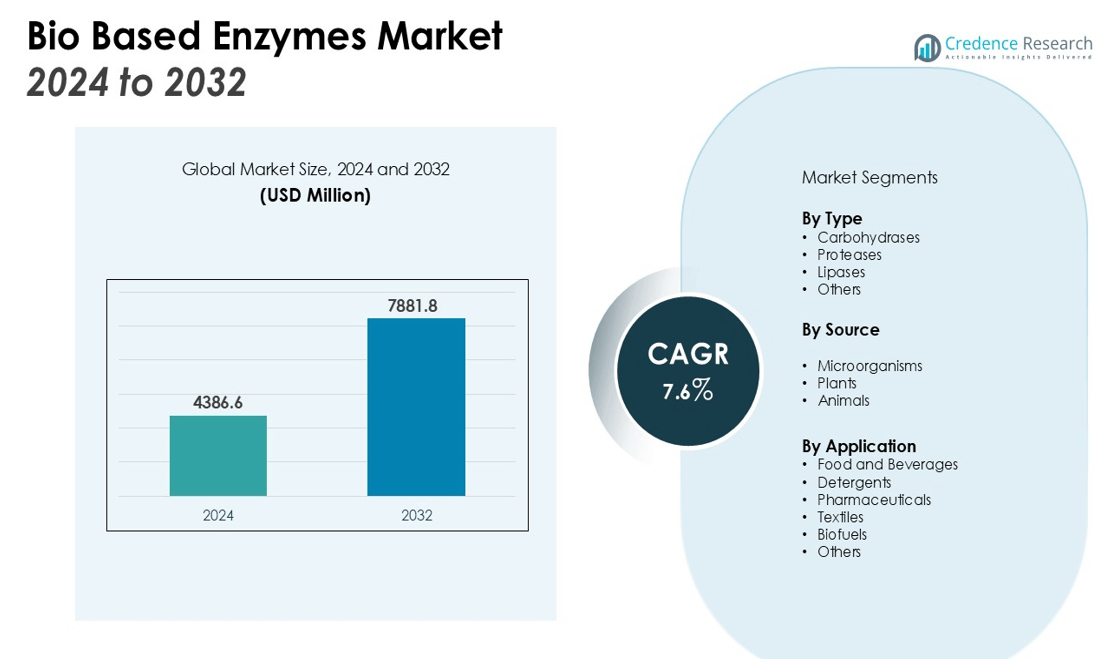
The Bio Based Enzymes Market size was valued at USD 4386.6 million in 2024 and is anticipated to reach USD 7881.8 million by 2032, at a CAGR of 7.6% during the forecast period (2024-2032).
| REPORT ATTRIBUTE |
DETAILS |
| Historical Period |
2020-2023 |
| Base Year |
2024 |
| Forecast Period |
2025-2032 |
| Bio Based Enzymes Market Size 2024 |
USD 4386.6 million |
| Bio Based Enzymes Market, CAGR |
7.6% |
| Bio Based Enzymes Market Size 2032 |
USD 7881.8 million |
The bio-based enzymes market is expanding steadily, fueled by the global shift toward eco-friendly and sustainable solutions. Key industries such as detergents, food processing, and textiles are increasingly adopting biodegradable and less chemically intensive alternatives, driving demand for these enzymes. Advancements in enzyme engineering, enhanced stability under diverse conditions, and cost-efficient fermentation processes are broadening applications and improving accessibility. Supportive regulatory frameworks and rising awareness of environmental and health benefits continue to strengthen the adoption of bio-based enzymes across industrial sectors.
North America maintains a leading position, supported by its strong biotechnology base, high consumer awareness, and extensive industrial adoption. Europe follows closely, shaped by stringent environmental standards and ongoing innovation in sustainable formulations. The Asia-Pacific region is emerging as a major growth hub, driven by expanding consumer markets, rapid industrialization, and rising emphasis on eco-conscious practices across major economies. Increasing research and development investments, coupled with strategic collaborations between global and regional players, are expected to accelerate market opportunities and reinforce competitiveness.
Market Insights:
- The Bio Based Enzymes Market was valued at USD 4386.6 million in 2024 and is projected to reach USD 7881.8 million by 2032, reflecting a CAGR of 7.6% during the forecast period.
- Growing demand for sustainable and biodegradable solutions in detergents, food processing, and textiles is driving adoption, supported by a global shift toward eco-friendly alternatives.
- Advancements in enzyme engineering and cost-efficient fermentation processes are enhancing stability, scalability, and application potential across multiple industries.
- Regulatory support and increasing consumer awareness of ecological and health benefits are strengthening adoption and creating long-term growth opportunities.
- North America holds 36% share, led by a strong biotechnology base, high consumer awareness, and robust industrial adoption across diverse sectors.
- Europe accounts for 30% share, supported by strict environmental regulations and continuous innovation in sustainable formulations within food, textile, and household care industries.
- Asia-Pacific secures 25% share, driven by rapid industrialization, expanding consumer demand, and government initiatives promoting green technologies and renewable energy solutions.
Access crucial information at unmatched prices!
Request your sample report today & start making informed decisions powered by Credence Research Inc.!
Download Sample
Market Drivers:
Growing Demand for Eco-Friendly and Sustainable Alternatives Across Industries
The Bio Based Enzymes Market is gaining momentum due to rising demand for sustainable and biodegradable solutions across detergents, food processing, and textile industries. Consumers and manufacturers are prioritizing alternatives that reduce chemical intensity and minimize environmental impact. It is witnessing strong acceptance in sectors that seek to balance performance with ecological responsibility. The global shift toward green products is reinforcing its relevance in industrial applications.
- For instance, Novozymes launched its Spirizyme T Portfolio, containing enzymes that convert wasted sugars into ethanol, enabling a typical plant to produce an additional 700,000 gallons of ethanol each year.
Advancements in Enzyme Engineering and Cost-Effective Production Technologies
Continuous innovation in enzyme engineering has played a critical role in market growth by improving enzyme stability, specificity, and adaptability under different conditions. It is supported by cost-efficient fermentation processes that reduce production costs while enhancing scalability. Enhanced performance attributes have enabled wider usage across multiple sectors. These technological gains are creating opportunities for both established players and emerging firms to strengthen their presence.
- For instance, Ginkgo Bioworks utilized its AI-driven platform to engineer an enzyme with a 10-fold improvement in function, a result achieved after testing just 100 enzyme variants generated by its sophisticated models.
Supportive Environmental Regulations and Rising Health Awareness
Regulatory frameworks that emphasize reducing chemical footprints are accelerating the adoption of bio-based enzymes across industries. It benefits from favorable policies that encourage sustainable practices in manufacturing and product design. Rising consumer awareness about the health and ecological advantages of bio-based solutions is further expanding the demand base. The alignment of industry practices with regulatory compliance is reinforcing its long-term growth potential.
Expanding Applications Through Industrial Diversification and Strategic Collaborations
The Bio Based Enzymes Market is expanding its footprint by diversifying into pharmaceuticals, agriculture, and specialty applications beyond its traditional sectors. It is driven by collaborations between global biotechnology firms and regional players that accelerate innovation and market reach. Growing research and development efforts are broadening application areas and improving competitive positioning. These strategic movements are expected to secure sustained growth and reinforce industry leadership.
Market Trends:
Integration of Advanced Biotechnological Innovations and Digital Solutions
The Bio Based Enzymes Market is witnessing significant transformation through the integration of advanced biotechnological innovations and digital platforms that enhance efficiency and scalability. It is benefiting from breakthroughs in protein engineering, synthetic biology, and gene editing, which are improving enzyme performance under varied industrial conditions. Companies are adopting digital simulation tools and AI-based modeling to accelerate enzyme design, reducing development timelines and production costs. The trend toward precision fermentation is enabling large-scale, consistent, and high-quality enzyme production, strengthening its industrial relevance. Strategic adoption of automation and data-driven optimization is further enhancing process reliability. These advancements are positioning bio-based enzymes as a vital component in sustainable industrial ecosystems.
- For instance, after commissioning its new manufacturing facility, Biocatalysts Ltd. successfully completed its first 5 consecutive fermentation batches for a range of customers, all of which met the agreed-upon yield expectations without a single failure.
Diversification of Applications and Expansion into High-Growth End-Use Industries
The Bio Based Enzymes Market is broadening its scope with diversified applications in pharmaceuticals, agriculture, and biofuels, extending its influence beyond traditional detergent and food sectors. It is being increasingly used in drug formulation, crop yield enhancement, and bioenergy production, aligning with global sustainability priorities. Growing consumer demand for natural and eco-friendly products is pushing industries to incorporate enzyme-based solutions across product lines. Companies are focusing on strategic partnerships and joint ventures to develop tailored enzyme applications that meet specialized requirements. Rising investment in R&D is driving innovation pipelines and expanding commercial opportunities. These trends are shaping the market into a more dynamic, multi-sector industry with significant long-term growth prospects.
- For instance, researchers from Queen’s University Belfast developed an enzyme-responsive hydrogel that, in preclinical studies, demonstrated the sustained release of the drug zidovudine at clinically relevant concentrations for 35 days following a single injection.
Market Challenges Analysis:
High Production Costs and Technical Limitations in Large-Scale Adoption
The Bio Based Enzymes Market faces challenges linked to high production costs and technical barriers that limit large-scale adoption. It is often constrained by the need for advanced fermentation facilities and specialized infrastructure, which increases operational expenses. Variability in enzyme activity under extreme industrial conditions creates performance inconsistencies that hinder widespread integration. Limited shelf life and sensitivity to temperature or pH fluctuations further restrict their usage in certain applications. Companies must invest heavily in research to overcome these barriers, which slows down commercial scalability. These cost and technical limitations remain critical hurdles for broader market penetration.
Regulatory Complexity and Intense Competitive Pressures Across Industries
The Bio Based Enzymes Market is also challenged by complex regulatory frameworks that vary across regions, creating delays in product approvals and commercialization. It is affected by stringent compliance requirements related to safety, quality, and sustainability standards. Competitive pressures from synthetic enzyme producers and chemical alternatives add another layer of difficulty for companies aiming to expand market share. The need for continuous innovation to differentiate offerings raises investment burdens, particularly for smaller players. Market participants often face difficulties in achieving consistent profitability while balancing compliance and innovation demands. These regulatory and competitive factors pose significant constraints on long-term market expansion.
Market Opportunities:
Expanding Role in Sustainable Industrial Applications and Green Manufacturing
The Bio Based Enzymes Market presents strong opportunities through its alignment with global sustainability goals and the growing demand for eco-friendly solutions. It is gaining traction in industries such as detergents, textiles, and food processing, where environmental compliance and consumer preference for natural alternatives are reshaping business models. The shift toward green chemistry and circular economy practices is creating new prospects for bio-based enzymes to replace synthetic chemicals. Rising demand for biodegradable products in packaging and household goods further enhances adoption potential. Companies investing in tailored enzyme formulations can capture significant growth opportunities in high-demand sectors. Strategic integration into green manufacturing processes is expected to secure a competitive advantage for early adopters.
Emerging Applications in Pharmaceuticals, Agriculture, and Renewable Energy
The Bio Based Enzymes Market is also poised for expansion through its increasing role in pharmaceuticals, agriculture, and renewable energy production. It is supporting drug formulation, controlled release systems, and disease treatment solutions, enhancing its medical relevance. In agriculture, bio-based enzymes are improving soil fertility, nutrient absorption, and crop yields, addressing food security challenges. The rising importance of biofuels and bioenergy is creating additional pathways for growth, as enzymes enhance production efficiency and reduce costs in renewable energy processes. Strategic partnerships with biotech firms and research institutions are accelerating innovation in these areas. Expanding into these diverse sectors provides a foundation for long-term market growth and resilience.
Market Segmentation Analysis:
By Type
The Bio Based Enzymes Market is segmented into carbohydrases, proteases, lipases, and other specialized enzymes. Carbohydrases lead adoption due to their extensive use in food processing, beverages, and biofuel production. Proteases maintain a strong presence in detergents and pharmaceuticals, supporting cleaning efficiency and therapeutic applications. Lipases are gaining traction in biodiesel and specialty products by offering effective fat and oil breakdown. It is also experiencing advancements in specialized enzyme types tailored for niche industrial requirements.
- For instance, Novozymes’ carbohydrase solution, Ronozyme® VP, is used in animal feed formulation, where it can reduce feed costs by as much as 6 Euros per ton.
By Source
The market is divided into microorganisms, plants, and animals, with microbial enzymes holding the largest share due to scalability and cost-effective production. Microbial fermentation ensures higher stability and reliable quality across industrial operations. Plant-derived enzymes are increasingly used in food and nutraceuticals where natural labeling is essential. Animal-based enzymes continue to support pharmaceutical and therapeutic fields but face restrictions from ethical and sustainability concerns. It is witnessing stronger reliance on microbial systems to meet rising industrial demands.
- For instance, the microbial protease Neutrase® from Novozymes can increase production capacity in the animal protein industry by reducing processing time to as low as 17 days.
By Application
The market is segmented into food and beverages, detergents, pharmaceuticals, textiles, biofuels, and other end uses. Food and beverages dominate demand with enzymes enhancing flavor, preservation, and processing efficiency. Detergents are another major segment, driven by eco-friendly formulations that replace harsh chemicals. Pharmaceuticals and biofuels are emerging as high-growth areas supported by innovation in medical applications and renewable energy. It is diversifying applications across industries, reinforcing long-term opportunities and competitiveness.
Segmentations:
By Type
- Carbohydrases
- Proteases
- Lipases
- Others
By Source
- Microorganisms
- Plants
- Animals
By Application
- Food and Beverages
- Detergents
- Pharmaceuticals
- Textiles
- Biofuels
- Others
By Region
- North America
- Europe
- Germany
- France
- U.K.
- Italy
- Spain
- Rest of Europe
- Asia Pacific
- China
- Japan
- India
- South Korea
- South-east Asia
- Rest of Asia Pacific
- Latin America
- Brazil
- Argentina
- Rest of Latin America
- Middle East & Africa
- GCC Countries
- South Africa
- Rest of the Middle East and Africa
Regional Analysis:
North America Holds 36% Share Driven by Biotechnology and Industrial Adoption
The Bio Based Enzymes Market in North America accounted for 36% share, supported by its advanced biotechnology ecosystem and wide industrial adoption. It is driven by robust demand across detergents, pharmaceuticals, and food processing sectors, where sustainability and innovation remain core priorities. High consumer awareness of eco-friendly products and established infrastructure for bioprocessing technologies further enhance market expansion. Strong investment in research and development, coupled with favorable regulatory initiatives, has strengthened the region’s position as a leader in sustainable solutions. Strategic collaborations between global players and local industries continue to accelerate adoption across diverse applications.
Europe Accounts for 30% Share Backed by Regulations and Sustainable Innovation
The Bio Based Enzymes Market in Europe accounted for 30% share, benefiting from strict environmental regulations that encourage the replacement of synthetic chemicals with natural and biodegradable alternatives. It is further supported by innovation in sustainable formulations, particularly in food and beverage processing, textiles, and household care. European consumers display strong preferences for products with reduced ecological footprints, reinforcing the demand for bio-based enzymes. Companies in the region are focusing on advancing enzyme efficiency and stability to meet the needs of varied industries. Partnerships with universities and research institutes are also shaping the innovation pipeline, contributing to competitive strength.
Asia-Pacific Secures 25% Share with Expanding Consumer and Industrial Demand
The Bio Based Enzymes Market in Asia-Pacific held 25% share, supported by expanding consumer markets, growing industrialization, and increasing focus on sustainable practices. It is driven by rising demand from food processing, agriculture, and biofuel industries across major economies such as China, India, and Japan. Government initiatives promoting green technologies and renewable energy adoption are creating favorable conditions for enzyme-based solutions. Expanding manufacturing capabilities in the region are also providing cost advantages to local producers and multinational companies. This dynamic growth environment positions Asia-Pacific as a crucial hub for future market expansion and innovation.
Access crucial information at unmatched prices!
Request your sample report today & start making informed decisions powered by Credence Research Inc.!
Download Sample
Key Player Analysis:
- BASF
- Evocatal
- AB Enzymes
- Novozymes
- Koninklijke DSM
- Dupont
- Johnson Matthey
- CLEA
- Ingenza
- Biocatalysts
- Prozomix
- Kerry Group
- Amano Enzyme
Competitive Analysis:
The Bio Based Enzymes Market is characterized by strong competition among global biotechnology firms, chemical manufacturers, and specialized enzyme producers. Leading companies focus on innovation in enzyme engineering, cost-effective fermentation processes, and improved stability to strengthen their portfolios. It is witnessing strategic mergers, acquisitions, and partnerships aimed at expanding geographic presence and diversifying applications in food, detergents, pharmaceuticals, and biofuels. Regional players are gaining ground by offering tailored solutions that align with local industry needs and sustainability goals. Continuous investment in research and development is enabling firms to differentiate their products while meeting evolving regulatory standards. Competitive intensity is further shaped by pricing strategies, supply chain optimization, and customer-specific solutions, positioning the market for steady innovation-driven growth.
Recent Developments:
- In August 2025, BASF announced its novel nematode-resistant soybean trait will be launched in combination with leading herbicide and insect resistance traits.
- In April 2025, BASF launched three new natural-based ingredients for the personal care market: Verdessence® Maize, Lamesoft® OP Plus, and Dehyton® PK45 GA/RA.
- In July 2025, Evotec announced an evolution of its strategic partnership with Sandoz, which included the divestiture of its Toulouse site.
Market Concentration & Characteristics:
The Bio Based Enzymes Market reflects moderate to high concentration, with a mix of global leaders and emerging regional players shaping competitive dynamics. It is dominated by a few multinational companies that control a significant share through advanced research capabilities, broad distribution networks, and diversified product portfolios. Smaller firms contribute by focusing on niche applications and offering customized enzyme solutions aligned with sustainability trends. The market is characterized by high entry barriers due to technological complexity, regulatory compliance, and the need for substantial R&D investment. It continues to evolve with strong emphasis on innovation, eco-friendly production, and integration into diverse industries, reinforcing its position as a critical component of sustainable industrial solutions.
Report Coverage:
The research report offers an in-depth analysis based on Type, Source, Application and Region. It details leading market players, providing an overview of their business, product offerings, investments, revenue streams, and key applications. Additionally, the report includes insights into the competitive environment, SWOT analysis, current market trends, as well as the primary drivers and constraints. Furthermore, it discusses various factors that have driven market expansion in recent years. The report also explores market dynamics, regulatory scenarios, and technological advancements that are shaping the industry. It assesses the impact of external factors and global economic changes on market growth. Lastly, it provides strategic recommendations for new entrants and established companies to navigate the complexities of the market.
Future Outlook:
- The Bio Based Enzymes Market is expected to benefit from the global emphasis on sustainability and the shift toward biodegradable alternatives across industries.
- It will witness rising adoption in detergents, textiles, and food processing, where eco-friendly formulations are becoming a key competitive differentiator.
- Expanding applications in pharmaceuticals, agriculture, and biofuels will drive diversification and strengthen long-term demand.
- Continuous advancements in enzyme engineering and fermentation technologies will enhance efficiency, stability, and cost-effectiveness.
- Regulatory support for reducing chemical footprints will accelerate integration into manufacturing and consumer products.
- Strategic collaborations between global biotechnology leaders and regional firms will expand product reach and innovation pipelines.
- Increasing investment in research and development will drive the creation of tailored enzyme solutions for niche applications.
- Growth in Asia-Pacific will intensify, supported by industrial expansion, consumer awareness, and government-led green initiatives.
- North America and Europe will retain strong positions through established biotechnology ecosystems and regulatory frameworks favoring sustainable products.
- Rising competition from both established players and emerging entrants will encourage innovation, pricing efficiency, and customer-focused strategies, shaping a dynamic and resilient market landscape.



