
| REPORT ATTRIBUTE | DETAILS |
|---|---|
| Historical Period | 2019-2022 |
| Base Year | 2023 |
| Forecast Period | 2024-2032 |
| Bluetooth Beacons Market Size 2023 | USD 2581.2 Million |
| Bluetooth Beacons Market, CAGR | 35.20% |
| Bluetooth Beacons Market Size 2032 | USD 38,959.3 Million |
Market Insights
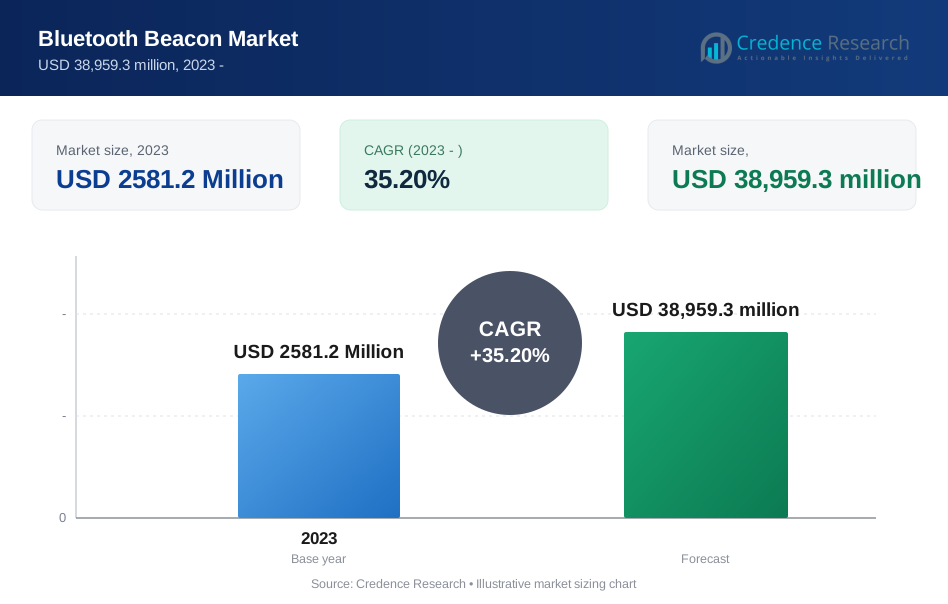
- The global demand for Bluetooth Beacons was valued at USD 2581.2 Million in 2023 and is expected to reach USD 38,959.3 Million in 2032, growing at a CAGR of 35.20% between 2024 and 2032.
- In 2023, Standard Bluetooth Beacons will hold the most market share in the Bluetooth Beacon Market, while Long-range beacons will be the fastest-growing category.
- The Bluetooth Beacon sector is dominated by battery-powered beacons, with solar-powered beacons representing the fastest-growing segment.
- In 2023, integrated beacons will lead the Bluetooth Beacon sector, with Stand-Alone Beacons accounting for another considerable market share.
- In 2023, the retail segment had a revenue share of more than 65%, and healthcare is another promising industry that is projected to develop at the fastest rate.
- In 2023, North America is predicted to have the largest market share, while the Asia Pacific (APAC) region is expected to develop at the fastest CAGR during the projection period.
- One of the key factors driving the global Bluetooth Beacon market is increased awareness of iBeacon technology.
- Limited Range and Interference hinders the market growth
Executive Summary
Market Definition
Bluetooth beacons are hardware transmitters, a type of Bluetooth low energy (LE) device that broadcasts its identity to adjacent portable electronic devices. When a smartphone, tablet, or other device comes into close contact with a beacon, it can do actions. Bluetooth Beacons employ Bluetooth low-energy proximity sensing to send a universally unique identifier that is detected by a compatible app or operating system. The identity and the bytes delivered with it can be used to determine the device's physical position, track consumers, or perform a location-based action on the device, such as a social network check-in or push notification.
Market Overview
The global Bluetooth Beacon market has witnessed steady growth in recent years and is expected to grow at a CAGR of 35.20% between 2024 and 2032. The market was valued at USD 2581.2 million in 2023 and is expected to reach USD 38,959.3 million in 2032.
Rising awareness of iBeacon technology, as well as increasing smartphone usage and consumer spending power, are some of the primary factors driving the Global Bluetooth Beacon And iBeacon Market. The implementation of beacon technology has transformed adopters' operations by enabling a new degree of client connection through personalization. The rising prominence of location-based marketing in the retail business is driving the growth potential. Combining the advantages of the physical shopping experience with the internet ecosystem has become critical for brick-and-mortar stores.
In addition, the increasing integration of beacons into cameras, LED lighting, point-of-sale (POS) devices, digital signage, and vending machines is likely to drive industry growth throughout the projection period. Aside from retail uses, beacons are expected to become a widespread commodity in industrial settings. Furthermore, advancements in IT solutions such as the Internet of Things (IoT), low power consumption, and low cost are among the important factors driving the Global Bluetooth Beacon And iBeacon Market. Continuous technological improvement is a critical factor in the transformation of global retail and corporate sectors.
However, users of iBeacons and Bluetooth Beacon are expected to face challenges due to the limited transmit-only protocol (no bidirectional communications between two devices), frequency variance (do not have the same frequency and do not transmit signals of the same power), privacy and security concerns, signal accuracy fluctuations due to weather conditions, device power, temperature, and polling intervals. This reduces user adoption of iBeacons and Bluetooth Beacon, limiting the growth of the Global Bluetooth Beacon and iBeacon Market.
Segmentation by Type of Beacon
- In 2023, Standard Bluetooth Beacons have the highest market share in the Bluetooth Beacon Market because they can be integrated into a wide range of products, are widely used, and have a very solid presence across numerous industries.
- Long-range beacons represent the market's fastest-expanding category. Such beacons provide more coverage than regular beacons and are best suited for applications requiring communication over longer distances.
Segmentation by Power Sources
- Battery-powered beacons dominate the Bluetooth Beacon industry. Convenience, flexibility, and ease of deployment of beacons across multiple sites without the need to be constantly connected to a power source are some of the traits that enable their application to a broad reach.
- Solar-powered beacons are the most rapidly expanding segment of the industry. Because they are sustainable and environmentally benign, demand for such beacons has increased rapidly. Solar-powered beacons use renewable energy and require fewer battery replacements, making them ideal for long-term deployment in outdoor and isolated settings.
Segmentation by Form Factor
- In 2023, Integrated beacons will lead the Bluetooth Beacon industry. The explanation could be that integrated beacons are more compact and easier to integrate into existing systems and devices.
- Stand-Alone Beacons is another significant market share-holding group. Stand-alone beacons are another popular form factor because of their simplicity and independence from external systems, making them an ideal alternative for any business looking to use beacon technology without requiring extensive integration.
Segmentation by Industry Vertical
- In 2023, the retail segment had a revenue share of more than 65% due to increased beacon deployment for improving customer experience.
- Healthcare is another promising area that is predicted to grow at the highest rate to meet the growing demand for emergency response.
Segmentation by Region
- In 2023, North America is expected to have the biggest market share.
- The Asia Pacific (APAC) region is expected to grow at the quickest CAGR during the projection period.
- The rest of the world, including Latin America, the Middle East, and Africa, supplies the remaining demand for Bluetooth Beacon.
North America is predicted to have the largest market share over the projection period. North America accounted for a significant portion of market revenue in 2023. This is due to the strong presence of important players in the region, as well as the growing usage of essential communication technologies, including Bluetooth, NFC, Wi-Fi, and ongoing loT (internet of Things) technology. Other important market factors include increased investment from North American countries and rising demand for proximity tools in the retail and public sectors.
Moreover, the Asia Pacific (APAC) region is predicted to expand at the fastest CAGR throughout the projection period. This is due to increased demand for location-based services in businesses such as transportation and logistics, entertainment, and education and research. To meet the growing need for beacons in various industries, several APAC firms are working on developing and deploying improved beacon devices. Beacon market growth in countries such as India, China, and Korea is likely to accelerate during the forecast period because to increased investments by the government and foreign investors in different smart city projects.

Key Highlights of the Report
The global Bluetooth Beacon market is segmented by Type of Beacon, Power Sources, Form Factors, Industry Vertical, and region. Standard Bluetooth Beacons will dominate the market in 2023, with integrated beacons taking the lead. Furthermore, long-range beacons will be the fastest-growing sector. At the same time, healthcare is another potential market that is expected to expand at the highest rate, with North America leading the market growth.
The market's primary drivers are the rising need for location-based marketing, increased IoT use, and improved customer experience. Furthermore, important market obstacles include privacy concerns, limited range, and interference, as well as cost and implementation challenges. The market's significant opportunities include integration with mobile apps, expansion in other industries, and advancements in beacon technology.
Nonetheless, North America generated a sizable portion of market revenue in 2023. This is due to the strong presence of key players in the region, as well as the expanding use of critical communication technologies such as Bluetooth, NFC, Wi-Fi, and ongoing loT (Internet of Things) technology. Furthermore, the Asia-Pacific (APAC) region is expected to grow at the quickest CAGR over the forecast period. This is due to rising demand for location-based services in industries such as transportation and logistics, entertainment, and education and research.
What Are The Main Drivers Of The Global Bluetooth Beacon Market?
The Bluetooth Beacon Market is being driven by the growing demand for location-based marketing, which allows businesses to send targeted messages to clients depending on their location, hence increasing engagement and sales. Furthermore, the increasing use of IoT is driving the use of Bluetooth beacons for a variety of applications, including asset tracking and smart devices. Additionally, Bluetooth beacons improve user experiences by enabling targeted interactions in locations such as retail stores, museums, and airports, hence increasing overall customer happiness.
What Are The Major Challenges Faced By The Global Bluetooth Beacon Market?
Despite the market's expansion, there are some constraints to consider. Bluetooth beacons' location tracking capabilities raise issues about data privacy and exploitation. Another limitation is the restricted range and potential interference that Bluetooth beacons may encounter, affecting their performance in particular circumstances. Furthermore, the cost and implementation challenges of adopting Bluetooth beacon technology can be significant, particularly for large-scale installations that necessitate expertise for setup and maintenance.
What Are The Growth Opportunities In The Global Bluetooth Beacon Market?
The Bluetooth Beacon Market offers tremendous potential for growth and innovation. Integrating Bluetooth beacons with mobile apps offers a tremendous opportunity to provide tailored experiences, collect useful statistics, and increase user engagement. Furthermore, the spread of Bluetooth beacons into areas other than retail, such as healthcare, hotels, and transportation, creates new market opportunities and applications. Beacon technology advancements, such as longer battery life, improved security features, and increased accuracy, open up new potential for innovation and industry expansion.
Market Drivers
Increasing awareness of iBeacon technology
One of the primary factors boosting the worldwide Bluetooth Beacon market is growing awareness of iBeacon technology. Other major causes include expanding smartphone usage and rising consumer buying power, which in turn boosts smartphone usage. By encouraging greater consumer connection through customisation, beacon technology has revolutionized the operations of its early adopters. The increased popularity of location-based marketing in the retail industry is to blame for the expected growth. Brick-and-mortar stores have recognized the need of combining the benefits of the physical shopping environment with the digital ecosystem.
Increase use of Bluetooth beacons
The market for Bluetooth beacons is also expanding due to increased organized commerce, which includes hypermarkets, supermarkets, specialized shops, department stores, cash and carry retailers, and discounters. This is because contactless payment systems and offers, flash discounts, and product information are all given to customers via Bluetooth beacons in the retail industry. Product distribution and multichannel marketing have emerged as significant retail trends, boosting the expansion of the Bluetooth beacons market. Manufacturers are now required to provide software for beacons. Bluetooth beacons are popular at airports and ground transit hubs because they provide travelers with real-time updates on aircraft delays, departures, and gate and platform information.
Market Restraints
Limited Range and Interference
In the Bluetooth beacon industry, restricted range and interference refer to the distance that a Bluetooth beacon can efficiently send signals and receive data. This is typically limited to a distance of about 70 meters, which can be further hampered by physical obstacles such as walls or other wireless devices operating in the same frequency band. This, in turn, may limit location-based services by lowering the accuracy and dependability of the Bluetooth beacons services, particularly in congested or complex environments. To address this issue, beacon placement optimization, the addition of repeaters, or the investigation of other technologies to improve signal coverage with less interference for robust and accurate beacon performance could be implemented.
Opportunities
Advancements in Beacon Technology
Improving technological breakthroughs in beacon technology support the continuous evolution and improvement of beacon devices, including crucial improvements in areas such as battery life, security features, and location tracking precision. Increased battery life equates to more time in operation, requiring less maintenance. Improved security features address data protection and privacy concerns. Higher accuracy in location monitoring allows for more effective and dependable interaction with the user. These technological improvements pave the way for new applications that deliver a rich user experience while driving the market toward more efficient and effective use of Bluetooth beacons across various sectors.
Competitive Landscape
Key Players
The global Bluetooth Beacon market is highly competitive, with several key players. Some of the major players in the market and their market share are as follows:
- JK Tech
- GCell
- Bluvision
- Apple Inc.
- Estimote Inc
- GeLo Inc.
- MobileCoderz Technologies Pvt Ltd
- Accent Systems
- Bluecats
- Hewlett Packard Enterprise
- Proximity Solutions
- Google LLC (Alphabet)
- Kontakt
- K2B Solutions
- Mobstac Inc
- UFO Beacons
- Onyx Beacon
- Others
These organizations prioritize product innovation, distribution channel expansion, and mergers and acquisitions to stay competitive.
The global Bluetooth Beacon market's key players continually seek to stay ahead by offering new products and developments.
In January 2023, Berkeley Lights, Inc. has announced Beacon Select, their new optofluidic technology for cell line creation. Beacon Select is built on the same advanced technology as the original Beacon System, which was debuted in 2017 and already has over 130 units installed worldwide.
In November 2022, Infsoft has launched a new Locator Beacon that blends BLE and UWB. The upgraded Infsoft Locator Beacon combines Bluetooth Low Energy and Ultra-wideband tracking technology to track both clients and servers. With the new hardware from the Ingolstadt-based full-service provider, major businesses can achieve a variety of locator-related use cases.
How are Companies Performing in the Bluetooth Beacon Market?
Companies and startups are actively participating and innovating in the Bluetooth Beacon Market. Startups bring new ideas and handy ways to the market, increasing competition and forcing incumbent firms to innovate. Moreover, Recent market advancements have placed a strong emphasis on beacon technology enhancements such as longer battery life, higher accuracy, and enhanced application potential. These efforts go a long way toward providing a more effective and dependable service for businesses and consumers.
Other issues, such as sustainability and carbon emissions, are also being addressed in the market. More and more organizations are moving toward green operations by using sustainable materials, increasing energy efficiency, and relying on renewable energy sources, including solar energy for beacons. This trend aligns with the global endeavor to reduce carbon footprints and become greener in several technical areas.
Summary of Key Findings
- Advancements in Beacon Technology are the primary market opportunity.
- Market segmented by Type of Beacon, Power Sources, Form Factors, Industry Vertical, and region.
- In 2023, Standard Bluetooth Beacons will hold the most market share in the Bluetooth Beacon Market, while Long-range beacons will be the fastest-growing category.
- Integrated beacons will lead the Bluetooth Beacon industry in 2023
- North America is leading market growth; the market is highly competitive with key players including JK Tech, GCell, Bluvision, Apple Inc., Estimote Inc., GeLo Inc., MobileCoderz Technologies Pvt Ltd and Others.
Future Outlook
- Increased Adoption in Various Industries
- Improved integration with IoT ecosystem.
- Continuous Innovation in Beacon Technology
- Expanding Location-Based Services.
- Greater emphasis on data privacy and security.
- Increased demand for personalized customer experiences.
How CXOs Can Benefit from the Credence Research Bluetooth Beacon Market Report
The Credence Research Bluetooth Beacon Market Report provides CXOs with a comprehensive overview of the market, including:
- Market size and growth forecast:The report provides detailed estimates of the global Bluetooth Beacon market size, segmented by Type of Beacon, Power Source, Form Factor, Industry Vertical, and region. It also includes forecasts for the market through 2032 based on key trends and drivers.
- Market segmentation:The report segments the Bluetooth Beacon market by Type of Beacon, Power Source, Form Factor, Industry Vertical, and region. This segmentation provides CXOs with a granular understanding of the market and the opportunities in each segment.
- Competitive Landscape:The report profiles the key players in the Bluetooth Beacon market and provides insights into their strategies, product offerings, and financial performance. This information can help CXOs to identify and assess their competition.
- Key trends and drivers:The report identifies and analyzes the key trends and drivers that are shaping the Bluetooth Beacon market. This information can help CXOs to make informed decisions about their investments and strategies.
CXOs can use the insights from the Credence Research Bluetooth Beacon Market Report to:
- Identify growth opportunities:The report can help CXOs identify new growth opportunities in the Bluetooth Beacon market. For example, the report may highlight opportunities for businesses to explore new application areas for Bluetooth beacons, such as enhancing customer engagement in retail settings, improving asset tracking in logistics, or optimizing visitor experiences in the tourism and hospitality industries.
- Make informed investment decisions:The report can help CXOs make informed investment decisions about Bluetooth Beacon. For example, the report may highlight the increasing adoption of Bluetooth beacons in various industries, the projected market growth rate, key players in the market, and regulatory factors affecting the industry
- Develop competitive strategies:The report can help CXOs develop competitive strategies for their Bluetooth Beacon businesses. For example, the report may offer information on innovative use cases for Bluetooth beacons, potential partnerships or collaborations with other industry players, and strategies to differentiate products or services in the market.
- Track market developments:The report can help CXOs track market developments and stay ahead of the curve. For example, the report provides insights into the latest trends and innovations in the Bluetooth Beacon market.
Overall, the Credence Research Bluetooth Beacon Market Report is a valuable resource for CXOs who are looking to gain a deeper understanding of the market and identify opportunities for growth.
Segmentation
-
By Type of Beacon:
- Standard Bluetooth Beacons
- Long-Range Beacons
- USB Beacons
- Sticker Beacons
-
By Power Source:
- Battery-Powered Beacons
- USB-Powered Beacons
- Solar-Powered Beacons
-
By Form Factor:
- Stand-Alone Beacons
- Integrated Beacons
-
By Industry Vertical:
- Retail
- Hospitality
- Transportation
- Healthcare
- Entertainment and Events
- Smart Cities
- Education
- Industrial and Logistics
-
By Region
- North America
- US
- Canada
- Mexico
- Europe
- Germany
- France
- UK
- Italy
- Spain
- Rest of Europe
- Asia Pacific
- China
- Japan
- India
- South Korea
- South-east Asia
- Rest of Asia Pacific
- Latin America
- Brazil
- Argentina
- Rest of Latin America
- Middle East & Africa
- GCC Countries
- South Africa
- Rest of Middle East and Africa
- North America
Adjacent Markets
In the Bluetooth Beacon market, there are several adjacent markets which has high revenue growth opportunities. The key adjacent markets for Bluetooth Beacon market -
Adjacent Markets |
||
| Geofencing Market | Indoor Positioning Systems Market | Internet of Things (IoT) Devices Market |
| Wearable Technology Market | Asset Tracking Market | Location-Based Services Market |
| Mobile Advertising Market | Smart Retail Market | Proximity Marketing Market |
Request a Free Sample
Fill in your details and we'll send you a free sample report.
- Sample data tables & charts
- Research methodology
Market Dynamics
Rising Awareness and Adoption of iBeacon Technology
Growing recognition of iBeacon and Bluetooth beacon solutions is driving adoption across industries, especially as businesses seek to leverage proximity-based marketing and customer engagement tools.
Expansion of Location-Based Marketing in Retail
Retailers are increasingly deploying Bluetooth beacons to enhance in-store experiences, deliver personalized promotions, and integrate physical shopping with digital channels, fueling significant market growth.
Integration with IoT and Smart Devices
Bluetooth beacons are being embedded into a wide range of IoT devices, such as POS systems, digital signage, and smart lighting, enabling new use cases in asset tracking, automation, and real-time analytics.
Advancements in Beacon Technology
Continuous improvements in battery life, signal range, security, and integration capabilities are making beacons more attractive for long-term, large-scale deployments in diverse environments.
Growth in Demand for Location-Based Services Beyond Retail
Industries such as healthcare, transportation, and smart cities are increasingly adopting Bluetooth beacons for applications like patient tracking, asset management, and public information, broadening the market’s scope.
Need a Custom Version of This Report?
Tailor the scope, geography, or segments to your exact requirements.
- Custom geography or segment scope
- Direct access to our analyst team
Frequently Asked Questions
What is the current size of the global Bluetooth Beacon market?
What is the expected growth rate of the Bluetooth Beacon market between 2024 and 2032?
Which segment is leading the market share in terms of Form Factor?
Which Type of Beacon segment governs the demand for Bluetooth Beacons in the world?
Which Power Source segment is expected to post the fastest growth rate during the forecast period?
Which region is fueling the growth of the Bluetooth Beacon industry?
Who are the major players in the global Bluetooth Beacon market?
What are the major market drivers of the Bluetooth Beacon industry?
What are the major market restraints of the Bluetooth Beacon industry?
What are the major market opportunities of the Bluetooth Beacon industry?
Table of Content
Chapter 1 Market Segmentation
- 1.1 Segmentation Framework
- 1.1.1 Product and Service Classification
- 1.1.2 Application and End-Use Classification
- 1.1.3 Technology and Solution Classification
- 1.1.4 Customer and Distribution Channel Classification
- 1.1.5 Geographic Segmentation
- 1.1.6 Market Segment Definitions and Boundaries
- 1.2 By Form Factor
- 1.2.1 Stand-Alone Beacons
- 1.2.2 Integrated Beacons
- 1.3 By Power Source
- 1.3.1 Battery-Powered Beacons
- 1.3.2 USB-Powered Beacons
- 1.3.3 Solar-Powered Beacons
- 1.4 By Type of Beacon
- 1.4.1 Standard Bluetooth Beacons
- 1.4.2 Long-Range Beacons
- 1.4.3 USB Beacons
- 1.4.4 Sticker Beacons
- 1.5 By Industry Vertical
- 1.5.1 Retail
- 1.5.2 Healthcare
- 1.5.3 Transportation
- 1.5.4 Hospitality
- 1.5.5 Entertainment and Events
- 1.5.6 Smart Cities
- 1.5.7 Education
- 1.5.8 Industrial and Logistics
Chapter 2 Introduction
- 2.1 Report Objectives and Scope
- 2.2 Product Definition and Industry Terminology
- 2.3 Market Inclusions and Exclusions
- 2.4 Research Process
- 2.4.1 Primary Research and Expert Interviews
- 2.4.2 Secondary Research and Source Review
- 2.4.3 Top-Down and Bottom-Up Estimation
- 2.4.4 Data Triangulation and Verification
- 2.5 Market Size Measurement Basis
- 2.5.1 2023: USD 2581.2 Million → 2032: USD 38,959.3 million
- 2.6 Historical and Forecast Reference Periods
- 2.6.1 Base Year: 2023
- 2.6.2 Forecast Period: 2023-2032
- 2.7 Research Assumptions and Limitations
Chapter 3 Executive Summary
- 3.1 Market Snapshot and Key Findings
- 3.2 Base-Year Market Size, 2023
- 3.3 Forecast Market Size, 2032
- 3.4 Revenue and Volume Growth Outlook
- 3.5 Key Demand and Supply Indicators
- 3.6 Leading Market Segments
- 3.7 Fastest-Growing Market Opportunities
- 3.8 Regional Performance Highlights
- 3.9 Technology and Industry Transformation
- 3.10 Competitive Landscape Summary
- 3.11 Analyst View and Strategic Implications
Chapter 4 Global Bluetooth Beacon Market Trends and Developments
- 4.1 Historical Industry Development
- 4.2 Recent Market Trends and Developments
- 4.3 Demand and Customer Behavior Trends
- 4.4 Technology and Product Innovation
- 4.5 Artificial Intelligence, Automation and Digitalization
- 4.6 Local Manufacturing and Supply Chain Realignment
- 4.7 Industry Partnerships, Mergers and Acquisitions
- 4.8 Sustainability and Circular Economy Developments
- 4.9 Government and Private Sector Investment Trends
- 4.10 Emerging Business Models and Commercialization
- 4.11 Industry Developments and Announcements
Chapter 5 Global Bluetooth Beacon Market Production, Supply and Demand Analysis
- 5.1 Demand Trend and Consumption Analysis
- 5.2 Demand Forecast, 2023-2032
- 5.3 Production and Output Trend
- 5.4 Production and Output Forecast, 2023-2032
- 5.5 Installed Capacity and Capacity Utilization
- 5.6 Company-Wise Production Plants and Statistics
- 5.6.1 Installed Production Capacity
- 5.6.2 Actual Production
- 5.6.3 Planned Capacity and Expansion Targets
- 5.7 Supply Chain Structure and Procurement Trends
- 5.8 Supply-Demand Gap and Bottlenecks
- 5.9 Import Dependence and Sourcing Structure
- 5.10 Contract Manufacturing and Outsourcing
- 5.11 Regional Supply and Demand Concentration
Chapter 6 Global Bluetooth Beacon Market Pricing Analysis
- 6.1 Pricing Structure and Measurement
- 6.2 Historical Pricing Trends
- 6.3 Pricing Outlook, 2023-2032
- 6.4 Average Selling Price and Unit Economics
- 6.5 Pricing by Product and Market Segment
- 6.6 Geographic Pricing Differences
- 6.7 Key Input, Energy, Labor and Logistics Costs
- 6.8 Contract Pricing and Purchasing Models
- 6.9 Pricing Sensitivity and Competitive Positioning
- 6.10 Price, Margin and Profitability Implications
Chapter 7 Global Bluetooth Beacon Market Dynamics
- 7.1 Market Growth Drivers
- 7.1.1 Demand-Side Drivers
- 7.1.2 Technology and Innovation Drivers
- 7.1.3 Infrastructure and Investment Drivers
- 7.1.4 Regulatory and Policy Drivers
- 7.2 Market Restraints
- 7.2.1 Cost and Affordability Constraints
- 7.2.2 Technology and Adoption Barriers
- 7.2.3 Supply Chain and Operational Constraints
- 7.3 Market Challenges
- 7.3.1 Competitive Pressure and Margin Erosion
- 7.3.2 Skills, Infrastructure and Implementation Gaps
- 7.4 Emerging Market Opportunities
- 7.5 Market Dynamics Impact and Time-Horizon Assessment
Chapter 8 Global Bluetooth Beacon Value Chain Analysis
- 8.1 Industry Value Chain Overview
- 8.2 Upstream Suppliers and Critical Inputs
- 8.3 Technology and Component Providers
- 8.4 Manufacturing or Service Delivery
- 8.5 Distribution, Channel Partners and Integrators
- 8.6 Downstream Applications and End Users
- 8.7 Value Addition and Profit Pools
- 8.8 Vertical Integration and Outsourcing
- 8.9 Supplier Concentration and Risk
- 8.10 Supply Chain Localization and Resilience
Chapter 9 Global Bluetooth Beacon Market Regulations and Policies
- 9.1 Relevant Laws, Standards and Compliance Frameworks
- 9.2 Product, Service, Safety and Quality Requirements
- 9.3 Government Policies, Incentives and Subsidies
- 9.4 Imports, Exports and Trade Barriers
- 9.5 Public Procurement and Local Content Requirements
- 9.6 Environmental and Sustainability Compliance
- 9.7 Data Protection, AI and Cybersecurity Compliance
- 9.8 Upcoming Policy Changes and Market Implications
Chapter 10 Global Bluetooth Beacon Market Hotspots and Opportunities
- 10.1 Market Opportunity Mapping and Growth Hotspots
- 10.2 High-Growth Applications and Customer Groups
- 10.3 Underserved Markets and White-Space Opportunities
- 10.4 Emerging Technology and Product Opportunities
- 10.5 New Capacity and Investment Hotspots
- 10.6 Market Entry and Expansion Opportunities
- 10.7 Distribution and Partnership Opportunities
- 10.8 Near-Term and Long-Term Commercial Potential
- 10.9 Opportunity Attractiveness and Execution Risks
Chapter 11 Global Bluetooth Beacon Market Outlook, 2023-2032
- 11.1 Market Size and Analysis
- 11.1.1 Revenue (Market Measurement: 2023: USD 2581.2 Million → 2032: USD 38,959.3 million)
- 11.1.2 Market Volume and Quantity Sold
- 11.1.3 Historical Market Size
- 11.1.4 Base-Year Market Size, 2023
- 11.2 Market Forecast, 2023-2032
- 11.2.1 Revenue Forecast to 2032
- 11.2.2 Volume Forecast to 2032
- 11.2.3 CAGR and Year-on-Year Growth
- 11.2.4 Incremental Revenue Opportunity
- 11.3 Forecast Assumptions and Scenario Analysis
- 11.3.1 Base-Case Forecast
- 11.3.2 Optimistic and Conservative Scenarios
- 11.3.3 Technology, Pricing and Policy Sensitivities
- 11.4 Market Attractiveness and Growth Outlook
Chapter 12 Global Bluetooth Beacon Market Segmentation and Outlook
- 12.1 Segmentation Summary and Market Shares, 2023
- 12.2 Largest and Fastest-Growing Segments
- 12.3 By Form Factor - Market Size and Forecast, 2023-2032
- 12.3.1 Segment Definition and Scope
- 12.3.2 Historical Market Size
- 12.3.3 Revenue Forecast, 2023-2032
- 12.3.4 Volume Forecast, 2023-2032
- 12.3.5 Base-Year Market Share, 2023
- 12.3.6 Segment CAGR and Growth Drivers
- 12.3.7 Subsegment Market Size and Forecast
- 12.3.7.1 Stand-Alone Beacons
- 12.3.7.2 Integrated Beacons
- 12.3.8 Subsegment Pricing and Adoption Trends
- 12.3.9 Leading Suppliers and Competition
- 12.3.10 Regional Demand and Opportunities
- 12.4 By Power Source - Market Size and Forecast, 2023-2032
- 12.4.1 Segment Definition and Scope
- 12.4.2 Historical Market Size
- 12.4.3 Revenue Forecast, 2023-2032
- 12.4.4 Volume Forecast, 2023-2032
- 12.4.5 Base-Year Market Share, 2023
- 12.4.6 Segment CAGR and Growth Drivers
- 12.4.7 Subsegment Market Size and Forecast
- 12.4.7.1 Battery-Powered Beacons
- 12.4.7.2 USB-Powered Beacons
- 12.4.7.3 Solar-Powered Beacons
- 12.4.8 Subsegment Pricing and Adoption Trends
- 12.4.9 Leading Suppliers and Competition
- 12.4.10 Regional Demand and Opportunities
- 12.5 By Type of Beacon - Market Size and Forecast, 2023-2032
- 12.5.1 Segment Definition and Scope
- 12.5.2 Historical Market Size
- 12.5.3 Revenue Forecast, 2023-2032
- 12.5.4 Volume Forecast, 2023-2032
- 12.5.5 Base-Year Market Share, 2023
- 12.5.6 Segment CAGR and Growth Drivers
- 12.5.7 Subsegment Market Size and Forecast
- 12.5.7.1 Standard Bluetooth Beacons
- 12.5.7.2 Long-Range Beacons
- 12.5.7.3 USB Beacons
- 12.5.7.4 Sticker Beacons
- 12.5.8 Subsegment Pricing and Adoption Trends
- 12.5.9 Leading Suppliers and Competition
- 12.5.10 Regional Demand and Opportunities
- 12.6 By Industry Vertical - Market Size and Forecast, 2023-2032
- 12.6.1 Segment Definition and Scope
- 12.6.2 Historical Market Size
- 12.6.3 Revenue Forecast, 2023-2032
- 12.6.4 Volume Forecast, 2023-2032
- 12.6.5 Base-Year Market Share, 2023
- 12.6.6 Segment CAGR and Growth Drivers
- 12.6.7 Subsegment Market Size and Forecast
- 12.6.7.1 Retail
- 12.6.7.2 Healthcare
- 12.6.7.3 Transportation
- 12.6.7.4 Hospitality
- 12.6.7.5 Entertainment and Events
- 12.6.7.6 Smart Cities
- 12.6.7.7 Education
- 12.6.7.8 Industrial and Logistics
- 12.6.8 Subsegment Pricing and Adoption Trends
- 12.6.9 Leading Suppliers and Competition
- 12.6.10 Regional Demand and Opportunities
- 12.7 Segment Growth Comparison
- 12.8 Segment Attractiveness and Priority Matrix
Chapter 13 Global Bluetooth Beacon End-Use and Application Market Outlook
- 13.1 End-Use Industry and Customer Demand Structure
- 13.2 Leading Applications and Customer Groups
- 13.3 End-Use Market Size, Share and Forecast
- 13.4 Major End-Use Industry Deep Dives
- 13.4.1 Customer Requirements and Use Cases
- 13.4.2 Demand and Replacement Cycles
- 13.4.3 Technical and Regulatory Considerations
- 13.4.4 Purchasing and Procurement Models
- 13.4.5 Leading Vendors and Distribution Channels
- 13.4.6 Forecast and Commercial Opportunities
- 13.5 Emerging Applications and Cross-Segment Demand
- 13.6 End-Use Industry Investment Priorities
Chapter 14 Global Bluetooth Beacon Geographic Market Outlook, 2023-2032
- 14.1 Regional Market Size and Share, 2023
- 14.2 Regional Market Forecast, 2023-2032
- 14.3 Regional Pricing, Production and Demand Differences
- 14.4 North America
- 14.4.1 United States
- 14.4.2 Canada
- 14.4.3 Mexico
- 14.5 Europe
- 14.5.1 Germany
- 14.5.2 France
- 14.5.3 Italy
- 14.5.4 United Kingdom
- 14.5.5 Spain
- 14.5.6 Poland
- 14.5.7 Russia
- 14.5.8 Netherlands
- 14.5.9 Belgium
- 14.5.10 Sweden
- 14.5.11 Denmark
- 14.5.12 Norway
- 14.5.13 Rest of Europe
- 14.6 Asia Pacific
- 14.6.1 China
- 14.6.2 India
- 14.6.3 Japan
- 14.6.4 South Korea
- 14.6.5 Thailand
- 14.6.6 Indonesia
- 14.6.7 Vietnam
- 14.6.8 Malaysia
- 14.6.9 Australia
- 14.6.10 Rest of Asia Pacific
- 14.7 Latin America
- 14.7.1 Brazil
- 14.7.2 Argentina
- 14.7.3 Colombia
- 14.7.4 Chile
- 14.7.5 Rest of Latin America
- 14.8 Middle East
- 14.8.1 Saudi Arabia
- 14.8.2 United Arab Emirates
- 14.8.3 Turkey
- 14.8.4 Israel
- 14.8.5 Iran
- 14.8.6 Rest of the Middle East
- 14.9 Africa
- 14.9.1 South Africa
- 14.9.2 Egypt
- 14.9.3 Nigeria
- 14.9.4 Morocco
- 14.9.5 Rest of Africa
- 14.10 Regional Investment, Policy and Supply Chain Differences
- 14.11 Regional Competitive Landscape
- 14.12 Geographic Growth Hotspots
Chapter 15 Global Bluetooth Beacon Technology, Innovation and Sustainability Outlook
- 15.1 Technology Landscape and Maturity
- 15.2 Product, Process and Service Innovation
- 15.3 AI, Automation and Digital Tools in the Industry
- 15.4 Technology Adoption and Performance Benchmarking
- 15.5 Innovation Pipeline and R&D Investment
- 15.6 Patent and Intellectual Property Trends
- 15.7 Energy Efficiency and Resource Management
- 15.8 Sustainability, Recycling and Circularity
- 15.9 Technology Roadmap, 2023-2032
- 15.10 Risks of Obsolescence and Technology Substitution
Chapter 16 Global Bluetooth Beacon Market Key Strategic Imperatives
- 16.1 Growth and Market Entry Priorities
- 16.2 High-Return Products and Segments
- 16.3 Pricing, Profitability and Cost Optimization
- 16.4 Technology Investment and Product Differentiation
- 16.5 Supply Chain Localization and Resilience
- 16.6 Distribution and Customer Acquisition
- 16.7 Partnership, Acquisition and Capacity Strategy
- 16.8 Regional Expansion Priorities
- 16.9 Short-, Medium- and Long-Term Actions
Chapter 17 Competition Outlook
- 17.1 Industry Competition Characteristics
- 17.2 Market Structure and Concentration
- 17.3 Market Share and Competitive Positioning, 2023
- 17.4 Company-Wise Revenue and Product Benchmarking
- 17.5 Production and Service Capacity Benchmarking
- 17.6 Technology, Pricing and Differentiation
- 17.7 Regional Footprint and Distribution Strength
- 17.8 Mergers, Acquisitions and Strategic Alliances
- 17.9 New Entrants and Competitive Threats
- 17.10 Porter's Five Forces and Industry Attractiveness
- 17.11 Competitive Outlook, 2023-2032
Chapter 18 Company Profiles
- 18.1 Company Coverage and Selection Criteria
- 18.2 Apple Inc.
- 18.2.1 Business Description
- 18.2.2 Company Ownership and Geographic Presence
- 18.2.3 Product and Service Portfolio
- 18.2.4 Manufacturing and Operating Footprint
- 18.2.5 Production Capacity and Expansion Plans
- 18.2.6 Financial Performance and Investment
- 18.2.7 Market Share and Competitive Position
- 18.2.8 Technology and Innovation Capabilities
- 18.2.9 Strategic Alliances or Partnerships
- 18.2.10 Recent Developments
- 18.2.11 Growth Strategy and Outlook
- 18.3 Google LLC (Alphabet)
- 18.4 Estimote Inc.
- 18.5 Kontakt.io
- 18.6 Bluvision
- 18.7 Hewlett Packard Enterprise
- 18.8 Bluecats
- 18.9 GCell
- 18.10 JK Tech
- 18.11 Mobstac Inc.
- 18.12 Other Relevant Market Participants
Note: Every listed company is profiled on the structure shown under the first company. The company list is preliminary and may change based on research findings, market developments, data availability and client requirements.
Chapter 19 Disclaimer
- 19.1 Research and Forecast Disclaimer
- 19.2 Data Source and Estimation Limitations
Note: The depth of individual sections depends on data availability for this market. Volume, capacity, trade and other unit-based metrics are included where applicable.

