
Carbon Accounting Market Overview:
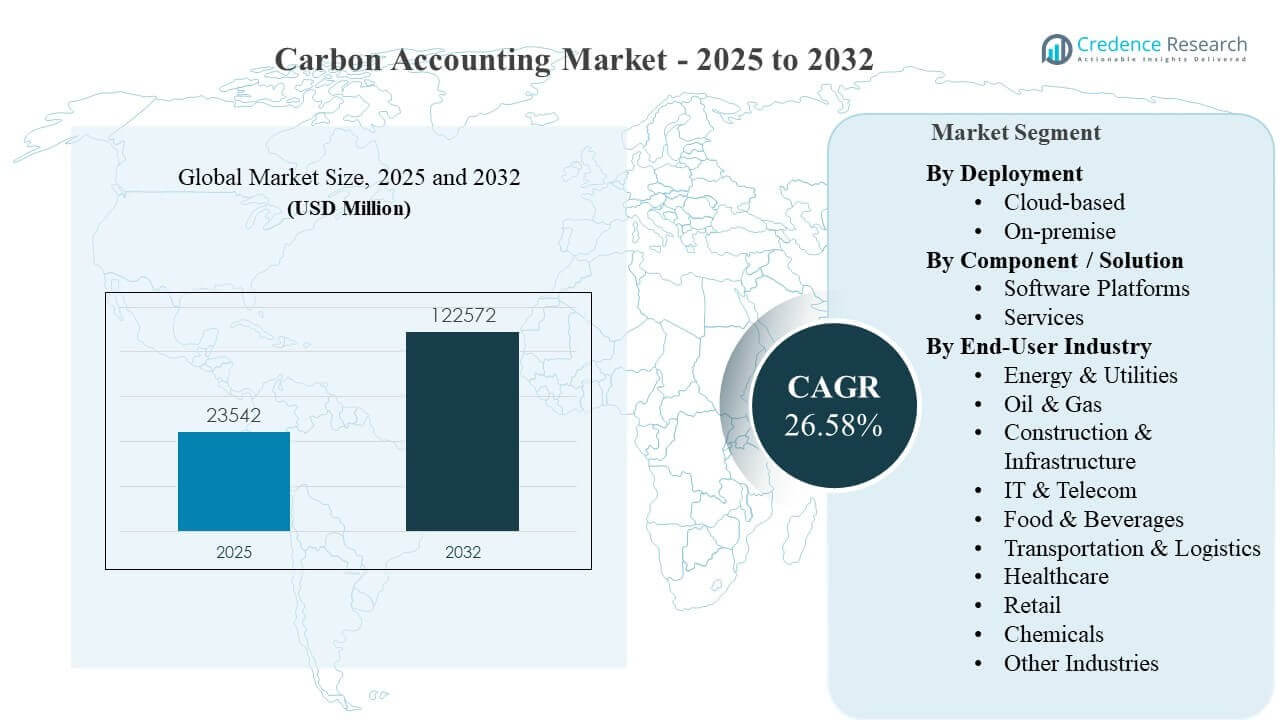
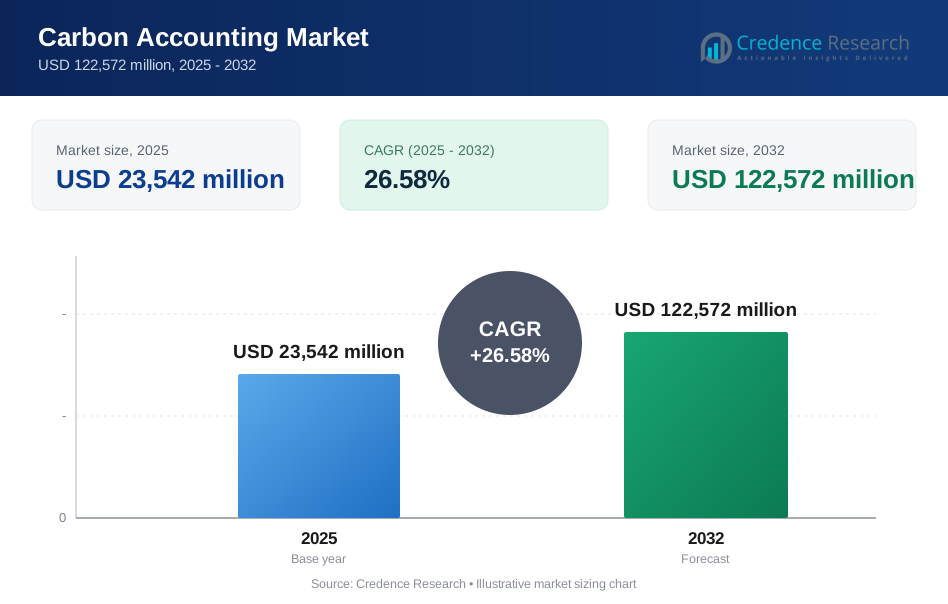
The global Carbon Accounting Market size was estimated at USD 23,542 million in 2025 and is expected to reach USD 122,572 million by 2032, growing at a CAGR of 26.58% from 2025 to 2032. Growth is primarily driven by expanding enterprise requirements to quantify, manage, and report emissions across Scope 1–3 as sustainability disclosures move from voluntary reporting toward board-level governance, audit readiness, and supplier accountability. Adoption is also supported by multi-region operations that require standardized emissions calculation logic, repeatable workflows, and integration of emissions data into planning and procurement decisions.
| REPORT ATTRIBUTE | DETAILS |
|---|---|
| Historical Period | 2020-2024 |
| Base Year | 2025 |
| Forecast Period | 2026-2032 |
| Carbon Accounting Market Size 2025 | USD 23,542 million |
| Carbon Accounting Market, CAGR | 26.58% |
| Carbon Accounting Market Size 2032 | USD 122,572 million |
Key Market Trends & Insights
- The Carbon Accounting Market was valued at USD 23,542 million in 2025, reflecting rapid expansion of enterprise sustainability measurement programs.
- The Carbon Accounting Market is projected to reach USD 122,572 million by 2032, indicating strong multi-year demand for emissions measurement and reporting solutions.
- Market growth is expected at a 26.58% CAGR during 2025–2032, supported by accelerating disclosure and decarbonization execution needs.
- Cloud-based deployment accounted for 67.8% share in 2025, supported by scalability, faster onboarding, and distributed data capture across facilities and suppliers.
- North America represented 36.7% share in 2025, reflecting high enterprise adoption intensity and earlier operationalization of carbon disclosure workflows.
Segment Analysis
The Carbon Accounting Market is increasingly characterized by enterprise buyers moving beyond one-time footprinting toward repeatable, audit-friendly operating models for emissions management. Purchasing decisions are shaped by data integration breadth, the ability to handle Scope 3 complexity, and workflow controls that support internal review and external assurance. As organizations standardize emissions reporting, demand is rising for configurable calculation logic, supplier data capture, and structured disclosure outputs that can be refreshed on a recurring cadence.
Solution positioning is also shifting toward actionability. Platforms are expected to support hotspot identification, reduction planning, and scenario assessment alongside measurement and reporting. Vendors that pair strong integrations with governance workflows and reusable reporting templates are better positioned to support cross-functional adoption involving sustainability, finance, operations, and procurement teams.
By Deployment Insights
Cloud-based accounted for the largest share of 67.8% in 2025. Cloud deployments lead because they scale efficiently across multi-site organizations and simplify distributed data collection from facilities and suppliers. Cloud delivery also reduces implementation friction by minimizing on-premise infrastructure dependencies and enabling faster configuration updates. Continuous enhancement cycles support evolving reporting requirements and internal governance workflows. Integration ecosystems further strengthen the cloud advantage by connecting emissions tracking with ERP, procurement, and analytics systems.
By Component / Solution Insights
Software Platforms are typically the core purchase because they centralize emissions calculations, data governance, dashboards, and disclosure outputs into repeatable workflows. Buyers prioritize platforms that reduce manual effort by automating data capture, mapping activity data to emission factors, and maintaining traceability for audit readiness. Services remain important for implementation, data quality improvement, methodology alignment, and ongoing advisory support as Scope 3 workflows mature. As programs scale, service demand increasingly shifts from initial setup toward verification support, reporting cadence management, and supplier engagement enablement.
By End-User Industry Insights
Energy & Utilities often anchors demand because emissions intensity and reporting expectations are high, making measurement and governance foundational to program credibility. Oil & Gas, chemicals, and construction also require strong emissions accounting due to complex operational footprints and supply chains. Transportation & Logistics continues to increase adoption as fleets, routes, and subcontractor networks create granular accounting requirements and frequent reporting cycles. IT & Telecom and retail adoption grows as organizations operationalize supplier and product-footprint emissions programs. Across industries, multi-site operations and supplier complexity elevate the value of structured data pipelines and governance controls.
Carbon Accounting Market Drivers
Regulatory and disclosure acceleration across corporate reporting
Corporate sustainability reporting is increasingly treated as a structured governance process rather than an ad hoc publication exercise. Organizations are implementing repeatable workflows to quantify emissions consistently, maintain traceability, and support internal approvals. The requirement to manage Scope 3 data pushes companies to build supplier engagement workflows and category-level data models. As disclosures become more frequent and decision-relevant, automation becomes essential to reduce manual overhead. These factors collectively drive sustained demand for carbon accounting platforms and supporting services.
- For instance, BASF stated that its in-house digital solution can calculate cradle-to-gate product carbon footprints for approximately 45,000 sales products across its portfolio, illustrating how emissions disclosure is moving toward repeatable, system-based reporting at enterprise scale.
Expansion of Scope 3 accountability and supplier transparency
Scope 3 emissions are often the largest share of a company’s footprint, but they are also the most complex to measure. Supplier variability, data gaps, and inconsistent activity records require structured collection processes and governance controls. Enterprises are deploying tools that standardize supplier inputs, convert activity data into emissions, and preserve audit trails. As procurement teams are asked to improve supplier transparency, carbon accounting shifts from reporting to operational execution. This broadens adoption beyond sustainability teams into sourcing and supply chain leadership.
Integration of emissions data into operational planning and finance
Carbon accounting is evolving from an isolated sustainability function into an input for planning, budgeting, and risk assessment. Organizations increasingly want emissions data connected to cost, capital planning, and operational KPIs. This elevates demand for integration-ready platforms that connect with ERP, procurement, energy management, and analytics systems. Decision-makers value solutions that enable scenario analysis and prioritization of reduction levers. As carbon becomes a managed performance metric, platform adoption expands across finance, operations, and strategy stakeholders.
- For instance, SAP states that Green Ledger can analyze Scope 1, 2, and 3 emissions aligned with financials at a transactional level, allocate CO2 quantities to specific cost centers and profit centers, and apply standard financial controls such as double bookkeeping, showing how carbon data is being embedded directly into finance workflows.
Corporate decarbonization execution and measurable progress tracking
Companies face increasing pressure to show measurable emissions reductions, not only targets. Carbon accounting tools support baseline creation, hotspot detection, and ongoing tracking of progress against reduction initiatives. As initiatives expand across sites and suppliers, program complexity increases and manual methods become unsustainable. Organizations require repeatability, quality controls, and reporting outputs that can be refreshed on schedule. The shift from “measurement only” to “management and execution” reinforces long-term investment in platforms and services.
Carbon Accounting Market Challenges
Data availability and quality remain persistent obstacles, particularly for Scope 3 categories where suppliers may lack standardized reporting capabilities. Inconsistent activity data, incomplete procurement records, and limited traceability create uncertainty in calculations and complicate governance sign-off. Organizations also struggle to align emission factor selection and methodology consistency across business units. These issues can slow deployment timelines and increase reliance on services for data engineering and validation.
- For instance, Persefoni states that its platform has codified 107,000 emissions factors, and it also says GHG measurements can be traced back to the underlying calculation and source data through controlled workflows, illustrating how vendors are trying to reduce uncertainty caused by fragmented supplier inputs and inconsistent records.
Platform differentiation can be difficult for buyers to evaluate due to varied methodologies, boundary definitions, and feature claims. Implementation complexity increases when organizations require deep integrations with ERP, procurement, and energy systems, especially in multi-site, multi-region environments. Internal change management is another barrier, as emissions workflows require cross-functional ownership and recurring data stewardship. As expectations for assurance readiness rise, buyers also face added effort to document controls and maintain audit trails at scale.
Carbon Accounting Market Trends and Opportunities
Automation and workflow orchestration are emerging as high-impact differentiators. Buyers increasingly prioritize solutions that streamline data ingestion, normalize activity data, and enforce governance controls to reduce manual intervention. There is also growing demand for configurable templates that accelerate recurring disclosures and make reporting more repeatable across business units. Platforms that reduce cycle time for monthly or quarterly emissions refreshes create tangible operational value. This opens opportunity for vendors that combine usability with traceability and controls.
Another opportunity lies in expanding from reporting into reduction execution. Organizations want capabilities for hotspot identification, initiative tracking, and scenario modeling that connect emissions metrics to operational levers. Supplier engagement tools, category-level analytics, and data validation workflows are becoming central to value delivery. As companies embed emissions into procurement and planning, vendors that integrate across enterprise systems can expand wallet share. These trends support growth across both software platforms and implementation services.
- For instance, SINAI says its AI-enabled supply-chain decarbonization platform uses a library of more than 40,000 emission factors, and it highlights a prioritization pattern in which just 10% of suppliers account for over 50% of Scope 3 emissions while more than 70% of suppliers contribute only 20% collectively, helping users focus supplier engagement and scenario-based reduction actions where they matter most.
Regional Insights
North America
North America held 36.7% share in 2025, supported by early enterprise adoption of structured emissions governance and strong platform integration ecosystems. Organizations in the region often prioritize repeatable reporting cycles, automation, and assurance readiness. Partner networks and enterprise software familiarity support faster deployment across large organizations. Demand is also reinforced by complex supply chains that increase Scope 3 requirements and supplier data workflows.
Europe
Europe accounted for 26.1% share in 2025, driven by structured sustainability governance cultures and strong emphasis on standardized reporting practices. Enterprises typically require robust methodology alignment, auditable workflows, and supplier engagement capabilities. Carbon accounting solutions benefit from cross-border operations that require consistent measurement across diverse facilities and suppliers. Implementation often emphasizes compliance readiness, reporting discipline, and data traceability.
Asia Pacific
Asia Pacific represented 27.8% share in 2025, reflecting rapid digitization of sustainability programs and scaling enterprise adoption across large manufacturing and service ecosystems. Regional growth is supported by expanding corporate net-zero commitments and rising expectations for supplier transparency. Organizations increasingly seek scalable deployments that can handle multi-site footprints and complex supplier bases. Platform opportunities are strongest where emissions management is linked to operational efficiency and global customer requirements.
Latin America
Latin America captured 5.9% share in 2025, with demand concentrated among export-linked industries and multinational operations that require standardized reporting. Adoption often starts with foundational footprinting and evolves toward structured supplier data capture as programs mature. Implementation success depends on practical data collection workflows and support services that improve data completeness. Platforms that simplify onboarding and provide clear governance controls are better suited to scale in this region.
Middle East & Africa
Middle East & Africa held 3.5% share in 2025, with growth tied to modernization of corporate reporting and increasing sustainability commitments in energy-intensive industries. Early deployments commonly focus on baseline measurement and structured reporting processes. Supplier engagement and multi-site governance capabilities become more important as programs scale. Vendors that offer strong implementation support and clear methodology governance are better positioned to address adoption barriers.
Competitive Landscape
Competition in the Carbon Accounting Market centers on breadth of Scope 1–3 coverage, ease of data ingestion, audit-ready governance workflows, and integration depth with enterprise systems. Vendors differentiate through calculation transparency, data validation controls, reporting configurability, and partner-led implementation capacity. Large enterprise platforms compete on ecosystem integrations and cross-functional workflow enablement, while specialists compete on depth in carbon methodologies, supplier engagement, and speed of deployment. As buyers mature, preference shifts toward solutions that combine repeatable reporting with actionable decarbonization execution.
Salesforce emphasizes enterprise adoption through platform-driven workflows that connect emissions programs with broader operational processes and enterprise data ecosystems. The approach typically prioritizes configurable data capture, governance workflows, and reporting outputs that can be standardized across business units. Scalability is a core positioning theme, particularly for multi-site organizations that need repeatable measurement cycles. Integration alignment with existing business systems supports cross-functional adoption beyond sustainability teams. This positioning suits organizations seeking a unified operating model for emissions governance and reporting.
The industry research and growth report includes detailed analyses of the competitive landscape of the market and information about key companies, including:
- Salesforce
- Wolters Kluwer
- ENGIE Impact
- Schneider Electric
- Accenture
- Intelex Technologies
- Enablon
- Simble Solutions
- Carbon Trust
- Ecova
- Watershed
- Normative
- Greenly
- CarbonChain
Qualitative and quantitative analysis of companies has been conducted to help clients understand the wider business environment as well as the strengths and weaknesses of key industry players. Data is qualitatively analyzed to categorize companies as pure play, category-focused, industry-focused, and diversified; it is quantitatively analyzed to categorize companies as dominant, leading, strong, tentative, and weak.
Recent Developments
- In January 2026, Diginex announced the acquisition of Plan A, a carbon accounting and decarbonization software company, in a transaction valued at about €55 million. The deal was positioned to combine Diginex’s ESG reporting capabilities with Plan A’s carbon accounting technology to create a more integrated sustainability platform.
- In June 2025, Wolters Kluwer expanded its ESG-oriented solution capabilities with new offerings designed to connect ESG data with financial planning and support compliance workflows for carbon-related reporting requirements.
- In January 2025, Schneider Electric strengthened its positioning in financed emissions and carbon accounting methodologies through collaboration frameworks that support standardized measurement and reporting practices for financial-sector use cases.
Report Scope
| Report Attribute | Details |
| Market size value in 2025 | USD 23,542 million |
| Revenue forecast in 2032 | USD 122,572 million |
| Growth rate (CAGR) | 26.58% (2025–2032) |
| Base year | 2025 |
| Forecast period | 2026–2032 |
| Quantitative units | USD million |
| Segments covered | By Deployment Outlook: Cloud-based, On-premise; By Component / Solution Outlook: Software Platforms, Services; By End-User Industry Outlook: Energy & Utilities, Oil & Gas, Construction & Infrastructure, IT & Telecom, Food & Beverages, Transportation & Logistics, Healthcare, Retail, Chemicals, Other Industries |
| Regional scope | North America, Europe, Asia Pacific, Latin America, Middle East & Africa |
| Key companies profiled | Salesforce; Wolters Kluwer; ENGIE Impact; Schneider Electric; Accenture; Intelex Technologies; Enablon; Simble Solutions; Carbon Trust; Ecova; Watershed; Normative; Greenly; CarbonChain |
| No. of Pages | 328 |
Segmentation
By Deployment
- Cloud-based
- On-premise
By Component / Solution
- Software Platforms
- Services
By End-User Industry
- Energy & Utilities
- Oil & Gas
- Construction & Infrastructure
- IT & Telecom
- Food & Beverages
- Transportation & Logistics
- Healthcare
- Retail
- Chemicals
- Other Industries
By Region
- North America
- U.S.
- Canada
- Mexico
- Europe
- Germany
- France
- U.K.
- Italy
- Spain
- Rest of Europe
- Asia Pacific
- China
- Japan
- India
- South Korea
- South-east Asia
- Rest of Asia Pacific
- Latin America
- Brazil
- Argentina
- Rest of Latin America
- Middle East & Africa
- GCC Countries
- South Africa
- Rest of the Middle East and Africa
Request a Free Sample
Fill in your details and we'll send you a free sample report.
- Sample data tables & charts
- Research methodology
Need a Custom Version of This Report?
Tailor the scope, geography, or segments to your exact requirements.
- Custom geography or segment scope
- Direct access to our analyst team
Frequently Asked Questions
What is the market size of the Carbon Accounting Market in 2025 and the forecast for 2032?
What is the CAGR of the Carbon Accounting Market during 2025–2032?
What is the largest segment in the Carbon Accounting Market?
What factors are driving growth in the Carbon Accounting Market?
Which companies are leading in the Carbon Accounting Market?
Which region is leading the Carbon Accounting Market?
Table of Content
Chapter 1. Report Introduction
- 1.1 Report Description & Purpose
- 1.1.1 Report Title & Market Definition
- 1.1.2 Unique Selling Propositions (USP) & Key Differentiators
- 1.1.3 Value Proposition for Stakeholders
- 1.2 Research Objectives
- 1.2.1 Market Sizing Objectives (Volume & Revenue)
- 1.2.2 Segmentation Objectives
- 1.2.3 Competitive Intelligence Objectives
- 1.2.4 Forecast & Scenario Objectives
- 1.3 Report Scope
- 1.3.1 Carbon Accounting Scope – Types & Subtypes Covered
- 1.3.2 Geographic Scope – Regions & Countries Covered
- 1.3.3 Historical Period, Base Year & Forecast Period (2025; forecast to 2032)
- 1.3.4 Inclusions & Exclusions
- 1.4 HS Code & Classification Framework
- 1.5 Currency, Units & Pricing Basis
- 1.6 Target Stakeholders
- 1.7 Limitations & Assumptions
Chapter 2. Executive Summary
- 2.1 Global Carbon Accounting Market Snapshot
- 2.1.1 Market Size – Historical (2025) & Forecast (2025-2032) (2025: USD 23,542 million → 2032: USD 122,572 million)
- 2.1.2 Volume & Revenue – Global Totals
- 2.1.3 Key Market Highlights – Top Five Facts
- 2.2 Carbon Accounting Market Segmentation Snapshot
- 2.2.1 Market Split by Region – 2025 vs. 2032
- 2.3 Competitive Snapshot
- 2.3.1 Top 10 Players by Revenue Share – 2025
- 2.3.2 Top 10 Players by Volume Share – 2025
- 2.3.3 Recent Strategic Developments (18-Month Summary)
- 2.4 Key Investment Highlights & Strategic Conclusions
Chapter 3. Carbon Accounting Market Dynamics & Industry Analysis
- 3.1 Market Overview & Context
- 3.1.1 Carbon Accounting Market Position in the Broader Automotive Value Chain
- 3.1.2 OEM vs. Replacement Market Dynamics
- 3.1.3 Market Maturity & Development Stage by Region
- 3.2 Carbon Accounting Market Drivers
- 3.3 Carbon Accounting Market Restraints & Challenges
- 3.4 Carbon Accounting Market Opportunities
- 3.5 Porter's Five Forces Analysis
- 3.5.1 Threat of New Entrants
- 3.5.2 Bargaining Power of Suppliers
- 3.5.3 Bargaining Power of Buyers
- 3.5.4 Threat of Substitutes
- 3.5.5 Competitive Rivalry – Intensity Assessment
- 3.6 Carbon Accounting Value Chain Analysis
- 3.6.1 Upstream – Raw Material/Input Suppliers
- 3.6.1.1 Raw Material/Input 1
- 3.6.1.2 Raw Material/Input 2
- 3.6.1.3 Raw Material/Input 3
- 3.6.2 Midstream – Production/Manufacturing/Service Delivery
- 3.6.2.1 Production/Process Overview
- 3.6.2.2 Key Facility Locations & Capacity by Manufacturer
- 3.6.3 Downstream – Distribution & End Consumer
- 3.6.3.1 Primary Channel – B2B/OEM
- 3.6.3.2 Secondary Channels – Dealer, Retail, Online, Direct
- 3.6.4 Value Chain Profitability Analysis
- 3.6.1 Upstream – Raw Material/Input Suppliers
- 3.7 PESTEL Analysis
- 3.7.1 Political Factors
- 3.7.2 Economic Factors
- 3.7.3 Social Factors
- 3.7.4 Technological Factors
- 3.7.5 Environmental Factors
- 3.7.6 Legal Factors
- 3.8 Carbon Accounting Supply Chain Analysis
- 3.8.1 Raw Material/Input Supply Risk Assessment
- 3.8.2 Manufacturing Concentration Risk (Geographic Exposure)
- 3.8.3 Trade Disruption Impact Analysis
- 3.9 Regulatory & Policy Landscape
Note: The regulatory and policy landscape section covers regulations based on their applicability to the market, Carbon Accounting category, geography, and scope of the study. Only regulatory frameworks with a material impact on operations, compliance, trade, sustainability, or market access are analyzed in detail.
Chapter 4. Key Investment Pockets & Opportunity Analysis
- 4.1 Carbon Accounting Market Attractiveness Analysis
- 4.1.1 By Region – Investment Attractiveness Matrix (Volume × CAGR)
- 4.2 Absolute Revenue Growth Opportunity
- 4.2.1 By Region – Absolute USD Growth Through 2032
- 4.3 Incremental Volume Opportunity
- 4.3.1 By Region – Incremental Volume Through 2032
- 4.3.2 Segment – Incremental Volume
- 4.4 Emerging Submarket Opportunity Deep Dive (Subject to Applicability)
- 4.5 Emerging Market Opportunity Scorecards
- 4.5.1 United States
- 4.5.2 Europe
- 4.5.3 Asia
- 4.5.4 Middle East & Africa
Note: Emerging Market Opportunity Scorecards will be included based on relevance and strategic importance. Regions listed are indicative and may vary depending on data availability and market dynamics.
Chapter 5. Carbon Accounting Import-Export Analysis & Trade Flows
- 5.1 Global Trade Overview
- 5.1.1 Global Export Value by Country (2025)
- 5.1.2 Global Export Volume by Country (2025)
- 5.1.3 Global Import Value by Country (2025)
- 5.1.4 Global Import Volume by Country (2025)
- 5.1.5 Net Trade Balance by Country (2025)
- 5.2 Export Analysis – Segment
- 5.2.1 Type 1 (HS Code)
- 5.2.2 Type 2 (HS Code)
- 5.2.3 Type 3 (HS Code)
- 5.2.4 Type 4 (HS Code)
- 5.2.5 Type 5 (HS Code)
- 5.3 Import Analysis – Segment
- 5.3.1 Type 1 (HS Code)
- 5.3.2 Type 2 (HS Code)
- 5.3.3 Type 3 (HS Code)
- 5.3.4 Type 4 (HS Code)
- 5.3.5 Type 5 (HS Code)
- 5.4 Average Unit Trade Prices
- 5.4.1 Average Export Price – Segment & Country
- 5.4.2 Average Import Price – Segment & Source Country
- 5.4.3 Price Trends (2025)
- 5.5 Key Trade Route Analysis
- 5.5.1 Trade Route 1
- 5.5.2 Trade Route 2
- 5.5.3 Trade Route 3
- 5.5.4 Trade Route 4
- 5.5.5 Trade Route 5
- 5.6 Trade Policy Impact Assessment
- 5.6.1 US Anti-Dumping & Section 301 Tariffs
- 5.6.2 EU Customs Union Impact
- 5.6.3 Major Free Trade Agreements
- 5.6.4 USMCA Rules of Origin
Note: Trade policy analysis will be included only where relevant to the Carbon Accounting market.
Chapter 6. Competitive Landscape & Company Benchmarking
- 6.1 Carbon Accounting Market Concentration & Structure
- 6.1.1 Herfindahl-Hirschman Index (HHI) – vs. 2025
- 6.1.2 Tier 1, Tier 2 & Tier 3 Market Structure
- 6.1.3 Global, Regional & Local Player Dynamics
- 6.2 Carbon Accounting Market Share Analysis – 2025
- 6.2.1 Global Revenue Share by Company
- 6.2.2 Global Volume Share by Company
- 6.2.3 Regional Revenue Share
- 6.2.4 Market Share Evolution ( vs. 2025)
- 6.2.5 OEM Segment Share by Company
- 6.2.6 Replacement Segment Share by Company
- 6.3 Production/Delivery Capacity & Facility Analysis
- 6.3.1 Global Installed Capacity
- 6.3.2 Capacity Utilization Rates
- 6.3.3 Production/Output Volume
- 6.3.4 Facility Locations & Capacity Map
- 6.3.5 Planned Capacity Additions
- 6.4 Carbon Accounting Competitive Benchmarking Matrix
- 6.4.1 Revenue, Volume, CAGR & Profitability Comparison
- 6.4.2 Channel Revenue Mix
- 6.4.3 Geographic Revenue Exposure
- 6.4.4 R&D Intensity
- 6.4.5 Sustainability Maturity
- 6.5 Strategic Developments in Carbon Accounting (Last 24 Months)
- 6.5.1 Mergers, Acquisitions & Divestments
- 6.5.2 New Carbon Accounting Launches
- 6.5.3 Facility Expansions
- 6.5.4 Strategic Alliances, Joint Ventures & Partnerships
- 6.5.5 Distribution Expansion & Market Entry
- 6.5.6 Sustainability & ESG Initiatives
- 6.6 Competitive Strategy Mapping
- 6.6.1 Leader, Challenger, Follower & Niche Classification
- 6.6.2 Pricing Strategy Comparison
- 6.6.3 Channel Strategy Matrix
Note: Strategic developments are included based on their materiality and the availability of reliable information.
Chapter 7. Global Carbon Accounting Market – By Distribution Channel
- 7.1 Segment Overview
- 7.1.1 Volume & Revenue Split by Channel (2025 & 2032)
- 7.1.2 Channel Mix Evolution (2025-2032)
Chapter 8. Regional Market Analysis – Global Overview
- 8.1 Global Regional Overview
- 8.1.1 Regional Volume Share
- 8.1.2 Regional Revenue Share
- 8.1.3 Regional Volume by Region
- 8.1.4 Regional Revenue by Region
- 8.1.5 Regional Forecast Through 2032
- 8.2 Cross-Regional Segment Analysis
- 8.2.1 By Distribution Channel
- 8.2.2 By Brand/Price Tier
Chapter 9. North America Carbon Accounting Market
- 9.1 United States
- 9.2 Canada
- 9.3 Mexico
Chapter 10. Europe Carbon Accounting Market
- 10.1 Germany
- 10.2 France
- 10.3 Italy
- 10.4 United Kingdom
- 10.5 Spain
- 10.6 Poland
- 10.7 Russia
- 10.8 Netherlands
- 10.9 Belgium
- 10.10 Sweden
- 10.11 Denmark
- 10.12 Norway
- 10.13 Rest of Europe
Chapter 11. Asia Pacific Carbon Accounting Market
- 11.1 China
- 11.2 India
- 11.3 Japan
- 11.4 South Korea
- 11.5 Thailand
- 11.6 Indonesia
- 11.7 Vietnam
- 11.8 Malaysia
- 11.9 Australia
- 11.10 Rest of Asia Pacific
Chapter 12. Latin America Carbon Accounting Market
- 12.1 Brazil
- 12.2 Argentina
- 12.3 Colombia
- 12.4 Chile
- 12.5 Rest of Latin America
Chapter 13. Middle East Carbon Accounting Market
- 13.1 Saudi Arabia
- 13.2 United Arab Emirates
- 13.3 Turkey
- 13.4 Israel
- 13.5 Iran
- 13.6 Rest of the Middle East
Chapter 14. Africa Carbon Accounting Market
- 14.1 South Africa
- 14.2 Egypt
- 14.3 Nigeria
- 14.4 Morocco
- 14.5 Rest of Africa
Chapter 15. Carbon Accounting Company Profiles
- 15.1 [Company 01]
- 15.1.1 Company Overview
- 15.1.2 Key Management Personnel
- 15.1.3 Products & Services Portfolio
- 15.1.4 Financial Performance
- 15.1.5 Key Market Focus & Geographic Presence
- 15.1.6 Recent Developments & Strategic Initiatives
Note: The company profile list is preliminary and may change based on research findings, market developments, data availability, and client requirements.
Chapter 16. Appendices
- Appendix A – List of Abbreviations & Acronyms
- Appendix B – Industry Classification Code Reference – Full Series
- Appendix C – Production & Capacity Data Tables
- Appendix D – End-Use & Demand Base Tables
- Appendix E – Consumption & Replacement Rate Assumptions
- Appendix F – ASP Reference Tables
- Appendix G – Manufacturing & Facility Database
- Appendix H – Import-Export Data Tables
- Appendix I – Regulatory Summary Tables
- Appendix J – Primary Research Participant List (Anonymized)
- Appendix K – Primary Research Questionnaire Framework
- Appendix L – Data Sources & Bibliography
- Appendix M – Market Size Divergence & Source Comparison
Chapter 17. Research Methodology
- 17.1 Research Framework & Philosophy
- 17.2 Secondary Research – Sources, Hierarchy & Data Extraction
- 17.3 Data Modeling – Bottom-Up & Top-Down Market Sizing
- 17.4 Primary Research – Stakeholder Framework, LOI & Sample Sizes
- 17.5 Forecast Methodology – Regression, Scenario & Sensitivity Analysis
- 17.6 Quality Control – Four-Layer Validation Framework
- 17.7 Limitations & Standard Assumptions
- 17.8 Disclaimer
