
Utility Scale Flexible Electrical Conduit Market Overview:
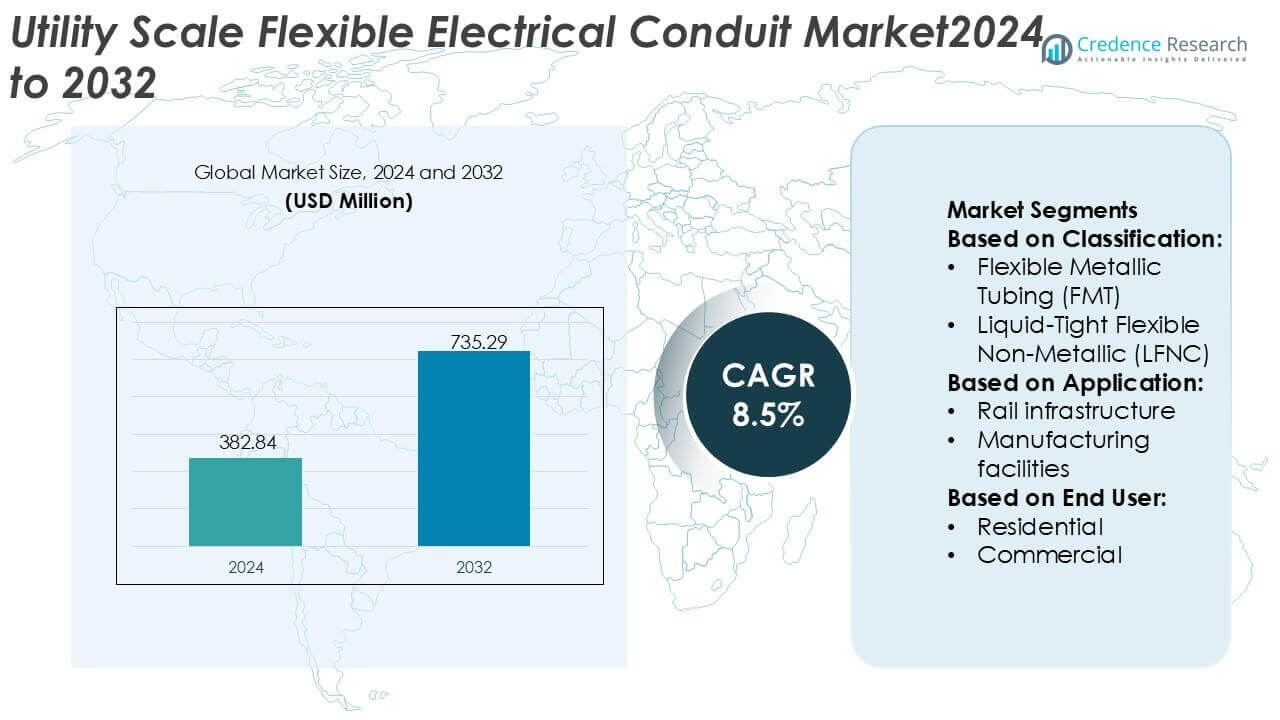
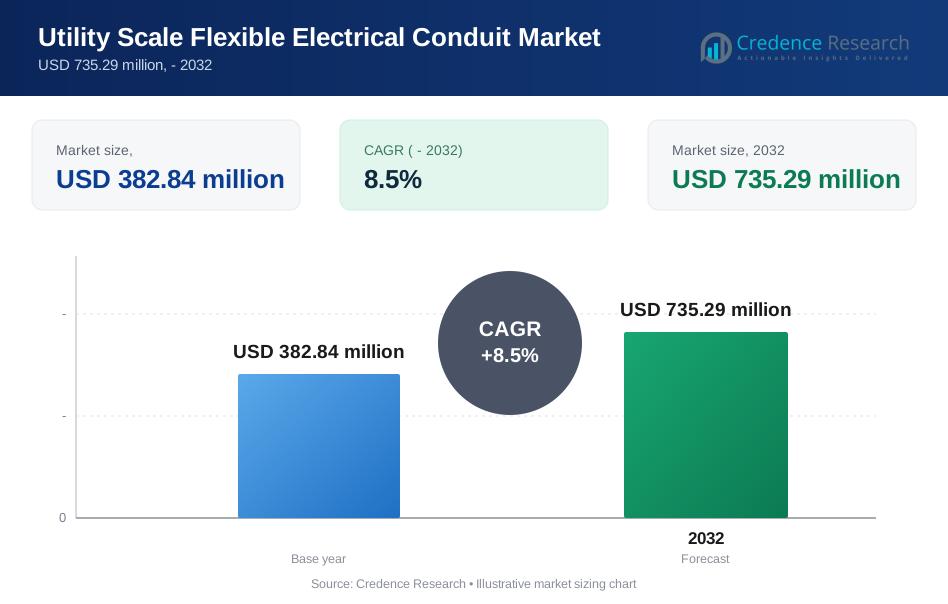
Utility Scale Flexible Electrical Conduit Market size was valued USD 382.84 million in 2024 and is anticipated to reach USD 735.29 million by 2032, at a CAGR of 8.5% during the forecast period.
| REPORT ATTRIBUTE | DETAILS |
|---|---|
| Historical Period | 2020-2023 |
| Base Year | 2024 |
| Forecast Period | 2025-2032 |
| Utility Scale Flexible Electrical Conduit Market Size 2024 | USD 382.84 million |
| Utility Scale Flexible Electrical Conduit Market, CAGR | 8.5% |
| Utility Scale Flexible Electrical Conduit Market Size 2032 | USD 735.29 million |
Utility Scale Flexible Electrical Conduit Market Insights
- Market growth is driven by increased deployment of flexible conduits engineered for high-voltage networks, undergrounding projects, and renewable-linked substations requiring enhanced thermal and mechanical performance.
- Trends highlight stronger adoption of corrosion-resistant, UV-stable, and easy-to-install conduit systems, along with expanding integration of digital-ready designs that support smart grid monitoring pathways.
- Competitive intensity accelerates as global manufacturers upgrade certified conduit portfolios and expand supply chains to meet utility demand, while restraints emerge from fluctuating raw material costs and installation-standard complexities.
- Asia-Pacific leads with 38% regional share, followed by North America and Europe, while metallic flexible conduits account for the dominant product segment due to their durability advantage in transmission infrastructure.
Utility Scale Flexible Electrical Conduit Market Segmentation Analysis:
By Classification
Metal conduits dominate the Utility Scale Flexible Electrical Conduit Market with a 42% share, led by Electrical Metal Tubing (EMT) due to its strength, corrosion resistance, and suitability for high-voltage installations. EMT’s lightweight structure and easy bending characteristics accelerate adoption in large-scale retrofits and substation expansions. Flexible conduit types, particularly Liquid-Tight Flexible Metal Conduit (LFMC), gain traction for vibration-prone environments and moisture-exposed assets. Non-metallic variants like PVC and RTRC/FRE grow steadily, driven by applications requiring low weight, dielectric performance, and installation in chemically aggressive surroundings.
- For instance, Southwire Company’s ARMOR-X™ cable incorporates a continuous corrugated aluminum interlock armor design that is impervious to moisture, liquids, and gases. This robust construction is validated for mechanical durability required for utility-scale installations and is rated for a normal continuous operating conductor temperature of up to 90°C in both wet and dry locations. For emergency overload conditions, the conductors are rated to withstand up to 130°C.
By Application
Rail infrastructure stands as the dominant application segment with a 33% share, driven by the expansion of electrified corridors, signaling upgrades, and resilient cable-protection needs for continuous rail operations. Flexible conduits support rolling-stock wiring, traction substations, trackside instrumentation, and tunnel systems exposed to mechanical stress. Manufacturing facilities and process plants increasingly adopt flexible metal and LFMC variants to enable modular layouts, robotic automation, and thermal resilience. Offshore and shipbuilding applications demand corrosion-resistant conduits to protect high-reliability cabling under extreme humidity and vibration, reinforcing segment-wide growth.
- For instance, Eaton Corporation strengthens this segment through its Crouse-Hinds liquid-tight flexible non-metallic conduit systems, specifically products like the EFC Series. EFC Series, appears to be a fire alarm pull station line or related control station components (e.g., EFC-APS100) manufactured by Eaton/Cooper.
By End User
The industrial sector leads the market with a 39% share, propelled by modernization of heavy machinery, automation systems, and grid-connected production units requiring durable, high-flex conduit systems. Industrial sites prioritize LFMC and FMC products to safeguard wiring in high-temperature zones, hazardous environments, and dynamic equipment interfaces. Commercial deployments grow steadily with rising construction of data centers and large facilities requiring structured electrical protection. Utility end users adopt reinforced conduits for transmission, distribution, and renewable-energy assets, while residential usage remains limited but expands with smart-home installations and safety-compliant electrical routing.
Key Growth Drivers
- Expansion of Utility Modernization and Grid Reinforcement Programs
Utility operators accelerate investments in substation upgrades, renewable-energy integration, and high-capacity distribution networks, increasing demand for flexible conduits that ensure safe routing of power, control, and communication cables. These systems require conduits with strong mechanical endurance, flame resistance, and moisture protection to support aging infrastructure replacement and new high-voltage installations. Growing deployment of automation equipment, digital sensors, and fault-monitoring devices further amplifies the need for adaptable conduit systems that streamline cable management, reduce installation complexity, and maintain operational reliability across diverse environmental conditions.
- For instance, Hubbell Incorporated reinforces this demand through its Kellems® wire management products, which include a wide range of armored and non-metallic options like the PolyTuff® II Non-Metallic Flexible Tubing. These systems meet essential safety standards, such as the UL 94 V-0 flame-resistance criteria for specific materials used in their construction.
- Rising Adoption of Renewable and Distributed Energy Assets
Large-scale solar, wind, and battery-storage facilities rely on flexible conduits to protect extensive cabling networks exposed to heat, vibration, and movement. The expansion of inverter stations, grid-tie transformers, and energy-storage modules increases demand for conduits that deliver thermal stability and long-term corrosion resistance. Utilities prioritize flexible and liquid-tight conduit structures to enable efficient wiring layouts across uneven terrains and outdoor installations. The growth of microgrids and distributed generation also strengthens demand for conduit solutions that support modularity, rapid installation, and compliance with evolving electrical safety standards.
- For instance, Thomas & Betts (an ABB company) advances these requirements through its Liquatite® flexible metallic conduit series, offering various types to meet specific demands. High-performance models, such as the Type LTTU, maintain reliable operation at continuous temperatures reaching 105°C in dry locations, certified by UL and CSA listings.
- Increasing Automation and Electrification Across Industrial Infrastructure
Industrial facilities adopt flexible electrical conduits to support high-density wiring associated with robotics, process automation, and advanced manufacturing lines. These environments require conduits capable of tolerating continuous motion, abrasion, chemical exposure, and high temperatures. The expansion of Industry 4.0 ecosystems—including sensor networks, communication modules, and intelligent control systems—drives the need for conduit solutions enabling durable protection and easy routing. Utility-driven industrial electrification, especially in heavy industries transitioning toward cleaner energy and digital operations, accelerates the shift toward flexible, customizable conduit architectures.
Key Trends & Opportunities
- Shift Toward Non-Metallic and Composite Conduit Solutions
Demand increases for lightweight PVC, RTRC/FRE, and flexible non-metallic conduits as utilities seek corrosion-free, easy-to-install options suitable for chemically aggressive or moisture-rich environments. Composite materials offer improved dielectric strength and lower maintenance, expanding their use in underground, tunnel, and renewable-energy installations. Manufacturers gain opportunities by developing halogen-free, UV-resistant, and fire-retardant variants tailored for harsh field conditions. This trend also aligns with sustainability goals as utilities explore recyclable and lower-emission conduit materials.
- For instance, Eaton Corporation (which acquired Cooper Industries' Crouse-Hinds business) supports this transition with its Crouse-Hinds DURALOY® RTRC/FRE (Reinforced Thermosetting Resin Conduit/Fiberglass Reinforced Epoxy) system. This system is known for superior mechanical strength and corrosion resistance compared to traditional PVC or steel. The conduit is designed to withstand a wide temperature range, typically from −40°C to +110°C.
- Growth of Liquid-Tight and Flexible Conduits for Dynamic Installations
Liquid-tight flexible metal and non-metal conduits (LFMC and LFNC) experience increased adoption in environments prone to vibration, movement, or fluid exposure, such as substations, offshore platforms, and rail systems. These conduits support secure routing in compact spaces and protect wiring from dust, oils, and mechanical stress. Opportunities emerge for vendors offering enhanced ingress protection ratings, temperature performance, and strain-relief designs. As utilities deploy more smart devices, flexible conduits enable efficient rewiring and equipment retrofits without disrupting operations.
- For instance, Siemens advances these requirements through its SIPLUS extreme cable-routing and enclosure systems, which integrate standard automation components modified for harsh environments. The full systems are engineered and certified to operate reliably between −40°C and 70°C.
- Rising Use of Smart Conduit Systems with Embedded Monitoring Features
Emerging innovations integrate temperature, moisture, or fault-detection sensors directly into conduit assemblies to support predictive maintenance and asset visibility. Utilities increasingly explore these systems to reduce downtime, anticipate cable degradation, and improve field safety. Opportunities arise for manufacturers offering data-integrated conduits compatible with SCADA and IoT platforms. The rise of digital substations and connected distribution assets further accelerates adoption as utilities seek holistic monitoring across cable-routing infrastructure.
Key Challenges
- High Installation and Maintenance Costs in Large-Scale Deployments
Utility-scale projects often require extensive conduit runs across substations, industrial plants, and renewable sites, leading to significant material and labor expenses. Specialized flexible and liquid-tight conduits add cost due to advanced coatings, reinforcements, and certification requirements. Harsh-field installations—involving underground routing, corrosive environments, or extreme temperatures—increase maintenance burdens. Budget constraints at utilities and delays in infrastructure spending can slow replacement cycles, limiting the pace at which advanced conduit solutions are adopted.
- Compliance Complexity and Variability Across Regional Standards
Flexible conduit systems must meet diverse certification requirements related to flame resistance, grounding, ingress protection, and dielectric performance. Compliance varies significantly across regions, creating challenges for global manufacturers navigating multiple regulatory frameworks. Utilities often require adherence to local codes, utility-specific specifications, and compatibility with existing equipment, increasing engineering complexity. This slows procurement and prolongs testing cycles, especially for new materials or composite conduits, delaying market penetration and raising product development costs.
Regional Analysis
North America
North America holds a 34% share, driven by extensive grid modernization programs, reinforced transmission corridors, and rising electrification across industrial and commercial facilities. Utilities prioritize flexible metallic and liquid-tight conduits to support infrastructure resilience, especially in regions facing extreme weather events. Strong regulatory compliance frameworks and accelerated investments in renewable-energy projects strengthen adoption. Growth also stems from rapid expansion of data centers and automation-intensive industries requiring high-performance conduit systems. The U.S. leads demand due to large-scale upgrades in substations, underground cabling, and advanced protection networks.
Europe
Europe commands a 27% share, supported by stringent safety regulations, rapid renewable-energy integration, and modernization of rail and utility infrastructure. Countries across Western and Northern Europe emphasize fire-resistant, halogen-free, and corrosion-proof conduit systems for both above-ground and underground installations. Flexible metal and composite non-metallic conduits gain traction in wind, solar, and offshore grid projects requiring durability under harsh climates. The region’s aggressive decarbonization and electrification initiatives enhance deployment across industrial automation settings. Germany, the UK, and France remain key contributors due to continued investment in substation digitalization and resilient cabling networks.
Asia-Pacific
Asia-Pacific leads with a dominant 38% share, driven by large-scale utility expansion, massive industrialization, and accelerated renewable-energy development. Rapid construction of transmission lines, distribution substations, and rail networks fuels extensive adoption of flexible conduit systems. Demand rises across manufacturing hubs requiring high-capacity wiring, automation upgrades, and reinforced protection for harsh operating environments. Countries such as China, India, Japan, and South Korea invest heavily in underground cabling and smart-grid programs, boosting consumption of metal, liquid-tight, and advanced non-metallic conduits. Population growth and urbanization further strengthen long-term market momentum.
Latin America
Latin America accounts for an 8% share, supported by grid-strengthening initiatives, expansion of hydropower assets, and modernization of industrial plants. Flexible metal and PVC-based non-metallic conduits see increasing adoption in utility and energy sectors requiring durable, cost-efficient protection systems. Growth is influenced by rising investment in rail transit, mining operations, and oil & gas facilities that depend on vibration-resistant and corrosion-proof conduit solutions. Brazil, Mexico, and Chile lead demand as governments prioritize reliability improvements and reduced electrical downtime. Economic variability remains a factor but does not hinder long-term infrastructure-driven uptake.
Middle East & Africa
The Middle East & Africa region holds a 6% share, driven by ongoing development of power transmission networks, large industrial zones, and utility-scale renewable projects, particularly solar and wind installations. Extreme temperatures and sand exposure increase reliance on liquid-tight and corrosion-resistant conduits capable of protecting sensitive wiring. Gulf countries invest heavily in grid digitalization and underground cabling expansion, boosting flexible conduit adoption. Africa’s demand grows gradually with electrification programs and industrial development corridors. While budget constraints persist, utility modernization and energy diversification initiatives ensure a stable growth outlook.
Utility Scale Flexible Electrical Conduit Market Segmentations:
By Classification:
- Flexible Metallic Tubing (FMT)
- Liquid-Tight Flexible Non-Metallic (LFNC)
By Application:
- Rail infrastructure
- Manufacturing facilities
By End User:
- Residential
- Commercial
By Geography
- North America
- U.S.
- Canada
- Mexico
- Europe
- Germany
- France
- U.K.
- Italy
- Spain
- Rest of Europe
- Asia Pacific
- China
- Japan
- India
- South Korea
- South-east Asia
- Rest of Asia Pacific
- Latin America
- Brazil
- Argentina
- Rest of Latin America
- Middle East & Africa
- GCC Countries
- South Africa
- Rest of the Middle East and Africa
Competitive Landscape
The Utility Scale Flexible Electrical Conduit Market features a competitive ecosystem shaped by leading global manufacturers Southwire Company, Eaton Corporation, Hubbell, Thomas & Betts, Cooper Industries, Siemens, Atkore International, Legrand, General Electric, and Schneider Electric. The Utility Scale Flexible Electrical Conduit Market is defined by strong competition among global electrical infrastructure manufacturers that focus on delivering high-durability conduit systems engineered for utility-grade performance. Companies emphasize innovations that enhance mechanical strength, corrosion resistance, thermal stability, and flexibility to support complex installations across substations, transmission corridors, and renewable-energy sites. The competitive environment is further shaped by advancements in metallic and non-metallic conduit technologies tailored for harsh outdoor conditions, underground cabling, and vibration-prone environments. Vendors increasingly invest in certifications, sustainable materials, and integrated monitoring capabilities to align with evolving utility standards. Market competition also intensifies through product line expansions, regional manufacturing strategies, and partnerships with EPC contractors to secure long-term utility contracts. As utilities modernize grid assets and adopt smart-infrastructure frameworks, players differentiate through performance reliability, compliance assurance, and value-driven lifecycle solutions.
Key Player Analysis
- Southwire Company
- Eaton Corporation
- Hubbell
- Thomas & Betts
- Cooper Industries
- Siemens
- Atkore International
- Legrand
- General Electric
- Schneider Electric
Recent Developments
- In September 2024, Legrand unfolded new horizons by acquiring Australian Plastic Profiles (APP), a PVC conduit manufacturer of the AussieDuct and Pipe King brands. This acquisition strategically expands Legrand's presence in Australia while augmenting its local manufacturing capacity and expanding into residential and commercial infrastructure markets.
- In October 2024, Caparo ME launches electrical products plant in Saudi Arabia. Dammam will manufacture electrical conduits and fittings. Caparo Middle East inaugurated a fully integrated manufacturing plant in Dammam, Saudi Arabia, in collaboration with Engineer Sinan Ali Ahmed Bukamseen.
- In May 2024, ABB has opened a new injection molding manufacturing site at Evergem, near Ghent in Belgium, to meet the growing demand for safe. According to ABB, the new center is able to automate and increase energy efficiency through its combination of cutting-edge numeric control machines, molding technology, and digital infrastructure.
Report Coverage
The research report offers an in-depth analysis based on Classification, Application, End-User and Geography. It details leading market players, providing an overview of their business, product offerings, investments, revenue streams, and key applications. Additionally, the report includes insights into the competitive environment, SWOT analysis, current market trends, as well as the primary drivers and constraints. Furthermore, it discusses various factors that have driven market expansion in recent years. The report also explores market dynamics, regulatory scenarios, and technological advancements that are shaping the industry. It assesses the impact of external factors and global economic changes on market growth. Lastly, it provides strategic recommendations for new entrants and established companies to navigate the complexities of the market.
Future Outlook
- The market will advance with broader adoption of flexible conduit solutions that support utility grid modernization and renewable integration.
- Demand will grow for conduits engineered to withstand higher thermal loads and mechanical stresses in evolving substation environments.
- Utilities will increasingly prefer corrosion-resistant and UV-stable conduit materials suited for long-life outdoor applications.
- Digital-ready conduit systems with integrated sensor pathways will gain traction in smart grid deployments.
- Manufacturers will expand development of lighter, easier-to-install conduit designs to reduce labor costs and installation time.
- Eco-friendly and recyclable conduit materials will gain importance as utilities strengthen sustainability commitments.
- Rising investments in undergrounding projects will accelerate uptake of high-flexibility, crush-resistant conduit systems.
- Partnerships between conduit manufacturers and EPC contractors will deepen to streamline supply and project execution.
- Regulatory shifts emphasizing electrical safety and fire protection will drive innovation in compliant conduit technologies.
- Global vendors will expand regional production and distribution networks to meet increasing demand from fast-growing utility sectors.
Request a Free Sample
Fill in your details and we'll send you a free sample report.
- Sample data tables & charts
- Research methodology
Need a Custom Version of This Report?
Tailor the scope, geography, or segments to your exact requirements.
- Custom geography or segment scope
- Direct access to our analyst team
Frequently Asked Questions
What is the current market size for the Utility Scale Flexible Electrical Conduit Market, and what is its projected size in 2032?
At what Compound Annual Growth Rate is the Utility Scale Flexible Electrical Conduit Market projected to grow between 2024 and 2032?
Which Utility Scale Flexible Electrical Conduit Market segment held the largest share in 2024?
What are the primary factors fueling the growth of the Utility Scale Flexible Electrical Conduit Market?
Who are the leading companies in the Utility Scale Flexible Electrical Conduit Market?
Which region commanded the largest share of the Utility Scale Flexible Electrical Conduit Market in 2024?
Table of Content
Chapter 1. Report Introduction
- 1.1 Report Description & Purpose
- 1.1.1 Report Title & Market Definition
- 1.1.2 Unique Selling Propositions (USP) & Key Differentiators
- 1.1.3 Value Proposition for Stakeholders
- 1.2 Research Objectives
- 1.2.1 Market Sizing Objectives (Volume & Revenue)
- 1.2.2 Segmentation Objectives
- 1.2.3 Competitive Intelligence Objectives
- 1.2.4 Forecast & Scenario Objectives
- 1.3 Report Scope
- 1.3.1 Utility Scale Flexible Electrical Conduit Scope – Types & Subtypes Covered
- 1.3.2 Geographic Scope – Regions & Countries Covered
- 1.3.3 Historical Period, Base Year & Forecast Period (the historical period; forecast to 2032)
- 1.3.4 Inclusions & Exclusions
- 1.4 HS Code & Classification Framework
- 1.5 Currency, Units & Pricing Basis
- 1.6 Target Stakeholders
- 1.7 Limitations & Assumptions
Chapter 2. Executive Summary
- 2.1 Global Utility Scale Flexible Electrical Conduit Market Snapshot
- 2.1.1 Market Size – Historical (the historical period) & Forecast (2032) (base year: USD 382.84 million → 2032: USD 735.29 million)
- 2.1.2 Volume & Revenue – Global Totals
- 2.1.3 Key Market Highlights – Top Five Facts
- 2.2 Utility Scale Flexible Electrical Conduit Market Segmentation Snapshot
- 2.2.1 Market Split by Region – vs. 2032
- 2.3 Competitive Snapshot
- 2.3.1 Top 10 Players by Revenue Share –
- 2.3.2 Top 10 Players by Volume Share –
- 2.3.3 Recent Strategic Developments (18-Month Summary)
- 2.4 Key Investment Highlights & Strategic Conclusions
Chapter 3. Utility Scale Flexible Electrical Conduit Market Dynamics & Industry Analysis
- 3.1 Market Overview & Context
- 3.1.1 Utility Scale Flexible Electrical Conduit Market Position in the Broader Automotive Value Chain
- 3.1.2 OEM vs. Replacement Market Dynamics
- 3.1.3 Market Maturity & Development Stage by Region
- 3.2 Utility Scale Flexible Electrical Conduit Market Drivers
- 3.3 Utility Scale Flexible Electrical Conduit Market Restraints & Challenges
- 3.4 Utility Scale Flexible Electrical Conduit Market Opportunities
- 3.5 Porter's Five Forces Analysis
- 3.5.1 Threat of New Entrants
- 3.5.2 Bargaining Power of Suppliers
- 3.5.3 Bargaining Power of Buyers
- 3.5.4 Threat of Substitutes
- 3.5.5 Competitive Rivalry – Intensity Assessment
- 3.6 Utility Scale Flexible Electrical Conduit Value Chain Analysis
- 3.6.1 Upstream – Raw Material/Input Suppliers
- 3.6.1.1 Raw Material/Input 1
- 3.6.1.2 Raw Material/Input 2
- 3.6.1.3 Raw Material/Input 3
- 3.6.2 Midstream – Production/Manufacturing/Service Delivery
- 3.6.2.1 Production/Process Overview
- 3.6.2.2 Key Facility Locations & Capacity by Manufacturer
- 3.6.3 Downstream – Distribution & End Consumer
- 3.6.3.1 Primary Channel – B2B/OEM
- 3.6.3.2 Secondary Channels – Dealer, Retail, Online, Direct
- 3.6.4 Value Chain Profitability Analysis
- 3.6.1 Upstream – Raw Material/Input Suppliers
- 3.7 PESTEL Analysis
- 3.7.1 Political Factors
- 3.7.2 Economic Factors
- 3.7.3 Social Factors
- 3.7.4 Technological Factors
- 3.7.5 Environmental Factors
- 3.7.6 Legal Factors
- 3.8 Utility Scale Flexible Electrical Conduit Supply Chain Analysis
- 3.8.1 Raw Material/Input Supply Risk Assessment
- 3.8.2 Manufacturing Concentration Risk (Geographic Exposure)
- 3.8.3 Trade Disruption Impact Analysis
- 3.9 Regulatory & Policy Landscape
Note: The regulatory and policy landscape section covers regulations based on their applicability to the market, Utility Scale Flexible Electrical Conduit category, geography, and scope of the study. Only regulatory frameworks with a material impact on operations, compliance, trade, sustainability, or market access are analyzed in detail.
Chapter 4. Key Investment Pockets & Opportunity Analysis
- 4.1 Utility Scale Flexible Electrical Conduit Market Attractiveness Analysis
- 4.1.1 By Region – Investment Attractiveness Matrix (Volume × CAGR)
- 4.2 Absolute Revenue Growth Opportunity
- 4.2.1 By Region – Absolute USD Growth Through 2032
- 4.3 Incremental Volume Opportunity
- 4.3.1 By Region – Incremental Volume Through 2032
- 4.3.2 Segment – Incremental Volume
- 4.4 Emerging Submarket Opportunity Deep Dive (Subject to Applicability)
- 4.5 Emerging Market Opportunity Scorecards
- 4.5.1 United States
- 4.5.2 Europe
- 4.5.3 Asia
- 4.5.4 Middle East & Africa
Note: Emerging Market Opportunity Scorecards will be included based on relevance and strategic importance. Regions listed are indicative and may vary depending on data availability and market dynamics.
Chapter 5. Utility Scale Flexible Electrical Conduit Import-Export Analysis & Trade Flows
- 5.1 Global Trade Overview
- 5.1.1 Global Export Value by Country (the historical period)
- 5.1.2 Global Export Volume by Country (the historical period)
- 5.1.3 Global Import Value by Country (the historical period)
- 5.1.4 Global Import Volume by Country (the historical period)
- 5.1.5 Net Trade Balance by Country (the historical period)
- 5.2 Export Analysis – Segment
- 5.2.1 Type 1 (HS Code)
- 5.2.2 Type 2 (HS Code)
- 5.2.3 Type 3 (HS Code)
- 5.2.4 Type 4 (HS Code)
- 5.2.5 Type 5 (HS Code)
- 5.3 Import Analysis – Segment
- 5.3.1 Type 1 (HS Code)
- 5.3.2 Type 2 (HS Code)
- 5.3.3 Type 3 (HS Code)
- 5.3.4 Type 4 (HS Code)
- 5.3.5 Type 5 (HS Code)
- 5.4 Average Unit Trade Prices
- 5.4.1 Average Export Price – Segment & Country
- 5.4.2 Average Import Price – Segment & Source Country
- 5.4.3 Price Trends (the historical period)
- 5.5 Key Trade Route Analysis
- 5.5.1 Trade Route 1
- 5.5.2 Trade Route 2
- 5.5.3 Trade Route 3
- 5.5.4 Trade Route 4
- 5.5.5 Trade Route 5
- 5.6 Trade Policy Impact Assessment
- 5.6.1 US Anti-Dumping & Section 301 Tariffs
- 5.6.2 EU Customs Union Impact
- 5.6.3 Major Free Trade Agreements
- 5.6.4 USMCA Rules of Origin
Note: Trade policy analysis will be included only where relevant to the Utility Scale Flexible Electrical Conduit market.
Chapter 6. Competitive Landscape & Company Benchmarking
- 6.1 Utility Scale Flexible Electrical Conduit Market Concentration & Structure
- 6.1.1 Herfindahl-Hirschman Index (HHI) – vs.
- 6.1.2 Tier 1, Tier 2 & Tier 3 Market Structure
- 6.1.3 Global, Regional & Local Player Dynamics
- 6.2 Utility Scale Flexible Electrical Conduit Market Share Analysis –
- 6.2.1 Global Revenue Share by Company
- 6.2.2 Global Volume Share by Company
- 6.2.3 Regional Revenue Share
- 6.2.4 Market Share Evolution ( vs. )
- 6.2.5 OEM Segment Share by Company
- 6.2.6 Replacement Segment Share by Company
- 6.3 Production/Delivery Capacity & Facility Analysis
- 6.3.1 Global Installed Capacity
- 6.3.2 Capacity Utilization Rates
- 6.3.3 Production/Output Volume
- 6.3.4 Facility Locations & Capacity Map
- 6.3.5 Planned Capacity Additions
- 6.4 Utility Scale Flexible Electrical Conduit Competitive Benchmarking Matrix
- 6.4.1 Revenue, Volume, CAGR & Profitability Comparison
- 6.4.2 Channel Revenue Mix
- 6.4.3 Geographic Revenue Exposure
- 6.4.4 R&D Intensity
- 6.4.5 Sustainability Maturity
- 6.5 Strategic Developments in Utility Scale Flexible Electrical Conduit (Last 24 Months)
- 6.5.1 Mergers, Acquisitions & Divestments
- 6.5.2 New Utility Scale Flexible Electrical Conduit Launches
- 6.5.3 Facility Expansions
- 6.5.4 Strategic Alliances, Joint Ventures & Partnerships
- 6.5.5 Distribution Expansion & Market Entry
- 6.5.6 Sustainability & ESG Initiatives
- 6.6 Competitive Strategy Mapping
- 6.6.1 Leader, Challenger, Follower & Niche Classification
- 6.6.2 Pricing Strategy Comparison
- 6.6.3 Channel Strategy Matrix
Note: Strategic developments are included based on their materiality and the availability of reliable information.
Chapter 7. Global Utility Scale Flexible Electrical Conduit Market – By Distribution Channel
- 7.1 Segment Overview
- 7.1.1 Volume & Revenue Split by Channel ( & 2032)
- 7.1.2 Channel Mix Evolution (2032)
Chapter 8. Regional Market Analysis – Global Overview
- 8.1 Global Regional Overview
- 8.1.1 Regional Volume Share
- 8.1.2 Regional Revenue Share
- 8.1.3 Regional Volume by Region
- 8.1.4 Regional Revenue by Region
- 8.1.5 Regional Forecast Through 2032
- 8.2 Cross-Regional Segment Analysis
- 8.2.1 By Distribution Channel
- 8.2.2 By Brand/Price Tier
Chapter 9. North America Utility Scale Flexible Electrical Conduit Market
- 9.1 United States
- 9.2 Canada
- 9.3 Mexico
Chapter 10. Europe Utility Scale Flexible Electrical Conduit Market
- 10.1 Germany
- 10.2 France
- 10.3 Italy
- 10.4 United Kingdom
- 10.5 Spain
- 10.6 Poland
- 10.7 Russia
- 10.8 Netherlands
- 10.9 Belgium
- 10.10 Sweden
- 10.11 Denmark
- 10.12 Norway
- 10.13 Rest of Europe
Chapter 11. Asia Pacific Utility Scale Flexible Electrical Conduit Market
- 11.1 China
- 11.2 India
- 11.3 Japan
- 11.4 South Korea
- 11.5 Thailand
- 11.6 Indonesia
- 11.7 Vietnam
- 11.8 Malaysia
- 11.9 Australia
- 11.10 Rest of Asia Pacific
Chapter 12. Latin America Utility Scale Flexible Electrical Conduit Market
- 12.1 Brazil
- 12.2 Argentina
- 12.3 Colombia
- 12.4 Chile
- 12.5 Rest of Latin America
Chapter 13. Middle East Utility Scale Flexible Electrical Conduit Market
- 13.1 Saudi Arabia
- 13.2 United Arab Emirates
- 13.3 Turkey
- 13.4 Israel
- 13.5 Iran
- 13.6 Rest of the Middle East
Chapter 14. Africa Utility Scale Flexible Electrical Conduit Market
- 14.1 South Africa
- 14.2 Egypt
- 14.3 Nigeria
- 14.4 Morocco
- 14.5 Rest of Africa
Chapter 15. Utility Scale Flexible Electrical Conduit Company Profiles
- 15.1 [Company 01]
- 15.1.1 Company Overview
- 15.1.2 Key Management Personnel
- 15.1.3 Products & Services Portfolio
- 15.1.4 Financial Performance
- 15.1.5 Key Market Focus & Geographic Presence
- 15.1.6 Recent Developments & Strategic Initiatives
Note: The company profile list is preliminary and may change based on research findings, market developments, data availability, and client requirements.
Chapter 16. Appendices
- Appendix A – List of Abbreviations & Acronyms
- Appendix B – Industry Classification Code Reference – Full Series
- Appendix C – Production & Capacity Data Tables
- Appendix D – End-Use & Demand Base Tables
- Appendix E – Consumption & Replacement Rate Assumptions
- Appendix F – ASP Reference Tables
- Appendix G – Manufacturing & Facility Database
- Appendix H – Import-Export Data Tables
- Appendix I – Regulatory Summary Tables
- Appendix J – Primary Research Participant List (Anonymized)
- Appendix K – Primary Research Questionnaire Framework
- Appendix L – Data Sources & Bibliography
- Appendix M – Market Size Divergence & Source Comparison
Chapter 17. Research Methodology
- 17.1 Research Framework & Philosophy
- 17.2 Secondary Research – Sources, Hierarchy & Data Extraction
- 17.3 Data Modeling – Bottom-Up & Top-Down Market Sizing
- 17.4 Primary Research – Stakeholder Framework, LOI & Sample Sizes
- 17.5 Forecast Methodology – Regression, Scenario & Sensitivity Analysis
- 17.6 Quality Control – Four-Layer Validation Framework
- 17.7 Limitations & Standard Assumptions
- 17.8 Disclaimer
