
Carbon Footprint Assessment Services Market Overview:
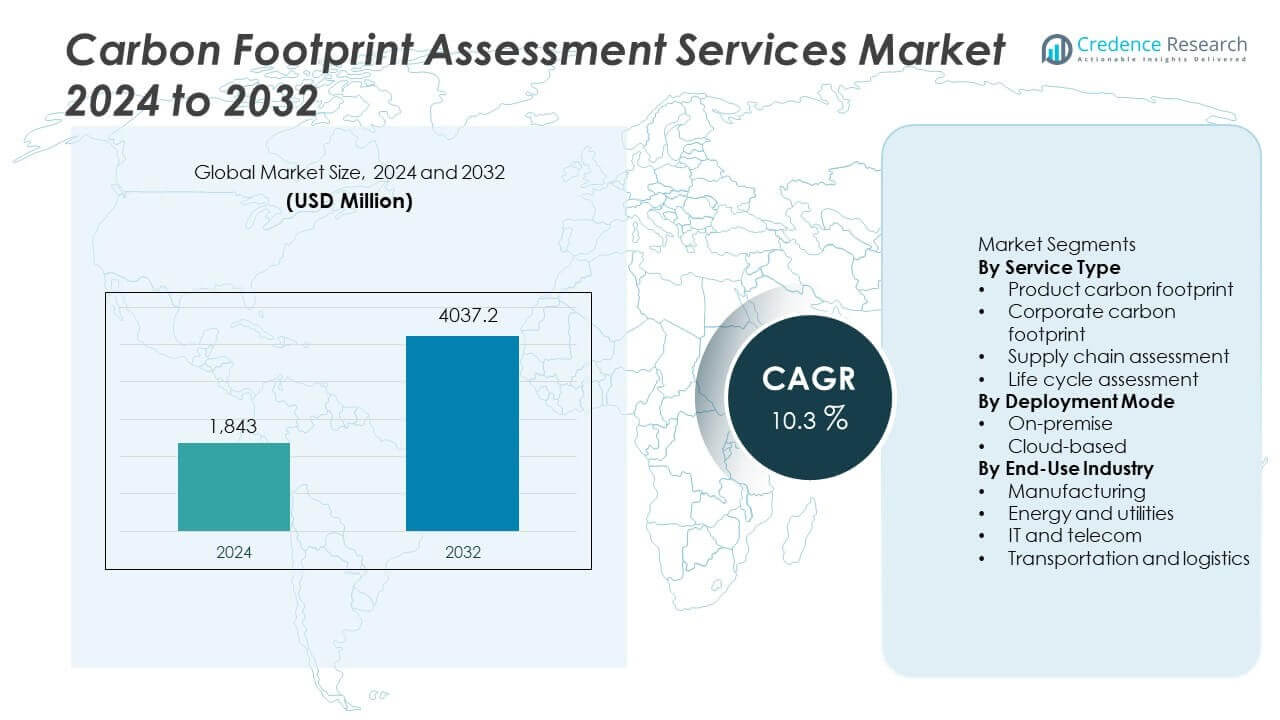
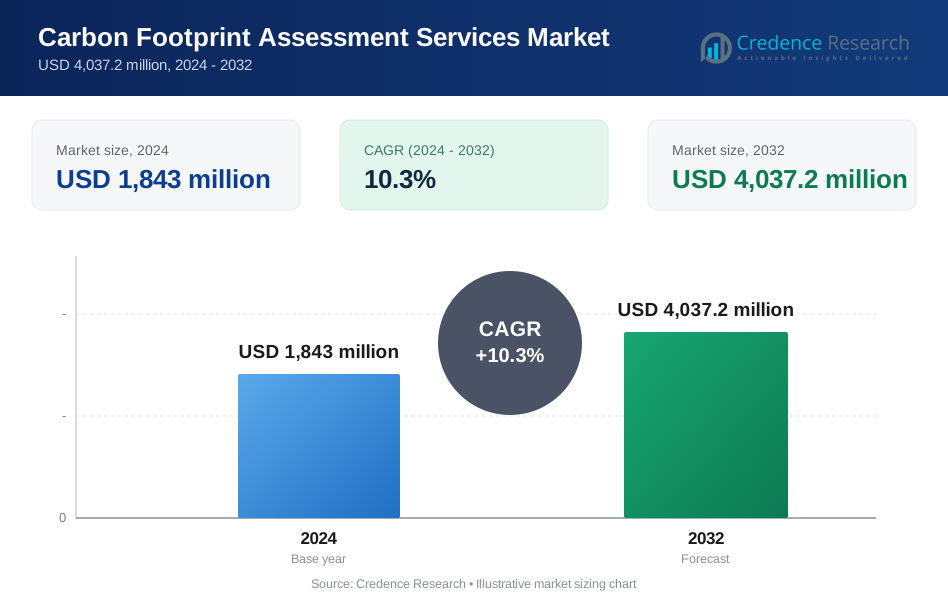
The Carbon Footprint Assessment Services market was valued at USD 1,843 million in 2024 and is projected to reach USD 4,037.2 million by 2032, registering a CAGR of 10.3% during the forecast period.
| REPORT ATTRIBUTE | DETAILS |
|---|---|
| Historical Period | 2020-2023 |
| Base Year | 2024 |
| Forecast Period | 2025-2032 |
| Carbon Footprint Assessment Services Market Size 2024 | USD 1,843 million |
| Carbon Footprint Assessment Services Market, CAGR | 10.3% |
| Carbon Footprint Assessment Services Market Size 2032 | USD 4,037.2 million |
Carbon Footprint Assessment Services Market Insights
- Rising regulatory pressure and mandatory ESG reporting drive demand for accurate carbon measurement across enterprises, with corporate carbon footprint services leading the service segment at a 38% market share due to organization-wide emission tracking needs.
- Market trends highlight rapid adoption of cloud-based platforms, which hold a 64% share, driven by scalability, automation, and real-time analytics that reduce reporting complexity and operational costs.
- Competitive activity remains intense as consulting firms and software providers expand integrated platforms, while data accuracy challenges and high implementation costs continue to restrain adoption among smaller enterprises.
- North America leads the market with a 36% share, followed by Europe at 29% and Asia Pacific at 24%, supported by strong regulations, industrial emissions management, and expanding sustainability initiatives.
Carbon Footprint Assessment Services Market Segmentation Analysis:
By Service Type
The service type segment is led by corporate carbon footprint services, holding a market share of 38%. Enterprises increasingly track organization-wide emissions to meet regulatory and reporting needs. Corporate-level assessments support ESG disclosure, net-zero planning, and compliance alignment. Large firms prefer centralized emissions measurement across operations and subsidiaries. Product carbon footprint services follow, driven by eco-labeling and consumer transparency demands. Supply chain assessment services gain traction due to Scope 3 emission pressures. Life cycle assessment supports long-term sustainability planning but shows lower adoption. Rising climate regulations and investor scrutiny strongly drive corporate carbon footprint dominance.
- For instance, SAP integrated carbon accounting into SAP S/4HANA, enabling tracking across more than 1,000 emission data points per enterprise system.
By Deployment Mode
The deployment mode segment is dominated by cloud-based solutions, accounting for 64% market share. Organizations favor cloud platforms for scalability, real-time analytics, and lower infrastructure costs. Cloud deployment supports remote audits, automated data capture, and integration with ERP systems. These platforms also enable frequent updates aligned with evolving emission standards. On-premise solutions remain relevant for data-sensitive industries but show slower growth. Small and mid-sized enterprises prefer cloud access for cost efficiency. Increasing digitalization and subscription-based pricing models continue to strengthen cloud-based deployment leadership.
- For instance, IBM expanded its Envizi platform to automate the collection and management of diverse sustainability data types across its global enterprise clients.
By End-Use Industry
The end-use industry segment is led by manufacturing, holding a market share of 41%. Manufacturers face strict emission controls across production, sourcing, and logistics. Carbon assessment helps optimize processes and reduce energy intensity. Energy and utilities follow, driven by transition planning and emission disclosure mandates. Transportation and logistics adopt services to manage fleet emissions and fuel efficiency. IT and telecom show steady growth due to data center sustainability goals. Manufacturing dominance is supported by complex supply chains, high emission intensity, and strong regulatory oversight.
Key Growth Drivers
Rising Regulatory and Compliance Pressure
Governments continue to tighten emission disclosure and reporting requirements. Companies must measure and report greenhouse gas emissions with higher accuracy. Carbon footprint assessment services support regulatory compliance and audit readiness. Penalties for non-compliance increase financial and reputational risk. Public climate reporting frameworks further raise transparency expectations. As regulations expand across regions and industries, compliance-driven adoption remains strong. Regulatory enforcement continues to act as a primary market growth driver.
- For instance, Deloitte implemented automated carbon reporting tools that align with more than 20 global regulatory frameworks, supporting audits across thousands of enterprise entities.
Corporate Net-Zero Targets and ESG Commitments
Enterprises increasingly commit to net-zero and science-based emission targets. Accurate carbon measurement is essential for tracking sustainability progress. Carbon footprint assessment services enable baseline creation and performance monitoring. Investors assess ESG performance during funding and valuation decisions. Verified emission data strengthens stakeholder trust and corporate credibility. Sustainability-linked financing also depends on reliable carbon metrics. Expanding ESG integration across business strategies supports steady market growth.
- For instance, Accenture deployed enterprise carbon platforms that track emissions across more than 3 million supplier data records for global clients.
Growing Supply Chain Emission Accountability Organizations face rising pressure to measure Scope 3 emissions across supply chains. Supplier activities contribute a major share of total emissions. Carbon footprint assessment services help identify and quantify supplier-level impacts. Large enterprises mandate emission disclosures from vendors and partners. Supply chain transparency improves procurement decisions and risk management. As global value chains grow complex, supply chain assessments gain importance. This accountability shift continues to drive market expansion.
Key Trends & Opportunities
Digitalization and Automation of Carbon Assessment
Digital platforms automate emission data collection and calculations. Advanced analytics reduce manual effort and improve accuracy. Cloud-based tools enable real-time monitoring across operations. Automation lowers operational costs and improves scalability. Integration with ERP and IoT systems enhances data reliability. These advancements support wider adoption among mid-sized firms. Digital transformation creates strong long-term growth opportunities.
- For instance, IBM enhanced its Envizi platform to process more than 500 million sustainability data records each year, supporting automated Scope 1, Scope 2, and Scope 3 calculations.
Expansion of Industry-Specific Assessment Solutions
Service providers increasingly offer sector-focused carbon assessment tools. Manufacturing, energy, and transport require tailored emission models. Industry-specific solutions improve data relevance and compliance efficiency. Customized frameworks support deeper insights and operational planning. Sector expertise strengthens client engagement and retention. Growing emission complexity across industries creates differentiation opportunities. This trend supports future market expansion.
- For instance, Schneider Electric developed sector-specific carbon tools for manufacturing clients, covering more than 10,000 equipment-level emission factors within its EcoStruxure sustainability suite.
Key Challenges
Data Accuracy and Standardization Limitations
Carbon footprint assessments depend heavily on data quality. Many organizations lack structured emission data systems. Inconsistent global standards complicate reporting alignment. Manual data entry increases error and audit risks. Supply chain data gaps further reduce reliability. These issues weaken confidence in reported results. Data standardization remains a key market challenge.
High Cost and Complexity for Small Enterprises
Assessment services require software, expertise, and ongoing monitoring. Small enterprises face budget and resource constraints. Complex frameworks slow adoption and implementation. Integration and customization increase overall costs. Limited internal sustainability expertise raises dependence on consultants. Cost sensitivity restricts penetration among smaller firms. Affordability challenges continue to limit broader adoption.
Regional Analysis
North America
North America holds a market share of 36% in the Carbon Footprint Assessment Services market. The region benefits from strict environmental regulations and advanced ESG reporting practices. The United States leads adoption due to mandatory emission disclosures and strong investor focus on sustainability. Large enterprises actively invest in carbon accounting platforms to manage Scope 1, Scope 2, and Scope 3 emissions. High digital maturity supports cloud-based assessment tools and automation. Canada also contributes through climate policy enforcement and corporate net-zero commitments. Strong consulting presence and technology innovation continue to support regional market leadership.
Europe
Europe accounts for a market share of 29%, driven by aggressive climate policies and regulatory frameworks. The European Union enforces mandatory carbon reporting under sustainability directives. Companies across manufacturing, energy, and transportation sectors adopt assessment services to ensure compliance. Carbon pricing mechanisms and emission trading schemes increase demand for accurate measurement tools. Germany, France, and the United Kingdom remain key contributors due to industrial activity and ESG leadership. Strong focus on supply chain transparency further supports service adoption. Europe continues to show stable growth supported by policy-driven sustainability initiatives.
Asia Pacific
Asia Pacific holds a market share of 24% and shows strong growth momentum. Rapid industrialization increases emission monitoring needs across manufacturing and energy sectors. Countries such as China, Japan, and South Korea strengthen carbon reporting regulations. Multinational firms expand carbon assessment adoption across regional operations. Growing export-driven industries face pressure to meet global ESG standards. Cloud-based tools gain traction due to scalability and cost efficiency. Government-led decarbonization programs further support demand. Asia Pacific remains a key growth region with expanding regulatory and corporate sustainability focus.
Rest of the World
The Rest of the World region accounts for a market share of 11%. Latin America, the Middle East, and Africa show rising awareness of carbon management practices. Energy, mining, and infrastructure sectors drive initial adoption. International investors push companies to improve emission transparency. Regulatory frameworks remain uneven but continue to evolve. Multinational partnerships support service penetration across emerging markets. Carbon assessment adoption remains gradual but consistent. Increasing participation in global sustainability initiatives supports long-term regional growth potential.
Carbon Footprint Assessment Services Market Segmentations:
By Service Type
- Product carbon footprint
- Corporate carbon footprint
- Supply chain assessment
- Life cycle assessment
By Deployment Mode
- On-premise
- Cloud-based
By End-Use Industry
- Manufacturing
- Energy and utilities
- IT and telecom
- Transportation and logistics
By Geography
- North America
- U.S.
- Canada
- Mexico
- Europe
- Germany
- France
- U.K.
- Italy
- Spain
- Rest of Europe
- Asia Pacific
- China
- Japan
- India
- South Korea
- South-east Asia
- Rest of Asia Pacific
- Latin America
- Brazil
- Argentina
- Rest of Latin America
- Middle East & Africa
- GCC Countries
- South Africa
- Rest of the Middle East and Africa
Competitive Landscape
Competitive landscape analysis features key players including Accenture, Deloitte, PwC, KPMG, EY, IBM, SAP, Sphera Solutions, Enablon, and Schneider Electric. The market shows strong competition across consulting, software, and integrated platforms. Firms compete on data accuracy, regulatory alignment, and platform scalability. Many providers combine advisory expertise with digital tools. Cloud-based delivery strengthens recurring revenue models. Partnerships with ERP vendors improve data integration and client stickiness. Product differentiation focuses on Scope 3 coverage and automation. Global reach and sector expertise influence client selection. Continuous platform upgrades support compliance with evolving standards. Competitive intensity remains high as demand expands across regions.
Key Player Analysis
- Accenture
- Deloitte
- PwC
- KPMG
- EY
- IBM
- SAP
- Sphera Solutions
- Enablon
- Schneider Electric
Recent Developments
- In March 2025, PwC released its 2025 State of Decarbonization report, reinforcing carbon measurement and reduction services.
- In 2025, KPMG matured its integrated ESG consulting model by shifting from standalone initiatives to fully embedded, measurable goals across all business units.
- In 2025, Deloitte supported the development of SAP’s carbon accounting solution used for tracking and reporting product-level emissions.
Report Coverage
The research report offers an in-depth analysis based on Service Type, Deployment Mode, End-Use Industry and Geography. It details leading market players, providing an overview of their business, product offerings, investments, revenue streams, and key applications. Additionally, the report includes insights into the competitive environment, SWOT analysis, current market trends, as well as the primary drivers and constraints. Furthermore, it discusses various factors that have driven market expansion in recent years. The report also explores market dynamics, regulatory scenarios, and technological advancements that are shaping the industry. It assesses the impact of external factors and global economic changes on market growth. Lastly, it provides strategic recommendations for new entrants and established companies to navigate the complexities of the market.
Future Outlook
- Regulatory requirements will expand across industries, increasing mandatory carbon reporting.
- Corporate net-zero targets will drive long-term demand for verified carbon assessment services.
- Cloud-based platforms will see higher adoption due to scalability and automation benefits.
- Scope 3 emission measurement will gain priority across global supply chains.
- Industry-specific assessment solutions will grow to address complex emission profiles.
- Integration with ERP and digital systems will improve data accuracy and efficiency.
- Small and mid-sized enterprises will adopt simplified assessment tools.
- Demand for real-time emission tracking will increase across operations.
- Service providers will strengthen advisory and analytics capabilities.
- Global market competition will intensify as sustainability regulations evolve.
Request a Free Sample
Fill in your details and we'll send you a free sample report.
- Sample data tables & charts
- Research methodology
Need a Custom Version of This Report?
Tailor the scope, geography, or segments to your exact requirements.
- Custom geography or segment scope
- Direct access to our analyst team
Frequently Asked Questions
What is the current market size for Carbon Footprint Assessment Services market, and what is its projected size in 2032?
At what Compound Annual Growth Rate is the Carbon Footprint Assessment Services market projected to grow between 2024 and 2032?
Which Carbon Footprint Assessment Services market segment held the largest share in 2024?
What are the primary factors fueling the growth of the Carbon Footprint Assessment Services market?
Who are the leading companies in the Carbon Footprint Assessment Services market?
Which region commanded the largest share of the Carbon Footprint Assessment Services market in 2024?
Table of Content
Chapter 1. Report Introduction
- 1.1 Report Description & Purpose
- 1.1.1 Report Title & Market Definition
- 1.1.2 Unique Selling Propositions (USP) & Key Differentiators
- 1.1.3 Value Proposition for Stakeholders
- 1.2 Research Objectives
- 1.2.1 Market Sizing Objectives (Volume & Revenue)
- 1.2.2 Segmentation Objectives
- 1.2.3 Competitive Intelligence Objectives
- 1.2.4 Forecast & Scenario Objectives
- 1.3 Report Scope
- 1.3.1 Carbon Footprint Assessment Services Scope – Types & Subtypes Covered
- 1.3.2 Geographic Scope – Regions & Countries Covered
- 1.3.3 Historical Period, Base Year & Forecast Period (2024; forecast to 2032)
- 1.3.4 Inclusions & Exclusions
- 1.4 HS Code & Classification Framework
- 1.5 Currency, Units & Pricing Basis
- 1.6 Target Stakeholders
- 1.7 Limitations & Assumptions
Chapter 2. Executive Summary
- 2.1 Global Carbon Footprint Assessment Services Market Snapshot
- 2.1.1 Market Size – Historical (2024) & Forecast (2024-2032) (2024: USD 1,843 million → 2032: USD 4,037.2 million)
- 2.1.2 Volume & Revenue – Global Totals
- 2.1.3 Key Market Highlights – Top Five Facts
- 2.2 Carbon Footprint Assessment Services Market Segmentation Snapshot
- 2.2.1 Market Split by Region – 2024 vs. 2032
- 2.3 Competitive Snapshot
- 2.3.1 Top 10 Players by Revenue Share – 2024
- 2.3.2 Top 10 Players by Volume Share – 2024
- 2.3.3 Recent Strategic Developments (18-Month Summary)
- 2.4 Key Investment Highlights & Strategic Conclusions
Chapter 3. Carbon Footprint Assessment Services Market Dynamics & Industry Analysis
- 3.1 Market Overview & Context
- 3.1.1 Carbon Footprint Assessment Services Market Position in the Broader Automotive Value Chain
- 3.1.2 OEM vs. Replacement Market Dynamics
- 3.1.3 Market Maturity & Development Stage by Region
- 3.2 Carbon Footprint Assessment Services Market Drivers
- 3.3 Carbon Footprint Assessment Services Market Restraints & Challenges
- 3.4 Carbon Footprint Assessment Services Market Opportunities
- 3.5 Porter's Five Forces Analysis
- 3.5.1 Threat of New Entrants
- 3.5.2 Bargaining Power of Suppliers
- 3.5.3 Bargaining Power of Buyers
- 3.5.4 Threat of Substitutes
- 3.5.5 Competitive Rivalry – Intensity Assessment
- 3.6 Carbon Footprint Assessment Services Value Chain Analysis
- 3.6.1 Upstream – Raw Material/Input Suppliers
- 3.6.1.1 Raw Material/Input 1
- 3.6.1.2 Raw Material/Input 2
- 3.6.1.3 Raw Material/Input 3
- 3.6.2 Midstream – Production/Manufacturing/Service Delivery
- 3.6.2.1 Production/Process Overview
- 3.6.2.2 Key Facility Locations & Capacity by Manufacturer
- 3.6.3 Downstream – Distribution & End Consumer
- 3.6.3.1 Primary Channel – B2B/OEM
- 3.6.3.2 Secondary Channels – Dealer, Retail, Online, Direct
- 3.6.4 Value Chain Profitability Analysis
- 3.6.1 Upstream – Raw Material/Input Suppliers
- 3.7 PESTEL Analysis
- 3.7.1 Political Factors
- 3.7.2 Economic Factors
- 3.7.3 Social Factors
- 3.7.4 Technological Factors
- 3.7.5 Environmental Factors
- 3.7.6 Legal Factors
- 3.8 Carbon Footprint Assessment Services Supply Chain Analysis
- 3.8.1 Raw Material/Input Supply Risk Assessment
- 3.8.2 Manufacturing Concentration Risk (Geographic Exposure)
- 3.8.3 Trade Disruption Impact Analysis
- 3.9 Regulatory & Policy Landscape
Note: The regulatory and policy landscape section covers regulations based on their applicability to the market, Carbon Footprint Assessment Services category, geography, and scope of the study. Only regulatory frameworks with a material impact on operations, compliance, trade, sustainability, or market access are analyzed in detail.
Chapter 4. Key Investment Pockets & Opportunity Analysis
- 4.1 Carbon Footprint Assessment Services Market Attractiveness Analysis
- 4.1.1 By Region – Investment Attractiveness Matrix (Volume × CAGR)
- 4.2 Absolute Revenue Growth Opportunity
- 4.2.1 By Region – Absolute USD Growth Through 2032
- 4.3 Incremental Volume Opportunity
- 4.3.1 By Region – Incremental Volume Through 2032
- 4.3.2 Segment – Incremental Volume
- 4.4 Emerging Submarket Opportunity Deep Dive (Subject to Applicability)
- 4.5 Emerging Market Opportunity Scorecards
- 4.5.1 United States
- 4.5.2 Europe
- 4.5.3 Asia
- 4.5.4 Middle East & Africa
Note: Emerging Market Opportunity Scorecards will be included based on relevance and strategic importance. Regions listed are indicative and may vary depending on data availability and market dynamics.
Chapter 5. Carbon Footprint Assessment Services Import-Export Analysis & Trade Flows
- 5.1 Global Trade Overview
- 5.1.1 Global Export Value by Country (2024)
- 5.1.2 Global Export Volume by Country (2024)
- 5.1.3 Global Import Value by Country (2024)
- 5.1.4 Global Import Volume by Country (2024)
- 5.1.5 Net Trade Balance by Country (2024)
- 5.2 Export Analysis – Segment
- 5.2.1 Type 1 (HS Code)
- 5.2.2 Type 2 (HS Code)
- 5.2.3 Type 3 (HS Code)
- 5.2.4 Type 4 (HS Code)
- 5.2.5 Type 5 (HS Code)
- 5.3 Import Analysis – Segment
- 5.3.1 Type 1 (HS Code)
- 5.3.2 Type 2 (HS Code)
- 5.3.3 Type 3 (HS Code)
- 5.3.4 Type 4 (HS Code)
- 5.3.5 Type 5 (HS Code)
- 5.4 Average Unit Trade Prices
- 5.4.1 Average Export Price – Segment & Country
- 5.4.2 Average Import Price – Segment & Source Country
- 5.4.3 Price Trends (2024)
- 5.5 Key Trade Route Analysis
- 5.5.1 Trade Route 1
- 5.5.2 Trade Route 2
- 5.5.3 Trade Route 3
- 5.5.4 Trade Route 4
- 5.5.5 Trade Route 5
- 5.6 Trade Policy Impact Assessment
- 5.6.1 US Anti-Dumping & Section 301 Tariffs
- 5.6.2 EU Customs Union Impact
- 5.6.3 Major Free Trade Agreements
- 5.6.4 USMCA Rules of Origin
Note: Trade policy analysis will be included only where relevant to the Carbon Footprint Assessment Services market.
Chapter 6. Competitive Landscape & Company Benchmarking
- 6.1 Carbon Footprint Assessment Services Market Concentration & Structure
- 6.1.1 Herfindahl-Hirschman Index (HHI) – vs. 2024
- 6.1.2 Tier 1, Tier 2 & Tier 3 Market Structure
- 6.1.3 Global, Regional & Local Player Dynamics
- 6.2 Carbon Footprint Assessment Services Market Share Analysis – 2024
- 6.2.1 Global Revenue Share by Company
- 6.2.2 Global Volume Share by Company
- 6.2.3 Regional Revenue Share
- 6.2.4 Market Share Evolution ( vs. 2024)
- 6.2.5 OEM Segment Share by Company
- 6.2.6 Replacement Segment Share by Company
- 6.3 Production/Delivery Capacity & Facility Analysis
- 6.3.1 Global Installed Capacity
- 6.3.2 Capacity Utilization Rates
- 6.3.3 Production/Output Volume
- 6.3.4 Facility Locations & Capacity Map
- 6.3.5 Planned Capacity Additions
- 6.4 Carbon Footprint Assessment Services Competitive Benchmarking Matrix
- 6.4.1 Revenue, Volume, CAGR & Profitability Comparison
- 6.4.2 Channel Revenue Mix
- 6.4.3 Geographic Revenue Exposure
- 6.4.4 R&D Intensity
- 6.4.5 Sustainability Maturity
- 6.5 Strategic Developments in Carbon Footprint Assessment Services (Last 24 Months)
- 6.5.1 Mergers, Acquisitions & Divestments
- 6.5.2 New Carbon Footprint Assessment Services Launches
- 6.5.3 Facility Expansions
- 6.5.4 Strategic Alliances, Joint Ventures & Partnerships
- 6.5.5 Distribution Expansion & Market Entry
- 6.5.6 Sustainability & ESG Initiatives
- 6.6 Competitive Strategy Mapping
- 6.6.1 Leader, Challenger, Follower & Niche Classification
- 6.6.2 Pricing Strategy Comparison
- 6.6.3 Channel Strategy Matrix
Note: Strategic developments are included based on their materiality and the availability of reliable information.
Chapter 7. Global Carbon Footprint Assessment Services Market – By Distribution Channel
- 7.1 Segment Overview
- 7.1.1 Volume & Revenue Split by Channel (2024 & 2032)
- 7.1.2 Channel Mix Evolution (2024-2032)
Chapter 8. Regional Market Analysis – Global Overview
- 8.1 Global Regional Overview
- 8.1.1 Regional Volume Share
- 8.1.2 Regional Revenue Share
- 8.1.3 Regional Volume by Region
- 8.1.4 Regional Revenue by Region
- 8.1.5 Regional Forecast Through 2032
- 8.2 Cross-Regional Segment Analysis
- 8.2.1 By Distribution Channel
- 8.2.2 By Brand/Price Tier
Chapter 9. North America Carbon Footprint Assessment Services Market
- 9.1 United States
- 9.2 Canada
- 9.3 Mexico
Chapter 10. Europe Carbon Footprint Assessment Services Market
- 10.1 Germany
- 10.2 France
- 10.3 Italy
- 10.4 United Kingdom
- 10.5 Spain
- 10.6 Poland
- 10.7 Russia
- 10.8 Netherlands
- 10.9 Belgium
- 10.10 Sweden
- 10.11 Denmark
- 10.12 Norway
- 10.13 Rest of Europe
Chapter 11. Asia Pacific Carbon Footprint Assessment Services Market
- 11.1 China
- 11.2 India
- 11.3 Japan
- 11.4 South Korea
- 11.5 Thailand
- 11.6 Indonesia
- 11.7 Vietnam
- 11.8 Malaysia
- 11.9 Australia
- 11.10 Rest of Asia Pacific
Chapter 12. Latin America Carbon Footprint Assessment Services Market
- 12.1 Brazil
- 12.2 Argentina
- 12.3 Colombia
- 12.4 Chile
- 12.5 Rest of Latin America
Chapter 13. Middle East Carbon Footprint Assessment Services Market
- 13.1 Saudi Arabia
- 13.2 United Arab Emirates
- 13.3 Turkey
- 13.4 Israel
- 13.5 Iran
- 13.6 Rest of the Middle East
Chapter 14. Africa Carbon Footprint Assessment Services Market
- 14.1 South Africa
- 14.2 Egypt
- 14.3 Nigeria
- 14.4 Morocco
- 14.5 Rest of Africa
Chapter 15. Carbon Footprint Assessment Services Company Profiles
- 15.1 [Company 01]
- 15.1.1 Company Overview
- 15.1.2 Key Management Personnel
- 15.1.3 Products & Services Portfolio
- 15.1.4 Financial Performance
- 15.1.5 Key Market Focus & Geographic Presence
- 15.1.6 Recent Developments & Strategic Initiatives
Note: The company profile list is preliminary and may change based on research findings, market developments, data availability, and client requirements.
Chapter 16. Appendices
- Appendix A – List of Abbreviations & Acronyms
- Appendix B – Industry Classification Code Reference – Full Series
- Appendix C – Production & Capacity Data Tables
- Appendix D – End-Use & Demand Base Tables
- Appendix E – Consumption & Replacement Rate Assumptions
- Appendix F – ASP Reference Tables
- Appendix G – Manufacturing & Facility Database
- Appendix H – Import-Export Data Tables
- Appendix I – Regulatory Summary Tables
- Appendix J – Primary Research Participant List (Anonymized)
- Appendix K – Primary Research Questionnaire Framework
- Appendix L – Data Sources & Bibliography
- Appendix M – Market Size Divergence & Source Comparison
Chapter 17. Research Methodology
- 17.1 Research Framework & Philosophy
- 17.2 Secondary Research – Sources, Hierarchy & Data Extraction
- 17.3 Data Modeling – Bottom-Up & Top-Down Market Sizing
- 17.4 Primary Research – Stakeholder Framework, LOI & Sample Sizes
- 17.5 Forecast Methodology – Regression, Scenario & Sensitivity Analysis
- 17.6 Quality Control – Four-Layer Validation Framework
- 17.7 Limitations & Standard Assumptions
- 17.8 Disclaimer
