CBD Hemp Oil Market Overview:
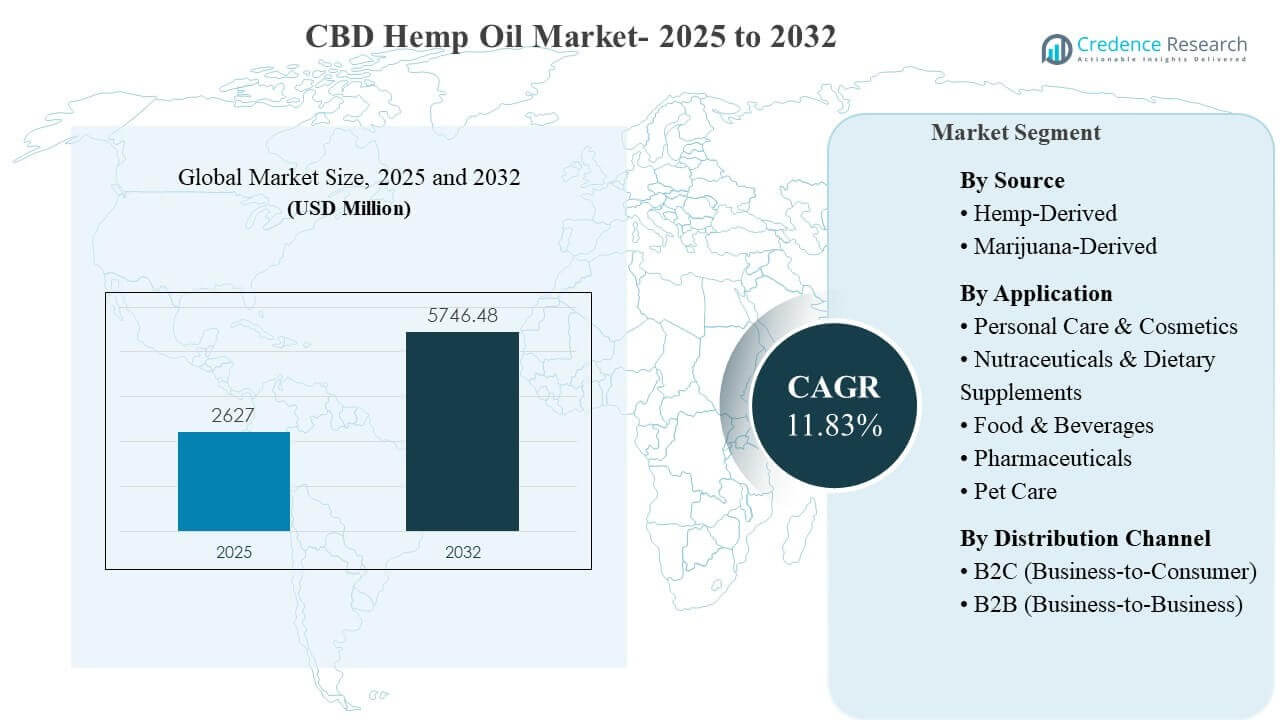
The global CBD Hemp Oil Market size was estimated at USD 2627 million in 2025 and is expected to reach USD 5746.48 million by 2032, growing at a CAGR of 11.83% from 2025 to 2032. Growth is primarily driven by widening consumer adoption of CBD-based wellness routines across stress management, sleep support, skin health, and functional nutrition, supported by expanding retail availability and stronger product standardization. Commercial momentum is also reinforced by brand investments in compliance-grade sourcing, lab testing, and differentiated formats that improve trust and repeat purchasing across major consumption regions.
| REPORT ATTRIBUTE | DETAILS |
|---|---|
| Historical Period | 2020-2024 |
| Base Year | 2025 |
| Forecast Period | 2026-2032 |
| CBD Hemp Oil Market Size 2025 | USD 1996 million |
| CBD Hemp Oil Market, CAGR | 11.4% |
| CBD Hemp Oil Market Size 2032 | USD 4248.67 million |
Key Market Trends & Insights
- The market is projected to expand from USD 2627 million (2025) to USD 5746.48 million (2032), reflecting 11.83% CAGR (2025–2032).
- Hemp-derived CBD accounted for the largest share of 58.40% in 2025, supported by broader mainstream acceptance and scalable cultivation economics.
- B2B (Business-to-Business) represented 57.20% in 2025, reflecting strong bulk procurement by supplement, personal care, and functional food manufacturers.
- Pharmaceuticals held 44.60% share in 2025, supported by demand for consistent dosing formats and higher-quality extraction and testing requirements.
- North America led with 45.90% share in 2025, followed by Europe at 27.10% and Asia Pacific at 18.60%, showing concentration in mature consumer markets while APAC accelerates.
Segment Analysis
CBD hemp oil demand is increasingly shaped by routine wellness use-cases, where consumers prioritize transparent labeling, third-party testing, and predictable effects. Product differentiation is moving from basic tinctures toward targeted formulations-sleep, calm, recovery, skin, and functional blends-supported by stronger brand storytelling and ingredient traceability. As the category matures, purchasing behavior is also shifting toward trusted retail, subscription models, and repeat regimens that favor consistent quality and recognizable brands.
Commercially, manufacturers are balancing compliance, supply consistency, and cost by strengthening hemp sourcing strategies and investing in extraction, purification, and quality systems. Larger buyers increasingly prefer suppliers that can provide documentation, batch-level testing, and scalable production to reduce risk across regulated channels. Over the forecast period, format innovation and channel expansion are expected to remain central to value capture, especially where regulations enable broader commercialization and cross-category product integration.
By Source Insights
Hemp-Derived accounted for the largest share of 58.40% in 2025. It leads because hemp supply chains are more scalable and widely accepted for mainstream consumer products, enabling consistent input availability for brands and manufacturers. Many companies prioritize hemp-derived inputs to reduce regulatory complexity and maintain THC-threshold compliance in broader markets. Improved cultivation practices and extraction efficiencies also support more predictable quality and pricing for high-volume product lines.
By Application Insights
Pharmaceuticals accounted for the largest share of 44.60% in 2025. This leadership is supported by demand for controlled formulations where consistency, dosage precision, and safety testing are critical to adoption. Pharmaceutical-oriented buyers typically require stronger quality assurance and documentation, which increases the competitiveness of suppliers with robust standards and validated processes. Continued clinical interest and physician-supervised use-cases also reinforce steady demand for medical-grade oils and derivatives.
By Distribution Channel Insights
B2B (Business-to-Business) accounted for the largest share of 57.20% in 2025. B2B remains dominant because finished-product manufacturers in supplements, cosmetics, functional foods, and wellness procure CBD inputs at scale to support brand portfolios. As compliance requirements tighten, supplier qualification, testing transparency, and dependable batch consistency become decisive differentiators in B2B procurement. Contract manufacturing and private-label production further amplify bulk demand, sustaining B2B leadership even as DTC grows.
CBD Hemp Oil Market Drivers
Expansion Of Wellness-Focused Consumption
CBD hemp oil adoption is rising as consumers increasingly incorporate wellness products into daily routines for stress relief, sleep support, recovery, and general wellbeing. Broader product accessibility across retail and digital channels improves trial and repeat purchases, especially for oils, capsules, topicals, and blends. More brands are investing in clearer dosing guidance and product education, which reduces uncertainty for first-time buyers. This driver is reinforced by growing interest in plant-based ingredients and functional health positioning across multiple end-use categories.
Product Standardization And Quality Transparency
The market benefits as producers improve consistency through better extraction methods, purification processes, and batch-level testing practices. Standardization builds consumer trust and supports wider distribution through reputable retail chains and professional channels. Brands differentiating on traceability, lab reports, and formulation integrity often achieve stronger retention and premium positioning. As more buyers become quality-sensitive, suppliers with documented compliance systems and stable sourcing are better positioned to capture long-term contracts and expand across regulated segments.
- For instance, CV Sciences, Inc. (PlusCBD) implemented a supercritical CO₂ extraction system operating at 3,500 psi and 45°C, achieving ≥98% cannabinoid recovery efficiency and <0.5% residual solvent levels across 150+ batches in 2024, with every batch assigned a QR-code-linked Certificate of Analysis (CoA) showing 100% compliance with USDA hemp rules and California Prop 65 limits for heavy metals and pesticides .
Channel Expansion And Omnichannel Availability
Distribution is widening through a mix of specialty retail, pharmacy-led expansion in select markets, online commerce, and brand-owned DTC platforms. Omnichannel strategies strengthen customer acquisition and enable targeted marketing, subscriptions, and personalized regimens that improve lifetime value. Retail placement can accelerate mainstream awareness, while e-commerce supports broader assortment and convenient repurchase. This diversification reduces reliance on any single channel and allows brands to adjust quickly to changing regulations, consumer preferences, and competitive pressure.
Cross-Category Integration In Consumer Products
CBD hemp oil is increasingly incorporated into personal care, nutraceuticals, functional food and beverage concepts, and pet wellness offerings where permitted. This cross-category integration expands total addressable demand and encourages innovation in formats, flavors, and functional combinations. Large consumer brands and contract manufacturers can accelerate scale by integrating CBD derivatives into established product lines. As formulation capabilities mature, differentiated use-case products calm, sleep, skin soothing, and mobility support help companies defend margins and reduce direct price competition.
- For instance, Charlotte’s Web has built an omnichannel presence with products distributed through more than 15,000 retail locations and over 8,000 healthcare practitioners, while also selling directly through its online platform. Similarly, Medterra stated that its products were available in more than 14,000 retail locations globally through partners including CVS, Kroger, and Walgreens, illustrating how pharmacy and mass-retail access can complement direct online sales.
CBD Hemp Oil Market Challenges
Regulatory uncertainty remains a key obstacle because rules for cannabinoid products vary significantly by country and can change rapidly. Companies must manage evolving requirements around THC thresholds, allowable claims, testing standards, labeling, and permissible channels, which increases operational cost and slows expansion. Compliance complexity also creates distribution barriers, particularly for food and beverage applications where approvals may be stricter. These factors can limit product variety and delay mainstream adoption in certain markets.
- For instance, in 2023 the U.K. Food Standards Agency (FSA) removed numerous CBD food and drink products from its public “list of accepted CBD novel food applications” after determining they no longer met submission requirements, effectively blocking their sale in mainstream retail and foodservice channels.
Quality inconsistency and consumer trust issues also challenge growth, especially when low-cost products enter the market without robust testing and traceability. Variability in potency, contaminants, or inaccurate labeling can lead to reputational damage across the broader category. Brands must invest in quality systems, supplier audits, and transparent communication to protect credibility. Competitive intensity further pressures pricing, making it difficult for smaller companies to sustain marketing and compliance investments at scale.
CBD Hemp Oil Market Trends and Opportunities
Product innovation is accelerating toward targeted and premiumized offerings that emphasize specific outcomes such as sleep support, calm, recovery, and skin health. Brands are increasingly using cleaner ingredient decks, functional combinations, and differentiated delivery forms to improve consumer experience and retention. As the category matures, opportunities expand for clinically oriented positioning, measured dosing formats, and quality-led portfolios that appeal to cautious mainstream buyers. Companies that build trust through documentation and consistency can compete beyond price.
- For instance, in March 2024 Charlotte’s Web launched “Stay Asleep” CBN gummies delivering a 20 mg dose of cannabinol (CBN) per serving, backed by a placebo-controlled, peer-reviewed clinical study showing improved sleep continuity in adults who wake during the night.
Partnerships and consolidation are creating opportunities to scale distribution, secure reliable supply, and broaden product portfolios across channels. Strategic collaborations with retailers, manufacturers, and wellness platforms can improve market access and lower customer acquisition costs. In parallel, B2B growth opportunities remain strong where suppliers provide standardized inputs, technical support, and regulatory documentation for large brand customers. Expansion into new geographies will favor companies with adaptable compliance strategies and proven quality controls.
Regional Insights
North America
North America accounted for 45.90% share in 2025, supported by strong consumer awareness, broad product availability, and established retail and online distribution networks. The region benefits from active brand competition focused on quality, transparency, and differentiated wellness positioning. Manufacturers and retailers also drive category visibility through product education, merchandising, and format expansion. Demand remains strong across oils, capsules, topicals, and wellness blends, with continued emphasis on trust, testing, and consistent dosing.
Europe
Europe held 27.10% share in 2025, shaped by uneven regulatory frameworks and varying channel access across countries. Growth is supported by increasing consumer interest in natural wellness products and gradual expansion of compliant product offerings. Brands that adapt labeling, claims, and THC-compliance requirements to local regulations gain advantage in distribution and repeat purchasing. Market development is also influenced by pharmacy and specialty retail dynamics, where credibility and product consistency play a major role.
Asia Pacific
Asia Pacific captured 18.60% share in 2025, with growth driven by evolving acceptance, rising disposable income, and expanding wellness consumption in select markets. While regulation can be restrictive in parts of the region, demand is building where compliant formats are available and consumer education improves. Market momentum is often strongest for personal care and nutraceutical-style positioning, supported by e-commerce and cross-border sales models. Companies that navigate approvals and localization can unlock significant upside as the region matures.
Latin America
Latin America represented 5.80% share in 2025, reflecting early-stage commercialization and uneven regulatory progress across countries. Growth is supported by rising awareness of CBD wellness use-cases and gradual expansion of medical and compliant consumer pathways. Distribution often depends on trustworthy retail networks, professional channels, and clear product documentation. As frameworks stabilize, opportunities are likely to expand for standardized oils and value-priced wellness formats, especially through online channels.
Middle East & Africa
The Middle East and Africa accounted for 2.60% share in 2025, constrained by restrictive policies in many countries and limited formal commercialization routes. Where medical or tightly controlled use is permitted, demand favors higher-compliance products with strong documentation and quality assurance. Market growth depends heavily on regulatory clarity, import permissions, and channel development through approved distributors. Over time, selective liberalization could support niche growth, especially for medical and premium wellness categories.
Competitive Landscape
Competition in the CBD hemp oil market is shaped by product quality differentiation, brand trust, and the ability to navigate compliance requirements across diverse jurisdictions. Companies compete through third-party testing transparency, traceable sourcing, specialized formulations, and expansion across retail and direct-to-consumer channels. Portfolio breadth across oils, gummies, topicals, capsules, and functional blends is used to address multiple wellness needs and defend pricing. Strategic partnerships, retailer access, and manufacturing capabilities are increasingly important as the market consolidates.
Charlotte's Web Holdings, Inc. typically competes through a quality-led approach built on brand recognition, product consistency, and broad consumer wellness positioning. The company’s strategy often emphasizes traceability, testing transparency, and a diversified portfolio that spans key wellness use-cases. Expansion into wider retail footprints and continued formulation innovation can strengthen visibility and repeat purchase behavior. Sustained competitiveness depends on maintaining quality differentiation while scaling distribution and managing regulatory complexity across channels.
The industry research and growth report includes detailed analyses of the competitive landscape of the market and information about key companies, including:
- Charlotte's Web Holdings, Inc.
- CV Sciences, Inc.
- Medterra CBD
- Green Roads Inc.
- Joy Organics
- CBDfx
- NuLeaf Naturals
- Aurora Cannabis Inc.
- Canopy Growth Corporation
- Elixinol LLC
- Endoca BV
- Hemp Bombs
- Pure Spectrum
- Medical Marijuana, Inc.
Qualitative and quantitative analysis of companies has been conducted to help clients understand the wider business environment as well as the strengths and weaknesses of key industry players. Data is qualitatively analyzed to categorize companies as pure play, category-focused, industry-focused, and diversified; it is quantitatively analyzed to categorize companies as dominant, leading, strong, tentative, and weak.
Recent Developments
- In January 2026, cbdMD, Inc. finalized its strategic acquisition of Bluebird Botanicals, a well-established CBD brand with AS-status full-spectrum CBD products. This deal encompasses Bluebird's e-commerce operations and valuable intellectual property, enabling cbdMD to broaden its revenue stream and capitalize on operational synergies. The integration is currently in progress, with management expecting improved earnings through cost savings and enhanced distribution.
- In February 2026, cbdMD expanded distribution for its Herbal Oasis THC-infused social seltzer (which contains CBD hemp oil alongside hemp-derived THC and CBG) into Louisiana through an expanded partnership with Morales Beverage Group (MBG). Initial shipments began leveraging MBG's statewide infrastructure after strong early performance in Texas, tapping into the rapidly growing THC beverage market projected to reach $3.5 billion by 2030.
- In March 2026, High Tide Inc. and its U.S. hemp-derived CBD subsidiary NuLeaf Naturals joined the National Compassionate Care Council (NCCC) as founding members alongside Lazarus Naturals, Medterra CBD, Feals, Tilray Inc., and others. This partnership aims to improve patient access to cannabinoid therapies by modernizing healthcare standards and advancing evidence-based policy, strengthening the medical legitimacy of CBD hemp oil products.
- In March 2026, Splash Beverage Group signed a Letter of Intent for a strategic partnership with Medterra CBD LLC, positioning both companies to drive category leadership in the emerging cannabinoid wellness market. Through this proposed partnership, the companies plan to leverage operational scale and participate in the CMS CBD pilot initiative, which could represent a meaningful long-term growth opportunity as Medicare evaluates CBD reimbursement pathways.
Report Scope
| Report Attribute | Details |
| Market size value in 2025 | USD 2627 million |
| Revenue forecast in 2032 | USD 5746.48 million |
| Growth rate (CAGR) | 11.83% (2025–2032) |
| Base year | 2025 |
| Forecast period | 2026–2032 |
| Quantitative units | USD million |
| Segments covered | By Source Outlook: Hemp-Derived, Marijuana-Derived; By Application Outlook: Personal Care & Cosmetics, Nutraceuticals & Dietary Supplements, Food & Beverages, Pharmaceuticals, Pet Care; By Distribution Channel Outlook: B2C (Business-to-Consumer), B2B (Business-to-Business) |
| Regional scope | North America, Europe, Asia Pacific, Latin America, Middle East & Africa |
| Key companies profiled | Charlotte's Web Holdings, Inc.; CV Sciences, Inc.; Medterra CBD; Green Roads Inc.; Joy Organics; CBDfx; NuLeaf Naturals; Aurora Cannabis Inc.; Canopy Growth Corporation; Elixinol LLC; Endoca BV; Hemp Bombs; Pure Spectrum; Medical Marijuana, Inc. |
| No.of Pages | 328 |
Segmentation
By Source
- Hemp-Derived
- Marijuana-Derived
By Application
- Personal Care & Cosmetics
- Nutraceuticals & Dietary Supplements
- Food & Beverages
- Pharmaceuticals
- Pet Care
By Distribution Channel
- B2C (Business-to-Consumer)
- B2B (Business-to-Business)
By Region
- North America
- U.S.
- Canada
- Mexico
- Europe
- Germany
- France
- U.K.
- Italy
- Spain
- Rest of Europe
- Asia Pacific
- China
- Japan
- India
- South Korea
- South-east Asia
- Rest of Asia Pacific
- Latin America
- Brazil
- Argentina
- Rest of Latin America
- Middle East & Africa
- GCC Countries
- South Africa
- Rest of the Middle East and Africa
Request a Free Sample
Fill in your details and we'll send you a free sample report.
- Sample data tables & charts
- Research methodology
Need a Custom Version of This Report?
Tailor the scope, geography, or segments to your exact requirements.
- Custom geography or segment scope
- Direct access to our analyst team
Frequently Asked Questions
What is the Cervical Dysplasia Market size and forecast?
What is the CAGR for Cervical Dysplasia Market during 2025–2032?
What is the largest segment in Cervical Dysplasia Market?
What factors are driving Cervical Dysplasia Market growth?
Who are the key players in Cervical Dysplasia Market?
Which region leads Cervical Dysplasia Market in 2025?
Table of Content
Chapter 1 Market Segmentation
- 1.1 Segmentation Framework
- 1.1.1 Product and Service Classification
- 1.1.2 Application and End-Use Classification
- 1.1.3 Technology and Solution Classification
- 1.1.4 Customer and Distribution Channel Classification
- 1.1.5 Geographic Segmentation
- 1.1.6 Market Segment Definitions and Boundaries
Chapter 2 Introduction
- 2.1 Report Objectives and Scope
- 2.2 Product Definition and Industry Terminology
- 2.3 Market Inclusions and Exclusions
- 2.4 Research Process
- 2.4.1 Primary Research and Expert Interviews
- 2.4.2 Secondary Research and Source Review
- 2.4.3 Top-Down and Bottom-Up Estimation
- 2.4.4 Data Triangulation and Verification
- 2.5 Market Size Measurement Basis
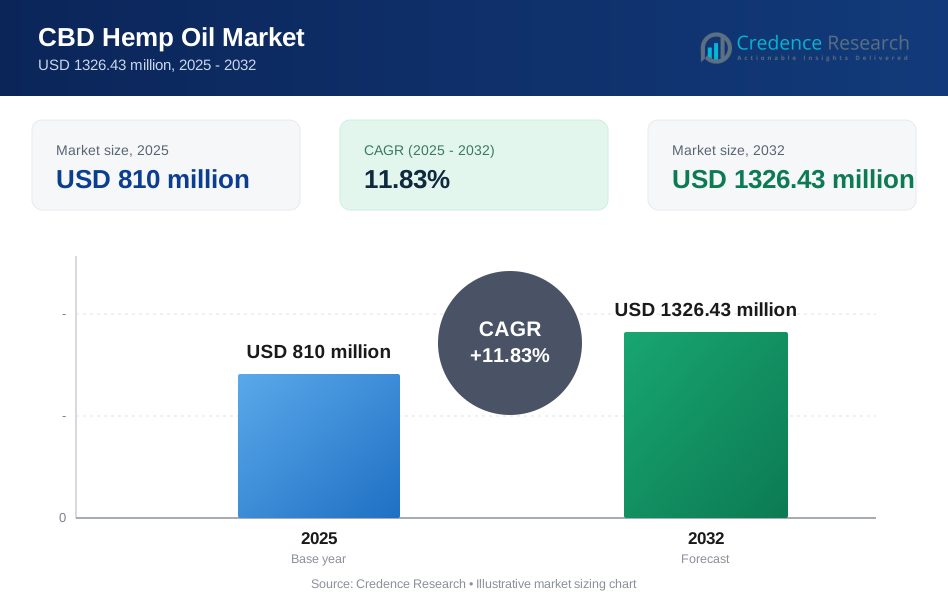
- 2.5.1 2025: USD 810 million → 2032: USD 1326.43 million
- 2.6 Historical and Forecast Reference Periods
- 2.6.1 Base Year: 2025
- 2.6.2 Forecast Period: 2025-2032
- 2.7 Research Assumptions and Limitations
Chapter 3 Executive Summary
- 3.1 Market Snapshot and Key Findings
- 3.2 Base-Year Market Size, 2025
- 3.3 Forecast Market Size, 2032
- 3.4 Revenue and Volume Growth Outlook
- 3.5 Key Demand and Supply Indicators
- 3.6 Leading Market Segments
- 3.7 Fastest-Growing Market Opportunities
- 3.8 Regional Performance Highlights
- 3.9 Technology and Industry Transformation
- 3.10 Competitive Landscape Summary
- 3.11 Analyst View and Strategic Implications
Chapter 4 Global CBD Hemp Oil Market Trends and Developments
- 4.1 Historical Industry Development
- 4.2 Recent Market Trends and Developments
- 4.3 Demand and Customer Behavior Trends
- 4.4 Technology and Product Innovation
- 4.5 Artificial Intelligence, Automation and Digitalization
- 4.6 Local Manufacturing and Supply Chain Realignment
- 4.7 Industry Partnerships, Mergers and Acquisitions
- 4.8 Sustainability and Circular Economy Developments
- 4.9 Government and Private Sector Investment Trends
- 4.10 Emerging Business Models and Commercialization
- 4.11 Industry Developments and Announcements
Chapter 5 Global CBD Hemp Oil Market Production, Supply and Demand Analysis
- 5.1 Demand Trend and Consumption Analysis
- 5.2 Demand Forecast, 2025-2032
- 5.3 Production and Output Trend
- 5.4 Production and Output Forecast, 2025-2032
- 5.5 Installed Capacity and Capacity Utilization
- 5.6 Company-Wise Production Plants and Statistics
- 5.6.1 Installed Production Capacity
- 5.6.2 Actual Production
- 5.6.3 Planned Capacity and Expansion Targets
- 5.7 Supply Chain Structure and Procurement Trends
- 5.8 Supply-Demand Gap and Bottlenecks
- 5.9 Import Dependence and Sourcing Structure
- 5.10 Contract Manufacturing and Outsourcing
- 5.11 Regional Supply and Demand Concentration
Chapter 6 Global CBD Hemp Oil Market Pricing Analysis
- 6.1 Pricing Structure and Measurement
- 6.2 Historical Pricing Trends
- 6.3 Pricing Outlook, 2025-2032
- 6.4 Average Selling Price and Unit Economics
- 6.5 Pricing by Product and Market Segment
- 6.6 Geographic Pricing Differences
- 6.7 Key Input, Energy, Labor and Logistics Costs
- 6.8 Contract Pricing and Purchasing Models
- 6.9 Pricing Sensitivity and Competitive Positioning
- 6.10 Price, Margin and Profitability Implications
Chapter 7 Global CBD Hemp Oil Market Dynamics
- 7.1 Market Growth Drivers
- 7.1.1 Demand-Side Drivers
- 7.1.2 Technology and Innovation Drivers
- 7.1.3 Infrastructure and Investment Drivers
- 7.1.4 Regulatory and Policy Drivers
- 7.2 Market Restraints
- 7.2.1 Cost and Affordability Constraints
- 7.2.2 Technology and Adoption Barriers
- 7.2.3 Supply Chain and Operational Constraints
- 7.3 Market Challenges
- 7.3.1 Competitive Pressure and Margin Erosion
- 7.3.2 Skills, Infrastructure and Implementation Gaps
- 7.4 Emerging Market Opportunities
- 7.5 Market Dynamics Impact and Time-Horizon Assessment
Chapter 8 Global CBD Hemp Oil Value Chain Analysis
- 8.1 Industry Value Chain Overview
- 8.2 Upstream Suppliers and Critical Inputs
- 8.3 Technology and Component Providers
- 8.4 Manufacturing or Service Delivery
- 8.5 Distribution, Channel Partners and Integrators
- 8.6 Downstream Applications and End Users
- 8.7 Value Addition and Profit Pools
- 8.8 Vertical Integration and Outsourcing
- 8.9 Supplier Concentration and Risk
- 8.10 Supply Chain Localization and Resilience
Chapter 9 Global CBD Hemp Oil Market Regulations and Policies
- 9.1 Relevant Laws, Standards and Compliance Frameworks
- 9.2 Product, Service, Safety and Quality Requirements
- 9.3 Government Policies, Incentives and Subsidies
- 9.4 Imports, Exports and Trade Barriers
- 9.5 Public Procurement and Local Content Requirements
- 9.6 Environmental and Sustainability Compliance
- 9.7 Upcoming Policy Changes and Market Implications
Chapter 10 Global CBD Hemp Oil Market Hotspots and Opportunities
- 10.1 Market Opportunity Mapping and Growth Hotspots
- 10.2 High-Growth Applications and Customer Groups
- 10.3 Underserved Markets and White-Space Opportunities
- 10.4 Emerging Technology and Product Opportunities
- 10.5 New Capacity and Investment Hotspots
- 10.6 Market Entry and Expansion Opportunities
- 10.7 Distribution and Partnership Opportunities
- 10.8 Near-Term and Long-Term Commercial Potential
- 10.9 Opportunity Attractiveness and Execution Risks
Chapter 11 Global CBD Hemp Oil Market Outlook, 2025-2032
- 11.1 Market Size and Analysis
- 11.1.1 Revenue (Market Measurement: 2025: USD 810 million → 2032: USD 1326.43 million)
- 11.1.2 Market Volume and Quantity Sold
- 11.1.3 Historical Market Size
- 11.1.4 Base-Year Market Size, 2025
- 11.2 Market Forecast, 2025-2032
- 11.2.1 Revenue Forecast to 2032
- 11.2.2 Volume Forecast to 2032
- 11.2.3 CAGR and Year-on-Year Growth
- 11.2.4 Incremental Revenue Opportunity
- 11.3 Forecast Assumptions and Scenario Analysis
- 11.3.1 Base-Case Forecast
- 11.3.2 Optimistic and Conservative Scenarios
- 11.3.3 Technology, Pricing and Policy Sensitivities
- 11.4 Market Attractiveness and Growth Outlook
Chapter 12 Global CBD Hemp Oil Market Segmentation and Outlook
- 12.1 Segmentation Summary and Market Shares, 2025
- 12.2 Largest and Fastest-Growing Segments
- 12.3 Segment Growth Comparison
- 12.4 Segment Attractiveness and Priority Matrix
Chapter 13 Global CBD Hemp Oil Geographic Market Outlook, 2025-2032
- 13.1 Regional Market Size and Share, 2025
- 13.2 Regional Market Forecast, 2025-2032
- 13.3 Regional Pricing, Production and Demand Differences
- 13.4 North America
- 13.4.1 United States
- 13.4.2 Canada
- 13.4.3 Mexico
- 13.5 Europe
- 13.5.1 Germany
- 13.5.2 France
- 13.5.3 Italy
- 13.5.4 United Kingdom
- 13.5.5 Spain
- 13.5.6 Poland
- 13.5.7 Russia
- 13.5.8 Netherlands
- 13.5.9 Belgium
- 13.5.10 Sweden
- 13.5.11 Denmark
- 13.5.12 Norway
- 13.5.13 Rest of Europe
- 13.6 Asia Pacific
- 13.6.1 China
- 13.6.2 India
- 13.6.3 Japan
- 13.6.4 South Korea
- 13.6.5 Thailand
- 13.6.6 Indonesia
- 13.6.7 Vietnam
- 13.6.8 Malaysia
- 13.6.9 Australia
- 13.6.10 Rest of Asia Pacific
- 13.7 Latin America
- 13.7.1 Brazil
- 13.7.2 Argentina
- 13.7.3 Colombia
- 13.7.4 Chile
- 13.7.5 Rest of Latin America
- 13.8 Middle East
- 13.8.1 Saudi Arabia
- 13.8.2 United Arab Emirates
- 13.8.3 Turkey
- 13.8.4 Israel
- 13.8.5 Iran
- 13.8.6 Rest of the Middle East
- 13.9 Africa
- 13.9.1 South Africa
- 13.9.2 Egypt
- 13.9.3 Nigeria
- 13.9.4 Morocco
- 13.9.5 Rest of Africa
- 13.10 Regional Investment, Policy and Supply Chain Differences
- 13.11 Regional Competitive Landscape
- 13.12 Geographic Growth Hotspots
Chapter 14 Global CBD Hemp Oil Technology, Innovation and Sustainability Outlook
- 14.1 Technology Landscape and Maturity
- 14.2 Product, Process and Service Innovation
- 14.3 AI, Automation and Digital Tools in the Industry
- 14.4 Technology Adoption and Performance Benchmarking
- 14.5 Innovation Pipeline and R&D Investment
- 14.6 Patent and Intellectual Property Trends
- 14.7 Energy Efficiency and Resource Management
- 14.8 Sustainability, Recycling and Circularity
- 14.9 Technology Roadmap, 2025-2032
- 14.10 Risks of Obsolescence and Technology Substitution
Chapter 15 Global CBD Hemp Oil Market Key Strategic Imperatives
- 15.1 Growth and Market Entry Priorities
- 15.2 High-Return Products and Segments
- 15.3 Pricing, Profitability and Cost Optimization
- 15.4 Technology Investment and Product Differentiation
- 15.5 Supply Chain Localization and Resilience
- 15.6 Distribution and Customer Acquisition
- 15.7 Partnership, Acquisition and Capacity Strategy
- 15.8 Regional Expansion Priorities
- 15.9 Short-, Medium- and Long-Term Actions
Chapter 16 Competition Outlook
- 16.1 Industry Competition Characteristics
- 16.2 Market Structure and Concentration
- 16.3 Market Share and Competitive Positioning, 2025
- 16.4 Company-Wise Revenue and Product Benchmarking
- 16.5 Production and Service Capacity Benchmarking
- 16.6 Technology, Pricing and Differentiation
- 16.7 Regional Footprint and Distribution Strength
- 16.8 Mergers, Acquisitions and Strategic Alliances
- 16.9 New Entrants and Competitive Threats
- 16.10 Porter's Five Forces and Industry Attractiveness
- 16.11 Competitive Outlook, 2025-2032
Chapter 17 Company Profiles
- 17.1 Company Coverage and Selection Criteria
- 17.2 Leading Market Participants – Standard Profile Structure
- 17.2.1 Business Description
- 17.2.2 Company Ownership and Geographic Presence
- 17.2.3 Product and Service Portfolio
- 17.2.4 Manufacturing and Operating Footprint
- 17.2.5 Production Capacity and Expansion Plans
- 17.2.6 Financial Performance and Investment
- 17.2.7 Market Share and Competitive Position
- 17.2.8 Technology and Innovation Capabilities
- 17.2.9 Strategic Alliances or Partnerships
- 17.2.10 Recent Developments
- 17.2.11 Growth Strategy and Outlook
- 17.3 Other Relevant Market Participants
Note: Every listed company is profiled on the structure shown under the first company. The company list is preliminary and may change based on research findings, market developments, data availability and client requirements.
Chapter 18 Disclaimer
- 18.1 Research and Forecast Disclaimer
- 18.2 Data Source and Estimation Limitations
Note: The depth of individual sections depends on data availability for this market. Volume, capacity, trade and other unit-based metrics are included where applicable.