
Key Highlights of the Report
The global Chemical Processing Catalysts market is segmented by type, application, and region. Polymerization catalysts are the leading segment by type. The chemicals segment is predicted to have the most significant CAGR during the forecast period. Asia Pacific is boosting the expansion of the Chemical Processing Catalysts industry.
The key factors boosting market growth include rising chemical demand in various end-user sectors, as well as a shift towards green chemistry. High cost and limited raw material availability are restraining the market growth.
Significant technological advances in chemical processing catalysts have occurred in the Asia Pacific region. This encompasses the development of enhanced catalyst materials, novel catalytic compositions, and unique catalyst manufacturing procedures. Advanced characterization techniques, computer modeling, and data-driven approaches assist catalyst design and optimization. These technological advances aid in improving catalyst performance, selectivity, and stability.
What Are the Most Significant Factors Driving the Global Chemical Processing Catalysts Market?
The primary factors driving market growth are increasing demand for chemicals in various end-user industries and a shift towards green chemistry.
What Are the Major Challenges Facing the Global Chemical Processing Catalysts Market?
High cost and limited raw material availability are restraining the market growth.
What Are the Opportunities for Growth in the Global Chemical Processing Catalysts Market?
The market's primary opportunities are the transition to a sustainable and circular economy, digitalization, and process optimization.
Executive Summary
Overview of the Global Chemical Processing Catalysts Market
Chemical processing catalysts provide several major advantages in a variety of industrial applications. Catalysts speed up chemical reactions by providing an alternate reaction pathway with lower activation energy. They facilitate the production of intermediate species, allowing reactions to proceed at a higher rate than in their absence. This enhanced reaction rate leads to increased productivity and process efficiency. Catalysts can be designed and optimized for specific chemical reactions and product results. Due to their versatility, catalysts can be utilized in various industrial processes, including petrochemicals, medicines, polymers, and specialty chemicals. Catalysts can be fine-tuned to accept a variety of feedstocks, modify reaction conditions, and meet specific process needs.
Market Definition
The chemical processing catalysts market refers to the industry that manufactures, distributes, and sells catalysts used in chemical processes. Catalysts are substances that accelerate chemical reactions by decreasing the activation energy required. They are not consumed during the reaction and can be reused, making them crucial components in various industrial processes.
Market Insights
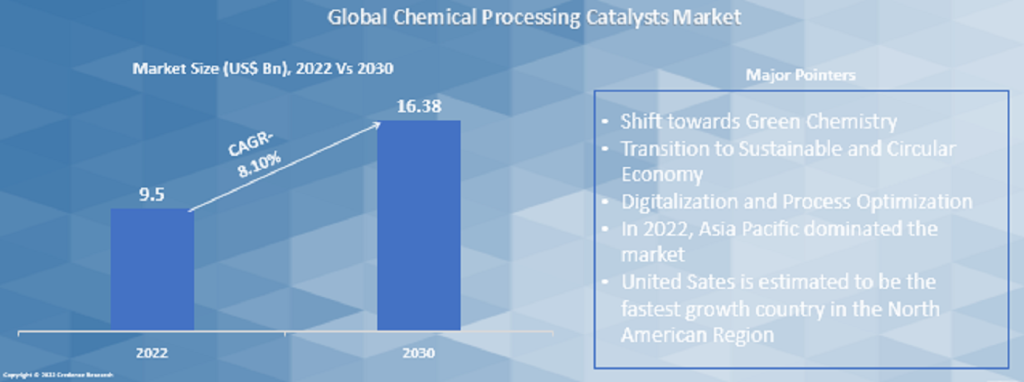
- The global market for chemical processing catalysts was valued at USD 9.5 billion in 2022 and is predicted to reach USD 16.38 billion in 2030, rising at an 8.10% CAGR between 2023 and 2030.
- Polymerization catalysts are the leading segment by type.
- The chemicals segment is predicted to have the most significant CAGR during the forecast period.
- Asia Pacific is driving the growth of the Chemical Processing Catalysts industry.
- North America is the second largest region in the Chemical Processing Catalysts industry.
- Europe is expected to be the fastest-growing region in the Chemical Processing Catalysts industry.
- The primary factors driving market growth are increasing demand for chemicals in various end-user industries and a shift towards green chemistry.
- High cost and limited raw material availability are restraining the market growth.
- The market's primary opportunities are the transition to a sustainable and circular economy, digitalization, and process optimization.
Market Overview
The global Chemical Processing Catalysts market has grown steadily in recent years and is predicted to increase at an 8.10% CAGR between 2023 and 2030. In 2022, the market was valued at USD 9.5 billion, and it is predicted to grow to USD 16.38 billion by 2030.
Segmentation by Type
- Polymerization Catalysts are the leading segment by type.
- During the forecast period, the Oxidation Catalysts segment is expected to grow at the fastest rate.
- Other types, such as Organic Synthesis Catalysts, Synthesis Gas Catalysts, Hydrogenation Catalysts, and Dehydrogenation Catalysts, also contribute to the demand for Chemical Processing Catalysts.
Segmentation by Application
- The Chemicals segment is predicted to have the most significant CAGR during the forecast period.
- Other applications, such as the Production of Isobutylene and Others, also contribute to the demand for Chemical Processing Catalysts.
Segmentation by Region
- Asia Pacific is driving the growth of the Chemical Processing Catalysts industry.
- North America is the second largest region in the Chemical Processing Catalysts industry.
- Europe is expected to be the fastest-growing region in the Chemical Processing Catalysts industry.
- The rest of the world, including Latin America, the Middle East, and Africa, contributes to the remaining demand for Chemical Processing Catalysts.
The rising demand for Chemical Processing Catalysts might be due to rising chemical demand in many end-user industries. However, the market is hampered by the scarcity of raw materials.
In the India Chemical Processing Catalysts Market, enzymatic and biocatalysts have gained popularity. The advantages of enzymes and biocatalysts include high selectivity, gentle reaction conditions, and compatibility with renewable feedstocks. They are used in biofuels, biopolymers, pharmaceutical synthesis, and food processing, among other things. The development of enzymatic and biocatalytic processes corresponds to the growing demand for environmentally friendly and biodegradable alternatives.
Specialty catalysts have expanded tremendously in the United States Chemical Processing Catalysts Market. Specialty catalysts are designed for specific reactions and have excellent selectivity, resilience to extreme environments, and compatibility with complicated feedstocks. The desire to optimize process efficiency, product quality, and competitiveness in specialized sectors drives the demand for specialty catalysts. Some examples are catalysts for hydrogenation, oxidation, polymerization, and precise chemical synthesis.
Market Drivers
Several factors influence the global Chemical Processing Catalysts market. The following are the primary drivers of the global Chemical Processing Catalysts market:
Increasing demand for chemicals in various end-user industries
The rising demand for chemicals in numerous end-user industries is a primary driver of the Chemical Processing Catalysts Market. Chemical catalysts are essential in industrial operations for facilitating and accelerating chemical reactions. They're used to make a variety of chemicals, including petrochemicals, polymers, medicines, and specialty chemicals.
Demand for chemical processing catalysts is closely related to expanding end-user sectors such as petroleum refining, chemical production, and pharmaceuticals. These catalysts make production processes more efficient and cost-effective by increasing yields, selectivity, and reaction speeds. As a result, organizations in these industries are increasingly using catalyst-based processes to boost efficiency and fulfill rising product demand.
In addition, growing industries such as renewable energy, biofuels, and environmental applications are increasing demand for chemical processing catalysts. Catalysts are critical in biomass conversion, hydrogenation, and emission control, enabling sustainable and environmentally friendly manufacturing practices. Overall, rising demand for chemicals across various industries, combined with technological advances, is driving the Chemical Processing Catalysts Market forward.
Shift toward Green Chemistry
The trend toward green chemistry is driving the Chemical Processing Catalysts Market forward. Green chemistry is concerned with researching and implementing ecologically friendly chemical processes that minimize the use of hazardous compounds, reduce waste output, and improve energy efficiency. Catalysts for chemical processing are critical in enabling and expediting green chemistry practices.
Increasing environmental rules and sustainability goals set by governments and organizations worldwide have put a tremendous push on industry to embrace green chemical practices. Catalysts provide options for increasing process efficiency, lowering energy consumption, and allowing the use of ecologically friendly reactions and materials.
The utilization of renewable feedstock and alternative energy sources to replace fossil fuels and petrochemicals is promoted by green chemistry. Catalysts are critical in the transformation of biomass, such as agricultural waste or algae, into value-added chemicals or biofuels. They are also critical in the manufacture of hydrogen for fuel cells, allowing clean and sustainable energy sources to be used.
Market Restraints
Some hurdles may impede the global Chemical Processing Catalysts market's growth. These are some examples:
High Cost
Catalysts sometimes entail sophisticated manufacturing techniques and advanced materials, contributing to high production costs. The high cost of catalysts can be an impediment, especially for small and medium-sized firms (SMEs) or industries with limited resources. This economic barrier may hinder the widespread use of chemical processing catalysts.
Limited Availability of Raw Materials
The limited availability of raw materials may hamper the growth of the Chemical Processing Catalysts Market. Raw materials are essential for the production of catalysts, and their availability and cost can have a considerable impact on the market. Some raw materials used in catalyst synthesis may be limited or geographically concentrated, posing possible supply chain risks. Disruptions in the supply of crucial raw materials can have an impact on the manufacturing and availability of catalysts, producing delays or production limitations.
The scarcity of certain raw materials can hamper catalyst research and development efforts. To address a lack of specific raw materials, researchers may need to locate alternate materials or develop novel synthesis processes. These obstacles may limit the rate of catalyst development and impede market growth.
Opportunities
The global market for Chemical Processing Catalysts has substantial growth opportunities. These are some examples:
Transition to a Sustainable and Circular Economy
The global shift towards more sustainable and circular economies creates exciting opportunities for chemical processing catalysts. The circular economy promotes recycling, reuse, and sustainable material cycles in order to reduce waste output and maximize resource efficiency. Catalysts are critical in enabling circular economy operations like converting waste materials into useful products, developing effective recycling technologies, and converting renewable feedstocks into high-value compounds. The use of catalysts in circular economy projects opens up a new market growth opportunity.
Digitalization and Process Optimization
Catalyst producers can benefit from the increased usage of digitalization and process optimization technologies like artificial intelligence (AI), machine learning, and advanced analytics. These technologies provide real-time monitoring, data-driven process optimization, and predictive maintenance, resulting in better catalyst performance, less downtime, and increased operational efficiency. Insights for catalyst design, formulation optimization, and quality control can be gained by incorporating digital technologies into catalyst production processes.
Advanced Materials and Nanotechnology
Catalyst manufacturers will benefit from the increased demand for innovative materials with improved characteristics and functionalities. Catalysts are essential in producing and functionalizing nanomaterials such as nanoparticles, nanofibers, and nanostructured catalytic supports. These sophisticated materials are used in various industries, including electronics, energy storage, catalysis, and environmental remediation. Catalyst development for advanced materials synthesis and processing opens new growth opportunities in emerging industries.
Competitive Landscape
Key Players
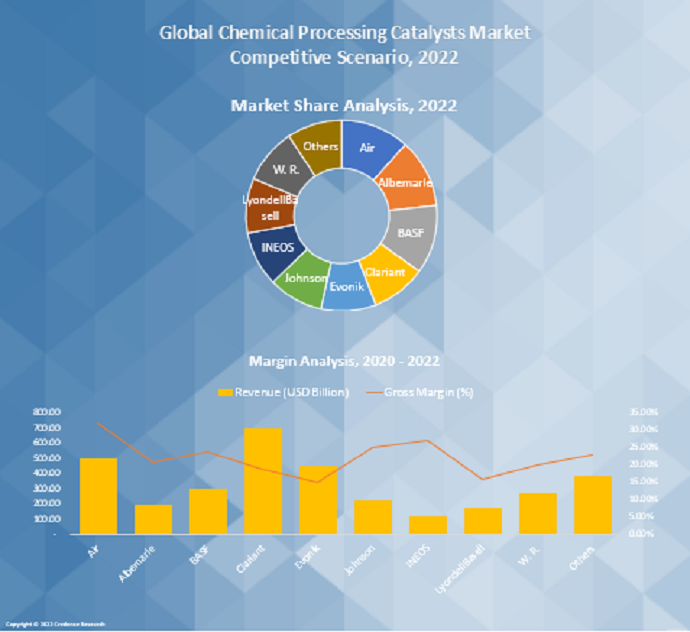
The global Chemical Processing Catalysts market is extremely competitive, with several key competitors. The following are some of the top market players and their market shares:
- Air Products and Chemicals, Inc. (USA)
- Albemarle Corp. (USA)
- BASF Catalysts LLC (USA)
- Clariant (Switzerland)
- Evonik Industries AG (Germany)
- Johnson Matthey (UK)
- INEOS Group Holdings S.A (Switzerland)
- LyondellBasell Industries N.V. (The Netherlands)
- W. R. Grace & Co. (USA)
These organizations prioritize product innovation, distribution channel expansion, and mergers and acquisitions to stay competitive.
The global Chemical Processing Catalysts market's key players constantly seek to stay ahead by offering new products and technologies.
BASF SE, a renowned chemical corporation headquartered in Ludwigshafen, Germany, announced CircleStar, a unique dehydration catalyst for processing renewable feedstocks, on September 29, 2022. The unique star-shaped catalyst achieves 99.5% selectivity in the Ethanol-to-Ethylene (E2E) conversion. CircleStar reduces the carbon footprint in the bio-ethylene value chain by more than 10% while retaining the same performance by operating at a temperature more than 25 degrees Celsius lower than conventional processes.
BASF SE, a renowned chemical firm located in Germany, announced the acquisition of Zodiac Enterprises LLC in Caldwell, Texas, on July 2, 2021, to enhance its chemical catalyst recycling capacity and capability. The plant recycles precious metals from industrial scrap, primarily chemical catalysts, and collaborates with BASF's existing precious metal recycling operations in Seneca, South Carolina. Furthermore, it increases smelting capacity in North American countries.
Summary of Key Findings
- The primary factors driving market growth are increasing demand for chemicals in various end-user industries and a shift towards green chemistry.
- Market segmented by type, application, and region.
- Polymerization Catalysts are the leading segment by type.
- The Chemicals segment is predicted to have the most significant CAGR during the forecast period.
- Asia Pacific is leading market growth; the market is highly competitive with key players, including Air Products and Chemicals, Inc. (USA), Albemarle Corp. (USA), and BASF Catalysts LLC (USA).
Future Outlook
- With the shift towards Green Chemistry, the global Chemical Processing Catalysts market has a bright future.
- The primary factors driving market growth are increasing demand for chemicals in various end-user industries and a shift towards green chemistry.
- High cost and limited raw material availability are restraining the market growth.
- Key firms must focus on product innovation, growing market reach, and maintaining competitive pricing to keep ahead of the competition.
Segmentation
- By Type
- Polymerization Catalysts
- Oxidation Catalysts
- Organic Synthesis Catalysts
- Synthesis Gas Catalysts
- Hydrogenation Catalysts
- Dehydrogenation Catalysts
- By Application
- Production of Isobutylene
- Chemicals
- Others
- By Region
- North America
- The US.
- Canada
- Mexico
- Europe
- Germany
- France
- The U.K.
- Italy
- Spain
- Rest of Europe
- Asia Pacific
- China
- Japan
- India
- South Korea
- South-east Asia
- Rest of Asia Pacific
- Latin America
- Brazil
- Argentina
- Rest of Latin America
- Middle East & Africa
- GCC Countries
- South Africa
- Rest of the Middle East and Africa

Request a Free Sample
Fill in your details and we'll send you a free sample report.
- Sample data tables & charts
- Research methodology
Need a Custom Version of This Report?
Tailor the scope, geography, or segments to your exact requirements.
- Custom geography or segment scope
- Direct access to our analyst team
Frequently Asked Questions
What is the current global market size for Chemical Processing Catalysts?
What is the predicted growth rate of the Chemical Processing Catalysts market between 2023 and 2030?
Which segment is leading the market in terms of type?
During the forecast period, which segment is expected to have the highest CAGR?
Which segments are covered in the global Chemical Processing Catalysts Market report?
Which region is driving the growth of the Chemical Processing Catalysts industry?
Who are the key vendors in the global Chemical Processing Catalysts market?
What are the key market factors driving the Chemical Processing Catalysts industry?
What are the main market restraints for Chemical Processing Catalysts?
What are the key market opportunities for Chemical Processing Catalysts?
Table of Content
Chapter 1. Report Introduction
- 1.1 Report Description & Purpose
- 1.1.1 Report Title & Market Definition
- 1.1.2 Unique Selling Propositions (USP) & Key Differentiators
- 1.1.3 Value Proposition for Stakeholders
- 1.2 Research Objectives
- 1.2.1 Market Sizing Objectives (Volume & Revenue) (Volume Where Applicable)
- 1.2.2 Segmentation Objectives
- 1.2.3 Competitive Intelligence Objectives
- 1.2.4 Forecast & Scenario Objectives
- 1.3 Report Scope
- 1.3.1 Chemical Processing Catalysts Scope – Segments & Subsegments Covered
- 1.3.2 Geographic Scope – Regions & Countries Covered
- 1.3.3 Historical Period, Base Year & Forecast Period (the historical period; forecast to the forecast period)
- 1.3.4 Inclusions & Exclusions
- 1.4 Industry Classification & Applicable Codes
- 1.5 Currency, Measurement Units & Valuation Basis
- 1.6 Target Stakeholders
- 1.7 Limitations & Assumptions
Chapter 2. Executive Summary
- 2.1 Global Chemical Processing Catalysts Market Snapshot
- 2.1.1 Market Size – Historical (the historical period) & Forecast (the forecast period)
- 2.1.2 Volume & Revenue – Global Totals (Volume Where Applicable)
- 2.1.3 Key Market Highlights – Top Five Facts
- 2.2 Chemical Processing Catalysts Market Segmentation Snapshot
- 2.2.1 Market Split by Region – the base year vs. the forecast year
- 2.3 Competitive Snapshot
- 2.3.1 Top 10 Players by Revenue Share – the base year
- 2.3.2 Top 10 Players by Volume Share – the base year (Volume Where Applicable)
- 2.3.3 Recent Strategic Developments (18-Month Summary)
- 2.4 Key Investment Highlights & Strategic Conclusions
Chapter 3. Chemical Processing Catalysts Market Dynamics & Industry Analysis
- 3.1 Market Overview & Context
- 3.1.1 Chemical Processing Catalysts Market Position in the Broader Industry Value Chain
- 3.1.2 Demand Structure & Purchasing Dynamics
- 3.1.3 Market Maturity & Development Stage by Region
- 3.2 Chemical Processing Catalysts Market Drivers
- 3.3 Chemical Processing Catalysts Market Restraints & Challenges
- 3.4 Chemical Processing Catalysts Market Opportunities
- 3.5 Porter's Five Forces Analysis
- 3.5.1 Threat of New Entrants
- 3.5.2 Bargaining Power of Suppliers
- 3.5.3 Bargaining Power of Buyers
- 3.5.4 Threat of Substitutes
- 3.5.5 Competitive Rivalry – Intensity Assessment
- 3.6 Chemical Processing Catalysts Value Chain Analysis
- 3.6.1 Upstream – Key Inputs, Resources & Suppliers
- 3.6.1.1 Key Input/Resource 1
- 3.6.1.2 Key Input/Resource 2
- 3.6.1.3 Key Input/Resource 3
- 3.6.2 Midstream – Core Operations & Value Creation
- 3.6.2.1 Operating Model & Process Overview
- 3.6.2.2 Key Operating Locations & Capabilities by Company
- 3.6.3 Downstream – Market Channels & End Users
- 3.6.3.1 Direct Sales & Customer Engagement Channels
- 3.6.3.2 Indirect Sales, Intermediaries & Partner Channels
- 3.6.4 Value Chain Profitability Analysis
- 3.6.1 Upstream – Key Inputs, Resources & Suppliers
- 3.7 PESTEL Analysis
- 3.7.1 Political Factors
- 3.7.2 Economic Factors
- 3.7.3 Social Factors
- 3.7.4 Technological Factors
- 3.7.5 Environmental Factors
- 3.7.6 Legal Factors
- 3.8 Chemical Processing Catalysts Supply Chain Analysis
- 3.8.1 Critical Input & Resource Availability Risk Assessment
- 3.8.2 Supplier & Operational Concentration Risk (Geographic Exposure)
- 3.8.3 Supply & Service Disruption Impact Analysis
- 3.9 Regulatory & Policy Landscape
Note: The regulatory and policy landscape section covers regulations based on their applicability to the market, Chemical Processing Catalysts category, geography, and scope of the study. Only regulatory frameworks with a material impact on operations, compliance, trade, sustainability, or market access are analyzed in detail.
Chapter 4. Key Investment Pockets & Opportunity Analysis
- 4.1 Chemical Processing Catalysts Market Attractiveness Analysis
- 4.1.1 By Region – Investment Attractiveness Matrix (Market Size × CAGR)
- 4.2 Absolute Revenue Growth Opportunity
- 4.2.1 By Region – Absolute Revenue Growth Through the forecast period
- 4.3 Incremental Demand Opportunity
- 4.3.1 By Region – Incremental Demand Through the forecast period
- 4.3.2 Segment – Incremental Demand
- 4.4 Emerging Submarket Opportunity Deep Dive (Subject to Applicability)
- 4.5 Priority Market Opportunity Scorecards
- 4.5.1 United States
- 4.5.2 Europe
- 4.5.3 Asia
- 4.5.4 Middle East & Africa
Note: Priority market opportunity scorecards reflect the geographic scope and strategic relevance of the study. Listed markets are indicative and may be adapted to the industry.
Chapter 5. Chemical Processing Catalysts Cross-Border Trade & Market Access Analysis
- 5.1 International Trade & Cross-Border Activity Overview
- 5.1.1 Global Export Value by Country (the historical period)
- 5.1.2 Global Export Volume by Country (the historical period) (Volume Where Applicable)
- 5.1.3 Global Import Value by Country (the historical period)
- 5.1.4 Global Import Volume by Country (the historical period) (Volume Where Applicable)
- 5.1.5 Net Trade Balance by Country (the historical period)
- 5.2 Export Analysis – Segment
- 5.2.1 Category 1 (Applicable Classification Code)
- 5.2.2 Category 2 (Applicable Classification Code)
- 5.2.3 Category 3 (Applicable Classification Code)
- 5.2.4 Category 4 (Applicable Classification Code)
- 5.2.5 Category 5 (Applicable Classification Code)
- 5.3 Import Analysis – Segment
- 5.3.1 Category 1 (Applicable Classification Code)
- 5.3.2 Category 2 (Applicable Classification Code)
- 5.3.3 Category 3 (Applicable Classification Code)
- 5.3.4 Category 4 (Applicable Classification Code)
- 5.3.5 Category 5 (Applicable Classification Code)
- 5.4 Cross-Border Pricing & Transaction Benchmarks
- 5.4.1 Export Pricing – Segment & Country
- 5.4.2 Import Pricing – Segment & Source Country
- 5.4.3 Price Trends (the historical period)
- 5.5 Key Cross-Border Trade & Delivery Routes
- 5.5.1 Cross-Border Trade/Delivery Route 1
- 5.5.2 Cross-Border Trade/Delivery Route 2
- 5.5.3 Cross-Border Trade/Delivery Route 3
- 5.5.4 Cross-Border Trade/Delivery Route 4
- 5.5.5 Cross-Border Trade/Delivery Route 5
- 5.6 Trade Policy & Market Access Impact Assessment
- 5.6.1 Tariff & Non-Tariff Barriers
- 5.6.2 Regional Trade & Economic Integration Frameworks
- 5.6.3 Bilateral & Multilateral Trade Agreements
- 5.6.4 Cross-Border Operating, Licensing & Localization Requirements
Note: This chapter applies where cross-border trade or delivery is relevant to Chemical Processing Catalysts. Goods, services, and digital offerings are assessed using applicable classifications and transaction measures. Import-export volumes, trade balances, and route analyses are included only where meaningful to the market.
Chapter 6. Competitive Landscape & Company Benchmarking
- 6.1 Chemical Processing Catalysts Market Concentration & Structure
- 6.1.1 Herfindahl-Hirschman Index (HHI) – the historical period vs. the base year
- 6.1.2 Leading, Mid-Sized & Emerging Player Structure
- 6.1.3 Global, Regional & Local Player Dynamics
- 6.2 Chemical Processing Catalysts Market Share Analysis – the base year
- 6.2.1 Global Revenue Share by Company
- 6.2.2 Global Volume Share by Company (Volume Where Applicable)
- 6.2.3 Regional Revenue Share
- 6.2.4 Market Share Evolution (the historical period vs. the base year)
- 6.2.5 Company Market Share by Key Segment
- 6.2.6 Company Market Share by Customer Group
- 6.3 Operating Scale, Capacity & Infrastructure Analysis
- 6.3.1 Global Operating Scale & Supply Capacity
- 6.3.2 Resource Utilization & Operating Efficiency
- 6.3.3 Output, Service Delivery & Activity Metrics
- 6.3.4 Operating Footprint & Infrastructure Map
- 6.3.5 Planned Operational & Capacity Expansion
- 6.4 Chemical Processing Catalysts Competitive Benchmarking Matrix
- 6.4.1 Revenue, Growth, Profitability & Operating Metric Comparison
- 6.4.2 Channel Revenue Mix
- 6.4.3 Geographic Revenue Exposure
- 6.4.4 R&D Intensity
- 6.4.5 Sustainability Maturity
- 6.5 Strategic Developments in Chemical Processing Catalysts (Last 24 Months)
- 6.5.1 Mergers, Acquisitions & Divestments
- 6.5.2 New Products, Services & Solutions in Chemical Processing Catalysts
- 6.5.3 Operational & Infrastructure Expansions
- 6.5.4 Strategic Alliances, Joint Ventures & Partnerships
- 6.5.5 Distribution Expansion & Market Entry
- 6.5.6 Sustainability & ESG Initiatives
- 6.6 Competitive Strategy Mapping
- 6.6.1 Leader, Challenger, Follower & Niche Classification
- 6.6.2 Pricing Strategy Comparison
- 6.6.3 Channel Strategy Matrix
Note: Strategic developments are included based on their materiality and the availability of reliable information.
Chapter 7. Global Chemical Processing Catalysts Market – By Sales & Delivery Channel
- 7.1 Segment Overview
- 7.1.1 Volume & Revenue Split by Channel (the base year & the forecast year) (Volume Where Applicable)
- 7.1.2 Channel Mix Evolution (the forecast period)
Chapter 8. Regional Market Analysis – Global Overview
- 8.1 Global Regional Overview
- 8.1.1 Regional Volume Share (Volume Where Applicable)
- 8.1.2 Regional Revenue Share
- 8.1.3 Regional Volume by Region (Volume Where Applicable)
- 8.1.4 Regional Revenue by Region
- 8.1.5 Regional Forecast Through the forecast period
- 8.2 Cross-Regional Segment Analysis
- 8.2.1 By Sales & Delivery Channel
- 8.2.2 By Competitive Positioning & Price Tier
Chapter 9. North America Chemical Processing Catalysts Market
- 9.1 United States
- 9.2 Canada
- 9.3 Mexico
Chapter 10. Europe Chemical Processing Catalysts Market
- 10.1 Germany
- 10.2 France
- 10.3 Italy
- 10.4 United Kingdom
- 10.5 Spain
- 10.6 Poland
- 10.7 Russia
- 10.8 Netherlands
- 10.9 Belgium
- 10.10 Sweden
- 10.11 Denmark
- 10.12 Norway
- 10.13 Rest of Europe
Chapter 11. Asia Pacific Chemical Processing Catalysts Market
- 11.1 China
- 11.2 India
- 11.3 Japan
- 11.4 South Korea
- 11.5 Thailand
- 11.6 Indonesia
- 11.7 Vietnam
- 11.8 Malaysia
- 11.9 Australia
- 11.10 Rest of Asia Pacific
Chapter 12. Latin America Chemical Processing Catalysts Market
- 12.1 Brazil
- 12.2 Argentina
- 12.3 Colombia
- 12.4 Chile
- 12.5 Rest of Latin America
Chapter 13. Middle East Chemical Processing Catalysts Market
- 13.1 Saudi Arabia
- 13.2 United Arab Emirates
- 13.3 Turkey
- 13.4 Israel
- 13.5 Iran
- 13.6 Rest of the Middle East
Chapter 14. Africa Chemical Processing Catalysts Market
- 14.1 South Africa
- 14.2 Egypt
- 14.3 Nigeria
- 14.4 Morocco
- 14.5 Rest of Africa
Chapter 15. Chemical Processing Catalysts Company Profiles
- 15.1 [Company 01]
- 15.1.1 Company Overview
- 15.1.2 Key Management Personnel
- 15.1.3 Products & Services Portfolio
- 15.1.4 Financial Performance
- 15.1.5 Key Market Focus & Geographic Presence
- 15.1.6 Recent Developments & Strategic Initiatives
Note: The company profile list is preliminary and may change based on research findings, market developments, data availability, and client requirements.
Chapter 16. Appendices
- Appendix A – List of Abbreviations & Acronyms
- Appendix B – Industry Classification Code Reference – Full Series
- Appendix C – Supply, Output & Operating Capacity Data Tables
- Appendix D – End-Use & Demand Base Tables
- Appendix E – Demand, Adoption & Usage Assumptions
- Appendix F – Pricing & Revenue Metric Reference Tables
- Appendix G – Company Operations & Infrastructure Database
- Appendix H – Cross-Border Trade & Activity Data Tables (Where Applicable)
- Appendix I – Regulatory Summary Tables
- Appendix J – Primary Research Participant List (Anonymized)
- Appendix K – Primary Research Questionnaire Framework
- Appendix L – Data Sources & Bibliography
- Appendix M – Market Size Divergence & Source Comparison
Chapter 17. Research Methodology
- 17.1 Research Framework & Philosophy
- 17.2 Secondary Research – Sources, Hierarchy & Data Extraction
- 17.3 Data Modeling – Bottom-Up & Top-Down Market Sizing
- 17.4 Primary Research – Stakeholder Framework, LOI & Sample Sizes
- 17.5 Forecast Methodology – Regression, Scenario & Sensitivity Analysis
- 17.6 Quality Control – Four-Layer Validation Framework
- 17.7 Limitations & Standard Assumptions
- 17.8 Disclaimer
