
Christmas Tree Market Overview:
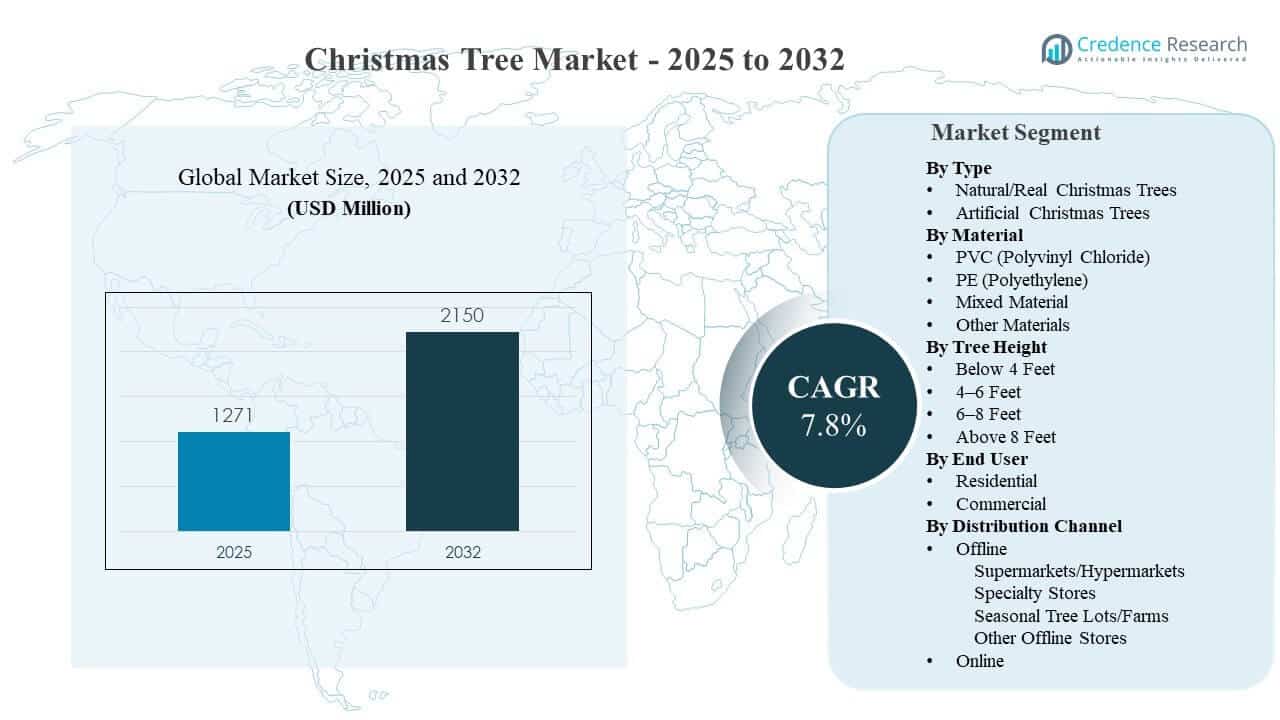
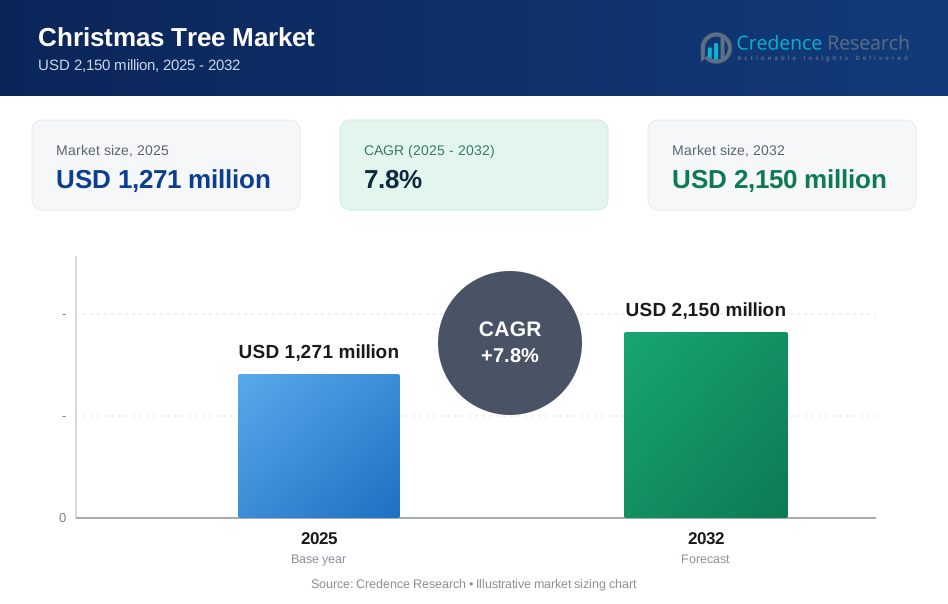
The global Christmas Tree Market size was estimated at USD 1,271 million in 2025 and is expected to reach USD 2,150 million by 2032, growing at a CAGR of 7.8% from 2025 to 2032. The global Christmas Tree Market growth is primarily driven by premiumization in holiday décor, where buyers increasingly prefer fuller silhouettes, realistic needle finishes, and integrated lighting that raise average selling prices and replacement cycles in mature markets. North America remains the largest regional demand center in 2025, supported by strong household participation and broad retail availability across offline and online channels.
| REPORT ATTRIBUTE | DETAILS |
|---|---|
| Historical Period | 2020-2024 |
| Base Year | 2025 |
| Forecast Period | 2026-2032 |
| Christmas Tree Market Size 2025 | USD 1,271 million |
| Christmas Tree Market, CAGR | 7.8% |
| Christmas Tree Market Size 2032 | USD 2,150 million |
Key Market Trends & Insights
- The Christmas Tree Market is projected to expand from USD 1,271 million in 2025 to USD 2,150 million by 2032, reflecting a 7.8% CAGR over 2025–2032.
- North America accounted for 37.7% of Christmas Tree Market revenue in 2025, supported by high seasonal décor penetration and dense retail distribution.
- Europe represented 26.8% of Christmas Tree Market revenue in 2025, driven by established holiday traditions and strong specialty and mass retail coverage.
- Artificial Christmas Trees led By Type with an altered 2025 share of 58.2%, supported by reuse economics, pre-lit formats, and convenience-led purchasing.
- Residential accounted for an altered 66.4% share in 2025, reflecting household-led demand and repeat purchases tied to décor refresh cycles.
Segment Analysis
Christmas Tree Market demand is shaped by a short selling season but a long planning cycle that favors differentiated product propositions. Christmas Tree Market buyers increasingly evaluate trees as a multi-year household asset, which supports the shift toward higher-quality artificial offerings with realistic aesthetics, integrated lighting, and faster assembly. Christmas Tree Market channel performance reflects the importance of last-mile availability and confidence in product quality, pushing retailers to optimize both in-store display and online content. Christmas Tree Market purchasing is also influenced by inflation sensitivity, leading to trade-offs between premium realism and value-focused bundles.
Christmas Tree Market segment performance also varies by housing format, available floor space, and the role of the tree as a centerpiece in seasonal decoration. Christmas Tree Market adoption of compact and tabletop trees expands use cases in apartments, offices, and secondary spaces, while larger premium trees remain relevant in suburban households and commercial venues. Christmas Tree Market materials selection continues to matter because realism, durability, and price tier are closely linked to needle design and structural quality. Christmas Tree Market growth is supported by omnichannel fulfillment that reduces purchase friction during peak weeks.
By Type Insights
Artificial Christmas Trees accounted for the largest share of 58.2% in 2025. Artificial Christmas Trees lead because reuse value over multiple seasons improves perceived total cost, particularly for mid-to-premium buyers. Artificial Christmas Trees also benefit from pre-lit and quick-setup features that reduce effort during a time-compressed seasonal window. Artificial Christmas Trees gain additional preference as retailers expand assortments with more realistic needle aesthetics and fuller silhouettes that replicate natural trees.
By Material Insights
PVC (Polyvinyl Chloride) accounted for the largest share of 46.5% in 2025. PVC remains widely used because PVC-based construction supports scale production, broad price coverage, and consistent availability across major retail formats. PVC-based products also serve entry and mid-tier demand where affordability and easy maintenance are primary purchase drivers. Mixed-material designs are increasing, but PVC continues to anchor volume across mainstream SKUs.
By Tree Height Insights
6–8 Feet accounted for the largest share of 44.1% in 2025. The 6–8 feet category leads because the height range fits common residential ceiling heights and living-room placement needs. The 6–8 feet category also aligns with typical ornament and lighting set sizes, improving compatibility with existing décor accessories. Commercial use often skews higher, but residential dominance keeps the mid-height band as the core volume driver.
By End User Insights
Residential accounted for the largest share of 66.4% in 2025. Residential leadership is supported by household tradition, repeat seasonal spending, and the tree’s role as a centerpiece for décor and gifting rituals. Residential demand also benefits from replacement cycles driven by style refresh, lighting upgrades, and convenience features. Residential buyers respond strongly to premium positioning that combines realism, durability, and time-saving setup.
By Distribution Channel Insights
Offline accounted for the largest share of 64.9% in 2025. Offline leads because buyers prefer physical inspection for fullness, height accuracy, and perceived quality, particularly for premium trees. Offline retail also supports immediate fulfillment during peak seasonal weeks when delivery lead times can be a barrier. Offline channels remain important for real-tree purchasing through farms and seasonal lots, sustaining volume even as online penetration rises.
Christmas Tree Market Drivers
Premiumization of holiday décor and willingness to pay for realism
Christmas Tree Market growth is supported by premiumization across artificial tree offerings, where buyers increasingly prioritize realistic needle finishes, fuller branch density, and natural-looking silhouettes. Christmas Tree Market premium tiers also benefit from integrated lighting and improved build quality that reduce setup time and maintenance effort. Christmas Tree Market brands differentiate through design storytelling and curated collections that mirror interior décor trends. Christmas Tree Market pricing power strengthens when product features translate into multi-season reuse and improved display outcomes.
Convenience-led adoption of pre-lit and quick-assembly formats
Christmas Tree Market demand is driven by convenience features that reduce time and complexity during the seasonal setup window. Christmas Tree Market pre-lit designs address a major pain point by eliminating separate lighting installation and reducing tangling and replacement issues. Christmas Tree Market quick-connect poles, hinged branches, and guided assembly steps improve accessibility for a wider range of households. Christmas Tree Market adoption increases when retailers communicate setup simplicity through packaging, in-store demos, and online video content.
Omnichannel distribution expansion and improved seasonal availability
Christmas Tree Market performance benefits from omnichannel strategies that combine showroom-style offline displays with online assortment depth. Christmas Tree Market buyers frequently research online even when purchase occurs offline, making content quality and review volume influential. Christmas Tree Market online delivery and store pickup options improve access during peak demand weeks and reduce stockout risk for shoppers. Christmas Tree Market retailers that synchronize inventory visibility and delivery windows can protect conversion rates during the short selling season.
- For instance, The Home Depot promotes Christmas decorations through both Buy Online Pick Up in Store and Same-Day Delivery options, showing how retailer-specific fulfillment infrastructure is used to improve holiday availability across digital and physical channels.
Commercial seasonal installations and experiential retail spending
Christmas Tree Market growth is supported by commercial demand from hospitality, retail, corporate offices, and public venues that use trees as seasonal experience anchors. Christmas Tree Market commercial buyers often require larger formats, durable construction, and coordinated décor sets that increase average order values. Christmas Tree Market demand rises when malls and experiential retailers invest in seasonal footfall drivers and themed installations. Christmas Tree Market suppliers benefit when commercial programs include recurring annual refresh budgets and service support.
- For instance, Bronner’s highlights commercial-scale Christmas tree capability through installations such as a 40-foot musical Christmas tree in Frankenmuth, while also noting that its LED tree offerings can reduce electrical usage to 1/10 of that required by regular mini lights, illustrating how large-format display scale and energy-efficiency metrics support commercial adoption.
Christmas Tree Market Challenges
Christmas Tree Market faces supply-side and cost challenges linked to raw material pricing, freight volatility, and seasonal inventory planning. Christmas Tree Market brands must commit inventory ahead of demand signals, creating forecasting risk and potential markdown exposure if seasonality shifts. Christmas Tree Market also sees margin pressure when promotional intensity increases in late season, particularly for mass-market artificial trees. Christmas Tree Market quality consistency is another challenge because lighting failures and assembly issues can harm reviews and elevate returns.
- For instance, National Tree Company’s 7.5 ft. Pre-Lit Downswept Douglas Fir is built with 1,867 branch tips and 750 clear lights that are designed to remain lit even if a bulb burns out, showing how brands use stay-lit lighting systems and hinged construction to reduce failure-related complaints and setup friction.
Christmas Tree Market also experiences perception and sustainability challenges that influence buyer decisions, especially for plastic-based artificial trees. Christmas Tree Market messaging must address durability, recyclability, and material sourcing to maintain trust among sustainability-minded consumers. Christmas Tree Market real-tree supply can be constrained by farm capacity and multi-year growing cycles, limiting flexibility in short-term demand spikes. Christmas Tree Market participants must balance affordability with feature upgrades without eroding value propositions.
Market Trends and Opportunities
Christmas Tree Market trends include product innovation around lighting control, modular assembly, and improved realism that supports premium price tiers. Christmas Tree Market opportunities expand when smart lighting and app-based control features improve personalization and repeat usage across seasons. Christmas Tree Market brands can increase differentiation through curated themes and bundles that combine trees with coordinated ornaments, toppers, and skirts. Christmas Tree Market also benefits from compact formats that fit apartments, secondary rooms, and small commercial spaces.
- For instance, Balsam Hill supports this premium positioning with pre-lit trees available in heights up to 14 feet, and its larger 14-foot models can feature upwards of 11,650 lights for fully coordinated high-impact displays.
Christmas Tree Market opportunities also include material innovation that lowers perceived environmental impact while maintaining realism and durability. Christmas Tree Market premium lines increasingly use advanced needle designs and mixed constructions to elevate aesthetic quality. Christmas Tree Market sellers can grow online conversion through better product visualization, accurate measurements, and clearer setup demonstrations. Christmas Tree Market demand can also rise through B2B programs serving offices, hotels, and retail chains with standardized seasonal décor packages.
Regional Insights
North America
Christmas Tree Market in North America held an estimated 37.7% share in 2025, supported by strong household participation and deep retail penetration. Christmas Tree Market demand benefits from wide assortments across mass retail, specialty décor brands, and seasonal lots for real trees. Christmas Tree Market premium artificial offerings perform well where convenience and reuse value are prioritized. Christmas Tree Market competition is intense in the pre-lit premium segment, where brand differentiation is driven by realism, lighting quality, and warranty support.
Europe
Christmas Tree Market in Europe accounted for an estimated 26.8% share in 2025, backed by established holiday traditions across multiple countries. Christmas Tree Market demand spans both real and artificial formats, with strong specialty retail presence and seasonal merchandising in mass channels. Christmas Tree Market premiumization is visible through design-focused aesthetics that align with interior décor themes. Christmas Tree Market growth is supported by omnichannel purchasing behavior and strong last-mile logistics in major markets.
Asia Pacific
Christmas Tree Market in Asia Pacific represented an estimated 22.4% share in 2025, reflecting expanding urban consumption and growing adoption of seasonal décor in modern retail. Christmas Tree Market online channels play an important role in assortment access and price comparison, supporting wider participation beyond major metros. Christmas Tree Market demand is strongest in higher-income urban clusters and commercial venues that use seasonal installations. Christmas Tree Market supply ecosystem advantages also support availability and pricing competitiveness in artificial trees.
Latin America
Christmas Tree Market in Latin America captured an estimated 8.1% share in 2025, with demand concentrated in large urban centers and modern retail corridors. Christmas Tree Market growth is influenced by household income sensitivity, leading to strong demand for value-focused artificial trees and smaller height bands. Christmas Tree Market commercial installations in malls and hospitality can lift seasonal volume in key cities. Christmas Tree Market expansion opportunities exist through improved assortment availability and promotional financing strategies.
Middle East & Africa
Christmas Tree Market in Middle East & Africa accounted for an estimated 5.0% share in 2025, driven by pockets of demand in expat communities and hospitality-driven commercial décor. Christmas Tree Market sales are supported by premium installations in hotels, malls, and event venues that prioritize visual impact. Christmas Tree Market household adoption varies significantly by country and retail structure. Christmas Tree Market growth can improve through stronger distribution partnerships and curated seasonal décor programs for commercial buyers.
Competitive Landscape
Christmas Tree Market competition spans premium direct-to-consumer brands, large-scale manufacturers, mass retailers, and regional farm networks serving real-tree demand. Christmas Tree Market participants differentiate through realism, lighting systems, ease-of-setup engineering, merchandising strength, and seasonal inventory readiness. Christmas Tree Market premium brands emphasize design quality and customer experience, while value-led suppliers compete on price, availability, and broad height coverage. Christmas Tree Market also includes real-tree farms and seasonal lots that compete on freshness, local tradition, and experiential purchasing.
Balsam Hill positions within the Christmas Tree Market as a premium artificial tree specialist focused on realistic needle aesthetics, curated collections, and integrated lighting packages that support higher average selling prices. Balsam Hill competes through differentiated design execution and brand-led storytelling that elevates perceived quality relative to mainstream mass-market alternatives. Balsam Hill also aligns product development to evolving consumer expectations around materials and sustainability narratives. Balsam Hill’s premium approach supports stronger differentiation in the segment where buyers prioritize realism and multi-season durability.
The industry research and growth report includes detailed analyses of the competitive landscape of the market and information about key companies, including:
- Balsam Hill
- National Tree Company
- Puleo International
- Treetopia
- Vickerman
- King of Christmas
- Crystal Valley Decorating
- Hallmark
- Fraser Fir Farms
- Christmas Tree Farms
- Pine Valley Farms
- Evergreen Farms
- Holly Hill Farms
- Blue Spruce Christmas Trees
- Noble Fir Christmas Trees
Qualitative and quantitative analysis of companies has been conducted to help clients understand the wider business environment as well as the strengths and weaknesses of key industry players. Data is qualitatively analyzed to categorize companies as pure play, category-focused, industry-focused, and diversified; it is quantitatively analyzed to categorize companies as dominant, leading, strong, tentative, and weak.
Recent Developments
- In June 2025, Balsam Brands, the parent company of Balsam Hill, entered a brand licensing partnership with GE Holiday Lighting, becoming the official global brand licensing partner for GE holiday lighting starting with the 2026 season. The partnership combines Balsam Brands’ strength in premium artificial Christmas trees and décor with GE’s long-standing lighting expertise.
- In September 2025, Balsam Hill announced a sustainability-focused product development initiative aimed at creating a more sustainable Christmas tree offering. The company said these advances represented a major shift for the Christmas tree industry, reinforcing its push toward more reusable and environmentally improved artificial tree products.
- In October 2025, Balsam Hill partnered with Braskem to introduce what the companies described as the world’s first Christmas trees made with plant-based plastic. For the 2025 holiday season, Balsam Hill also began using plant-based plastic in selected existing tree models, including the Alpine Balsam Fir and the Calistoga Ornament Tree.
Report Scope
| Report Attribute | Details |
| Market size value in 2025 | USD 1271 million |
| Revenue forecast in 2032 | USD 2150 million |
| Growth rate (CAGR) | 7.8% (2025–2032) |
| Base year | 2025 |
| Forecast period | 2026-2032 |
| Quantitative units | USD million |
| Segments covered | By Type; By Material; By Tree Height; By End User; By Distribution Channel |
| Regional scope | North America, Europe, Asia Pacific, Latin America, Middle East & Africa |
| Key companies profiled | Balsam Hill; National Tree Company; Puleo International; Treetopia; Vickerman; King of Christmas; Crystal Valley Decorating; Hallmark; Fraser Fir Farms; Christmas Tree Farms; Pine Valley Farms; Evergreen Farms; Holly Hill Farms; Blue Spruce Christmas Trees; Noble Fir Christmas Trees |
| No.of Pages | 328 |
By Segmentation
By Type
- Natural/Real Christmas Trees
- Artificial Christmas Trees
By Material
- PVC (Polyvinyl Chloride)
- PE (Polyethylene)
- Mixed Material
- Other Materials
By Tree Height
- Below 4 Feet
- 4–6 Feet
- 6–8 Feet
- Above 8 Feet
By End User
- Residential
- Commercial
By Distribution Channel
- Offline
- Supermarkets/Hypermarkets
- Specialty Stores
- Seasonal Tree Lots/Farms
- Other Offline Stores
- Online
By Region
- North America
- U.S.
- Canada
- Mexico
- Europe
- Germany
- France
- U.K.
- Italy
- Spain
- Rest of Europe
- Asia Pacific
- China
- Japan
- India
- South Korea
- South-east Asia
- Rest of Asia Pacific
- Latin America
- Brazil
- Argentina
- Rest of Latin America
- Middle East & Africa
- GCC Countries
- South Africa
- Rest of the Middle East and Africa
Request a Free Sample
Fill in your details and we'll send you a free sample report.
- Sample data tables & charts
- Research methodology
Need a Custom Version of This Report?
Tailor the scope, geography, or segments to your exact requirements.
- Custom geography or segment scope
- Direct access to our analyst team
Frequently Asked Questions
What is the market size and forecast for the Christmas Tree Market?
What is the CAGR of the Christmas Tree Market?
Which segment is the largest in the Christmas Tree Market?
What factors are driving growth in the Christmas Tree Market?
Who are the leading companies in the Christmas Tree Market?
Which region leads the Christmas Tree Market?
Table of Content
Chapter 1. Report Introduction
- 1.1 Report Description & Purpose
- 1.1.1 Report Title & Market Definition
- 1.1.2 Unique Selling Propositions (USP) & Key Differentiators
- 1.1.3 Value Proposition for Stakeholders
- 1.2 Research Objectives
- 1.2.1 Market Sizing Objectives (Volume & Revenue)
- 1.2.2 Segmentation Objectives
- 1.2.3 Competitive Intelligence Objectives
- 1.2.4 Forecast & Scenario Objectives
- 1.3 Report Scope
- 1.3.1 Christmas Tree Scope – Types & Subtypes Covered
- 1.3.2 Geographic Scope – Regions & Countries Covered
- 1.3.3 Historical Period, Base Year & Forecast Period (2025; forecast to 2032)
- 1.3.4 Inclusions & Exclusions
- 1.4 HS Code & Classification Framework
- 1.5 Currency, Units & Pricing Basis
- 1.6 Target Stakeholders
- 1.7 Limitations & Assumptions
Chapter 2. Executive Summary
- 2.1 Global Christmas Tree Market Snapshot
- 2.1.1 Market Size – Historical (2025) & Forecast (2025-2032) (2025: USD 1,271 million → 2032: USD 2,150 million)
- 2.1.2 Volume & Revenue – Global Totals
- 2.1.3 Key Market Highlights – Top Five Facts
- 2.2 Christmas Tree Market Segmentation Snapshot
- 2.2.1 Market Split by Region – 2025 vs. 2032
- 2.3 Competitive Snapshot
- 2.3.1 Top 10 Players by Revenue Share – 2025
- 2.3.2 Top 10 Players by Volume Share – 2025
- 2.3.3 Recent Strategic Developments (18-Month Summary)
- 2.4 Key Investment Highlights & Strategic Conclusions
Chapter 3. Christmas Tree Market Dynamics & Industry Analysis
- 3.1 Market Overview & Context
- 3.1.1 Christmas Tree Market Position in the Broader Automotive Value Chain
- 3.1.2 OEM vs. Replacement Market Dynamics
- 3.1.3 Market Maturity & Development Stage by Region
- 3.2 Christmas Tree Market Drivers
- 3.3 Christmas Tree Market Restraints & Challenges
- 3.4 Christmas Tree Market Opportunities
- 3.5 Porter's Five Forces Analysis
- 3.5.1 Threat of New Entrants
- 3.5.2 Bargaining Power of Suppliers
- 3.5.3 Bargaining Power of Buyers
- 3.5.4 Threat of Substitutes
- 3.5.5 Competitive Rivalry – Intensity Assessment
- 3.6 Christmas Tree Value Chain Analysis
- 3.6.1 Upstream – Raw Material/Input Suppliers
- 3.6.1.1 Raw Material/Input 1
- 3.6.1.2 Raw Material/Input 2
- 3.6.1.3 Raw Material/Input 3
- 3.6.2 Midstream – Production/Manufacturing/Service Delivery
- 3.6.2.1 Production/Process Overview
- 3.6.2.2 Key Facility Locations & Capacity by Manufacturer
- 3.6.3 Downstream – Distribution & End Consumer
- 3.6.3.1 Primary Channel – B2B/OEM
- 3.6.3.2 Secondary Channels – Dealer, Retail, Online, Direct
- 3.6.4 Value Chain Profitability Analysis
- 3.6.1 Upstream – Raw Material/Input Suppliers
- 3.7 PESTEL Analysis
- 3.7.1 Political Factors
- 3.7.2 Economic Factors
- 3.7.3 Social Factors
- 3.7.4 Technological Factors
- 3.7.5 Environmental Factors
- 3.7.6 Legal Factors
- 3.8 Christmas Tree Supply Chain Analysis
- 3.8.1 Raw Material/Input Supply Risk Assessment
- 3.8.2 Manufacturing Concentration Risk (Geographic Exposure)
- 3.8.3 Trade Disruption Impact Analysis
- 3.9 Regulatory & Policy Landscape
Note: The regulatory and policy landscape section covers regulations based on their applicability to the market, Christmas Tree category, geography, and scope of the study. Only regulatory frameworks with a material impact on operations, compliance, trade, sustainability, or market access are analyzed in detail.
Chapter 4. Key Investment Pockets & Opportunity Analysis
- 4.1 Christmas Tree Market Attractiveness Analysis
- 4.1.1 By Region – Investment Attractiveness Matrix (Volume × CAGR)
- 4.2 Absolute Revenue Growth Opportunity
- 4.2.1 By Region – Absolute USD Growth Through 2032
- 4.3 Incremental Volume Opportunity
- 4.3.1 By Region – Incremental Volume Through 2032
- 4.3.2 Segment – Incremental Volume
- 4.4 Emerging Submarket Opportunity Deep Dive (Subject to Applicability)
- 4.5 Emerging Market Opportunity Scorecards
- 4.5.1 United States
- 4.5.2 Europe
- 4.5.3 Asia
- 4.5.4 Middle East & Africa
Note: Emerging Market Opportunity Scorecards will be included based on relevance and strategic importance. Regions listed are indicative and may vary depending on data availability and market dynamics.
Chapter 5. Christmas Tree Import-Export Analysis & Trade Flows
- 5.1 Global Trade Overview
- 5.1.1 Global Export Value by Country (2025)
- 5.1.2 Global Export Volume by Country (2025)
- 5.1.3 Global Import Value by Country (2025)
- 5.1.4 Global Import Volume by Country (2025)
- 5.1.5 Net Trade Balance by Country (2025)
- 5.2 Export Analysis – Segment
- 5.2.1 Type 1 (HS Code)
- 5.2.2 Type 2 (HS Code)
- 5.2.3 Type 3 (HS Code)
- 5.2.4 Type 4 (HS Code)
- 5.2.5 Type 5 (HS Code)
- 5.3 Import Analysis – Segment
- 5.3.1 Type 1 (HS Code)
- 5.3.2 Type 2 (HS Code)
- 5.3.3 Type 3 (HS Code)
- 5.3.4 Type 4 (HS Code)
- 5.3.5 Type 5 (HS Code)
- 5.4 Average Unit Trade Prices
- 5.4.1 Average Export Price – Segment & Country
- 5.4.2 Average Import Price – Segment & Source Country
- 5.4.3 Price Trends (2025)
- 5.5 Key Trade Route Analysis
- 5.5.1 Trade Route 1
- 5.5.2 Trade Route 2
- 5.5.3 Trade Route 3
- 5.5.4 Trade Route 4
- 5.5.5 Trade Route 5
- 5.6 Trade Policy Impact Assessment
- 5.6.1 US Anti-Dumping & Section 301 Tariffs
- 5.6.2 EU Customs Union Impact
- 5.6.3 Major Free Trade Agreements
- 5.6.4 USMCA Rules of Origin
Note: Trade policy analysis will be included only where relevant to the Christmas Tree market.
Chapter 6. Competitive Landscape & Company Benchmarking
- 6.1 Christmas Tree Market Concentration & Structure
- 6.1.1 Herfindahl-Hirschman Index (HHI) – vs. 2025
- 6.1.2 Tier 1, Tier 2 & Tier 3 Market Structure
- 6.1.3 Global, Regional & Local Player Dynamics
- 6.2 Christmas Tree Market Share Analysis – 2025
- 6.2.1 Global Revenue Share by Company
- 6.2.2 Global Volume Share by Company
- 6.2.3 Regional Revenue Share
- 6.2.4 Market Share Evolution ( vs. 2025)
- 6.2.5 OEM Segment Share by Company
- 6.2.6 Replacement Segment Share by Company
- 6.3 Production/Delivery Capacity & Facility Analysis
- 6.3.1 Global Installed Capacity
- 6.3.2 Capacity Utilization Rates
- 6.3.3 Production/Output Volume
- 6.3.4 Facility Locations & Capacity Map
- 6.3.5 Planned Capacity Additions
- 6.4 Christmas Tree Competitive Benchmarking Matrix
- 6.4.1 Revenue, Volume, CAGR & Profitability Comparison
- 6.4.2 Channel Revenue Mix
- 6.4.3 Geographic Revenue Exposure
- 6.4.4 R&D Intensity
- 6.4.5 Sustainability Maturity
- 6.5 Strategic Developments in Christmas Tree (Last 24 Months)
- 6.5.1 Mergers, Acquisitions & Divestments
- 6.5.2 New Christmas Tree Launches
- 6.5.3 Facility Expansions
- 6.5.4 Strategic Alliances, Joint Ventures & Partnerships
- 6.5.5 Distribution Expansion & Market Entry
- 6.5.6 Sustainability & ESG Initiatives
- 6.6 Competitive Strategy Mapping
- 6.6.1 Leader, Challenger, Follower & Niche Classification
- 6.6.2 Pricing Strategy Comparison
- 6.6.3 Channel Strategy Matrix
Note: Strategic developments are included based on their materiality and the availability of reliable information.
Chapter 7. Global Christmas Tree Market – By Distribution Channel
- 7.1 Segment Overview
- 7.1.1 Volume & Revenue Split by Channel (2025 & 2032)
- 7.1.2 Channel Mix Evolution (2025-2032)
Chapter 8. Regional Market Analysis – Global Overview
- 8.1 Global Regional Overview
- 8.1.1 Regional Volume Share
- 8.1.2 Regional Revenue Share
- 8.1.3 Regional Volume by Region
- 8.1.4 Regional Revenue by Region
- 8.1.5 Regional Forecast Through 2032
- 8.2 Cross-Regional Segment Analysis
- 8.2.1 By Distribution Channel
- 8.2.2 By Brand/Price Tier
Chapter 9. North America Christmas Tree Market
- 9.1 United States
- 9.2 Canada
- 9.3 Mexico
Chapter 10. Europe Christmas Tree Market
- 10.1 Germany
- 10.2 France
- 10.3 Italy
- 10.4 United Kingdom
- 10.5 Spain
- 10.6 Poland
- 10.7 Russia
- 10.8 Netherlands
- 10.9 Belgium
- 10.10 Sweden
- 10.11 Denmark
- 10.12 Norway
- 10.13 Rest of Europe
Chapter 11. Asia Pacific Christmas Tree Market
- 11.1 China
- 11.2 India
- 11.3 Japan
- 11.4 South Korea
- 11.5 Thailand
- 11.6 Indonesia
- 11.7 Vietnam
- 11.8 Malaysia
- 11.9 Australia
- 11.10 Rest of Asia Pacific
Chapter 12. Latin America Christmas Tree Market
- 12.1 Brazil
- 12.2 Argentina
- 12.3 Colombia
- 12.4 Chile
- 12.5 Rest of Latin America
Chapter 13. Middle East Christmas Tree Market
- 13.1 Saudi Arabia
- 13.2 United Arab Emirates
- 13.3 Turkey
- 13.4 Israel
- 13.5 Iran
- 13.6 Rest of the Middle East
Chapter 14. Africa Christmas Tree Market
- 14.1 South Africa
- 14.2 Egypt
- 14.3 Nigeria
- 14.4 Morocco
- 14.5 Rest of Africa
Chapter 15. Christmas Tree Company Profiles
- 15.1 [Company 01]
- 15.1.1 Company Overview
- 15.1.2 Key Management Personnel
- 15.1.3 Products & Services Portfolio
- 15.1.4 Financial Performance
- 15.1.5 Key Market Focus & Geographic Presence
- 15.1.6 Recent Developments & Strategic Initiatives
Note: The company profile list is preliminary and may change based on research findings, market developments, data availability, and client requirements.
Chapter 16. Appendices
- Appendix A – List of Abbreviations & Acronyms
- Appendix B – Industry Classification Code Reference – Full Series
- Appendix C – Production & Capacity Data Tables
- Appendix D – End-Use & Demand Base Tables
- Appendix E – Consumption & Replacement Rate Assumptions
- Appendix F – ASP Reference Tables
- Appendix G – Manufacturing & Facility Database
- Appendix H – Import-Export Data Tables
- Appendix I – Regulatory Summary Tables
- Appendix J – Primary Research Participant List (Anonymized)
- Appendix K – Primary Research Questionnaire Framework
- Appendix L – Data Sources & Bibliography
- Appendix M – Market Size Divergence & Source Comparison
Chapter 17. Research Methodology
- 17.1 Research Framework & Philosophy
- 17.2 Secondary Research – Sources, Hierarchy & Data Extraction
- 17.3 Data Modeling – Bottom-Up & Top-Down Market Sizing
- 17.4 Primary Research – Stakeholder Framework, LOI & Sample Sizes
- 17.5 Forecast Methodology – Regression, Scenario & Sensitivity Analysis
- 17.6 Quality Control – Four-Layer Validation Framework
- 17.7 Limitations & Standard Assumptions
- 17.8 Disclaimer
