
Commercial Greenhouse Market Overview:
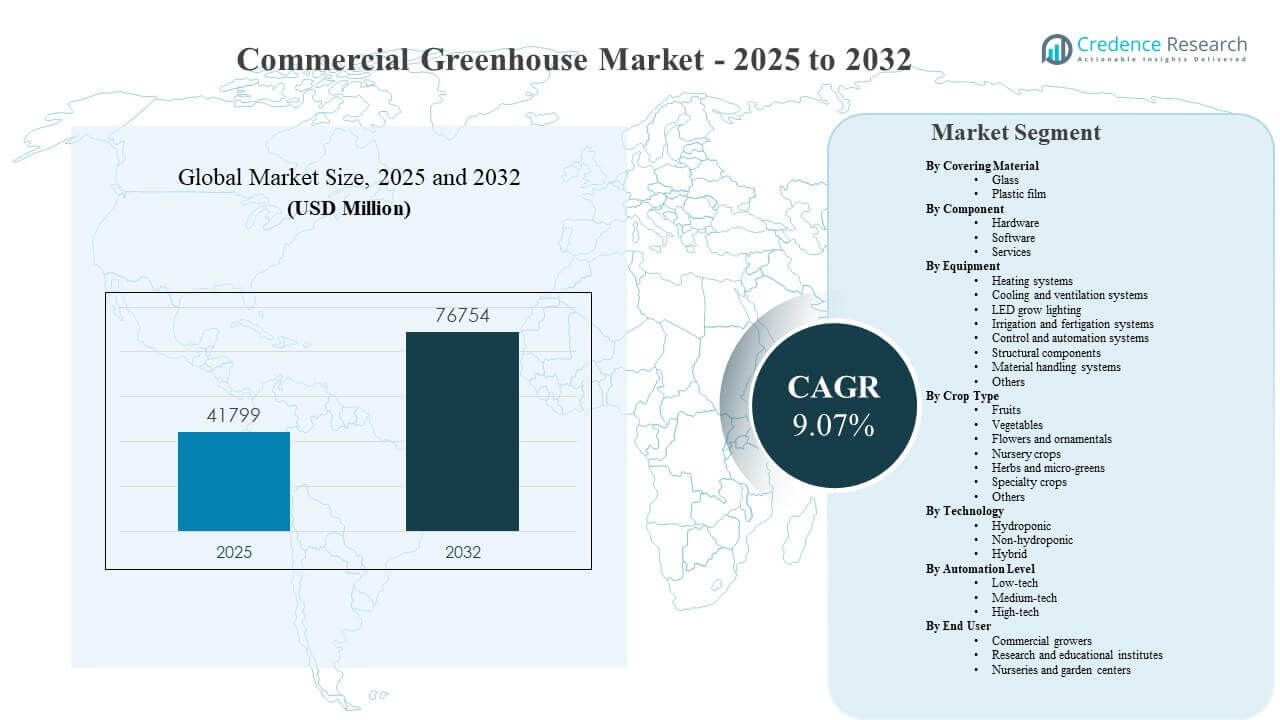
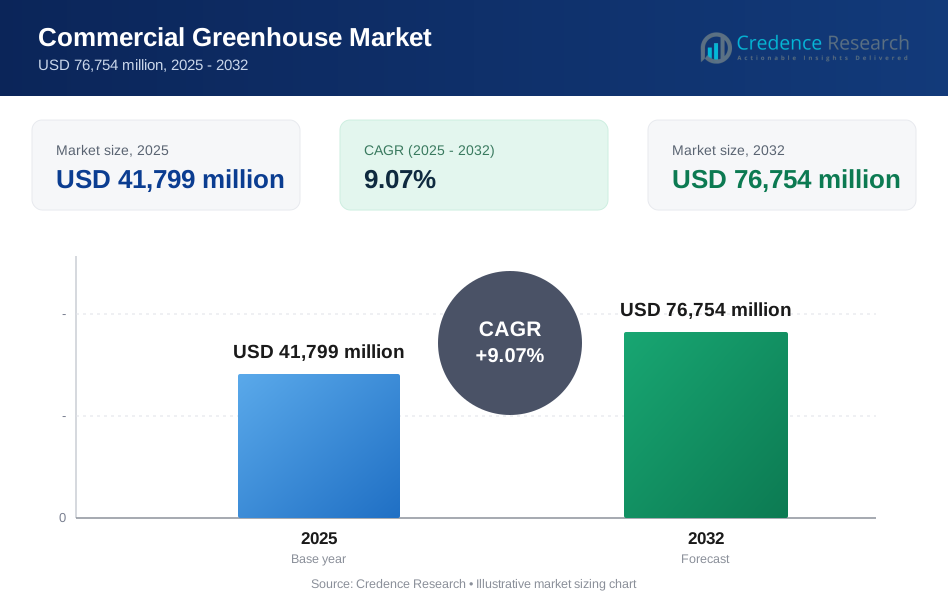
The global Commercial Greenhouse Market size was estimated at USD 41,799 million in 2025 and is expected to reach USD 76,754 million by 2032, growing at a CAGR of 9.07% from 2025 to 2032. Expansion of protected cultivation is accelerating as growers seek more reliable yields, better climate control, lower weather-related crop losses, and improved year-round production across food and ornamental crops. Commercial greenhouse investment is also gaining momentum as automation, precision irrigation, and energy-efficient lighting improve operating performance in both advanced and emerging agricultural markets.
| REPORT ATTRIBUTE | DETAILS |
|---|---|
| Historical Period | 2020-2024 |
| Base Year | 2025 |
| Forecast Period | 2026-2032 |
| Commercial Greenhouse Market Size 2025 | USD 41,799 million |
| Commercial Greenhouse Market , CAGR | 9.07% |
| Commercial Greenhouse Market Size 2032 | USD 76,754 million |
Key Market Trends & Insights
- Asia Pacific accounted for 64.2% of the global Commercial Greenhouse Market in 2025, making the region the clear center of large-scale protected cultivation adoption.
- Plastic film led the covering material segment with a 57.4% share in 2025, reflecting strong demand for scalable and cost-efficient greenhouse construction.
- Hardware captured 54.8% of the component segment in 2025, supported by continued spending on physical climate, irrigation, and lighting infrastructure.
- LED grow lighting represented 26.7% of the equipment segment in 2025, showing the rising role of energy-efficient crop illumination systems in controlled-environment agriculture.
- Fruits and vegetables held the largest crop-type share at 49.3% in 2025, driven by high-volume demand for consistent produce supply across retail and foodservice channels.
Segment Analysis
The Commercial Greenhouse Market is evolving from basic protected cultivation toward more integrated controlled-environment production systems. Commercial operators are investing in greenhouse formats that improve yield predictability, reduce exposure to adverse weather, and support more stable supply planning across fresh produce and ornamental categories. Market development is also being shaped by stronger interest in water efficiency, labor productivity, and energy management, especially in regions facing climate variability and rising input costs. Greenhouse design decisions increasingly reflect a balance between installation cost, crop value, and the degree of environmental control required.
Technology adoption across the Commercial Greenhouse Market is becoming more selective and application-driven. Large operators are prioritizing lighting, irrigation, fertigation, cooling, and automation systems that directly influence crop output and operating efficiency. Demand is moving beyond simple structure deployment toward system optimization, with more attention on sensors, greenhouse software, and integrated control platforms. Crop mix, regional climate, and target yield performance continue to determine how greenhouse owners allocate capital across materials, equipment, and digital tools.
Commercial greenhouse demand also reflects differences in buyer profile and production objective. Commercial growers focus on throughput, consistency, and profitability, whereas nurseries and garden centers emphasize propagation quality and plant health. Research and educational institutes support demand for controlled environments that enable breeding, testing, and agronomic experimentation. These varied end uses create demand for greenhouse systems ranging from low-tech cost-efficient structures to highly automated, data-enabled facilities.
Covering Material Insights
Plastic film accounted for the largest share of 57.4% in 2025. Commercial greenhouse operators favor plastic film because the material supports lower upfront construction costs and faster expansion across broad cultivation areas. The format is particularly attractive in price-sensitive markets where growers prioritize scalable protected farming with manageable capital requirements. Plastic film also offers flexibility for varied crop programs and regional climate needs. Glass remains strategically important in premium and high-tech projects where durability, light transmission, and long-term operational performance carry greater weight.
Component Insights
Hardware accounted for the largest share of 54.8% in 2025. Commercial greenhouse projects continue to depend heavily on physical infrastructure such as lighting, irrigation, climate control, and structural systems that directly affect crop growth conditions. Buyers typically allocate the largest share of capital to these assets because greenhouse performance is closely tied to environmental reliability and equipment quality. Hardware leadership also reflects replacement and upgrade demand in mature greenhouse clusters. Software and services are expanding as operators connect greenhouse assets to more centralized monitoring, crop planning, and maintenance programs.
Equipment Insights
LED grow lighting accounted for the largest share of 26.7% in 2025. The segment leads because commercial growers increasingly use LED systems to improve crop uniformity, extend growing cycles, and reduce energy consumption compared with older lighting technologies. Adoption is especially strong in high-value crops and regions where natural light conditions require supplementation. LED systems also support more precise crop steering in controlled environments. Control and automation systems are gaining traction quickly as greenhouse operators pursue integrated management of climate, lighting, irrigation, and labor workflows.
Crop Type Insights
Fruits and vegetables accounted for the largest share of 49.3% in 2025. The segment leads because greenhouse cultivation is widely used to improve the availability, consistency, and quality of staple produce categories with steady retail demand. Tomatoes, peppers, cucumbers, leafy greens, and similar crops benefit from the controlled growing conditions that support better output planning and lower weather-related disruption. Commercial growers also prefer these crops because greenhouse investment can be tied directly to recurring food demand. Specialty crops, herbs, and ornamentals remain attractive in operations focused on premium pricing and differentiated market positioning.
Technology Insights
Hybrid systems held the leading position in the Commercial Greenhouse Market in 2025. Hybrid greenhouse approaches are gaining acceptance because they allow operators to combine conventional infrastructure with more advanced cultivation and monitoring features. This balance supports a more flexible operating model across varying crop types, greenhouse sizes, and budget levels. Hydroponic systems remain important in intensive cultivation environments where water efficiency and nutrient precision are critical. Non-hydroponic formats continue to appeal to growers seeking simpler deployment and lower operational complexity.
Automation Level Insights
High-tech greenhouse systems represented the leading automation trend in the Commercial Greenhouse Market in 2025. Demand is moving toward more advanced greenhouse environments because operators increasingly need better climate control, labor efficiency, and crop monitoring capabilities. High-tech formats are particularly relevant for larger operations managing energy use, fertigation accuracy, and production consistency at scale. Medium-tech systems remain important where buyers seek a practical balance between cost and automation. Low-tech systems continue to retain relevance in cost-sensitive regions and in applications where basic protective cultivation is sufficient.
End User Insights
Nurseries and garden centers accounted for the largest share of the Commercial Greenhouse Market in 2025. The segment benefits from strong need for controlled propagation, plant protection, and quality management across ornamentals, young plants, shrubs, and related horticultural products. Greenhouse infrastructure helps these buyers maintain visual quality, improve growth consistency, and reduce weather-related losses during sensitive cultivation stages. Commercial growers also remain a major customer group because of increasing protected production of fruits and vegetables. Research and educational institutes are expanding greenhouse usage as controlled environments become more important for crop trials, breeding, and academic research.
Commercial Greenhouse Market Drivers
Rising demand for year-round and climate-resilient crop production
Commercial greenhouse adoption is being accelerated by the need for more stable and climate-resilient agricultural production. Open-field farming remains vulnerable to erratic rainfall, heat stress, cold spells, and pest pressure, which increases yield uncertainty across many crop categories. Greenhouse systems offer growers a more controlled production environment that supports predictable harvest cycles and better planning for supply contracts. This reliability is becoming more valuable for food retailers, distributors, and commercial farms that need consistent quality and volume throughout the year.
- For instance, BrightFarms said its three new 8-acre greenhouse hubs would increase its growing capability to 150 million pounds of leafy greens annually, and the company stated that KUBO’s Ultra-Clima technology helps maintain optimal climate conditions 365 days a year regardless of geography or outside weather.
Greater focus on water, fertilizer, and input-use efficiency
Resource efficiency has become a central growth driver for the Commercial Greenhouse Market. Greenhouse cultivation allows tighter control over irrigation, fertigation, and crop nutrition, which can reduce waste and improve output per square meter. In regions facing water stress or rising fertilizer costs, these advantages strengthen the case for protected cultivation. Commercial operators are also using precision systems to optimize plant growth without excessive input application. This improves both economic performance and sustainability positioning for greenhouse-based production.
Technology upgrades are improving operating performance
The market is benefiting from steady improvements in greenhouse equipment and digital infrastructure. LED lighting, sensors, environmental controls, fertigation systems, and software platforms are making greenhouse operations more precise and more manageable at scale. These systems help growers fine-tune temperature, humidity, light intensity, and nutrient delivery according to crop requirements. Better system integration also supports labor productivity and reduces manual intervention in repetitive processes. As technology becomes more commercially viable, investment in greenhouse modernization continues to broaden.
- For instance, Signify said its Philips GreenPower LED toplighting compact, used in AppHarvest’s 25-hectare greenhouse, is 40% more energy efficient than traditional greenhouse lighting, delivers 1,800 µmol/s of light output, and reaches efficacy of up to 3.0 µmol/J.
Expansion of high-value horticulture and protected cultivation models
Commercial greenhouse demand is also being supported by the expansion of high-value horticulture. Fruits, vegetables, herbs, nursery crops, and ornamentals are increasingly being cultivated in protected systems to achieve better visual quality, shelf life, and output consistency. This is especially important in premium fresh produce and ornamental plant markets where quality variation directly affects pricing and buyer acceptance. Greenhouse cultivation also helps producers enter supply windows that would be difficult to serve through open-field production alone. These advantages are strengthening the long-term business case for commercial greenhouse investment.
Commercial Greenhouse Market Challenges
Commercial greenhouse projects require meaningful upfront investment, which can limit adoption among smaller growers and in cost-sensitive markets. Expenditure on structures, lighting, climate systems, irrigation equipment, and automation platforms can be substantial, particularly in high-tech greenhouse formats. Financing access, return visibility, and operating scale often determine whether projects move forward. Cost inflation in construction materials and energy systems can further complicate investment planning. These factors can slow deployment even where the long-term productivity case is strong.
- For instance, Better Future Farms’ greenhouse in Virginia covers 5.5 hectares, is fully automated from seeding to packing, and produces more than 3,500 kilograms of fresh lettuce per day, showing how large commercial projects often require advanced infrastructure and automation at a scale that can be difficult for smaller growers to finance.
Operational complexity is another important challenge for the Commercial Greenhouse Market. Greenhouse performance depends on effective management of temperature, humidity, water, nutrients, pest control, and crop cycles, which requires technical skill and process discipline. Labor shortages and gaps in specialized agronomic knowledge can reduce the value realized from advanced greenhouse infrastructure. Energy use also remains a challenge in some climates where heating, cooling, or supplemental lighting is intensive. Market participants must therefore balance productivity gains against operational demands and cost exposure.
Market Trends and Opportunities
The market is seeing a strong shift toward smarter and more connected greenhouse operations. Growers are increasingly interested in integrated systems that link sensors, climate controls, lighting schedules, and irrigation management into one operating environment. This trend creates opportunities for software providers, control platform developers, and equipment manufacturers able to deliver easier system integration. Demand for data-enabled greenhouse management is also rising because operators want better visibility into crop conditions and asset performance. These trends are expected to support greater adoption of advanced greenhouse technologies over time.
- For instance, Koidra reported that its KoPilot autonomous greenhouse deployment at DC Farms lifted eggplant yield to 33.3 kg/m2 versus 31.18 kg/m2 in the reference zone, reduced steam-heating use to 2,556 tonnes versus 2,686 tonnes, improved overall energy efficiency by 12.23%, and held EC drain at 4.27 mS/cm with a 7% coefficient of variation versus 4.02 mS/cm and 24% in the reference zone, demonstrating the measurable value of integrated climate and irrigation control.
Another important opportunity lies in the expansion of premium produce, propagation, and specialty crop programs. Greenhouse cultivation is well suited to crop categories where consistency, cleanliness, visual quality, and year-round supply influence pricing power. This creates room for producers to build differentiated offerings in vegetables, herbs, ornamentals, young plants, and selected specialty crops. Regional food security concerns and localized supply strategies also strengthen the case for controlled-environment production. As a result, greenhouse investment opportunities are expanding beyond traditional horticulture centers into newer agricultural markets.
Regional Insights
North America
North America accounted for 8.9% of the Commercial Greenhouse Market in 2025. Regional demand is supported by strong interest in controlled-environment agriculture, local food production, and technology-enabled cultivation systems. Commercial greenhouse operators in the region are investing in automation, LED lighting, and precision irrigation to improve output reliability and reduce operational waste. Adoption is also encouraged by demand for pesticide-conscious and high-quality fresh produce. The United States remains the principal market in the region due to its larger commercial farming base and stronger greenhouse technology adoption.
Europe
Europe held 18.6% of the Commercial Greenhouse Market in 2025. The region benefits from a mature greenhouse ecosystem, broad horticultural expertise, and established demand for high-quality produce and ornamental crops. Market activity is shaped by strong emphasis on efficient resource use, controlled production, and advanced environmental systems. European greenhouse operators often focus on energy management, productivity optimization, and sustainable cultivation models. Countries such as the Netherlands, Spain, Italy, and Germany continue to play important roles in regional market development.
Asia Pacific
Asia Pacific accounted for 64.2% of the Commercial Greenhouse Market in 2025. Regional leadership reflects the scale of agricultural activity, increasing protected cultivation adoption, and stronger investment in modern farming methods across major economies. Commercial greenhouse development is being supported by rising food demand, water-efficiency needs, and broader agricultural modernization efforts. The region also benefits from large-scale deployment of plastic-film greenhouse structures and growing use of hydroponic and automated systems. China, Japan, India, and South Korea remain important contributors to regional expansion.
Latin America
Latin America represented 5.1% of the Commercial Greenhouse Market in 2025. The region is advancing through increasing interest in export-oriented horticulture, crop protection, and improved production efficiency. Greenhouse adoption supports better control over quality and seasonality, which is important for producers serving both domestic and international buyers. Market development is also linked to rising awareness of hydroponic methods and protected cultivation economics. Mexico, Chile, and Brazil continue to stand out as important regional markets for greenhouse deployment.
Middle East & Africa
Middle East & Africa held 3.2% of the Commercial Greenhouse Market in 2025. Regional growth is supported by the need for more reliable crop production in climates characterized by heat stress, water scarcity, and difficult open-field growing conditions. Commercial greenhouse systems help improve food security, input management, and cultivation control in these environments. Demand is rising gradually for protected agriculture formats that can support vegetables, herbs, and selected high-value crops. Market expansion is expected to benefit from continued investment in climate-controlled agricultural infrastructure.
Competitive Landscape
The Commercial Greenhouse Market is characterized by a mix of greenhouse builders, horticulture technology specialists, irrigation providers, and control-system companies. Competition is shaped by engineering capabilities, project customization, automation expertise, and the ability to integrate multiple greenhouse subsystems into one operating environment. Companies are differentiating through climate management, turnkey design, lighting solutions, fertigation technologies, and digital control platforms. The market also reflects growing importance of service support, retrofit capability, and long-term customer relationships in commercial cultivation projects.
Richel Group remains one of the notable companies in the market through its specialization in greenhouse design, structure manufacturing, and protected cultivation solutions across professional horticulture applications. The company’s positioning reflects the importance of combining structural expertise with crop-specific greenhouse configurations and scalable project delivery. Commercial greenhouse customers increasingly value suppliers that can address ventilation, covering systems, production efficiency, and durability in a single offer. This supports strong relevance for companies with broad greenhouse engineering capabilities and established horticultural know-how.
The industry research and growth report includes detailed analyses of the competitive landscape of the market and information about key companies, including:
- Richel Group
- Certhon
- Priva Holding B.V.
- Argus Control Systems Ltd.
- Rough Brothers Inc.
- Logiqs B.V.
- Agra Tech, Inc.
- Nexus Corporation
- Hort Americas
- Heliospectra AB
- Netafim
- Poly-Tex, Inc.
- Stuppy Greenhouse
- Luiten Greenhouses B.V.
Qualitative and quantitative analysis of companies has been conducted to help clients understand the wider business environment as well as the strengths and weaknesses of key industry players. Data is qualitatively analyzed to categorize companies as pure play, category-focused, industry-focused, and diversified; it is quantitatively analyzed to categorize companies as dominant, leading, strong, tentative, and weak.
Recent Developments
- In March 2025, Source.ag launched new product tiers designed to make data tools and AI more accessible for greenhouse growers, aiming to improve daily decision-making and accelerate AI adoption in greenhouse operations worldwide. This update is relevant to the commercial greenhouse market because it supports smarter and more efficient controlled-environment growing.
- In April 2025, Hoffmann Family of Companies announced that it had entered into a definitive letter of intent to acquire N.G. Heimos Greenhouses, a major U.S. greenhouse grower, with the planned closing scheduled for June 2025. The deal signals ongoing consolidation in the greenhouse industry as investors expand their agricultural and horticulture portfolios.
Report Scope
| Report Attribute | Details |
| Market size value in 2025 | USD 41,799 million |
| Revenue forecast in 2032 | USD 76,754 million |
| Growth rate (CAGR) | 9.07% (2025–2032) |
| Base year | 2025 |
| Forecast period | 2026-2032 |
| Quantitative units | USD million |
| Segments covered | Covering Material, Component, Equipment, Crop Type, Technology, Automation Level, End User |
| Regional scope | North America, Europe, Asia Pacific, Latin America, Middle East & Africa |
| Key companies profiled | Richel Group, Certhon, Priva Holding B.V., Argus Control Systems Ltd., Rough Brothers Inc., Logiqs B.V., Agra Tech, Inc., Nexus Corporation, Hort Americas, Heliospectra AB, Netafim, Poly-Tex, Inc., Stuppy Greenhouse, Luiten Greenhouses B.V. |
| No.of Pages | 336 |
Segmentation
By Covering Material
- Glass
- Plastic film
By Component
- Hardware
- Software
- Services
By Equipment
- Heating systems
- Cooling and ventilation systems
- LED grow lighting
- Irrigation and fertigation systems
- Control and automation systems
- Structural components
- Material handling systems
- Others
By Crop Type
- Fruits
- Vegetables
- Flowers and ornamentals
- Nursery crops
- Herbs and micro-greens
- Specialty crops
- Others
By Technology
- Hydroponic
- Non-hydroponic
- Hybrid
By Automation Level
- Low-tech
- Medium-tech
- High-tech
By End User
- Commercial growers
- Research and educational institutes
- Nurseries and garden centers
By Region
- North America
- U.S.
- Canada
- Mexico
- Europe
- Germany
- France
- U.K.
- Italy
- Spain
- Rest of Europe
- Asia Pacific
- China
- Japan
- India
- South Korea
- South-east Asia
- Rest of Asia Pacific
- Latin America
- Brazil
- Argentina
- Rest of Latin America
- Middle East & Africa
- GCC Countries
- South Africa
- Rest of the Middle East and Africa
Request a Free Sample
Fill in your details and we'll send you a free sample report.
- Sample data tables & charts
- Research methodology
Need a Custom Version of This Report?
Tailor the scope, geography, or segments to your exact requirements.
- Custom geography or segment scope
- Direct access to our analyst team
Frequently Asked Questions
What is the current and forecast size of the Commercial Greenhouse Market?
What is the CAGR of the Commercial Greenhouse Market?
Which segment accounted for the largest share in the Commercial Greenhouse Market?
What factors are driving growth in the Commercial Greenhouse Market?
Who are the leading companies in the Commercial Greenhouse Market?
Which region led the Commercial Greenhouse Market?
Table of Content
Chapter 1. Report Introduction
- 1.1 Report Description & Purpose
- 1.1.1 Report Title & Market Definition
- 1.1.2 Unique Selling Propositions (USP) & Key Differentiators
- 1.1.3 Value Proposition for Stakeholders
- 1.2 Research Objectives
- 1.2.1 Market Sizing Objectives (Volume & Revenue)
- 1.2.2 Segmentation Objectives
- 1.2.3 Competitive Intelligence Objectives
- 1.2.4 Forecast & Scenario Objectives
- 1.3 Report Scope
- 1.3.1 Commercial Greenhouse Scope – Types & Subtypes Covered
- 1.3.2 Geographic Scope – Regions & Countries Covered
- 1.3.3 Historical Period, Base Year & Forecast Period (2025; forecast to 2032)
- 1.3.4 Inclusions & Exclusions
- 1.4 HS Code & Classification Framework
- 1.5 Currency, Units & Pricing Basis
- 1.6 Target Stakeholders
- 1.7 Limitations & Assumptions
Chapter 2. Executive Summary
- 2.1 Global Commercial Greenhouse Market Snapshot
- 2.1.1 Market Size – Historical (2025) & Forecast (2025-2032) (2025: USD 41,799 million → 2032: USD 76,754 million)
- 2.1.2 Volume & Revenue – Global Totals
- 2.1.3 Key Market Highlights – Top Five Facts
- 2.2 Commercial Greenhouse Market Segmentation Snapshot
- 2.2.1 Market Split by Region – 2025 vs. 2032
- 2.3 Competitive Snapshot
- 2.3.1 Top 10 Players by Revenue Share – 2025
- 2.3.2 Top 10 Players by Volume Share – 2025
- 2.3.3 Recent Strategic Developments (18-Month Summary)
- 2.4 Key Investment Highlights & Strategic Conclusions
Chapter 3. Commercial Greenhouse Market Dynamics & Industry Analysis
- 3.1 Market Overview & Context
- 3.1.1 Commercial Greenhouse Market Position in the Broader Automotive Value Chain
- 3.1.2 OEM vs. Replacement Market Dynamics
- 3.1.3 Market Maturity & Development Stage by Region
- 3.2 Commercial Greenhouse Market Drivers
- 3.3 Commercial Greenhouse Market Restraints & Challenges
- 3.4 Commercial Greenhouse Market Opportunities
- 3.5 Porter's Five Forces Analysis
- 3.5.1 Threat of New Entrants
- 3.5.2 Bargaining Power of Suppliers
- 3.5.3 Bargaining Power of Buyers
- 3.5.4 Threat of Substitutes
- 3.5.5 Competitive Rivalry – Intensity Assessment
- 3.6 Commercial Greenhouse Value Chain Analysis
- 3.6.1 Upstream – Raw Material/Input Suppliers
- 3.6.1.1 Raw Material/Input 1
- 3.6.1.2 Raw Material/Input 2
- 3.6.1.3 Raw Material/Input 3
- 3.6.2 Midstream – Production/Manufacturing/Service Delivery
- 3.6.2.1 Production/Process Overview
- 3.6.2.2 Key Facility Locations & Capacity by Manufacturer
- 3.6.3 Downstream – Distribution & End Consumer
- 3.6.3.1 Primary Channel – B2B/OEM
- 3.6.3.2 Secondary Channels – Dealer, Retail, Online, Direct
- 3.6.4 Value Chain Profitability Analysis
- 3.6.1 Upstream – Raw Material/Input Suppliers
- 3.7 PESTEL Analysis
- 3.7.1 Political Factors
- 3.7.2 Economic Factors
- 3.7.3 Social Factors
- 3.7.4 Technological Factors
- 3.7.5 Environmental Factors
- 3.7.6 Legal Factors
- 3.8 Commercial Greenhouse Supply Chain Analysis
- 3.8.1 Raw Material/Input Supply Risk Assessment
- 3.8.2 Manufacturing Concentration Risk (Geographic Exposure)
- 3.8.3 Trade Disruption Impact Analysis
- 3.9 Regulatory & Policy Landscape
Note: The regulatory and policy landscape section covers regulations based on their applicability to the market, Commercial Greenhouse category, geography, and scope of the study. Only regulatory frameworks with a material impact on operations, compliance, trade, sustainability, or market access are analyzed in detail.
Chapter 4. Key Investment Pockets & Opportunity Analysis
- 4.1 Commercial Greenhouse Market Attractiveness Analysis
- 4.1.1 By Region – Investment Attractiveness Matrix (Volume × CAGR)
- 4.2 Absolute Revenue Growth Opportunity
- 4.2.1 By Region – Absolute USD Growth Through 2032
- 4.3 Incremental Volume Opportunity
- 4.3.1 By Region – Incremental Volume Through 2032
- 4.3.2 Segment – Incremental Volume
- 4.4 Emerging Submarket Opportunity Deep Dive (Subject to Applicability)
- 4.5 Emerging Market Opportunity Scorecards
- 4.5.1 United States
- 4.5.2 Europe
- 4.5.3 Asia
- 4.5.4 Middle East & Africa
Note: Emerging Market Opportunity Scorecards will be included based on relevance and strategic importance. Regions listed are indicative and may vary depending on data availability and market dynamics.
Chapter 5. Commercial Greenhouse Import-Export Analysis & Trade Flows
- 5.1 Global Trade Overview
- 5.1.1 Global Export Value by Country (2025)
- 5.1.2 Global Export Volume by Country (2025)
- 5.1.3 Global Import Value by Country (2025)
- 5.1.4 Global Import Volume by Country (2025)
- 5.1.5 Net Trade Balance by Country (2025)
- 5.2 Export Analysis – Segment
- 5.2.1 Type 1 (HS Code)
- 5.2.2 Type 2 (HS Code)
- 5.2.3 Type 3 (HS Code)
- 5.2.4 Type 4 (HS Code)
- 5.2.5 Type 5 (HS Code)
- 5.3 Import Analysis – Segment
- 5.3.1 Type 1 (HS Code)
- 5.3.2 Type 2 (HS Code)
- 5.3.3 Type 3 (HS Code)
- 5.3.4 Type 4 (HS Code)
- 5.3.5 Type 5 (HS Code)
- 5.4 Average Unit Trade Prices
- 5.4.1 Average Export Price – Segment & Country
- 5.4.2 Average Import Price – Segment & Source Country
- 5.4.3 Price Trends (2025)
- 5.5 Key Trade Route Analysis
- 5.5.1 Trade Route 1
- 5.5.2 Trade Route 2
- 5.5.3 Trade Route 3
- 5.5.4 Trade Route 4
- 5.5.5 Trade Route 5
- 5.6 Trade Policy Impact Assessment
- 5.6.1 US Anti-Dumping & Section 301 Tariffs
- 5.6.2 EU Customs Union Impact
- 5.6.3 Major Free Trade Agreements
- 5.6.4 USMCA Rules of Origin
Note: Trade policy analysis will be included only where relevant to the Commercial Greenhouse market.
Chapter 6. Competitive Landscape & Company Benchmarking
- 6.1 Commercial Greenhouse Market Concentration & Structure
- 6.1.1 Herfindahl-Hirschman Index (HHI) – vs. 2025
- 6.1.2 Tier 1, Tier 2 & Tier 3 Market Structure
- 6.1.3 Global, Regional & Local Player Dynamics
- 6.2 Commercial Greenhouse Market Share Analysis – 2025
- 6.2.1 Global Revenue Share by Company
- 6.2.2 Global Volume Share by Company
- 6.2.3 Regional Revenue Share
- 6.2.4 Market Share Evolution ( vs. 2025)
- 6.2.5 OEM Segment Share by Company
- 6.2.6 Replacement Segment Share by Company
- 6.3 Production/Delivery Capacity & Facility Analysis
- 6.3.1 Global Installed Capacity
- 6.3.2 Capacity Utilization Rates
- 6.3.3 Production/Output Volume
- 6.3.4 Facility Locations & Capacity Map
- 6.3.5 Planned Capacity Additions
- 6.4 Commercial Greenhouse Competitive Benchmarking Matrix
- 6.4.1 Revenue, Volume, CAGR & Profitability Comparison
- 6.4.2 Channel Revenue Mix
- 6.4.3 Geographic Revenue Exposure
- 6.4.4 R&D Intensity
- 6.4.5 Sustainability Maturity
- 6.5 Strategic Developments in Commercial Greenhouse (Last 24 Months)
- 6.5.1 Mergers, Acquisitions & Divestments
- 6.5.2 New Commercial Greenhouse Launches
- 6.5.3 Facility Expansions
- 6.5.4 Strategic Alliances, Joint Ventures & Partnerships
- 6.5.5 Distribution Expansion & Market Entry
- 6.5.6 Sustainability & ESG Initiatives
- 6.6 Competitive Strategy Mapping
- 6.6.1 Leader, Challenger, Follower & Niche Classification
- 6.6.2 Pricing Strategy Comparison
- 6.6.3 Channel Strategy Matrix
Note: Strategic developments are included based on their materiality and the availability of reliable information.
Chapter 7. Global Commercial Greenhouse Market – By Distribution Channel
- 7.1 Segment Overview
- 7.1.1 Volume & Revenue Split by Channel (2025 & 2032)
- 7.1.2 Channel Mix Evolution (2025-2032)
Chapter 8. Regional Market Analysis – Global Overview
- 8.1 Global Regional Overview
- 8.1.1 Regional Volume Share
- 8.1.2 Regional Revenue Share
- 8.1.3 Regional Volume by Region
- 8.1.4 Regional Revenue by Region
- 8.1.5 Regional Forecast Through 2032
- 8.2 Cross-Regional Segment Analysis
- 8.2.1 By Distribution Channel
- 8.2.2 By Brand/Price Tier
Chapter 9. North America Commercial Greenhouse Market
- 9.1 United States
- 9.2 Canada
- 9.3 Mexico
Chapter 10. Europe Commercial Greenhouse Market
- 10.1 Germany
- 10.2 France
- 10.3 Italy
- 10.4 United Kingdom
- 10.5 Spain
- 10.6 Poland
- 10.7 Russia
- 10.8 Netherlands
- 10.9 Belgium
- 10.10 Sweden
- 10.11 Denmark
- 10.12 Norway
- 10.13 Rest of Europe
Chapter 11. Asia Pacific Commercial Greenhouse Market
- 11.1 China
- 11.2 India
- 11.3 Japan
- 11.4 South Korea
- 11.5 Thailand
- 11.6 Indonesia
- 11.7 Vietnam
- 11.8 Malaysia
- 11.9 Australia
- 11.10 Rest of Asia Pacific
Chapter 12. Latin America Commercial Greenhouse Market
- 12.1 Brazil
- 12.2 Argentina
- 12.3 Colombia
- 12.4 Chile
- 12.5 Rest of Latin America
Chapter 13. Middle East Commercial Greenhouse Market
- 13.1 Saudi Arabia
- 13.2 United Arab Emirates
- 13.3 Turkey
- 13.4 Israel
- 13.5 Iran
- 13.6 Rest of the Middle East
Chapter 14. Africa Commercial Greenhouse Market
- 14.1 South Africa
- 14.2 Egypt
- 14.3 Nigeria
- 14.4 Morocco
- 14.5 Rest of Africa
Chapter 15. Commercial Greenhouse Company Profiles
- 15.1 [Company 01]
- 15.1.1 Company Overview
- 15.1.2 Key Management Personnel
- 15.1.3 Products & Services Portfolio
- 15.1.4 Financial Performance
- 15.1.5 Key Market Focus & Geographic Presence
- 15.1.6 Recent Developments & Strategic Initiatives
Note: The company profile list is preliminary and may change based on research findings, market developments, data availability, and client requirements.
Chapter 16. Appendices
- Appendix A – List of Abbreviations & Acronyms
- Appendix B – Industry Classification Code Reference – Full Series
- Appendix C – Production & Capacity Data Tables
- Appendix D – End-Use & Demand Base Tables
- Appendix E – Consumption & Replacement Rate Assumptions
- Appendix F – ASP Reference Tables
- Appendix G – Manufacturing & Facility Database
- Appendix H – Import-Export Data Tables
- Appendix I – Regulatory Summary Tables
- Appendix J – Primary Research Participant List (Anonymized)
- Appendix K – Primary Research Questionnaire Framework
- Appendix L – Data Sources & Bibliography
- Appendix M – Market Size Divergence & Source Comparison
Chapter 17. Research Methodology
- 17.1 Research Framework & Philosophy
- 17.2 Secondary Research – Sources, Hierarchy & Data Extraction
- 17.3 Data Modeling – Bottom-Up & Top-Down Market Sizing
- 17.4 Primary Research – Stakeholder Framework, LOI & Sample Sizes
- 17.5 Forecast Methodology – Regression, Scenario & Sensitivity Analysis
- 17.6 Quality Control – Four-Layer Validation Framework
- 17.7 Limitations & Standard Assumptions
- 17.8 Disclaimer
