
| REPORT ATTRIBUTE | DETAILS |
|---|---|
| Historical Period | 2019-2022 |
| Base Year | 2023 |
| Forecast Period | 2024-2032 |
| Consumer Electronic Accessories Market Size 2024 | USD 50,425 Million |
| Consumer Electronic Accessories Market, CAGR | 8.1% |
| Consumer Electronic Accessories Market Size 2032 | USD 94,026.75 Million |
Market Overview
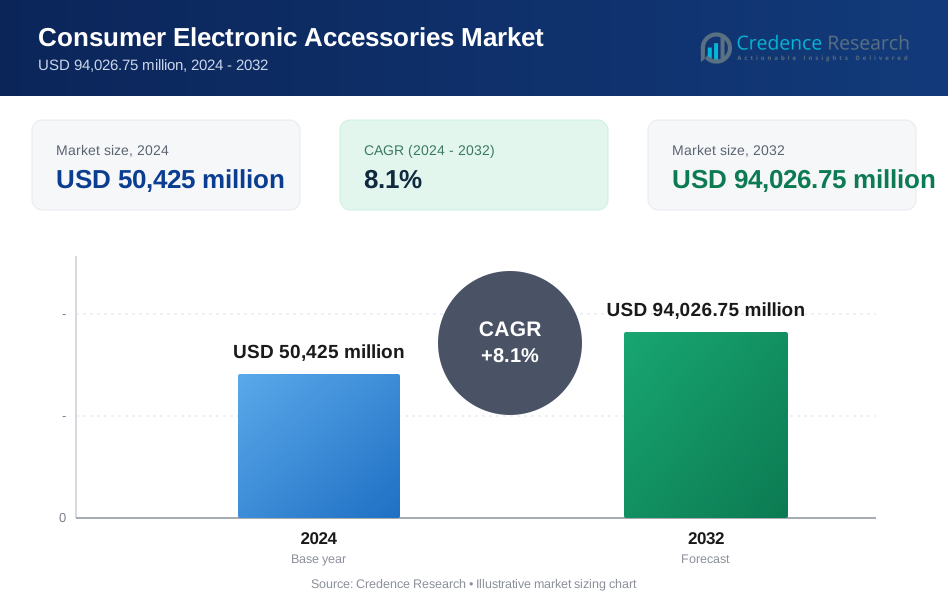
The Consumer Electronic Accessories Market is projected to grow from USD 50,425 million in 2024 to USD 94,026.75 million by 2032, representing a robust compound annual growth rate (CAGR) of 8.1%.
The consumer electronic accessories market is driven by the increasing demand for smartphones, laptops, and wearables, which necessitate compatible accessories for enhanced functionality and user experience. The proliferation of smart devices and the rise of remote work have further fueled this growth, as consumers seek products like chargers, cases, and audio devices. Additionally, advancements in technology, such as wireless connectivity and enhanced durability, are shaping product innovation. The growing trend towards personalization and customization in consumer electronics also propels demand, as consumers increasingly prioritize unique accessories that reflect their individual styles and preferences.
The consumer electronic accessories market is characterized by diverse geographical dynamics, with North America and the Asia-Pacific region leading in market share. Key players such as Logitech International S.A., Samsung Electronics Co., Ltd., and Sony Corporation dominate the industry, leveraging their innovative product offerings and strong brand recognition. Additionally, companies like Zebronics India Pvt. Ltd., Belkin International, Inc., and Portronics Digital Pvt. Ltd. cater to regional demands, providing tailored solutions. The competitive landscape is further enhanced by Targus International LLC, Thermaltake Technology Co. Ltd., Philips International B.V., and Incipio Group, each contributing to the market's growth through strategic partnerships and product diversification.
Market Drivers
Rising Penetration of Smartphones and Other Devices
The consumer electronic accessories market is significantly driven by the rising penetration of smartphones and other devices. Increased affordability has made these technologies accessible to a broader audience, leading to higher adoption rates. For instance, the global smartphone penetration rate reached 69% in 2023, with an estimated 6.7 billion smartphone subscriptions worldwide. As manufacturers enhance device features and capabilities, consumers seek accessories that complement and improve functionality. This growing demand for advanced accessories reflects consumers' desire to maximize the potential of their devices, fostering further market expansion.
Growing Demand for Personalization
Another crucial driver is the increasing consumer demand for personalization. Today’s consumers are keen on accessories that allow them to express their individuality, resulting in a market filled with customization options. From stylish cases and covers to unique chargers and headphones, the wide variety of available accessories caters to diverse preferences and styles. This emphasis on personalization not only enhances the user experience but also encourages consumers to invest in accessories that align with their personal tastes.
Advancements in Technology
Technological advancements also play a pivotal role in shaping the accessories market. The introduction of new devices, such as smartwatches and wireless earbuds, creates a substantial demand for compatible accessories. Additionally, improved connectivity options, like Bluetooth and wireless charging, necessitate specific accessories to ensure optimal functionality. For instance, the rise of smart home devices and wearables has significantly boosted the demand for advanced electronic accessories. As technology continues to evolve, manufacturers are tasked with developing innovative accessories that meet the growing needs of tech-savvy consumers.
Lifestyle Changes and Consumer Trends
Lifestyle changes and emerging consumer trends further drive the demand for electronic accessories. The shift toward remote work and online learning has increased the need for essential accessories like headsets, webcams, and ergonomic equipment. Moreover, the popularity of fitness trackers and smartwatches has led to a surge in demand for complementary accessories such as bands and chargers. In the realm of entertainment, the growing interest in gaming and streaming has intensified the demand for gaming controllers, headsets, and charging stations, creating a dynamic market landscape.
Market Trends
Advancements in Wireless Connectivity and Wearable Technology
The consumer electronics accessories market is witnessing significant trends driven by advancements in wireless connectivity and the growing popularity of wearable technology. Wireless charging has gained immense traction, as consumers prefer the convenience and aesthetic appeal of untethered devices. For instance, a report by the Wi-Fi Alliance highlighted that nearly 18 billion Wi-Fi devices were in use by 2022, with a significant portion supporting wireless charging. This surge in popularity is complemented by the mainstream adoption of Bluetooth headphones and earbuds, which offer users enhanced sound quality and the freedom to enjoy audio without the constraints of wires. Simultaneously, wearable technology, particularly smartwatches and fitness trackers, continues to gain momentum. These devices provide users with health monitoring capabilities, fitness tracking features, and various smart functionalities, appealing to health-conscious consumers. Emerging smart accessories, such as smart rings and glasses, are further expanding the possibilities for connected devices, creating a more integrated and interactive user experience.
Growing Demand for Gaming Accessories and Sustainable Solutions
Another prominent trend in the market is the rising demand for gaming accessories and sustainable, eco-friendly options. High-performance gaming headsets have become essential for gamers seeking advanced audio capabilities, noise cancellation, and comfortable designs for extended gaming sessions. The gaming industry continues to drive demand for specialized controllers, keyboards, and mice tailored to specific gaming genres, reflecting the evolving landscape of gaming technology. In parallel, there is a growing consumer awareness regarding sustainability, leading to an increased interest in accessories made from recycled materials and biodegradable cases. Consumers are actively seeking products that reduce environmental impact, prompting brands to innovate in this space. Energy-efficient charging solutions, such as solar-powered chargers, are also gaining popularity, aligning with the demand for environmentally friendly alternatives. Additionally, customization and personalization have emerged as key consumer preferences, with modular and interchangeable designs allowing users to tailor their accessories to their liking. Personalized engravings and unique designs further cater to individual tastes, enhancing the overall appeal of consumer electronic accessories. Lastly, the integration of smart home ecosystems has led to the proliferation of accessories that connect seamlessly with devices like smart plugs, bulbs, and thermostats, enabling users to control their environments conveniently through voice-activated systems. These trends collectively shape the future of the consumer electronic accessories market, driving innovation and enhancing user experience.
Market Challenges Analysis
Challenges Posed by Rapid Technological Advancements and Intense Competition
The consumer electronics accessories market faces significant challenges stemming from rapid technological advancements and intense competition. The swift pace of innovation results in short product lifecycles, compelling brands to continuously adapt and launch new offerings to stay relevant. This constant evolution can lead to compatibility issues, as ensuring that accessories function seamlessly with the latest devices and operating systems becomes increasingly complex. Additionally, the market is saturated with numerous players, including established brands and emerging companies, intensifying competition for market share. This rivalry often leads to aggressive pricing strategies, putting pressure on profit margins and making it challenging for brands to sustain profitability. As businesses strive to differentiate themselves in this crowded landscape, they must navigate the delicate balance between innovation, quality, and cost-efficiency to capture consumer interest while maintaining a solid financial footing.
Threats from Counterfeit Products and Supply Chain Disruptions
Another pressing challenge in the market involves the prevalence of counterfeit and low-quality products, which threaten brand reputation and erode consumer trust. For instance, the Global Brand Counterfeiting Report estimated losses due to counterfeit consumer electronics at over $100 billion annually. Imitation goods can undermine the perceived value of authentic accessories, while intellectual property infringement poses significant challenges, particularly in regions with lax enforcement. Additionally, supply chain disruptions, fueled by global events such as geopolitical tensions, natural disasters, and economic instability, can lead to shortages and delays in product availability. Companies reliant on specific components or materials face vulnerabilities if those resources become scarce or expensive. Compounding these issues are changing consumer behaviors and preferences, which can shift rapidly, making accurate demand forecasting difficult. Establishing strong brand loyalty is increasingly challenging in an environment saturated with options and constant product introductions. Furthermore, regulatory and compliance challenges, including adherence to safety standards and environmental regulations, require significant resources and can complicate market entry strategies. Lastly, data privacy and security concerns loom large, as accessories that collect personal information must adhere to stringent consumer data protection regulations while being fortified against cybersecurity threats. Addressing these multifaceted challenges will be critical for brands seeking to thrive in the dynamic landscape of consumer electronic accessories.
Market Segmentation Analysis:
By Type:
The consumer electronic accessories market comprises several key segments categorized by type. Cell phone accessories dominate the market, driven by the widespread adoption of smartphones and the demand for complementary products such as cases, chargers, and screen protectors. Car electronic accessories are also gaining traction, fueled by the integration of advanced technology in vehicles, including infotainment systems and GPS devices. Laptop and PC accessories follow suit, with consumers seeking peripherals like keyboards, mice, and docking stations to enhance productivity. Audio and video accessories, including headphones, speakers, and home theater systems, are witnessing significant growth as consumers prioritize high-quality audio experiences. Additionally, camera and photo accessories, such as tripods and lens filters, cater to the burgeoning interest in photography, particularly among amateur enthusiasts. Office appliance accessories represent a niche segment, supporting the increasing remote work trend by providing ergonomic and functional solutions. The "Others" category encompasses various products, reflecting the diverse needs of consumers in a rapidly evolving market.
By Application:
In terms of application, the consumer electronic accessories market can be segmented into multi-brand stores, single brand stores, and online stores. Multi-brand stores offer consumers a wide selection of products from various manufacturers, enabling them to compare and choose accessories that best suit their needs. This approach fosters competition among brands, often resulting in better pricing and promotional offers. Single brand stores, on the other hand, provide a focused shopping experience for consumers loyal to specific brands, allowing for deeper brand engagement and a curated selection of high-quality accessories. However, the most significant growth is observed in online stores, driven by the convenience of e-commerce and the ability to access an extensive range of products from the comfort of home. Online platforms also enable consumers to read reviews, compare prices, and take advantage of special discounts, enhancing their overall shopping experience. As consumer preferences shift towards digital shopping channels, brands must prioritize their online presence to capitalize on this growing trend and meet evolving customer expectations.
Segments:
Based on Type:
- Cell Phone Accessories
- Car Electronic Accessories
- Laptop and PC Accessories
- Audio and Video Accessories
- Camera and Photo Accessories
- Office Appliance Accessories
- Others
Based on Application
- Multi-Brand Stores
- Single Brand Stores
- Online Stores
Based on the Geography:
- North America
- U.S.
- Canada
- Mexico
- Europe
- Germany
- France
- U.K.
- Italy
- Spain
- Rest of Europe
- Asia Pacific
- China
- Japan
- India
- South Korea
- South-east Asia
- Rest of Asia Pacific
- Latin America
- Brazil
- Argentina
- Rest of Latin America
- Middle East & Africa
- GCC Countries
- South Africa
- Rest of the Middle East and Africa
Regional Analysis
North America
North America holds a substantial market share in the consumer electronic accessories sector, accounting for approximately 30% of the global market. This dominance is primarily driven by the high penetration of smartphones, laptops, and other electronic devices among consumers. The region's strong technological infrastructure and consumer willingness to adopt new technologies further fuel demand for various accessories, including audio and video equipment, cell phone accessories, and gaming peripherals. Additionally, the presence of major retailers and e-commerce platforms in North America facilitates easy access to a wide range of products, enhancing consumer convenience. The growing trend of remote work and online learning has also led to increased purchases of office-related accessories, such as webcams and ergonomic devices, contributing to market growth in this region.
Asia-Pacific
The Asia-Pacific region is another significant player in the consumer electronic accessories market, capturing around 25% of the global market share. The rapid urbanization and increasing disposable incomes in countries like China and India have led to a surge in demand for electronic devices and their accessories. With a burgeoning middle class and a tech-savvy population, the region is witnessing a significant shift towards premium electronic products, driving the need for high-quality accessories. Furthermore, the proliferation of e-commerce platforms has made it easier for consumers to access a vast array of products, fostering growth in online sales. In addition, the rising popularity of wearables and smart home devices is expected to further enhance the market for accessories in the Asia-Pacific region, as consumers seek to optimize their technology experiences. As the demand for innovation and connectivity continues to rise, the region is poised for substantial growth in the coming years.
Key Player Analysis
- Logitech International S.A.
- Zebronics India Pvt. Ltd.
- Sony Corporation
- Belkin International, Inc.
- Portronics Digital Pvt. Ltd.
- Samsung Electronics Co., Ltd.
- Thermaltake Technology Co. Ltd.
- Philips International B.V.
- Targus International LLC
- Incipio Group
Competitive Analysis
The competitive landscape of the consumer electronic accessories market is marked by significant innovation and strategic positioning among leading players. Companies such as Logitech International S.A., Samsung Electronics Co., Ltd., Sony Corporation, Zebronics India Pvt. Ltd., Belkin International, Inc., Portronics Digital Pvt. Ltd., Targus International LLC, Thermaltake Technology Co. Ltd., Philips International B.V., and Incipio Group are at the forefront of this industry. Leading companies excel in various segments, focusing on audio, gaming, and mobile accessories to meet diverse consumer needs. Some players emphasize affordability and quality, targeting budget-conscious consumers, while others leverage extensive portfolios in consumer electronics to enhance compatibility and performance across their accessory lines. Moreover, many brands prioritize functionality and design, offering products that align with current trends in personalization and sustainability. The rivalry among these companies drives continuous advancements and product diversification, allowing them to cater to evolving consumer preferences and technological developments in the market. As the industry grows, the emphasis on strategic partnerships, effective marketing, and responsive supply chain management will be crucial for maintaining a competitive edge.
Recent Developments
- In February 2023, Belkin Has introduces its Screen Force True-Clear Curvature screen protectors for the new Samsung Galaxy S23 series. These products not only passed Belkin's stringent design and engineering quality tests, but they earned the SMAPP's (Samsung Mobile Accessory Partnership Program) Designed for Samsung badge.
- In May 2022, Logitech has extended its master series with two latest mechanical keyboards the full size MX mechanical and minimalist MX mechanical mini and MX Master 3S mouse. With precision tracking and high-performance mechanical typing, Logitech's Master Series offers advanced digital creators the ultimate.
- In Sept 2022, Tietoevry and Bose began collaborating in 2021, focusing initially on consumer electronics development. The companies’ agreement has now been expanded to include capabilities for developing automotive sound systems.
- In July 2022, Bosch, a German and global supplier that is the automotive industry’s leading company for semiconductor development and manufacturing, is expanding its semiconductor manufacturing capacity.
Market Concentration & Characteristics
The consumer electronic accessories market exhibits a moderate level of concentration, characterized by a mix of established players and emerging brands. This dynamic landscape allows for diverse product offerings, catering to various consumer preferences and technological needs. Major companies leverage their extensive resources and brand recognition to innovate continuously and maintain market share, while smaller firms often focus on niche segments or unique product features to differentiate themselves. Key characteristics of the market include rapid technological advancements, with new devices and accessories frequently introduced to meet evolving consumer demands. Additionally, the rise of e-commerce has transformed distribution channels, providing consumers with convenient access to a wide range of products. Sustainability is increasingly influencing consumer choices, prompting brands to develop eco-friendly accessories. Overall, the market is marked by competition, innovation, and adaptability, as companies strive to capture consumer attention in a fast-paced technological environment.
Report Coverage
The research report offers an in-depth analysis based on Type, Application and Geography. It details leading market players, providing an overview of their business, product offerings, investments, revenue streams, and key applications. Additionally, the report includes insights into the competitive environment, SWOT analysis, current market trends, as well as the primary drivers and constraints. Furthermore, it discusses various factors that have driven market expansion in recent years. The report also explores market dynamics, regulatory scenarios, and technological advancements that are shaping the industry. It assesses the impact of external factors and global economic changes on market growth. Lastly, it provides strategic recommendations for new entrants and established companies to navigate the complexities of the market.
Future Outlook
- The market for consumer electronic accessories is expected to experience steady growth, driven by increasing smartphone and device penetration.
- The demand for wireless charging solutions and Bluetooth accessories will continue to rise as consumers seek convenience and enhanced user experiences.
- Personalization and customization will become key trends, with brands offering modular designs and unique features to cater to individual preferences.
- Sustainability will play a significant role in product development, with a growing emphasis on eco-friendly materials and energy-efficient solutions.
- The integration of smart technology into accessories will expand, enabling seamless connectivity with smart home ecosystems and wearables.
- E-commerce will dominate sales channels, as consumers increasingly prefer online shopping for its convenience and variety.
- Innovations in gaming accessories will drive growth, fueled by the expanding gaming industry and demand for high-performance products.
- Enhanced focus on data privacy and cybersecurity will prompt manufacturers to develop secure accessories that protect consumer information.
- Regional markets in Asia-Pacific are anticipated to grow rapidly, driven by rising disposable incomes and tech-savvy consumers.
- Strategic partnerships and collaborations will become more common, allowing brands to leverage complementary strengths and enhance product offerings.
Request a Free Sample
Fill in your details and we'll send you a free sample report.
- Sample data tables & charts
- Research methodology
Market Dynamics
Rising Penetration of Smartphones and Other Devices
The widespread adoption of smartphones, laptops, and wearables is fueling demand for compatible accessories such as chargers, cases, and audio devices. As device ownership grows globally, consumers seek products that enhance functionality and user experience, driving market expansion.
Growing Demand for Personalization
Consumers increasingly desire accessories that reflect their individual styles and preferences, leading to a surge in demand for customizable and unique products. This trend encourages brands to offer a wide variety of designs and personalization options, boosting accessory sales.
Advancements in Technology
Innovations such as wireless charging, Bluetooth connectivity, and smart features are creating new categories of accessories and increasing the need for compatible products. As technology evolves, consumers upgrade their accessories to match new device capabilities, sustaining market growth.
Lifestyle Changes and Remote Work
The shift toward remote work and online learning has increased the need for accessories like headsets, webcams, and ergonomic equipment. Additionally, the popularity of gaming and fitness tracking has driven demand for specialized accessories, further diversifying the market.
Sustainability and Eco-Friendly Solutions
Growing environmental awareness is prompting consumers to seek accessories made from recycled or biodegradable materials and energy-efficient charging solutions. Brands responding to this demand are capturing market share and differentiating themselves in a competitive landscape.
Need a Custom Version of This Report?
Tailor the scope, geography, or segments to your exact requirements.
- Custom geography or segment scope
- Direct access to our analyst team
Frequently Asked Questions
What is the current size of the Consumer Electronic Accessories market?
What factors are driving the growth of the Consumer Electronic Accessories market?
What are the key segments within the Consumer Electronic Accessories market?
What are some challenges faced by the Consumer Electronic Accessories market?
Who are the major players in the Consumer Electronic Accessories market?
Table of Content
Chapter 1 Market Segmentation
- 1.1 Segmentation Framework
- 1.1.1 Product and Service Classification
- 1.1.2 Application and End-Use Classification
- 1.1.3 Technology and Solution Classification
- 1.1.4 Customer and Distribution Channel Classification
- 1.1.5 Geographic Segmentation
- 1.1.6 Market Segment Definitions and Boundaries
- 1.2 By Type
- 1.2.1 Cell Phone Accessories
- 1.2.2 Car Electronic Accessories
- 1.2.3 Laptop and PC Accessories
- 1.2.4 Audio and Video Accessories
- 1.2.5 Camera and Photo Accessories
- 1.2.6 Office Appliance Accessories
- 1.2.7 Others
- 1.3 By Application
- 1.3.1 Multi-Brand Stores
- 1.3.2 Single Brand Stores
- 1.3.3 Online Stores
Chapter 2 Introduction
- 2.1 Report Objectives and Scope
- 2.2 Product Definition and Industry Terminology
- 2.3 Market Inclusions and Exclusions
- 2.4 Research Process
- 2.4.1 Primary Research and Expert Interviews
- 2.4.2 Secondary Research and Source Review
- 2.4.3 Top-Down and Bottom-Up Estimation
- 2.4.4 Data Triangulation and Verification
- 2.5 Market Size Measurement Basis
- 2.5.1 2024: USD 50,425 million → 2032: USD 94,026.75 million
- 2.6 Historical and Forecast Reference Periods
- 2.6.1 Base Year: 2024
- 2.6.2 Forecast Period: 2024-2032
- 2.7 Research Assumptions and Limitations
Chapter 3 Executive Summary
- 3.1 Market Snapshot and Key Findings
- 3.2 Base-Year Market Size, 2024
- 3.3 Forecast Market Size, 2032
- 3.4 Revenue and Volume Growth Outlook
- 3.5 Key Demand and Supply Indicators
- 3.6 Leading Market Segments
- 3.7 Fastest-Growing Market Opportunities
- 3.8 Regional Performance Highlights
- 3.9 Technology and Industry Transformation
- 3.10 Competitive Landscape Summary
- 3.11 Analyst View and Strategic Implications
Chapter 4 Global Consumer Electronic Accessories Market Trends and Developments
- 4.1 Historical Industry Development
- 4.2 Recent Market Trends and Developments
- 4.3 Demand and Customer Behavior Trends
- 4.4 Technology and Product Innovation
- 4.5 Artificial Intelligence, Automation and Digitalization
- 4.6 Local Manufacturing and Supply Chain Realignment
- 4.7 Industry Partnerships, Mergers and Acquisitions
- 4.8 Sustainability and Circular Economy Developments
- 4.9 Government and Private Sector Investment Trends
- 4.10 Emerging Business Models and Commercialization
- 4.11 Industry Developments and Announcements
Chapter 5 Global Consumer Electronic Accessories Market Production, Supply and Demand Analysis
- 5.1 Demand Trend and Consumption Analysis
- 5.2 Demand Forecast, 2024-2032
- 5.3 Production and Output Trend
- 5.4 Production and Output Forecast, 2024-2032
- 5.5 Installed Capacity and Capacity Utilization
- 5.6 Company-Wise Production Plants and Statistics
- 5.6.1 Installed Production Capacity
- 5.6.2 Actual Production
- 5.6.3 Planned Capacity and Expansion Targets
- 5.7 Supply Chain Structure and Procurement Trends
- 5.8 Supply-Demand Gap and Bottlenecks
- 5.9 Import Dependence and Sourcing Structure
- 5.10 Contract Manufacturing and Outsourcing
- 5.11 Regional Supply and Demand Concentration
Chapter 6 Global Consumer Electronic Accessories Market Pricing Analysis
- 6.1 Pricing Structure and Measurement
- 6.2 Historical Pricing Trends
- 6.3 Pricing Outlook, 2024-2032
- 6.4 Average Selling Price and Unit Economics
- 6.5 Pricing by Product and Market Segment
- 6.6 Geographic Pricing Differences
- 6.7 Key Input, Energy, Labor and Logistics Costs
- 6.8 Contract Pricing and Purchasing Models
- 6.9 Pricing Sensitivity and Competitive Positioning
- 6.10 Price, Margin and Profitability Implications
Chapter 7 Global Consumer Electronic Accessories Market Dynamics
- 7.1 Market Growth Drivers
- 7.1.1 Demand-Side Drivers
- 7.1.2 Technology and Innovation Drivers
- 7.1.3 Infrastructure and Investment Drivers
- 7.1.4 Regulatory and Policy Drivers
- 7.2 Market Restraints
- 7.2.1 Cost and Affordability Constraints
- 7.2.2 Technology and Adoption Barriers
- 7.2.3 Supply Chain and Operational Constraints
- 7.3 Market Challenges
- 7.3.1 Competitive Pressure and Margin Erosion
- 7.3.2 Skills, Infrastructure and Implementation Gaps
- 7.4 Emerging Market Opportunities
- 7.5 Market Dynamics Impact and Time-Horizon Assessment
Chapter 8 Global Consumer Electronic Accessories Value Chain Analysis
- 8.1 Industry Value Chain Overview
- 8.2 Upstream Suppliers and Critical Inputs
- 8.3 Technology and Component Providers
- 8.4 Manufacturing or Service Delivery
- 8.5 Distribution, Channel Partners and Integrators
- 8.6 Downstream Applications and End Users
- 8.7 Value Addition and Profit Pools
- 8.8 Vertical Integration and Outsourcing
- 8.9 Supplier Concentration and Risk
- 8.10 Supply Chain Localization and Resilience
Chapter 9 Global Consumer Electronic Accessories Market Regulations and Policies
- 9.1 Relevant Laws, Standards and Compliance Frameworks
- 9.2 Product, Service, Safety and Quality Requirements
- 9.3 Government Policies, Incentives and Subsidies
- 9.4 Imports, Exports and Trade Barriers
- 9.5 Public Procurement and Local Content Requirements
- 9.6 Environmental and Sustainability Compliance
- 9.7 Data Protection, AI and Cybersecurity Compliance
- 9.8 Upcoming Policy Changes and Market Implications
Chapter 10 Global Consumer Electronic Accessories Market Hotspots and Opportunities
- 10.1 Market Opportunity Mapping and Growth Hotspots
- 10.2 High-Growth Applications and Customer Groups
- 10.3 Underserved Markets and White-Space Opportunities
- 10.4 Emerging Technology and Product Opportunities
- 10.5 New Capacity and Investment Hotspots
- 10.6 Market Entry and Expansion Opportunities
- 10.7 Distribution and Partnership Opportunities
- 10.8 Near-Term and Long-Term Commercial Potential
- 10.9 Opportunity Attractiveness and Execution Risks
Chapter 11 Global Consumer Electronic Accessories Market Outlook, 2024-2032
- 11.1 Market Size and Analysis
- 11.1.1 Revenue (Market Measurement: 2024: USD 50,425 million → 2032: USD 94,026.75 million)
- 11.1.2 Market Volume and Quantity Sold
- 11.1.3 Historical Market Size
- 11.1.4 Base-Year Market Size, 2024
- 11.2 Market Forecast, 2024-2032
- 11.2.1 Revenue Forecast to 2032
- 11.2.2 Volume Forecast to 2032
- 11.2.3 CAGR and Year-on-Year Growth
- 11.2.4 Incremental Revenue Opportunity
- 11.3 Forecast Assumptions and Scenario Analysis
- 11.3.1 Base-Case Forecast
- 11.3.2 Optimistic and Conservative Scenarios
- 11.3.3 Technology, Pricing and Policy Sensitivities
- 11.4 Market Attractiveness and Growth Outlook
Chapter 12 Global Consumer Electronic Accessories Market Segmentation and Outlook
- 12.1 Segmentation Summary and Market Shares, 2024
- 12.2 Largest and Fastest-Growing Segments
- 12.3 By Type - Market Size and Forecast, 2024-2032
- 12.3.1 Segment Definition and Scope
- 12.3.2 Historical Market Size
- 12.3.3 Revenue Forecast, 2024-2032
- 12.3.4 Volume Forecast, 2024-2032
- 12.3.5 Base-Year Market Share, 2024
- 12.3.6 Segment CAGR and Growth Drivers
- 12.3.7 Subsegment Market Size and Forecast
- 12.3.7.1 Cell Phone Accessories
- 12.3.7.2 Car Electronic Accessories
- 12.3.7.3 Laptop and PC Accessories
- 12.3.7.4 Audio and Video Accessories
- 12.3.7.5 Camera and Photo Accessories
- 12.3.7.6 Office Appliance Accessories
- 12.3.7.7 Others
- 12.3.8 Subsegment Pricing and Adoption Trends
- 12.3.9 Leading Suppliers and Competition
- 12.3.10 Regional Demand and Opportunities
- 12.4 By Application - Market Size and Forecast, 2024-2032
- 12.4.1 Segment Definition and Scope
- 12.4.2 Historical Market Size
- 12.4.3 Revenue Forecast, 2024-2032
- 12.4.4 Volume Forecast, 2024-2032
- 12.4.5 Base-Year Market Share, 2024
- 12.4.6 Segment CAGR and Growth Drivers
- 12.4.7 Subsegment Market Size and Forecast
- 12.4.7.1 Multi-Brand Stores
- 12.4.7.2 Single Brand Stores
- 12.4.7.3 Online Stores
- 12.4.8 Subsegment Pricing and Adoption Trends
- 12.4.9 Leading Suppliers and Competition
- 12.4.10 Regional Demand and Opportunities
- 12.5 Segment Growth Comparison
- 12.6 Segment Attractiveness and Priority Matrix
Chapter 13 Global Consumer Electronic Accessories End-Use and Application Market Outlook
- 13.1 End-Use Industry and Customer Demand Structure
- 13.2 Leading Applications and Customer Groups
- 13.3 End-Use Market Size, Share and Forecast
- 13.4 Major End-Use Industry Deep Dives
- 13.4.1 Customer Requirements and Use Cases
- 13.4.2 Demand and Replacement Cycles
- 13.4.3 Technical and Regulatory Considerations
- 13.4.4 Purchasing and Procurement Models
- 13.4.5 Leading Vendors and Distribution Channels
- 13.4.6 Forecast and Commercial Opportunities
- 13.5 Emerging Applications and Cross-Segment Demand
- 13.6 End-Use Industry Investment Priorities
Chapter 14 Global Consumer Electronic Accessories Geographic Market Outlook, 2024-2032
- 14.1 Regional Market Size and Share, 2024
- 14.2 Regional Market Forecast, 2024-2032
- 14.3 Regional Pricing, Production and Demand Differences
- 14.4 North America
- 14.4.1 United States
- 14.4.2 Canada
- 14.4.3 Mexico
- 14.5 Europe
- 14.5.1 Germany
- 14.5.2 France
- 14.5.3 Italy
- 14.5.4 United Kingdom
- 14.5.5 Spain
- 14.5.6 Poland
- 14.5.7 Russia
- 14.5.8 Netherlands
- 14.5.9 Belgium
- 14.5.10 Sweden
- 14.5.11 Denmark
- 14.5.12 Norway
- 14.5.13 Rest of Europe
- 14.6 Asia Pacific
- 14.6.1 China
- 14.6.2 India
- 14.6.3 Japan
- 14.6.4 South Korea
- 14.6.5 Thailand
- 14.6.6 Indonesia
- 14.6.7 Vietnam
- 14.6.8 Malaysia
- 14.6.9 Australia
- 14.6.10 Rest of Asia Pacific
- 14.7 Latin America
- 14.7.1 Brazil
- 14.7.2 Argentina
- 14.7.3 Colombia
- 14.7.4 Chile
- 14.7.5 Rest of Latin America
- 14.8 Middle East
- 14.8.1 Saudi Arabia
- 14.8.2 United Arab Emirates
- 14.8.3 Turkey
- 14.8.4 Israel
- 14.8.5 Iran
- 14.8.6 Rest of the Middle East
- 14.9 Africa
- 14.9.1 South Africa
- 14.9.2 Egypt
- 14.9.3 Nigeria
- 14.9.4 Morocco
- 14.9.5 Rest of Africa
- 14.10 Regional Investment, Policy and Supply Chain Differences
- 14.11 Regional Competitive Landscape
- 14.12 Geographic Growth Hotspots
Chapter 15 Global Consumer Electronic Accessories Technology, Innovation and Sustainability Outlook
- 15.1 Technology Landscape and Maturity
- 15.2 Product, Process and Service Innovation
- 15.3 AI, Automation and Digital Tools in the Industry
- 15.4 Technology Adoption and Performance Benchmarking
- 15.5 Innovation Pipeline and R&D Investment
- 15.6 Patent and Intellectual Property Trends
- 15.7 Energy Efficiency and Resource Management
- 15.8 Sustainability, Recycling and Circularity
- 15.9 Technology Roadmap, 2024-2032
- 15.10 Risks of Obsolescence and Technology Substitution
Chapter 16 Global Consumer Electronic Accessories Market Key Strategic Imperatives
- 16.1 Growth and Market Entry Priorities
- 16.2 High-Return Products and Segments
- 16.3 Pricing, Profitability and Cost Optimization
- 16.4 Technology Investment and Product Differentiation
- 16.5 Supply Chain Localization and Resilience
- 16.6 Distribution and Customer Acquisition
- 16.7 Partnership, Acquisition and Capacity Strategy
- 16.8 Regional Expansion Priorities
- 16.9 Short-, Medium- and Long-Term Actions
Chapter 17 Competition Outlook
- 17.1 Industry Competition Characteristics
- 17.2 Market Structure and Concentration
- 17.3 Market Share and Competitive Positioning, 2024
- 17.4 Company-Wise Revenue and Product Benchmarking
- 17.5 Production and Service Capacity Benchmarking
- 17.6 Technology, Pricing and Differentiation
- 17.7 Regional Footprint and Distribution Strength
- 17.8 Mergers, Acquisitions and Strategic Alliances
- 17.9 New Entrants and Competitive Threats
- 17.10 Porter's Five Forces and Industry Attractiveness
- 17.11 Competitive Outlook, 2024-2032
Chapter 18 Company Profiles
- 18.1 Company Coverage and Selection Criteria
- 18.2 Logitech International S.A.
- 18.2.1 Business Description
- 18.2.2 Company Ownership and Geographic Presence
- 18.2.3 Product and Service Portfolio
- 18.2.4 Manufacturing and Operating Footprint
- 18.2.5 Production Capacity and Expansion Plans
- 18.2.6 Financial Performance and Investment
- 18.2.7 Market Share and Competitive Position
- 18.2.8 Technology and Innovation Capabilities
- 18.2.9 Strategic Alliances or Partnerships
- 18.2.10 Recent Developments
- 18.2.11 Growth Strategy and Outlook
- 18.3 Samsung Electronics Co., Ltd.
- 18.4 Sony Corporation
- 18.5 Zebronics India Pvt. Ltd.
- 18.6 Belkin International, Inc.
- 18.7 Portronics Digital Pvt. Ltd.
- 18.8 Targus International LLC
- 18.9 Thermaltake Technology Co. Ltd.
- 18.10 Philips International B.V.
- 18.11 Incipio Group
- 18.12 Other Relevant Market Participants
Note: Every listed company is profiled on the structure shown under the first company. The company list is preliminary and may change based on research findings, market developments, data availability and client requirements.
Chapter 19 Disclaimer
- 19.1 Research and Forecast Disclaimer
- 19.2 Data Source and Estimation Limitations
Note: The depth of individual sections depends on data availability for this market. Volume, capacity, trade and other unit-based metrics are included where applicable.

