Market Overview
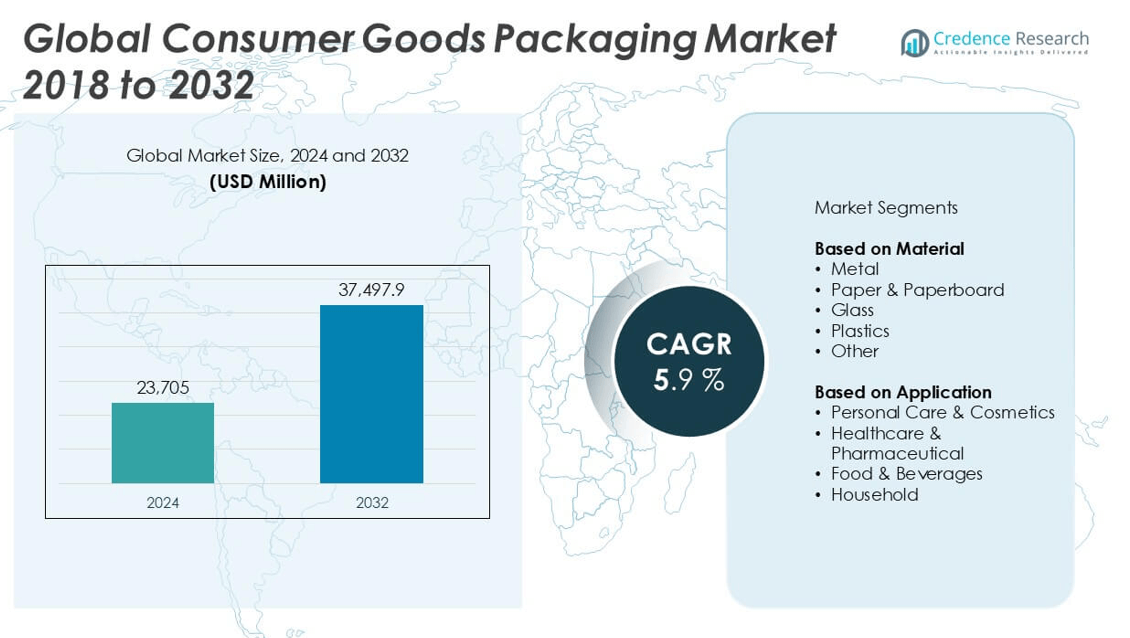
Consumer Goods Packaging market size was valued at USD 23,705 million in 2024 and is anticipated to reach USD 37,497.9 million by 2032, at a CAGR of 5.9% during the forecast period.
| REPORT ATTRIBUTE | DETAILS |
|---|---|
| Historical Period | 2020-2023 |
| Base Year | 2024 |
| Forecast Period | 2025-2032 |
| Consumer Goods Packaging Market Size 2024 | USD 23,705 million |
| Consumer Goods Packaging Market, CAGR | 5.9% |
| Consumer Goods Packaging Market Size 2032 | USD 37,497.9 million |
The consumer goods packaging market is led by prominent players such as Amcor plc, Sealed Air, Mondi Group, Berry Global, and International Paper Co, known for their global presence and innovation in sustainable and functional packaging solutions. Other key contributors include Uflex Limited, Graphic Packaging International, Ball Corporation, Crown Cork & Seal Co, Huhtamaki India, and Autofits Packaging Private Limited, which enhance market competitiveness through regional expertise and cost-effective production. In 2024, Asia Pacific emerged as the leading region, accounting for over 35% of the global market share, driven by rapid urbanization, rising consumption of packaged products, and expanding e-commerce.\
Market Insights
- The consumer goos packaging market was valued at USD 23,705 million in 2024 and is expected to reach USD 37,497.9 million by 2032, growing at a CAGR of 5.9% during the forecast period.
- The market is primarily driven by rising demand for sustainable packaging materials, growing e-commerce activity, and increased consumption of packaged food, personal care, and pharmaceutical products.
- Key trends include the adoption of recyclable and biodegradable materials, along with the integration of smart packaging technologies such as QR codes and sensors for traceability and consumer engagement.
- Major players include Amcor plc, Sealed Air, Mondi Group, Berry Global, and International Paper Co, with companies focusing on innovation, acquisitions, and sustainable solutions to stay competitive.
- Asia Pacific held the largest regional share at over 35%, followed by North America (27%) and Europe (25%). By material, plastic dominated the segment due to its versatility, while food & beverages led by application category.
Market Segmentation Analysis:
By Material
Plastics emerged as the dominant material segment in the Consumer Goods Packaging market in 2024, accounting for the highest market share due to its lightweight properties, cost efficiency, and versatility across diverse product categories. The widespread adoption of PET and HDPE plastics in food, beverage, and personal care packaging has significantly contributed to segment growth. Moreover, technological advancements in biodegradable and recyclable plastic materials have further driven demand amid rising sustainability concerns. Although paper & paperboard are gaining traction due to eco-friendly trends, plastics continue to lead due to durability and mass production capabilities.
- For instance, Berry Global Group produced over 3.5 billion plastic packaging units using post-consumer recycled (PCR) content in 2023, demonstrating its scalable commitment to circular plastic solutions.
By Application
The Food & Beverages segment held the largest share in the application category, driven by the continuous growth in packaged and ready-to-eat food consumption. The demand for extended shelf-life packaging, particularly in dairy, snacks, and beverages, has bolstered the adoption of advanced barrier materials and vacuum-sealed formats. Additionally, the rise of e-commerce and modern retail formats has increased the demand for visually appealing and durable packaging. Personal care & cosmetics and healthcare & pharmaceutical segments are also growing steadily, but food & beverages remain the key driver of overall packaging market expansion.
- For instance, Amcor’s AmPrima™ PE Plus packaging-launched for snack and dairy products-has been validated for recyclability by Cyclos-HTP and is currently used across more than 2,000 SKU units in global food retail chains.
Market Overview
Rising Demand for Sustainable and Eco-Friendly Packaging
The increasing consumer and regulatory focus on environmental sustainability has become a major driver for the consumer goods packaging market. Brands are investing in biodegradable, recyclable, and compostable materials to reduce plastic waste and meet evolving compliance standards. This shift is further accelerated by global bans on single-use plastics and the adoption of Extended Producer Responsibility (EPR) regulations. Manufacturers are integrating recycled content and minimalistic designs, driving innovation across materials like paperboard, bio-plastics, and plant-based polymers, thus reshaping the market landscape with green packaging alternatives.
- For instance, Mondi converted over 81% of its consumer flexible packaging solutions to paper-based or recyclable materials by the end of 2022 as part of its MAP2030 sustainability initiative.
Growth in E-commerce and Direct-to-Consumer Channels
The rapid expansion of e-commerce and direct-to-consumer models has significantly boosted the demand for innovative, protective, and visually engaging packaging solutions. Online retailing, especially in personal care, household goods, and food delivery services, requires packaging that ensures product integrity during transit while providing a positive unboxing experience. This has led to a surge in demand for tamper-proof, lightweight, and branded packaging formats. The need for compact, sustainable shipping options and return-friendly designs has made e-commerce packaging a key growth engine in the consumer goods sector.
- For instance, Sealed Air shipped over 6.4 billion mailer units globally through its e-commerce solutions in 2023, supporting direct-to-consumer delivery for major platforms like Amazon and Shopify.
Increasing Urbanization and Changing Lifestyles
Rapid urbanization and changing consumer lifestyles have increased the demand for convenience-driven packaging solutions such as resealable, single-serve, and on-the-go formats. As dual-income households rise and time constraints grow, consumers are seeking quick-access, easy-to-use packaging across food, beverages, and personal care products. This behavioral shift encourages manufacturers to innovate functional and ergonomic packaging. Furthermore, premium and aesthetically appealing packaging designs are gaining popularity in urban markets, especially among younger demographics, boosting volume sales and strengthening brand differentiation.
Key Trends & Opportunities
Technological Advancements in Smart Packaging
The integration of technologies such as QR codes, NFC tags, and sensors into packaging is reshaping consumer engagement and supply chain transparency. Smart packaging enables real-time tracking, anti-counterfeit verification, and interactive brand experiences. In the healthcare and food sectors, smart labels help monitor product freshness and dosage tracking. As IoT adoption increases and costs of implementation decrease, smart packaging presents a lucrative opportunity for brands seeking to enhance safety, personalization, and traceability in consumer goods packaging.
- For instance, Tetra Pak deployed over 1.2 billion smart packaging units with QR codes and serialized tracking in 2023 across its beverage packaging lines in Asia and Europe.
Growing Emphasis on Circular Economy Practices
There is a notable trend toward closed-loop packaging systems, driven by circular economy principles. Companies are investing in reusable and refillable packaging models, particularly in cosmetics and home care segments. Loop-based initiatives and deposit return schemes (DRS) are being piloted and scaled globally, offering opportunities for brands to reduce environmental impact and enhance brand loyalty. Collaboration across supply chains to enable effective recycling infrastructure and material recovery is unlocking new value streams in sustainable packaging.
- For instance, Unilever’s partnership with Loop has enabled over 2.1 million refill transactions across its home care and personal care products, reducing single-use packaging waste across multiple global markets.
Key Challenges
Fluctuating Raw Material Costs
Volatile prices of key packaging materials such as plastic resins, paperboard, and aluminum pose a significant challenge for manufacturers. Global supply chain disruptions, inflationary pressures, and geopolitical tensions often result in unpredictable cost structures. These fluctuations impact profit margins, especially for small and medium enterprises, and compel manufacturers to continuously adjust procurement strategies and pricing models. Managing long-term supply agreements and material substitutions becomes critical in maintaining competitiveness.
Regulatory Compliance and Packaging Waste Management
Stringent environmental regulations around packaging waste, recyclability, and labeling continue to challenge packaging producers. Compliance with diverse global standards-such as the EU Packaging and Packaging Waste Directive, FDA guidelines, and plastic tax mandates-requires continuous material innovation and process updates. Non-compliance can result in heavy penalties and loss of market access. Moreover, the absence of uniform recycling infrastructure in many regions complicates efforts to meet sustainability goals.
Balancing Innovation with Cost Efficiency
While innovation in packaging design and functionality is essential for brand differentiation, it often comes at a higher cost. Introducing smart features, biodegradable materials, or premium aesthetics requires investment in R&D and advanced manufacturing capabilities. For cost-sensitive segments, especially in emerging markets, this poses a challenge as brands must deliver value without compromising affordability. Achieving the right balance between performance, sustainability, and cost remains a persistent hurdle in competitive markets.
Regional Analysis
North America
North America held a significant share of the consumer goods packaging market in 2024, accounting for approximately 27% of the global market. The region’s dominance is supported by a mature consumer base, high demand for premium and sustainable packaging, and strong retail infrastructure. The U.S. leads with widespread use of recyclable and functional packaging, particularly in food and personal care segments. Technological advancements and regulatory pressures, such as plastic bans and EPR policies, are driving innovation. Additionally, the growth of e-commerce and direct-to-consumer brands is fueling demand for customized and protective packaging formats across North America.
Europe
Europe accounted for nearly 25% of the global consumer goods packaging market in 2024, driven by stringent environmental regulations and a strong push toward circular economy practices. Countries like Germany, France, and the UK are at the forefront of adopting sustainable materials such as recycled paperboard, compostable plastics, and reusable formats. The market benefits from robust infrastructure, advanced packaging technologies, and high consumer awareness regarding eco-friendly solutions. Rising demand for premium and biodegradable packaging in cosmetics, food, and healthcare sectors further boosts regional growth. Government mandates and active industry participation are shaping a highly innovation-focused packaging ecosystem.
Asia Pacific
Asia Pacific dominated the consumer goods packaging market with a commanding share of over 35% in 2024, led by China, India, and Japan. The region’s rapid urbanization, growing middle-class population, and increasing consumption of packaged food and personal care products are major drivers. Flexible and cost-effective plastic packaging remains prevalent, though demand for sustainable alternatives is growing due to environmental concerns. The rise of online retail, especially in India and Southeast Asia, fuels demand for tamper-evident and branded packaging. Investments in manufacturing capabilities and expanding domestic production support strong regional growth across both developed and emerging economies.
Latin America
Latin America contributed around 8% to the global consumer goods packaging market in 2024, with Brazil and Mexico serving as key markets. Economic recovery, expanding retail sectors, and increased consumer preference for packaged goods are fostering growth. Food and beverage packaging dominates due to high consumption of processed and convenience foods. Although plastic remains the dominant material, demand for biodegradable and paper-based packaging is increasing, driven by regulatory developments and consumer awareness. Regional players are also adopting automation and localized packaging designs to enhance efficiency and meet diverse consumer needs across income levels.
Middle East & Africa
The Middle East & Africa (MEA) region held an estimated 5% share of the global consumer goods packaging market in 2024. Rising urbanization, population growth, and an expanding retail landscape are driving demand for packaged consumer products, particularly in food, hygiene, and cosmetics. The UAE and South Africa are leading markets, supported by growing disposable incomes and modern trade penetration. While plastic packaging remains widespread due to cost advantages, regulatory attention on sustainability is gradually influencing material choices. However, infrastructure and recycling limitations continue to pose challenges, constraining the widespread adoption of eco-friendly packaging in the region.
Market Segmentations:
By Material
- Metal
- Paper & Paperboard
- Glass
- Plastics
- Other
By Application
- Personal Care & Cosmetics
- Healthcare & Pharmaceutical
- Food & Beverages
- Household
By Geography
- North America
- U.S.
- Canada
- Mexico
- Europe
- Germany
- France
- U.K.
- Italy
- Spain
- Rest of Europe
- Asia Pacific
- China
- Japan
- India
- South Korea
- South-east Asia
- Rest of Asia Pacific
- Latin America
- Brazil
- Argentina
- Rest of Latin America
- Middle East & Africa
- GCC Countries
- South Africa
- Rest of the Middle East and Africa
Competitive Landscape
The competitive landscape of the consumer goods packaging market is characterized by the presence of both global leaders and regional players striving for market share through innovation, sustainability, and strategic partnerships. Companies such as Amcor plc, Sealed Air, Mondi Group, and Berry Global lead the market with their extensive product portfolios, advanced manufacturing capabilities, and strong global distribution networks. These players continuously invest in research and development to introduce eco-friendly and functional packaging solutions tailored to evolving consumer preferences. Meanwhile, firms like Uflex Limited, Huhtamaki India, and Autofits Packaging Private Limited strengthen their positions in emerging markets through localized production and cost-efficient operations. Strategic mergers, acquisitions, and collaborations are common as companies aim to expand their geographic footprint and technological expertise. With increasing regulatory pressure and consumer demand for sustainable packaging, competition has intensified, pushing companies to innovate in areas such as biodegradable materials, smart packaging, and circular economy practices to maintain their market relevance.
Key Player Analysis
- Uflex Limited
- Graphic Packaging International
- Sealed Air
- Berry Global
- Amcor plc
- Huhtamaki India
- Crown Cork & Seal Co
- International Paper Co
- Mondi Group
- Autofits Packaging Private Limited
- Ball Corporation
Recent Developments
- In April 2025, FMCG brands adopt a new packaging strategy for q-commerce and kirana stores.
- In June 2024, Saica and Mondelez collaborated to launch a new paper-based product targeted to multipack products for the confectionery, biscuits and chocolate markets.
- In June 2024, General Manager at Saica Flex, Miguel Angel Dora, expressed, “We believe that packaging sustainability is a very serious challenge that required our full commitment and far-reaching collaborations with companies equally committed, like Mondelez.”
- In May 2025, the company launched Always Pocket Flexfoam, a compact, tiny pouch with a resealable wrapper ideal for on-the-go use. It offers full-sized Flexfoam pad protection in a discreet, portable pack.
- In March 2025, Unilever launched a premium range of multi-purpose soaps and body washes that combine skincare benefits with germ protection. The packaging is designed for convenient shower use, featuring modern, attractive bottles that appeal to younger, skin-savvy consumers.
- In February 2025, Colgate-Palmolive’s Hill’s Pet Nutrition division acquired Prime100, an Australian fresh pet food brand, to enter the fresh pet food category and strengthen its presence in Australia. Transaction expected to close Q2 2025, financed by debt and cash, pending regulatory approval.
Market Concentration & Characteristics
The Consumer Goods Packaging Market demonstrates moderate to high market concentration, with a mix of global giants and regional players shaping its competitive dynamics. Leading companies such as Amcor plc, Sealed Air, Mondi Group, and Berry Global hold significant shares due to their broad product portfolios, global distribution networks, and continuous innovation. It features a strong focus on sustainability, material efficiency, and product differentiation, particularly in segments such as food and beverages and personal care. The market benefits from long-term supply agreements and technological advancements in barrier protection, lightweight materials, and smart packaging. Regional players like Uflex Limited and Huhtamaki India contribute through cost-effective manufacturing and localized solutions. Entry barriers remain moderate due to capital-intensive production setups, strict regulatory requirements, and the need for supply chain efficiency. It is also shaped by evolving consumer preferences, sustainability regulations, and rapid growth in e-commerce, which drive the demand for protective, visually appealing, and functionally advanced packaging solutions.
Report Coverage
The research report offers an in-depth analysis based on Material, Application and Geography. It details leading market players, providing an overview of their business, product offerings, investments, revenue streams, and key applications. Additionally, the report includes insights into the competitive environment, SWOT analysis, current market trends, as well as the primary drivers and constraints. Furthermore, it discusses various factors that have driven market expansion in recent years. The report also explores market dynamics, regulatory scenarios, and technological advancements that are shaping the industry. It assesses the impact of external factors and global economic changes on market growth. Lastly, it provides strategic recommendations for new entrants and established companies to navigate the complexities of the market.
Future Outlook
- The market will continue to grow steadily due to rising demand for packaged food, beverages, and personal care products.
- Eco-friendly packaging solutions will gain strong momentum as sustainability becomes a top priority for consumers and regulators.
- Flexible packaging formats will see increased adoption due to their cost-efficiency, lightweight nature, and convenience.
- E-commerce growth will drive demand for tamper-evident, durable, and visually appealing packaging.
- Smart packaging technologies such as NFC tags and QR codes will become more common to enhance traceability and user interaction.
- Companies will increase investment in biodegradable and recyclable materials to meet environmental compliance.
- Digital printing and customization will expand to support personalized consumer experiences and branding.
- Asia Pacific will remain the leading region due to growing consumption and production capacity.
- Technological advancements will improve packaging functionality, shelf-life, and waste reduction.
- Strategic partnerships, mergers, and acquisitions will rise as companies seek to strengthen market position and global reach.

Request a Free Sample
Fill in your details and we'll send you a free sample report.
- Sample data tables & charts
- Research methodology
Market Dynamics
Sustainability and Eco-Friendly Packaging
Increasing consumer and regulatory focus on environmental sustainability is driving brands to adopt biodegradable, recyclable, and compostable packaging materials. This shift is reinforced by global bans on single-use plastics and the implementation of Extended Producer Responsibility (EPR) regulations, pushing manufacturers to innovate with greener alternatives.
Growth in E-commerce and Direct-to-Consumer Channels
The rapid expansion of e-commerce and direct-to-consumer sales is fueling demand for protective, lightweight, and visually appealing packaging that ensures product integrity during transit and enhances the unboxing experience. This trend is particularly strong in food, personal care, and household goods, where online retailing is surging.
Urbanization and Changing Lifestyles
Rising urbanization and the prevalence of dual-income households are increasing the demand for convenience-driven packaging solutions such as resealable, single-serve, and on-the-go formats. These lifestyle changes are prompting manufacturers to develop functional and ergonomic packaging that caters to busy, urban consumers.
Technological Advancements in Smart Packaging
The integration of QR codes, NFC tags, and sensors into packaging is enhancing supply chain transparency, product traceability, and consumer engagement. Smart packaging is particularly valuable in food and healthcare segments, where it can monitor freshness, ensure authenticity, and provide interactive experiences.
Circular Economy and Reusable Packaging Models
Growing emphasis on circular economy practices is encouraging companies to invest in reusable and refillable packaging systems, especially in cosmetics and home care. Initiatives like deposit return schemes and closed-loop recycling are gaining traction, helping brands reduce waste and strengthen customer loyalty.
Need a Custom Version of This Report?
Tailor the scope, geography, or segments to your exact requirements.
- Custom geography or segment scope
- Direct access to our analyst team
Frequently Asked Questions
What is the current size of the Consumer Goods Packaging Market?
What are the key segments within the Consumer Goods Packaging Market?
Which segment is leading the Consumer Goods Packaging Market share?
What are the market drivers in the Consumer Goods Packaging Market?
Table of Content
Chapter 1 Market Segmentation
- 1.1 Segmentation Framework
- 1.1.1 Product and Service Classification
- 1.1.2 Application and End-Use Classification
- 1.1.3 Technology and Solution Classification
- 1.1.4 Customer and Distribution Channel Classification
- 1.1.5 Geographic Segmentation
- 1.1.6 Market Segment Definitions and Boundaries
- 1.2 By Material
- 1.2.1 Plastics
- 1.2.2 Paper & Paperboard
- 1.2.3 Metal
- 1.2.4 Glass
- 1.2.5 Other
- 1.3 By Application
- 1.3.1 Food & Beverages
- 1.3.2 Personal Care & Cosmetics
- 1.3.3 Healthcare & Pharmaceutical
- 1.3.4 Household
Chapter 2 Introduction
- 2.1 Report Objectives and Scope
- 2.2 Product Definition and Industry Terminology
- 2.3 Market Inclusions and Exclusions
- 2.4 Research Process
- 2.4.1 Primary Research and Expert Interviews
- 2.4.2 Secondary Research and Source Review
- 2.4.3 Top-Down and Bottom-Up Estimation
- 2.4.4 Data Triangulation and Verification
- 2.5 Market Size Measurement Basis
- 2.5.1 2024: USD 23,705 million → 2032: USD 37,497.9 million
- 2.6 Historical and Forecast Reference Periods
- 2.6.1 Base Year: 2024
- 2.6.2 Forecast Period: 2024-2032
- 2.7 Research Assumptions and Limitations
Chapter 3 Executive Summary
- 3.1 Market Snapshot and Key Findings
- 3.2 Base-Year Market Size, 2024
- 3.3 Forecast Market Size, 2032
- 3.4 Revenue and Volume Growth Outlook
- 3.5 Key Demand and Supply Indicators
- 3.6 Leading Market Segments
- 3.7 Fastest-Growing Market Opportunities
- 3.8 Regional Performance Highlights
- 3.9 Technology and Industry Transformation
- 3.10 Competitive Landscape Summary
- 3.11 Analyst View and Strategic Implications
Chapter 4 Global Consumer Goods Packaging Market Trends and Developments
- 4.1 Historical Industry Development
- 4.2 Recent Market Trends and Developments
- 4.3 Demand and Customer Behavior Trends
- 4.4 Technology and Product Innovation
- 4.5 Artificial Intelligence, Automation and Digitalization
- 4.6 Local Manufacturing and Supply Chain Realignment
- 4.7 Industry Partnerships, Mergers and Acquisitions
- 4.8 Sustainability and Circular Economy Developments
- 4.9 Government and Private Sector Investment Trends
- 4.10 Emerging Business Models and Commercialization
- 4.11 Industry Developments and Announcements
Chapter 5 Global Consumer Goods Packaging Market Production, Supply and Demand Analysis
- 5.1 Demand Trend and Consumption Analysis
- 5.2 Demand Forecast, 2024-2032
- 5.3 Production and Output Trend
- 5.4 Production and Output Forecast, 2024-2032
- 5.5 Installed Capacity and Capacity Utilization
- 5.6 Company-Wise Production Plants and Statistics
- 5.6.1 Installed Production Capacity
- 5.6.2 Actual Production
- 5.6.3 Planned Capacity and Expansion Targets
- 5.7 Supply Chain Structure and Procurement Trends
- 5.8 Supply-Demand Gap and Bottlenecks
- 5.9 Import Dependence and Sourcing Structure
- 5.10 Contract Manufacturing and Outsourcing
- 5.11 Regional Supply and Demand Concentration
Chapter 6 Global Consumer Goods Packaging Market Pricing Analysis
- 6.1 Pricing Structure and Measurement
- 6.2 Historical Pricing Trends
- 6.3 Pricing Outlook, 2024-2032
- 6.4 Average Selling Price and Unit Economics
- 6.5 Pricing by Product and Market Segment
- 6.6 Geographic Pricing Differences
- 6.7 Key Input, Energy, Labor and Logistics Costs
- 6.8 Contract Pricing and Purchasing Models
- 6.9 Pricing Sensitivity and Competitive Positioning
- 6.10 Price, Margin and Profitability Implications
Chapter 7 Global Consumer Goods Packaging Market Dynamics
- 7.1 Market Growth Drivers
- 7.1.1 Demand-Side Drivers
- 7.1.2 Technology and Innovation Drivers
- 7.1.3 Infrastructure and Investment Drivers
- 7.1.4 Regulatory and Policy Drivers
- 7.2 Market Restraints
- 7.2.1 Cost and Affordability Constraints
- 7.2.2 Technology and Adoption Barriers
- 7.2.3 Supply Chain and Operational Constraints
- 7.3 Market Challenges
- 7.3.1 Competitive Pressure and Margin Erosion
- 7.3.2 Skills, Infrastructure and Implementation Gaps
- 7.4 Emerging Market Opportunities
- 7.5 Market Dynamics Impact and Time-Horizon Assessment
Chapter 8 Global Consumer Goods Packaging Value Chain Analysis
- 8.1 Industry Value Chain Overview
- 8.2 Upstream Suppliers and Critical Inputs
- 8.3 Technology and Component Providers
- 8.4 Manufacturing or Service Delivery
- 8.5 Distribution, Channel Partners and Integrators
- 8.6 Downstream Applications and End Users
- 8.7 Value Addition and Profit Pools
- 8.8 Vertical Integration and Outsourcing
- 8.9 Supplier Concentration and Risk
- 8.10 Supply Chain Localization and Resilience
Chapter 9 Global Consumer Goods Packaging Market Regulations and Policies
- 9.1 Relevant Laws, Standards and Compliance Frameworks
- 9.2 Product, Service, Safety and Quality Requirements
- 9.3 Government Policies, Incentives and Subsidies
- 9.4 Imports, Exports and Trade Barriers
- 9.5 Public Procurement and Local Content Requirements
- 9.6 Environmental and Sustainability Compliance
- 9.7 Upcoming Policy Changes and Market Implications
Chapter 10 Global Consumer Goods Packaging Market Hotspots and Opportunities
- 10.1 Market Opportunity Mapping and Growth Hotspots
- 10.2 High-Growth Applications and Customer Groups
- 10.3 Underserved Markets and White-Space Opportunities
- 10.4 Emerging Technology and Product Opportunities
- 10.5 New Capacity and Investment Hotspots
- 10.6 Market Entry and Expansion Opportunities
- 10.7 Distribution and Partnership Opportunities
- 10.8 Near-Term and Long-Term Commercial Potential
- 10.9 Opportunity Attractiveness and Execution Risks
Chapter 11 Global Consumer Goods Packaging Market Outlook, 2024-2032
- 11.1 Market Size and Analysis
- 11.1.1 Revenue (Market Measurement: 2024: USD 23,705 million → 2032: USD 37,497.9 million)
- 11.1.2 Market Volume and Quantity Sold
- 11.1.3 Historical Market Size
- 11.1.4 Base-Year Market Size, 2024
- 11.2 Market Forecast, 2024-2032
- 11.2.1 Revenue Forecast to 2032
- 11.2.2 Volume Forecast to 2032
- 11.2.3 CAGR and Year-on-Year Growth
- 11.2.4 Incremental Revenue Opportunity
- 11.3 Forecast Assumptions and Scenario Analysis
- 11.3.1 Base-Case Forecast
- 11.3.2 Optimistic and Conservative Scenarios
- 11.3.3 Technology, Pricing and Policy Sensitivities
- 11.4 Market Attractiveness and Growth Outlook
Chapter 12 Global Consumer Goods Packaging Market Segmentation and Outlook
- 12.1 Segmentation Summary and Market Shares, 2024
- 12.2 Largest and Fastest-Growing Segments
- 12.3 By Material - Market Size and Forecast, 2024-2032
- 12.3.1 Segment Definition and Scope
- 12.3.2 Historical Market Size
- 12.3.3 Revenue Forecast, 2024-2032
- 12.3.4 Volume Forecast, 2024-2032
- 12.3.5 Base-Year Market Share, 2024
- 12.3.6 Segment CAGR and Growth Drivers
- 12.3.7 Subsegment Market Size and Forecast
- 12.3.7.1 Plastics
- 12.3.7.2 Paper & Paperboard
- 12.3.7.3 Metal
- 12.3.7.4 Glass
- 12.3.7.5 Other
- 12.3.8 Subsegment Pricing and Adoption Trends
- 12.3.9 Leading Suppliers and Competition
- 12.3.10 Regional Demand and Opportunities
- 12.4 By Application - Market Size and Forecast, 2024-2032
- 12.4.1 Segment Definition and Scope
- 12.4.2 Historical Market Size
- 12.4.3 Revenue Forecast, 2024-2032
- 12.4.4 Volume Forecast, 2024-2032
- 12.4.5 Base-Year Market Share, 2024
- 12.4.6 Segment CAGR and Growth Drivers
- 12.4.7 Subsegment Market Size and Forecast
- 12.4.7.1 Food & Beverages
- 12.4.7.2 Personal Care & Cosmetics
- 12.4.7.3 Healthcare & Pharmaceutical
- 12.4.7.4 Household
- 12.4.8 Subsegment Pricing and Adoption Trends
- 12.4.9 Leading Suppliers and Competition
- 12.4.10 Regional Demand and Opportunities
- 12.5 Segment Growth Comparison
- 12.6 Segment Attractiveness and Priority Matrix
Chapter 13 Global Consumer Goods Packaging End-Use and Application Market Outlook
- 13.1 End-Use Industry and Customer Demand Structure
- 13.2 Leading Applications and Customer Groups
- 13.3 End-Use Market Size, Share and Forecast
- 13.4 Major End-Use Industry Deep Dives
- 13.4.1 Customer Requirements and Use Cases
- 13.4.2 Demand and Replacement Cycles
- 13.4.3 Technical and Regulatory Considerations
- 13.4.4 Purchasing and Procurement Models
- 13.4.5 Leading Vendors and Distribution Channels
- 13.4.6 Forecast and Commercial Opportunities
- 13.5 Emerging Applications and Cross-Segment Demand
- 13.6 End-Use Industry Investment Priorities
Chapter 14 Global Consumer Goods Packaging Geographic Market Outlook, 2024-2032
- 14.1 Regional Market Size and Share, 2024
- 14.2 Regional Market Forecast, 2024-2032
- 14.3 Regional Pricing, Production and Demand Differences
- 14.4 North America
- 14.4.1 United States
- 14.4.2 Canada
- 14.4.3 Mexico
- 14.5 Europe
- 14.5.1 Germany
- 14.5.2 France
- 14.5.3 Italy
- 14.5.4 United Kingdom
- 14.5.5 Spain
- 14.5.6 Poland
- 14.5.7 Russia
- 14.5.8 Netherlands
- 14.5.9 Belgium
- 14.5.10 Sweden
- 14.5.11 Denmark
- 14.5.12 Norway
- 14.5.13 Rest of Europe
- 14.6 Asia Pacific
- 14.6.1 China
- 14.6.2 India
- 14.6.3 Japan
- 14.6.4 South Korea
- 14.6.5 Thailand
- 14.6.6 Indonesia
- 14.6.7 Vietnam
- 14.6.8 Malaysia
- 14.6.9 Australia
- 14.6.10 Rest of Asia Pacific
- 14.7 Latin America
- 14.7.1 Brazil
- 14.7.2 Argentina
- 14.7.3 Colombia
- 14.7.4 Chile
- 14.7.5 Rest of Latin America
- 14.8 Middle East
- 14.8.1 Saudi Arabia
- 14.8.2 United Arab Emirates
- 14.8.3 Turkey
- 14.8.4 Israel
- 14.8.5 Iran
- 14.8.6 Rest of the Middle East
- 14.9 Africa
- 14.9.1 South Africa
- 14.9.2 Egypt
- 14.9.3 Nigeria
- 14.9.4 Morocco
- 14.9.5 Rest of Africa
- 14.10 Regional Investment, Policy and Supply Chain Differences
- 14.11 Regional Competitive Landscape
- 14.12 Geographic Growth Hotspots
Chapter 15 Global Consumer Goods Packaging Technology, Innovation and Sustainability Outlook
- 15.1 Technology Landscape and Maturity
- 15.2 Product, Process and Service Innovation
- 15.3 AI, Automation and Digital Tools in the Industry
- 15.4 Technology Adoption and Performance Benchmarking
- 15.5 Innovation Pipeline and R&D Investment
- 15.6 Patent and Intellectual Property Trends
- 15.7 Energy Efficiency and Resource Management
- 15.8 Sustainability, Recycling and Circularity
- 15.9 Technology Roadmap, 2024-2032
- 15.10 Risks of Obsolescence and Technology Substitution
Chapter 16 Global Consumer Goods Packaging Market Key Strategic Imperatives
- 16.1 Growth and Market Entry Priorities
- 16.2 High-Return Products and Segments
- 16.3 Pricing, Profitability and Cost Optimization
- 16.4 Technology Investment and Product Differentiation
- 16.5 Supply Chain Localization and Resilience
- 16.6 Distribution and Customer Acquisition
- 16.7 Partnership, Acquisition and Capacity Strategy
- 16.8 Regional Expansion Priorities
- 16.9 Short-, Medium- and Long-Term Actions
Chapter 17 Competition Outlook
- 17.1 Industry Competition Characteristics
- 17.2 Market Structure and Concentration
- 17.3 Market Share and Competitive Positioning, 2024
- 17.4 Company-Wise Revenue and Product Benchmarking
- 17.5 Production and Service Capacity Benchmarking
- 17.6 Technology, Pricing and Differentiation
- 17.7 Regional Footprint and Distribution Strength
- 17.8 Mergers, Acquisitions and Strategic Alliances
- 17.9 New Entrants and Competitive Threats
- 17.10 Porter's Five Forces and Industry Attractiveness
- 17.11 Competitive Outlook, 2024-2032
Chapter 18 Company Profiles
- 18.1 Company Coverage and Selection Criteria
- 18.2 Amcor plc
- 18.2.1 Business Description
- 18.2.2 Company Ownership and Geographic Presence
- 18.2.3 Product and Service Portfolio
- 18.2.4 Manufacturing and Operating Footprint
- 18.2.5 Production Capacity and Expansion Plans
- 18.2.6 Financial Performance and Investment
- 18.2.7 Market Share and Competitive Position
- 18.2.8 Technology and Innovation Capabilities
- 18.2.9 Strategic Alliances or Partnerships
- 18.2.10 Recent Developments
- 18.2.11 Growth Strategy and Outlook
- 18.3 Sealed Air
- 18.4 Mondi Group
- 18.5 Berry Global
- 18.6 International Paper Co
- 18.7 Uflex Limited
- 18.8 Graphic Packaging International
- 18.9 Ball Corporation
- 18.10 Crown Cork & Seal Co
- 18.11 Huhtamaki India
- 18.12 Other Relevant Market Participants
Note: Every listed company is profiled on the structure shown under the first company. The company list is preliminary and may change based on research findings, market developments, data availability and client requirements.
Chapter 19 Disclaimer
- 19.1 Research and Forecast Disclaimer
- 19.2 Data Source and Estimation Limitations
Note: The depth of individual sections depends on data availability for this market. Volume, capacity, trade and other unit-based metrics are included where applicable.