
Market Overview
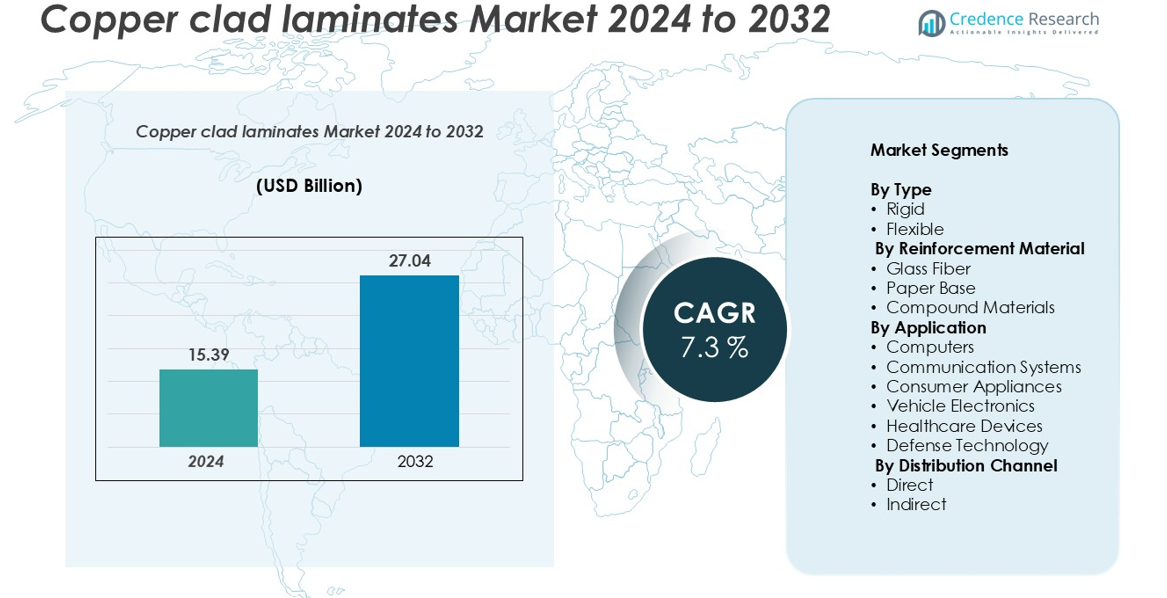
Copper Clad laminates market size was valued at USD 15.39 billion in 2024 and is anticipated to reach USD 27.04 billion by 2032, at a CAGR of 7.3% during the forecast period.
| REPORT ATTRIBUTE | DETAILS |
|---|---|
| Historical Period | 2020-2023 |
| Base Year | 2024 |
| Forecast Period | 2025-2032 |
| Copper Clad laminates market Size 2024 | USD 15.39 billion |
| Copper Clad laminates market, CAGR | 7.3% |
| Copper Clad laminates market Size 2032 | USD 27.04 billion |
The Copper Clad Laminates market is led by prominent players such as Isola, ITEQ, Kingboard Laminates, Nan Ya Plastics, Panasonic Corporation, Rogers, Resonac, Shengyi Technology, Shandong Jinbao Electronics, Cipel Italia, Doosan Electro-Materials, and Guangdong Chaohua Technology. These companies maintain competitive advantages through advanced R&D, product innovation, and strong global distribution networks. Asia-Pacific emerges as the dominant region, holding over 40% of the market share, driven by large-scale electronics manufacturing in China, Japan, South Korea, and India. North America accounts for approximately 25% of the market, supported by high demand in computing, telecommunications, and automotive electronics. Europe contributes around 20% through robust automotive and industrial electronics sectors, while Latin America and the Middle East & Africa hold 8% and 7%, respectively, benefiting from growing consumer electronics, infrastructure projects, and emerging manufacturing hubs. These top players strategically expand across regions to strengthen market presence and capture growth opportunities.
Market Insights
- The Copper Clad Laminates market was valued at USD 15.39 billion in 2024 and is projected to reach USD 27.04 billion by 2032, growing at a CAGR of 7.3% during the forecast period.
- Strong demand from consumer electronics, automotive electronics, and communication systems is driving market growth, with rigid laminates and glass fiber materials being the dominant sub-segments.
- Emerging trends include the adoption of flexible and high-density laminates, integration of eco-friendly materials, and growing opportunities in electric vehicles and 5G infrastructure.
- The market is highly competitive, led by key players such as Isola, ITEQ, Kingboard Laminates, Nan Ya Plastics, Panasonic Corporation, and Rogers, focusing on innovation, strategic partnerships, and expansion in regional hubs.
- Regionally, Asia-Pacific dominates with over 40% market share, followed by North America (25%), Europe (20%), Latin America (8%), and MEA (7%), supported by electronics manufacturing, automotive growth, and infrastructure development.
Market Segmentation Analysis:
By Type
The Copper Clad Laminates market, segmented by type, comprises rigid and flexible laminates. Rigid laminates dominate the market, accounting for approximately 65% of the total share, driven by their extensive use in printed circuit boards (PCBs) for computers, communication devices, and automotive electronics. The high mechanical strength, dimensional stability, and cost-effectiveness of rigid laminates make them a preferred choice in large-scale electronic assemblies. Flexible laminates, although witnessing growing adoption in wearable electronics and compact devices, currently occupy a smaller share due to higher manufacturing complexity and cost considerations.
- For instance, in 2023, the global market for copper clad laminates (CCL) reached a certain significant value. Within this market, the rigid copper clad laminate segment was the largest contributor, accounting for over 82% of the total market share in 2023.
By Reinforcement Material
Glass fiber, paper base, and compound materials form the reinforcement material segment. Glass fiber-based laminates hold the leading position, representing nearly 70% of the market, owing to their excellent thermal resistance, dimensional stability, and superior electrical insulation properties. Paper-based laminates, typically used in low-cost consumer appliances, and compound materials, applied in specialized industrial devices, account for the remaining share. The demand for glass fiber laminates is further fueled by the growing need for high-performance PCBs in communication systems, healthcare devices, and automotive electronics, emphasizing durability and reliability.
- For instance, in 2024, glass fiber fabric-based copper clad laminates accounted for 70.12% of the market share, by reinforcement material.
By Application
In terms of application, the Copper Clad Laminates market spans computers, communication systems, consumer appliances, vehicle electronics, healthcare devices, and defense technology. The computer segment dominates, capturing over 40% of the market share, driven by the ongoing growth of PC and server production and high demand for miniaturized, high-performance PCBs. Communication systems and consumer appliances follow closely, benefiting from 5G adoption, IoT deployment, and smart device proliferation. Vehicle electronics and healthcare devices are witnessing accelerated growth due to electric vehicle adoption and the rise of medical electronics, highlighting innovation as a key market driver
Key Growth Drivers
Rising Demand for Consumer Electronics
The surge in consumer electronics, including smartphones, laptops, tablets, and wearable devices, is a major driver for the Copper Clad Laminates (CCL) market. High-performance and miniaturized printed circuit boards (PCBs) require reliable laminates that offer excellent thermal and electrical properties. As manufacturers aim to improve device performance and reduce size and weight, rigid and flexible CCLs are increasingly adopted. Additionally, growing internet penetration, digitalization, and the proliferation of smart home devices are boosting demand. The consumer electronics sector’s focus on innovation and faster product cycles directly supports sustained growth in the CCL market, emphasizing laminates that provide durability, heat resistance, and high signal integrity.
- For instance, EMC has developed advanced copper clad laminates tailored for high-frequency applications in consumer electronics. Their materials are optimized for 5G smartphones, tablets, wearable devices, and high-density interconnect (HDI) notebooks. These laminates are engineered to meet the stringent requirements of modern electronic devices, ensuring reliable performance in compact and high-speed environments.
Expansion in Automotive and Electric Vehicle Electronics
The rapid adoption of electric vehicles (EVs) and advanced automotive electronics is fueling demand for copper clad laminates. EVs and hybrid vehicles rely heavily on sophisticated PCBs for battery management, infotainment systems, and advanced driver-assistance systems (ADAS). Rigid and flexible laminates with high thermal conductivity and electrical insulation properties are essential to meet these requirements. The automotive industry’s push for lightweight and compact electronic components further enhances the need for advanced laminates. As global EV sales continue to rise and vehicles become increasingly connected, CCL manufacturers are capitalizing on this growing segment, ensuring consistent market expansion driven by innovation and stringent quality standards.
- For instance, Resonac Corporation (formerly Showa Denko Materials) has developed specialized copper clad laminates designed for automotive electronics. Their products are utilized in control devices and Advanced Driver-Assistance Systems (ADAS), which are critical for autonomous and safety-focused vehicle technologies. These laminates are engineered to withstand the harsh conditions within automotive environments, such as high temperatures and vibration, providing reliable performance and contributing to the advancement of automotive electronics.
Growth in Telecommunication and Data Infrastructure
The expansion of 5G networks, fiber-optic communication, and data centers is a significant growth driver for the Copper Clad Laminates market. High-frequency and high-speed PCBs are critical for communication devices, servers, and networking equipment. Laminates with low dielectric loss and superior signal integrity are increasingly preferred to handle high-frequency signals efficiently. As telecom operators invest in network upgrades and data centers expand to support cloud computing and IoT applications, the demand for advanced laminates rises. This growth is reinforced by the need for miniaturized and high-performance electronic circuits, positioning CCLs as a core material for modern telecommunication and networking infrastructure.
Key Trends & Opportunities
Adoption of Flexible and High-Density Laminates
Flexible and high-density copper clad laminates are emerging as a notable trend in the market. Flexible laminates enable compact designs in wearable electronics, foldable devices, and automotive applications, while high-density laminates support miniaturized PCBs with complex circuitry. Manufacturers are increasingly investing in R&D to improve thermal performance, signal integrity, and mechanical strength of these advanced laminates. This trend opens opportunities for innovative applications across consumer electronics, healthcare devices, and electric vehicles. Additionally, as industries demand lighter, thinner, and more reliable electronic assemblies, flexible and high-density CCLs are expected to gain a larger share, driving long-term market growth.
- For instance, DuPont's Pyralux® TK copper-clad laminate features a proprietary layered dielectric comprising Kapton® polyimide and fluoropolymer films, achieving a very low dielectric loss (Df = 0.0015–0.002 @ 10 GHz) and high heat resistance (decomposition temperatures typically above 494°C). This makes it ideal for high-frequency, high-speed digital applications
Integration with Sustainable and Eco-Friendly Materials
Sustainability is becoming a crucial trend in the Copper Clad Laminates market, with manufacturers exploring eco-friendly and recyclable materials. The shift toward greener production processes, reduced use of hazardous chemicals, and energy-efficient manufacturing aligns with global environmental regulations. This trend presents opportunities to develop laminates that combine high performance with sustainability credentials, catering to environmentally conscious customers. Companies adopting these practices can differentiate themselves in competitive markets, particularly in consumer electronics and automotive sectors, where sustainability is increasingly influencing purchasing decisions.
- For instance, Jiva Materials Ltd has developed Soluboard®, which it claims is the world's first fully recyclable rigid PCB substrate. The material can be dissolved using hot water (specifically, 90°C water) within a controlled environment, enabling easy recovery of valuable components and metals. This technology offers up to a 67% lower carbon footprint compared to traditional glass-fiber and epoxy technologies (FR-4), a figure supported by Life Cycle Assessments performed in collaboration with the University of Portsmouth.
Expansion in Emerging Markets
Emerging economies in Asia-Pacific, Latin America, and the Middle East present significant opportunities for the CCL market. Increasing electronics manufacturing hubs, rising disposable incomes, and government initiatives to support digital infrastructure are driving local demand. Companies are leveraging these regions to expand production facilities, reduce costs, and meet regional demand. The growing adoption of smartphones, IoT devices, and electric vehicles in these markets offers a strategic opportunity for CCL manufacturers to capture new customer segments and enhance global market presence.
Key Challenges
Volatility in Raw Material Prices
Copper and resin prices significantly impact the production cost of Copper Clad Laminates. Fluctuations in global copper markets, supply chain disruptions, and rising resin costs can adversely affect profitability. Manufacturers often face challenges in maintaining stable pricing while ensuring quality standards. Small and medium-sized producers may struggle to absorb cost increases, leading to competitive pressures. This volatility can also influence end-product prices in electronics, potentially impacting overall demand growth. Managing raw material procurement, optimizing production efficiency, and strategic sourcing are essential to mitigate these risks.
Stringent Regulatory and Environmental Compliance
The CCL industry faces challenges related to strict environmental regulations, including limits on hazardous substances and waste management standards. Compliance with RoHS, REACH, and other environmental directives requires investment in sustainable production processes and monitoring systems. Failure to meet these standards can result in penalties, supply chain disruptions, or restricted market access. Additionally, the pressure to develop eco-friendly products while maintaining high performance increases operational complexity. Manufacturers must balance innovation, regulatory compliance, and cost efficiency to remain competitive in the global market.
Regional Analysis
North America
North America holds a significant share of the Copper Clad Laminates market, accounting for approximately 25% of global revenue. The region benefits from advanced electronics manufacturing, widespread adoption of high-performance computing systems, and the growing automotive electronics sector. Continuous investments in 5G infrastructure and defense technology drive demand for high-quality laminates. The presence of leading semiconductor and PCB manufacturers, coupled with stringent quality standards, supports market growth. Increasing demand for compact, reliable electronic devices and expansion of data centers further reinforce North America’s position as a key regional market for CCLs.
Europe
Europe captures around 20% of the global Copper Clad Laminates market, driven by robust automotive and industrial electronics sectors. The adoption of electric and hybrid vehicles, coupled with rising investments in renewable energy and smart grid technologies, fuels demand for high-performance laminates. Stringent regulatory frameworks on environmental sustainability encourage manufacturers to develop eco-friendly CCLs. Key industries, including defense, healthcare, and telecommunications, are adopting advanced PCBs that rely on durable and thermally stable laminates. Europe’s focus on research, innovation, and high-quality production standards ensures steady growth in the regional CCL market.
Asia-Pacific
Asia-Pacific dominates the global Copper Clad Laminates market with a share exceeding 40%, fueled by large-scale electronics manufacturing hubs in China, Japan, South Korea, and India. High demand for consumer electronics, smartphones, automotive electronics, and industrial automation drives rapid growth. Expanding 5G networks, increasing adoption of electric vehicles, and government initiatives promoting digital infrastructure further support the market. Competitive manufacturing costs, availability of raw materials, and strong presence of leading CCL producers consolidate the region’s market leadership. Continuous technological advancements and rising urbanization create additional opportunities for market expansion in the Asia-Pacific region.
Latin America Latin America holds approximately 8% of the Copper Clad Laminates market, supported by growing electronics manufacturing and communication infrastructure development. Expansion of consumer electronics, automotive electronics, and industrial automation is creating steady demand for high-quality laminates. Countries like Brazil and Mexico are investing in smart city projects and renewable energy initiatives, which indirectly boost PCB applications. Market growth is also driven by the presence of regional distributors and increasing awareness of advanced electronic solutions. While the region faces some supply chain and raw material cost challenges, emerging manufacturing facilities and technology adoption offer growth potential for CCLs.
Middle East & Africa (MEA)
The Middle East & Africa region accounts for around 7% of the global Copper Clad Laminates market. Growth is primarily driven by defense, telecommunications, and infrastructure development projects. Increasing government investments in smart cities, industrial automation, and energy-efficient electronics support demand for advanced laminates. While the market is relatively smaller compared to Asia-Pacific and North America, emerging electronics manufacturing hubs and foreign investments are creating new opportunities. Adoption of high-performance laminates in healthcare devices, automotive electronics, and communication systems is expected to expand, with focus on durability, thermal stability, and regulatory compliance driving regional market growth.
Market Segmentations:
By Type
- Rigid
- Flexible
By Reinforcement Material
- Glass Fiber
- Paper Base
- Compound Materials
By Application
- Computers
- Communication Systems
- Consumer Appliances
- Vehicle Electronics
- Healthcare Devices
- Defense Technology
By Distribution Channel
- Direct
- Indirect
By Geography
- North America
- U.S.
- Canada
- Mexico
- Europe
- UK
- France
- Germany
- Italy
- Spain
- Russia
- Belgium
- Netherlands
- Austria
- Sweden
- Poland
- Denmark
- Switzerland
- Rest of Europe
- Asia Pacific
- China
- Japan
- South Korea
- India
- Australia
- Thailand
- Indonesia
- Vietnam
- Malaysia
- Philippines
- Taiwan
- Rest of Asia Pacific
- Latin America
- Brazil
- Argentina
- Peru
- Chile
- Colombia
- Rest of Latin America
- Middle East
- UAE
- KSA
- Israel
- Turkey
- Iran
- Rest of Middle East
- Africa
- Egypt
- Nigeria
- Algeria
- Morocco
- Rest of Africa
Competitive Landscape
The Copper Clad Laminates market is highly competitive, characterized by the presence of global and regional players focusing on innovation, product differentiation, and strategic partnerships. Leading companies such as Isola, ITEQ, Kingboard Laminates, Nan Ya Plastics, Panasonic Corporation, and Rogers dominate the market, leveraging advanced R&D capabilities and strong distribution networks to maintain their market positions. Regional players, including Shengyi Technology, Shandong Jinbao Electronics, Cipel Italia, Doosan Electro-Materials, and Guangdong Chaohua Technology, compete by offering cost-effective solutions and catering to local demand. Companies are increasingly investing in high-performance laminates, flexible substrates, and eco-friendly materials to address evolving customer requirements in consumer electronics, automotive, telecommunications, and industrial applications. Strategic initiatives such as mergers, acquisitions, capacity expansions, and collaborations further intensify competition, while continuous innovation and quality improvement remain critical to sustaining long-term growth and market leadership.
Key Player Analysis
- Isola
- ITEQ
- Kingboard Laminates
- Nan Ya Plastics
- Panasonic Corporation
- Resonac
- Rogers
- Shandong Jinbao Electronics
- Shengyi Technology
- Cipel Italia
- Doosan Electro-Materials
- Guangdong Chaohua Technology
Recent Developments
- In June 2023, Doosan Corporation announced a strategic partnership with Vietnam's Hai Duong province to explore new business opportunities in advanced electro-material manufacturing. The collaboration was formalized through a Memorandum of Understanding (MOU) signed in Hanoi, coinciding with South Korean President Yoon Suk Yeol's state visit to Vietnam. This partnership underscores Doosan's strategic focus on expanding its presence in the global electro-materials market and aligns with Vietnam's goals of attracting foreign investment to boost economic development.
- In June 2023, Doosan Corporation Electro-Materials showcased its innovative products and technologies aimed at enhancing the customer experience in the 5G era and beyond. This presentation took place at IMS 2023, North America's largest Microwave/RF trade show. During the event, Doosan highlighted its advancements in 5G millimeter-wave (mmWave) antenna modules, a MEMS timing solution, and copper clad laminates (CCL) designed for high-speed and high-frequency applications. These technologies underscore Doosan's commitment to providing next-generation solutions for improved connectivity and advanced electronic performance.
Report Coverage
The research report offers an in-depth analysis based on Type, Reinforcement Material, Application, Distribution Channel and Geography. It details leading market players, providing an overview of their business, product offerings, investments, revenue streams, and key applications. Additionally, the report includes insights into the competitive environment, SWOT analysis, current market trends, as well as the primary drivers and constraints. Furthermore, it discusses various factors that have driven market expansion in recent years. The report also explores market dynamics, regulatory scenarios, and technological advancements that are shaping the industry. It assesses the impact of external factors and global economic changes on market growth. Lastly, it provides strategic recommendations for new entrants and established companies to navigate the complexities of the market.
Future Outlook
- Demand for high-performance laminates will increase with the growth of consumer electronics.
- Flexible and high-density laminates will see higher adoption in compact devices and wearable technology.
- Automotive electronics, including electric and hybrid vehicles, will drive sustained market growth.
- Expansion of 5G networks and advanced communication systems will boost demand for reliable PCBs.
- Manufacturers will focus on eco-friendly and recyclable laminates to meet environmental regulations.
- Technological advancements in thermal management and signal integrity will create new product opportunities.
- Emerging markets in Asia-Pacific, Latin America, and MEA will offer significant growth potential.
- Strategic collaborations, mergers, and capacity expansions will intensify market competition.
- Rising investment in smart devices, IoT, and industrial automation will increase CCL adoption.
- Continuous innovation and quality enhancement will remain critical to maintain market leadership.

Request a Free Sample
Fill in your details and we'll send you a free sample report.
- Sample data tables & charts
- Research methodology
Need a Custom Version of This Report?
Tailor the scope, geography, or segments to your exact requirements.
- Custom geography or segment scope
- Direct access to our analyst team
Frequently Asked Questions
What is the current market size for Copper Clad Laminates market, and what is its projected size in 2032?
At what Compound Annual Growth Rate is the Copper Clad Laminates market projected to grow between 2024 and 2032?
Which Copper Clad Laminates market segment held the largest share in 2024?
Who are the leading companies in the Copper Clad Laminates market?
Table of Content
Chapter 1 Market Segmentation
- 1.1 Segmentation Framework
- 1.1.1 Product and Service Classification
- 1.1.2 Application and End-Use Classification
- 1.1.3 Technology and Solution Classification
- 1.1.4 Customer and Distribution Channel Classification
- 1.1.5 Geographic Segmentation
- 1.1.6 Market Segment Definitions and Boundaries
Chapter 2 Introduction
- 2.1 Report Objectives and Scope
- 2.2 Product Definition and Industry Terminology
- 2.3 Market Inclusions and Exclusions
- 2.4 Research Process
- 2.4.1 Primary Research and Expert Interviews
- 2.4.2 Secondary Research and Source Review
- 2.4.3 Top-Down and Bottom-Up Estimation
- 2.4.4 Data Triangulation and Verification
- 2.5 Market Size Measurement Basis
- 2.5.1 2024: USD 15.39 billion → 2032: USD 27.04 billion
- 2.6 Historical and Forecast Reference Periods
- 2.6.1 Base Year: 2024
- 2.6.2 Forecast Period: 2024-2032
- 2.7 Research Assumptions and Limitations
Chapter 3 Executive Summary
- 3.1 Market Snapshot and Key Findings
- 3.2 Base-Year Market Size, 2024
- 3.3 Forecast Market Size, 2032
- 3.4 Revenue and Volume Growth Outlook
- 3.5 Key Demand and Supply Indicators
- 3.6 Leading Market Segments
- 3.7 Fastest-Growing Market Opportunities
- 3.8 Regional Performance Highlights
- 3.9 Technology and Industry Transformation
- 3.10 Competitive Landscape Summary
- 3.11 Analyst View and Strategic Implications
Chapter 4 Global Copper Clad laminates Market Trends and Developments
- 4.1 Historical Industry Development
- 4.2 Recent Market Trends and Developments
- 4.3 Demand and Customer Behavior Trends
- 4.4 Technology and Product Innovation
- 4.5 Artificial Intelligence, Automation and Digitalization
- 4.6 Local Manufacturing and Supply Chain Realignment
- 4.7 Industry Partnerships, Mergers and Acquisitions
- 4.8 Sustainability and Circular Economy Developments
- 4.9 Government and Private Sector Investment Trends
- 4.10 Emerging Business Models and Commercialization
- 4.11 Industry Developments and Announcements
Chapter 5 Global Copper Clad laminates Market Production, Supply and Demand Analysis
- 5.1 Demand Trend and Consumption Analysis
- 5.2 Demand Forecast, 2024-2032
- 5.3 Production and Output Trend
- 5.4 Production and Output Forecast, 2024-2032
- 5.5 Installed Capacity and Capacity Utilization
- 5.6 Company-Wise Production Plants and Statistics
- 5.6.1 Installed Production Capacity
- 5.6.2 Actual Production
- 5.6.3 Planned Capacity and Expansion Targets
- 5.7 Supply Chain Structure and Procurement Trends
- 5.8 Supply-Demand Gap and Bottlenecks
- 5.9 Import Dependence and Sourcing Structure
- 5.10 Contract Manufacturing and Outsourcing
- 5.11 Regional Supply and Demand Concentration
Chapter 6 Global Copper Clad laminates Market Pricing Analysis
- 6.1 Pricing Structure and Measurement
- 6.2 Historical Pricing Trends
- 6.3 Pricing Outlook, 2024-2032
- 6.4 Average Selling Price and Unit Economics
- 6.5 Pricing by Product and Market Segment
- 6.6 Geographic Pricing Differences
- 6.7 Key Input, Energy, Labor and Logistics Costs
- 6.8 Contract Pricing and Purchasing Models
- 6.9 Pricing Sensitivity and Competitive Positioning
- 6.10 Price, Margin and Profitability Implications
Chapter 7 Global Copper Clad laminates Market Dynamics
- 7.1 Market Growth Drivers
- 7.1.1 Demand-Side Drivers
- 7.1.2 Technology and Innovation Drivers
- 7.1.3 Infrastructure and Investment Drivers
- 7.1.4 Regulatory and Policy Drivers
- 7.2 Market Restraints
- 7.2.1 Cost and Affordability Constraints
- 7.2.2 Technology and Adoption Barriers
- 7.2.3 Supply Chain and Operational Constraints
- 7.3 Market Challenges
- 7.3.1 Competitive Pressure and Margin Erosion
- 7.3.2 Skills, Infrastructure and Implementation Gaps
- 7.4 Emerging Market Opportunities
- 7.5 Market Dynamics Impact and Time-Horizon Assessment
Chapter 8 Global Copper Clad laminates Value Chain Analysis
- 8.1 Industry Value Chain Overview
- 8.2 Upstream Suppliers and Critical Inputs
- 8.3 Technology and Component Providers
- 8.4 Manufacturing or Service Delivery
- 8.5 Distribution, Channel Partners and Integrators
- 8.6 Downstream Applications and End Users
- 8.7 Value Addition and Profit Pools
- 8.8 Vertical Integration and Outsourcing
- 8.9 Supplier Concentration and Risk
- 8.10 Supply Chain Localization and Resilience
Chapter 9 Global Copper Clad laminates Market Regulations and Policies
- 9.1 Relevant Laws, Standards and Compliance Frameworks
- 9.2 Product, Service, Safety and Quality Requirements
- 9.3 Government Policies, Incentives and Subsidies
- 9.4 Imports, Exports and Trade Barriers
- 9.5 Public Procurement and Local Content Requirements
- 9.6 Environmental and Sustainability Compliance
- 9.7 Upcoming Policy Changes and Market Implications
Chapter 10 Global Copper Clad laminates Market Hotspots and Opportunities
- 10.1 Market Opportunity Mapping and Growth Hotspots
- 10.2 High-Growth Applications and Customer Groups
- 10.3 Underserved Markets and White-Space Opportunities
- 10.4 Emerging Technology and Product Opportunities
- 10.5 New Capacity and Investment Hotspots
- 10.6 Market Entry and Expansion Opportunities
- 10.7 Distribution and Partnership Opportunities
- 10.8 Near-Term and Long-Term Commercial Potential
- 10.9 Opportunity Attractiveness and Execution Risks
Chapter 11 Global Copper Clad laminates Market Outlook, 2024-2032
- 11.1 Market Size and Analysis
- 11.1.1 Revenue (Market Measurement: 2024: USD 15.39 billion → 2032: USD 27.04 billion)
- 11.1.2 Market Volume and Quantity Sold
- 11.1.3 Historical Market Size
- 11.1.4 Base-Year Market Size, 2024
- 11.2 Market Forecast, 2024-2032
- 11.2.1 Revenue Forecast to 2032
- 11.2.2 Volume Forecast to 2032
- 11.2.3 CAGR and Year-on-Year Growth
- 11.2.4 Incremental Revenue Opportunity
- 11.3 Forecast Assumptions and Scenario Analysis
- 11.3.1 Base-Case Forecast
- 11.3.2 Optimistic and Conservative Scenarios
- 11.3.3 Technology, Pricing and Policy Sensitivities
- 11.4 Market Attractiveness and Growth Outlook
Chapter 12 Global Copper Clad laminates Market Segmentation and Outlook
- 12.1 Segmentation Summary and Market Shares, 2024
- 12.2 Largest and Fastest-Growing Segments
- 12.3 Segment Growth Comparison
- 12.4 Segment Attractiveness and Priority Matrix
Chapter 13 Global Copper Clad laminates Geographic Market Outlook, 2024-2032
- 13.1 Regional Market Size and Share, 2024
- 13.2 Regional Market Forecast, 2024-2032
- 13.3 Regional Pricing, Production and Demand Differences
- 13.4 North America
- 13.4.1 United States
- 13.4.2 Canada
- 13.4.3 Mexico
- 13.5 Europe
- 13.5.1 Germany
- 13.5.2 France
- 13.5.3 Italy
- 13.5.4 United Kingdom
- 13.5.5 Spain
- 13.5.6 Poland
- 13.5.7 Russia
- 13.5.8 Netherlands
- 13.5.9 Belgium
- 13.5.10 Sweden
- 13.5.11 Denmark
- 13.5.12 Norway
- 13.5.13 Rest of Europe
- 13.6 Asia Pacific
- 13.6.1 China
- 13.6.2 India
- 13.6.3 Japan
- 13.6.4 South Korea
- 13.6.5 Thailand
- 13.6.6 Indonesia
- 13.6.7 Vietnam
- 13.6.8 Malaysia
- 13.6.9 Australia
- 13.6.10 Rest of Asia Pacific
- 13.7 Latin America
- 13.7.1 Brazil
- 13.7.2 Argentina
- 13.7.3 Colombia
- 13.7.4 Chile
- 13.7.5 Rest of Latin America
- 13.8 Middle East
- 13.8.1 Saudi Arabia
- 13.8.2 United Arab Emirates
- 13.8.3 Turkey
- 13.8.4 Israel
- 13.8.5 Iran
- 13.8.6 Rest of the Middle East
- 13.9 Africa
- 13.9.1 South Africa
- 13.9.2 Egypt
- 13.9.3 Nigeria
- 13.9.4 Morocco
- 13.9.5 Rest of Africa
- 13.10 Regional Investment, Policy and Supply Chain Differences
- 13.11 Regional Competitive Landscape
- 13.12 Geographic Growth Hotspots
Chapter 14 Global Copper Clad laminates Technology, Innovation and Sustainability Outlook
- 14.1 Technology Landscape and Maturity
- 14.2 Product, Process and Service Innovation
- 14.3 AI, Automation and Digital Tools in the Industry
- 14.4 Technology Adoption and Performance Benchmarking
- 14.5 Innovation Pipeline and R&D Investment
- 14.6 Patent and Intellectual Property Trends
- 14.7 Energy Efficiency and Resource Management
- 14.8 Sustainability, Recycling and Circularity
- 14.9 Technology Roadmap, 2024-2032
- 14.10 Risks of Obsolescence and Technology Substitution
Chapter 15 Global Copper Clad laminates Market Key Strategic Imperatives
- 15.1 Growth and Market Entry Priorities
- 15.2 High-Return Products and Segments
- 15.3 Pricing, Profitability and Cost Optimization
- 15.4 Technology Investment and Product Differentiation
- 15.5 Supply Chain Localization and Resilience
- 15.6 Distribution and Customer Acquisition
- 15.7 Partnership, Acquisition and Capacity Strategy
- 15.8 Regional Expansion Priorities
- 15.9 Short-, Medium- and Long-Term Actions
Chapter 16 Competition Outlook
- 16.1 Industry Competition Characteristics
- 16.2 Market Structure and Concentration
- 16.3 Market Share and Competitive Positioning, 2024
- 16.4 Company-Wise Revenue and Product Benchmarking
- 16.5 Production and Service Capacity Benchmarking
- 16.6 Technology, Pricing and Differentiation
- 16.7 Regional Footprint and Distribution Strength
- 16.8 Mergers, Acquisitions and Strategic Alliances
- 16.9 New Entrants and Competitive Threats
- 16.10 Porter's Five Forces and Industry Attractiveness
- 16.11 Competitive Outlook, 2024-2032
Chapter 17 Company Profiles
- 17.1 Company Coverage and Selection Criteria
- 17.2 Leading Market Participants – Standard Profile Structure
- 17.2.1 Business Description
- 17.2.2 Company Ownership and Geographic Presence
- 17.2.3 Product and Service Portfolio
- 17.2.4 Manufacturing and Operating Footprint
- 17.2.5 Production Capacity and Expansion Plans
- 17.2.6 Financial Performance and Investment
- 17.2.7 Market Share and Competitive Position
- 17.2.8 Technology and Innovation Capabilities
- 17.2.9 Strategic Alliances or Partnerships
- 17.2.10 Recent Developments
- 17.2.11 Growth Strategy and Outlook
- 17.3 Other Relevant Market Participants
Note: Every listed company is profiled on the structure shown under the first company. The company list is preliminary and may change based on research findings, market developments, data availability and client requirements.
Chapter 18 Disclaimer
- 18.1 Research and Forecast Disclaimer
- 18.2 Data Source and Estimation Limitations
Note: The depth of individual sections depends on data availability for this market. Volume, capacity, trade and other unit-based metrics are included where applicable.

