
Market Overview
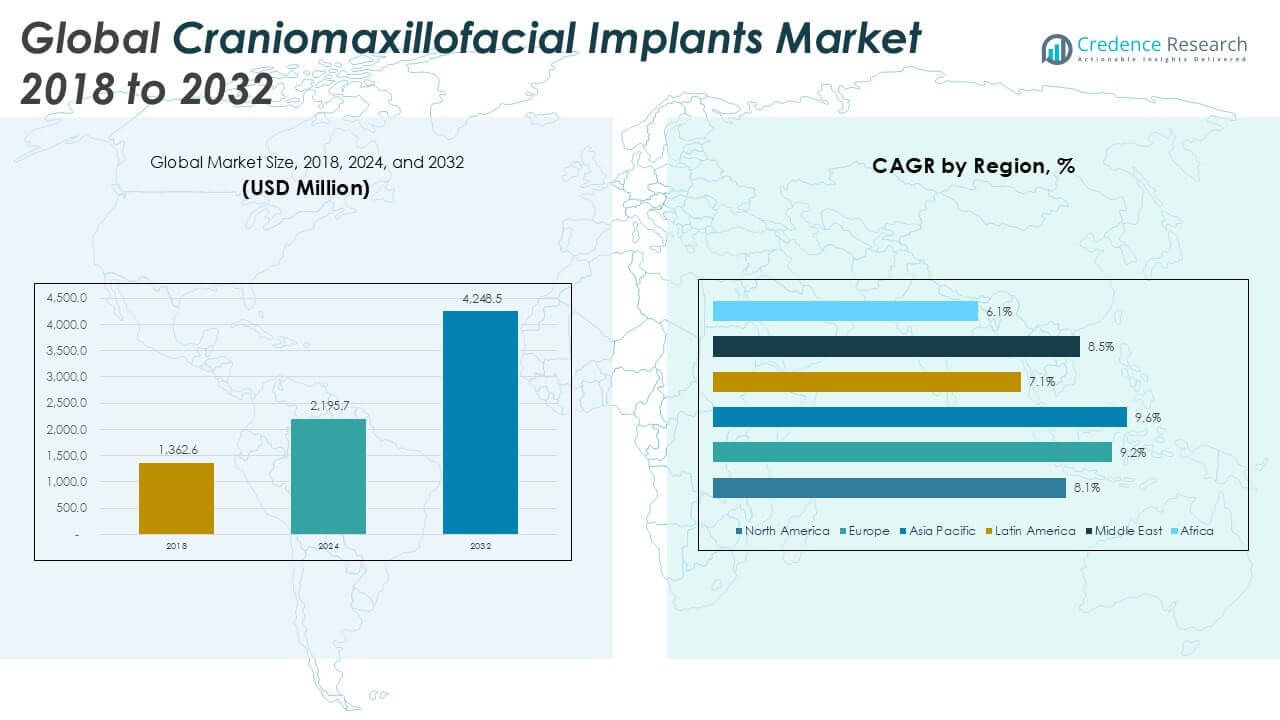
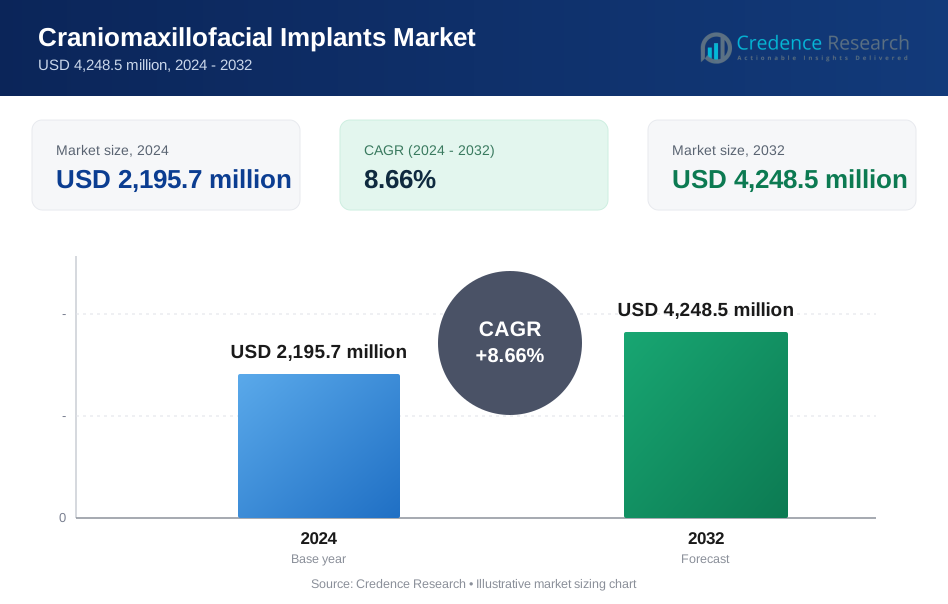
The Craniomaxillofacial Implants market size was valued at USD 1,362.6 million in 2018, reached USD 2,195.7 million in 2024, and is anticipated to reach USD 4,248.5 million by 2032, at a CAGR of 8.66% during the forecast period.
| REPORT ATTRIBUTE | DETAILS |
|---|---|
| Historical Period | 2020-2023 |
| Base Year | 2024 |
| Forecast Period | 2025-2032 |
| Craniomaxillofacial Implants Market Size 2024 | USD 2,195.7 Million |
| Craniomaxillofacial Implants Market, CAGR | 8.66% |
| Craniomaxillofacial Implants Market Size 2032 | USD 4,248.5 Million |
The Craniomaxillofacial Implants market is led by prominent players such as Stryker, DePuy Synthes, Zimmer Biomet, Medartis AG, Integra LifeSciences, KLS Martin, OsteoMed, and Anatomics Pty Ltd. These companies maintain their competitive edge through innovations in implant materials, adoption of 3D printing technologies, and expansion into emerging markets. North America remains the dominant regional market, accounting for 31.7% of the global market share in 2024, driven by advanced healthcare infrastructure and high procedural volumes. Europe follows with a 27.0% share, supported by regulatory advancements and rising demand for reconstructive surgeries.
Market Insights
- The Craniomaxillofacial Implants market was valued at USD 2,195.7 million in 2024 and is projected to reach USD 4,248.5 million by 2032, growing at a CAGR of 8.66% during the forecast period.
- Market growth is primarily driven by the rising incidence of facial trauma, increasing reconstructive surgeries, and advancements in bioabsorbable and patient-specific implant technologies.
- Trends include growing adoption of 3D-printed implants, use of surgical planning software, and the rising demand for aesthetic facial corrections in both developed and emerging economies.
- The competitive landscape is shaped by global players like Stryker, Zimmer Biomet, and DePuy Synthes, with innovations focused on titanium mesh, custom implants, and bioresorbable materials; however, high costs and regulatory complexity restrain broader market penetration.
- Regionally, North America led with 31.7% of the market in 2024, followed by Europe (27.0%) and Asia Pacific (24.4%); by product, mandibular implants held the largest share due to high trauma case volumes.
Market Segmentation Analysis:
By Product:
In the Craniomaxillofacial Implants market, mandibular implants held the dominant share among product types in 2024, accounting for the largest portion of global revenue. This dominance is attributed to the high incidence of mandibular fractures resulting from road accidents and facial trauma, along with the increasing number of reconstructive surgeries. Cranial implants and distraction systems are also experiencing notable growth due to rising applications in neurosurgery and pediatric craniofacial corrections. Based on location, internal fixators emerged as the leading segment, driven by their superior stability and widespread use in rigid bone fixation procedures, particularly in complex craniofacial reconstructions.
- For instance, Zimmer Biomet’s Vitoss BA system, which includes titanium-reinforced structures, has been adopted in more than 80,000 reconstructive procedures worldwide due to its proven load-bearing performance.
By Material
Among materials used, metal-based craniomaxillofacial implants dominated the market in 2024, holding a substantial market share. Titanium, in particular, is widely used due to its excellent biocompatibility, strength, and corrosion resistance, making it ideal for load-bearing facial implant applications. However, bioabsorbable materials are gaining traction due to their ability to degrade naturally in the body, eliminating the need for secondary removal surgeries. Despite this growing trend, metals remain the preferred choice in most surgical procedures, especially in trauma and oncology-related reconstructions, where durability and long-term stability are critical.
- For instance, DePuy Synthes’ MatrixMANDIBLE system has been deployed in more than 60 trauma centers globally, supporting complex reconstructions in over 90,000 trauma cases since its launch.
By End User
Hospitals constituted the largest end user segment in the Craniomaxillofacial Implants market in 2024, capturing the highest revenue share. Their dominance is fueled by the availability of advanced surgical infrastructure, skilled healthcare professionals, and a higher patient inflow for both trauma and elective surgeries. The growth of specialized maxillofacial departments within hospitals further supports the adoption of advanced implant systems. Ambulatory surgery centres are also witnessing steady growth due to increasing preference for minimally invasive outpatient procedures, faster recovery times, and reduced costs, though they continue to trail hospitals in terms of procedural volume and complexity.
Market Overview
Key Growth Drivers
Rising Incidence of Facial Trauma and Accidents
The increasing number of road accidents, sports injuries, and interpersonal violence cases globally has significantly boosted the demand for craniomaxillofacial implants. Facial fractures, particularly those involving the mandible, maxilla, and zygomatic bones, often require surgical intervention with implantable devices. According to the World Health Organization, road traffic injuries are a leading cause of hospitalizations among adults, directly contributing to a rise in maxillofacial surgical procedures. This growing burden of trauma cases across both developed and emerging markets continues to drive the adoption of advanced implants for structural restoration.
- For instance, KLS Martin’s IPS Implants have supported over 30,000 custom reconstructions globally using 3D CAD planning and direct metal laser sintering technology.
Technological Advancements in Implant Materials and 3D Printing
Innovation in biomaterials and manufacturing techniques is reshaping the craniomaxillofacial implants landscape. The advent of titanium mesh implants, bioabsorbable polymers, and patient-specific 3D-printed implants has enhanced surgical outcomes and reduced complications. Custom implants tailored through 3D imaging and CAD/CAM technologies ensure anatomical precision and improved post-operative recovery. Furthermore, the use of resorbable materials eliminates the need for secondary surgeries, making treatments more efficient. These technological breakthroughs have not only improved treatment efficacy but also widened the scope of applications across trauma, oncology, and cosmetic procedures.
Growing Demand for Reconstructive and Aesthetic Procedures
The expanding population undergoing facial reconstruction for congenital anomalies, tumor resections, and cosmetic enhancements is contributing to sustained market growth. Increasing social acceptance and awareness of facial aesthetics, along with higher disposable incomes, have driven the uptake of surgical implants for both medical and elective purposes. Countries like the U.S., Brazil, and South Korea have witnessed a surge in facial aesthetic surgeries, many of which involve implant-based corrections. This trend is further supported by advancements in minimally invasive techniques, which have made reconstructive and cosmetic procedures more accessible and appealing.
Key Trends & Opportunities
Adoption of Patient-Specific Implants and Surgical Planning Software
There is a growing trend toward the use of patient-specific implants (PSIs) developed through pre-surgical virtual planning and 3D imaging. These implants offer superior anatomical fit and reduce intraoperative time and complications. Integration of surgical planning software enables surgeons to simulate procedures, enhancing accuracy and confidence. Companies are increasingly investing in platforms that combine CT imaging with 3D-printed solutions, creating a streamlined workflow for complex reconstructions. This customization trend not only improves clinical outcomes but also represents a lucrative opportunity for device manufacturers to differentiate through precision-based solutions.
- For instance, Medartis AG has implemented its Modus 3D PSI workflow in over 25 countries, enabling over 12,000 successful patient-specific implant surgeries using AI-enhanced planning tools.
Expansion of Healthcare Infrastructure in Emerging Markets
Emerging economies across Asia-Pacific, Latin America, and the Middle East are investing heavily in healthcare infrastructure, increasing access to advanced surgical care. Government initiatives to improve trauma care units and reconstructive surgery centers are expanding the potential customer base for craniomaxillofacial implant providers. Additionally, medical tourism in countries like India and Thailand, driven by affordable and high-quality surgical procedures, is creating new avenues for growth. The rise in trained maxillofacial surgeons and improved hospital capabilities in these regions offer untapped potential for market expansion over the coming years.
- For instance, OsteoMed partnered with over 180 hospitals across India and Southeast Asia since 2020, deploying over 40,000 implants through localized manufacturing hubs and regional surgeon training programs.
Key Challenges
High Cost of Implants and Surgical Procedures
The cost-intensive nature of craniomaxillofacial implants and associated surgical procedures remains a significant barrier, particularly in low- and middle-income countries. High expenses related to 3D imaging, custom implant fabrication, and post-operative care often make such treatments inaccessible to a broad patient base. Insurance coverage for reconstructive or cosmetic maxillofacial surgeries is also limited in many regions, further restricting market penetration. These financial constraints hinder widespread adoption, especially in public healthcare settings where budget limitations impact procurement decisions.
Stringent Regulatory Approvals and Compliance Burdens
Craniomaxillofacial implants are classified as high-risk medical devices, subject to stringent regulatory scrutiny. Regulatory bodies such as the U.S. FDA and the European Medicines Agency require extensive clinical trials and documentation to ensure patient safety. This leads to long approval timelines and high compliance costs for manufacturers. Additionally, differences in regulatory standards across regions complicate global market entry and delay commercialization. These barriers can stifle innovation and discourage small and mid-sized companies from entering or expanding in the market.
Post-Surgical Complications and Implant Failures
Despite advances in materials and design, post-surgical complications such as infection, implant rejection, and hardware failure continue to challenge the market. These complications not only compromise patient outcomes but also increase healthcare costs due to revision surgeries and prolonged hospitalization. Factors such as poor bone quality, incorrect implant placement, or patient non-compliance with post-operative care can contribute to implant failure. The risk of complications often deters both patients and providers from adopting implant-based solutions, particularly in elective and aesthetic cases.
Regional Analysis
North America
North America held the largest share in the Craniomaxillofacial Implants market, accounting for approximately 31.7% of the global market in 2024. The market grew from USD 444.21 million in 2018 to USD 696.61 million in 2024, and it is projected to reach USD 1,298.35 million by 2032, registering a CAGR of 8.1%. This growth is driven by advanced healthcare infrastructure, high incidence of facial trauma, and strong adoption of 3D-printed and patient-specific implants. The U.S. leads regional demand, supported by the presence of key manufacturers and favorable reimbursement policies for surgical procedures.
Europe
Europe captured approximately 27.0% of the global Craniomaxillofacial Implants market in 2024, with a market size that rose from USD 355.78 million in 2018 to USD 591.09 million in 2024, and is forecasted to reach USD 1,189.58 million by 2032, expanding at a CAGR of 9.2%. The region benefits from well-established healthcare systems, growing cosmetic surgery volumes, and regulatory support for innovation in bioabsorbable implants. Countries like Germany, the UK, and France are key contributors due to increasing trauma cases, aging populations, and the availability of advanced surgical planning technologies.
Asia Pacific
Asia Pacific accounted for about 24.4% of the global Craniomaxillofacial Implants market share in 2024. The market expanded from USD 314.76 million in 2018 to USD 534.50 million in 2024, and is anticipated to reach USD 1,104.61 million by 2032, reflecting a CAGR of 9.6%, the highest among all regions. This robust growth is driven by increasing healthcare expenditure, rising incidence of road accidents, and growing adoption of reconstructive surgeries. China, India, and Japan represent the core of regional demand, supported by large patient populations and growing investments in trauma care and medical tourism.
Latin America
Latin America represented around 9.6% of the global market share in 2024, growing from USD 141.98 million in 2018 to USD 211.67 million in 2024, and is projected to reach USD 365.37 million by 2032, with a CAGR of 7.1%. The region’s growth is supported by an expanding network of private hospitals, growing interest in cosmetic surgery, and gradual improvements in healthcare access. Brazil and Mexico are the leading contributors, fueled by rising surgical volumes, improving medical technologies, and increased awareness of facial reconstructive options for trauma and congenital deformities.
Middle East
The Middle East accounted for approximately 3.9% of the global Craniomaxillofacial Implants market in 2024. The market grew from USD 63.63 million in 2018 to USD 101.51 million in 2024, and is estimated to reach USD 193.73 million by 2032, advancing at a CAGR of 8.5%. The region is witnessing increased adoption of facial implants driven by rising accident-related injuries, improving healthcare infrastructure, and growing numbers of specialized maxillofacial surgeons. Countries such as the UAE and Saudi Arabia are driving market growth, leveraging strategic investments in advanced surgical care and medical device importation.
Africa
Africa contributed about 2.7% to the global Craniomaxillofacial Implants market in 2024. The market increased from USD 42.24 million in 2018 to USD 60.35 million in 2024, and is expected to reach USD 96.87 million by 2032, registering a CAGR of 6.1%, the slowest among all regions. Limited access to advanced surgical facilities and high costs of implants remain key barriers. However, growth is gradually improving due to international aid programs, non-profit medical missions, and investments in trauma centers. South Africa and Egypt are emerging as focal points for surgical innovation and patient outreach in maxillofacial care.
Market Segmentations:
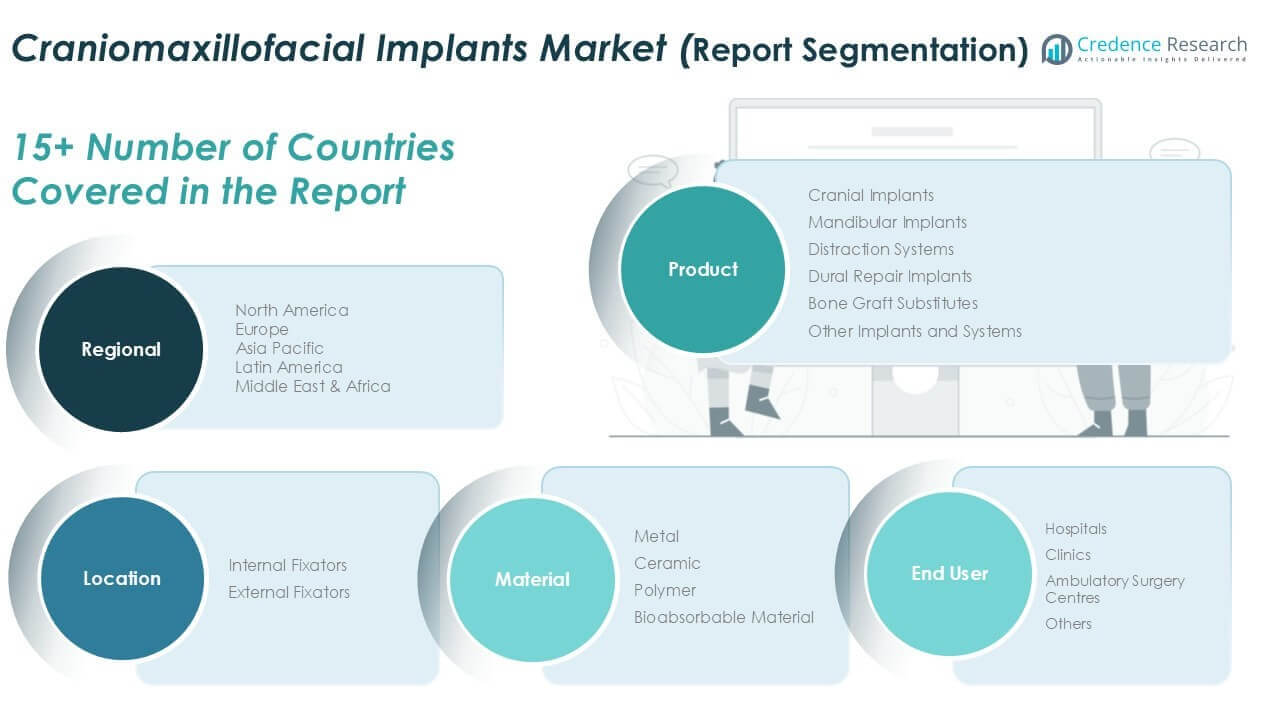
By Product
- Cranial Implants
- Mandibular Implants
- Distraction Systems
- Dural Repair Implants
- Bone Graft Substitutes
- Other Implants and Systems
By Location
- Internal Fixators
- External Fixators
By Material
- Metal
- Ceramic
- Polymer
- Bioabsorbable Material
By End User
- Hospitals
- Clinics
- Ambulatory Surgery Centres
- Others
By Geography
- North America
- U.S.
- Canada
- Mexico
- Europe
- Germany
- France
- U.K.
- Italy
- Spain
- Rest of Europe
- Asia Pacific
- China
- Japan
- India
- South Korea
- South-east Asia
- Rest of Asia Pacific
- Latin America
- Brazil
- Argentina
- Rest of Latin America
- Middle East & Africa
- GCC Countries
- South Africa
- Rest of the Middle East and Africa
Competitive Landscape
The Craniomaxillofacial Implants market is characterized by a moderately consolidated competitive landscape, with several global and regional players vying for technological leadership and market share. Leading companies such as Stryker, DePuy Synthes, Zimmer Biomet, and Medartis AG dominate the market through broad product portfolios, extensive distribution networks, and continuous investment in R&D. These players focus on innovation in implant materials, patient-specific solutions, and minimally invasive technologies to enhance clinical outcomes. Strategic collaborations, acquisitions, and partnerships with hospitals and surgical centers are common approaches to enhance product reach and brand recognition. Startups and regional manufacturers, including Anatomics Pty Ltd. and Matrix Surgical USA, are also gaining traction by offering customized 3D-printed implants and cost-effective alternatives. Overall, the market remains competitive, with differentiation driven by innovation, regulatory compliance, and surgeon-focused solutions.
Key Player Analysis
- Anatomics Pty Ltd.
- Novartis AG
- Braun Melsungen AG
- Stryker
- KLS Martin
- DePuy Synthes
- Zimmer Biomet
- Integra LifeSciences
- OsteoMed
- Medartis AG
- Matrix Surgical USA
Recent Developments
- In June 2025, B. Braun remains a significant player in the craniomaxillofacial (CMF) devices market, particularly known for its advancements in plate and screw fixation systems and bone graft substitutes. The company is recognized for its contributions to market growth through innovative implant designs and materials, with bone graft substitutes expected to experience rapid expansion through 2030.
- In the 2024-2025 period, DePuy Synthes is focusing on advancing cranio-maxillofacial (CMF)implant systems, particularly with patient-specific and 3D-printed solutions. The company is integrating digital planning and manufacturing to support complex craniofacial reconstructions. This includes the use of 3D-printed titanium implants based on patient CT scans, and the collaboration with Materialise for delivering these implants through DePuy Synthes TRUMATCH CMF Solutions.
- In July 2023, Anatomics was recognized for its continued innovation in patient-specific surgical implants, specifically those derived from CT scans, and for its focus on customized solutions and advanced materials. The company received government grants to commercialize its StarPore® porous high-density polyethylene technology, which is designed to integrate with patient tissue for craniofacial bone repair and augmentation according to Anatomics.
- In October 2022, Zimmer Biomet partnered with a 3D printing company to develop customized implants for craniomaxillofacial (CMF) applications, according to a medical device news source. This collaboration aimed to leverage 3D printing technology to create personalized implants for patients needing reconstructive surgery in the skull and face area.
Market Concentration & Characteristics
The Craniomaxillofacial Implants market shows a moderate to high level of concentration, with a few dominant players holding significant global market share. Companies such as Stryker, DePuy Synthes, Zimmer Biomet, and Medartis AG lead the space due to their extensive product portfolios, technological capabilities, and strong distribution networks. It reflects a market where innovation, surgeon preference, and regulatory compliance drive purchasing decisions. Key characteristics include a focus on patient-specific solutions, growing reliance on 3D printing technologies, and strong demand in both trauma and elective procedures. The market favors firms that can offer precision, biocompatibility, and regulatory-cleared products. Emerging players focus on niche offerings and regional expansion but face challenges related to clinical validation and market access. Regulatory requirements remain stringent across major markets, influencing development timelines and entry strategies. It also exhibits a steady demand pattern driven by accident-related trauma, congenital defect repairs, and increasing facial aesthetic surgeries. High product costs and the need for skilled surgical teams limit widespread adoption in price-sensitive regions, although growth opportunities remain strong in Asia Pacific and parts of Latin America.
Report Coverage
The research report offers an in-depth analysis based on Product, Location, Material and Geography. It details leading market players, providing an overview of their business, product offerings, investments, revenue streams, and key applications. Additionally, the report includes insights into the competitive environment, SWOT analysis, current market trends, as well as the primary drivers and constraints. Furthermore, it discusses various factors that have driven market expansion in recent years. The report also explores market dynamics, regulatory scenarios, and technological advancements that are shaping the industry. It assesses the impact of external factors and global economic changes on market growth. Lastly, it provides strategic recommendations for new entrants and established companies to navigate the complexities of the market.
Future Outlook
- The market will continue to expand due to rising global cases of facial trauma and road accidents.
- Demand for patient-specific implants will increase as 3D printing and surgical planning tools become more accessible.
- Metal implants, especially titanium-based products, will retain dominance due to their strength and biocompatibility.
- Bioabsorbable materials will gain traction as surgeons seek alternatives that eliminate the need for secondary surgeries.
- Growth in cosmetic and reconstructive facial procedures will drive demand across developed and emerging regions.
- Asia Pacific will witness the fastest growth supported by improving healthcare infrastructure and growing medical tourism.
- Hospitals will remain the primary end users, although ambulatory surgical centers will see rising adoption rates.
- Key players will focus on mergers, acquisitions, and partnerships to strengthen global presence and product range.
- Technological innovation will continue to shape product development, especially in imaging-guided and minimally invasive solutions.
- Regulatory compliance will remain a critical factor influencing market entry, product approval, and long-term success.
Request a Free Sample
Fill in your details and we'll send you a free sample report.
- Sample data tables & charts
- Research methodology
Need a Custom Version of This Report?
Tailor the scope, geography, or segments to your exact requirements.
- Custom geography or segment scope
- Direct access to our analyst team
Frequently Asked Questions
What is the current size of the Craniomaxillofacial Implants Market?
What factors are driving the growth of the Craniomaxillofacial Implants Market?
What are the key segments within the Craniomaxillofacial Implants Market?
What are some challenges faced by the Craniomaxillofacial Implants Market?
Who are the major players in the Craniomaxillofacial Implants Market?
Table of Content
Chapter 1. Report Introduction
- 1.1 Report Description & Purpose
- 1.1.1 Report Title & Market Definition
- 1.1.2 Unique Selling Propositions (USP) & Key Differentiators
- 1.1.3 Value Proposition for Stakeholders
- 1.2 Research Objectives
- 1.2.1 Market Sizing Objectives (Volume & Revenue)
- 1.2.2 Segmentation Objectives
- 1.2.3 Competitive Intelligence Objectives
- 1.2.4 Forecast & Scenario Objectives
- 1.3 Report Scope
- 1.3.1 Craniomaxillofacial Implants Scope – Types & Subtypes Covered
- 1.3.2 Geographic Scope – Regions & Countries Covered
- 1.3.3 Historical Period, Base Year & Forecast Period (2024; forecast to 2032)
- 1.3.4 Inclusions & Exclusions
- 1.4 HS Code & Classification Framework
- 1.5 Currency, Units & Pricing Basis
- 1.6 Target Stakeholders
- 1.7 Limitations & Assumptions
Chapter 2. Executive Summary
- 2.1 Global Craniomaxillofacial Implants Market Snapshot
- 2.1.1 Market Size – Historical (2024) & Forecast (2024-2032) (2024: USD 2,195.7 million → 2032: USD 4,248.5 million)
- 2.1.2 Volume & Revenue – Global Totals
- 2.1.3 Key Market Highlights – Top Five Facts
- 2.2 Craniomaxillofacial Implants Market Segmentation Snapshot
- 2.2.1 Market Split by Region – 2024 vs. 2032
- 2.3 Competitive Snapshot
- 2.3.1 Top 10 Players by Revenue Share – 2024
- 2.3.2 Top 10 Players by Volume Share – 2024
- 2.3.3 Recent Strategic Developments (18-Month Summary)
- 2.4 Key Investment Highlights & Strategic Conclusions
Chapter 3. Craniomaxillofacial Implants Market Dynamics & Industry Analysis
- 3.1 Market Overview & Context
- 3.1.1 Craniomaxillofacial Implants Market Position in the Broader Automotive Value Chain
- 3.1.2 OEM vs. Replacement Market Dynamics
- 3.1.3 Market Maturity & Development Stage by Region
- 3.2 Craniomaxillofacial Implants Market Drivers
- 3.3 Craniomaxillofacial Implants Market Restraints & Challenges
- 3.4 Craniomaxillofacial Implants Market Opportunities
- 3.5 Porter's Five Forces Analysis
- 3.5.1 Threat of New Entrants
- 3.5.2 Bargaining Power of Suppliers
- 3.5.3 Bargaining Power of Buyers
- 3.5.4 Threat of Substitutes
- 3.5.5 Competitive Rivalry – Intensity Assessment
- 3.6 Craniomaxillofacial Implants Value Chain Analysis
- 3.6.1 Upstream – Raw Material/Input Suppliers
- 3.6.1.1 Raw Material/Input 1
- 3.6.1.2 Raw Material/Input 2
- 3.6.1.3 Raw Material/Input 3
- 3.6.2 Midstream – Production/Manufacturing/Service Delivery
- 3.6.2.1 Production/Process Overview
- 3.6.2.2 Key Facility Locations & Capacity by Manufacturer
- 3.6.3 Downstream – Distribution & End Consumer
- 3.6.3.1 Primary Channel – B2B/OEM
- 3.6.3.2 Secondary Channels – Dealer, Retail, Online, Direct
- 3.6.4 Value Chain Profitability Analysis
- 3.6.1 Upstream – Raw Material/Input Suppliers
- 3.7 PESTEL Analysis
- 3.7.1 Political Factors
- 3.7.2 Economic Factors
- 3.7.3 Social Factors
- 3.7.4 Technological Factors
- 3.7.5 Environmental Factors
- 3.7.6 Legal Factors
- 3.8 Craniomaxillofacial Implants Supply Chain Analysis
- 3.8.1 Raw Material/Input Supply Risk Assessment
- 3.8.2 Manufacturing Concentration Risk (Geographic Exposure)
- 3.8.3 Trade Disruption Impact Analysis
- 3.9 Regulatory & Policy Landscape
Note: The regulatory and policy landscape section covers regulations based on their applicability to the market, Craniomaxillofacial Implants category, geography, and scope of the study. Only regulatory frameworks with a material impact on operations, compliance, trade, sustainability, or market access are analyzed in detail.
Chapter 4. Key Investment Pockets & Opportunity Analysis
- 4.1 Craniomaxillofacial Implants Market Attractiveness Analysis
- 4.1.1 By Region – Investment Attractiveness Matrix (Volume × CAGR)
- 4.2 Absolute Revenue Growth Opportunity
- 4.2.1 By Region – Absolute USD Growth Through 2032
- 4.3 Incremental Volume Opportunity
- 4.3.1 By Region – Incremental Volume Through 2032
- 4.3.2 Segment – Incremental Volume
- 4.4 Emerging Submarket Opportunity Deep Dive (Subject to Applicability)
- 4.5 Emerging Market Opportunity Scorecards
- 4.5.1 United States
- 4.5.2 Europe
- 4.5.3 Asia
- 4.5.4 Middle East & Africa
Note: Emerging Market Opportunity Scorecards will be included based on relevance and strategic importance. Regions listed are indicative and may vary depending on data availability and market dynamics.
Chapter 5. Craniomaxillofacial Implants Import-Export Analysis & Trade Flows
- 5.1 Global Trade Overview
- 5.1.1 Global Export Value by Country (2024)
- 5.1.2 Global Export Volume by Country (2024)
- 5.1.3 Global Import Value by Country (2024)
- 5.1.4 Global Import Volume by Country (2024)
- 5.1.5 Net Trade Balance by Country (2024)
- 5.2 Export Analysis – Segment
- 5.2.1 Type 1 (HS Code)
- 5.2.2 Type 2 (HS Code)
- 5.2.3 Type 3 (HS Code)
- 5.2.4 Type 4 (HS Code)
- 5.2.5 Type 5 (HS Code)
- 5.3 Import Analysis – Segment
- 5.3.1 Type 1 (HS Code)
- 5.3.2 Type 2 (HS Code)
- 5.3.3 Type 3 (HS Code)
- 5.3.4 Type 4 (HS Code)
- 5.3.5 Type 5 (HS Code)
- 5.4 Average Unit Trade Prices
- 5.4.1 Average Export Price – Segment & Country
- 5.4.2 Average Import Price – Segment & Source Country
- 5.4.3 Price Trends (2024)
- 5.5 Key Trade Route Analysis
- 5.5.1 Trade Route 1
- 5.5.2 Trade Route 2
- 5.5.3 Trade Route 3
- 5.5.4 Trade Route 4
- 5.5.5 Trade Route 5
- 5.6 Trade Policy Impact Assessment
- 5.6.1 US Anti-Dumping & Section 301 Tariffs
- 5.6.2 EU Customs Union Impact
- 5.6.3 Major Free Trade Agreements
- 5.6.4 USMCA Rules of Origin
Note: Trade policy analysis will be included only where relevant to the Craniomaxillofacial Implants market.
Chapter 6. Competitive Landscape & Company Benchmarking
- 6.1 Craniomaxillofacial Implants Market Concentration & Structure
- 6.1.1 Herfindahl-Hirschman Index (HHI) – vs. 2024
- 6.1.2 Tier 1, Tier 2 & Tier 3 Market Structure
- 6.1.3 Global, Regional & Local Player Dynamics
- 6.2 Craniomaxillofacial Implants Market Share Analysis – 2024
- 6.2.1 Global Revenue Share by Company
- 6.2.2 Global Volume Share by Company
- 6.2.3 Regional Revenue Share
- 6.2.4 Market Share Evolution ( vs. 2024)
- 6.2.5 OEM Segment Share by Company
- 6.2.6 Replacement Segment Share by Company
- 6.3 Production/Delivery Capacity & Facility Analysis
- 6.3.1 Global Installed Capacity
- 6.3.2 Capacity Utilization Rates
- 6.3.3 Production/Output Volume
- 6.3.4 Facility Locations & Capacity Map
- 6.3.5 Planned Capacity Additions
- 6.4 Craniomaxillofacial Implants Competitive Benchmarking Matrix
- 6.4.1 Revenue, Volume, CAGR & Profitability Comparison
- 6.4.2 Channel Revenue Mix
- 6.4.3 Geographic Revenue Exposure
- 6.4.4 R&D Intensity
- 6.4.5 Sustainability Maturity
- 6.5 Strategic Developments in Craniomaxillofacial Implants (Last 24 Months)
- 6.5.1 Mergers, Acquisitions & Divestments
- 6.5.2 New Craniomaxillofacial Implants Launches
- 6.5.3 Facility Expansions
- 6.5.4 Strategic Alliances, Joint Ventures & Partnerships
- 6.5.5 Distribution Expansion & Market Entry
- 6.5.6 Sustainability & ESG Initiatives
- 6.6 Competitive Strategy Mapping
- 6.6.1 Leader, Challenger, Follower & Niche Classification
- 6.6.2 Pricing Strategy Comparison
- 6.6.3 Channel Strategy Matrix
Note: Strategic developments are included based on their materiality and the availability of reliable information.
Chapter 7. Global Craniomaxillofacial Implants Market – By Distribution Channel
- 7.1 Segment Overview
- 7.1.1 Volume & Revenue Split by Channel (2024 & 2032)
- 7.1.2 Channel Mix Evolution (2024-2032)
Chapter 8. Regional Market Analysis – Global Overview
- 8.1 Global Regional Overview
- 8.1.1 Regional Volume Share
- 8.1.2 Regional Revenue Share
- 8.1.3 Regional Volume by Region
- 8.1.4 Regional Revenue by Region
- 8.1.5 Regional Forecast Through 2032
- 8.2 Cross-Regional Segment Analysis
- 8.2.1 By Distribution Channel
- 8.2.2 By Brand/Price Tier
Chapter 9. North America Craniomaxillofacial Implants Market
- 9.1 United States
- 9.2 Canada
- 9.3 Mexico
Chapter 10. Europe Craniomaxillofacial Implants Market
- 10.1 Germany
- 10.2 France
- 10.3 Italy
- 10.4 United Kingdom
- 10.5 Spain
- 10.6 Poland
- 10.7 Russia
- 10.8 Netherlands
- 10.9 Belgium
- 10.10 Sweden
- 10.11 Denmark
- 10.12 Norway
- 10.13 Rest of Europe
Chapter 11. Asia Pacific Craniomaxillofacial Implants Market
- 11.1 China
- 11.2 India
- 11.3 Japan
- 11.4 South Korea
- 11.5 Thailand
- 11.6 Indonesia
- 11.7 Vietnam
- 11.8 Malaysia
- 11.9 Australia
- 11.10 Rest of Asia Pacific
Chapter 12. Latin America Craniomaxillofacial Implants Market
- 12.1 Brazil
- 12.2 Argentina
- 12.3 Colombia
- 12.4 Chile
- 12.5 Rest of Latin America
Chapter 13. Middle East Craniomaxillofacial Implants Market
- 13.1 Saudi Arabia
- 13.2 United Arab Emirates
- 13.3 Turkey
- 13.4 Israel
- 13.5 Iran
- 13.6 Rest of the Middle East
Chapter 14. Africa Craniomaxillofacial Implants Market
- 14.1 South Africa
- 14.2 Egypt
- 14.3 Nigeria
- 14.4 Morocco
- 14.5 Rest of Africa
Chapter 15. Craniomaxillofacial Implants Company Profiles
- 15.1 [Company 01]
- 15.1.1 Company Overview
- 15.1.2 Key Management Personnel
- 15.1.3 Products & Services Portfolio
- 15.1.4 Financial Performance
- 15.1.5 Key Market Focus & Geographic Presence
- 15.1.6 Recent Developments & Strategic Initiatives
Note: The company profile list is preliminary and may change based on research findings, market developments, data availability, and client requirements.
Chapter 16. Appendices
- Appendix A – List of Abbreviations & Acronyms
- Appendix B – Industry Classification Code Reference – Full Series
- Appendix C – Production & Capacity Data Tables
- Appendix D – End-Use & Demand Base Tables
- Appendix E – Consumption & Replacement Rate Assumptions
- Appendix F – ASP Reference Tables
- Appendix G – Manufacturing & Facility Database
- Appendix H – Import-Export Data Tables
- Appendix I – Regulatory Summary Tables
- Appendix J – Primary Research Participant List (Anonymized)
- Appendix K – Primary Research Questionnaire Framework
- Appendix L – Data Sources & Bibliography
- Appendix M – Market Size Divergence & Source Comparison
Chapter 17. Research Methodology
- 17.1 Research Framework & Philosophy
- 17.2 Secondary Research – Sources, Hierarchy & Data Extraction
- 17.3 Data Modeling – Bottom-Up & Top-Down Market Sizing
- 17.4 Primary Research – Stakeholder Framework, LOI & Sample Sizes
- 17.5 Forecast Methodology – Regression, Scenario & Sensitivity Analysis
- 17.6 Quality Control – Four-Layer Validation Framework
- 17.7 Limitations & Standard Assumptions
- 17.8 Disclaimer
