
Dental Liners And Bases Market Overview:
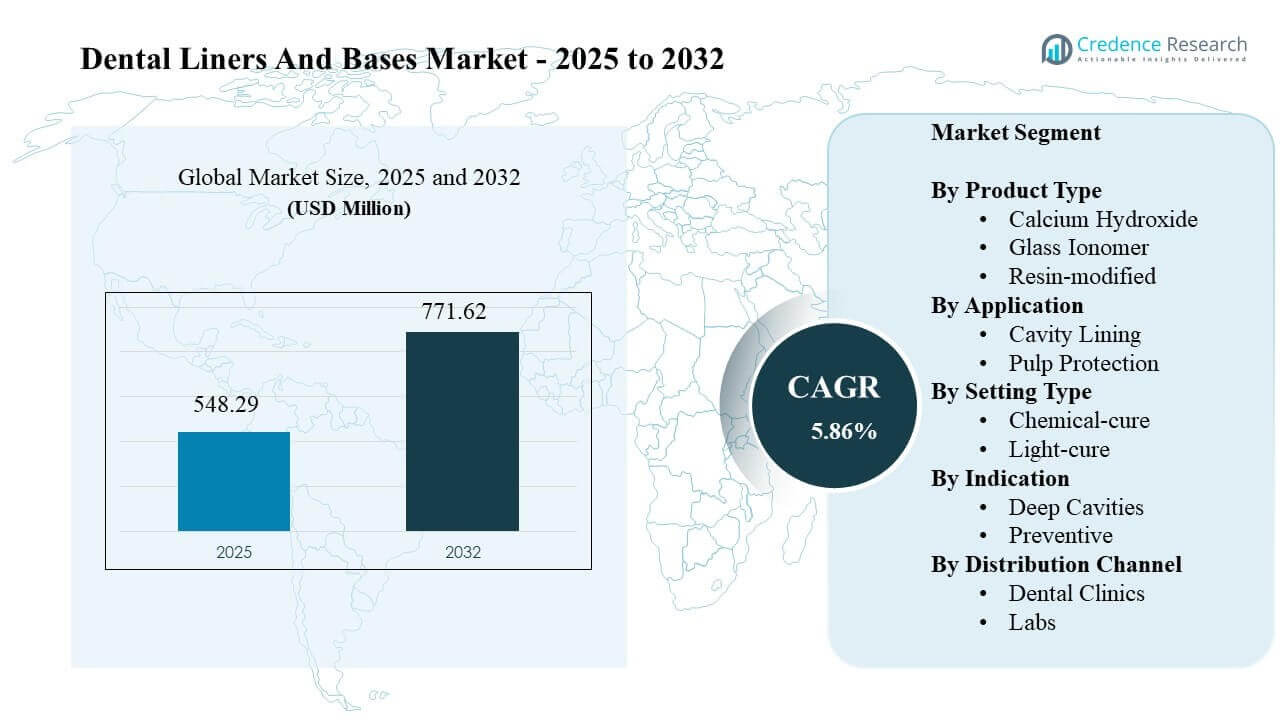
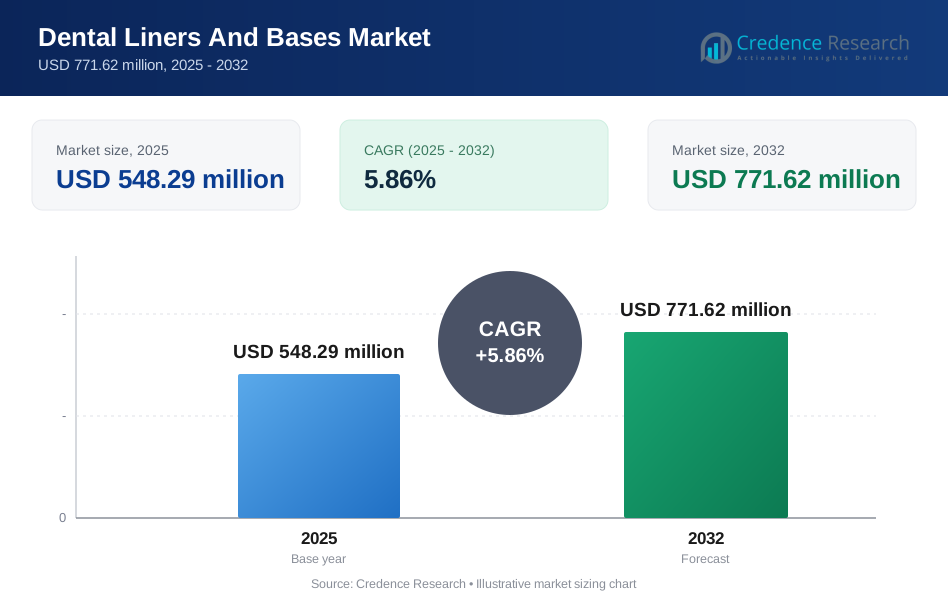
The global Dental Liners And Bases Market size was estimated at USD 548.29 million in 2025 and is expected to reach USD 771.62 million by 2032, growing at a CAGR of 5.86% from 2025 to 2032. Demand is being driven by the steady rise in restorative procedures, especially for deep caries management where clinicians use liners and bases to protect the pulp, reduce sensitivity risk, and improve restoration longevity. Expanding private dental clinic networks and standardization of restorative protocols across group practices are also reinforcing repeat purchasing of workflow-friendly, light-cure and ion-releasing materials.
| REPORT ATTRIBUTE | DETAILS |
|---|---|
| Historical Period | 2020-2024 |
| Base Year | 2025 |
| Forecast Period | 2026-2032 |
| Dental Liners And Bases Market Size 2025 | USD 548.29 million |
| Dental Liners And Bases Market, CAGR | 5.86% |
| Dental Liners And Bases Market Size 2032 | USD 771.62 million |
Key Market Trends & Insights
- North America accounted for 39.70% of 2025 revenue, supported by high restorative procedure volumes and established chairside material protocols.
- Europe represented 25.90% of 2025 revenue, reflecting broad restorative care access and consistent utilization across mature dental markets.
- Asia Pacific reached 23.40% of 2025 revenue, supported by expanding clinic capacity and increasing adoption of modern restorative materials.
- Liners held 55.60% share in 2025, reflecting routine use as a protective barrier under restorations in everyday restorative workflows.
- Glass Ionomer captured 36.40% share in 2025, supported by ion release expectations and compatibility with common restorative protocols.
Segment Analysis
Dental liners and bases are procedure-linked consumables used primarily to support pulp protection and cavity lining in restorative dentistry. Product selection is strongly influenced by clinical indication, depth of preparation, moisture tolerance needs, and compatibility with adhesive and composite systems. Workflow requirements also shape demand, including predictable placement, simplified delivery, and curing preferences that fit routine chairside schedules across high-throughput clinics.
Purchasing decisions increasingly reflect protocol standardization in multi-site dental groups and the growing emphasis on repeatable restorative outcomes. Clinics tend to favor products that minimize post-operative sensitivity risk and support restoration durability across common restorative case mixes. Preventive strategies and minimally invasive approaches further support use of ion-releasing chemistries where clinicians aim to reduce recurrent caries risk and enhance patient comfort.
By Product Type Insights
Glass Ionomer accounted for the largest share of 36.40% in 2025. Glass ionomer demand is supported by clinician familiarity and routine use across restorative cases where ion release and sealing behavior are valued. Protocol-driven dentistry favors materials that perform consistently across providers and locations, which supports repeat ordering through standardized kits and distributor catalogs. Glass ionomer adoption also benefits from broad compatibility expectations with common restorative workflows in general dentistry.
By Application Insights
Cavity lining and pulp protection demand is sustained by routine restorative case volumes and the need to create a protective interface between the restoration and the dentin-pulp complex. Pulp protection use is reinforced in deeper preparations where clinicians prioritize thermal and chemical insulation and aim to reduce post-operative sensitivity. Material choice is often guided by handling, placement control, and how well the product fits adhesive and composite workflows. Clinical training and chairside standardization also influence consistent use across similar indications.
By Setting Type Insights
Light-cure systems are favored in many practices because they support predictable placement and faster workflows during restorative appointments. Chemical-cure products remain relevant where clinicians prefer self-cure handling or where curing constraints influence material choice. Compatibility with adhesive systems and composite layering remains a key selection factor. Inventory simplification and preference for easy-to-dispense formats support broader uptake of clinic-friendly curing options.
By Indication Insights
Deep-cavity cases drive liner and base usage because clinicians seek added protection close to the pulp to support comfort and reduce complication risk. Preventive indications also support demand where clinicians select materials aligned with caries management strategies and long-term restoration performance. Practice protocols increasingly encourage consistent selection rules based on cavity depth and patient risk profiles. Product differentiation tied to ion release, sealing behavior, and clinical handling helps guide indication-based choices.
By Distribution Channel Insights
Dental Clinics accounted for the largest share of 51.80% in 2025. Clinic purchasing leads because liners and bases are consumed chairside in routine restorative procedures, creating steady replenishment needs. Consolidated dental groups often standardize materials across locations, which increases volume concentration and supports preferred-supplier purchasing. Distributor availability, training support, and familiarity with placement protocols further reinforce repeat demand through clinic-led procurement.
Dental Liners And Bases Market Drivers
Rising restorative procedure volumes and caries burden
Dental liners and bases benefit directly from restorative procedure throughput because liners and bases are placed during routine fillings and deeper preparations. Higher case volumes increase consumption across general dentistry settings. Clinical emphasis on reducing sensitivity and protecting the pulp supports continued use in deep cavities. Demand also rises as more practices adopt standardized protocols for restoration longevity. These dynamics support steady purchasing across high-frequency restorative workflows.
Protocol standardization in dental clinic networks
Multi-site dental groups and expanding private clinic chains often standardize restorative materials to improve consistency and simplify procurement. Standardization reduces variation in material choice across providers and locations. Liners and bases that integrate smoothly with common adhesive and restorative systems gain preference. Vendor training and distributor reliability reinforce adoption once a product becomes part of the standard kit. This supports repeat, predictable ordering patterns at scale.
- For instance, 3M reported that the Clicker dispensing system used with Vitrebond Plus reduces paste-to-liquid ratio variability by about 74% versus traditional powder-liquid dispensing, and the product was field evaluated with 144 dentists, supporting more uniform mixing, training, and rollout across clinic networks.
Shift toward workflow efficiency and predictable placement
Chairside time pressure drives preference for materials that place easily, cure predictably, and fit common restoration steps. Products that reduce handling variability help improve consistency across clinicians. Simplified dispensing formats also support efficiency and reduce waste. Practices tend to favor products that align with routine appointment structures and reduce rework risk. This driver supports adoption of clinic-friendly systems across general restorative care.
- For instance, VOCO’s Ionoseal is a ready-to-use one-component liner that light-cures in 20 seconds and delivers 226 MPa compressive strength plus 95 MPa transverse strength, while its NDT syringe is designed to pull back after pressure release to reduce dripping and improve placement control.
Focus on pulp preservation and restoration longevity
Clinical preference increasingly emphasizes preserving tooth vitality and minimizing complications in deeper preparations. Liners and bases play a key role by creating a protective barrier and supporting comfort after treatment. Practices also prioritize durable restorative outcomes because redo work affects scheduling and patient experience. Products positioned around consistent sealing behavior and predictable handling can gain traction. This strengthens recurring demand in pulp-protection-driven use cases.
Dental Liners And Bases Market Challenges
Dental liners and bases face ongoing pricing pressure because many products compete in overlapping indications, and practices often evaluate alternatives based on chairside efficiency and unit economics. Product differentiation can be difficult to communicate without strong clinical education, which can slow switching behavior even when new chemistries emerge. Compatibility concerns with adhesives and restorative materials can create hesitancy, especially in standardized protocols. Inventory simplification efforts may reduce the number of liner options carried by clinics.
- For instance, GC’s Fuji LINING LC Paste Pak differentiates on measurable workflow and performance parameters, including a 10-second mix, 20-second light cure, 2 minutes 15 seconds of working time, 194 MPa compressive strength at 24 hours, and 13 MPa tensile bond strength to composite resin with bonding agent.
Supply continuity and distributor availability also influence purchasing, particularly for group practices that require consistent replenishment across locations. Practices may resist change when a liner is embedded in a preferred workflow and staff training is aligned to a specific placement technique. Regulatory expectations and documentation needs can increase the burden of maintaining multiple product lines. These factors can limit rapid adoption of newer formulations despite clinical interest.
Dental Liners And Bases Market Trends and Opportunities
Clinician interest is rising for liners and bases aligned with minimally invasive dentistry and long-term caries management strategies. Products positioned around predictable handling and integration with common restorative steps are gaining attention as practices optimize chairside throughput. Protocol-driven purchasing favors offerings with consistent performance across operators and locations. This trend creates opportunities for suppliers that pair products with strong training and placement guidance.
- For instance, Solventum’s 3M™ Vitrebond™ Plus Light Cure Glass Ionomer Liner/Base is designed for pre-measured Clicker™ dispensing and a short 20-second light-cure cycle, while 3M technical documentation also states a minimum working time of 2 minutes 30 seconds and curing in 1.5 mm or less increments, supporting consistent placement in routine restorative workflows.
Digital workflow growth in restorative dentistry is also shaping material expectations, including consistency, compatibility, and simplified steps that reduce chairside variability. Expanding dental clinic networks in growth markets can support higher volumes for standardized consumables. Suppliers can capture share through packaging innovations, easy-dispense formats, and portfolio bundling aligned to restorative kits. These opportunities support sustained adoption in routine restorative pathways.
Regional Insights
North America
North America led demand with a 39.70% share in 2025, supported by high restorative procedure volumes and strong penetration of standardized chairside protocols. Group practices and clinic networks reinforce repeat purchasing through preferred-supplier models and consistent material selection rules. Clinicians prioritize predictable handling and compatibility with widely used adhesive and restorative systems, which supports premium and mid-tier product mix. Training access and distributor coverage further sustain consistent utilization across general dentistry.
Europe
Europe accounted for 25.90% of 2025 revenue, supported by broad access to restorative care and steady utilization across mature dental markets. Clinics often prioritize protocol consistency and predictable restorative outcomes, which supports repeat use of liners and bases in routine restorations. Cost discipline in parts of the region encourages balanced adoption across product tiers, with strong emphasis on reliable clinical performance. Established distribution channels and clinician familiarity with common liner chemistries reinforce stable demand.
Asia Pacific
Asia Pacific represented 23.40% in 2025, driven by expanding private clinic networks, growing restorative case volumes, and increasing adoption of modern restorative protocols in urban centers. Demand is supported by capacity expansion and increasing patient willingness to pursue restorative treatment, especially in markets with rising middle-income populations. Pricing sensitivity influences product mix, but protocol standardization in organized clinics supports more consistent ordering patterns. Vendor education and channel reach remain key differentiators across diverse markets.
Latin America
Latin America reached 6.70% in 2025, supported by growing private dental care utilization in major cities and gradual expansion of organized clinic networks. Procurement is often value-driven, which influences adoption of cost-effective liner options aligned to routine restorative procedures. Distributor availability and clinician training shape brand preferences and repeat usage. Market growth is strongest where private care investment improves clinic throughput and material standardization.
Middle East & Africa
Middle East & Africa held 4.30% in 2025, with demand concentrated in markets with stronger private dental infrastructure and higher per-capita dental spending. Adoption is supported by modernization of dental clinics and rising utilization of restorative care in urban hubs. Uneven access and variability in procurement systems limit broader penetration across the region. Supplier presence, distribution reliability, and training support remain central to sustained adoption.
Competitive Landscape
Competition is shaped by portfolio breadth across restorative consumables, clinician trust built through training and distribution, and product positioning around predictable placement and compatibility with modern restorative workflows. Suppliers compete by strengthening relationships with distributors and dental service organizations, supporting protocol standardization in multi-site clinics, and expanding adjacent restorative offerings that encourage bundled purchasing. Differentiation is also driven by formulation performance claims, packaging convenience, and the ability to support consistent outcomes across operators.
3M competes through broad restorative portfolio coverage and strong clinic penetration supported by distributor relationships and practice-level protocol adoption. 3M’s strategy typically aligns materials selection with workflow consistency, emphasizing products that integrate into common adhesive and composite procedures. Education, product availability, and brand familiarity support repeat procurement in organized clinic environments. This approach reinforces resilience in demand where standardization and throughput drive purchasing behavior.
The industry research and growth report includes detailed analyses of the competitive landscape of the market and information about key companies, including:
- 3M
- Dentsply Sirona
- GC Corporation
- Ivoclar
- Kerr
- VOCO
- Shofu
- Coltene
- Septodont
- Kuraray
Qualitative and quantitative analysis of companies has been conducted to help clients understand the wider business environment as well as the strengths and weaknesses of key industry players. Data is qualitatively analyzed to categorize companies as pure play, category-focused, industry-focused, and diversified; it is quantitatively analyzed to categorize companies as dominant, leading, strong, tentative, and weak.
Recent Developments
- In December 2025, GC America Inc. and TAG The Aspen Group launched COE-SOFT™ PRINT, a new soft denture liner designed specifically for digitally printed dentures, with the companies describing it as a breakthrough that bonds seamlessly to printed dentures while also remaining usable for conventional removable prosthetics.
- In April 2024, Behrman Capital acquired Vista Apex, a dental products manufacturer serving preventive oral hygiene, endodontics, and restorative dentistry, and said the transaction would support expansion of Vista Apex’s operations and product portfolio.
- In September 2024, Dentsply Sirona highlighted its continued partnership with the FDI World Dental Federation for World Oral Health Day 2024, extending its collaboration around oral-health education and outreach.
Report Scope
| Report Attribute | Details |
| Market size value in 2025 | USD 548.29 million |
| Revenue forecast in 2032 | USD 771.62 million by 2032 |
| Growth rate (CAGR) | 5.86% (2025–2032) |
| Base year | 2025 |
| Forecast period | 2026–2032 |
| Quantitative units | USD million |
| Segments covered | By Product Type Outlook: Calcium Hydroxide, Glass Ionomer, Resin-modified; By Application Outlook: Cavity Lining, Pulp Protection; By Setting Type Outlook: Chemical-cure, Light-cure; By Indication Outlook: Deep Cavities, Preventive; By Distribution Channel Outlook: Dental Clinics, Labs |
| Regional scope | North America, Europe, Asia Pacific, Latin America, Middle East & Africa |
| Key companies profiled | 3M; Dentsply Sirona; GC Corporation; Ivoclar; Kerr; VOCO; Shofu; Coltene; Septodont; Kuraray |
| No.of Pages | 330 |
Segmentation
By Product Type
- Calcium Hydroxide
- Glass Ionomer
- Resin-modified
By Application
- Cavity Lining
- Pulp Protection
By Setting Type
- Chemical-cure
- Light-cure
By Indication
- Deep Cavities
- Preventive
By Distribution Channel
- Dental Clinics
- Labs
By Region
- North America
- U.S.
- Canada
- Mexico
- Europe
- Germany
- France
- U.K.
- Italy
- Spain
- Rest of Europe
- Asia Pacific
- China
- Japan
- India
- South Korea
- South-east Asia
- Rest of Asia Pacific
- Latin America
- Brazil
- Argentina
- Rest of Latin America
- Middle East & Africa
- GCC Countries
- South Africa
- Rest of the Middle East and Africa
Request a Free Sample
Fill in your details and we'll send you a free sample report.
- Sample data tables & charts
- Research methodology
Need a Custom Version of This Report?
Tailor the scope, geography, or segments to your exact requirements.
- Custom geography or segment scope
- Direct access to our analyst team
Frequently Asked Questions
What is the market size of the Dental Liners And Bases Market in 2025 and 2032?
What is the CAGR for the Dental Liners And Bases Market during 2025–2032?
Which segment leads the Dental Liners And Bases Market in 2025?
What factors are driving growth in the Dental Liners And Bases Market?
Who are the key companies in the Dental Liners And Bases Market?
Which region leads the Dental Liners And Bases Market in 2025?
Table of Content
Chapter 1. Report Introduction
- 1.1 Report Description & Purpose
- 1.1.1 Report Title & Market Definition
- 1.1.2 Unique Selling Propositions (USP) & Key Differentiators
- 1.1.3 Value Proposition for Stakeholders
- 1.2 Research Objectives
- 1.2.1 Market Sizing Objectives (Volume & Revenue)
- 1.2.2 Segmentation Objectives
- 1.2.3 Competitive Intelligence Objectives
- 1.2.4 Forecast & Scenario Objectives
- 1.3 Report Scope
- 1.3.1 Dental Liners And Bases Scope – Types & Subtypes Covered
- 1.3.2 Geographic Scope – Regions & Countries Covered
- 1.3.3 Historical Period, Base Year & Forecast Period (2025; forecast to 2032)
- 1.3.4 Inclusions & Exclusions
- 1.4 HS Code & Classification Framework
- 1.5 Currency, Units & Pricing Basis
- 1.6 Target Stakeholders
- 1.7 Limitations & Assumptions
Chapter 2. Executive Summary
- 2.1 Global Dental Liners And Bases Market Snapshot
- 2.1.1 Market Size – Historical (2025) & Forecast (2025-2032) (2025: USD 548.29 million → 2032: USD 771.62 million)
- 2.1.2 Volume & Revenue – Global Totals
- 2.1.3 Key Market Highlights – Top Five Facts
- 2.2 Dental Liners And Bases Market Segmentation Snapshot
- 2.2.1 Market Split by Region – 2025 vs. 2032
- 2.3 Competitive Snapshot
- 2.3.1 Top 10 Players by Revenue Share – 2025
- 2.3.2 Top 10 Players by Volume Share – 2025
- 2.3.3 Recent Strategic Developments (18-Month Summary)
- 2.4 Key Investment Highlights & Strategic Conclusions
Chapter 3. Dental Liners And Bases Market Dynamics & Industry Analysis
- 3.1 Market Overview & Context
- 3.1.1 Dental Liners And Bases Market Position in the Broader Automotive Value Chain
- 3.1.2 OEM vs. Replacement Market Dynamics
- 3.1.3 Market Maturity & Development Stage by Region
- 3.2 Dental Liners And Bases Market Drivers
- 3.3 Dental Liners And Bases Market Restraints & Challenges
- 3.4 Dental Liners And Bases Market Opportunities
- 3.5 Porter's Five Forces Analysis
- 3.5.1 Threat of New Entrants
- 3.5.2 Bargaining Power of Suppliers
- 3.5.3 Bargaining Power of Buyers
- 3.5.4 Threat of Substitutes
- 3.5.5 Competitive Rivalry – Intensity Assessment
- 3.6 Dental Liners And Bases Value Chain Analysis
- 3.6.1 Upstream – Raw Material/Input Suppliers
- 3.6.1.1 Raw Material/Input 1
- 3.6.1.2 Raw Material/Input 2
- 3.6.1.3 Raw Material/Input 3
- 3.6.2 Midstream – Production/Manufacturing/Service Delivery
- 3.6.2.1 Production/Process Overview
- 3.6.2.2 Key Facility Locations & Capacity by Manufacturer
- 3.6.3 Downstream – Distribution & End Consumer
- 3.6.3.1 Primary Channel – B2B/OEM
- 3.6.3.2 Secondary Channels – Dealer, Retail, Online, Direct
- 3.6.4 Value Chain Profitability Analysis
- 3.6.1 Upstream – Raw Material/Input Suppliers
- 3.7 PESTEL Analysis
- 3.7.1 Political Factors
- 3.7.2 Economic Factors
- 3.7.3 Social Factors
- 3.7.4 Technological Factors
- 3.7.5 Environmental Factors
- 3.7.6 Legal Factors
- 3.8 Dental Liners And Bases Supply Chain Analysis
- 3.8.1 Raw Material/Input Supply Risk Assessment
- 3.8.2 Manufacturing Concentration Risk (Geographic Exposure)
- 3.8.3 Trade Disruption Impact Analysis
- 3.9 Regulatory & Policy Landscape
Note: The regulatory and policy landscape section covers regulations based on their applicability to the market, Dental Liners And Bases category, geography, and scope of the study. Only regulatory frameworks with a material impact on operations, compliance, trade, sustainability, or market access are analyzed in detail.
Chapter 4. Key Investment Pockets & Opportunity Analysis
- 4.1 Dental Liners And Bases Market Attractiveness Analysis
- 4.1.1 By Region – Investment Attractiveness Matrix (Volume × CAGR)
- 4.2 Absolute Revenue Growth Opportunity
- 4.2.1 By Region – Absolute USD Growth Through 2032
- 4.3 Incremental Volume Opportunity
- 4.3.1 By Region – Incremental Volume Through 2032
- 4.3.2 Segment – Incremental Volume
- 4.4 Emerging Submarket Opportunity Deep Dive (Subject to Applicability)
- 4.5 Emerging Market Opportunity Scorecards
- 4.5.1 United States
- 4.5.2 Europe
- 4.5.3 Asia
- 4.5.4 Middle East & Africa
Note: Emerging Market Opportunity Scorecards will be included based on relevance and strategic importance. Regions listed are indicative and may vary depending on data availability and market dynamics.
Chapter 5. Dental Liners And Bases Import-Export Analysis & Trade Flows
- 5.1 Global Trade Overview
- 5.1.1 Global Export Value by Country (2025)
- 5.1.2 Global Export Volume by Country (2025)
- 5.1.3 Global Import Value by Country (2025)
- 5.1.4 Global Import Volume by Country (2025)
- 5.1.5 Net Trade Balance by Country (2025)
- 5.2 Export Analysis – Segment
- 5.2.1 Type 1 (HS Code)
- 5.2.2 Type 2 (HS Code)
- 5.2.3 Type 3 (HS Code)
- 5.2.4 Type 4 (HS Code)
- 5.2.5 Type 5 (HS Code)
- 5.3 Import Analysis – Segment
- 5.3.1 Type 1 (HS Code)
- 5.3.2 Type 2 (HS Code)
- 5.3.3 Type 3 (HS Code)
- 5.3.4 Type 4 (HS Code)
- 5.3.5 Type 5 (HS Code)
- 5.4 Average Unit Trade Prices
- 5.4.1 Average Export Price – Segment & Country
- 5.4.2 Average Import Price – Segment & Source Country
- 5.4.3 Price Trends (2025)
- 5.5 Key Trade Route Analysis
- 5.5.1 Trade Route 1
- 5.5.2 Trade Route 2
- 5.5.3 Trade Route 3
- 5.5.4 Trade Route 4
- 5.5.5 Trade Route 5
- 5.6 Trade Policy Impact Assessment
- 5.6.1 US Anti-Dumping & Section 301 Tariffs
- 5.6.2 EU Customs Union Impact
- 5.6.3 Major Free Trade Agreements
- 5.6.4 USMCA Rules of Origin
Note: Trade policy analysis will be included only where relevant to the Dental Liners And Bases market.
Chapter 6. Competitive Landscape & Company Benchmarking
- 6.1 Dental Liners And Bases Market Concentration & Structure
- 6.1.1 Herfindahl-Hirschman Index (HHI) – vs. 2025
- 6.1.2 Tier 1, Tier 2 & Tier 3 Market Structure
- 6.1.3 Global, Regional & Local Player Dynamics
- 6.2 Dental Liners And Bases Market Share Analysis – 2025
- 6.2.1 Global Revenue Share by Company
- 6.2.2 Global Volume Share by Company
- 6.2.3 Regional Revenue Share
- 6.2.4 Market Share Evolution ( vs. 2025)
- 6.2.5 OEM Segment Share by Company
- 6.2.6 Replacement Segment Share by Company
- 6.3 Production/Delivery Capacity & Facility Analysis
- 6.3.1 Global Installed Capacity
- 6.3.2 Capacity Utilization Rates
- 6.3.3 Production/Output Volume
- 6.3.4 Facility Locations & Capacity Map
- 6.3.5 Planned Capacity Additions
- 6.4 Dental Liners And Bases Competitive Benchmarking Matrix
- 6.4.1 Revenue, Volume, CAGR & Profitability Comparison
- 6.4.2 Channel Revenue Mix
- 6.4.3 Geographic Revenue Exposure
- 6.4.4 R&D Intensity
- 6.4.5 Sustainability Maturity
- 6.5 Strategic Developments in Dental Liners And Bases (Last 24 Months)
- 6.5.1 Mergers, Acquisitions & Divestments
- 6.5.2 New Dental Liners And Bases Launches
- 6.5.3 Facility Expansions
- 6.5.4 Strategic Alliances, Joint Ventures & Partnerships
- 6.5.5 Distribution Expansion & Market Entry
- 6.5.6 Sustainability & ESG Initiatives
- 6.6 Competitive Strategy Mapping
- 6.6.1 Leader, Challenger, Follower & Niche Classification
- 6.6.2 Pricing Strategy Comparison
- 6.6.3 Channel Strategy Matrix
Note: Strategic developments are included based on their materiality and the availability of reliable information.
Chapter 7. Global Dental Liners And Bases Market – By Distribution Channel
- 7.1 Segment Overview
- 7.1.1 Volume & Revenue Split by Channel (2025 & 2032)
- 7.1.2 Channel Mix Evolution (2025-2032)
Chapter 8. Regional Market Analysis – Global Overview
- 8.1 Global Regional Overview
- 8.1.1 Regional Volume Share
- 8.1.2 Regional Revenue Share
- 8.1.3 Regional Volume by Region
- 8.1.4 Regional Revenue by Region
- 8.1.5 Regional Forecast Through 2032
- 8.2 Cross-Regional Segment Analysis
- 8.2.1 By Distribution Channel
- 8.2.2 By Brand/Price Tier
Chapter 9. North America Dental Liners And Bases Market
- 9.1 United States
- 9.2 Canada
- 9.3 Mexico
Chapter 10. Europe Dental Liners And Bases Market
- 10.1 Germany
- 10.2 France
- 10.3 Italy
- 10.4 United Kingdom
- 10.5 Spain
- 10.6 Poland
- 10.7 Russia
- 10.8 Netherlands
- 10.9 Belgium
- 10.10 Sweden
- 10.11 Denmark
- 10.12 Norway
- 10.13 Rest of Europe
Chapter 11. Asia Pacific Dental Liners And Bases Market
- 11.1 China
- 11.2 India
- 11.3 Japan
- 11.4 South Korea
- 11.5 Thailand
- 11.6 Indonesia
- 11.7 Vietnam
- 11.8 Malaysia
- 11.9 Australia
- 11.10 Rest of Asia Pacific
Chapter 12. Latin America Dental Liners And Bases Market
- 12.1 Brazil
- 12.2 Argentina
- 12.3 Colombia
- 12.4 Chile
- 12.5 Rest of Latin America
Chapter 13. Middle East Dental Liners And Bases Market
- 13.1 Saudi Arabia
- 13.2 United Arab Emirates
- 13.3 Turkey
- 13.4 Israel
- 13.5 Iran
- 13.6 Rest of the Middle East
Chapter 14. Africa Dental Liners And Bases Market
- 14.1 South Africa
- 14.2 Egypt
- 14.3 Nigeria
- 14.4 Morocco
- 14.5 Rest of Africa
Chapter 15. Dental Liners And Bases Company Profiles
- 15.1 [Company 01]
- 15.1.1 Company Overview
- 15.1.2 Key Management Personnel
- 15.1.3 Products & Services Portfolio
- 15.1.4 Financial Performance
- 15.1.5 Key Market Focus & Geographic Presence
- 15.1.6 Recent Developments & Strategic Initiatives
Note: The company profile list is preliminary and may change based on research findings, market developments, data availability, and client requirements.
Chapter 16. Appendices
- Appendix A – List of Abbreviations & Acronyms
- Appendix B – Industry Classification Code Reference – Full Series
- Appendix C – Production & Capacity Data Tables
- Appendix D – End-Use & Demand Base Tables
- Appendix E – Consumption & Replacement Rate Assumptions
- Appendix F – ASP Reference Tables
- Appendix G – Manufacturing & Facility Database
- Appendix H – Import-Export Data Tables
- Appendix I – Regulatory Summary Tables
- Appendix J – Primary Research Participant List (Anonymized)
- Appendix K – Primary Research Questionnaire Framework
- Appendix L – Data Sources & Bibliography
- Appendix M – Market Size Divergence & Source Comparison
Chapter 17. Research Methodology
- 17.1 Research Framework & Philosophy
- 17.2 Secondary Research – Sources, Hierarchy & Data Extraction
- 17.3 Data Modeling – Bottom-Up & Top-Down Market Sizing
- 17.4 Primary Research – Stakeholder Framework, LOI & Sample Sizes
- 17.5 Forecast Methodology – Regression, Scenario & Sensitivity Analysis
- 17.6 Quality Control – Four-Layer Validation Framework
- 17.7 Limitations & Standard Assumptions
- 17.8 Disclaimer
