
Cryosurgery Devices Market Overview:
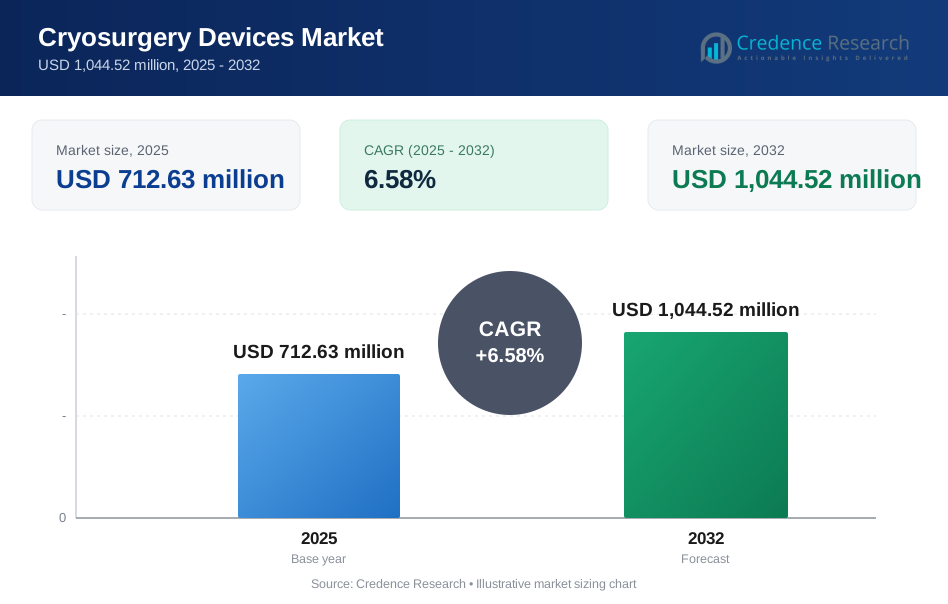
The global Cryosurgery Devices Market size was estimated at USD 712.63 million in 2025 and is expected to reach USD 1,044.52 million by 2032, growing at a CAGR of 6.58% from 2025 to 2032. Growth is driven by wider clinical preference for minimally invasive tissue-destruction procedures that can reduce incision burden, shorten recovery time, and expand treatment options for patients who may not be ideal candidates for open surgery. Cryosurgery Devices Market adoption is also supported by expanding outpatient procedure volumes and improving access to image-guided and office-based interventions across major healthcare systems.
| REPORT ATTRIBUTE | DETAILS |
|---|---|
| Historical Period | 2020-2024 |
| Base Year | 2025 |
| Forecast Period | 2026-2032 |
| Cryosurgery Devices Market Size 2025 | USD 712.63 million |
| Cryosurgery Devices Market, CAGR | 6.58% |
| Cryosurgery Devices Market Size 2032 | USD 1,044.52 million |
Key Market Trends & Insights
- The Cryosurgery Devices Market is projected to expand from USD 712.63 million (2025) to USD 1,044.52 million (2032), reflecting 6.58% CAGR during 2025–2032.
- Probe-based devices accounted for the largest share at 47.80% in 2025, reflecting demand for controlled, localized freezing and repeatable procedure workflows.
- North America held the leading regional share at 37.65% in 2025, supported by higher procedural volumes and strong adoption of minimally invasive therapies.
- Europe represented 28.55% of Cryosurgery Devices Market revenue in 2025, reflecting broad specialty coverage across dermatology, oncology, and gynecology settings.
- Asia Pacific captured 23.65% share in 2025, supported by expanding procedure capacity and rising utilization of device-enabled interventions.
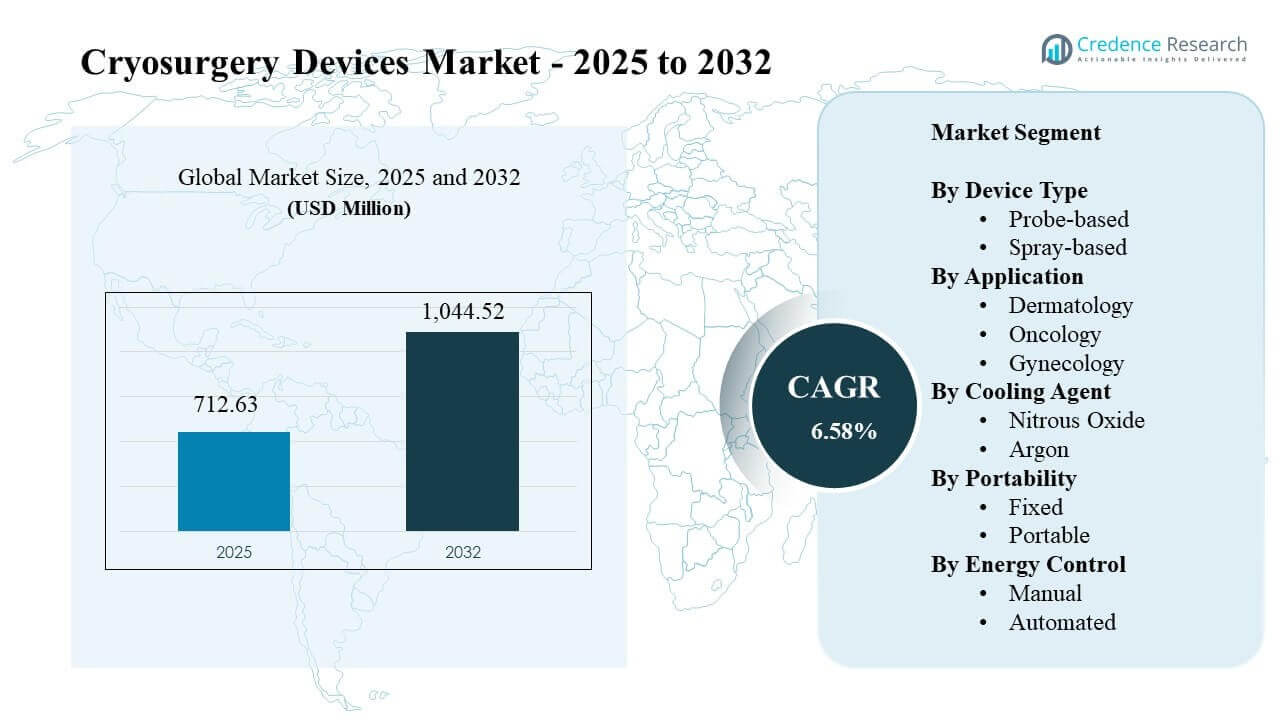
Segment Analysis
Cryosurgery Devices Market demand is shaped by clinical use cases that value rapid tissue destruction with limited invasiveness across outpatient clinics, hospitals, and interventional suites. Procedural suitability across dermatology, oncology, and gynecology sustains steady utilization, supported by clinician familiarity with freeze-thaw protocols and expanding access to specialty care. Purchasing decisions often prioritize safety, ease of use, probe or applicator versatility, and maintenance needs. Reimbursement pathways and facility preferences for office-based procedures can influence the mix of compact systems versus suite-based platforms.
Cryosurgery Devices Market competition centers on device ergonomics, system reliability, consumable ecosystems, and workflow integration. Providers evaluate devices based on treatment consistency, control over freeze parameters, and compatibility with clinical protocols. Training requirements and service support are also important, particularly for facilities scaling procedural volumes. Over the forecast period through 2032, Cryosurgery Devices Market growth is expected to reflect increasing minimally invasive procedure penetration and broader specialty adoption.
By Device Type Insights
Probe-based accounted for the largest share of 47.80% in 2025. Probe-based systems lead because probe designs support controlled contact-based freezing that helps clinicians target localized tissue with repeatable technique. Probe-based workflows also align with interventional settings that value predictable ablation zones and procedure standardization. Accessory options and multiple probe geometries expand procedural flexibility across specialty use cases.
By Application Insights
Cryosurgery Devices Market demand across Dermatology, Oncology, and Gynecology is supported by the ability to treat a range of benign and malignant conditions with limited procedural disruption. Dermatology volumes benefit from clinic-based lesion treatment where speed and simplicity matter. Oncology adoption is supported by growing use of minimally invasive tumor destruction pathways in settings equipped for image guidance and procedural monitoring. Gynecology utilization remains relevant for office-based treatment pathways where cryosurgery is a practical modality.
By Cooling Agent Insights
Cooling-agent selection in the Cryosurgery Devices Market is guided by temperature performance, workflow safety, and system compatibility. Nitrous oxide remains common in office-based procedures where practical handling and familiarity influence adoption. Argon-based systems are often associated with higher-performance freezing needs in more complex interventional settings. Supply reliability, storage requirements, and facility infrastructure can shape operating costs and procurement decisions.
By Portability Insights
Portability preferences in the Cryosurgery Devices Market are tied to site of care and throughput needs. Portable systems are attractive for office-based dermatology and gynecology procedures where limited footprint and fast setup are critical. Fixed systems are favored in higher-acuity environments where broader accessory support and integration with clinical workflows can improve procedural consistency. Outpatient migration continues to push demand for compact, easy-to-maintain systems.
By Energy Control Insights
Energy-control preferences reflect the balance between simplicity and standardization in Cryosurgery Devices Market procedures. Manual control is widely used where clinicians prioritize procedural familiarity and straightforward operation. Automated control gains attention in settings focused on reproducibility, preset protocols, and reduced operator variability. Monitoring features and protocol-driven freeze-thaw cycles can support training and consistent outcomes in higher-volume environments.
Cryosurgery Devices Market Drivers
Expanding preference for minimally invasive treatment pathways
Cryosurgery Devices Market growth is supported by increasing clinical preference for minimally invasive procedures that reduce incision burden and support faster recovery. Many cryosurgery workflows can be performed in outpatient settings, which aligns with health system objectives to improve efficiency and manage capacity. Procedure versatility across multiple specialties helps sustain baseline demand. Cryosurgery Devices Market adoption also benefits from clinician familiarity with freeze-thaw techniques and routine lesion management pathways.
Rising procedure volumes across dermatology and outpatient care
Cryosurgery Devices Market demand is reinforced by steady outpatient volumes, especially in dermatology where lesion treatment is routine and time-sensitive. High-throughput clinic workflows favor devices that are reliable, easy to set up, and supported by dependable consumable supply. Office-based care models can reduce total care pathway friction for patients and providers. Cryosurgery Devices Market penetration improves when devices match clinician preferences for ergonomic handling and consistent results.
- For instance, Brymill’s cryosurgery systems are described as reaching -25°C to -50°C within 30 seconds, while lesion destruction typically requires tissue temperatures between -20°C and -30°C. Cryosurgery Devices Market penetration improves when devices match clinician preferences for ergonomic handling and consistent results.
Growth in interventional oncology and image-guided procedures
Cryosurgery Devices Market growth benefits from expansion of interventional oncology programs that seek device-enabled tumor treatment pathways. Procedural approaches that offer localized tissue destruction can be attractive for patients who are not ideal candidates for open surgery or who require targeted interventions. Multidisciplinary care teams can integrate cryo-based procedures with broader treatment plans. Cryosurgery Devices Market demand increases when procedural planning, safety workflows, and follow-up pathways are well established.
Product design improvements and stronger service support
Cryosurgery Devices Market performance is influenced by ongoing device improvements in ergonomics, protocol consistency, and accessory breadth. Facilities value systems that minimize downtime, simplify maintenance, and offer responsive technical support. Training resources and standard operating procedures help enable broader staff participation and consistent outcomes. Cryosurgery Devices Market expansion is supported when vendors provide reliable after-sales service and clear pathways for device upgrades.
- For instance, Varian states that its CryoCare SL console can independently control up to 8 single-use cryoprobes and up to 8 independent temperature-monitoring devices, while IceCure’s ProSense manual specifies that users must complete certified training before use and that only IceCure-trained technicians are qualified to service the system.
Cryosurgery Devices Market Challenges
Cryosurgery Devices Market adoption can be constrained by variability in clinical protocols, facility readiness, and staff training requirements. Differences in site-of-care workflows can create friction when device setup, gas handling, or safety checks are not standardized. Procurement decisions may also be affected by budget constraints and competing priorities for minimally invasive technology investments. Cryosurgery Devices Market growth can slow in facilities that lack specialized teams or consistent procedure demand to justify capital spending.
- For instance, IceCure Medical states that its ProSense cryoablation system can reach below -160°C ± 10°C, and the company says its single-cryoprobe platform can create a lethal zone comparable to three cryoprobes in an argon-based multiprobe system. Even with that level of technical performance, facilities still need standardized cryogen handling, setup routines, and trained operators to convert device capability into consistent procedural use.
Cryosurgery Devices Market utilization can also face reimbursement uncertainty and uneven access to specialty care across regions. Procedure coding, payer coverage, and local clinical guidelines can shape adoption and limit scale in some settings. Maintenance expectations and consumable supply reliability can influence total cost of ownership perceptions. Cryosurgery Devices Market vendors must address these barriers with training support, service networks, and practical device configurations.
Cryosurgery Devices Market Trends and Opportunities
Cryosurgery Devices Market opportunities are strengthening as outpatient care models expand and specialty clinics seek efficient, procedure-driven revenue streams. Devices that support quick setup, strong ergonomics, and consistent performance can gain traction in high-volume settings. Product strategies increasingly emphasize usability improvements that reduce staff burden and shorten procedure time. Cryosurgery Devices Market vendors that align device design with clinic workflows can improve customer retention and repeat purchasing.
- For instance, CryoIQ states that its CryoIQ Pro system uses 4 interchangeable applicators with surface coverage from 1 mm to 22 mm, while the platform delivers a constant freezing temperature of -89°C at 725 psi, giving clinics a concrete example of device design built for controlled, repeatable use in busy outpatient settings.
Cryosurgery Devices Market innovation also trends toward better workflow standardization and procedure reproducibility through enhanced controls and protocol support. Automated features that reduce operator variability can be attractive in facilities scaling procedural capacity. Broader accessory ecosystems and specialty-focused configurations can help expand the addressable application base. Cryosurgery Devices Market growth is supported when vendors build training pathways that enable faster onboarding and consistent use.
Regional Insights
North America
North America led the Cryosurgery Devices Market with 37.65% share in 2025, supported by strong adoption of minimally invasive procedures and broad specialty coverage. Healthcare delivery models in North America support both office-based and hospital-based cryosurgery workflows, sustaining device utilization across settings. Clinical infrastructure and access to specialty providers support continued demand. Vendor competition in North America often emphasizes workflow efficiency, service support, and differentiated device portfolios.
Europe
Europe accounted for 28.55% of Cryosurgery Devices Market revenue in 2025, reflecting established hospital systems and widespread specialty care access. Adoption is supported by mature outpatient care pathways and consistent clinical use across dermatology and gynecology settings. Procurement decisions in Europe often emphasize reliability, safety protocols, and total cost of ownership. Strong clinical governance can also shape device standardization and training requirements.
Asia Pacific
Asia Pacific represented 23.65% share in 2025, supported by healthcare investment and expanding access to specialty procedures across large patient populations. Growth momentum is reinforced by the scale-up of outpatient clinics and increasing procedural capability in major urban centers. Vendor strategies that focus on distribution reach, training support, and cost-effective configurations can improve adoption. Cryosurgery Devices Market penetration improves as procedural awareness and specialist availability expand.
Latin America
Latin America held 5.95% share of Cryosurgery Devices Market revenue in 2025, with adoption concentrated in private hospitals and major urban healthcare hubs. Demand growth is supported by expanding specialty services and gradual uptake of minimally invasive procedural pathways. Budget sensitivity and procurement constraints can influence device selection. Strong distributor networks and reliable service support often determine vendor success.
Middle East & Africa
Middle East and Africa captured 4.20% share in 2025, with utilization typically centered in tertiary centers and private provider networks. Adoption trends reflect selective investment in specialty procedures and gradual expansion of outpatient services. Training availability, service coverage, and supply reliability can shape purchasing decisions. Vendors that build localized support and fit-for-purpose product configurations can strengthen positioning.
Competitive Landscape
Cryosurgery Devices Market competition is characterized by product portfolio breadth, system reliability, service networks, and workflow-centric design. Vendors differentiate through probe or applicator options, clinical specialty alignment, and ease-of-use features that support consistent outcomes. Commercial strategies often focus on hospital accounts for higher-acuity procedures and specialty clinics for repeat volumes. Competitive positioning also depends on distributor strength, training programs, and responsive technical support.
Medtronic often competes through breadth across minimally invasive technologies and the ability to support integrated clinical workflows. Medtronic positioning can benefit from established relationships with hospitals and procedural specialists, supported by structured training and service capabilities. Cryosurgery Devices Market adoption for Medtronic is strengthened when devices align with interventional pathways and standard operating procedures. Product support and clinician education can influence utilization and account expansion.
The industry research and growth report includes detailed analyses of the competitive landscape of the market and information about key companies, including:
- Medtronic
- CooperSurgical
- Galil Medical
- Wallach Surgical
- Brymill
- Erbe
- Boston Scientific
- IceCure Medical
- Zimmer MedizinSysteme
- Metrum Cryoflex
Qualitative and quantitative analysis of companies has been conducted to help clients understand the wider business environment as well as the strengths and weaknesses of key industry players. Data is qualitatively analyzed to categorize companies as pure play, category-focused, industry-focused, and diversified; it is quantitatively analyzed to categorize companies as dominant, leading, strong, tentative, and weak.
Recent Developments
- In March 2025, Cryofocus Medtech (Shanghai) Co., Ltd. received NMPA approval for its Malignant Stenosis Cryoablation System, and the company said the product was commercialized in China in May 2025; in the same corporate update, Cryofocus also said it had further deepened its distribution partnership with Boston Scientific in the Chinese market.
- In September 2025, AtriCure, Inc. launched the cryoXT device, a new cryoablation technology designed to help manage post-operative pain following amputation, and the company said the device had recently received FDA 510(k) clearance.
- In October 2025, IceCure Medical Ltd. announced that the U.S. FDA granted marketing authorization to its ProSense cryoablation system for the local treatment of breast cancer in patients aged 70 years and older with biologically low-risk tumors up to 1.5 cm, making it a major recent commercial product update in the cryosurgery space.
- In October 2025, PENTAX Medical announced the sale of its C2 CryoBalloon product line to Merit Medical Systems through an asset purchase agreement, a transaction that moves a minimally invasive cryotherapy ablation platform into Merit’s portfolio.
Report Scope
| Report Attribute | Details |
| Market size value in 2025 | USD 712.63 million |
| Revenue forecast in 2032 | USD 1,044.52 million |
| Growth rate (CAGR) | 6.58% (2025–2032) |
| Base year | 2025 |
| Forecast period | 2026-2032 |
| Quantitative units | USD million |
| Segments covered | By Device Type, By Application, By Cooling Agent, By Portability, By Energy Control |
| Regional scope | North America, Europe, Asia Pacific, Latin America, Middle East & Africa |
| Key companies profiled | Medtronic, CooperSurgical, Galil Medical, Wallach Surgical, Brymill, Erbe, Boston Scientific, IceCure Medical, Zimmer MedizinSysteme, Metrum Cryoflex |
| No.of Pages | 328 |
Segmentation
By Device Type
- Probe-based
- Spray-based
By Application
- Dermatology
- Oncology
- Gynecology
By Cooling Agent
- Nitrous Oxide
- Argon
By Portability
- Fixed
- Portable
By Energy Control
- Manual
- Automated
By Region
- North America
- U.S.
- Canada
- Mexico
- Europe
- Germany
- France
- U.K.
- Italy
- Spain
- Rest of Europe
- Asia Pacific
- China
- Japan
- India
- South Korea
- South-east Asia
- Rest of Asia Pacific
- Latin America
- Brazil
- Argentina
- Rest of Latin America
- Middle East & Africa
- GCC Countries
- South Africa
- Rest of the Middle East and Africa
Request a Free Sample
Fill in your details and we'll send you a free sample report.
- Sample data tables & charts
- Research methodology
Need a Custom Version of This Report?
Tailor the scope, geography, or segments to your exact requirements.
- Custom geography or segment scope
- Direct access to our analyst team
Frequently Asked Questions
What is the market size of Cryosurgery Devices Market in 2025 and the forecast for 2032?
What is the CAGR for Cryosurgery Devices Market during 2025–2032?
What is the largest segment in Cryosurgery Devices Market?
What factors are driving growth in Cryosurgery Devices Market?
Which companies are profiled in Cryosurgery Devices Market?
Which region leads Cryosurgery Devices Market?
Table of Content
Chapter 1. Report Introduction
- 1.1 Report Description & Purpose
- 1.1.1 Report Title & Market Definition
- 1.1.2 Unique Selling Propositions (USP) & Key Differentiators
- 1.1.3 Value Proposition for Stakeholders
- 1.2 Research Objectives
- 1.2.1 Market Sizing Objectives (Volume & Revenue)
- 1.2.2 Segmentation Objectives
- 1.2.3 Competitive Intelligence Objectives
- 1.2.4 Forecast & Scenario Objectives
- 1.3 Report Scope
- 1.3.1 Cryosurgery Devices Scope – Types & Subtypes Covered
- 1.3.2 Geographic Scope – Regions & Countries Covered
- 1.3.3 Historical Period, Base Year & Forecast Period (2025; forecast to 2032)
- 1.3.4 Inclusions & Exclusions
- 1.4 HS Code & Classification Framework
- 1.5 Currency, Units & Pricing Basis
- 1.6 Target Stakeholders
- 1.7 Limitations & Assumptions
Chapter 2. Executive Summary
- 2.1 Global Cryosurgery Devices Market Snapshot
- 2.1.1 Market Size – Historical (2025) & Forecast (2025-2032) (2025: USD 712.63 million → 2032: USD 1,044.52 million)
- 2.1.2 Volume & Revenue – Global Totals
- 2.1.3 Key Market Highlights – Top Five Facts
- 2.2 Cryosurgery Devices Market Segmentation Snapshot
- 2.2.1 Market Split by Region – 2025 vs. 2032
- 2.3 Competitive Snapshot
- 2.3.1 Top 10 Players by Revenue Share – 2025
- 2.3.2 Top 10 Players by Volume Share – 2025
- 2.3.3 Recent Strategic Developments (18-Month Summary)
- 2.4 Key Investment Highlights & Strategic Conclusions
Chapter 3. Cryosurgery Devices Market Dynamics & Industry Analysis
- 3.1 Market Overview & Context
- 3.1.1 Cryosurgery Devices Market Position in the Broader Automotive Value Chain
- 3.1.2 OEM vs. Replacement Market Dynamics
- 3.1.3 Market Maturity & Development Stage by Region
- 3.2 Cryosurgery Devices Market Drivers
- 3.3 Cryosurgery Devices Market Restraints & Challenges
- 3.4 Cryosurgery Devices Market Opportunities
- 3.5 Porter's Five Forces Analysis
- 3.5.1 Threat of New Entrants
- 3.5.2 Bargaining Power of Suppliers
- 3.5.3 Bargaining Power of Buyers
- 3.5.4 Threat of Substitutes
- 3.5.5 Competitive Rivalry – Intensity Assessment
- 3.6 Cryosurgery Devices Value Chain Analysis
- 3.6.1 Upstream – Raw Material/Input Suppliers
- 3.6.1.1 Raw Material/Input 1
- 3.6.1.2 Raw Material/Input 2
- 3.6.1.3 Raw Material/Input 3
- 3.6.2 Midstream – Production/Manufacturing/Service Delivery
- 3.6.2.1 Production/Process Overview
- 3.6.2.2 Key Facility Locations & Capacity by Manufacturer
- 3.6.3 Downstream – Distribution & End Consumer
- 3.6.3.1 Primary Channel – B2B/OEM
- 3.6.3.2 Secondary Channels – Dealer, Retail, Online, Direct
- 3.6.4 Value Chain Profitability Analysis
- 3.6.1 Upstream – Raw Material/Input Suppliers
- 3.7 PESTEL Analysis
- 3.7.1 Political Factors
- 3.7.2 Economic Factors
- 3.7.3 Social Factors
- 3.7.4 Technological Factors
- 3.7.5 Environmental Factors
- 3.7.6 Legal Factors
- 3.8 Cryosurgery Devices Supply Chain Analysis
- 3.8.1 Raw Material/Input Supply Risk Assessment
- 3.8.2 Manufacturing Concentration Risk (Geographic Exposure)
- 3.8.3 Trade Disruption Impact Analysis
- 3.9 Regulatory & Policy Landscape
Note: The regulatory and policy landscape section covers regulations based on their applicability to the market, Cryosurgery Devices category, geography, and scope of the study. Only regulatory frameworks with a material impact on operations, compliance, trade, sustainability, or market access are analyzed in detail.
Chapter 4. Key Investment Pockets & Opportunity Analysis
- 4.1 Cryosurgery Devices Market Attractiveness Analysis
- 4.1.1 By Region – Investment Attractiveness Matrix (Volume × CAGR)
- 4.2 Absolute Revenue Growth Opportunity
- 4.2.1 By Region – Absolute USD Growth Through 2032
- 4.3 Incremental Volume Opportunity
- 4.3.1 By Region – Incremental Volume Through 2032
- 4.3.2 Segment – Incremental Volume
- 4.4 Emerging Submarket Opportunity Deep Dive (Subject to Applicability)
- 4.5 Emerging Market Opportunity Scorecards
- 4.5.1 United States
- 4.5.2 Europe
- 4.5.3 Asia
- 4.5.4 Middle East & Africa
Note: Emerging Market Opportunity Scorecards will be included based on relevance and strategic importance. Regions listed are indicative and may vary depending on data availability and market dynamics.
Chapter 5. Cryosurgery Devices Import-Export Analysis & Trade Flows
- 5.1 Global Trade Overview
- 5.1.1 Global Export Value by Country (2025)
- 5.1.2 Global Export Volume by Country (2025)
- 5.1.3 Global Import Value by Country (2025)
- 5.1.4 Global Import Volume by Country (2025)
- 5.1.5 Net Trade Balance by Country (2025)
- 5.2 Export Analysis – Segment
- 5.2.1 Type 1 (HS Code)
- 5.2.2 Type 2 (HS Code)
- 5.2.3 Type 3 (HS Code)
- 5.2.4 Type 4 (HS Code)
- 5.2.5 Type 5 (HS Code)
- 5.3 Import Analysis – Segment
- 5.3.1 Type 1 (HS Code)
- 5.3.2 Type 2 (HS Code)
- 5.3.3 Type 3 (HS Code)
- 5.3.4 Type 4 (HS Code)
- 5.3.5 Type 5 (HS Code)
- 5.4 Average Unit Trade Prices
- 5.4.1 Average Export Price – Segment & Country
- 5.4.2 Average Import Price – Segment & Source Country
- 5.4.3 Price Trends (2025)
- 5.5 Key Trade Route Analysis
- 5.5.1 Trade Route 1
- 5.5.2 Trade Route 2
- 5.5.3 Trade Route 3
- 5.5.4 Trade Route 4
- 5.5.5 Trade Route 5
- 5.6 Trade Policy Impact Assessment
- 5.6.1 US Anti-Dumping & Section 301 Tariffs
- 5.6.2 EU Customs Union Impact
- 5.6.3 Major Free Trade Agreements
- 5.6.4 USMCA Rules of Origin
Note: Trade policy analysis will be included only where relevant to the Cryosurgery Devices market.
Chapter 6. Competitive Landscape & Company Benchmarking
- 6.1 Cryosurgery Devices Market Concentration & Structure
- 6.1.1 Herfindahl-Hirschman Index (HHI) – vs. 2025
- 6.1.2 Tier 1, Tier 2 & Tier 3 Market Structure
- 6.1.3 Global, Regional & Local Player Dynamics
- 6.2 Cryosurgery Devices Market Share Analysis – 2025
- 6.2.1 Global Revenue Share by Company
- 6.2.2 Global Volume Share by Company
- 6.2.3 Regional Revenue Share
- 6.2.4 Market Share Evolution ( vs. 2025)
- 6.2.5 OEM Segment Share by Company
- 6.2.6 Replacement Segment Share by Company
- 6.3 Production/Delivery Capacity & Facility Analysis
- 6.3.1 Global Installed Capacity
- 6.3.2 Capacity Utilization Rates
- 6.3.3 Production/Output Volume
- 6.3.4 Facility Locations & Capacity Map
- 6.3.5 Planned Capacity Additions
- 6.4 Cryosurgery Devices Competitive Benchmarking Matrix
- 6.4.1 Revenue, Volume, CAGR & Profitability Comparison
- 6.4.2 Channel Revenue Mix
- 6.4.3 Geographic Revenue Exposure
- 6.4.4 R&D Intensity
- 6.4.5 Sustainability Maturity
- 6.5 Strategic Developments in Cryosurgery Devices (Last 24 Months)
- 6.5.1 Mergers, Acquisitions & Divestments
- 6.5.2 New Cryosurgery Devices Launches
- 6.5.3 Facility Expansions
- 6.5.4 Strategic Alliances, Joint Ventures & Partnerships
- 6.5.5 Distribution Expansion & Market Entry
- 6.5.6 Sustainability & ESG Initiatives
- 6.6 Competitive Strategy Mapping
- 6.6.1 Leader, Challenger, Follower & Niche Classification
- 6.6.2 Pricing Strategy Comparison
- 6.6.3 Channel Strategy Matrix
Note: Strategic developments are included based on their materiality and the availability of reliable information.
Chapter 7. Global Cryosurgery Devices Market – By Distribution Channel
- 7.1 Segment Overview
- 7.1.1 Volume & Revenue Split by Channel (2025 & 2032)
- 7.1.2 Channel Mix Evolution (2025-2032)
Chapter 8. Regional Market Analysis – Global Overview
- 8.1 Global Regional Overview
- 8.1.1 Regional Volume Share
- 8.1.2 Regional Revenue Share
- 8.1.3 Regional Volume by Region
- 8.1.4 Regional Revenue by Region
- 8.1.5 Regional Forecast Through 2032
- 8.2 Cross-Regional Segment Analysis
- 8.2.1 By Distribution Channel
- 8.2.2 By Brand/Price Tier
Chapter 9. North America Cryosurgery Devices Market
- 9.1 United States
- 9.2 Canada
- 9.3 Mexico
Chapter 10. Europe Cryosurgery Devices Market
- 10.1 Germany
- 10.2 France
- 10.3 Italy
- 10.4 United Kingdom
- 10.5 Spain
- 10.6 Poland
- 10.7 Russia
- 10.8 Netherlands
- 10.9 Belgium
- 10.10 Sweden
- 10.11 Denmark
- 10.12 Norway
- 10.13 Rest of Europe
Chapter 11. Asia Pacific Cryosurgery Devices Market
- 11.1 China
- 11.2 India
- 11.3 Japan
- 11.4 South Korea
- 11.5 Thailand
- 11.6 Indonesia
- 11.7 Vietnam
- 11.8 Malaysia
- 11.9 Australia
- 11.10 Rest of Asia Pacific
Chapter 12. Latin America Cryosurgery Devices Market
- 12.1 Brazil
- 12.2 Argentina
- 12.3 Colombia
- 12.4 Chile
- 12.5 Rest of Latin America
Chapter 13. Middle East Cryosurgery Devices Market
- 13.1 Saudi Arabia
- 13.2 United Arab Emirates
- 13.3 Turkey
- 13.4 Israel
- 13.5 Iran
- 13.6 Rest of the Middle East
Chapter 14. Africa Cryosurgery Devices Market
- 14.1 South Africa
- 14.2 Egypt
- 14.3 Nigeria
- 14.4 Morocco
- 14.5 Rest of Africa
Chapter 15. Cryosurgery Devices Company Profiles
- 15.1 [Company 01]
- 15.1.1 Company Overview
- 15.1.2 Key Management Personnel
- 15.1.3 Products & Services Portfolio
- 15.1.4 Financial Performance
- 15.1.5 Key Market Focus & Geographic Presence
- 15.1.6 Recent Developments & Strategic Initiatives
Note: The company profile list is preliminary and may change based on research findings, market developments, data availability, and client requirements.
Chapter 16. Appendices
- Appendix A – List of Abbreviations & Acronyms
- Appendix B – Industry Classification Code Reference – Full Series
- Appendix C – Production & Capacity Data Tables
- Appendix D – End-Use & Demand Base Tables
- Appendix E – Consumption & Replacement Rate Assumptions
- Appendix F – ASP Reference Tables
- Appendix G – Manufacturing & Facility Database
- Appendix H – Import-Export Data Tables
- Appendix I – Regulatory Summary Tables
- Appendix J – Primary Research Participant List (Anonymized)
- Appendix K – Primary Research Questionnaire Framework
- Appendix L – Data Sources & Bibliography
- Appendix M – Market Size Divergence & Source Comparison
Chapter 17. Research Methodology
- 17.1 Research Framework & Philosophy
- 17.2 Secondary Research – Sources, Hierarchy & Data Extraction
- 17.3 Data Modeling – Bottom-Up & Top-Down Market Sizing
- 17.4 Primary Research – Stakeholder Framework, LOI & Sample Sizes
- 17.5 Forecast Methodology – Regression, Scenario & Sensitivity Analysis
- 17.6 Quality Control – Four-Layer Validation Framework
- 17.7 Limitations & Standard Assumptions
- 17.8 Disclaimer
