
Dental Microscope Market Overview:
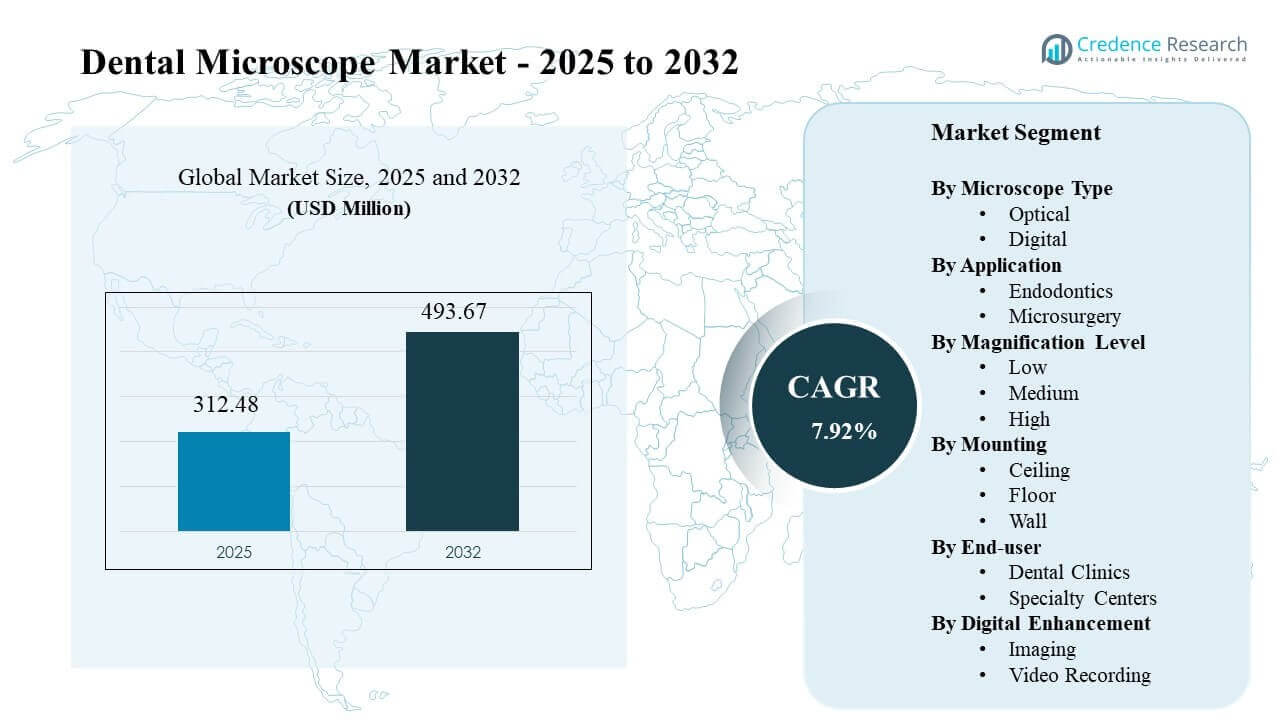
The global Dental Microscope Market size was estimated at USD 312.48 million in 2025 and is expected to reach USD 493.67 million by 2032, growing at a CAGR of 7.92% from 2025 to 2032. Rising demand for precision dentistry is increasing the use of magnification-assisted workflows in endodontics and microsurgical procedures, where visualization supports technique control and procedural consistency. Adoption is also improving as more dental clinics invest in advanced operatory setups that enhance documentation, training, and patient communication across complex casework.
| REPORT ATTRIBUTE | DETAILS |
|---|---|
| Historical Period | 2020-2024 |
| Base Year | 2025 |
| Forecast Period | 2026-2032 |
| Dental Microscope Market Size 2025 | USD 312.48 million |
| Dental Microscope Market, CAGR | 7.92% |
| Dental Microscope Market Size 2032 | USD 493.67 million |
Key Market Trends & Insights
- The Dental Microscope Market is expected to expand at a CAGR of 7.92% from 2025 to 2032, supported by growing adoption of precision visualization in specialty procedures.
- The market was valued at USD 312.48 million in 2025, reflecting sustained procurement in clinic modernization and specialty care delivery.
- The market is projected to reach USD 493.67 million by 2032, supported by rising upgrades and new-install demand across advanced operatories.
- Dental Clinics accounted for the largest share of 44.30% in 2025, driven by higher procedure throughput and investment in standardized workflows.
- Endodontics accounted for the largest share of 38.10% in 2025, supported by complex case handling and demand for improved clinical visibility.
Segment Analysis
Adoption in the Dental Microscope Market is shaped by procedure complexity, clinician training, and practice economics. Clinics expanding advanced restorative and specialty services increasingly value magnification for improved visibility, ergonomics, and procedural consistency. Purchasing decisions often prioritize optical clarity, illumination quality, stability during repositioning, and ease of integration into chairside workflows. Digital enhancement features are becoming more relevant as documentation and patient communication expectations rise.
Demand also varies by operatory layout and installation constraints, which influence mounting choices across ceiling, floor, and wall configurations. Specialty-driven environments prioritize stable positioning and repeatable ergonomics to reduce fatigue in longer procedures. Digital workflows are gradually influencing product selection, with increased interest in imaging and video recording for case review, training, referrals, and patient education. Distributor coverage and service responsiveness remain important differentiators because downtime risk directly affects clinic productivity.
Microscope Type Insights
Microscope type selection is primarily influenced by the required level of visualization performance and workflow preference in daily clinical practice. Optical systems remain widely adopted where clinicians prioritize direct visualization, reliable illumination, and familiar ergonomics for precision procedures. Digital microscopes gain traction in environments that emphasize screen-based workflows, team viewing, training, and streamlined documentation. Practices often evaluate usability, service support, and integration with existing operatory infrastructure before choosing a platform.
Application Insights
Endodontics accounted for the largest share of 38.10% in 2025. Complex canal anatomy, retreatment workflows, and precision access requirements make magnification and illumination more valuable in endodontic care delivery. Microsurgery demand increases in clinics and specialty centers that perform advanced procedures requiring controlled manipulation and improved visualization. Application-driven procurement often aligns microscope specifications with case mix, clinician technique preferences, and documentation expectations.
Magnification Level Insights
Magnification level decisions reflect the balance between procedure versatility and the need for fine-detail recognition. Low and medium magnification levels support broader day-to-day use across general and specialty procedures where workflow speed and comfort matter. High magnification is selected for tasks that require greater detail visibility and controlled instrumentation, particularly in advanced procedures. Practices also consider image stability, illumination consistency, and ergonomics because these factors influence routine utilization.
Mounting Insights
Mounting choices are driven by operatory layout, clinician ergonomics, and installation feasibility. Ceiling-mounted systems are selected when clinics prioritize reduced floor footprint and stable positioning that supports efficient chairside workflows. Floor-mounted configurations remain common when flexibility and simpler installation are preferred across varied room setups. Wall-mounted options are used in specific layouts that prioritize reach and structured operatory design to support consistent positioning during procedures.
End-user Insights
Dental Clinics accounted for the largest share of 44.30% in 2025. Higher throughput, standardized clinical protocols, and investment in differentiated care encourage clinics to adopt microscope-enabled workflows for complex procedures. Specialty Centers prioritize microscopes as core infrastructure where advanced procedures are central to service delivery and outcomes consistency. End-user purchasing decisions are influenced by training support, service responsiveness, and total cost of ownership in high-utilization environments.
Digital Enhancement Insights
Digital enhancement adoption is influenced by documentation requirements and the need to improve communication with patients and referral partners. Imaging features support case capture, review, and presentation in workflows where visual explanation improves understanding and acceptance. Video recording is increasingly valued for training, collaboration, and education, especially in specialty-focused practices. Practices typically prioritize features that integrate smoothly into chairside routines without adding workflow friction or extending procedure time.
Dental Microscope Market Drivers
Expanding demand for precision endodontics and advanced procedure workflows
The Dental Microscope Market is supported by rising demand for precision dentistry in procedures where enhanced visibility improves technique control. Endodontic and microsurgical workflows benefit from better visualization, which helps clinicians manage complexity and improve procedural confidence. Clinics adopting more advanced restorative and specialty services increasingly prioritize magnification-assisted workflows. Training programs and technique standardization reinforce routine microscope use, especially in practices that compete on quality and outcomes consistency.
- For instance, Carl Zeiss Meditec’s OPMI Pico dental microscope offers magnification ranges up to 25× with LED illumination exceeding 100,000 lux, enabling clinicians to detect microfractures and accessory canals with significantly higher procedural accuracy during endodontic treatments.
Growth of clinic modernization and specialty service expansion
Dental clinics and specialty centers continue to modernize operatories to support differentiated services and higher-value procedures. Microscope installation aligns with equipment upgrades that improve workflow consistency and clinician ergonomics. Group practices also pursue standardization across sites to maintain consistent care delivery and staff training. As advanced services expand, visualization systems become a strategic investment that supports predictable execution and patient-facing quality perception.
Increasing value placed on documentation, education, and communication
Dental practices increasingly use clinical documentation to support patient communication, referrals, and internal quality review. Microscopes that enable imaging and video capture help practices improve case presentation and strengthen treatment acceptance for complex procedures. Education-focused environments also value recording to support training and collaboration. As digital tools become more embedded in operatory routines, documentation capability strengthens the business rationale for adopting advanced visualization systems.
- For instance, Global Surgical Corporation’s G-Series dental microscopes incorporate 4K video recording systems capable of capturing over 8 million pixels per frame, allowing clinicians to document fine procedural details and improve case acceptance rates through high-resolution visual evidence.
Ergonomic benefits and productivity alignment in high-utilization settings
Clinician comfort and posture are important considerations, particularly for longer procedures that increase fatigue risk. Microscopes can support ergonomic positioning when mounted and configured to fit workflow preferences. High-throughput settings value equipment that reduces strain and supports consistent performance across repeated procedures. Practices that focus on productivity often evaluate stability, ease of repositioning, and service support because these factors reduce workflow disruption over time.
Dental Microscope Market Challenges
Adoption can be constrained by procurement cost, installation requirements, and service expectations that vary across clinic types. Smaller practices may delay purchase when case volume does not justify the investment or when financing terms are unfavorable. Training and technique adoption can also slow utilization because clinicians must integrate microscope-assisted workflows into routine practice. If utilization remains low, return on investment becomes harder to justify and replacement cycles lengthen.
Operational complexity is another constraint because mounting compatibility and operatory layout limitations can add friction to deployment. Multi-clinician environments may face variability in preferences for magnification and positioning, complicating standardization. Service coverage and maintenance responsiveness influence vendor selection since downtime affects productivity and scheduling. Practices also evaluate long-term support, parts availability, and distributor capability before committing to higher-end systems.
- For instance, Leica Microsystems’ M320 dental microscope features an LED illumination system delivering up to 100,000 lux and multiple mounting configurations (floor, wall, and ceiling mounts), but clinics must align operatory layouts with specific load-bearing and positioning requirements, while ensuring service agreements meet uptime expectations, particularly given typical LED lifetimes exceeding 60,000 hours.
Dental Microscope Market Trends and Opportunities
Digital dentistry trends are increasing interest in microscopes that support imaging and video workflows for documentation and patient education. Practices that prioritize consistent clinical communication increasingly value tools that make procedures easier to explain and review. Vendors that offer streamlined integrations with chairside displays and documentation workflows can strengthen differentiation. Training-led adoption programs also create opportunities to expand utilization beyond early adopters and improve customer retention.
- For instance, Carl Zeiss Meditec’s EXTARO 300 dental microscope integrates 4K video output with real-time fluorescence visualization modes and supports up to 25× magnification, enabling clinicians to capture high-resolution procedural footage for patient education and case documentation.
Opportunities are also emerging in fast-growing private clinic networks and specialty service expansion in developing markets. Premium clinic models that compete on advanced care experience are more likely to invest in visualization equipment. Flexible mounting options and workflow-oriented designs can help suppliers address diverse operatory constraints. Strong distributor and service networks remain a key commercial lever because installation support and uptime assurance influence buying decisions.
Regional Insights
North America
North America accounted for 39.80% in 2025, supported by strong penetration of specialty procedures and higher investment capacity in clinic modernization. Practice networks that standardize protocols and training often prioritize advanced visualization equipment to improve procedural consistency. Adoption is reinforced by demand for documentation tools that support patient communication and referrals. Vendor service coverage and rapid support remain important differentiators in high-utilization settings.
Europe
Europe represented 23.60% in 2025, supported by mature dental infrastructure and steady utilization of advanced restorative and specialty services in key markets. Procurement decisions typically emphasize reliability, serviceability, and workflow fit across diverse clinic environments. Adoption increases in practices that focus on specialty care and structured clinical protocols. Distributor presence and long-term support influence purchasing behavior across the region.
Asia Pacific
Asia Pacific captured 26.40% in 2025, supported by expanding private dental clinics and rising demand for premium care in urban centers. Growing specialty service availability increases interest in magnification-assisted workflows that improve visibility and technique control. Practices increasingly value documentation features that support patient education and case review. Market expansion is influenced by training accessibility, distribution reach, and service reliability across diverse countries.
Latin America
Latin America accounted for 6.80% in 2025, with demand concentrated in major urban markets where private dentistry and specialty services are expanding. Budget sensitivity influences purchasing decisions, often favoring phased upgrades and configurations that balance performance with affordability. Adoption is supported by practices competing on service quality and advanced procedure capability. Distributor strength and financing options can materially affect penetration.
Middle East & Africa
Middle East & Africa represented 3.40% in 2025, led by premium private clinics and regional hubs with growing demand for advanced dental services. Adoption tends to be strongest in markets that invest in modern operatories and specialty offerings. Service coverage and installation support are key factors because supply continuity and uptime influence clinic productivity. Growth potential is supported by private care expansion and premium clinic models in select locations.
Competitive Landscape
Competition in the Dental Microscope Market centers on optical performance, illumination quality, ergonomic design, mounting stability, and service responsiveness. Suppliers differentiate through workflow usability, clinician training support, and documentation capability that aligns with modern operatory expectations. Distributor networks and after-sales service play a central role because installation quality and uptime affect productivity. Product positioning increasingly emphasizes integrated workflows that support specialty procedures and patient communication.
Zeiss typically competes through premium positioning focused on optical clarity, illumination performance, and ergonomics suited to precision dentistry workflows. The company’s approach aligns with practices that prioritize consistent visualization in advanced procedures and value long-term service support. Strong brand recognition can support preference in specialty-driven procurement decisions. Competitive advantage is reinforced when training resources and service coverage reduce adoption friction and improve routine utilization.
The industry research and growth report includes detailed analyses of the competitive landscape of the market and information about key companies, including:
- Zeiss
- Leica Microsystems
- Global Surgical
- Seiler Instrument
- Labomed
- Karl Kaps
- Takagi
- Alltion
- CJ-Optik
- ATMOS
Qualitative and quantitative analysis of companies has been conducted to help clients understand the wider business environment as well as the strengths and weaknesses of key industry players. Data is qualitatively analyzed to categorize companies as pure play, category-focused, industry-focused, and diversified; it is quantitatively analyzed to categorize companies as dominant, leading, strong, tentative, and weak.
Recent Developments
In February 2026, Leica Microsystems announced that it had appointed Diamond Dent Trading Co as its authorized partner for dental surgical microscopy solutions in Saudi Arabia, with the partnership effective since 2025 and focused on distribution, training, and educational activities for dental clinics and professionals in the Kingdom.
Report Scope
| Report Attribute | Details |
| Market size value in 2025 | USD 312.48 million |
| Revenue forecast in 2032 | USD 493.67 million |
| Growth rate (CAGR) | 7.92% (2025–2032) |
| Base year | 2025 |
| Forecast period | 2026-2032 |
| Quantitative units | USD million |
| Segments covered | By Microscope Type; By Application; By Magnification Level; By Mounting; By End-user; By Digital Enhancement |
| Regional scope | North America; Europe; Asia Pacific; Latin America; Middle East & Africa |
| Key companies profiled | Zeiss; Leica Microsystems; Global Surgical; Seiler Instrument; Labomed; Karl Kaps; Takagi; Alltion; CJ-Optik; ATMOS |
| No. of Pages | 327 |
Segmentation
By Microscope Type
- Optical
- Digital
By Application
- Endodontics
- Microsurgery
By Magnification Level
- Low
- Medium
- High
By Mounting
- Ceiling
- Floor
- Wall
By End-user
- Dental Clinics
- Specialty Centers
By Digital Enhancement
- Imaging
- Video Recording
By Region
- North America
- U.S.
- Canada
- Mexico
- Europe
- Germany
- France
- U.K.
- Italy
- Spain
- Rest of Europe
- Asia Pacific
- China
- Japan
- India
- South Korea
- South-east Asia
- Rest of Asia Pacific
- Latin America
- Brazil
- Argentina
- Rest of Latin America
- Middle East & Africa
- GCC Countries
- South Africa
- Rest of the Middle East and Africa

Request a Free Sample
Fill in your details and we'll send you a free sample report.
- Sample data tables & charts
- Research methodology
Need a Custom Version of This Report?
Tailor the scope, geography, or segments to your exact requirements.
- Custom geography or segment scope
- Direct access to our analyst team
Frequently Asked Questions
What is the market size and forecast for the Dental Microscope Market?
What is the CAGR for the Dental Microscope Market?
What is the largest segment in the Dental Microscope Market?
What factors are driving growth in the Dental Microscope Market?
Who are the leading companies in the Dental Microscope Market?
Which region leads the Dental Microscope Market?
Table of Content
Chapter 1 Market Segmentation
- 1.1 Segmentation Framework
- 1.1.1 Product and Service Classification
- 1.1.2 Application and End-Use Classification
- 1.1.3 Technology and Solution Classification
- 1.1.4 Customer and Distribution Channel Classification
- 1.1.5 Geographic Segmentation
- 1.1.6 Market Segment Definitions and Boundaries
Chapter 2 Introduction
- 2.1 Report Objectives and Scope
- 2.2 Product Definition and Industry Terminology
- 2.3 Market Inclusions and Exclusions
- 2.4 Research Process
- 2.4.1 Primary Research and Expert Interviews
- 2.4.2 Secondary Research and Source Review
- 2.4.3 Top-Down and Bottom-Up Estimation
- 2.4.4 Data Triangulation and Verification
- 2.5 Market Size Measurement Basis
- 2.5.1 2025: USD 312.48 million → 2032: USD 493.67 million
- 2.6 Historical and Forecast Reference Periods
- 2.6.1 Base Year: 2025
- 2.6.2 Forecast Period: 2025-2032
- 2.7 Research Assumptions and Limitations
Chapter 3 Executive Summary
- 3.1 Market Snapshot and Key Findings
- 3.2 Base-Year Market Size, 2025
- 3.3 Forecast Market Size, 2032
- 3.4 Revenue and Volume Growth Outlook
- 3.5 Key Demand and Supply Indicators
- 3.6 Leading Market Segments
- 3.7 Fastest-Growing Market Opportunities
- 3.8 Regional Performance Highlights
- 3.9 Technology and Industry Transformation
- 3.10 Competitive Landscape Summary
- 3.11 Analyst View and Strategic Implications
Chapter 4 Global Dental Microscope Market Trends and Developments
- 4.1 Historical Industry Development
- 4.2 Recent Market Trends and Developments
- 4.3 Demand and Customer Behavior Trends
- 4.4 Technology and Product Innovation
- 4.5 Artificial Intelligence, Automation and Digitalization
- 4.6 Local Manufacturing and Supply Chain Realignment
- 4.7 Industry Partnerships, Mergers and Acquisitions
- 4.8 Sustainability and Circular Economy Developments
- 4.9 Government and Private Sector Investment Trends
- 4.10 Emerging Business Models and Commercialization
- 4.11 Industry Developments and Announcements
Chapter 5 Global Dental Microscope Market Production, Supply and Demand Analysis
- 5.1 Demand Trend and Consumption Analysis
- 5.2 Demand Forecast, 2025-2032
- 5.3 Production and Output Trend
- 5.4 Production and Output Forecast, 2025-2032
- 5.5 Installed Capacity and Capacity Utilization
- 5.6 Company-Wise Production Plants and Statistics
- 5.6.1 Installed Production Capacity
- 5.6.2 Actual Production
- 5.6.3 Planned Capacity and Expansion Targets
- 5.7 Supply Chain Structure and Procurement Trends
- 5.8 Supply-Demand Gap and Bottlenecks
- 5.9 Import Dependence and Sourcing Structure
- 5.10 Contract Manufacturing and Outsourcing
- 5.11 Regional Supply and Demand Concentration
Chapter 6 Global Dental Microscope Market Pricing Analysis
- 6.1 Pricing Structure and Measurement
- 6.2 Historical Pricing Trends
- 6.3 Pricing Outlook, 2025-2032
- 6.4 Average Selling Price and Unit Economics
- 6.5 Pricing by Product and Market Segment
- 6.6 Geographic Pricing Differences
- 6.7 Key Input, Energy, Labor and Logistics Costs
- 6.8 Contract Pricing and Purchasing Models
- 6.9 Pricing Sensitivity and Competitive Positioning
- 6.10 Price, Margin and Profitability Implications
Chapter 7 Global Dental Microscope Market Dynamics
- 7.1 Market Growth Drivers
- 7.1.1 Demand-Side Drivers
- 7.1.2 Technology and Innovation Drivers
- 7.1.3 Infrastructure and Investment Drivers
- 7.1.4 Regulatory and Policy Drivers
- 7.2 Market Restraints
- 7.2.1 Cost and Affordability Constraints
- 7.2.2 Technology and Adoption Barriers
- 7.2.3 Supply Chain and Operational Constraints
- 7.3 Market Challenges
- 7.3.1 Competitive Pressure and Margin Erosion
- 7.3.2 Skills, Infrastructure and Implementation Gaps
- 7.4 Emerging Market Opportunities
- 7.5 Market Dynamics Impact and Time-Horizon Assessment
Chapter 8 Global Dental Microscope Value Chain Analysis
- 8.1 Industry Value Chain Overview
- 8.2 Upstream Suppliers and Critical Inputs
- 8.3 Technology and Component Providers
- 8.4 Manufacturing or Service Delivery
- 8.5 Distribution, Channel Partners and Integrators
- 8.6 Downstream Applications and End Users
- 8.7 Value Addition and Profit Pools
- 8.8 Vertical Integration and Outsourcing
- 8.9 Supplier Concentration and Risk
- 8.10 Supply Chain Localization and Resilience
Chapter 9 Global Dental Microscope Market Regulations and Policies
- 9.1 Relevant Laws, Standards and Compliance Frameworks
- 9.2 Product, Service, Safety and Quality Requirements
- 9.3 Government Policies, Incentives and Subsidies
- 9.4 Imports, Exports and Trade Barriers
- 9.5 Public Procurement and Local Content Requirements
- 9.6 Environmental and Sustainability Compliance
- 9.7 Upcoming Policy Changes and Market Implications
Chapter 10 Global Dental Microscope Market Hotspots and Opportunities
- 10.1 Market Opportunity Mapping and Growth Hotspots
- 10.2 High-Growth Applications and Customer Groups
- 10.3 Underserved Markets and White-Space Opportunities
- 10.4 Emerging Technology and Product Opportunities
- 10.5 New Capacity and Investment Hotspots
- 10.6 Market Entry and Expansion Opportunities
- 10.7 Distribution and Partnership Opportunities
- 10.8 Near-Term and Long-Term Commercial Potential
- 10.9 Opportunity Attractiveness and Execution Risks
Chapter 11 Global Dental Microscope Market Outlook, 2025-2032
- 11.1 Market Size and Analysis
- 11.1.1 Revenue (Market Measurement: 2025: USD 312.48 million → 2032: USD 493.67 million)
- 11.1.2 Market Volume and Quantity Sold
- 11.1.3 Historical Market Size
- 11.1.4 Base-Year Market Size, 2025
- 11.2 Market Forecast, 2025-2032
- 11.2.1 Revenue Forecast to 2032
- 11.2.2 Volume Forecast to 2032
- 11.2.3 CAGR and Year-on-Year Growth
- 11.2.4 Incremental Revenue Opportunity
- 11.3 Forecast Assumptions and Scenario Analysis
- 11.3.1 Base-Case Forecast
- 11.3.2 Optimistic and Conservative Scenarios
- 11.3.3 Technology, Pricing and Policy Sensitivities
- 11.4 Market Attractiveness and Growth Outlook
Chapter 12 Global Dental Microscope Market Segmentation and Outlook
- 12.1 Segmentation Summary and Market Shares, 2025
- 12.2 Largest and Fastest-Growing Segments
- 12.3 Segment Growth Comparison
- 12.4 Segment Attractiveness and Priority Matrix
Chapter 13 Global Dental Microscope Geographic Market Outlook, 2025-2032
- 13.1 Regional Market Size and Share, 2025
- 13.2 Regional Market Forecast, 2025-2032
- 13.3 Regional Pricing, Production and Demand Differences
- 13.4 North America
- 13.4.1 United States
- 13.4.2 Canada
- 13.4.3 Mexico
- 13.5 Europe
- 13.5.1 Germany
- 13.5.2 France
- 13.5.3 Italy
- 13.5.4 United Kingdom
- 13.5.5 Spain
- 13.5.6 Poland
- 13.5.7 Russia
- 13.5.8 Netherlands
- 13.5.9 Belgium
- 13.5.10 Sweden
- 13.5.11 Denmark
- 13.5.12 Norway
- 13.5.13 Rest of Europe
- 13.6 Asia Pacific
- 13.6.1 China
- 13.6.2 India
- 13.6.3 Japan
- 13.6.4 South Korea
- 13.6.5 Thailand
- 13.6.6 Indonesia
- 13.6.7 Vietnam
- 13.6.8 Malaysia
- 13.6.9 Australia
- 13.6.10 Rest of Asia Pacific
- 13.7 Latin America
- 13.7.1 Brazil
- 13.7.2 Argentina
- 13.7.3 Colombia
- 13.7.4 Chile
- 13.7.5 Rest of Latin America
- 13.8 Middle East
- 13.8.1 Saudi Arabia
- 13.8.2 United Arab Emirates
- 13.8.3 Turkey
- 13.8.4 Israel
- 13.8.5 Iran
- 13.8.6 Rest of the Middle East
- 13.9 Africa
- 13.9.1 South Africa
- 13.9.2 Egypt
- 13.9.3 Nigeria
- 13.9.4 Morocco
- 13.9.5 Rest of Africa
- 13.10 Regional Investment, Policy and Supply Chain Differences
- 13.11 Regional Competitive Landscape
- 13.12 Geographic Growth Hotspots
Chapter 14 Global Dental Microscope Technology, Innovation and Sustainability Outlook
- 14.1 Technology Landscape and Maturity
- 14.2 Product, Process and Service Innovation
- 14.3 AI, Automation and Digital Tools in the Industry
- 14.4 Technology Adoption and Performance Benchmarking
- 14.5 Innovation Pipeline and R&D Investment
- 14.6 Patent and Intellectual Property Trends
- 14.7 Energy Efficiency and Resource Management
- 14.8 Sustainability, Recycling and Circularity
- 14.9 Technology Roadmap, 2025-2032
- 14.10 Risks of Obsolescence and Technology Substitution
Chapter 15 Global Dental Microscope Market Key Strategic Imperatives
- 15.1 Growth and Market Entry Priorities
- 15.2 High-Return Products and Segments
- 15.3 Pricing, Profitability and Cost Optimization
- 15.4 Technology Investment and Product Differentiation
- 15.5 Supply Chain Localization and Resilience
- 15.6 Distribution and Customer Acquisition
- 15.7 Partnership, Acquisition and Capacity Strategy
- 15.8 Regional Expansion Priorities
- 15.9 Short-, Medium- and Long-Term Actions
Chapter 16 Competition Outlook
- 16.1 Industry Competition Characteristics
- 16.2 Market Structure and Concentration
- 16.3 Market Share and Competitive Positioning, 2025
- 16.4 Company-Wise Revenue and Product Benchmarking
- 16.5 Production and Service Capacity Benchmarking
- 16.6 Technology, Pricing and Differentiation
- 16.7 Regional Footprint and Distribution Strength
- 16.8 Mergers, Acquisitions and Strategic Alliances
- 16.9 New Entrants and Competitive Threats
- 16.10 Porter's Five Forces and Industry Attractiveness
- 16.11 Competitive Outlook, 2025-2032
Chapter 17 Company Profiles
- 17.1 Company Coverage and Selection Criteria
- 17.2 Leading Market Participants – Standard Profile Structure
- 17.2.1 Business Description
- 17.2.2 Company Ownership and Geographic Presence
- 17.2.3 Product and Service Portfolio
- 17.2.4 Manufacturing and Operating Footprint
- 17.2.5 Production Capacity and Expansion Plans
- 17.2.6 Financial Performance and Investment
- 17.2.7 Market Share and Competitive Position
- 17.2.8 Technology and Innovation Capabilities
- 17.2.9 Strategic Alliances or Partnerships
- 17.2.10 Recent Developments
- 17.2.11 Growth Strategy and Outlook
- 17.3 Other Relevant Market Participants
Note: Every listed company is profiled on the structure shown under the first company. The company list is preliminary and may change based on research findings, market developments, data availability and client requirements.
Chapter 18 Disclaimer
- 18.1 Research and Forecast Disclaimer
- 18.2 Data Source and Estimation Limitations
Note: The depth of individual sections depends on data availability for this market. Volume, capacity, trade and other unit-based metrics are included where applicable.

