Market Overview:
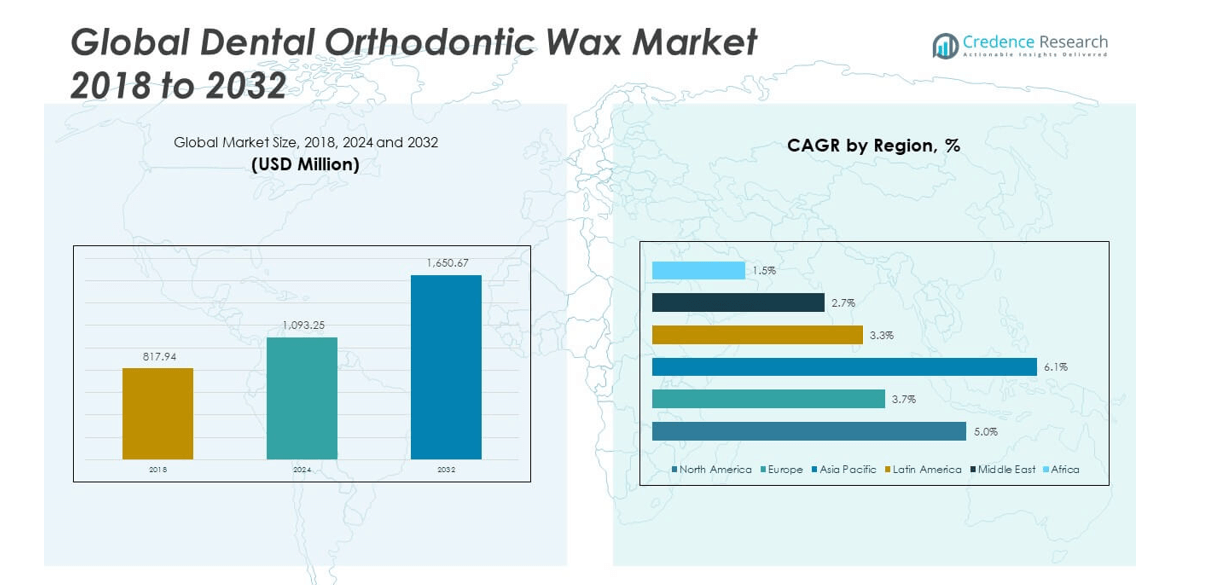
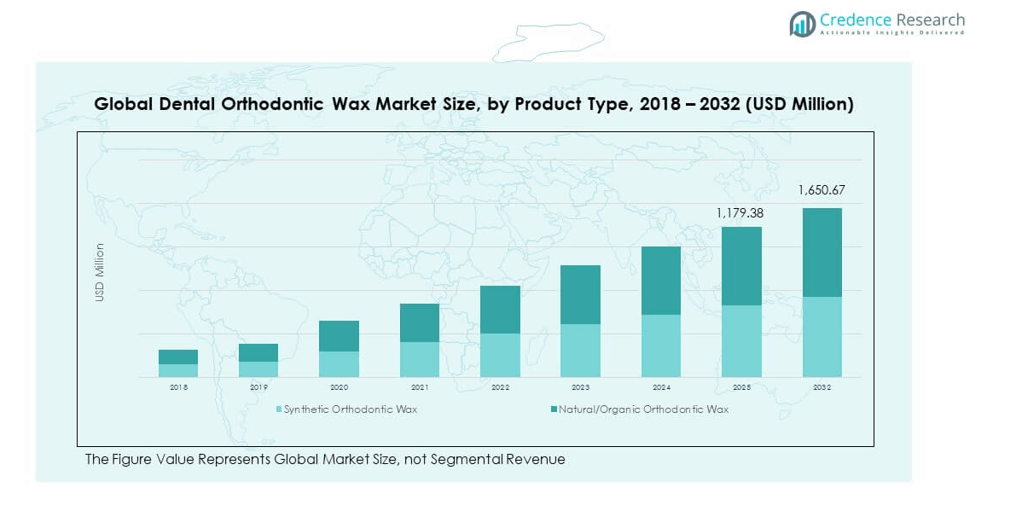
The Global Dental Orthodontic Wax Market size was valued at USD 817.94 million in 2018 to USD 1,093.25 million in 2024 and is anticipated to reach USD 1,650.67 million by 2032, at a CAGR of 4.92% during the forecast period.
| REPORT ATTRIBUTE | DETAILS |
|---|---|
| Historical Period | 2020-2023 |
| Base Year | 2024 |
| Forecast Period | 2025-2032 |
| Dental Orthodontic Wax Market Size 2024 | USD 1,093.25 million |
| Dental Orthodontic Wax Market, CAGR | 4.92% |
| Dental Orthodontic Wax Market Size 2032 | USD 1,650.67 million |
The market growth is driven by increasing orthodontic treatments, particularly among adolescents and adults seeking corrective dental solutions. Rising awareness about oral health, coupled with higher demand for affordable and effective products that reduce discomfort from braces, has boosted market expansion. Manufacturers are focusing on product quality and innovations such as flavored and transparent waxes, which further attract consumers. Additionally, growing adoption of cosmetic dentistry procedures and rising disposable income levels strengthen demand for orthodontic wax.
Geographically, North America leads the market due to advanced dental care infrastructure, strong consumer awareness, and high orthodontic treatment rates. Europe follows closely, supported by a robust healthcare system and increasing aesthetic dentistry demand. Meanwhile, Asia-Pacific is emerging as the fastest-growing region, fueled by expanding healthcare access, rising disposable incomes, and greater adoption of orthodontic care in countries like China, India, and Japan. Latin America and the Middle East are also witnessing gradual growth as awareness of orthodontic solutions rises.
Market Insights:
- The Global Dental Orthodontic Wax Market was valued at USD 817.94 million in 2018, reached USD 1,093.25 million in 2024, and is projected to hit USD 1,650.67 million by 2032, growing at a CAGR of 4.92%.
- North America held the largest share of 43.4% in 2024, supported by advanced dental infrastructure, high orthodontic adoption, and strong consumer awareness.
- Europe captured 17.6% of the market share in 2024, driven by cosmetic dentistry demand and established healthcare systems, followed by Asia Pacific with 30.3% share due to rising disposable income and treatment adoption.
- Asia Pacific is the fastest-growing region, holding 30.3% of the market share in 2024, supported by expanding healthcare access, rising awareness, and high demand in China, India, and Japan.
- By product type in 2024, synthetic orthodontic wax accounted for 63% of the market, while natural/organic orthodontic wax represented 37%, highlighting stronger adoption of synthetic products but rising preference for natural alternatives.
Market Drivers
Rising Orthodontic Procedures Among Adolescents and Adults Expanding Wax Demand
The Global Dental Orthodontic Wax Market is expanding due to the increasing number of orthodontic procedures performed worldwide. A growing number of adolescents and adults now seek corrective dental treatments, including braces and aligners, to enhance oral health and appearance. With higher adoption of orthodontic devices, the need for orthodontic wax to reduce discomfort and protect oral tissues has surged. It provides relief from irritation caused by brackets and wires, making treatments more tolerable. Rising awareness of oral hygiene among consumers supports the growing demand for these products. Orthodontists recommend wax as an essential accessory for treatment management. Rising disposable incomes and lifestyle changes are fueling greater acceptance of orthodontic solutions. The market continues to gain strength from increasing patient willingness to undergo long-duration dental corrections.
Expanding Focus on Oral Health Awareness Across Emerging and Developed Regions
Public awareness about oral health is expanding in both developed and developing nations, driving consistent demand. The Global Dental Orthodontic Wax Market benefits from campaigns by dental associations that highlight the importance of comfort during orthodontic care. It remains one of the most accessible and affordable solutions for mitigating oral discomfort. Schools, universities, and social platforms play a role in spreading awareness among younger populations. Governments are also supporting initiatives for better dental hygiene, further encouraging product uptake. Orthodontic wax is often recommended alongside oral hygiene kits, boosting consumer adoption. Continuous education from dental practitioners enhances the perception of orthodontic wax as a necessary tool. Increasing emphasis on preventive oral healthcare strengthens market adoption across all demographics.
- For instance, the American Association of Orthodontists’ Consumer Awareness Program reported over 15.4 million unique visitors to its consumer website and 676 million ad impressions in the 2025 fiscal year, which marks the highest consumer engagement on record for the association and helps boost demand for recommended orthodontic accessories such as wax.
Innovations in Wax Products with Varied Forms and Features Expanding Consumer Appeal
Continuous innovation is shaping the Global Dental Orthodontic Wax Market, with manufacturers developing waxes in flavored, colored, and transparent forms. Consumers increasingly prefer products that offer comfort while also enhancing usability and aesthetics. It reflects the growing demand for customized options that suit individual preferences. Manufacturers are introducing eco-friendly packaging and safe ingredients to meet rising sustainability concerns. Innovation also includes waxes that are easier to mold and apply, improving patient compliance. Retailers and pharmacies stock a wider variety of waxes, offering convenience to consumers. Online platforms help spread awareness and increase product availability across geographies. Enhanced product design ensures stronger appeal among tech-savvy and health-conscious populations.
- For instance, OrVance launched the OrthoDots CLEAR product line, made from biomedical-grade silicone that is 20 times more pliable than leading dental wax and features a proprietary moisture-activated technology, in 2022; the product’s transparency was improved to be 17 times more transparent than traditional options, offering greater user appeal for aligner and bracket patients.
Expanding Role of Cosmetic Dentistry Strengthening Wax Market Growth Globally
Cosmetic dentistry is experiencing growth, and this strongly supports demand for orthodontic accessories. The Global Dental Orthodontic Wax Market gains traction from the rising popularity of treatments focused on aesthetics. It complements orthodontic devices used in cosmetic procedures, providing essential comfort during prolonged treatment periods. Patients often undergo treatments that require extended adjustment phases, which makes orthodontic wax highly relevant. Growing beauty consciousness encourages individuals to seek orthodontic corrections at a younger age. Dentists emphasize orthodontic wax as part of post-treatment care, ensuring better treatment satisfaction. High media influence and growing consumer focus on smiles accelerate orthodontic corrections. This alignment between cosmetic dentistry and wax demand strengthens the overall growth trajectory.
Market Trends
Increasing Penetration of E-Commerce Platforms for Orthodontic Accessories Distribution
E-commerce is becoming a dominant channel for orthodontic product distribution, including orthodontic wax. The Global Dental Orthodontic Wax Market benefits from platforms offering convenience, variety, and competitive pricing. It ensures broader access to consumers in urban and semi-urban locations. Online pharmacies also play a key role in making orthodontic wax available with prescription and non-prescription kits. Companies use digital marketing strategies to attract younger demographics and highlight product advantages. Reviews and feedback on e-commerce platforms influence purchasing decisions. Subscription-based supply models ensure continuous availability for patients undergoing treatment. This digital expansion trend reshapes consumer purchasing behavior in dental accessories.
Growing Adoption of Sustainable and Biodegradable Dental Materials in Wax Production
Sustainability has become a central trend across healthcare industries, and dental accessories are no exception. The Global Dental Orthodontic Wax Market is responding with eco-friendly formulations and biodegradable packaging. It aligns with rising consumer demand for products that minimize environmental impact. Manufacturers are testing plant-based and non-toxic ingredients to replace petroleum-based wax. Consumers show preference for natural and allergen-free wax products. Governments encourage sustainability compliance, prompting companies to innovate in material science. The trend supports stronger brand differentiation in competitive markets. Long-term adoption of sustainable practices will reshape product offerings across orthodontic care.
Personalized Dental Care and Preference for Customized Wax Products
Personalization is a defining trend, extending into orthodontic accessories with rising consumer preference for customized wax products. The Global Dental Orthodontic Wax Market is adapting with varied textures, colors, and flavors. It offers patients better choice and enhances user experience during orthodontic treatment. It appeals to younger populations, particularly adolescents who value personalization in healthcare products. Dentists also recommend customized wax to improve treatment adherence. Manufacturers focus on targeted marketing campaigns for flavored and personalized options. The personalization trend increases repeat purchases and enhances brand loyalty. A patient-centric approach ensures stronger consumer engagement in orthodontic care.
- For instance, Element Dental manufactures medical-grade orthodontic wax available in ten unique flavors and colors, with customizable orders ranging from single color/flavor to assorted packs, fully verified by their U.S. distributor catalog
Integration of Orthodontic Wax Products into Complete Oral Care Kits
Dental kits including brushes, floss, and wax are increasingly marketed together for comprehensive patient support. The Global Dental Orthodontic Wax Market is shaped by this trend, as orthodontic wax becomes part of bundled offerings. It increases product visibility and promotes frequent usage among patients. Dental clinics provide orthodontic kits as part of treatment packages, making wax a standardized accessory. Pharmacies and retailers stock these kits, boosting consumer convenience. This integration encourages wider acceptance of orthodontic wax as a mainstream dental product. Manufacturers benefit from cross-selling opportunities and stronger retail partnerships. The bundling trend creates higher consumer trust and sustained market demand.
- For instance, Tess Oral Health supplies orthodontic dental kits that include wax, toothbrushes, and floss as customizable bundle options, shipped directly to dental clinics and verified in their product catalog.
Market Challenges Analysis
Limited Awareness in Underdeveloped Regions and Restricted Access to Dental Care Services
The Global Dental Orthodontic Wax Market faces challenges due to limited awareness and restricted access in underdeveloped regions. It remains underutilized where dental infrastructure is weak and orthodontic treatments are less common. Low-income populations prioritize urgent care over orthodontic correction, reducing wax adoption. Distribution channels are fragmented in many rural areas, limiting consumer access. Affordability concerns also slow down product penetration. The lack of professional guidance further hampers consumer adoption in these areas. Marketing campaigns are not equally effective in remote regions, leaving large potential markets untapped. These barriers create a significant growth gap across global regions.
Product Substitutes and Patient Non-Compliance Affecting Long-Term Adoption
Orthodontic wax faces competition from substitutes such as silicone covers and advanced aligner technologies. The Global Dental Orthodontic Wax Market is challenged by shifting patient preferences toward products requiring less maintenance. It often suffers from compliance issues, as patients sometimes neglect consistent wax usage. The short-term relief provided by wax may discourage long-term reliance. Manufacturing quality inconsistencies also create consumer dissatisfaction. Patient discomfort with application and removal reduces overall acceptance. Competition from orthodontic innovations may limit wax’s role in modern treatments. These combined challenges restrict consistent market growth despite strong demand potential.
Market Opportunities
Expansion of Distribution Networks and Digital Sales Creating Growth Pathways
The Global Dental Orthodontic Wax Market holds significant opportunities through expanded retail and online distribution. It gains momentum from wider penetration of e-commerce platforms and pharmacy chains offering dental kits. Manufacturers can leverage digital sales to target younger and urban populations. Strong marketing campaigns emphasizing patient comfort drive stronger product acceptance. Partnerships with clinics and hospitals expand visibility in treatment plans. Rural outreach programs further extend access to new consumer bases. Strengthening distribution channels ensures reliable market growth across developed and emerging regions.
Rising Demand for Affordable Orthodontic Solutions in Developing Countries
Developing nations present a vast opportunity due to growing middle-class populations seeking affordable orthodontic solutions. The Global Dental Orthodontic Wax Market is positioned to benefit from increased awareness and expanding healthcare infrastructure. It offers an economical and effective accessory for patients undergoing dental correction. Local manufacturers can capitalize on cost-sensitive markets by producing budget-friendly products. Awareness campaigns highlighting oral comfort expand patient demand. Expanding government healthcare initiatives enhance adoption of orthodontic treatments. These factors combine to strengthen growth opportunities across emerging regions.
Market Segmentation Analysis:
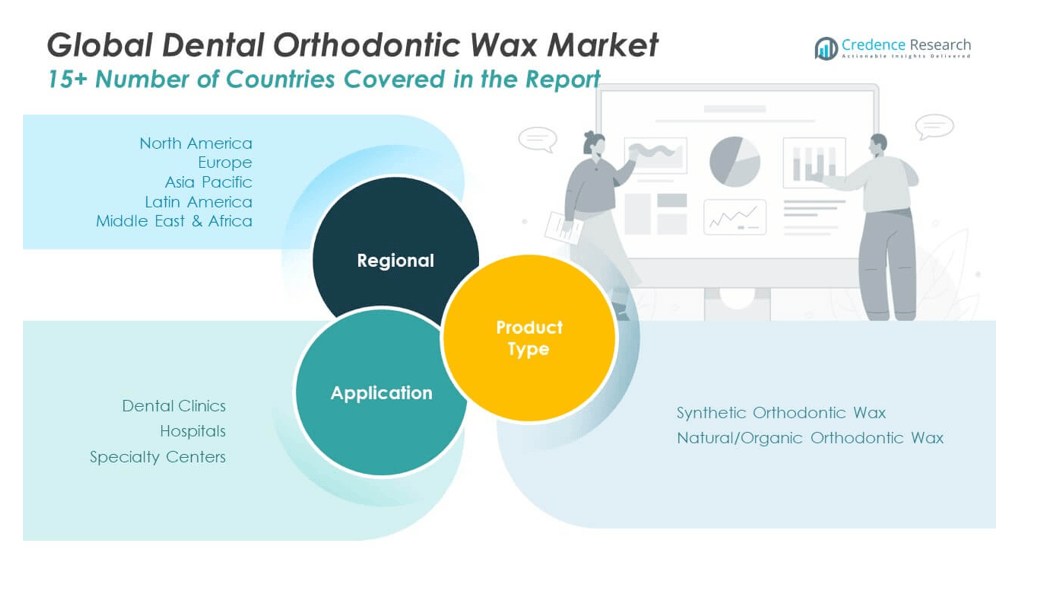
The Global Dental Orthodontic Wax Market is segmented
By product type into synthetic orthodontic wax and natural or organic orthodontic wax. Synthetic orthodontic wax dominates due to its cost-effectiveness, ease of production, and widespread availability across developed and emerging regions. It remains a preferred option for large-scale dental practices and hospitals that require standardized solutions. Natural or organic orthodontic wax is gaining traction among consumers seeking safe, allergen-free, and eco-friendly alternatives. It appeals strongly to health-conscious and sustainability-driven populations, creating growth opportunities in premium and niche markets.
- For instance, ReliaWax by Reliance Orthodontic Products is a synthetic, semi-permanent orthodontic wax that offers durable, clear protection in a light-cure gel format. It is designed for use in dental offices and withstands routine brushing and eating, remaining in place for days between appointments and is widely adopted for standardized patient comfort in high-volume clinical settings.
By application, the Global Dental Orthodontic Wax Market is divided into dental clinics, hospitals, and specialty centers. Dental clinics represent the largest share, supported by the rising number of orthodontic procedures and routine patient visits for corrective care. It benefits from steady demand as orthodontists commonly recommend wax to ease discomfort during treatments. Hospitals hold a significant position due to advanced dental departments that integrate orthodontic solutions into broader healthcare services. Specialty centers, focusing on orthodontics and cosmetic dentistry, are emerging as high-growth areas. Their growth is linked to rising consumer demand for specialized treatment and patient comfort. This balanced segmentation highlights diverse adoption pathways across healthcare settings.
- For instance, the OrthoDots® CLEAR (OrVance) patient pack is distributed by orthodontic specialists and general dentists across the United States, serving as a modern alternative to traditional orthodontic wax for patients with braces and aligner trays.
Segmentation:
By Product Type
- Synthetic Orthodontic Wax
- Natural/Organic Orthodontic Wax
By Application
- Dental Clinics
- Hospitals
- Specialty Centers
By Region
- North America
- U.S.
- Canada
- Mexico
- Europe
- UK
- France
- Germany
- Italy
- Spain
- Russia
- Belgium
- Netherlands
- Austria
- Sweden
- Poland
- Denmark
- Switzerland
- Rest of Europe
- Asia Pacific
- China
- Japan
- South Korea
- India
- Australia
- Thailand
- Indonesia
- Vietnam
- Malaysia
- Philippines
- Taiwan
- Rest of Asia Pacific
- Latin America
- Brazil
- Argentina
- Peru
- Chile
- Colombia
- Rest of Latin America
- Middle East
- UAE
- KSA
- Israel
- Turkey
- Iran
- Rest of Middle East
- Africa
- Egypt
- Nigeria
- Algeria
- Morocco
- Rest of Africa
Regional Analysis:
North America
The North America Global Dental Orthodontic Wax Market size was valued at USD 358.63 million in 2018 to USD 474.39 million in 2024 and is anticipated to reach USD 718.24 million by 2032, at a CAGR of 5.0% during the forecast period. North America holds the largest market share of 43.4% in 2024, driven by advanced dental infrastructure and high orthodontic treatment adoption. The Global Dental Orthodontic Wax Market in this region benefits from strong consumer awareness and insurance coverage supporting orthodontic procedures. It remains well established in the U.S. due to the high prevalence of braces among adolescents and adults. Dental associations and campaigns further encourage usage by highlighting patient comfort. Canada contributes through public health initiatives promoting oral care. Mexico shows steady growth due to increasing disposable income and expanding dental clinics. The regional growth trajectory remains solid with high acceptance of orthodontic accessories.
Europe
The Europe Global Dental Orthodontic Wax Market size was valued at USD 152.42 million in 2018 to USD 192.54 million in 2024 and is anticipated to reach USD 264.30 million by 2032, at a CAGR of 3.7% during the forecast period. Europe accounts for 17.6% of the market share in 2024, supported by strong healthcare systems and established dental practices. The Global Dental Orthodontic Wax Market benefits from rising cosmetic dentistry adoption across countries such as Germany, France, and the UK. It is further shaped by increasing demand for oral comfort solutions among adult patients seeking aesthetic corrections. Southern European countries, including Italy and Spain, contribute through higher orthodontic treatment rates linked to cosmetic appeal. Eastern Europe shows slower adoption but demonstrates gradual progress. Stringent regulatory frameworks maintain quality standards, fostering consumer trust. The overall market outlook remains positive with steady adoption across developed and emerging economies within the region.
Asia Pacific
The Asia Pacific Global Dental Orthodontic Wax Market size was valued at USD 234.21 million in 2018 to USD 330.69 million in 2024 and is anticipated to reach USD 544.92 million by 2032, at a CAGR of 6.1% during the forecast period. Asia Pacific holds 30.3% of the market share in 2024, positioning it as the fastest-growing region. The Global Dental Orthodontic Wax Market is supported by rapid expansion of healthcare infrastructure in China, India, and Japan. It benefits from rising disposable incomes and stronger demand for orthodontic and cosmetic dental care. Growing awareness of oral health among young populations drives higher adoption. Governments invest in dental programs and promote preventive care. Clinics and specialty centers expand rapidly in urban areas, enhancing accessibility. South Korea and Australia further strengthen regional performance through advanced orthodontic practices. Asia Pacific’s growth trajectory highlights its importance in shaping the global landscape.
Latin America
The Latin America Global Dental Orthodontic Wax Market size was valued at USD 38.63 million in 2018 to USD 51.00 million in 2024 and is anticipated to reach USD 68.15 million by 2032, at a CAGR of 3.3% during the forecast period. Latin America represents 4.7% of the market share in 2024, with growth supported by increasing access to dental care in Brazil and Argentina. The Global Dental Orthodontic Wax Market in this region is shaped by a rising middle class seeking affordable orthodontic treatments. It benefits from expanding urban dental clinics and gradual improvements in healthcare systems. Public awareness of dental hygiene is increasing but remains uneven across countries. Brazil leads the region due to higher treatment rates and availability of trained orthodontists. Argentina demonstrates consistent growth through private dental practices. Other Latin American countries contribute at smaller scales but show potential through expanding clinics. Market development remains steady, though infrastructure gaps limit faster expansion.
Middle East
The Middle East Global Dental Orthodontic Wax Market size was valued at USD 23.09 million in 2018 to USD 28.24 million in 2024 and is anticipated to reach USD 36.03 million by 2032, at a CAGR of 2.7% during the forecast period. The region contributes 2.6% of the market share in 2024, reflecting modest but stable growth. The Global Dental Orthodontic Wax Market here is influenced by expanding healthcare investments in GCC countries. It benefits from rising demand for orthodontic treatments linked to aesthetic dental care. Israel demonstrates stronger adoption due to advanced medical facilities and high consumer awareness. Turkey also plays a growing role in regional dental tourism. However, disparities exist across the Middle East, with several markets remaining underdeveloped. Distribution channels are improving with growing private healthcare networks. Market growth continues but at a slower pace compared to developed economies.
Africa
The Africa Global Dental Orthodontic Wax Market size was valued at USD 10.95 million in 2018 to USD 16.41 million in 2024 and is anticipated to reach USD 19.03 million by 2032, at a CAGR of 1.5% during the forecast period. Africa holds 1.0% of the market share in 2024, making it the smallest regional contributor. The Global Dental Orthodontic Wax Market in this region faces challenges from limited access to orthodontic care and low awareness. It remains concentrated in South Africa and Egypt where healthcare infrastructure is relatively advanced. Rural and low-income populations prioritize essential health services over orthodontic treatments. Growth is constrained by affordability concerns and insufficient orthodontic professionals. Private clinics in urban centers drive modest adoption. Multinational manufacturers face distribution challenges but continue exploring long-term opportunities. The market outlook remains restricted but presents gradual growth potential with improved healthcare access.
Key Player Analysis:
- Carmel Industries
- Bilkim Ltd. Co.
- Colgate-Palmolive Company
- DWS Systems
- Pyrex Polymars Inc.
- J. Robinson Company
- Solstice T&I
- Bracon Dental
- Metrodent Ltd.
Competitive Analysis:
The Global Dental Orthodontic Wax Market is characterized by the presence of multinational corporations, regional manufacturers, and niche suppliers competing across product innovation, distribution reach, and pricing strategies. Leading companies such as Colgate-Palmolive, Carmel Industries, Bilkim Ltd. Co., and Bracon Dental focus on expanding product portfolios with synthetic and natural wax options to capture diverse consumer needs. It is shaped by strategies including new product launches, regional expansions, and mergers to strengthen market share. Online platforms and retail partnerships are increasingly used to expand access and visibility. Smaller players compete by offering cost-effective products and targeting emerging markets with tailored solutions. Sustainability and allergen-free formulations remain central areas of competition, reflecting shifting consumer preferences. The market demonstrates a balance between established global brands with strong distribution networks and local producers catering to price-sensitive regions, driving a dynamic competitive landscape.
Report Coverage:
The research report offers an in-depth analysis based on Product Type and Application. It details leading market players, providing an overview of their business, product offerings, investments, revenue streams, and key applications. Additionally, the report includes insights into the competitive environment, SWOT analysis, current market trends, as well as the primary drivers and constraints. Furthermore, it discusses various factors that have driven market expansion in recent years. The report also explores market dynamics, regulatory scenarios, and technological advancements that are shaping the industry. It assesses the impact of external factors and global economic changes on market growth. Lastly, it provides strategic recommendations for new entrants and established companies to navigate the complexities of the market.
Future Outlook:
- The Global Dental Orthodontic Wax Market will expand steadily with higher orthodontic treatment adoption worldwide.
- It will see stronger demand for natural and allergen-free wax products as consumers prioritize safety.
- Product innovation in flavors, transparency, and ease of use will enhance consumer appeal.
- Online platforms and digital retail strategies will significantly increase accessibility and patient awareness.
- Hospitals and specialty centers will play a larger role in driving institutional demand for wax.
- North America will maintain dominance, while Asia Pacific will emerge as the fastest-growing region.
- Dental tourism in emerging markets will support stronger sales of orthodontic wax products.
- Strategic collaborations among manufacturers, clinics, and distributors will improve product penetration globally.
- Sustainable packaging and eco-friendly materials will become competitive differentiators across regions.
- Rising cosmetic dentistry trends will continue to fuel consistent demand for orthodontic wax.

Request a Free Sample
Fill in your details and we'll send you a free sample report.
- Sample data tables & charts
- Research methodology
Need a Custom Version of This Report?
Tailor the scope, geography, or segments to your exact requirements.
- Custom geography or segment scope
- Direct access to our analyst team
Frequently Asked Questions
What is the current market size for Global Dental Orthodontic Wax Market, and what is its projected size in 2032?
Which Global Dental Orthodontic Wax Market market segment held the largest share in 2024?
What are the primary factors fueling the growth of the Global Dental Orthodontic Wax Market?
Who are the leading companies in the Global Dental Orthodontic Wax Market?
Table of Content
Chapter 1. Report Introduction
- 1.1 Report Description & Purpose
- 1.1.1 Report Title & Market Definition
- 1.1.2 Unique Selling Propositions (USP) & Key Differentiators
- 1.1.3 Value Proposition for Stakeholders
- 1.2 Research Objectives
- 1.2.1 Market Sizing Objectives (Volume & Revenue)
- 1.2.2 Segmentation Objectives
- 1.2.3 Competitive Intelligence Objectives
- 1.2.4 Forecast & Scenario Objectives
- 1.3 Report Scope
- 1.3.1 Dental Orthodontic Wax Scope – Types & Subtypes Covered
- 1.3.2 Geographic Scope – Regions & Countries Covered
- 1.3.3 Historical Period, Base Year & Forecast Period (2024; forecast to 2032)
- 1.3.4 Inclusions & Exclusions
- 1.4 HS Code & Classification Framework
- 1.5 Currency, Units & Pricing Basis
- 1.6 Target Stakeholders
- 1.7 Limitations & Assumptions
Chapter 2. Executive Summary
- 2.1 Global Dental Orthodontic Wax Market Snapshot
- 2.1.1 Market Size – Historical (2024) & Forecast (2024-2032) (2024: USD 1,093.25 million → 2032: USD 1,650.67 million)
- 2.1.2 Volume & Revenue – Global Totals
- 2.1.3 Key Market Highlights – Top Five Facts
- 2.2 Dental Orthodontic Wax Market Segmentation Snapshot
- 2.2.1 Market Split by Region – 2024 vs. 2032
- 2.3 Competitive Snapshot
- 2.3.1 Top 10 Players by Revenue Share – 2024
- 2.3.2 Top 10 Players by Volume Share – 2024
- 2.3.3 Recent Strategic Developments (18-Month Summary)
- 2.4 Key Investment Highlights & Strategic Conclusions
Chapter 3. Dental Orthodontic Wax Market Dynamics & Industry Analysis
- 3.1 Market Overview & Context
- 3.1.1 Dental Orthodontic Wax Market Position in the Broader Automotive Value Chain
- 3.1.2 OEM vs. Replacement Market Dynamics
- 3.1.3 Market Maturity & Development Stage by Region
- 3.2 Dental Orthodontic Wax Market Drivers
- 3.3 Dental Orthodontic Wax Market Restraints & Challenges
- 3.4 Dental Orthodontic Wax Market Opportunities
- 3.5 Porter's Five Forces Analysis
- 3.5.1 Threat of New Entrants
- 3.5.2 Bargaining Power of Suppliers
- 3.5.3 Bargaining Power of Buyers
- 3.5.4 Threat of Substitutes
- 3.5.5 Competitive Rivalry – Intensity Assessment
- 3.6 Dental Orthodontic Wax Value Chain Analysis
- 3.6.1 Upstream – Raw Material/Input Suppliers
- 3.6.1.1 Raw Material/Input 1
- 3.6.1.2 Raw Material/Input 2
- 3.6.1.3 Raw Material/Input 3
- 3.6.2 Midstream – Production/Manufacturing/Service Delivery
- 3.6.2.1 Production/Process Overview
- 3.6.2.2 Key Facility Locations & Capacity by Manufacturer
- 3.6.3 Downstream – Distribution & End Consumer
- 3.6.3.1 Primary Channel – B2B/OEM
- 3.6.3.2 Secondary Channels – Dealer, Retail, Online, Direct
- 3.6.4 Value Chain Profitability Analysis
- 3.6.1 Upstream – Raw Material/Input Suppliers
- 3.7 PESTEL Analysis
- 3.7.1 Political Factors
- 3.7.2 Economic Factors
- 3.7.3 Social Factors
- 3.7.4 Technological Factors
- 3.7.5 Environmental Factors
- 3.7.6 Legal Factors
- 3.8 Dental Orthodontic Wax Supply Chain Analysis
- 3.8.1 Raw Material/Input Supply Risk Assessment
- 3.8.2 Manufacturing Concentration Risk (Geographic Exposure)
- 3.8.3 Trade Disruption Impact Analysis
- 3.9 Regulatory & Policy Landscape
Note: The regulatory and policy landscape section covers regulations based on their applicability to the market, Dental Orthodontic Wax category, geography, and scope of the study. Only regulatory frameworks with a material impact on operations, compliance, trade, sustainability, or market access are analyzed in detail.
Chapter 4. Key Investment Pockets & Opportunity Analysis
- 4.1 Dental Orthodontic Wax Market Attractiveness Analysis
- 4.1.1 By Region – Investment Attractiveness Matrix (Volume × CAGR)
- 4.2 Absolute Revenue Growth Opportunity
- 4.2.1 By Region – Absolute USD Growth Through 2032
- 4.3 Incremental Volume Opportunity
- 4.3.1 By Region – Incremental Volume Through 2032
- 4.3.2 Segment – Incremental Volume
- 4.4 Emerging Submarket Opportunity Deep Dive (Subject to Applicability)
- 4.5 Emerging Market Opportunity Scorecards
- 4.5.1 United States
- 4.5.2 Europe
- 4.5.3 Asia
- 4.5.4 Middle East & Africa
Note: Emerging Market Opportunity Scorecards will be included based on relevance and strategic importance. Regions listed are indicative and may vary depending on data availability and market dynamics.
Chapter 5. Dental Orthodontic Wax Import-Export Analysis & Trade Flows
- 5.1 Global Trade Overview
- 5.1.1 Global Export Value by Country (2024)
- 5.1.2 Global Export Volume by Country (2024)
- 5.1.3 Global Import Value by Country (2024)
- 5.1.4 Global Import Volume by Country (2024)
- 5.1.5 Net Trade Balance by Country (2024)
- 5.2 Export Analysis – Segment
- 5.2.1 Type 1 (HS Code)
- 5.2.2 Type 2 (HS Code)
- 5.2.3 Type 3 (HS Code)
- 5.2.4 Type 4 (HS Code)
- 5.2.5 Type 5 (HS Code)
- 5.3 Import Analysis – Segment
- 5.3.1 Type 1 (HS Code)
- 5.3.2 Type 2 (HS Code)
- 5.3.3 Type 3 (HS Code)
- 5.3.4 Type 4 (HS Code)
- 5.3.5 Type 5 (HS Code)
- 5.4 Average Unit Trade Prices
- 5.4.1 Average Export Price – Segment & Country
- 5.4.2 Average Import Price – Segment & Source Country
- 5.4.3 Price Trends (2024)
- 5.5 Key Trade Route Analysis
- 5.5.1 Trade Route 1
- 5.5.2 Trade Route 2
- 5.5.3 Trade Route 3
- 5.5.4 Trade Route 4
- 5.5.5 Trade Route 5
- 5.6 Trade Policy Impact Assessment
- 5.6.1 US Anti-Dumping & Section 301 Tariffs
- 5.6.2 EU Customs Union Impact
- 5.6.3 Major Free Trade Agreements
- 5.6.4 USMCA Rules of Origin
Note: Trade policy analysis will be included only where relevant to the Dental Orthodontic Wax market.
Chapter 6. Competitive Landscape & Company Benchmarking
- 6.1 Dental Orthodontic Wax Market Concentration & Structure
- 6.1.1 Herfindahl-Hirschman Index (HHI) – vs. 2024
- 6.1.2 Tier 1, Tier 2 & Tier 3 Market Structure
- 6.1.3 Global, Regional & Local Player Dynamics
- 6.2 Dental Orthodontic Wax Market Share Analysis – 2024
- 6.2.1 Global Revenue Share by Company
- 6.2.2 Global Volume Share by Company
- 6.2.3 Regional Revenue Share
- 6.2.4 Market Share Evolution ( vs. 2024)
- 6.2.5 OEM Segment Share by Company
- 6.2.6 Replacement Segment Share by Company
- 6.3 Production/Delivery Capacity & Facility Analysis
- 6.3.1 Global Installed Capacity
- 6.3.2 Capacity Utilization Rates
- 6.3.3 Production/Output Volume
- 6.3.4 Facility Locations & Capacity Map
- 6.3.5 Planned Capacity Additions
- 6.4 Dental Orthodontic Wax Competitive Benchmarking Matrix
- 6.4.1 Revenue, Volume, CAGR & Profitability Comparison
- 6.4.2 Channel Revenue Mix
- 6.4.3 Geographic Revenue Exposure
- 6.4.4 R&D Intensity
- 6.4.5 Sustainability Maturity
- 6.5 Strategic Developments in Dental Orthodontic Wax (Last 24 Months)
- 6.5.1 Mergers, Acquisitions & Divestments
- 6.5.2 New Dental Orthodontic Wax Launches
- 6.5.3 Facility Expansions
- 6.5.4 Strategic Alliances, Joint Ventures & Partnerships
- 6.5.5 Distribution Expansion & Market Entry
- 6.5.6 Sustainability & ESG Initiatives
- 6.6 Competitive Strategy Mapping
- 6.6.1 Leader, Challenger, Follower & Niche Classification
- 6.6.2 Pricing Strategy Comparison
- 6.6.3 Channel Strategy Matrix
Note: Strategic developments are included based on their materiality and the availability of reliable information.
Chapter 7. Global Dental Orthodontic Wax Market – By Distribution Channel
- 7.1 Segment Overview
- 7.1.1 Volume & Revenue Split by Channel (2024 & 2032)
- 7.1.2 Channel Mix Evolution (2024-2032)
Chapter 8. Regional Market Analysis – Global Overview
- 8.1 Global Regional Overview
- 8.1.1 Regional Volume Share
- 8.1.2 Regional Revenue Share
- 8.1.3 Regional Volume by Region
- 8.1.4 Regional Revenue by Region
- 8.1.5 Regional Forecast Through 2032
- 8.2 Cross-Regional Segment Analysis
- 8.2.1 By Distribution Channel
- 8.2.2 By Brand/Price Tier
Chapter 9. North America Dental Orthodontic Wax Market
- 9.1 United States
- 9.2 Canada
- 9.3 Mexico
Chapter 10. Europe Dental Orthodontic Wax Market
- 10.1 Germany
- 10.2 France
- 10.3 Italy
- 10.4 United Kingdom
- 10.5 Spain
- 10.6 Poland
- 10.7 Russia
- 10.8 Netherlands
- 10.9 Belgium
- 10.10 Sweden
- 10.11 Denmark
- 10.12 Norway
- 10.13 Rest of Europe
Chapter 11. Asia Pacific Dental Orthodontic Wax Market
- 11.1 China
- 11.2 India
- 11.3 Japan
- 11.4 South Korea
- 11.5 Thailand
- 11.6 Indonesia
- 11.7 Vietnam
- 11.8 Malaysia
- 11.9 Australia
- 11.10 Rest of Asia Pacific
Chapter 12. Latin America Dental Orthodontic Wax Market
- 12.1 Brazil
- 12.2 Argentina
- 12.3 Colombia
- 12.4 Chile
- 12.5 Rest of Latin America
Chapter 13. Middle East Dental Orthodontic Wax Market
- 13.1 Saudi Arabia
- 13.2 United Arab Emirates
- 13.3 Turkey
- 13.4 Israel
- 13.5 Iran
- 13.6 Rest of the Middle East
Chapter 14. Africa Dental Orthodontic Wax Market
- 14.1 South Africa
- 14.2 Egypt
- 14.3 Nigeria
- 14.4 Morocco
- 14.5 Rest of Africa
Chapter 15. Dental Orthodontic Wax Company Profiles
- 15.1 [Company 01]
- 15.1.1 Company Overview
- 15.1.2 Key Management Personnel
- 15.1.3 Products & Services Portfolio
- 15.1.4 Financial Performance
- 15.1.5 Key Market Focus & Geographic Presence
- 15.1.6 Recent Developments & Strategic Initiatives
Note: The company profile list is preliminary and may change based on research findings, market developments, data availability, and client requirements.
Chapter 16. Appendices
- Appendix A – List of Abbreviations & Acronyms
- Appendix B – Industry Classification Code Reference – Full Series
- Appendix C – Production & Capacity Data Tables
- Appendix D – End-Use & Demand Base Tables
- Appendix E – Consumption & Replacement Rate Assumptions
- Appendix F – ASP Reference Tables
- Appendix G – Manufacturing & Facility Database
- Appendix H – Import-Export Data Tables
- Appendix I – Regulatory Summary Tables
- Appendix J – Primary Research Participant List (Anonymized)
- Appendix K – Primary Research Questionnaire Framework
- Appendix L – Data Sources & Bibliography
- Appendix M – Market Size Divergence & Source Comparison
Chapter 17. Research Methodology
- 17.1 Research Framework & Philosophy
- 17.2 Secondary Research – Sources, Hierarchy & Data Extraction
- 17.3 Data Modeling – Bottom-Up & Top-Down Market Sizing
- 17.4 Primary Research – Stakeholder Framework, LOI & Sample Sizes
- 17.5 Forecast Methodology – Regression, Scenario & Sensitivity Analysis
- 17.6 Quality Control – Four-Layer Validation Framework
- 17.7 Limitations & Standard Assumptions
- 17.8 Disclaimer