
| REPORT ATTRIBUTE | DETAILS |
|---|---|
| Historical Period | 2019-2022 |
| Base Year | 2023 |
| Forecast Period | 2024-2032 |
| Digital Marketing Software Market Size 2024 | USD 68,826 million |
| Digital Marketing Software Market, CAGR | 15% |
| Digital Marketing Software Market Size 2032 | USD 210,540.3 million |
Market Overview
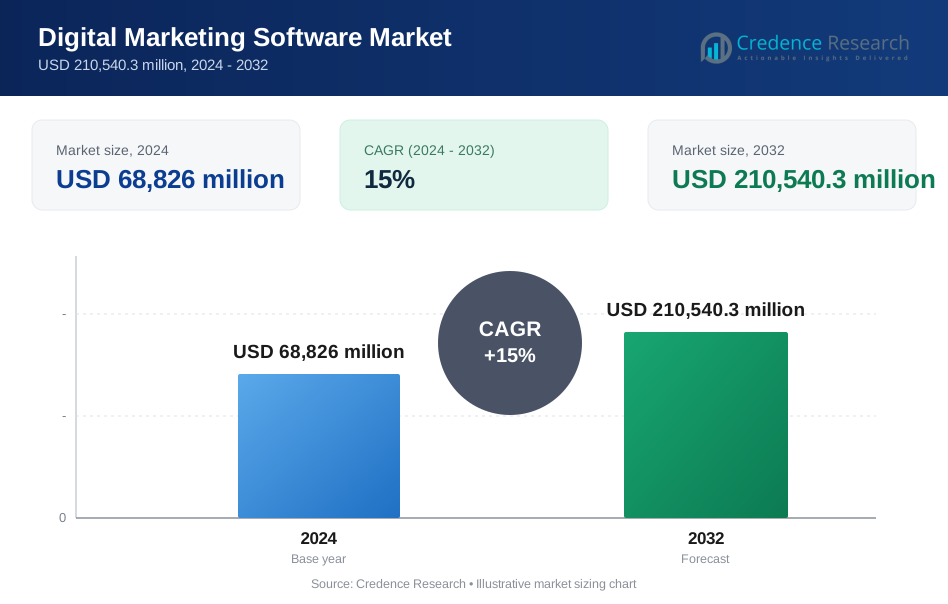
The Digital Marketing Software Market is projected to grow from USD 68,826 million in 2024 to USD 210,540.3 million by 2032, registering a robust compound annual growth rate (CAGR) of 15% during the forecast period.
The growth of the Digital Marketing Software Market is driven by the rapid adoption of advanced technologies such as artificial intelligence (AI), machine learning (ML), and big data analytics to optimize marketing campaigns and enhance customer engagement. The increasing shift toward digital transformation across industries has fueled demand for software solutions that streamline content management, email marketing, and social media analytics. Businesses are prioritizing personalized marketing strategies to cater to individual consumer preferences, further driving the adoption of these tools. Additionally, the rise in e-commerce and mobile commerce platforms, coupled with the widespread penetration of smartphones and high-speed internet, is contributing significantly to market growth. Trends such as the integration of chatbots for real-time customer interaction, predictive analytics for better decision-making, and cloud-based solutions for enhanced scalability are reshaping the industry. These factors collectively position digital marketing software as an indispensable tool for businesses seeking to stay competitive in the digital era.
The Digital Marketing Software Market exhibits strong geographical growth, with North America leading the market, accounting for 40% of the global share in 2024. The region benefits from early adoption of advanced technologies, a mature e-commerce sector, and robust regulatory frameworks that drive the demand for sophisticated marketing tools. The Asia-Pacific region follows closely, capturing 30% of the market share, with rapid digitalization, mobile-first consumption, and increasing e-commerce penetration in countries like China, India, and Japan. Key players in the market include industry leaders such as Adobe Systems, Oracle Corporation, Microsoft Corporation, SAP SE, and HubSpot. These companies dominate through innovative software solutions, offering AI-driven marketing, customer relationship management, and analytics capabilities that enhance marketing performance for businesses across diverse industries worldwide.
Market Drivers
Rising Adoption of Artificial Intelligence and Automation
The integration of artificial intelligence (AI) and automation is a major driver of the Digital Marketing Software Market. Businesses are leveraging AI to analyze vast datasets and gain insights into consumer behavior, enabling targeted and personalized marketing strategies. Automation tools streamline repetitive tasks, such as email campaigns and social media scheduling, increasing efficiency and reducing operational costs. For instance, companies like HubSpot use AI-driven tools to provide targeted marketing strategies and enhance customer engagement through personalized content. These advancements not only improve campaign effectiveness but also enable marketers to focus on strategic planning and creativity.
Growth of E-Commerce and Mobile Commerce
The surge in e-commerce and mobile commerce platforms is significantly boosting the demand for digital marketing software. As online shopping becomes more prevalent, businesses are prioritizing tools that enhance customer acquisition and retention. For instance, Shopify's digital marketing tools enable online retailers to optimize their marketing campaigns and increase sales through personalized product recommendations. Features such as targeted advertising, product recommendations, and dynamic pricing, supported by robust digital marketing software, help e-commerce businesses gain a competitive edge. Mobile commerce, driven by smartphone penetration and improved internet connectivity, further accelerates the adoption of these solutions.
Increasing Emphasis on Personalization and Customer Engagement
Modern consumers expect tailored experiences, making personalization a critical factor in marketing strategies. Digital marketing software enables businesses to create personalized content based on user preferences, browsing behavior, and purchase history. Additionally, tools such as CRM (Customer Relationship Management) and predictive analytics enhance customer engagement by enabling real-time interaction and proactive communication. For instance, Salesforce's CRM solutions help businesses engage with customers through personalized communications and predictive analytics, enhancing customer loyalty. This focus on personalized marketing not only improves customer satisfaction but also drives higher conversion rates and brand loyalty.
Proliferation of Social Media and Content Marketing
The widespread use of social media platforms has transformed how businesses connect with their target audience. Digital marketing software helps organizations create and manage engaging content, track performance metrics, and run impactful advertising campaigns on platforms like Facebook, Instagram, and LinkedIn. For instance, Hootsuite offers comprehensive social media management tools that allow businesses to schedule posts, track performance, and engage with their audience effectively. Content marketing, supported by analytics tools, ensures that businesses can deliver value-driven and relevant messages to their audiences, further fueling market growth.
Market Trends
Integration of Artificial Intelligence and Machine Learning
One of the most notable trends in the Digital Marketing Software Market is the integration of artificial intelligence (AI) and machine learning (ML) technologies. These tools enable businesses to analyze large volumes of data to predict consumer behavior, optimize campaigns, and deliver personalized marketing messages. For example, IBM Watson Marketing uses AI to predict consumer behavior and optimize marketing campaigns, improving overall effectiveness. AI-powered chatbots and virtual assistants enhance real-time customer engagement, while ML algorithms refine targeting and ad placements, driving higher ROI for digital marketing initiatives.
Increased Adoption of Omnichannel Marketing
The shift toward omnichannel marketing is reshaping the industry as businesses strive to deliver seamless and consistent customer experiences across multiple touchpoints. Digital marketing software facilitates the integration of campaigns across channels such as social media, email, websites, and mobile apps. For example, Adobe Experience Cloud enables businesses to create integrated omnichannel campaigns, ensuring consistent customer experiences across various platforms. This trend is driven by the growing expectation among consumers for cohesive interactions, regardless of the platform. Omnichannel strategies also allow marketers to track user journeys and optimize their efforts for maximum impact.
Growing Focus on Data-Driven Marketing
Data-driven marketing continues to gain traction as companies recognize the value of analytics in shaping effective strategies. Digital marketing software offers tools for collecting, processing, and analyzing data from various sources, enabling businesses to make informed decisions. Predictive analytics, sentiment analysis, and customer journey mapping are increasingly employed to enhance campaign precision and effectiveness. For example, Oracle Data Cloud provides comprehensive analytics tools that help businesses make data-driven marketing decisions to optimize their strategies. This trend supports the growing demand for measurable marketing outcomes and accountability.
Rise of Cloud-Based Marketing Solutions
Cloud-based digital marketing software is becoming the preferred choice for organizations due to its scalability, accessibility, and cost-efficiency. These solutions provide real-time updates, seamless collaboration among teams, and integration with other business systems. For example, Marketo offers a cloud-based marketing platform that allows teams to collaborate and manage campaigns from anywhere, ensuring agility and efficiency. As remote work and global collaboration become more prevalent, the demand for cloud-based platforms is expected to rise further, enabling businesses to stay agile and competitive in the evolving digital landscape.
Market Challenges Analysis
Data Privacy and Regulatory Compliance
One of the primary challenges in the Digital Marketing Software Market is navigating the complexities of data privacy and regulatory compliance. As consumers become increasingly aware of their digital footprints, governments worldwide are introducing stringent regulations such as the General Data Protection Regulation (GDPR) and the California Consumer Privacy Act (CCPA). Businesses leveraging digital marketing software must ensure that their practices align with these laws, including obtaining user consent for data collection and maintaining secure storage protocols. Non-compliance can lead to significant penalties, reputational damage, and the loss of customer trust, making it imperative for software providers to integrate robust privacy features. However, balancing personalization and data protection remains a persistent challenge, as overly restrictive measures can limit the effectiveness of targeted marketing efforts. In addition, adapting to the varying regulatory environments across countries adds another layer of complexity for global enterprises, further complicating compliance.
High Costs and Integration Complexities
The adoption of digital marketing software can be cost-prohibitive for small and medium-sized enterprises (SMEs), posing another significant market challenge. Advanced features such as AI-powered analytics, omnichannel capabilities, and real-time tracking often come with premium pricing models, making it difficult for budget-conscious businesses to invest. Additionally, integrating digital marketing software with existing systems, such as customer relationship management (CRM) and enterprise resource planning (ERP) platforms, can be complex and resource-intensive. Businesses may encounter technical compatibility issues, requiring significant time, expertise, and financial resources to resolve. Furthermore, the continuous updates and advancements in marketing software necessitate ongoing training and support, adding to operational expenses. Smaller companies also face challenges in measuring the return on investment (ROI) from such tools, leading to hesitation in adoption. These factors collectively hinder the widespread deployment of digital marketing solutions, particularly among smaller players, impacting overall market growth.
Market Segmentation Analysis:
By Component
The Digital Marketing Software Market can be segmented by component into two key categories: software and services. The software segment, which forms the bulk of market demand, includes various tools that support marketing automation, customer relationship management (CRM), social media marketing, and analytics. These software solutions enable businesses to manage and optimize their marketing campaigns, track performance, and provide personalized customer experiences. On the other hand, the services segment includes consulting, implementation, and support services that help businesses effectively integrate and maximize the use of digital marketing software. Services are critical for businesses that require tailored solutions, particularly in complex digital marketing strategies, and provide ongoing technical support and training for effective use of the software.
By Software
The software segment of the Digital Marketing Software Market is further categorized into various types, such as email marketing software, social media marketing tools, content management systems (CMS), and search engine optimization (SEO) software. Email marketing software facilitates the design and distribution of targeted campaigns, while social media tools help manage posts, track engagement, and analyze performance across platforms like Facebook, Instagram, and LinkedIn. Content management systems allow businesses to create, manage, and optimize content across websites and blogs, while SEO software enhances website visibility and search engine rankings. The increasing integration of AI and machine learning into these software tools is a growing trend, allowing for more personalized, predictive, and automated marketing strategies. These advancements are driving higher demand for sophisticated digital marketing software solutions.
Segments:
Based on Component
- Software
- Services
Based on Software
- Customer Relationship Management Software
- Email Marketing Software
- Social Media Advertising
- Search Marketing Software
- Web Content Management Software
- Marketing Automation Software
- Campaign Management
- Video Advertising
Based on Services
- Professional Service
- Support and Maintenance
- System Integration
- Testing and Optimization
- Training and Education
- Managed Service
Based on Deployment Type
- On-Premises
- Cloud
Based on Organization Size
- Large Enterprises
- Small and Medium-sized Enterprises (SMEs)
Based on Vertical
- BFSI
- Transportation and Logistics
- Consumer Goods and Retail
- Education
- Manufacturing
- Media and Entertainment
- Telecom and IT
- Travel and Hospitality
- Others
Based on the Geography:
- North America
- U.S.
- Canada
- Mexico
- Europe
- Germany
- France
- U.K.
- Italy
- Spain
- Rest of Europe
- Asia Pacific
- China
- Japan
- India
- South Korea
- South-east Asia
- Rest of Asia Pacific
- Latin America
- Brazil
- Argentina
- Rest of Latin America
- Middle East & Africa
- GCC Countries
- South Africa
- Rest of the Middle East and Africa
Regional Analysis
North America
North America holds the largest market share in the Digital Marketing Software Market, accounting for 40% of the global market in 2024. This dominance is primarily driven by the region’s early adoption of digital technologies, a highly developed technological infrastructure, and the presence of several leading global players, including Adobe, Salesforce, HubSpot, and Microsoft. The United States, in particular, plays a pivotal role, with its vast number of businesses across various industries leveraging advanced digital marketing strategies to stay competitive. High levels of investment in artificial intelligence (AI), machine learning, automation, and big data analytics are key drivers that fuel the demand for sophisticated digital marketing software. In addition, the region’s well-established e-commerce sector continues to grow, with businesses relying on marketing software to improve consumer targeting, optimize campaigns, and enhance customer retention. The expansion of social media platforms, such as Facebook, Instagram, and LinkedIn, has also increased demand for software that helps businesses manage their online presence. Furthermore, North America's robust regulatory environment, which includes data privacy laws like the GDPR in Europe and the California Consumer Privacy Act (CCPA) in the U.S., pushes businesses to adopt software solutions that not only enhance marketing performance but also ensure compliance. As companies focus on maintaining customer trust and engagement, the digital marketing software market in North America will continue to expand, solidifying its leadership position in the global landscape.
Asia-Pacific
The Asia-Pacific (APAC) region is projected to experience significant growth in the Digital Marketing Software Market, with the market share increasing at a rapid pace in 2024. APAC is expected to capture 30% of the global market share, making it one of the most dynamic regions for digital marketing software adoption. This growth is largely driven by the rapid digitalization of businesses, particularly in countries like China, India, Japan, and South Korea. With internet penetration increasing rapidly, particularly in rural and suburban areas, businesses in APAC are investing heavily in digital marketing tools to enhance customer engagement, optimize their advertising efforts, and drive sales through targeted campaigns. In countries like China, India, and Japan, the digital advertising landscape is evolving quickly, with businesses increasingly adopting software solutions to gain insights, manage customer relationships, and improve marketing outcomes. Moreover, the rise of mobile-first consumers, driven by widespread smartphone adoption and the growth of mobile commerce, has created a strong demand for digital marketing solutions optimized for mobile platforms. Cloud-based software solutions have become particularly popular in the region, offering scalability and flexibility to both small and large enterprises. Additionally, the expanding middle class and increasing disposable income across emerging markets in APAC are contributing to the surge in digital marketing software adoption. This region's diverse market, rapid technological advancements, and the increasing number of businesses focusing on online engagement and e-commerce platforms will continue to fuel the growth of digital marketing software, positioning APAC as a key player in the global market.
Key Player Analysis
- IBM Corporation (USA)
- Oracle Corporation (USA)
- Microsoft Corporation (USA)
- SS Institute Inc. (USA)
- HubSpot Inc. (USA)
- Adobe Systems (USA)
- HP Enterprise Development LP (USA)
- SAP SE (Germany)
- SAP SE (Germany)
- Adobe Systems (USA)
Competitive Analysis
The Digital Marketing Software Market is highly competitive, with major players continuously innovating to maintain their market positions. Adobe Systems, Oracle Corporation, Microsoft Corporation, SAP SE, and HubSpot lead the market, each offering a range of advanced software solutions designed to enhance digital marketing efforts. Adobe excels in creative tools and analytics, while Oracle and SAP focus on robust enterprise solutions that integrate customer relationship management and marketing automation. Microsoft offers powerful AI-driven marketing platforms, ensuring seamless integration with its broader enterprise software ecosystem. HubSpot, on the other hand, is known for its user-friendly inbound marketing solutions targeted at small and medium-sized businesses. These companies invest heavily in AI, machine learning, and big data analytics to improve personalization, customer engagement, and campaign optimization, positioning themselves as key players in the evolving digital marketing landscape. For instance, SAP's Customer Experience solutions leverage AI and big data to deliver personalized and optimized marketing campaigns, boosting customer satisfaction. Competition among these companies drives continuous advancements and sets high industry standard.
Recent Developments
- In April 2024, Adobe launched the next generation of its Experience Manager, which now incorporates more robust AI-driven content management features. This update is part of Adobe’s strategy to strengthen its position in the digital experience platform market, allowing users to automate content personalization at scale.
- In March 2023, Hewlett Packard Enterprise announced its acquisition of OpsRamp. By integrating OpsRamp's hybrid digital operations management solution with HPE GreenLake's edge-to-cloud technology and supporting it with HPE services, the company aims to reduce operational complexity across multi-vendor and multi-cloud IT environments, including those in the public cloud, colocations, and on-premises.
- In March 2023, HubSpot unveiled two new AI tools: Content Assistant and ChatSpot.ai. The Content Assistant helps marketing and sales teams efficiently generate, create, and share high-quality content. Meanwhile, ChatSpot.ai provides a natural language chat-based interface, enabling HubSpot users to perform tasks such as adding contacts and companies to the CRM and creating customized marketing reports.
- In July 2023, Google Ads unveiled a new auto-generated advertisement tool powered by generative AI. Leveraging Large Language Models (LLMs) and generative artificial intelligence (Gen AI), this tool enables Google Ads to generate campaign workflows based on prompts provided by marketers. This innovation allows advertisers and businesses to create advertisements on the Google Ads platform automatically.
- In March 2023, IBM expanded its collaboration with Adobe to include the integration of IBM’s Watson AI with Adobe Experience Manager. This collaboration enhances content personalization and streamlines digital marketing operations, making AI-infused applications more accessible to marketing teams.
Market Concentration & Characteristics
The Digital Marketing Software Market exhibits moderate to high concentration, with a few dominant players holding significant market shares. Leading companies like Adobe Systems, Oracle, Microsoft, and HubSpot drive market dynamics through continuous innovation, advanced product offerings, and strategic acquisitions. These major players focus on enhancing software functionalities, integrating AI and machine learning, and offering scalable cloud-based solutions, which contribute to their strong market positions. Despite the dominance of key players, the market also includes numerous small and medium-sized enterprises (SMEs) that provide specialized or niche solutions, fostering competition and driving market growth. The increasing demand for personalized marketing tools and data-driven insights has resulted in rapid technological advancements, ensuring that businesses of all sizes can access sophisticated marketing solutions. As digital marketing evolves, market players continue to adapt to emerging trends like omnichannel marketing, automation, and real-time analytics to meet diverse customer needs.
Report Coverage
The research report offers an in-depth analysis based on Software, Service, Deployment Type, Organization Size, Vertical and Geography. It details leading market players, providing an overview of their business, product offerings, investments, revenue streams, and key applications. Additionally, the report includes insights into the competitive environment, SWOT analysis, current market trends, as well as the primary drivers and constraints. Furthermore, it discusses various factors that have driven market expansion in recent years. The report also explores market dynamics, regulatory scenarios, and technological advancements that are shaping the industry. It assesses the impact of external factors and global economic changes on market growth. Lastly, it provides strategic recommendations for new entrants and established companies to navigate the complexities of the market.
Future Outlook
- The Digital Marketing Software Market is expected to continue growing at a rapid pace, driven by the increasing demand for personalized marketing solutions.
- AI and machine learning integration will play a pivotal role in enhancing campaign optimization and customer segmentation.
- Cloud-based solutions will dominate the market due to their scalability, flexibility, and cost-effectiveness.
- The growing importance of data privacy regulations will lead to the development of more secure and compliant marketing software.
- Mobile-first marketing will become more prominent, driven by the increasing reliance on smartphones and mobile commerce.
- Automation tools will continue to streamline marketing workflows, improving efficiency and reducing operational costs for businesses.
- The rise of omnichannel marketing strategies will drive demand for software that integrates multiple digital touchpoints seamlessly.
- Real-time analytics and data-driven decision-making will be increasingly prioritized to maximize ROI and improve marketing performance.
- SMEs will increasingly adopt affordable, user-friendly digital marketing software as digital transformation accelerates across industries.
- The market will see more partnerships and acquisitions as companies aim to expand their product offerings and reach new customer segments.
Request a Free Sample
Fill in your details and we'll send you a free sample report.
- Sample data tables & charts
- Research methodology
Need a Custom Version of This Report?
Tailor the scope, geography, or segments to your exact requirements.
- Custom geography or segment scope
- Direct access to our analyst team
Frequently Asked Questions
What is the current size of the Digital Marketing Software Market?
What factors are driving the growth of the Digital Marketing Software Market?
What are the key segments within the Digital Marketing Software Market?
What are some challenges faced by the Digital Marketing Software Market?
Who are the major players in the Digital Marketing Software Market?
Table of Content
Chapter 1. Report Introduction
- 1.1 Report Description & Purpose
- 1.1.1 Report Title & Market Definition
- 1.1.2 Unique Selling Propositions (USP) & Key Differentiators
- 1.1.3 Value Proposition for Stakeholders
- 1.2 Research Objectives
- 1.2.1 Market Sizing Objectives (Volume & Revenue)
- 1.2.2 Segmentation Objectives
- 1.2.3 Competitive Intelligence Objectives
- 1.2.4 Forecast & Scenario Objectives
- 1.3 Report Scope
- 1.3.1 Digital Marketing Software Scope – Types & Subtypes Covered
- 1.3.2 Geographic Scope – Regions & Countries Covered
- 1.3.3 Historical Period, Base Year & Forecast Period (2024; forecast to 2032)
- 1.3.4 Inclusions & Exclusions
- 1.4 HS Code & Classification Framework
- 1.5 Currency, Units & Pricing Basis
- 1.6 Target Stakeholders
- 1.7 Limitations & Assumptions
Chapter 2. Executive Summary
- 2.1 Global Digital Marketing Software Market Snapshot
- 2.1.1 Market Size – Historical (2024) & Forecast (2024-2032) (2024: USD 68,826 million → 2032: USD 210,540.3 million)
- 2.1.2 Volume & Revenue – Global Totals
- 2.1.3 Key Market Highlights – Top Five Facts
- 2.2 Digital Marketing Software Market Segmentation Snapshot
- 2.2.1 Market Split by Region – 2024 vs. 2032
- 2.3 Competitive Snapshot
- 2.3.1 Top 10 Players by Revenue Share – 2024
- 2.3.2 Top 10 Players by Volume Share – 2024
- 2.3.3 Recent Strategic Developments (18-Month Summary)
- 2.4 Key Investment Highlights & Strategic Conclusions
Chapter 3. Digital Marketing Software Market Dynamics & Industry Analysis
- 3.1 Market Overview & Context
- 3.1.1 Digital Marketing Software Market Position in the Broader Automotive Value Chain
- 3.1.2 OEM vs. Replacement Market Dynamics
- 3.1.3 Market Maturity & Development Stage by Region
- 3.2 Digital Marketing Software Market Drivers
- 3.3 Digital Marketing Software Market Restraints & Challenges
- 3.4 Digital Marketing Software Market Opportunities
- 3.5 Porter's Five Forces Analysis
- 3.5.1 Threat of New Entrants
- 3.5.2 Bargaining Power of Suppliers
- 3.5.3 Bargaining Power of Buyers
- 3.5.4 Threat of Substitutes
- 3.5.5 Competitive Rivalry – Intensity Assessment
- 3.6 Digital Marketing Software Value Chain Analysis
- 3.6.1 Upstream – Raw Material/Input Suppliers
- 3.6.1.1 Raw Material/Input 1
- 3.6.1.2 Raw Material/Input 2
- 3.6.1.3 Raw Material/Input 3
- 3.6.2 Midstream – Production/Manufacturing/Service Delivery
- 3.6.2.1 Production/Process Overview
- 3.6.2.2 Key Facility Locations & Capacity by Manufacturer
- 3.6.3 Downstream – Distribution & End Consumer
- 3.6.3.1 Primary Channel – B2B/OEM
- 3.6.3.2 Secondary Channels – Dealer, Retail, Online, Direct
- 3.6.4 Value Chain Profitability Analysis
- 3.6.1 Upstream – Raw Material/Input Suppliers
- 3.7 PESTEL Analysis
- 3.7.1 Political Factors
- 3.7.2 Economic Factors
- 3.7.3 Social Factors
- 3.7.4 Technological Factors
- 3.7.5 Environmental Factors
- 3.7.6 Legal Factors
- 3.8 Digital Marketing Software Supply Chain Analysis
- 3.8.1 Raw Material/Input Supply Risk Assessment
- 3.8.2 Manufacturing Concentration Risk (Geographic Exposure)
- 3.8.3 Trade Disruption Impact Analysis
- 3.9 Regulatory & Policy Landscape
Note: The regulatory and policy landscape section covers regulations based on their applicability to the market, Digital Marketing Software category, geography, and scope of the study. Only regulatory frameworks with a material impact on operations, compliance, trade, sustainability, or market access are analyzed in detail.
Chapter 4. Key Investment Pockets & Opportunity Analysis
- 4.1 Digital Marketing Software Market Attractiveness Analysis
- 4.1.1 By Region – Investment Attractiveness Matrix (Volume × CAGR)
- 4.2 Absolute Revenue Growth Opportunity
- 4.2.1 By Region – Absolute USD Growth Through 2032
- 4.3 Incremental Volume Opportunity
- 4.3.1 By Region – Incremental Volume Through 2032
- 4.3.2 Segment – Incremental Volume
- 4.4 Emerging Submarket Opportunity Deep Dive (Subject to Applicability)
- 4.5 Emerging Market Opportunity Scorecards
- 4.5.1 United States
- 4.5.2 Europe
- 4.5.3 Asia
- 4.5.4 Middle East & Africa
Note: Emerging Market Opportunity Scorecards will be included based on relevance and strategic importance. Regions listed are indicative and may vary depending on data availability and market dynamics.
Chapter 5. Digital Marketing Software Import-Export Analysis & Trade Flows
- 5.1 Global Trade Overview
- 5.1.1 Global Export Value by Country (2024)
- 5.1.2 Global Export Volume by Country (2024)
- 5.1.3 Global Import Value by Country (2024)
- 5.1.4 Global Import Volume by Country (2024)
- 5.1.5 Net Trade Balance by Country (2024)
- 5.2 Export Analysis – Segment
- 5.2.1 Type 1 (HS Code)
- 5.2.2 Type 2 (HS Code)
- 5.2.3 Type 3 (HS Code)
- 5.2.4 Type 4 (HS Code)
- 5.2.5 Type 5 (HS Code)
- 5.3 Import Analysis – Segment
- 5.3.1 Type 1 (HS Code)
- 5.3.2 Type 2 (HS Code)
- 5.3.3 Type 3 (HS Code)
- 5.3.4 Type 4 (HS Code)
- 5.3.5 Type 5 (HS Code)
- 5.4 Average Unit Trade Prices
- 5.4.1 Average Export Price – Segment & Country
- 5.4.2 Average Import Price – Segment & Source Country
- 5.4.3 Price Trends (2024)
- 5.5 Key Trade Route Analysis
- 5.5.1 Trade Route 1
- 5.5.2 Trade Route 2
- 5.5.3 Trade Route 3
- 5.5.4 Trade Route 4
- 5.5.5 Trade Route 5
- 5.6 Trade Policy Impact Assessment
- 5.6.1 US Anti-Dumping & Section 301 Tariffs
- 5.6.2 EU Customs Union Impact
- 5.6.3 Major Free Trade Agreements
- 5.6.4 USMCA Rules of Origin
Note: Trade policy analysis will be included only where relevant to the Digital Marketing Software market.
Chapter 6. Competitive Landscape & Company Benchmarking
- 6.1 Digital Marketing Software Market Concentration & Structure
- 6.1.1 Herfindahl-Hirschman Index (HHI) – vs. 2024
- 6.1.2 Tier 1, Tier 2 & Tier 3 Market Structure
- 6.1.3 Global, Regional & Local Player Dynamics
- 6.2 Digital Marketing Software Market Share Analysis – 2024
- 6.2.1 Global Revenue Share by Company
- 6.2.2 Global Volume Share by Company
- 6.2.3 Regional Revenue Share
- 6.2.4 Market Share Evolution ( vs. 2024)
- 6.2.5 OEM Segment Share by Company
- 6.2.6 Replacement Segment Share by Company
- 6.3 Production/Delivery Capacity & Facility Analysis
- 6.3.1 Global Installed Capacity
- 6.3.2 Capacity Utilization Rates
- 6.3.3 Production/Output Volume
- 6.3.4 Facility Locations & Capacity Map
- 6.3.5 Planned Capacity Additions
- 6.4 Digital Marketing Software Competitive Benchmarking Matrix
- 6.4.1 Revenue, Volume, CAGR & Profitability Comparison
- 6.4.2 Channel Revenue Mix
- 6.4.3 Geographic Revenue Exposure
- 6.4.4 R&D Intensity
- 6.4.5 Sustainability Maturity
- 6.5 Strategic Developments in Digital Marketing Software (Last 24 Months)
- 6.5.1 Mergers, Acquisitions & Divestments
- 6.5.2 New Digital Marketing Software Launches
- 6.5.3 Facility Expansions
- 6.5.4 Strategic Alliances, Joint Ventures & Partnerships
- 6.5.5 Distribution Expansion & Market Entry
- 6.5.6 Sustainability & ESG Initiatives
- 6.6 Competitive Strategy Mapping
- 6.6.1 Leader, Challenger, Follower & Niche Classification
- 6.6.2 Pricing Strategy Comparison
- 6.6.3 Channel Strategy Matrix
Note: Strategic developments are included based on their materiality and the availability of reliable information.
Chapter 7. Global Digital Marketing Software Market – By Distribution Channel
- 7.1 Segment Overview
- 7.1.1 Volume & Revenue Split by Channel (2024 & 2032)
- 7.1.2 Channel Mix Evolution (2024-2032)
Chapter 8. Regional Market Analysis – Global Overview
- 8.1 Global Regional Overview
- 8.1.1 Regional Volume Share
- 8.1.2 Regional Revenue Share
- 8.1.3 Regional Volume by Region
- 8.1.4 Regional Revenue by Region
- 8.1.5 Regional Forecast Through 2032
- 8.2 Cross-Regional Segment Analysis
- 8.2.1 By Distribution Channel
- 8.2.2 By Brand/Price Tier
Chapter 9. North America Digital Marketing Software Market
- 9.1 United States
- 9.2 Canada
- 9.3 Mexico
Chapter 10. Europe Digital Marketing Software Market
- 10.1 Germany
- 10.2 France
- 10.3 Italy
- 10.4 United Kingdom
- 10.5 Spain
- 10.6 Poland
- 10.7 Russia
- 10.8 Netherlands
- 10.9 Belgium
- 10.10 Sweden
- 10.11 Denmark
- 10.12 Norway
- 10.13 Rest of Europe
Chapter 11. Asia Pacific Digital Marketing Software Market
- 11.1 China
- 11.2 India
- 11.3 Japan
- 11.4 South Korea
- 11.5 Thailand
- 11.6 Indonesia
- 11.7 Vietnam
- 11.8 Malaysia
- 11.9 Australia
- 11.10 Rest of Asia Pacific
Chapter 12. Latin America Digital Marketing Software Market
- 12.1 Brazil
- 12.2 Argentina
- 12.3 Colombia
- 12.4 Chile
- 12.5 Rest of Latin America
Chapter 13. Middle East Digital Marketing Software Market
- 13.1 Saudi Arabia
- 13.2 United Arab Emirates
- 13.3 Turkey
- 13.4 Israel
- 13.5 Iran
- 13.6 Rest of the Middle East
Chapter 14. Africa Digital Marketing Software Market
- 14.1 South Africa
- 14.2 Egypt
- 14.3 Nigeria
- 14.4 Morocco
- 14.5 Rest of Africa
Chapter 15. Digital Marketing Software Company Profiles
- 15.1 [Company 01]
- 15.1.1 Company Overview
- 15.1.2 Key Management Personnel
- 15.1.3 Products & Services Portfolio
- 15.1.4 Financial Performance
- 15.1.5 Key Market Focus & Geographic Presence
- 15.1.6 Recent Developments & Strategic Initiatives
Note: The company profile list is preliminary and may change based on research findings, market developments, data availability, and client requirements.
Chapter 16. Appendices
- Appendix A – List of Abbreviations & Acronyms
- Appendix B – Industry Classification Code Reference – Full Series
- Appendix C – Production & Capacity Data Tables
- Appendix D – End-Use & Demand Base Tables
- Appendix E – Consumption & Replacement Rate Assumptions
- Appendix F – ASP Reference Tables
- Appendix G – Manufacturing & Facility Database
- Appendix H – Import-Export Data Tables
- Appendix I – Regulatory Summary Tables
- Appendix J – Primary Research Participant List (Anonymized)
- Appendix K – Primary Research Questionnaire Framework
- Appendix L – Data Sources & Bibliography
- Appendix M – Market Size Divergence & Source Comparison
Chapter 17. Research Methodology
- 17.1 Research Framework & Philosophy
- 17.2 Secondary Research – Sources, Hierarchy & Data Extraction
- 17.3 Data Modeling – Bottom-Up & Top-Down Market Sizing
- 17.4 Primary Research – Stakeholder Framework, LOI & Sample Sizes
- 17.5 Forecast Methodology – Regression, Scenario & Sensitivity Analysis
- 17.6 Quality Control – Four-Layer Validation Framework
- 17.7 Limitations & Standard Assumptions
- 17.8 Disclaimer
