
| REPORT ATTRIBUTE | DETAILS |
|---|---|
| Historical Period | 2020-2023 |
| Base Year | 2024 |
| Forecast Period | 2025-2032 |
| Dimethyl Carbonate Market Size 2024 | USD 1,162.3 million |
| Dimethyl Carbonate Market, CAGR | 11.43% |
| Dimethyl Carbonate Market Size 2032 | USD 2,757.6 million |
Market Overview
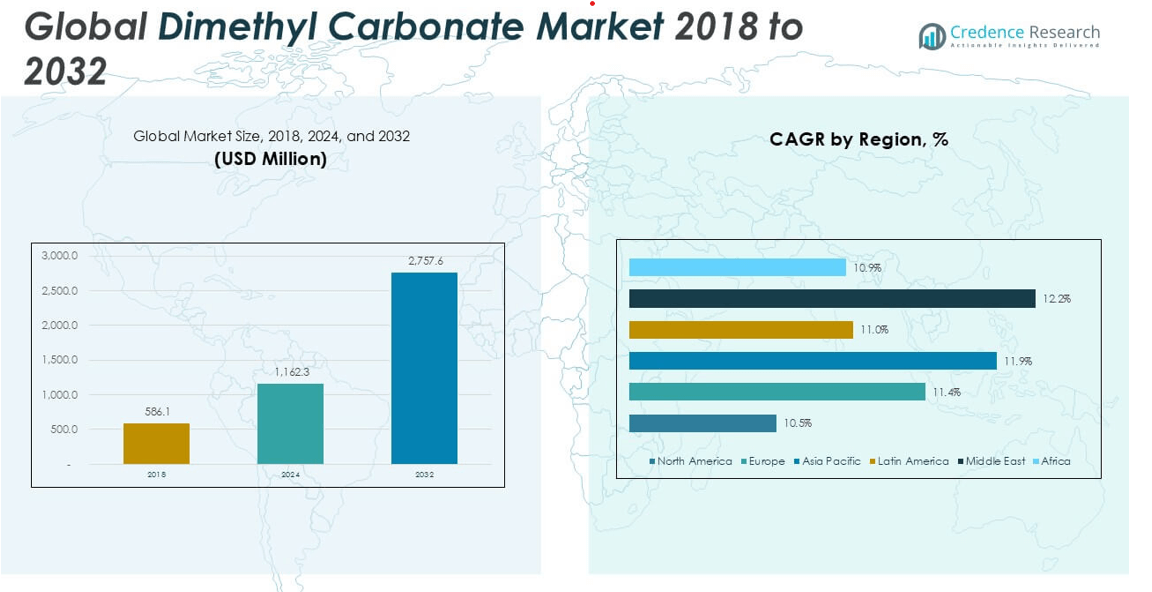
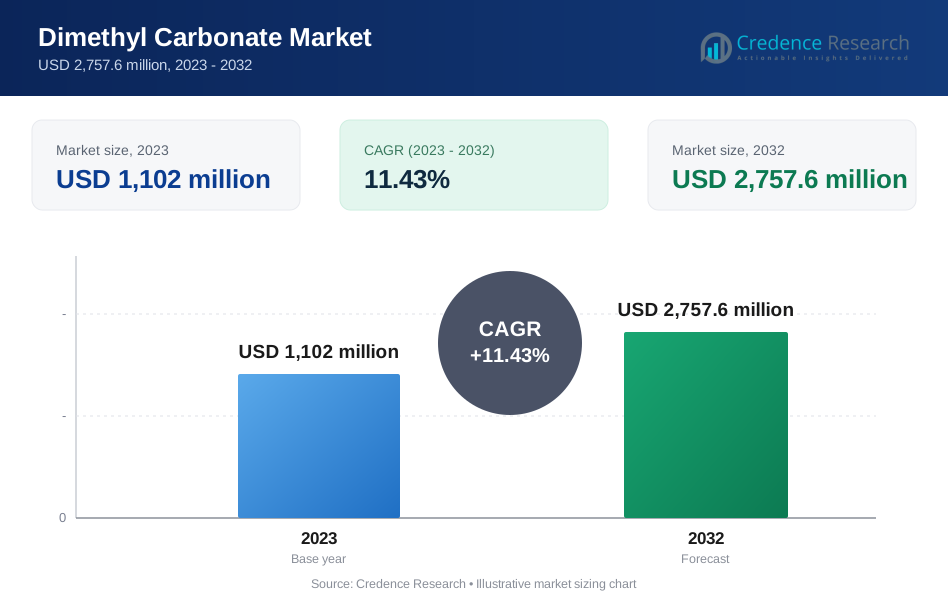
The Global Dimethyl Carbonate Market is projected to grow from USD 1,162.3 million in 2024 to an estimated USD 2,757.6 million by 2032, with a compound annual growth rate (CAGR) of 11.43% from 2025 to 2032.
Rising environmental regulations and the shift toward green chemistry are significantly driving market growth. The automotive sector's focus on reducing emissions and adopting cleaner fuels has propelled the use of DMC in lithium-ion batteries and fuel additives. Additionally, the expanding electronics and coatings industries are contributing to the rising consumption of DMC as a solvent and reagent. A key trend in the market is the growing investment in bio-based production technologies to reduce reliance on petrochemical routes and further enhance sustainability.
Geographically, Asia Pacific dominates the global Dimethyl Carbonate market due to rapid industrialization, especially in China, South Korea, and India, where DMC is extensively used in electronics and battery manufacturing. North America and Europe are also witnessing steady growth driven by regulatory push for green alternatives and increasing applications in pharmaceuticals. Major players in the market include UBE Industries Ltd., Shandong Shida Shenghua Chemical Group Co. Ltd., Merck KGaA, Kowa Company Ltd., and Thermo Fisher Scientific Inc.
Market Insights
- The Global Dimethyl Carbonate Market is projected to grow from USD 1,162.3 million in 2024 to USD 2,757.6 million by 2032, at a CAGR of 11.43% between 2025 and 2032.
- Battery-grade dimethyl carbonate is witnessing strong demand growth due to its critical role in lithium-ion batteries used in electric vehicles and grid storage.
- The market is driven by a shift toward environmentally friendly production processes, with DMC emerging as a safer alternative to phosgene and dimethyl sulfate.
- Volatile raw material prices and the need for high-purity production increase operational costs, posing a challenge for smaller manufacturers.
- Stringent storage and transportation regulations, especially for flammable chemicals like DMC, add to logistics and compliance costs.
- Asia Pacific dominates with over 35% market share in 2024, fueled by rapid industrialization and high demand from China, India, and South Korea.
- Pharmaceutical-grade DMC is gaining traction in drug synthesis due to its low toxicity, offering new avenues for market expansion.
Market Drivers
Growing Demand from Lithium-Ion Battery Production Drives Consumption
The expanding electric vehicle (EV) market has significantly boosted the demand for lithium-ion batteries, in which Dimethyl Carbonate (DMC) plays a crucial role as an electrolyte solvent. The Global Dimethyl Carbonate Market benefits from the rise in EV manufacturing and renewable energy storage systems. Automakers and battery producers prefer DMC due to its high dielectric constant and low toxicity compared to traditional alternatives. Government initiatives to reduce carbon emissions and shift to sustainable mobility further support this trend. Investments in EV infrastructure and battery production facilities continue to rise, especially in Asia Pacific and Europe. These developments increase the consumption of DMC and sustain long-term growth.
- For instance, nearly 17 million electric cars were sold globally in 2024, directly driving demand for DMC as a battery solvent.
Shift Toward Green Chemicals Reinforces Market Expansion
The push for sustainable chemical alternatives has increased the use of DMC in place of hazardous reagents like phosgene and dimethyl sulfate. The Global Dimethyl Carbonate Market responds to regulatory pressures that promote eco-friendly industrial practices. DMC offers a safer production route for polycarbonates, pesticides, and pharmaceuticals. It aligns with the goals of manufacturers aiming to comply with REACH, EPA, and other global environmental frameworks. Growing awareness of worker safety and environmental impact reinforces the shift to greener chemicals. Companies across sectors view DMC as a strategic input in reducing their environmental footprint.
- For instance, over 2,000 companies globally have adopted green chemical production processes in recent years, reflecting the widespread shift toward safer, eco-friendly chemicals like DMC.
Rising Use in Polycarbonate and Coatings Industry Strengthens Market Value
Polycarbonate production represents a major application area for DMC, where it serves as a precursor in non-phosgene processes. The Global Dimethyl Carbonate Market sees stable demand from automotive, electronics, and construction sectors where polycarbonate use is extensive. DMC’s role in producing high-performance polymers aligns with the rising need for lightweight and durable materials. The coatings industry also contributes to market growth through its use of DMC as a solvent. It improves performance characteristics while maintaining regulatory compliance. Industrial growth in Asia and Europe ensures continuous demand from these end-use sectors.
Pharmaceutical and Agrochemical Applications Fuel Diversification
The pharmaceutical industry uses DMC as a methylating and carbonylating agent in drug synthesis. The Global Dimethyl Carbonate Market benefits from increased investment in healthcare and drug production across developed and developing economies. Agrochemical manufacturers prefer DMC for its efficiency and low environmental risk profile in pesticide formulations. It contributes to safer and more cost-effective chemical processes. Diversification into high-value applications boosts the market’s resilience to economic fluctuations. These sectors provide a steady revenue stream and encourage innovation in DMC production methods.
Market Trends
Rising Adoption of Non-Phosgene Routes Enhances Sustainability and Safety
Manufacturers are increasingly adopting non-phosgene production methods for polycarbonate synthesis, where dimethyl carbonate serves as a cleaner alternative to toxic phosgene. This shift supports a safer working environment and aligns with tightening global environmental regulations. The Global Dimethyl Carbonate Market reflects this trend with growing demand from chemical producers looking to modernize operations. It helps reduce hazardous byproducts and ensures better compliance with REACH and other regulatory bodies. Companies are actively investing in new plants that integrate non-phosgene routes to improve sustainability profiles. These changes are reshaping production standards across the industry.
- For instance, in 2023, more than 20 new polycarbonate production lines using non-phosgene routes were commissioned worldwide by major chemical manufacturers.
Expansion in Battery-Grade DMC Production Targets Energy Transition Goals
Surging interest in clean energy solutions has intensified the focus on battery-grade dimethyl carbonate, a key component in lithium-ion batteries. The Global Dimethyl Carbonate Market is seeing increased capacity expansions aimed at meeting demand from electric vehicle and grid storage manufacturers. Producers are optimizing purification processes to deliver high-purity grades required by battery OEMs. It supports longer battery life and improved energy density, two critical requirements in modern EV applications. Major players are entering long-term supply agreements to secure positions in the energy storage value chain. This trend reinforces DMC’s strategic importance in the energy transition.
- For instance, in 2024, global production capacity for battery-grade dimethyl carbonate surpassed 400,000 tons, with several leading producers announcing plans for additional capacity expansions to serve the EV market.
Technological Advancements Drive Efficiency in Production and Application
Technology upgrades are improving DMC production efficiency, reducing cost per unit and minimizing emissions. The Global Dimethyl Carbonate Market benefits from catalytic innovations and continuous processing systems that streamline operations. These technologies lower energy consumption and allow scalable, high-volume output. It enables producers to meet rising global demand while maintaining competitive pricing. R\&D efforts also focus on refining DMC applications in sectors like coatings and adhesives. Innovation is central to maintaining market leadership and addressing shifting customer requirements.
Geographic Shifts in Production and Consumption Patterns Reshape Supply Chains
Asia Pacific remains a dominant region for DMC production and consumption, driven by rapid industrialization and electric vehicle adoption. The Global Dimethyl Carbonate Market is also witnessing rising demand in Europe and North America due to green technology adoption and stricter environmental standards. Producers are adjusting supply chains to balance regional demand fluctuations and reduce dependency on single-source suppliers. It improves supply chain resilience and lowers transportation risks. Trade dynamics are evolving with new export hubs emerging outside traditional manufacturing bases. This diversification strengthens market stability and enhances global accessibility.
Market Challenges
High Production Costs and Raw Material Dependency Impact Profit Margins
Dimethyl carbonate production depends heavily on raw materials like methanol and carbon monoxide, both subject to price fluctuations and supply constraints. These input costs increase operational expenses, particularly for manufacturers lacking backward integration. The Global Dimethyl Carbonate Market faces challenges in maintaining cost-efficiency while meeting rising demand. It often requires significant capital investment to develop or upgrade facilities for high-purity or eco-friendly grades. Variability in global methanol prices directly affects profitability and pricing strategies. Smaller players struggle to absorb such cost pressures, limiting their competitiveness.
- For instance, in March 2024, UBE Corporation, a major Japanese chemical company, announced an investment of $500 million to establish its first U.S. manufacturing plant dedicated to producing essential electric vehicle battery components, including dimethyl carbonate and ethyl methyl carbonate. The plant is expected to have an annual production capacity of 100,000 metric tons of dimethyl carbonate once operational.
Regulatory Compliance and Storage Safety Create Operational Barriers
Strict environmental and safety regulations across regions impose challenges on manufacturers and end-users of dimethyl carbonate. The Global Dimethyl Carbonate Market must align with evolving standards related to emissions, toxicity, and storage guidelines. DMC is flammable and requires specialized handling and storage infrastructure to ensure safety. It increases compliance costs and complicates logistics for producers and distributors. Companies operating in regions with fragmented regulatory frameworks face additional hurdles in cross-border trade. Meeting diverse legal requirements slows expansion and increases the time to market for new applications.
Market Opportunities
Emerging Applications in Electronics and Pharmaceuticals Broaden Growth Scope
Dimethyl carbonate is gaining attention in the electronics and pharmaceutical industries due to its versatility and low toxicity. The Global Dimethyl Carbonate Market can benefit from its use in high-purity solvents for semiconductor manufacturing and active pharmaceutical ingredient synthesis. It offers safer alternatives to conventional reagents, supporting innovation in drug development and cleanroom environments. Demand for high-performance solvents is rising in advanced manufacturing, creating space for tailored DMC formulations. Producers focusing on pharmaceutical-grade DMC stand to access new revenue streams. These emerging applications support long-term market diversification beyond conventional uses.
Bio-Based Production and Circular Economy Models Unlock Investment Potential
Growing interest in sustainable chemistry encourages the development of bio-based and CO₂-derived dimethyl carbonate. The Global Dimethyl Carbonate Market presents opportunities for companies investing in green production technologies. It aligns with global climate goals and helps reduce reliance on fossil-based raw materials. Government incentives and carbon-reduction mandates support adoption of circular production models. Companies adopting low-emission pathways gain regulatory advantages and brand credibility. Collaboration with biotech firms and research institutions can accelerate commercialization of eco-friendly DMC variants.
Market Segmentation Analysis
By Grade
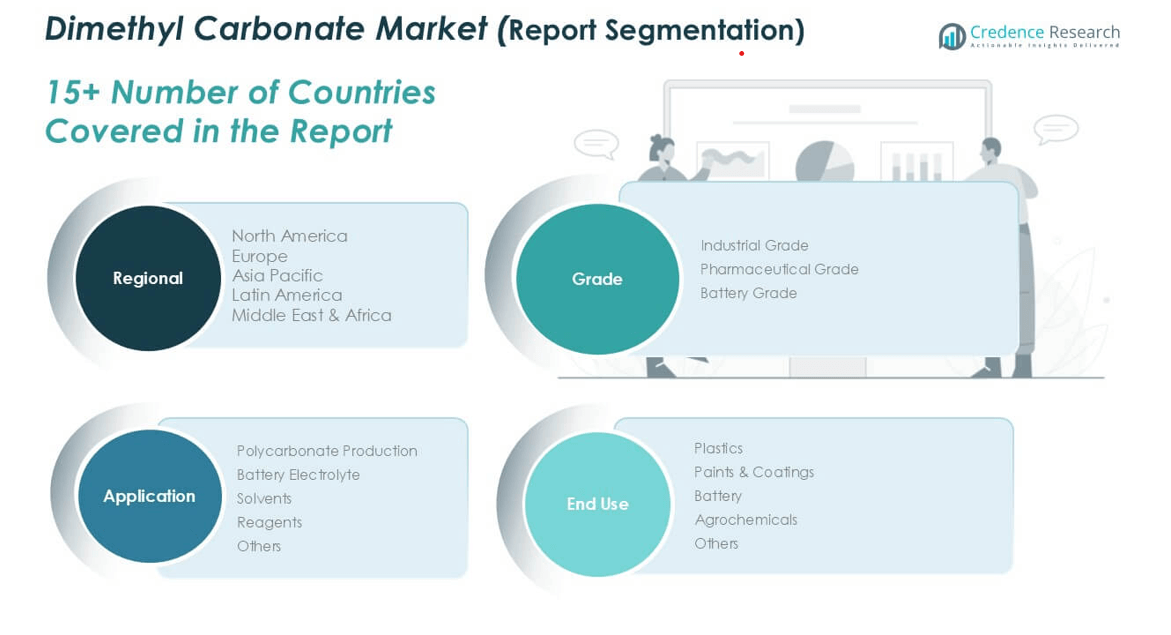
The Global Dimethyl Carbonate Market is segmented by grade into industrial, pharmaceutical, and battery grade. Industrial grade holds the largest revenue share due to its extensive use in polycarbonate production and solvents. It is widely adopted across chemical and plastics industries for its cost-effectiveness and functional versatility. Pharmaceutical grade DMC is gaining traction owing to its application in drug synthesis and formulation of active pharmaceutical ingredients, where purity and safety are critical. Battery grade dimethyl carbonate is expected to witness the fastest growth, supported by rising demand for lithium-ion batteries in electric vehicles and energy storage systems. Its high purity and electrochemical stability make it essential for battery electrolyte formulations.
- For instance, Daicel Corporation reports an annual production capacity of over 100,000 tons of dimethyl carbonate at its Japanese facilities, serving both industrial and battery-grade markets.
By Application
Based on application, the Global Dimethyl Carbonate Market is categorized into polycarbonate production, battery electrolyte, solvents, reagents, and others. Polycarbonate production remains the dominant segment, driven by demand in automotive, electronics, and construction sectors. Battery electrolyte is the fastest-growing application, fueled by the expanding EV market and renewable energy deployment. Solvents and reagents contribute steadily due to their use in coatings, paints, and fine chemicals. DMC is favored for its performance and lower toxicity, especially in regulated markets. Other applications include intermediates in agrochemicals and specialty polymers.
- For instance, SABIC’s LEXAN polycarbonate resins, which use dimethyl carbonate as a key intermediate, are produced at a scale exceeding 1.3 million tons annually across its global manufacturing sites.
By End Use
By end use, the market is segmented into plastics, paints & coatings, battery, agrochemicals, and others. Plastics lead the segment due to widespread adoption of polycarbonates in durable goods and packaging. The battery segment is rapidly expanding, supported by increasing investments in EV production and grid storage. Paints & coatings utilize DMC for its solvent properties and environmental advantages. In agrochemicals, it is used in synthesis of pesticide intermediates, offering safer processing alternatives. Other end uses include specialty chemical manufacturing and electronics, where performance and regulatory compliance are key.
Segments
Based on Grade
- Industrial Grade
- Pharmaceutical Grade
- Battery Grade
Based on Application
- Polycarbonate Production
- Battery Electrolyte
- Solvents
- Reagents
- Others
Based on End Use
- Plastics
- Paints & Coatings
- Battery
- Agrochemicals
- Other
Based on Region
- North America
- U.S.
- Canada
- Mexico
- Europe
- UK
- France
- Germany
- Italy
- Spain
- Russia
- Belgium
- Netherlands
- Austria
- Sweden
- Poland
- Denmark
- Switzerland
- Rest of Europe
- Asia Pacific
- China
- Japan
- South Korea
- India
- Australia
- Thailand
- Indonesia
- Vietnam
- Malaysia
- Philippines
- Taiwan
- Rest of Asia Pacific
- Latin America
- Brazil
- Argentina
- Peru
- Chile
- Colombia
- Rest of Latin America
- Middle East
- UAE
- KSA
- Israel
- Turkey
- Iran
- Rest of Middle East
- Africa
- Egypt
- Nigeria
- Algeria
- Morocco
- Rest of Africa
Regional Analysis
North America Dimethyl Carbonate Market
The Dimethyl Carbonate Market in North America was valued at USD 186.90 million in 2024 and is projected to reach USD 413.64 million by 2032, registering a CAGR of 10.5%. It holds approximately 16.1% of the global market share in 2024. The region benefits from strong demand for high-purity DMC used in pharmaceuticals and advanced battery technologies. The United States leads the market, supported by investments in electric vehicle manufacturing and clean energy solutions. Industrial-grade DMC continues to find wide usage across chemical production and coatings. Regulatory support for sustainable solvents and advanced materials further fuels regional consumption.
Europe Dimethyl Carbonate Market
Europe's Dimethyl Carbonate Market reached USD 218.22 million in 2024 and is forecasted to grow to USD 517.87 million by 2032, expanding at a CAGR of 11.4%. It accounts for nearly 18.8% of the global market share. Germany, France, and Italy are major contributors, with increasing demand for DMC in polycarbonate production and pharmaceutical synthesis. The region emphasizes non-phosgene production methods aligned with stringent environmental standards. Battery-grade DMC is gaining momentum with expanding EV infrastructure. Europe's strong chemical industry and circular economy initiatives support long-term market growth.
Asia Pacific Dimethyl Carbonate Market
The Asia Pacific Dimethyl Carbonate Market dominates globally, valued at USD 415.65 million in 2024 and projected to reach USD 1,020.30 million by 2032 at a CAGR of 11.9%. Holding approximately 35.8% of the global market share, the region leads due to large-scale manufacturing in China, South Korea, and Japan. It is driven by robust demand for lithium-ion batteries, electronic components, and construction materials. China remains the largest consumer and producer of DMC, supported by domestic EV policies and industrial expansion. Regional investments in battery production facilities are accelerating demand for high-purity DMC grades.
Latin America Dimethyl Carbonate Market
Latin America’s Dimethyl Carbonate Market was valued at USD 157.56 million in 2024 and is expected to reach USD 361.52 million by 2032, growing at a CAGR of 11.0%. It contributes approximately 13.6% to the global market share. Brazil and Mexico are key markets with increasing demand from plastics and agrochemical industries. The region's developing pharmaceutical sector also adds to DMC consumption. Growth in industrial applications and environmental compliance improves market penetration. Foreign investments and regional trade agreements enhance chemical import-export activities across Latin America.
Middle East Dimethyl Carbonate Market
The Middle East Dimethyl Carbonate Market stood at USD 110.32 million in 2024 and is projected to grow to USD 275.76 million by 2032, registering the highest regional CAGR of 12.2%. It holds around 9.5% of the global market share. Countries like Saudi Arabia and the UAE are expanding their chemical manufacturing capacities. Rising focus on clean energy and battery storage technologies drives demand for battery-grade DMC. Regional interest in diversifying away from oil-based economies supports green chemical adoption. Infrastructure investments create long-term opportunities for both production and application of DMC.
Africa Dimethyl Carbonate Market
Africa’s Dimethyl Carbonate Market is valued at USD 73.68 million in 2024 and is expected to reach USD 168.49 million by 2032, with a CAGR of 10.9%. It accounts for nearly 6.3% of the global market share. South Africa, Nigeria, and Egypt are emerging markets, showing steady growth in coatings, agrochemicals, and basic pharmaceuticals. Local production remains limited, but increasing imports meet rising demand across multiple industries. Governments are encouraging industrial development and cleaner production technologies. Investment in local chemical infrastructure could unlock further regional growth potential.
Key players
- Akzo Nobel N.V.
- Alfa Aesar
- BASF SE
- Dongying City Longxing Chemical Co. Ltd.
- EMD Millipore Corporation
- HaiKe Chemical Group
- Shandong Shida Shenghua Chemical Group Co. Ltd.
- Sigma-Aldrich Co. LLC
- Tangshan Chaoyang Chemical Co. Ltd.
- UBE Industries Limited
Competitive Analysis
The Global Dimethyl Carbonate Market features a competitive landscape dominated by both multinational chemical corporations and regional manufacturers. Leading players such as BASF SE, Akzo Nobel N.V., and UBE Industries Limited maintain strong market positions through extensive distribution networks and diversified product portfolios. It also includes specialized chemical firms like Shandong Shida Shenghua and HaiKe Chemical Group, which focus on high-volume production and cost advantages. Companies differentiate by offering battery-grade and pharmaceutical-grade dimethyl carbonate to meet rising industry-specific requirements. Strategic collaborations, capacity expansions, and sustainable production technologies are central to competitive positioning. Continuous investment in R\&D and regional expansion supports long-term market presence and customer retention.
Recent Developments
- In February 2025, UBE Industries Limited held a groundbreaking ceremony on February 13 for its new DMC and EMC plant near New Orleans, Louisiana. It marks UBE’s largest-ever investment and will produce 100,000 t/year DMC using its proprietary gas-phase nitrite process
- In February 2024, Akzo Nobel N.V. released its 2023 annual report online, signaling a positive shift in the company's performance with improved chemical and coatings operations. This improvement, particularly in the coatings sector, indirectly suggests a potential increase in demand for intermediates like dimethyl carbonate.
Market Concentration and Characteristics
The Global Dimethyl Carbonate Market exhibits moderate to high market concentration, with a few major players holding significant revenue shares. It features a mix of multinational chemical corporations and regional manufacturers, each targeting specific end-use sectors such as batteries, pharmaceuticals, and polycarbonates. The market is characterized by strong demand for high-purity grades and a growing preference for sustainable production technologies. It remains highly price-sensitive due to volatility in raw material costs. Competitive dynamics are influenced by technological innovation, regulatory compliance, and the ability to scale operations efficiently. Manufacturers focus on product differentiation, capacity expansion, and regional presence to strengthen their positions.
Report Coverage
The research report offers an in-depth analysis based on Grade, Application, End Use and Region. It details leading market players, providing an overview of their business, product offerings, investments, revenue streams, and key applications. Additionally, the report includes insights into the competitive environment, SWOT analysis, current market trends, as well as the primary drivers and constraints. Furthermore, it discusses various factors that have driven market expansion in recent years. The report also explores market dynamics, regulatory scenarios, and technological advancements that are shaping the industry. It assesses the impact of external factors and global economic changes on market growth. Lastly, it provides strategic recommendations for new entrants and established companies to navigate the complexities of the market.
Future Outlook
- The Global Dimethyl Carbonate Market will continue its upward trajectory, driven by expanding demand in lithium-ion battery production and green chemical synthesis.
- The rise in electric vehicle adoption will significantly increase the need for battery-grade DMC, pushing manufacturers to invest in high-purity production capacity.
- Companies will focus on bio-based and CO₂-derived production methods to align with global climate goals and reduce environmental impact.
- Asia Pacific will remain the largest and fastest-growing region, supported by China’s large-scale manufacturing base and government policies promoting clean energy.
- These regions will experience stable growth through adoption of non-phosgene DMC in pharmaceuticals, coatings, and specialty polymers under strict environmental regulations.
- DMC will gain traction in drug formulation and pesticide synthesis due to its low toxicity and efficiency as a methylating agent.
- Producers will adopt catalytic and continuous processing technologies to lower costs, improve yields, and ensure consistent product quality across applications.
- Mergers and acquisitions among regional and global players are likely as companies seek scale, technical capabilities, and access to emerging markets.
- Compliance with REACH, EPA, and other regional regulations will drive innovation in product formulation and safer handling practices for DMC.
- Ongoing investments in logistics, storage, and distribution infrastructure will be crucial to meet growing demand across diverse industries and geographies.
Request a Free Sample
Fill in your details and we'll send you a free sample report.
- Sample data tables & charts
- Research methodology
Need a Custom Version of This Report?
Tailor the scope, geography, or segments to your exact requirements.
- Custom geography or segment scope
- Direct access to our analyst team
Frequently Asked Questions
What was the market size of the Global Dimethyl Carbonate Market in 2023 and what is its projected size by 2032?
Which region holds the largest share in the Dimethyl Carbonate Market?
Which industries are the major end users of Dimethyl Carbonate?
Who are the key players in the Global Dimethyl Carbonate Market?
Table of Content
Chapter 1. Report Introduction
- 1.1 Report Description & Purpose
- 1.1.1 Report Title & Market Definition
- 1.1.2 Unique Selling Propositions (USP) & Key Differentiators
- 1.1.3 Value Proposition for Stakeholders
- 1.2 Research Objectives
- 1.2.1 Market Sizing Objectives (Volume & Revenue)
- 1.2.2 Segmentation Objectives
- 1.2.3 Competitive Intelligence Objectives
- 1.2.4 Forecast & Scenario Objectives
- 1.3 Report Scope
- 1.3.1 Dimethyl Carbonate Scope – Types & Subtypes Covered
- 1.3.2 Geographic Scope – Regions & Countries Covered
- 1.3.3 Historical Period, Base Year & Forecast Period (2023; forecast to 2032)
- 1.3.4 Inclusions & Exclusions
- 1.4 HS Code & Classification Framework
- 1.5 Currency, Units & Pricing Basis
- 1.6 Target Stakeholders
- 1.7 Limitations & Assumptions
Chapter 2. Executive Summary
- 2.1 Global Dimethyl Carbonate Market Snapshot
- 2.1.1 Market Size – Historical (2023) & Forecast (2023-2032) (2023: USD 1,102 million → 2032: USD 2,757.6 million)
- 2.1.2 Volume & Revenue – Global Totals
- 2.1.3 Key Market Highlights – Top Five Facts
- 2.2 Dimethyl Carbonate Market Segmentation Snapshot
- 2.2.1 Market Split by Region – 2023 vs. 2032
- 2.3 Competitive Snapshot
- 2.3.1 Top 10 Players by Revenue Share – 2023
- 2.3.2 Top 10 Players by Volume Share – 2023
- 2.3.3 Recent Strategic Developments (18-Month Summary)
- 2.4 Key Investment Highlights & Strategic Conclusions
Chapter 3. Dimethyl Carbonate Market Dynamics & Industry Analysis
- 3.1 Market Overview & Context
- 3.1.1 Dimethyl Carbonate Market Position in the Broader Automotive Value Chain
- 3.1.2 OEM vs. Replacement Market Dynamics
- 3.1.3 Market Maturity & Development Stage by Region
- 3.2 Dimethyl Carbonate Market Drivers
- 3.3 Dimethyl Carbonate Market Restraints & Challenges
- 3.4 Dimethyl Carbonate Market Opportunities
- 3.5 Porter's Five Forces Analysis
- 3.5.1 Threat of New Entrants
- 3.5.2 Bargaining Power of Suppliers
- 3.5.3 Bargaining Power of Buyers
- 3.5.4 Threat of Substitutes
- 3.5.5 Competitive Rivalry – Intensity Assessment
- 3.6 Dimethyl Carbonate Value Chain Analysis
- 3.6.1 Upstream – Raw Material/Input Suppliers
- 3.6.1.1 Raw Material/Input 1
- 3.6.1.2 Raw Material/Input 2
- 3.6.1.3 Raw Material/Input 3
- 3.6.2 Midstream – Production/Manufacturing/Service Delivery
- 3.6.2.1 Production/Process Overview
- 3.6.2.2 Key Facility Locations & Capacity by Manufacturer
- 3.6.3 Downstream – Distribution & End Consumer
- 3.6.3.1 Primary Channel – B2B/OEM
- 3.6.3.2 Secondary Channels – Dealer, Retail, Online, Direct
- 3.6.4 Value Chain Profitability Analysis
- 3.6.1 Upstream – Raw Material/Input Suppliers
- 3.7 PESTEL Analysis
- 3.7.1 Political Factors
- 3.7.2 Economic Factors
- 3.7.3 Social Factors
- 3.7.4 Technological Factors
- 3.7.5 Environmental Factors
- 3.7.6 Legal Factors
- 3.8 Dimethyl Carbonate Supply Chain Analysis
- 3.8.1 Raw Material/Input Supply Risk Assessment
- 3.8.2 Manufacturing Concentration Risk (Geographic Exposure)
- 3.8.3 Trade Disruption Impact Analysis
- 3.9 Regulatory & Policy Landscape
Note: The regulatory and policy landscape section covers regulations based on their applicability to the market, Dimethyl Carbonate category, geography, and scope of the study. Only regulatory frameworks with a material impact on operations, compliance, trade, sustainability, or market access are analyzed in detail.
Chapter 4. Key Investment Pockets & Opportunity Analysis
- 4.1 Dimethyl Carbonate Market Attractiveness Analysis
- 4.1.1 By Region – Investment Attractiveness Matrix (Volume × CAGR)
- 4.2 Absolute Revenue Growth Opportunity
- 4.2.1 By Region – Absolute USD Growth Through 2032
- 4.3 Incremental Volume Opportunity
- 4.3.1 By Region – Incremental Volume Through 2032
- 4.3.2 Segment – Incremental Volume
- 4.4 Emerging Submarket Opportunity Deep Dive (Subject to Applicability)
- 4.5 Emerging Market Opportunity Scorecards
- 4.5.1 United States
- 4.5.2 Europe
- 4.5.3 Asia
- 4.5.4 Middle East & Africa
Note: Emerging Market Opportunity Scorecards will be included based on relevance and strategic importance. Regions listed are indicative and may vary depending on data availability and market dynamics.
Chapter 5. Dimethyl Carbonate Import-Export Analysis & Trade Flows
- 5.1 Global Trade Overview
- 5.1.1 Global Export Value by Country (2023)
- 5.1.2 Global Export Volume by Country (2023)
- 5.1.3 Global Import Value by Country (2023)
- 5.1.4 Global Import Volume by Country (2023)
- 5.1.5 Net Trade Balance by Country (2023)
- 5.2 Export Analysis – Segment
- 5.2.1 Type 1 (HS Code)
- 5.2.2 Type 2 (HS Code)
- 5.2.3 Type 3 (HS Code)
- 5.2.4 Type 4 (HS Code)
- 5.2.5 Type 5 (HS Code)
- 5.3 Import Analysis – Segment
- 5.3.1 Type 1 (HS Code)
- 5.3.2 Type 2 (HS Code)
- 5.3.3 Type 3 (HS Code)
- 5.3.4 Type 4 (HS Code)
- 5.3.5 Type 5 (HS Code)
- 5.4 Average Unit Trade Prices
- 5.4.1 Average Export Price – Segment & Country
- 5.4.2 Average Import Price – Segment & Source Country
- 5.4.3 Price Trends (2023)
- 5.5 Key Trade Route Analysis
- 5.5.1 Trade Route 1
- 5.5.2 Trade Route 2
- 5.5.3 Trade Route 3
- 5.5.4 Trade Route 4
- 5.5.5 Trade Route 5
- 5.6 Trade Policy Impact Assessment
- 5.6.1 US Anti-Dumping & Section 301 Tariffs
- 5.6.2 EU Customs Union Impact
- 5.6.3 Major Free Trade Agreements
- 5.6.4 USMCA Rules of Origin
Note: Trade policy analysis will be included only where relevant to the Dimethyl Carbonate market.
Chapter 6. Competitive Landscape & Company Benchmarking
- 6.1 Dimethyl Carbonate Market Concentration & Structure
- 6.1.1 Herfindahl-Hirschman Index (HHI) – vs. 2023
- 6.1.2 Tier 1, Tier 2 & Tier 3 Market Structure
- 6.1.3 Global, Regional & Local Player Dynamics
- 6.2 Dimethyl Carbonate Market Share Analysis – 2023
- 6.2.1 Global Revenue Share by Company
- 6.2.2 Global Volume Share by Company
- 6.2.3 Regional Revenue Share
- 6.2.4 Market Share Evolution ( vs. 2023)
- 6.2.5 OEM Segment Share by Company
- 6.2.6 Replacement Segment Share by Company
- 6.3 Production/Delivery Capacity & Facility Analysis
- 6.3.1 Global Installed Capacity
- 6.3.2 Capacity Utilization Rates
- 6.3.3 Production/Output Volume
- 6.3.4 Facility Locations & Capacity Map
- 6.3.5 Planned Capacity Additions
- 6.4 Dimethyl Carbonate Competitive Benchmarking Matrix
- 6.4.1 Revenue, Volume, CAGR & Profitability Comparison
- 6.4.2 Channel Revenue Mix
- 6.4.3 Geographic Revenue Exposure
- 6.4.4 R&D Intensity
- 6.4.5 Sustainability Maturity
- 6.5 Strategic Developments in Dimethyl Carbonate (Last 24 Months)
- 6.5.1 Mergers, Acquisitions & Divestments
- 6.5.2 New Dimethyl Carbonate Launches
- 6.5.3 Facility Expansions
- 6.5.4 Strategic Alliances, Joint Ventures & Partnerships
- 6.5.5 Distribution Expansion & Market Entry
- 6.5.6 Sustainability & ESG Initiatives
- 6.6 Competitive Strategy Mapping
- 6.6.1 Leader, Challenger, Follower & Niche Classification
- 6.6.2 Pricing Strategy Comparison
- 6.6.3 Channel Strategy Matrix
Note: Strategic developments are included based on their materiality and the availability of reliable information.
Chapter 7. Global Dimethyl Carbonate Market – By Distribution Channel
- 7.1 Segment Overview
- 7.1.1 Volume & Revenue Split by Channel (2023 & 2032)
- 7.1.2 Channel Mix Evolution (2023-2032)
Chapter 8. Regional Market Analysis – Global Overview
- 8.1 Global Regional Overview
- 8.1.1 Regional Volume Share
- 8.1.2 Regional Revenue Share
- 8.1.3 Regional Volume by Region
- 8.1.4 Regional Revenue by Region
- 8.1.5 Regional Forecast Through 2032
- 8.2 Cross-Regional Segment Analysis
- 8.2.1 By Distribution Channel
- 8.2.2 By Brand/Price Tier
Chapter 9. North America Dimethyl Carbonate Market
- 9.1 United States
- 9.2 Canada
- 9.3 Mexico
Chapter 10. Europe Dimethyl Carbonate Market
- 10.1 Germany
- 10.2 France
- 10.3 Italy
- 10.4 United Kingdom
- 10.5 Spain
- 10.6 Poland
- 10.7 Russia
- 10.8 Netherlands
- 10.9 Belgium
- 10.10 Sweden
- 10.11 Denmark
- 10.12 Norway
- 10.13 Rest of Europe
Chapter 11. Asia Pacific Dimethyl Carbonate Market
- 11.1 China
- 11.2 India
- 11.3 Japan
- 11.4 South Korea
- 11.5 Thailand
- 11.6 Indonesia
- 11.7 Vietnam
- 11.8 Malaysia
- 11.9 Australia
- 11.10 Rest of Asia Pacific
Chapter 12. Latin America Dimethyl Carbonate Market
- 12.1 Brazil
- 12.2 Argentina
- 12.3 Colombia
- 12.4 Chile
- 12.5 Rest of Latin America
Chapter 13. Middle East Dimethyl Carbonate Market
- 13.1 Saudi Arabia
- 13.2 United Arab Emirates
- 13.3 Turkey
- 13.4 Israel
- 13.5 Iran
- 13.6 Rest of the Middle East
Chapter 14. Africa Dimethyl Carbonate Market
- 14.1 South Africa
- 14.2 Egypt
- 14.3 Nigeria
- 14.4 Morocco
- 14.5 Rest of Africa
Chapter 15. Dimethyl Carbonate Company Profiles
- 15.1 [Company 01]
- 15.1.1 Company Overview
- 15.1.2 Key Management Personnel
- 15.1.3 Products & Services Portfolio
- 15.1.4 Financial Performance
- 15.1.5 Key Market Focus & Geographic Presence
- 15.1.6 Recent Developments & Strategic Initiatives
Note: The company profile list is preliminary and may change based on research findings, market developments, data availability, and client requirements.
Chapter 16. Appendices
- Appendix A – List of Abbreviations & Acronyms
- Appendix B – Industry Classification Code Reference – Full Series
- Appendix C – Production & Capacity Data Tables
- Appendix D – End-Use & Demand Base Tables
- Appendix E – Consumption & Replacement Rate Assumptions
- Appendix F – ASP Reference Tables
- Appendix G – Manufacturing & Facility Database
- Appendix H – Import-Export Data Tables
- Appendix I – Regulatory Summary Tables
- Appendix J – Primary Research Participant List (Anonymized)
- Appendix K – Primary Research Questionnaire Framework
- Appendix L – Data Sources & Bibliography
- Appendix M – Market Size Divergence & Source Comparison
Chapter 17. Research Methodology
- 17.1 Research Framework & Philosophy
- 17.2 Secondary Research – Sources, Hierarchy & Data Extraction
- 17.3 Data Modeling – Bottom-Up & Top-Down Market Sizing
- 17.4 Primary Research – Stakeholder Framework, LOI & Sample Sizes
- 17.5 Forecast Methodology – Regression, Scenario & Sensitivity Analysis
- 17.6 Quality Control – Four-Layer Validation Framework
- 17.7 Limitations & Standard Assumptions
- 17.8 Disclaimer
