
Crispr And Crispr Associated Genes Market Overview:
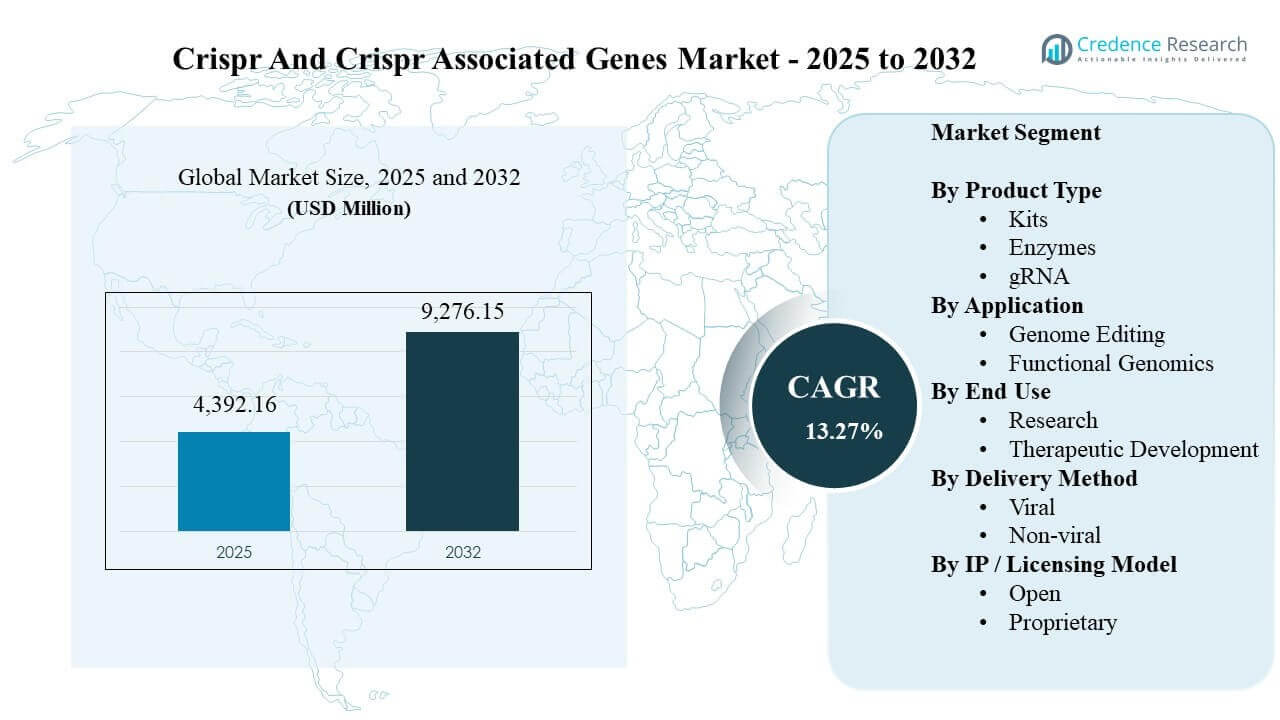
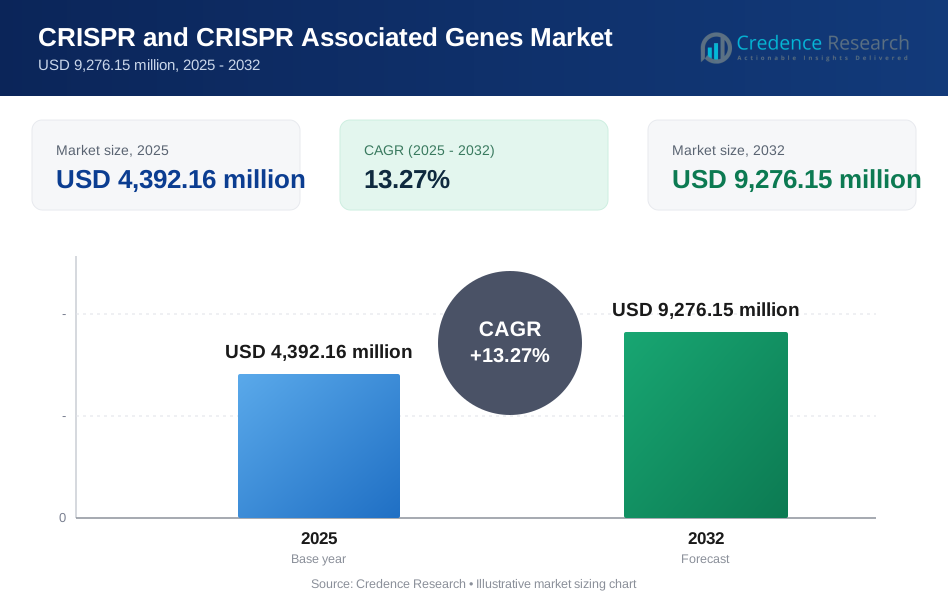
The global Crispr And Crispr Associated Genes Market size was estimated at USD 4,392.16 million in 2025 and is expected to reach USD 9,276.15 million by 2032, growing at a CAGR of 13.27% from 2025 to 2032. Growth is primarily driven by expanding use of CRISPR workflows in discovery research and therapeutic translation, where faster target validation and scalable editing toolchains are tightening development cycles. North America and Europe continue to anchor demand through strong biopharma R&D capacity, with Asia Pacific accelerating as regional research funding and translational infrastructure broaden.
| REPORT ATTRIBUTE | DETAILS |
|---|---|
| Historical Period | 2020-2024 |
| Base Year | 2025 |
| Forecast Period | 2026-2032 |
| CRISPR and CRISPR Associated Genes Market Size 2025 | USD 4,392.16 million |
| CRISPR and CRISPR Associated Genes Market, CAGR | 13.27% |
| CRISPR and CRISPR Associated Genes Market Size 2032 | USD 9,276.15 million |
Key Market Trends & Insights
- The Crispr And Crispr Associated Genes Market is projected to expand from USD 4,392.16 million (2025) to USD 9,276.15 million (2032).
- Market growth is expected at a CAGR of 13.27% during 2025–2032.
- Therapeutic Development led end-use demand with a 64.9% share in 2025.
- North America accounted for a 39.8% share of the Crispr And Crispr Associated Genes Market in 2025.
- Asia Pacific represented 26.4% of the Crispr And Crispr Associated Genes Market in 2025.
Segment Analysis
Crispr And Crispr Associated Genes Market demand reflects two core buying missions: high-throughput research workflows and translation-ready development programs. Research buyers prioritize standardization, ease of use, and compatibility with screening formats that compress setup time and support reproducibility across labs. Therapeutic development teams place greater emphasis on specificity, documentation depth, and scalability aligned with preclinical and clinical milestones. Vendor selection often centers on performance validation, fit with delivery choices, and the ability to support iterative optimization without disrupting timelines.
Crispr And Crispr Associated Genes Market purchasing behavior increasingly favors workflow integration from design and synthesis through editing and downstream verification. Buyers commonly seek dependable supply, consistent lot performance, and support assets that reduce protocol variability across cell types. As CRISPR use expands into broader functional genomics programs, demand rises for library-ready formats, controls, and analytics-aligned materials that lower operational friction. Partnerships and licensing clarity also influence adoption where therapeutic pathways require durable freedom-to-operate positioning.
By Product Type Insights
Kits typically lead adoption momentum in Crispr And Crispr Associated Genes Market workflows because kits reduce operational complexity and support standardized execution across multiple study sites. Enzymes remain central to performance outcomes, especially where fidelity and activity determine editing success in sensitive models. gRNA demand scales with multiplex editing and pooled screening, where validated designs and high-quality synthesis reduce iteration cycles. Procurement decisions often weigh workflow reliability, quality documentation, and compatibility with preferred downstream assays.
By Application Insights
Genome Editing activity remains a primary demand engine within the Crispr And Crispr Associated Genes Market because editing workflows support cell line engineering, model creation, and therapeutic pathway development. Functional Genomics use is expanding as pooled screening becomes more accessible through library availability and better operational toolchains. Research teams favor applications that shorten target discovery cycles and improve mechanistic validation. Platform maturity and reproducibility requirements continue to shape application-level purchasing preferences.
By End Use Insights
Therapeutic Development accounted for the largest share of 64.9% in 2025. Therapeutic Development demand leads because biopharma programs require consistent, high-performance reagents and systems that support translation from discovery into regulated development steps. Therapeutic Development purchasing often prioritizes documentation depth, traceability, and scalability aligned with manufacturing readiness. Therapeutic Development teams also evaluate vendors on editing specificity and risk mitigation practices that reduce downstream rework. Strong investment levels in gene-editing pipelines further reinforce repeat purchasing and longer supplier relationships.
By Delivery Method Insights
Viral delivery remains important within Crispr And Crispr Associated Genes Market workflows that require stable expression or consistent transduction in screening contexts. Non-viral delivery continues to gain attention for translation pathways where safety profile, repeat dosing considerations, and manufacturing scalability become decision drivers. Buyers frequently compare delivery methods based on editing efficiency in hard-to-edit primary cells and overall workflow throughput. Delivery method selection also affects the supporting product mix, including enzymes, guide designs, and validation controls.
By IP / Licensing Model Insights
Proprietary models influence Crispr And Crispr Associated Genes Market competition through differentiated nuclease performance claims, specialized chemistries, and licensing structures designed for therapeutic pathways. Open approaches remain relevant for early-stage research programs that prioritize flexibility and speed of adoption. IP clarity and licensing terms can become decisive for therapeutic development programs that require predictable freedom-to-operate. Organizations often align licensing choices with development stage, partnering strategy, and long-term commercialization plans.
CRISPR and CRISPR Associated Genes Market Drivers
Expanding therapeutic translation and pipeline activity
Crispr And Crispr Associated Genes Market growth is supported by increasing use of gene editing in therapeutic development programs that demand validated, reproducible tools. Therapeutic development teams require consistent reagents, strong documentation practices, and scalable supply aligned with program milestones. Editing workflows also support earlier go/no-go decisions by improving target validation speed and model relevance. Greater focus on specificity and safety increases demand for higher-performance enzymes and support solutions across development stages.
Broad adoption across functional genomics and screening workflows
Crispr And Crispr Associated Genes Market demand rises as functional genomics teams expand pooled screening and systematic perturbation studies. Screening adoption strengthens when libraries, controls, and delivery-ready formats reduce setup burden and streamline execution. Standardized workflows enable repeat purchasing across multiple projects and reduce variability across teams. Academic cores and biotech discovery groups often expand volume as CRISPR becomes embedded across target discovery and validation operations.
- For instance, Synthego’s whole-human-genome screening libraries target 19,753 genes with up to three modified sgRNA guides per gene, and the company states that these libraries can achieve up to 90% editing efficiency across human cell types, supporting broader adoption in high-throughput screening environments.
Workflow integration and supplier consolidation preferences
Crispr And Crispr Associated Genes Market buyers increasingly favor integrated workflows that connect design, synthesis, editing, and verification. Consolidated sourcing reduces procurement friction, shortens onboarding time, and improves protocol consistency. Vendors that provide broad portfolios and technical support can win multi-site deployments where standardization is required. Workflow integration also aligns with automation and higher-throughput research environments, strengthening recurring demand.
- For instance, Thermo Fisher’s Invitrogen TrueDesign Genome Editor supports seven edit types through a three-step workflow and compiles the required materials for ordering from one source, while the company’s validation workflow is organized into three stages confirm delivery, measure editing efficiency, and confirm phenotype showing how integrated supplier ecosystems can streamline design-to-verification execution.
Rising emphasis on quality, reproducibility, and compliance readiness
Crispr And Crispr Associated Genes Market purchasing decisions increasingly emphasize reproducibility, lot-to-lot consistency, and robust QC practices. Therapeutic development buyers expect traceability, documentation depth, and performance data that reduce risk in later-stage programs. Strong quality systems support vendor differentiation when similar product categories compete on price. As programs progress, procurement criteria shift toward compliance readiness and supply reliability, elevating barriers for smaller or less standardized suppliers.
CRISPR and CRISPR Associated Genes Market Challenges
Crispr And Crispr Associated Genes Market expansion faces technical and operational hurdles tied to editing outcomes in diverse biological systems. Off-target risk management, variable efficiencies across cell types, and complex optimization steps can increase cost and extend timelines. Delivery constraints further complicate program design, especially when target tissues require specialized approaches. These factors can slow scaling decisions and increase scrutiny on vendor validation evidence.
- For instance, Intellia Therapeutics reported that across 62 patients who received NTLA-2001 at doses of 0.3 mg/kg or higher, the median serum transthyretin reduction reached 91% at day 28, 29 patients maintained response through at least 12 months, and infusion-related reactions occurred in 38% of patients, highlighting how delivery design, durability, and safety monitoring directly affect development scalability.
Crispr And Crispr Associated Genes Market competition also reflects IP complexity and licensing uncertainty in certain use cases. Licensing terms may influence supplier selection, partnering strategies, and long-term commercialization pathways. Procurement teams must balance performance advantages against legal clarity and budget constraints. Inconsistent global regulatory expectations for gene-editing applications can add planning complexity for therapeutic development programs.
CRISPR and CRISPR Associated Genes Market Trends and Opportunities
Crispr And Crispr Associated Genes Market opportunity is expanding through tool improvements that raise precision and reduce operational friction. Higher-fidelity enzymes, improved guide design workflows, and better validation toolchains support faster iteration and more predictable outcomes. Growing integration with automation and high-throughput platforms increases demand for consistent formats and scalable supply. Vendors that align products with standardized workflows can capture stronger repeat purchasing behavior.
- For instance, Integrated DNA Technologies states that its Alt-R S.p. HiFi Cas9 Nuclease V3 maintains 90–100% on-target editing activity at most sites, while the company also reports a 10–20-fold reduction in editing at problematic off-target sites versus its standard Cas9, showing how enzyme engineering can improve precision without sacrificing workflow performance.
Crispr And Crispr Associated Genes Market growth opportunities also strengthen as Asia Pacific expands translational capacity and research funding. Regional investments in biotech ecosystems increase demand for CRISPR tools across universities, institutes, and emerging biopharma developers. Partnerships that improve local distribution, training, and application support can accelerate adoption. Licensing clarity and workflow enablement programs can further differentiate suppliers competing for therapeutic development budgets.
Regional Insights
North America
North America held a 39.8% share of the Crispr And Crispr Associated Genes Market in 2025, supported by strong biopharma R&D density and established research infrastructure. North America demand is reinforced by broad adoption of CRISPR across discovery, functional genomics, and therapeutic development pipelines. Procurement preferences often emphasize validated performance, dependable supply, and technical support that reduces protocol variability. Concentration of advanced research centers also supports recurring demand for higher-throughput workflows.
Europe
Europe accounted for 27.1% of the Crispr And Crispr Associated Genes Market in 2025, supported by mature academic research ecosystems and growing translational programs. Europe buyers frequently prioritize reproducibility, documentation strength, and cost-managed sourcing strategies. Collaborative research networks help accelerate adoption of standardized screening and validation workflows. Growing translation initiatives continue to expand demand for higher-quality reagents and integrated toolchains.
Asia Pacific
Asia Pacific represented 26.4% of the Crispr And Crispr Associated Genes Market in 2025, driven by expanding research capacity, rising biotech formation, and increasing investment in life sciences. Asia Pacific adoption benefits from broader access to advanced molecular biology workflows in major hubs. Demand growth is supported by scaling functional genomics programs and rising focus on therapeutic development capabilities. Suppliers that invest in training, local support, and reliable distribution can gain share as utilization expands.
Latin America
Latin America reached a 3.9% share of the Crispr And Crispr Associated Genes Market in 2025, shaped by selective concentration of research activity in leading urban centers. Funding variability and access constraints can influence purchasing cycles and product mix preferences. Institutions often emphasize reliable supply channels and protocols that reduce rework. Targeted capacity-building initiatives can gradually expand adoption across research and translation use cases.
Middle East & Africa
Middle East and Africa held a 2.8% share of the Crispr And Crispr Associated Genes Market in 2025, with demand concentrated in select research institutes and emerging biotech initiatives. Infrastructure availability and specialized talent access remain key adoption constraints in many locations. Programs that expand genomic research and translational capabilities can increase CRISPR utilization over time. Vendor support, training, and dependable distribution are often decisive factors in procurement decisions.
Competitive Landscape
Crispr And Crispr Associated Genes Market competition features diversified life science suppliers and specialized CRISPR-native providers competing on performance, workflow breadth, and technical enablement. Differentiation commonly centers on enzyme fidelity, guide quality, library availability, and the level of workflow integration from design through validation. Suppliers also compete through distribution reach, application support, and fit with high-throughput research environments. Partnerships and licensing approaches influence positioning for therapeutic development programs that require predictable long-term deployment.
Thermo Fisher maintains broad reach in Crispr And Crispr Associated Genes Market workflows by offering a portfolio designed to support end-to-end research execution, supported by global distribution and application support coverage. Thermo Fisher often competes on consistency, operational reliability, and compatibility with standardized laboratory workflows across research organizations. Thermo Fisher positioning also aligns with buyers seeking fewer vendors across adjacent molecular biology needs. Portfolio breadth can support procurement consolidation across multi-site research programs.
The industry research and growth report includes detailed analyses of the competitive landscape of the market and information about key companies, including:
- Thermo Fisher
- Merck KGaA
- Agilent
- Takara Bio
- NEB
- IDT
- GenScript
- Synthego
- Horizon Discovery
- Editas Medicine
Qualitative and quantitative analysis of companies has been conducted to help clients understand the wider business environment as well as the strengths and weaknesses of key industry players. Data is qualitatively analyzed to categorize companies as pure play, category-focused, industry-focused, and diversified; it is quantitatively analyzed to categorize companies as dominant, leading, strong, tentative, and weak.
Recent Developments
- In a January 2025 update, CRISPR Therapeutics said the launch of CASGEVY was continuing to gain momentum, and the company highlighted it as a key commercial driver for 2025. The same update noted that Vertex leads global development, manufacturing, and commercialization of CASGEVY under the companies’ collaboration agreement.
- In a February 2025 announcement, CRISPR Therapeutics disclosed a strategic partnership with NKure Therapeutics Private Limited to co-develop and co-commercialize CTX112 in India. The company said the alliance is intended to expand development of the allogeneic CAR-T candidate in a market with significant unmet need.
- In a May 2025 announcement, CRISPR Therapeutics and Sirius Therapeutics entered a multi-target collaboration to develop novel siRNA therapies, expanding CRISPR Therapeutics beyond gene editing into RNA-based medicines. The lead program in the deal is CTX611, a long-acting siRNA targeting Factor XI, with the companies set to share development costs and profits while splitting commercialization responsibilities between the U.S. and Greater China.
Report Scope
| Report Attribute | Details |
| Market size value in 2025 | USD 4,392.16 million |
| Revenue forecast in 2032 | USD 9,276.15 million |
| Growth rate (CAGR) | 13.27% (2025–2032) |
| Base year | 2025 |
| Forecast period | 2026-2032 |
| Quantitative units | USD million |
| Segments covered | By Product Type Outlook: Kits, Enzymes, gRNA; By Application Outlook: Genome Editing, Functional Genomics; By End Use Outlook: Research, Therapeutic Development; By Delivery Method Outlook: Viral, Non-viral; By IP / Licensing Model Outlook: Open, Proprietary |
| Regional scope | North America, Europe, Asia Pacific, Latin America, Middle East & Africa |
| Key companies profiled | Thermo Fisher, Merck KGaA, Agilent, Takara Bio, NEB, IDT, GenScript, Synthego, Horizon Discovery, Editas Medicine |
| No. of Pages | 332 |
Segmentation
By Product Type
- Kits
- Enzymes
- gRNA
By Application
- Genome Editing
- Functional Genomics
By End Use
- Research
- Therapeutic Development
By Delivery Method
- Viral
- Non-viral
By IP / Licensing Model
- Open
- Proprietary
By Region
- North America
- U.S.
- Canada
- Mexico
- Europe
- Germany
- France
- U.K.
- Italy
- Spain
- Rest of Europe
- Asia Pacific
- China
- Japan
- India
- South Korea
- South-east Asia
- Rest of Asia Pacific
- Latin America
- Brazil
- Argentina
- Rest of Latin America
- Middle East & Africa
- GCC Countries
- South Africa
- Rest of the Middle East and Africa
Request a Free Sample
Fill in your details and we'll send you a free sample report.
- Sample data tables & charts
- Research methodology
Need a Custom Version of This Report?
Tailor the scope, geography, or segments to your exact requirements.
- Custom geography or segment scope
- Direct access to our analyst team
Frequently Asked Questions
What is the market size of the Crispr And Crispr Associated Genes Market in 2025 and the forecast for 2032?
What is the CAGR for the Crispr And Crispr Associated Genes Market during 2025–2032?
Which segment holds the largest share in the Crispr And Crispr Associated Genes Market?
What factors are driving growth in the Crispr And Crispr Associated Genes Market?
Who are the leading companies in the Crispr And Crispr Associated Genes Market?
Which region leads the Crispr And Crispr Associated Genes Market?
Table of Content
Chapter 1. Report Introduction
- 1.1 Report Description & Purpose
- 1.1.1 Report Title & Market Definition
- 1.1.2 Unique Selling Propositions (USP) & Key Differentiators
- 1.1.3 Value Proposition for Stakeholders
- 1.2 Research Objectives
- 1.2.1 Market Sizing Objectives (Volume & Revenue)
- 1.2.2 Segmentation Objectives
- 1.2.3 Competitive Intelligence Objectives
- 1.2.4 Forecast & Scenario Objectives
- 1.3 Report Scope
- 1.3.1 CRISPR and CRISPR Associated Genes Scope – Types & Subtypes Covered
- 1.3.2 Geographic Scope – Regions & Countries Covered
- 1.3.3 Historical Period, Base Year & Forecast Period (2025; forecast to 2032)
- 1.3.4 Inclusions & Exclusions
- 1.4 HS Code & Classification Framework
- 1.5 Currency, Units & Pricing Basis
- 1.6 Target Stakeholders
- 1.7 Limitations & Assumptions
Chapter 2. Executive Summary
- 2.1 Global CRISPR and CRISPR Associated Genes Market Snapshot
- 2.1.1 Market Size – Historical (2025) & Forecast (2025-2032) (2025: USD 4,392.16 million → 2032: USD 9,276.15 million)
- 2.1.2 Volume & Revenue – Global Totals
- 2.1.3 Key Market Highlights – Top Five Facts
- 2.2 CRISPR and CRISPR Associated Genes Market Segmentation Snapshot
- 2.2.1 Market Split by Region – 2025 vs. 2032
- 2.3 Competitive Snapshot
- 2.3.1 Top 10 Players by Revenue Share – 2025
- 2.3.2 Top 10 Players by Volume Share – 2025
- 2.3.3 Recent Strategic Developments (18-Month Summary)
- 2.4 Key Investment Highlights & Strategic Conclusions
Chapter 3. CRISPR and CRISPR Associated Genes Market Dynamics & Industry Analysis
- 3.1 Market Overview & Context
- 3.1.1 CRISPR and CRISPR Associated Genes Market Position in the Broader Automotive Value Chain
- 3.1.2 OEM vs. Replacement Market Dynamics
- 3.1.3 Market Maturity & Development Stage by Region
- 3.2 CRISPR and CRISPR Associated Genes Market Drivers
- 3.3 CRISPR and CRISPR Associated Genes Market Restraints & Challenges
- 3.4 CRISPR and CRISPR Associated Genes Market Opportunities
- 3.5 Porter's Five Forces Analysis
- 3.5.1 Threat of New Entrants
- 3.5.2 Bargaining Power of Suppliers
- 3.5.3 Bargaining Power of Buyers
- 3.5.4 Threat of Substitutes
- 3.5.5 Competitive Rivalry – Intensity Assessment
- 3.6 CRISPR and CRISPR Associated Genes Value Chain Analysis
- 3.6.1 Upstream – Raw Material/Input Suppliers
- 3.6.1.1 Raw Material/Input 1
- 3.6.1.2 Raw Material/Input 2
- 3.6.1.3 Raw Material/Input 3
- 3.6.2 Midstream – Production/Manufacturing/Service Delivery
- 3.6.2.1 Production/Process Overview
- 3.6.2.2 Key Facility Locations & Capacity by Manufacturer
- 3.6.3 Downstream – Distribution & End Consumer
- 3.6.3.1 Primary Channel – B2B/OEM
- 3.6.3.2 Secondary Channels – Dealer, Retail, Online, Direct
- 3.6.4 Value Chain Profitability Analysis
- 3.6.1 Upstream – Raw Material/Input Suppliers
- 3.7 PESTEL Analysis
- 3.7.1 Political Factors
- 3.7.2 Economic Factors
- 3.7.3 Social Factors
- 3.7.4 Technological Factors
- 3.7.5 Environmental Factors
- 3.7.6 Legal Factors
- 3.8 CRISPR and CRISPR Associated Genes Supply Chain Analysis
- 3.8.1 Raw Material/Input Supply Risk Assessment
- 3.8.2 Manufacturing Concentration Risk (Geographic Exposure)
- 3.8.3 Trade Disruption Impact Analysis
- 3.9 Regulatory & Policy Landscape
Note: The regulatory and policy landscape section covers regulations based on their applicability to the market, CRISPR and CRISPR Associated Genes category, geography, and scope of the study. Only regulatory frameworks with a material impact on operations, compliance, trade, sustainability, or market access are analyzed in detail.
Chapter 4. Key Investment Pockets & Opportunity Analysis
- 4.1 CRISPR and CRISPR Associated Genes Market Attractiveness Analysis
- 4.1.1 By Region – Investment Attractiveness Matrix (Volume × CAGR)
- 4.2 Absolute Revenue Growth Opportunity
- 4.2.1 By Region – Absolute USD Growth Through 2032
- 4.3 Incremental Volume Opportunity
- 4.3.1 By Region – Incremental Volume Through 2032
- 4.3.2 Segment – Incremental Volume
- 4.4 Emerging Submarket Opportunity Deep Dive (Subject to Applicability)
- 4.5 Emerging Market Opportunity Scorecards
- 4.5.1 United States
- 4.5.2 Europe
- 4.5.3 Asia
- 4.5.4 Middle East & Africa
Note: Emerging Market Opportunity Scorecards will be included based on relevance and strategic importance. Regions listed are indicative and may vary depending on data availability and market dynamics.
Chapter 5. CRISPR and CRISPR Associated Genes Import-Export Analysis & Trade Flows
- 5.1 Global Trade Overview
- 5.1.1 Global Export Value by Country (2025)
- 5.1.2 Global Export Volume by Country (2025)
- 5.1.3 Global Import Value by Country (2025)
- 5.1.4 Global Import Volume by Country (2025)
- 5.1.5 Net Trade Balance by Country (2025)
- 5.2 Export Analysis – Segment
- 5.2.1 Type 1 (HS Code)
- 5.2.2 Type 2 (HS Code)
- 5.2.3 Type 3 (HS Code)
- 5.2.4 Type 4 (HS Code)
- 5.2.5 Type 5 (HS Code)
- 5.3 Import Analysis – Segment
- 5.3.1 Type 1 (HS Code)
- 5.3.2 Type 2 (HS Code)
- 5.3.3 Type 3 (HS Code)
- 5.3.4 Type 4 (HS Code)
- 5.3.5 Type 5 (HS Code)
- 5.4 Average Unit Trade Prices
- 5.4.1 Average Export Price – Segment & Country
- 5.4.2 Average Import Price – Segment & Source Country
- 5.4.3 Price Trends (2025)
- 5.5 Key Trade Route Analysis
- 5.5.1 Trade Route 1
- 5.5.2 Trade Route 2
- 5.5.3 Trade Route 3
- 5.5.4 Trade Route 4
- 5.5.5 Trade Route 5
- 5.6 Trade Policy Impact Assessment
- 5.6.1 US Anti-Dumping & Section 301 Tariffs
- 5.6.2 EU Customs Union Impact
- 5.6.3 Major Free Trade Agreements
- 5.6.4 USMCA Rules of Origin
Note: Trade policy analysis will be included only where relevant to the CRISPR and CRISPR Associated Genes market.
Chapter 6. Competitive Landscape & Company Benchmarking
- 6.1 CRISPR and CRISPR Associated Genes Market Concentration & Structure
- 6.1.1 Herfindahl-Hirschman Index (HHI) – vs. 2025
- 6.1.2 Tier 1, Tier 2 & Tier 3 Market Structure
- 6.1.3 Global, Regional & Local Player Dynamics
- 6.2 CRISPR and CRISPR Associated Genes Market Share Analysis – 2025
- 6.2.1 Global Revenue Share by Company
- 6.2.2 Global Volume Share by Company
- 6.2.3 Regional Revenue Share
- 6.2.4 Market Share Evolution ( vs. 2025)
- 6.2.5 OEM Segment Share by Company
- 6.2.6 Replacement Segment Share by Company
- 6.3 Production/Delivery Capacity & Facility Analysis
- 6.3.1 Global Installed Capacity
- 6.3.2 Capacity Utilization Rates
- 6.3.3 Production/Output Volume
- 6.3.4 Facility Locations & Capacity Map
- 6.3.5 Planned Capacity Additions
- 6.4 CRISPR and CRISPR Associated Genes Competitive Benchmarking Matrix
- 6.4.1 Revenue, Volume, CAGR & Profitability Comparison
- 6.4.2 Channel Revenue Mix
- 6.4.3 Geographic Revenue Exposure
- 6.4.4 R&D Intensity
- 6.4.5 Sustainability Maturity
- 6.5 Strategic Developments in CRISPR and CRISPR Associated Genes (Last 24 Months)
- 6.5.1 Mergers, Acquisitions & Divestments
- 6.5.2 New CRISPR and CRISPR Associated Genes Launches
- 6.5.3 Facility Expansions
- 6.5.4 Strategic Alliances, Joint Ventures & Partnerships
- 6.5.5 Distribution Expansion & Market Entry
- 6.5.6 Sustainability & ESG Initiatives
- 6.6 Competitive Strategy Mapping
- 6.6.1 Leader, Challenger, Follower & Niche Classification
- 6.6.2 Pricing Strategy Comparison
- 6.6.3 Channel Strategy Matrix
Note: Strategic developments are included based on their materiality and the availability of reliable information.
Chapter 7. Global CRISPR and CRISPR Associated Genes Market – By Distribution Channel
- 7.1 Segment Overview
- 7.1.1 Volume & Revenue Split by Channel (2025 & 2032)
- 7.1.2 Channel Mix Evolution (2025-2032)
Chapter 8. Regional Market Analysis – Global Overview
- 8.1 Global Regional Overview
- 8.1.1 Regional Volume Share
- 8.1.2 Regional Revenue Share
- 8.1.3 Regional Volume by Region
- 8.1.4 Regional Revenue by Region
- 8.1.5 Regional Forecast Through 2032
- 8.2 Cross-Regional Segment Analysis
- 8.2.1 By Distribution Channel
- 8.2.2 By Brand/Price Tier
Chapter 9. North America CRISPR and CRISPR Associated Genes Market
- 9.1 United States
- 9.2 Canada
- 9.3 Mexico
Chapter 10. Europe CRISPR and CRISPR Associated Genes Market
- 10.1 Germany
- 10.2 France
- 10.3 Italy
- 10.4 United Kingdom
- 10.5 Spain
- 10.6 Poland
- 10.7 Russia
- 10.8 Netherlands
- 10.9 Belgium
- 10.10 Sweden
- 10.11 Denmark
- 10.12 Norway
- 10.13 Rest of Europe
Chapter 11. Asia Pacific CRISPR and CRISPR Associated Genes Market
- 11.1 China
- 11.2 India
- 11.3 Japan
- 11.4 South Korea
- 11.5 Thailand
- 11.6 Indonesia
- 11.7 Vietnam
- 11.8 Malaysia
- 11.9 Australia
- 11.10 Rest of Asia Pacific
Chapter 12. Latin America CRISPR and CRISPR Associated Genes Market
- 12.1 Brazil
- 12.2 Argentina
- 12.3 Colombia
- 12.4 Chile
- 12.5 Rest of Latin America
Chapter 13. Middle East CRISPR and CRISPR Associated Genes Market
- 13.1 Saudi Arabia
- 13.2 United Arab Emirates
- 13.3 Turkey
- 13.4 Israel
- 13.5 Iran
- 13.6 Rest of the Middle East
Chapter 14. Africa CRISPR and CRISPR Associated Genes Market
- 14.1 South Africa
- 14.2 Egypt
- 14.3 Nigeria
- 14.4 Morocco
- 14.5 Rest of Africa
Chapter 15. CRISPR and CRISPR Associated Genes Company Profiles
- 15.1 [Company 01]
- 15.1.1 Company Overview
- 15.1.2 Key Management Personnel
- 15.1.3 Products & Services Portfolio
- 15.1.4 Financial Performance
- 15.1.5 Key Market Focus & Geographic Presence
- 15.1.6 Recent Developments & Strategic Initiatives
Note: The company profile list is preliminary and may change based on research findings, market developments, data availability, and client requirements.
Chapter 16. Appendices
- Appendix A – List of Abbreviations & Acronyms
- Appendix B – Industry Classification Code Reference – Full Series
- Appendix C – Production & Capacity Data Tables
- Appendix D – End-Use & Demand Base Tables
- Appendix E – Consumption & Replacement Rate Assumptions
- Appendix F – ASP Reference Tables
- Appendix G – Manufacturing & Facility Database
- Appendix H – Import-Export Data Tables
- Appendix I – Regulatory Summary Tables
- Appendix J – Primary Research Participant List (Anonymized)
- Appendix K – Primary Research Questionnaire Framework
- Appendix L – Data Sources & Bibliography
- Appendix M – Market Size Divergence & Source Comparison
Chapter 17. Research Methodology
- 17.1 Research Framework & Philosophy
- 17.2 Secondary Research – Sources, Hierarchy & Data Extraction
- 17.3 Data Modeling – Bottom-Up & Top-Down Market Sizing
- 17.4 Primary Research – Stakeholder Framework, LOI & Sample Sizes
- 17.5 Forecast Methodology – Regression, Scenario & Sensitivity Analysis
- 17.6 Quality Control – Four-Layer Validation Framework
- 17.7 Limitations & Standard Assumptions
- 17.8 Disclaimer
