| REPORT ATTRIBUTE | DETAILS |
|---|---|
| Historical Period | 2020-2023 |
| Base Year | 2024 |
| Forecast Period | 2025-2032 |
| Drugs For Schistosomiasis Market Size 2024 | USD 766.7 million |
| Drugs For Schistosomiasis Market, CAGR | 5.80% |
| Drugs For Schistosomiasis Market Size 2032 | USD 1,203.7 million |
Market overview
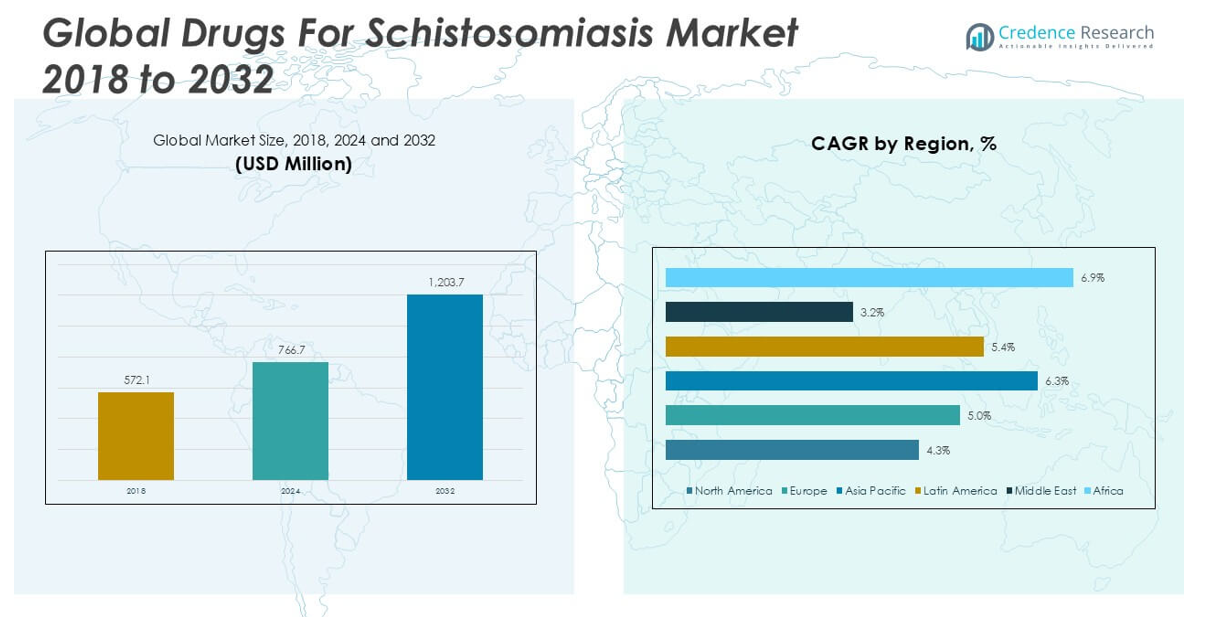
The Drugs for Schistosomiasis market size was valued at USD 572.1 million in 2018 and increased to USD 766.7 million in 2024. It is anticipated to reach USD 1,203.7 million by 2032, growing at a CAGR of 5.80% during the forecast period.
The Drugs for Schistosomiasis market is led by key players such as Bayer AG, Merck KGaA, Novartis AG, Pfizer Inc., Sanofi S.A., GlaxoSmithKline plc, Roche Holding AG, Teva Pharmaceutical Industries Ltd., Johnson & Johnson, Cipla Ltd., Sun Pharmaceutical Industries Ltd., Mylan N.V., Ipca Laboratories Ltd., and Shin Poong Pharmaceutical Co., Ltd. These companies maintain their competitive edge through strategic partnerships, global drug donation programs, and extensive distribution networks, particularly in endemic regions. Africa is the dominant regional market, holding the largest share of 42.2% in 2024, driven by the continent’s high disease burden and large-scale mass drug administration programs. Asia Pacific follows with a significant 19.4% market share, supported by growing public health initiatives and widespread schistosomiasis prevalence. The continued collaboration between leading pharmaceutical companies and international health organizations is expected to further strengthen the market presence of these top players across highly affected regions.
Market Insights
- The Drugs for Schistosomiasis market was valued at USD 572.1 million in 2018 and is projected to reach USD 1,203.7 million by 2032, growing at a CAGR of 5.80% during the forecast period.
- The market is driven by rising disease prevalence in endemic regions, large-scale mass drug administration programs, and increasing global health initiatives supporting preventive chemotherapy.
- Trends such as the development of pediatric formulations and growing research in combination therapies are creating new opportunities for pharmaceutical companies to improve treatment efficacy and expand their product offerings.
- The market is moderately competitive, with key players like Bayer AG, Merck KGaA, Novartis AG, Pfizer Inc., and Sanofi S.A. leading through strategic collaborations, drug donations, and strong global distribution networks.
- Africa holds the largest regional share at 42.2% in 2024, followed by Asia Pacific at 19.4%, while Praziquantel dominates the drug type segment due to its proven efficacy and wide usage.
Market Segmentation Analysis:
By Drug Type
Praziquantel dominates the Drugs for Schistosomiasis market, holding the largest market share due to its established efficacy, low cost, and widespread availability. It remains the first-line treatment recommended by the World Health Organization for all major Schistosoma species. The demand for Praziquantel continues to grow, driven by large-scale preventive chemotherapy programs and the increasing prevalence of schistosomiasis in endemic regions. Other drugs like Artemisinins and Oxamniquine are used in combination or as alternatives, but their market share remains comparatively limited due to lower accessibility and narrower treatment scope.
- For instance, Merck KGaA has donated over 1.8 billion tablets of Praziquantel since the start of its donation program in 2007, supplying more than 400 million children worldwide.
By Application
Schistosoma Mansoni accounts for the dominant market share among application segments, primarily due to its widespread prevalence across Africa, the Middle East, and parts of South America. The high disease burden and well-documented treatment protocols targeting this species contribute to its leading position. Demand for drugs targeting Schistosoma Mansoni is further driven by mass drug administration programs and increasing global health initiatives to control intestinal schistosomiasis. Other species such as Schistosoma Haematobium and Schistosoma Japonicum also hold notable shares but are geographically more concentrated.
- For instance, Johnson & Johnson supported deworming programs in Rwanda, reaching over 4.5 million children specifically for Schistosoma Mansoni control between 2014 and 2021.
By Distribution Channel
The Hospital Pharmacy segment holds the largest share in the Drugs for Schistosomiasis market, supported by the high volume of drug dispensation through hospitals in endemic regions. Hospitals remain the primary point of care for schistosomiasis diagnosis and treatment, particularly in moderate to severe cases. Hospital pharmacies benefit from bulk procurement and distribution agreements, especially in national health campaigns. Although the Online Pharmacy and Retail Pharmacy channels are expanding, especially in urban settings, their reach in rural, highly affected areas remains limited, sustaining the dominance of hospital-based distribution.
Market Overview
Rising Prevalence of Schistosomiasis in Endemic Regions
The increasing incidence of schistosomiasis, particularly in sub-Saharan Africa, Asia, and parts of South America, is a major driver for the market. Rapid population growth, poor sanitation, and limited access to clean water contribute to the sustained transmission of the disease. As the affected population continues to expand, the demand for effective schistosomiasis treatment, especially Praziquantel, has grown significantly. Government and non-government health organizations are actively supporting large-scale deworming programs, which further boosts market expansion.
- For instance, in 2020, the World Health Organization facilitated the treatment of over 70 million people for schistosomiasis in Africa alone, underscoring the scale of active deworming efforts.
Strong Support from Global Health Initiatives
Global health programs such as those led by the World Health Organization (WHO), the Bill & Melinda Gates Foundation, and various NGOs are actively working to control and eventually eliminate schistosomiasis. These initiatives provide significant funding, drug donations, and logistical support for mass drug administration (MDA) campaigns in highly endemic countries. The regular procurement of Praziquantel and the development of new therapeutic options under these programs are creating a steady demand for drugs, driving long-term market growth.
- For instance, the Schistosomiasis Control Initiative, supported by Imperial College London, delivered over 250 million treatments across 16 countries between 2002 and 2019.
Increasing Focus on Preventive Chemotherapy
Preventive chemotherapy, which involves mass drug administration to at-risk populations regardless of infection status, has become a key strategy in schistosomiasis control. Governments are increasingly adopting this approach to reduce disease transmission and prevalence in school-aged children and vulnerable communities. This growing emphasis on periodic preventive treatment is contributing to the sustained consumption of schistosomiasis drugs, especially in large-scale public health campaigns, providing a solid growth foundation for the market.
Key Trends & Opportunities
Expansion of Combination Therapies
The market is witnessing a rising trend toward combination therapies aimed at improving treatment efficacy and reducing the risk of drug resistance. Research is focusing on pairing Praziquantel with drugs like Artemisinins to target both adult and immature parasites. This evolving treatment approach presents an opportunity for pharmaceutical companies to develop and commercialize novel drug combinations that could address limitations of current monotherapies and meet the growing demand for more effective treatment options.
- For instance, Shin Poong Pharmaceutical developed PZQ-Artemisinin combination tablets and completed successful phase III trials involving over 600 patients in Côte d'Ivoire by 2021.
Development of Pediatric Formulations
There is increasing attention on developing child-friendly drug formulations, particularly chewable or dispersible tablets of Praziquantel, to facilitate easier administration in young children. This is a critical opportunity as current formulations are often large and bitter, making them difficult for pediatric patients to consume. Addressing this unmet need can significantly enhance treatment adherence, improve outcomes in pediatric populations, and open new market segments, especially in mass treatment programs targeting school-aged children.
- For instance, Merck KGaA developed a pediatric Praziquantel formulation, tested in over 400 children in Kenya and Côte d'Ivoire, which entered the final stage of clinical trials in 2022.
Key Challenges
Limited Access in Remote Areas
One of the primary challenges facing the Drugs for Schistosomiasis market is the limited access to effective treatments in remote and rural regions where the disease burden is highest. Poor healthcare infrastructure, logistical difficulties, and lack of trained medical personnel hinder timely drug distribution and administration. These access barriers contribute to continued disease transmission and limit the overall effectiveness of mass drug administration programs, thereby restraining market growth.
Dependence on Drug Donations
The market heavily relies on drug donation programs, particularly for Praziquantel, which limits commercial profitability for pharmaceutical companies. Although these donations are essential for public health, they reduce incentives for private players to invest in product development and commercialization. This dependency poses a sustainability challenge for the long-term supply of schistosomiasis drugs and may impact market dynamics if donation programs are reduced or discontinued.
Potential Drug Resistance
The potential emergence of resistance to Praziquantel poses a serious threat to the Drugs for Schistosomiasis market. Currently, Praziquantel is the cornerstone of treatment, and no widely available alternative is as effective or cost-efficient. Over-reliance on a single drug increases the risk of reduced efficacy over time. If resistance becomes widespread, it could compromise existing control efforts and require urgent development of new therapeutics, presenting a significant hurdle for the industry.
Regional Analysis
North America
North America held a market size of USD 64.1 million in 2018, which grew to USD 79.0 million in 2024 and is projected to reach USD 109.5 million by 2032, registering a CAGR of 4.3% during the forecast period. In 2024, North America accounts for approximately 10.3% of the global market share. The region benefits from advanced healthcare infrastructure, strong disease awareness, and steady investments in research. Although schistosomiasis is not endemic here, North America’s market growth is driven by drug imports for travelers, refugee care, and ongoing pharmaceutical research supporting global disease management initiatives.
Europe
Europe’s Drugs for Schistosomiasis market was valued at USD 77.2 million in 2018 and expanded to USD 97.4 million in 2024, with expectations to reach USD 137.2 million by 2032, growing at a CAGR of 5.0%. Europe captured 12.7% of the global market share in 2024. The region’s growth is supported by a rising number of imported schistosomiasis cases among immigrants and travelers, alongside increasing support for tropical disease management programs. European pharmaceutical companies also play a vital role in global drug supply, which bolsters regional market activity despite low local disease prevalence.
Asia Pacific
Asia Pacific dominates the Drugs for Schistosomiasis market with USD 98.4 million in 2018, increasing to USD 148.7 million in 2024 and projected to reach USD 260.0 million by 2032, the highest CAGR among regions at 6.3%. Asia Pacific holds a 19.4% market share in 2024, driven by significant disease burden in countries such as China, the Philippines, and Indonesia. High population density, expanding preventive chemotherapy programs, and increased government investments in public health infrastructure contribute to regional growth. The focus on early diagnosis and mass treatment campaigns further accelerates the demand for schistosomiasis drugs.
Latin America
Latin America’s market was valued at USD 34.9 million in 2018 and grew to USD 50.6 million in 2024, expected to reach USD 87.9 million by 2032, registering a CAGR of 5.4%. In 2024, Latin America holds a 6.6% share of the global market. The region’s growth is driven by endemic schistosomiasis areas, particularly in Brazil, where large-scale public health interventions and mass drug administration programs are implemented. Continuous efforts to improve water sanitation and disease control measures support steady drug demand across the region, despite improvements in healthcare access.
Middle East
The Drugs for Schistosomiasis market in the Middle East was USD 53.2 million in 2018, rising to USD 68.2 million in 2024 and projected to reach USD 98.7 million by 2032, growing at a CAGR of 3.2%. The region accounts for 8.9% of the global market share in 2024. The market growth is moderate due to limited schistosomiasis prevalence compared to Africa and Asia Pacific, but regional hotspots, especially in Yemen and parts of Saudi Arabia, continue to contribute to the demand. Government-led eradication initiatives and healthcare improvements are further sustaining the market.
Africa
Africa is the leading regional market, valued at USD 244.3 million in 2018, reaching USD 322.8 million in 2024, and expected to hit USD 510.4 million by 2032, with the highest market share of 42.2% in 2024 and a strong CAGR of 6.9%. The dominance of Africa is attributed to the continent’s extremely high disease burden, particularly in sub-Saharan countries. Extensive mass drug administration programs, significant support from international health organizations, and continuous investments in disease control fuel market growth. Africa remains the primary focus for schistosomiasis drug manufacturers due to its widespread transmission and large at-risk populations.
Market Segmentations:
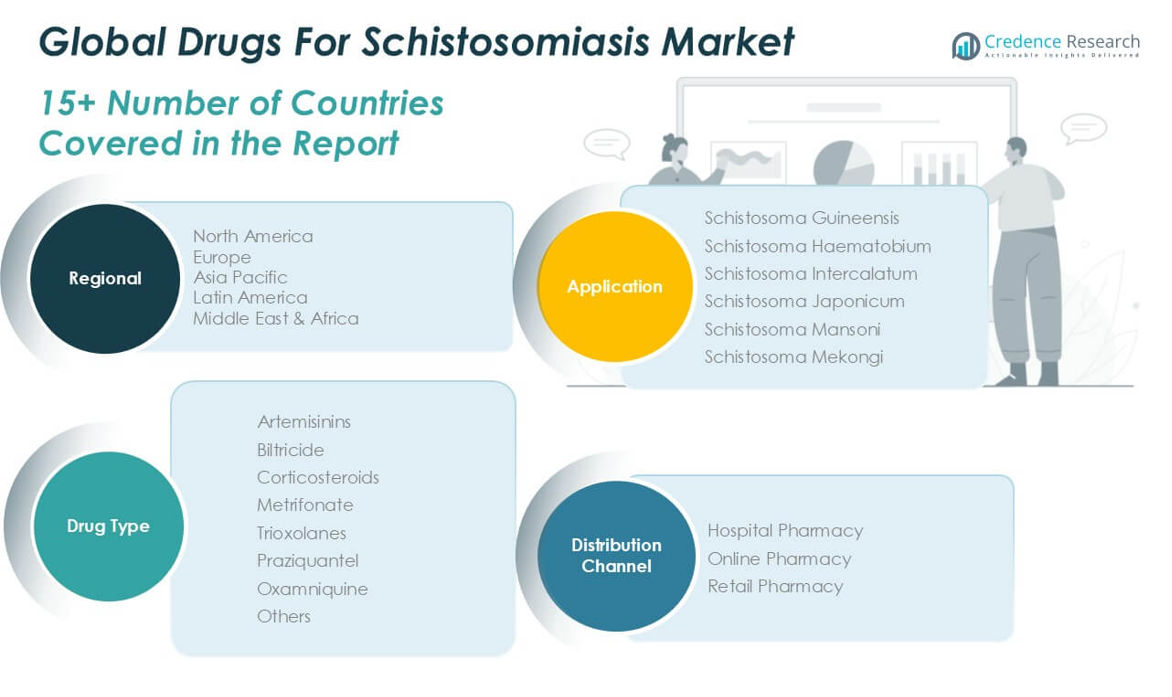
By Drug Type
- Artemisinins
- Biltricide
- Corticosteroids
- Metrifonate
- Trioxolanes
- Praziquantel
- Oxamniquine
- Others
By Application
- Schistosoma Guineensis
- Schistosoma Haematobium
- Schistosoma Intercalatum
- Schistosoma Japonicum
- Schistosoma Mansoni
- Schistosoma Mekongi
By Distribution Channel
- Hospital Pharmacy
- Online Pharmacy
- Retail Pharmacy
By Geography
- North America
- U.S.
- Canada
- Mexico
- Europe
- Germany
- France
- U.K.
- Italy
- Spain
- Rest of Europe
- Asia Pacific
- China
- Japan
- India
- South Korea
- South-east Asia
- Rest of Asia Pacific
- Latin America
- Brazil
- Argentina
- Rest of Latin America
- Middle East & Africa
- GCC Countries
- South Africa
- Rest of the Middle East and Africa
Competitive Landscape
The Drugs for Schistosomiasis market is moderately competitive, with several key players actively engaged in expanding their global presence and product portfolios. Major pharmaceutical companies such as Bayer AG, Merck KGaA, Novartis AG, Pfizer Inc., and Sanofi S.A. dominate the landscape through strong distribution networks, robust research capabilities, and participation in global health initiatives. Companies like GlaxoSmithKline plc, Roche Holding AG, and Johnson & Johnson contribute significantly through collaborative efforts and drug donation programs targeting endemic regions. Generic drug manufacturers, including Cipla Ltd., Sun Pharmaceutical Industries Ltd., and Mylan N.V., play a crucial role in ensuring affordable drug availability, particularly for mass treatment campaigns. Shin Poong Pharmaceutical Co., Ltd. and Ipca Laboratories Ltd. are emerging players focusing on regional markets and cost-effective production. The market is shaped by strategic collaborations, drug development for pediatric formulations, and increasing focus on combination therapies. Continued innovation, pricing strategies, and partnerships with global health organizations remain key competitive factors.
Key Player Analysis
- Bayer AG
- Merck KGaA
- Novartis AG
- Pfizer Inc.
- Sanofi S.A.
- GlaxoSmithKline plc
- Roche Holding AG
- Teva Pharmaceutical Industries Ltd.
- Johnson & Johnson
- Cipla Ltd.
- Sun Pharmaceutical Industries Ltd.
- Mylan N.V.
- Ipca Laboratories Ltd.
- Shin Poong Pharmaceutical Co., Ltd.

Market Concentration & Characteristics
The Drugs for Schistosomiasis Market demonstrates moderate concentration, with a mix of global pharmaceutical giants and regional players contributing to its structure. It features strong participation from companies such as Bayer AG, Merck KGaA, Novartis AG, and Pfizer Inc., which maintain significant control through large-scale production, extensive distribution networks, and collaborations with global health organizations. It relies heavily on drug donation programs and public health initiatives, particularly in low-income, high-prevalence regions. The market remains characterized by high dependency on a single drug, Praziquantel, which dominates treatment protocols due to its proven effectiveness and cost efficiency. Despite the presence of other drugs, market diversification is limited, increasing the risk of supply and treatment challenges if resistance develops. The market exhibits stable demand supported by mass drug administration campaigns, consistent public sector procurement, and growing attention to preventive strategies. It reflects low product differentiation but strong alignment with global disease control efforts, shaping its current structure and growth path.
Report Coverage
The research report offers an in-depth analysis based on Drug Type, Application, Distribution Channel and Geography. It details leading market players, providing an overview of their business, product offerings, investments, revenue streams, and key applications. Additionally, the report includes insights into the competitive environment, SWOT analysis, current market trends, as well as the primary drivers and constraints. Furthermore, it discusses various factors that have driven market expansion in recent years. The report also explores market dynamics, regulatory scenarios, and technological advancements that are shaping the industry. It assesses the impact of external factors and global economic changes on market growth. Lastly, it provides strategic recommendations for new entrants and established companies to navigate the complexities of the market.
Future Outlook
- The Drugs for Schistosomiasis Market will continue to grow steadily, supported by mass drug administration programs in endemic regions.
- Demand for Praziquantel will remain strong due to its proven efficacy and widespread acceptance as the first-line treatment.
- Development of pediatric formulations will gain momentum to improve treatment accessibility for children.
- Combination therapies will attract increased research to enhance treatment outcomes and reduce resistance risks.
- Pharmaceutical companies will strengthen collaborations with global health organizations to support large-scale distribution efforts.
- Drug donation programs will remain critical to maintaining drug availability in low-income regions.
- Africa will continue to lead the market with the highest regional share, driven by a high disease burden and strong public health interventions.
- Asia Pacific will show significant growth potential, supported by expanding public health initiatives and increasing awareness.
- Efforts to improve healthcare infrastructure and drug access in remote areas will influence market penetration.
- Monitoring of potential drug resistance will shape future investment in drug development and alternative therapies.

Request a Free Sample
Fill in your details and we'll send you a free sample report.
- Sample data tables & charts
- Research methodology
Need a Custom Version of This Report?
Tailor the scope, geography, or segments to your exact requirements.
- Custom geography or segment scope
- Direct access to our analyst team
Frequently Asked Questions
What is the current size of the Drugs For Schistosomiasis Market?
What are the key segments within the Drugs For Schistosomiasis Market?
What are some challenges faced by the Drugs For Schistosomiasis Market?
Who are the major players in the Drugs For Schistosomiasis Market?
Table of Content
Chapter 1. Report Introduction
- 1.1 Report Description & Purpose
- 1.1.1 Report Title & Market Definition
- 1.1.2 Unique Selling Propositions (USP) & Key Differentiators
- 1.1.3 Value Proposition for Stakeholders
- 1.2 Research Objectives
- 1.2.1 Market Sizing Objectives (Volume & Revenue)
- 1.2.2 Segmentation Objectives
- 1.2.3 Competitive Intelligence Objectives
- 1.2.4 Forecast & Scenario Objectives
- 1.3 Report Scope
- 1.3.1 Drugs For Schistosomiasis Scope – Types & Subtypes Covered
- 1.3.2 Geographic Scope – Regions & Countries Covered
- 1.3.3 Historical Period, Base Year & Forecast Period (the historical period; forecast to the forecast period)
- 1.3.4 Inclusions & Exclusions
- 1.4 HS Code & Classification Framework
- 1.5 Currency, Units & Pricing Basis
- 1.6 Target Stakeholders
- 1.7 Limitations & Assumptions
Chapter 2. Executive Summary
- 2.1 Global Drugs For Schistosomiasis Market Snapshot
- 2.1.1 Market Size – Historical (the historical period) & Forecast (the forecast period) (base year: USD 766.7 million → forecast year: USD 1,203.7 million)
- 2.1.2 Volume & Revenue – Global Totals
- 2.1.3 Key Market Highlights – Top Five Facts
- 2.2 Drugs For Schistosomiasis Market Segmentation Snapshot
- 2.2.1 Market Split by Region – vs.
- 2.3 Competitive Snapshot
- 2.3.1 Top 10 Players by Revenue Share –
- 2.3.2 Top 10 Players by Volume Share –
- 2.3.3 Recent Strategic Developments (18-Month Summary)
- 2.4 Key Investment Highlights & Strategic Conclusions
Chapter 3. Drugs For Schistosomiasis Market Dynamics & Industry Analysis
- 3.1 Market Overview & Context
- 3.1.1 Drugs For Schistosomiasis Market Position in the Broader Automotive Value Chain
- 3.1.2 OEM vs. Replacement Market Dynamics
- 3.1.3 Market Maturity & Development Stage by Region
- 3.2 Drugs For Schistosomiasis Market Drivers
- 3.3 Drugs For Schistosomiasis Market Restraints & Challenges
- 3.4 Drugs For Schistosomiasis Market Opportunities
- 3.5 Porter's Five Forces Analysis
- 3.5.1 Threat of New Entrants
- 3.5.2 Bargaining Power of Suppliers
- 3.5.3 Bargaining Power of Buyers
- 3.5.4 Threat of Substitutes
- 3.5.5 Competitive Rivalry – Intensity Assessment
- 3.6 Drugs For Schistosomiasis Value Chain Analysis
- 3.6.1 Upstream – Raw Material/Input Suppliers
- 3.6.1.1 Raw Material/Input 1
- 3.6.1.2 Raw Material/Input 2
- 3.6.1.3 Raw Material/Input 3
- 3.6.2 Midstream – Production/Manufacturing/Service Delivery
- 3.6.2.1 Production/Process Overview
- 3.6.2.2 Key Facility Locations & Capacity by Manufacturer
- 3.6.3 Downstream – Distribution & End Consumer
- 3.6.3.1 Primary Channel – B2B/OEM
- 3.6.3.2 Secondary Channels – Dealer, Retail, Online, Direct
- 3.6.4 Value Chain Profitability Analysis
- 3.6.1 Upstream – Raw Material/Input Suppliers
- 3.7 PESTEL Analysis
- 3.7.1 Political Factors
- 3.7.2 Economic Factors
- 3.7.3 Social Factors
- 3.7.4 Technological Factors
- 3.7.5 Environmental Factors
- 3.7.6 Legal Factors
- 3.8 Drugs For Schistosomiasis Supply Chain Analysis
- 3.8.1 Raw Material/Input Supply Risk Assessment
- 3.8.2 Manufacturing Concentration Risk (Geographic Exposure)
- 3.8.3 Trade Disruption Impact Analysis
- 3.9 Regulatory & Policy Landscape
Note: The regulatory and policy landscape section covers regulations based on their applicability to the market, Drugs For Schistosomiasis category, geography, and scope of the study. Only regulatory frameworks with a material impact on operations, compliance, trade, sustainability, or market access are analyzed in detail.
Chapter 4. Key Investment Pockets & Opportunity Analysis
- 4.1 Drugs For Schistosomiasis Market Attractiveness Analysis
- 4.1.1 By Region – Investment Attractiveness Matrix (Volume × CAGR)
- 4.2 Absolute Revenue Growth Opportunity
- 4.2.1 By Region – Absolute USD Growth Through the forecast period
- 4.3 Incremental Volume Opportunity
- 4.3.1 By Region – Incremental Volume Through the forecast period
- 4.3.2 Segment – Incremental Volume
- 4.4 Emerging Submarket Opportunity Deep Dive (Subject to Applicability)
- 4.5 Emerging Market Opportunity Scorecards
- 4.5.1 United States
- 4.5.2 Europe
- 4.5.3 Asia
- 4.5.4 Middle East & Africa
Note: Emerging Market Opportunity Scorecards will be included based on relevance and strategic importance. Regions listed are indicative and may vary depending on data availability and market dynamics.
Chapter 5. Drugs For Schistosomiasis Import-Export Analysis & Trade Flows
- 5.1 Global Trade Overview
- 5.1.1 Global Export Value by Country (the historical period)
- 5.1.2 Global Export Volume by Country (the historical period)
- 5.1.3 Global Import Value by Country (the historical period)
- 5.1.4 Global Import Volume by Country (the historical period)
- 5.1.5 Net Trade Balance by Country (the historical period)
- 5.2 Export Analysis – Segment
- 5.2.1 Type 1 (HS Code)
- 5.2.2 Type 2 (HS Code)
- 5.2.3 Type 3 (HS Code)
- 5.2.4 Type 4 (HS Code)
- 5.2.5 Type 5 (HS Code)
- 5.3 Import Analysis – Segment
- 5.3.1 Type 1 (HS Code)
- 5.3.2 Type 2 (HS Code)
- 5.3.3 Type 3 (HS Code)
- 5.3.4 Type 4 (HS Code)
- 5.3.5 Type 5 (HS Code)
- 5.4 Average Unit Trade Prices
- 5.4.1 Average Export Price – Segment & Country
- 5.4.2 Average Import Price – Segment & Source Country
- 5.4.3 Price Trends (the historical period)
- 5.5 Key Trade Route Analysis
- 5.5.1 Trade Route 1
- 5.5.2 Trade Route 2
- 5.5.3 Trade Route 3
- 5.5.4 Trade Route 4
- 5.5.5 Trade Route 5
- 5.6 Trade Policy Impact Assessment
- 5.6.1 US Anti-Dumping & Section 301 Tariffs
- 5.6.2 EU Customs Union Impact
- 5.6.3 Major Free Trade Agreements
- 5.6.4 USMCA Rules of Origin
Note: Trade policy analysis will be included only where relevant to the Drugs For Schistosomiasis market.
Chapter 6. Competitive Landscape & Company Benchmarking
- 6.1 Drugs For Schistosomiasis Market Concentration & Structure
- 6.1.1 Herfindahl-Hirschman Index (HHI) – vs.
- 6.1.2 Tier 1, Tier 2 & Tier 3 Market Structure
- 6.1.3 Global, Regional & Local Player Dynamics
- 6.2 Drugs For Schistosomiasis Market Share Analysis –
- 6.2.1 Global Revenue Share by Company
- 6.2.2 Global Volume Share by Company
- 6.2.3 Regional Revenue Share
- 6.2.4 Market Share Evolution ( vs. )
- 6.2.5 OEM Segment Share by Company
- 6.2.6 Replacement Segment Share by Company
- 6.3 Production/Delivery Capacity & Facility Analysis
- 6.3.1 Global Installed Capacity
- 6.3.2 Capacity Utilization Rates
- 6.3.3 Production/Output Volume
- 6.3.4 Facility Locations & Capacity Map
- 6.3.5 Planned Capacity Additions
- 6.4 Drugs For Schistosomiasis Competitive Benchmarking Matrix
- 6.4.1 Revenue, Volume, CAGR & Profitability Comparison
- 6.4.2 Channel Revenue Mix
- 6.4.3 Geographic Revenue Exposure
- 6.4.4 R&D Intensity
- 6.4.5 Sustainability Maturity
- 6.5 Strategic Developments in Drugs For Schistosomiasis (Last 24 Months)
- 6.5.1 Mergers, Acquisitions & Divestments
- 6.5.2 New Drugs For Schistosomiasis Launches
- 6.5.3 Facility Expansions
- 6.5.4 Strategic Alliances, Joint Ventures & Partnerships
- 6.5.5 Distribution Expansion & Market Entry
- 6.5.6 Sustainability & ESG Initiatives
- 6.6 Competitive Strategy Mapping
- 6.6.1 Leader, Challenger, Follower & Niche Classification
- 6.6.2 Pricing Strategy Comparison
- 6.6.3 Channel Strategy Matrix
Note: Strategic developments are included based on their materiality and the availability of reliable information.
Chapter 7. Global Drugs For Schistosomiasis Market – By Distribution Channel
- 7.1 Segment Overview
- 7.1.1 Volume & Revenue Split by Channel ( & )
- 7.1.2 Channel Mix Evolution (the forecast period)
Chapter 8. Regional Market Analysis – Global Overview
- 8.1 Global Regional Overview
- 8.1.1 Regional Volume Share
- 8.1.2 Regional Revenue Share
- 8.1.3 Regional Volume by Region
- 8.1.4 Regional Revenue by Region
- 8.1.5 Regional Forecast Through the forecast period
- 8.2 Cross-Regional Segment Analysis
- 8.2.1 By Distribution Channel
- 8.2.2 By Brand/Price Tier
Chapter 9. North America Drugs For Schistosomiasis Market
- 9.1 United States
- 9.2 Canada
- 9.3 Mexico
Chapter 10. Europe Drugs For Schistosomiasis Market
- 10.1 Germany
- 10.2 France
- 10.3 Italy
- 10.4 United Kingdom
- 10.5 Spain
- 10.6 Poland
- 10.7 Russia
- 10.8 Netherlands
- 10.9 Belgium
- 10.10 Sweden
- 10.11 Denmark
- 10.12 Norway
- 10.13 Rest of Europe
Chapter 11. Asia Pacific Drugs For Schistosomiasis Market
- 11.1 China
- 11.2 India
- 11.3 Japan
- 11.4 South Korea
- 11.5 Thailand
- 11.6 Indonesia
- 11.7 Vietnam
- 11.8 Malaysia
- 11.9 Australia
- 11.10 Rest of Asia Pacific
Chapter 12. Latin America Drugs For Schistosomiasis Market
- 12.1 Brazil
- 12.2 Argentina
- 12.3 Colombia
- 12.4 Chile
- 12.5 Rest of Latin America
Chapter 13. Middle East Drugs For Schistosomiasis Market
- 13.1 Saudi Arabia
- 13.2 United Arab Emirates
- 13.3 Turkey
- 13.4 Israel
- 13.5 Iran
- 13.6 Rest of the Middle East
Chapter 14. Africa Drugs For Schistosomiasis Market
- 14.1 South Africa
- 14.2 Egypt
- 14.3 Nigeria
- 14.4 Morocco
- 14.5 Rest of Africa
Chapter 15. Drugs For Schistosomiasis Company Profiles
- 15.1 [Company 01]
- 15.1.1 Company Overview
- 15.1.2 Key Management Personnel
- 15.1.3 Products & Services Portfolio
- 15.1.4 Financial Performance
- 15.1.5 Key Market Focus & Geographic Presence
- 15.1.6 Recent Developments & Strategic Initiatives
Note: The company profile list is preliminary and may change based on research findings, market developments, data availability, and client requirements.
Chapter 16. Appendices
- Appendix A – List of Abbreviations & Acronyms
- Appendix B – Industry Classification Code Reference – Full Series
- Appendix C – Production & Capacity Data Tables
- Appendix D – End-Use & Demand Base Tables
- Appendix E – Consumption & Replacement Rate Assumptions
- Appendix F – ASP Reference Tables
- Appendix G – Manufacturing & Facility Database
- Appendix H – Import-Export Data Tables
- Appendix I – Regulatory Summary Tables
- Appendix J – Primary Research Participant List (Anonymized)
- Appendix K – Primary Research Questionnaire Framework
- Appendix L – Data Sources & Bibliography
- Appendix M – Market Size Divergence & Source Comparison
Chapter 17. Research Methodology
- 17.1 Research Framework & Philosophy
- 17.2 Secondary Research – Sources, Hierarchy & Data Extraction
- 17.3 Data Modeling – Bottom-Up & Top-Down Market Sizing
- 17.4 Primary Research – Stakeholder Framework, LOI & Sample Sizes
- 17.5 Forecast Methodology – Regression, Scenario & Sensitivity Analysis
- 17.6 Quality Control – Four-Layer Validation Framework
- 17.7 Limitations & Standard Assumptions
- 17.8 Disclaimer