
| REPORT ATTRIBUTE | DETAILS |
|---|---|
| Historical Period | 2020-2023 |
| Base Year | 2024 |
| Forecast Period | 2025-2032 |
| Electric Hair Clipper and Trimmer Market Size 2024 | USD 5,749 Million |
| Electric Hair Clipper and Trimmer Market, CAGR | 3% |
| Electric Hair Clipper and Trimmer Market Size 2032 | USD 7,282.66 Million |
Market Overview:
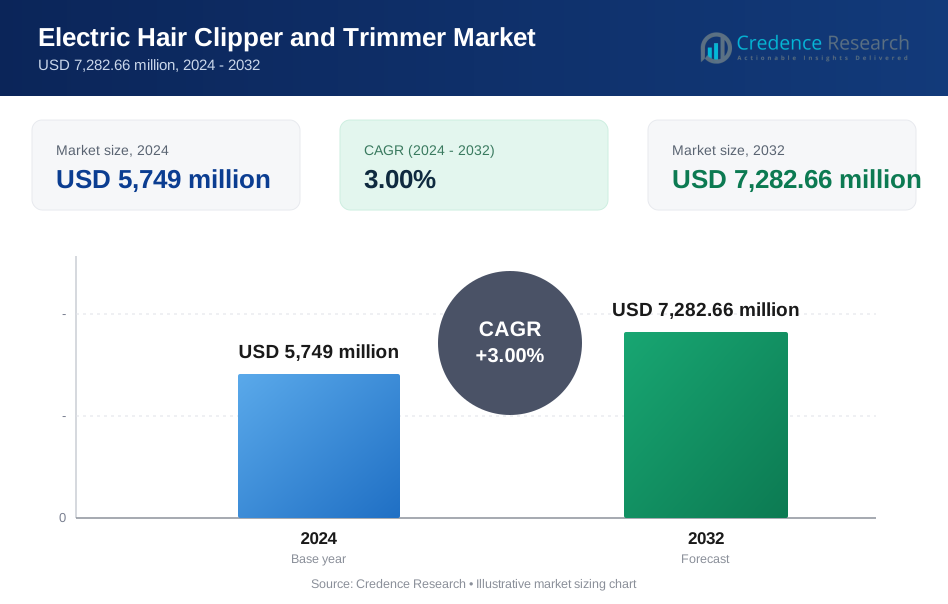
The Electric Hair Clipper and Trimmer Market is projected to grow from USD 5,749 million in 2024 to USD 7,282.66 million by 2032, with a compound annual growth rate (CAGR) of 3%.
The Electric Hair Clipper and Trimmer Market is driven by increasing consumer demand for personal grooming products, coupled with rising awareness about self-care and hygiene. Technological advancements, such as improved blade designs, longer battery life, and enhanced precision, are further fueling market growth. Additionally, the growing popularity of at-home grooming solutions and the expansion of e-commerce platforms are enabling wider product accessibility. Consumers’ preference for convenience, ease of use, and cost-effectiveness is accelerating the adoption of electric clippers and trimmers. Another significant trend is the increasing focus on eco-friendly products, with brands integrating sustainable materials and energy-efficient designs. The rise in disposable income, especially in emerging markets, is also contributing to market expansion, as more individuals invest in high-quality grooming tools. Overall, the electric hair clipper and trimmer market is poised for sustained growth, driven by innovations in technology, changing consumer behavior, and a greater emphasis on grooming as part of personal well-being.
The Electric Hair Clipper and Trimmer Market is experiencing strong growth across various regions, with North America holding a significant share of around 30% in 2024, driven by high demand for premium products. Europe follows with 25%, fueled by a focus on quality and sustainability. The Asia Pacific region, projected to grow at the highest rate, represents 20% of the market share, driven by rising disposable incomes and expanding e-commerce. Latin America and the Middle East & Africa together account for about 25%, showing steady growth due to increasing urbanization and changing grooming habits. Key players such as Andis Company, Koninklijke Philips N.V., Procter & Gamble, Remington Products, VEGA, Oneisall, Inc., Conair LLC, Panasonic Corporation, Spectrum Brands, Inc., Wahl Clipper Corporation, and Oster Professional Products (Sunbeam Products, Inc.) are strategically expanding their presence across these regions to tap into emerging market opportunities.
Market Insights:
- The Electric Hair Clipper and Trimmer Market is projected to grow from USD 5,749 million in 2024 to USD 7,282.66 million by 2032, at a CAGR of 3%.
- Increasing consumer demand for personal grooming products and rising awareness of self-care and hygiene are major growth drivers.
- Technological advancements such as improved blade designs, longer battery life, and enhanced precision are fueling market expansion.
- The popularity of at-home grooming solutions and the expansion of e-commerce platforms are enhancing product accessibility.
- Consumer preference for convenience, ease of use, and cost-effectiveness is driving the adoption of electric clippers and trimmers.
- The growing demand for eco-friendly products, with sustainable materials and energy-efficient designs, is a significant trend in the market.
- Rising disposable incomes in emerging markets are contributing to the broader adoption of high-quality grooming tools.
Market Drivers:
Growing Demand for Personal Grooming Products:
The increasing awareness surrounding personal hygiene and grooming is a significant driver for the Electric Hair Clipper and Trimmer Market. As consumers become more conscious of their appearance and self-care routines, the demand for high-quality grooming tools has surged. This trend is particularly evident in both developed and emerging markets, where grooming has evolved into a routine rather than a luxury. For instance, brands like Philips and Wahl have introduced a range of high-performance clippers and trimmers that cater to diverse grooming needs, enhancing their appeal to a broad consumer base. The convenience and efficiency of electric clippers and trimmers make them essential for at-home grooming.
Technological Advancements in Grooming Tools:
Technological innovations play a pivotal role in driving the growth of the electric hair clipper and trimmer market. Manufacturers are consistently developing advanced products with improved blade designs, longer battery life, and enhanced precision. Features such as cordless operation, ergonomic designs, and multiple length settings offer users greater flexibility and control. For instance, Panasonic has developed clippers with precision-ground blades and advanced motor technology to ensure professional-grade performance. These technological improvements enhance the overall user experience, making electric clippers and trimmers more attractive to both professional barbers and everyday consumers.
Rising Popularity of At-Home Grooming:
The growing trend of at-home grooming has significantly contributed to the demand for electric clippers and trimmers. With consumers increasingly opting for self-grooming solutions to save time and money, these products have become essential tools in personal care routines. This shift is partly driven by the COVID-19 pandemic, which has influenced people to invest in home grooming kits as salons and barbershops faced restrictions. For instance, Remington’s DIY haircut kits gained popularity during the pandemic, offering users affordable and convenient at-home grooming options. The convenience, affordability, and ease of use of electric hair clippers and trimmers have reinforced this shift.
E-Commerce Growth and Product Accessibility:
The rise of e-commerce has expanded access to electric hair clippers and trimmers, driving their market penetration. Online platforms provide consumers with a wide variety of options, detailed product reviews, and competitive pricing, making it easier to compare and purchase grooming tools. For instance, Amazon and Flipkart offer a wide selection of grooming products, along with customer reviews and ratings that help buyers make informed decisions. The convenience of home delivery and the growing popularity of online shopping have made it more accessible for consumers across different regions to purchase grooming products. As e-commerce continues to grow, it is expected that the electric hair clipper and trimmer market will see further expansion.
Market Trends:
Rise in Eco-Friendly and Sustainable Products:
A significant current trend in the Electric Hair Clipper and Trimmer Market is the growing demand for eco-friendly and sustainable grooming tools. Consumers are increasingly prioritizing products made from sustainable materials and designed to minimize environmental impact. Many brands are responding to this trend by incorporating recycled materials, energy-efficient designs, and biodegradable packaging into their product lines. For instance, Wahl has introduced eco-friendly trimmers that feature recyclable components and energy-efficient motors, appealing to environmentally conscious consumers. This shift towards sustainability aligns with broader global efforts to reduce carbon footprints.
Smart and Connected Grooming Devices:
Another notable trend is the integration of smart technology in electric clippers and trimmers. Manufacturers are incorporating Bluetooth connectivity, allowing users to control and personalize their grooming experience via smartphone apps. These smart devices can offer features such as adjustable cutting lengths, battery status tracking, and usage statistics. For instance, Xiaomi has developed smart grooming devices that connect to apps, providing users with detailed usage insights and customizable settings for a tailored grooming experience. This trend reflects the growing consumer interest in tech-enabled products that enhance convenience and performance.
Customization and Versatility in Grooming Tools:
There is a noticeable trend towards offering more customizable and versatile electric hair clippers and trimmers. Consumers now prefer grooming devices that allow for a wide range of styling options, such as multiple length settings, adjustable attachments, and different blade options. For instance, Braun has introduced trimmers with interchangeable attachments that cater to beard grooming, haircuts, and body grooming needs, offering users a versatile all-in-one solution. This trend is driven by the desire for personalized grooming experiences, enabling users to achieve professional-level results at home.
Focus on Premium and Professional-Grade Products:
In line with increasing consumer demand for high-quality grooming tools, there is a growing preference for premium and professional-grade electric clippers and trimmers. Products that offer superior performance, durability, and precision are gaining traction among both professionals and home users. For instance, Andis Company provides professional-grade clippers used by barbers and stylists worldwide, known for their durability and precise cutting performance. This reflects a shift towards investing in long-lasting, high-performance devices that can provide an exceptional grooming experience.
Market Challenges Analysis:
Intense Market Competition and Brand Differentiation:
One of the key challenges in the Electric Hair Clipper and Trimmer Market is the intense competition among numerous brands, making it difficult for companies to differentiate themselves effectively. The market is flooded with a wide range of grooming tools, from budget-friendly options to high-end professional devices, leading to price wars, reduced profit margins, and increased difficulty in maintaining market share. Established brands such as Philips, Wahl, and Andis dominate the market, making it particularly challenging for smaller or new players to establish a strong foothold. To overcome this challenge, companies need to focus on innovation, quality, and effective marketing strategies to stand out. Offering unique features, such as advanced technology integration, customizable options, or enhanced user experiences, can help create a distinct market position. However, achieving differentiation in a saturated market requires significant investment in research and development, customer engagement, brand building, and maintaining long-term consumer loyalty.
Product Quality and Durability Concerns:
Another challenge faced by manufacturers in the Electric Hair Clipper and Trimmer Market is ensuring consistent product quality and durability. As consumer expectations continue to rise, there is an increasing demand for grooming devices that are not only effective but also long-lasting and reliable. Poor-quality products, which may include issues such as battery failure, overheating, or ineffective blades, can significantly damage a brand’s reputation and lead to negative customer reviews, ultimately harming sales. To address this challenge, manufacturers must focus on improving product durability, utilizing advanced materials, offering warranties, and ensuring that their products meet or exceed industry standards. Additionally, frequent product updates, robust quality control measures, and better customer support systems are essential to maintaining brand loyalty and ensuring that products remain competitive in the ever-evolving market. However, delivering consistently high-quality products can significantly increase manufacturing costs, which may affect pricing strategies, ultimately challenging profit margins.
Market Opportunities:
The Electric Hair Clipper and Trimmer Market presents significant opportunities driven by the increasing demand for premium grooming products and technological advancements. As consumers place a higher value on personal grooming and hygiene, there is a growing interest in high-performance, durable, and customizable grooming tools. Brands that focus on offering advanced features such as adjustable blades, ergonomic designs, and long battery life are poised to capture a larger market share. Additionally, the rising trend of at-home grooming presents an opportunity for manufacturers to develop and promote products that cater to both professional and personal use. The growth of e-commerce platforms further enhances the market potential, allowing brands to reach a global audience and provide consumers with convenient purchasing options.
Another key opportunity lies in the increasing consumer preference for sustainable and eco-friendly products. As environmental concerns grow, consumers are becoming more selective about the products they purchase, opting for grooming tools made from recyclable materials, energy-efficient designs, and environmentally friendly packaging. Manufacturers can capitalize on this shift by adopting sustainable practices and incorporating these elements into their product lines. Furthermore, the rise in disposable income, particularly in emerging markets, offers an expanded customer base for electric hair clippers and trimmers. As more consumers in developing countries seek high-quality grooming products, there is a vast opportunity for growth in untapped markets. By focusing on innovation, quality, and sustainability, companies can position themselves to meet the evolving needs of consumers and secure a competitive edge in the marketplace.
Market Segmentation Analysis:
By Type
The Electric Hair Clipper and Trimmer Market is segmented by type into clippers and trimmers. Clippers are commonly used for cutting hair at shorter lengths and are preferred by professionals for precise, bulk hair removal. Trimmers, on the other hand, are typically used for detailed grooming such as beard trimming and mustache shaping. Both segments have distinct consumer bases and are tailored to specific grooming needs.
By Product
The market is also segmented by product into corded and cordless options. Cordless clippers and trimmers are increasingly popular due to their portability and convenience, offering flexibility in usage. On the other hand, corded models, often preferred by professionals, provide consistent power without the need for recharging. This segmentation reflects consumer preferences for either mobility or uninterrupted use, catering to various needs.
By Distribution Channel
Distribution channels for electric clippers and trimmers include online retail, specialty stores, and direct sales. E-commerce platforms are seeing significant growth due to their convenience, variety, and competitive pricing. Specialty stores, including grooming and beauty supply retailers, offer a more personalized shopping experience. Direct sales to professionals also remain important in this market segment.
Segments:
Based on Product
- Hair Clipper
- Hair Trimmer
- Blades
Based on Type
- Human
- Pet
Based on Distribution Channel
- Online
- Offline
Based on the Geography:
- North America
- U.S.
- Canada
- Mexico
- Europe
- Germany
- France
- U.K.
- Italy
- Spain
- Rest of Europe
- Asia Pacific
- China
- Japan
- India
- South Korea
- South-east Asia
- Rest of Asia Pacific
- Latin America
- Brazil
- Argentina
- Rest of Latin America
- Middle East & Africa
- GCC Countries
- South Africa
- Rest of the Middle East and Africa
Regional Analysis:
North America
North America holds a significant share of the Electric Hair Clipper and Trimmer Market, accounting for 30% of the market in 2024. This dominance is driven by the high demand for premium grooming products, especially in the United States, where grooming has become an integral part of personal care routines. Consumers in this region are increasingly seeking advanced technology, such as cordless and customizable clippers, which enhance user experience. The presence of well-established brands like Philips, Wahl, and Andis further fuels market growth. Additionally, the rise of e-commerce platforms has facilitated easy access to a wide range of products, making it convenient for consumers to purchase grooming tools. Professional grooming services also drive demand, contributing to the growth of both home-use and salon-use products.
Europe
Europe is another key region in the Electric Hair Clipper and Trimmer Market, with a market share of 25% in 2024. The market in this region is expanding due to increasing consumer interest in personal grooming and beauty. Countries like Germany, the UK, and France are seeing growth in demand for both premium and budget-friendly grooming tools. European consumers are highly focused on quality, sustainability, and eco-friendly products, which has led to increased adoption of grooming devices made from sustainable materials. The growing trend of self-grooming, combined with the region’s focus on technological innovations, is further fueling the market in Europe.
Asia Pacific
The Asia Pacific region is expected to experience the highest growth rate in the Electric Hair Clipper and Trimmer Market, with a projected market share of 20% in 2024. This growth is driven by the increasing disposable incomes in countries like China, India, and Japan. As the middle class continues to expand, consumers are increasingly investing in grooming products, including electric clippers and trimmers. Additionally, the rise in online shopping platforms and growing awareness about personal grooming among young professionals are key factors driving demand in this region. The region's large, diverse population and expanding e-commerce market create immense opportunities for brands to capture new customers.
Latin America and Middle East & Africa
Latin America and the Middle East & Africa together contribute a smaller share to the overall market, accounting for 25% in 2024. However, both regions are experiencing growth due to increasing urbanization, rising disposable incomes, and changing grooming habits. In Latin America, countries like Brazil and Mexico are seeing a rise in demand for grooming products, while in the Middle East, consumer preferences for luxury grooming tools are driving market expansion. The potential for growth in these regions is significant, particularly as access to online shopping continues to improve and consumer awareness of high-quality grooming tools increases.
Key Player Analysis:
- Andis Company
- Koninklijke Philips N.V.
- Procter & Gamble
- Remington Products
- VEGA
- Oneisall, Inc.
- Conair LLC
- Panasonic Corporation
- Spectrum Brands, Inc.
- Wahl Clipper Corporation
- Oster Professional Products (Sunbeam Products, Inc.)
Competitive Analysis:
The Electric Hair Clipper and Trimmer Market is highly competitive, with key players like Andis Company, Koninklijke Philips N.V., Procter & Gamble, Remington Products, VEGA, Oneisall, Inc., Conair LLC, Panasonic Corporation, Spectrum Brands, Inc., Wahl Clipper Corporation, and Oster Professional Products (Sunbeam Products, Inc.) dominating the landscape. These companies continuously innovate by introducing advanced features such as longer battery life, customizable settings, and cordless capabilities, driving product differentiation. Brands like Philips and Wahl leverage their strong brand recognition and established consumer trust to maintain a competitive edge. Meanwhile, companies such as Andis and Oster cater to professional users with high-performance tools designed for durability and precision. For instance, Oster Professional Products manufactures clippers known for their robust motor technology and reliability, making them a popular choice among barbers worldwide. The rise in demand for eco-friendly products has also pushed companies to invest in sustainable materials and energy-efficient designs. With increasing consumer preference for online shopping, leading players are enhancing their digital presence to reach a wider audience, further intensifying the competition within this growing market.
Recent Developments:
- In September 2024, Manscaped, a global lifestyle consumer brand specializing in men’s grooming products, introduced The Chairman Pro electric foil shaver and The Chairman Pro Package face shaving kit. These new additions to the company's extensive portfolio demonstrate its commitment to expanding its electric shaving category with new launches and the adoption of advanced technology.
- In August 2024, Wahl, an international grooming brand known for its professional portfolio offerings, launched the Kuno Clipper. Specifically designed for stylists and other professionals, this clipper features innovative blade technology, a compact size, lightweight construction, and refined materials. This launch is expected to strengthen Wahl’s position in the professional hair grooming market.
- In May 2024, Philips, a global leader in technology and innovation, introduced a limited-edition trimmer co-designed with Virat Kohli. The collaboration between the popular cricketer and former team captain, along with precision engineering, aims to attract a large segment of young Indian consumers to the brand.
- In February 2024, Andis Company released its professional-grade eMERGE clipper, designed for high-volume use. Featuring a high-speed rotary motor operating at 4,500 strokes per minute, the clipper enables fast and accurate grooming.
Market Concentration & Characteristics:
The Electric Hair Clipper and Trimmer Market is moderately concentrated, with a few dominant players holding a significant share, while also leaving room for smaller, niche brands to capture market interest. Leading companies such as Philips, Wahl, Andis, and Panasonic control a large portion of the market, leveraging brand recognition, innovation, and global distribution networks to maintain their competitive edge. However, the market also features a variety of regional and emerging brands that cater to specific consumer needs, such as eco-friendly products or budget-friendly grooming tools. The characteristics of this market are defined by technological advancements, with companies focusing on improving product efficiency, durability, and user experience. Features such as cordless operation, customizable settings, and long battery life are increasingly becoming standard offerings. Additionally, the rise of e-commerce has transformed the distribution landscape, enabling both large and small players to reach a wider audience more effectively.
Report Coverage:
The research report offers an in-depth analysis based on Type, Product, Distribution Channel and Geography. It details leading market players, providing an overview of their business, product offerings, investments, revenue streams, and key applications. Additionally, the report includes insights into the competitive environment, SWOT analysis, current market trends, as well as the primary drivers and constraints. Furthermore, it discusses various factors that have driven market expansion in recent years. The report also explores market dynamics, regulatory scenarios, and technological advancements that are shaping the industry. It assesses the impact of external factors and global economic changes on market growth. Lastly, it provides strategic recommendations for new entrants and established companies to navigate the complexities of the market.
Future Outlook:
- The demand for electric hair clippers and trimmers will continue to rise as personal grooming becomes an integral part of daily routines.
- Technological innovations, such as improved blade precision and longer battery life, will drive product differentiation and enhance user experience.
- The trend of at-home grooming will strengthen, as consumers increasingly prefer convenience and cost-effectiveness.
- E-commerce platforms will play a key role in expanding product accessibility, providing a convenient purchasing option for global consumers.
- The focus on sustainability will increase, with manufacturers adopting eco-friendly materials and energy-efficient designs.
- Rising disposable incomes in emerging markets will create new growth opportunities for premium grooming products.
- Increasing consumer awareness about self-care and hygiene will continue to fuel demand for grooming tools.
- Personalization features, such as adjustable settings and cordless operation, will become more prevalent in product offerings.
- As urbanization increases, grooming tools will become more essential, particularly in regions like Asia Pacific and Latin America.
- Strong competition will persist, pushing companies to focus on innovation, quality, and customer engagement to differentiate themselves in the market.
Request a Free Sample
Fill in your details and we'll send you a free sample report.
- Sample data tables & charts
- Research methodology
Need a Custom Version of This Report?
Tailor the scope, geography, or segments to your exact requirements.
- Custom geography or segment scope
- Direct access to our analyst team
Frequently Asked Questions
What is the current size of the Electric Hair Clipper and Trimmer Market?
What factors are driving the growth of the Electric Hair Clipper and Trimmer Market?
What are the key segments within the Electric Hair Clipper and Trimmer Market?
What are some challenges faced by the Electric Hair Clipper and Trimmer Market?
Who are the major players in the Electric Hair Clipper and Trimmer Market?
Table of Content
Chapter 1. Report Introduction
- 1.1 Report Description & Purpose
- 1.1.1 Report Title & Market Definition
- 1.1.2 Unique Selling Propositions (USP) & Key Differentiators
- 1.1.3 Value Proposition for Stakeholders
- 1.2 Research Objectives
- 1.2.1 Market Sizing Objectives (Volume & Revenue)
- 1.2.2 Segmentation Objectives
- 1.2.3 Competitive Intelligence Objectives
- 1.2.4 Forecast & Scenario Objectives
- 1.3 Report Scope
- 1.3.1 Electric Hair Clipper and Trimmer Scope – Types & Subtypes Covered
- 1.3.2 Geographic Scope – Regions & Countries Covered
- 1.3.3 Historical Period, Base Year & Forecast Period (2024; forecast to 2032)
- 1.3.4 Inclusions & Exclusions
- 1.4 HS Code & Classification Framework
- 1.5 Currency, Units & Pricing Basis
- 1.6 Target Stakeholders
- 1.7 Limitations & Assumptions
Chapter 2. Executive Summary
- 2.1 Global Electric Hair Clipper and Trimmer Market Snapshot
- 2.1.1 Market Size – Historical (2024) & Forecast (2024-2032) (2024: USD 5,749 million → 2032: USD 7,282.66 million)
- 2.1.2 Volume & Revenue – Global Totals
- 2.1.3 Key Market Highlights – Top Five Facts
- 2.2 Electric Hair Clipper and Trimmer Market Segmentation Snapshot
- 2.2.1 Market Split by Region – 2024 vs. 2032
- 2.3 Competitive Snapshot
- 2.3.1 Top 10 Players by Revenue Share – 2024
- 2.3.2 Top 10 Players by Volume Share – 2024
- 2.3.3 Recent Strategic Developments (18-Month Summary)
- 2.4 Key Investment Highlights & Strategic Conclusions
Chapter 3. Electric Hair Clipper and Trimmer Market Dynamics & Industry Analysis
- 3.1 Market Overview & Context
- 3.1.1 Electric Hair Clipper and Trimmer Market Position in the Broader Automotive Value Chain
- 3.1.2 OEM vs. Replacement Market Dynamics
- 3.1.3 Market Maturity & Development Stage by Region
- 3.2 Electric Hair Clipper and Trimmer Market Drivers
- 3.3 Electric Hair Clipper and Trimmer Market Restraints & Challenges
- 3.4 Electric Hair Clipper and Trimmer Market Opportunities
- 3.5 Porter's Five Forces Analysis
- 3.5.1 Threat of New Entrants
- 3.5.2 Bargaining Power of Suppliers
- 3.5.3 Bargaining Power of Buyers
- 3.5.4 Threat of Substitutes
- 3.5.5 Competitive Rivalry – Intensity Assessment
- 3.6 Electric Hair Clipper and Trimmer Value Chain Analysis
- 3.6.1 Upstream – Raw Material/Input Suppliers
- 3.6.1.1 Raw Material/Input 1
- 3.6.1.2 Raw Material/Input 2
- 3.6.1.3 Raw Material/Input 3
- 3.6.2 Midstream – Production/Manufacturing/Service Delivery
- 3.6.2.1 Production/Process Overview
- 3.6.2.2 Key Facility Locations & Capacity by Manufacturer
- 3.6.3 Downstream – Distribution & End Consumer
- 3.6.3.1 Primary Channel – B2B/OEM
- 3.6.3.2 Secondary Channels – Dealer, Retail, Online, Direct
- 3.6.4 Value Chain Profitability Analysis
- 3.6.1 Upstream – Raw Material/Input Suppliers
- 3.7 PESTEL Analysis
- 3.7.1 Political Factors
- 3.7.2 Economic Factors
- 3.7.3 Social Factors
- 3.7.4 Technological Factors
- 3.7.5 Environmental Factors
- 3.7.6 Legal Factors
- 3.8 Electric Hair Clipper and Trimmer Supply Chain Analysis
- 3.8.1 Raw Material/Input Supply Risk Assessment
- 3.8.2 Manufacturing Concentration Risk (Geographic Exposure)
- 3.8.3 Trade Disruption Impact Analysis
- 3.9 Regulatory & Policy Landscape
Note: The regulatory and policy landscape section covers regulations based on their applicability to the market, Electric Hair Clipper and Trimmer category, geography, and scope of the study. Only regulatory frameworks with a material impact on operations, compliance, trade, sustainability, or market access are analyzed in detail.
Chapter 4. Key Investment Pockets & Opportunity Analysis
- 4.1 Electric Hair Clipper and Trimmer Market Attractiveness Analysis
- 4.1.1 By Region – Investment Attractiveness Matrix (Volume × CAGR)
- 4.2 Absolute Revenue Growth Opportunity
- 4.2.1 By Region – Absolute USD Growth Through 2032
- 4.3 Incremental Volume Opportunity
- 4.3.1 By Region – Incremental Volume Through 2032
- 4.3.2 Segment – Incremental Volume
- 4.4 Emerging Submarket Opportunity Deep Dive (Subject to Applicability)
- 4.5 Emerging Market Opportunity Scorecards
- 4.5.1 United States
- 4.5.2 Europe
- 4.5.3 Asia
- 4.5.4 Middle East & Africa
Note: Emerging Market Opportunity Scorecards will be included based on relevance and strategic importance. Regions listed are indicative and may vary depending on data availability and market dynamics.
Chapter 5. Electric Hair Clipper and Trimmer Import-Export Analysis & Trade Flows
- 5.1 Global Trade Overview
- 5.1.1 Global Export Value by Country (2024)
- 5.1.2 Global Export Volume by Country (2024)
- 5.1.3 Global Import Value by Country (2024)
- 5.1.4 Global Import Volume by Country (2024)
- 5.1.5 Net Trade Balance by Country (2024)
- 5.2 Export Analysis – Segment
- 5.2.1 Type 1 (HS Code)
- 5.2.2 Type 2 (HS Code)
- 5.2.3 Type 3 (HS Code)
- 5.2.4 Type 4 (HS Code)
- 5.2.5 Type 5 (HS Code)
- 5.3 Import Analysis – Segment
- 5.3.1 Type 1 (HS Code)
- 5.3.2 Type 2 (HS Code)
- 5.3.3 Type 3 (HS Code)
- 5.3.4 Type 4 (HS Code)
- 5.3.5 Type 5 (HS Code)
- 5.4 Average Unit Trade Prices
- 5.4.1 Average Export Price – Segment & Country
- 5.4.2 Average Import Price – Segment & Source Country
- 5.4.3 Price Trends (2024)
- 5.5 Key Trade Route Analysis
- 5.5.1 Trade Route 1
- 5.5.2 Trade Route 2
- 5.5.3 Trade Route 3
- 5.5.4 Trade Route 4
- 5.5.5 Trade Route 5
- 5.6 Trade Policy Impact Assessment
- 5.6.1 US Anti-Dumping & Section 301 Tariffs
- 5.6.2 EU Customs Union Impact
- 5.6.3 Major Free Trade Agreements
- 5.6.4 USMCA Rules of Origin
Note: Trade policy analysis will be included only where relevant to the Electric Hair Clipper and Trimmer market.
Chapter 6. Competitive Landscape & Company Benchmarking
- 6.1 Electric Hair Clipper and Trimmer Market Concentration & Structure
- 6.1.1 Herfindahl-Hirschman Index (HHI) – vs. 2024
- 6.1.2 Tier 1, Tier 2 & Tier 3 Market Structure
- 6.1.3 Global, Regional & Local Player Dynamics
- 6.2 Electric Hair Clipper and Trimmer Market Share Analysis – 2024
- 6.2.1 Global Revenue Share by Company
- 6.2.2 Global Volume Share by Company
- 6.2.3 Regional Revenue Share
- 6.2.4 Market Share Evolution ( vs. 2024)
- 6.2.5 OEM Segment Share by Company
- 6.2.6 Replacement Segment Share by Company
- 6.3 Production/Delivery Capacity & Facility Analysis
- 6.3.1 Global Installed Capacity
- 6.3.2 Capacity Utilization Rates
- 6.3.3 Production/Output Volume
- 6.3.4 Facility Locations & Capacity Map
- 6.3.5 Planned Capacity Additions
- 6.4 Electric Hair Clipper and Trimmer Competitive Benchmarking Matrix
- 6.4.1 Revenue, Volume, CAGR & Profitability Comparison
- 6.4.2 Channel Revenue Mix
- 6.4.3 Geographic Revenue Exposure
- 6.4.4 R&D Intensity
- 6.4.5 Sustainability Maturity
- 6.5 Strategic Developments in Electric Hair Clipper and Trimmer (Last 24 Months)
- 6.5.1 Mergers, Acquisitions & Divestments
- 6.5.2 New Electric Hair Clipper and Trimmer Launches
- 6.5.3 Facility Expansions
- 6.5.4 Strategic Alliances, Joint Ventures & Partnerships
- 6.5.5 Distribution Expansion & Market Entry
- 6.5.6 Sustainability & ESG Initiatives
- 6.6 Competitive Strategy Mapping
- 6.6.1 Leader, Challenger, Follower & Niche Classification
- 6.6.2 Pricing Strategy Comparison
- 6.6.3 Channel Strategy Matrix
Note: Strategic developments are included based on their materiality and the availability of reliable information.
Chapter 7. Global Electric Hair Clipper and Trimmer Market – By Distribution Channel
- 7.1 Segment Overview
- 7.1.1 Volume & Revenue Split by Channel (2024 & 2032)
- 7.1.2 Channel Mix Evolution (2024-2032)
Chapter 8. Regional Market Analysis – Global Overview
- 8.1 Global Regional Overview
- 8.1.1 Regional Volume Share
- 8.1.2 Regional Revenue Share
- 8.1.3 Regional Volume by Region
- 8.1.4 Regional Revenue by Region
- 8.1.5 Regional Forecast Through 2032
- 8.2 Cross-Regional Segment Analysis
- 8.2.1 By Distribution Channel
- 8.2.2 By Brand/Price Tier
Chapter 9. North America Electric Hair Clipper and Trimmer Market
- 9.1 United States
- 9.2 Canada
- 9.3 Mexico
Chapter 10. Europe Electric Hair Clipper and Trimmer Market
- 10.1 Germany
- 10.2 France
- 10.3 Italy
- 10.4 United Kingdom
- 10.5 Spain
- 10.6 Poland
- 10.7 Russia
- 10.8 Netherlands
- 10.9 Belgium
- 10.10 Sweden
- 10.11 Denmark
- 10.12 Norway
- 10.13 Rest of Europe
Chapter 11. Asia Pacific Electric Hair Clipper and Trimmer Market
- 11.1 China
- 11.2 India
- 11.3 Japan
- 11.4 South Korea
- 11.5 Thailand
- 11.6 Indonesia
- 11.7 Vietnam
- 11.8 Malaysia
- 11.9 Australia
- 11.10 Rest of Asia Pacific
Chapter 12. Latin America Electric Hair Clipper and Trimmer Market
- 12.1 Brazil
- 12.2 Argentina
- 12.3 Colombia
- 12.4 Chile
- 12.5 Rest of Latin America
Chapter 13. Middle East Electric Hair Clipper and Trimmer Market
- 13.1 Saudi Arabia
- 13.2 United Arab Emirates
- 13.3 Turkey
- 13.4 Israel
- 13.5 Iran
- 13.6 Rest of the Middle East
Chapter 14. Africa Electric Hair Clipper and Trimmer Market
- 14.1 South Africa
- 14.2 Egypt
- 14.3 Nigeria
- 14.4 Morocco
- 14.5 Rest of Africa
Chapter 15. Electric Hair Clipper and Trimmer Company Profiles
- 15.1 [Company 01]
- 15.1.1 Company Overview
- 15.1.2 Key Management Personnel
- 15.1.3 Products & Services Portfolio
- 15.1.4 Financial Performance
- 15.1.5 Key Market Focus & Geographic Presence
- 15.1.6 Recent Developments & Strategic Initiatives
Note: The company profile list is preliminary and may change based on research findings, market developments, data availability, and client requirements.
Chapter 16. Appendices
- Appendix A – List of Abbreviations & Acronyms
- Appendix B – Industry Classification Code Reference – Full Series
- Appendix C – Production & Capacity Data Tables
- Appendix D – End-Use & Demand Base Tables
- Appendix E – Consumption & Replacement Rate Assumptions
- Appendix F – ASP Reference Tables
- Appendix G – Manufacturing & Facility Database
- Appendix H – Import-Export Data Tables
- Appendix I – Regulatory Summary Tables
- Appendix J – Primary Research Participant List (Anonymized)
- Appendix K – Primary Research Questionnaire Framework
- Appendix L – Data Sources & Bibliography
- Appendix M – Market Size Divergence & Source Comparison
Chapter 17. Research Methodology
- 17.1 Research Framework & Philosophy
- 17.2 Secondary Research – Sources, Hierarchy & Data Extraction
- 17.3 Data Modeling – Bottom-Up & Top-Down Market Sizing
- 17.4 Primary Research – Stakeholder Framework, LOI & Sample Sizes
- 17.5 Forecast Methodology – Regression, Scenario & Sensitivity Analysis
- 17.6 Quality Control – Four-Layer Validation Framework
- 17.7 Limitations & Standard Assumptions
- 17.8 Disclaimer
