
Market Overview
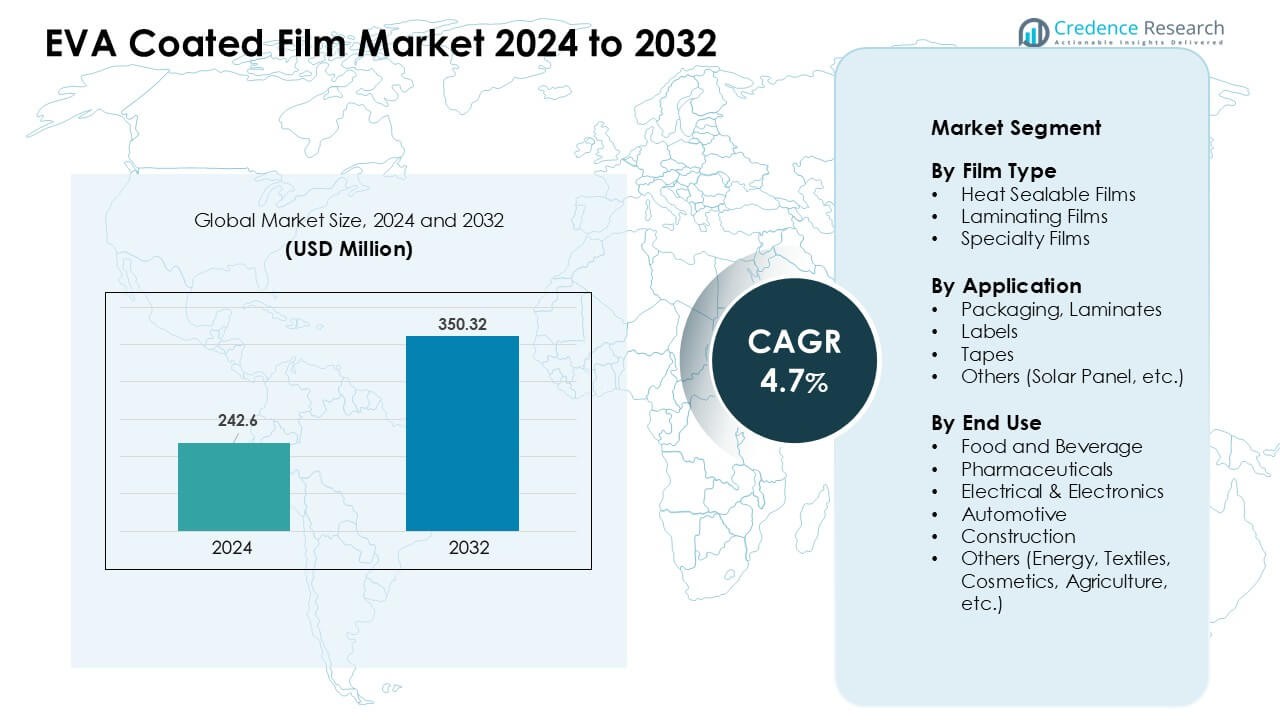
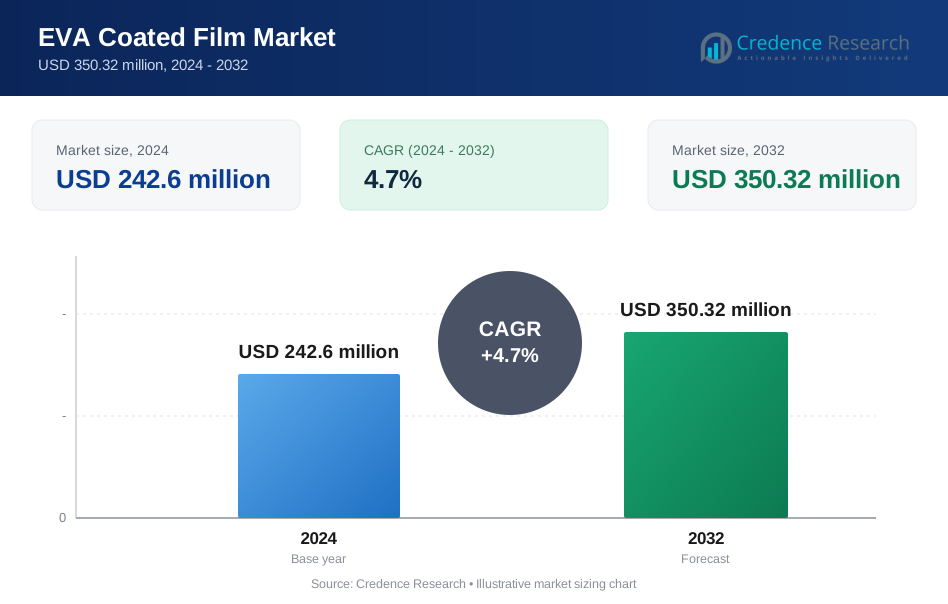
EVA Coated Film Market was valued at USD 242.6 million in 2024 and is anticipated to reach USD 350.32 million by 2032, growing at a CAGR of 4.7% during the forecast period.
| REPORT ATTRIBUTE | DETAILS |
|---|---|
| Historical Period | 2020-2023 |
| Base Year | 2024 |
| Forecast Period | 2025-2032 |
| EVA Coated Film Market Size 2024 | USD 242.6 Million |
| EVA Coated Film Market, CAGR | 4.7% |
| EVA Coated Film Market Size 2032 | USD 350.32 Million |
The EVA coated film market is shaped by key players such as Hanwha Solutions, Celanese Corporation, Arkema, Mitsui Chemicals Tohcello, Folienwerk Wolfen, Brentwood Plastics, Dr. Dietrich Müller, Changzhou Bbetter Film Technologies, and Allied Glasses, each competing through material innovation and application-specific film development. These companies focus on stronger sealing layers, improved optical clarity, and advanced lamination performance to serve packaging, solar, electronics, and automotive sectors. Asia Pacific emerged as the leading region in 2024 with about 38% share, driven by its large packaging base, expanding solar module production, and strong electronics manufacturing ecosystem.
Market Insights
- The EVA coated film market was valued at USD 6 million in 2024 and is projected to reach USD350.32 million by 2032, growing at a CAGR of 4.7%.
- Demand rises due to strong use in flexible packaging, where heat-sealable films led the segment with about 41% share in 2024, driven by better sealing strength and higher line efficiency.
- Key trends include growing adoption in solar module encapsulation and electronics, along with rising interest in recyclable mono-material packaging structures across major manufacturing regions.
- Leading players such as Hanwha Solutions, Celanese, Arkema, Mitsui Chemicals Tohcello, and Folienwerk Wolfen compete through coating innovation, expanded capacity, and application-specific film portfolios.
- Asia Pacific dominated the market with nearly 38% share in 2024, followed by North America at 28% and Europe at 25%, supported by strong packaging, solar, and automotive demand across these regions.
Market Segmentation Analysis:
By Film Type
Heat sealable films dominated this segment in 2024 with about 41% share. These films gained strong demand due to reliable sealing strength, flexibility, and wide use in food pouches and medical packs. Laminating films followed as converters used them to enhance durability and print clarity in consumer packaging. Specialty films grew in premium sectors that needed high optical clarity or barrier support. Rising focus on safe sealing, faster line speeds, and consistent pack quality helped heat sealable films maintain their lead across major packaging formats.
- For instance, Sealed Air Corporation supplies multilayer co-extruded heat-sealable films under its Cryovac® brand, engineered for high seal strength and reliable hot-tack performance on high-speed form-fill-seal packaging lines used in food and protein packaging.
By Application
Packaging and laminates led the application segment in 2024 with nearly 52% share. This category grew due to strong adoption in snacks, frozen goods, and flexible retail packs that required tight seals and stable mechanical strength. Labels saw steady demand in branded FMCG products, while EVA-coated tapes expanded in industrial bundling and protective wrapping. The solar panel segment also gained traction as EVA layers supported strong adhesion and moisture resistance. Higher packaging hygiene standards and the shift toward lightweight materials kept packaging and laminates at the top.
- For instance, Taghleef Industries Group supplies sealable BOPP films with wide sealing windows and strong hot-tack performance, supporting reliable vertical form-fill-seal packaging for heavy snack and frozen-food products.
By End Use
Food and beverage accounted for the largest share in 2024 with around 38%. Manufacturers preferred EVA-coated films because these films offered strong sealing, odor resistance, and clarity suited for ready-to-eat meals, snacks, and chilled foods. Pharmaceuticals adopted them for sterile wraps and protective pouches, while electrical and electronics companies used EVA films for insulation layers. Automotive and construction sectors applied them in laminates and protective sheets. Growth in packaged foods, rising cold-chain expansion, and stricter safety norms supported the strong position of food and beverage as the leading end-use.
Key Growth Drivers
Rising Demand for High-Performance Flexible Packaging
Growing use of flexible packaging in food, beverage, personal care, and pharmaceutical items drives strong demand for EVA coated films. Brand owners prefer EVA layers because the coating improves seal strength, clarity, and puncture resistance, which helps protect products during storage and transit. Many converters shift toward EVA-coated structures to meet faster sealing speeds and reduce material failures on automated lines. Expanding snack consumption, rising e-commerce shipments, and the shift toward lightweight packaging also strengthen this demand. EVA coated films support product safety, extend shelf life, and enable appealing pack formats, which keeps them central to the global flexible packaging growth cycle.
- For instance, Polfilm supplies BOPP films used in flexible packaging, where EVA-based coatings improve adhesion and enhance moisture and oil resistance for food and retail applications.
Expansion of Solar and Electronics Applications
Growth in solar panel production and electronics manufacturing increases the need for EVA-coated films, especially in lamination and encapsulation layers. Solar modules rely on EVA coatings to provide strong adhesion, UV resistance, and moisture barriers that help maintain panel efficiency over long periods. Electronics makers use EVA-coated films for insulation, cushioning, and protective interfaces. Rising investments in renewable energy, expanding semiconductor output, and broader use of smart devices lift consumption across these applications. EVA coatings also support thermal stability and optical clarity, which benefit both solar and electronic components. These features push the segment toward steady, long-term growth.
- For instance, solar industry data indicate that roughly 75–80% of photovoltaic modules worldwide use EVA encapsulant films between the glass and backsheet, due to their high light transmittance, elasticity, and long-term performance stability.
Strong Adoption in Automotive and Construction Sectors
Automotive and construction companies use EVA-coated films for vibration damping, interior laminates, safety glass layers, and protective coatings. These features improve noise control, durability, and resistance to cracking or delamination. Rapid urban growth boosts construction projects that require high-performance glazing and laminated structures. The automotive industry also moves toward lightweight components, where EVA-coated films support better energy absorption and long-term stability. Demand rises as both industries focus on safety, energy efficiency, and improved material performance. EVA-coated films serve as reliable intermediate layers that raise structural strength and enhance long-term mechanical behavior, making them key to many modern engineering needs.
Key Trends & Opportunities
Growing Shift Toward Recyclable and Sustainable Materials
Sustainability goals push packaging and industrial users to adopt EVA-coated films that support downgauging, reduced waste, and improved recyclability. Many companies explore mono-material structures where EVA coatings replace complex multilayer formats. This trend helps reduce disposal challenges and aligns with global regulations focused on reducing plastic waste. Brands seek materials with lower processing emissions and better end-of-life outcomes, which builds interest in EVA-coated solutions. The market continues to explore bio-based EVA and solvent-free coating technologies, creating new opportunities for cleaner production and greener product portfolios.
- For instance, Ester Industries supplies polyester films with EVA-based coatings designed to improve sealability, transparency, and dimensional stability, making them suitable for food-contact compliant flexible packaging applications, including lightweight mono-material structures.
Advancements in High-Clarity and Specialty Film Technologies
Innovations in coating and extrusion help manufacturers develop EVA-coated films with superior optical clarity, higher temperature resistance, and improved surface properties. These advancements benefit premium electronics, solar panels, and healthcare packaging. Better adhesion performance and controlled melt behavior also support faster manufacturing speeds. Many market players invest in new resin formulations to enhance durability without raising material cost. These innovations create opportunities for specialized applications that need tailored performance, such as advanced laminates, display screens, and technical tapes, expanding the market’s reach.
- For instance, Kuraray supplies EVA encapsulant films for photovoltaic modules with light transmittance above 90%, volume resistivity exceeding 10¹⁴ Ω·cm, and gel content typically above 80%, supporting long-term optical stability and mechanical durability in solar panel lamination.
Key Challenges
Volatility in Raw Material Prices
Fluctuations in EVA resin prices create cost pressures for film converters and brand owners. Price swings typically result from changes in crude oil values, supply disruptions, and regional production imbalances. These issues make it difficult for manufacturers to maintain stable pricing or forecast long-term costs. Smaller producers struggle more because they lack scale advantages. Persistent volatility often delays investment in new capacity or product innovation. Managing procurement risks becomes essential as global demand for EVA expands across packaging, solar, and automotive applications.
Limited Recycling Infrastructure and Material Compatibility
Recycling EVA-coated films remains challenging due to coating-layer separation issues and limited processing capacity. Many recycling facilities lack equipment that can efficiently handle coated structures, which restricts collection and reprocessing rates. This limitation affects adoption in regions with strict sustainability rules. Compatibility issues with certain polymers also reduce the ability to integrate EVA-coated films into closed-loop systems. These challenges slow progress toward circularity goals and force manufacturers to invest in redesigning materials for easier recycling.
Regional Analysis
North America
North America held about 28% share of the EVA coated film market in 2024. Strong demand came from food packaging, medical supplies, and electronics that required high seal strength and stable performance. The U.S. led regional use due to strong flexible packaging output and rising solar panel installations. Growth in ready-to-eat meals and cold-chain expansion also supported higher EVA film consumption. Regional converters adopted EVA coatings to improve clarity and mechanical strength in premium packs. Favorable investments in renewable energy and advanced electronics helped maintain steady momentum across end-use industries.
Europe
Europe captured nearly 25% share in 2024, supported by strong packaging regulations and high-quality manufacturing standards. Germany, Italy, and France led demand through automotive, solar, and industrial applications that relied on EVA-coated laminates for durability and optical clarity. Regional focus on recyclable and lightweight materials pushed converters to adopt EVA coatings as part of mono-material solutions. Expanding solar projects in Germany and the Netherlands also raised EVA usage. Strong pharmaceutical and food industries further contributed to steady market adoption across both Western and Eastern Europe.
Asia Pacific
Asia Pacific dominated the EVA coated film market in 2024 with about 38% share. China, India, Japan, and South Korea drove consumption due to rapid industrialization, strong packaging production, and large-scale solar module manufacturing. The region’s growth in electronics and automotive sectors strengthened demand for EVA-coated specialty films. Fast expansion of food processing and e-commerce packaging further supported market acceleration. High investments in renewable energy projects also boosted EVA film usage for encapsulation and lamination. Competitive manufacturing costs, rising export activity, and advanced film production capabilities kept Asia Pacific at the forefront.
Latin America
Latin America held around 5% share in 2024, with Brazil and Mexico leading adoption across food packaging, construction laminates, and automotive applications. Growth in processed food consumption and local packaging upgrades encouraged wider use of EVA-coated films for better sealing and clarity. Solar installations increased in parts of Brazil, driving modest uptake in encapsulation films. Regional converters adopted EVA coatings to improve product durability under warm climates. While market expansion remained steady, investment growth and rising retail packaging standards are expected to strengthen demand over the next few years.
Middle East & Africa
The Middle East & Africa accounted for nearly 4% share in 2024. Demand rose in construction, food packaging, and renewable energy projects, particularly in the UAE, Saudi Arabia, and South Africa. Solar capacity additions supported EVA film use in module encapsulation, while expanding retail sectors increased demand for flexible packaging. Adoption remained slower than other regions due to limited local film production, but imports met most requirements. Growing infrastructure projects, rising packaged food consumption, and investments in solar parks continue to support gradual regional growth.
Market Segmentations:
By Film Type
- Heat Sealable Films
- Laminating Films
- Specialty Films
By Application
- Packaging, Laminates
- Labels
- Tapes
- Others (Solar Panel, etc.)
By End Use
- Food and Beverage
- Pharmaceuticals
- Electrical & Electronics
- Automotive
- Construction
- Others (Energy, Textiles, Cosmetics, Agriculture, etc.)
By Geography
- North America
- U.S.
- Canada
- Mexico
- Europe
- Germany
- France
- U.K.
- Italy
- Spain
- Rest of Europe
- Asia Pacific
- China
- Japan
- India
- South Korea
- South-east Asia
- Rest of Asia Pacific
- Latin America
- Brazil
- Argentina
- Rest of Latin America
- Middle East & Africa
- GCC Countries
- South Africa
- Rest of the Middle East and Africa
Competitive Landscape
The competitive landscape of the EVA coated film market features a mix of global chemical manufacturers, specialty film producers, and regional converters that focus on high-performance packaging and industrial laminates. Leading companies such as Hanwha Solutions, Celanese Corporation, Arkema, Mitsui Chemicals Tohcello, Folienwerk Wolfen, Brentwood Plastics, Dr. Dietrich Müller, Changzhou Bbetter Film Technologies, and Allied Glasses compete through advancements in coating technology, improved resin formulations, and expanded application-specific product lines. Many players invest in solar encapsulation films, high-clarity laminating films, and heat-sealable structures to strengthen their presence in fast-growing sectors. Companies also pursue capacity expansions, strategic partnerships, and regional distribution enhancements to meet rising demand from packaging, electronics, automotive, and construction industries. The market remains innovation-driven, with strong emphasis on durability, recyclability, and cost-efficient production to maintain competitive advantage.
Key Player Analysis
- Hanwha Solutions/Chemical Corporation
- Brentwood Plastics, Inc.
- Folienwerk Wolfen GmbH
- Changzhou Bbetter Film Technologies Co., Ltd.
- Celanese Corporation
- Dietrich Müller GmbH
- Mitsui Chemicals Tohcello, Inc.
- Arkema
Recent Developments
- In October 2024, Mitsui Chemicals Tohcello, Inc. partnered with packaging converters to advance recyclable mono-material flexible packaging using EVA-coated sealant films. The collaboration focused on improving seal strength and hot-tack on BOPP and PE-based structures.
Report Coverage
The research report offers an in-depth analysis based on FilmType, Application, End-Use and Geography. It details leading market players, providing an overview of their business, product offerings, investments, revenue streams, and key applications. Additionally, the report includes insights into the competitive environment, SWOT analysis, current market trends, as well as the primary drivers and constraints. Furthermore, it discusses various factors that have driven market expansion in recent years. The report also explores market dynamics, regulatory scenarios, and technological advancements that are shaping the industry. It assesses the impact of external factors and global economic changes on market growth. Lastly, it provides strategic recommendations for new entrants and established companies to navigate the complexities of the market.
Future Outlook
- The market will grow as flexible packaging demand increases across global retail channels.
- Solar panel installations will boost consumption of EVA-coated encapsulation films.
- Advances in coating technology will improve clarity, seal strength, and heat resistance.
- Mono-material packaging designs will create new opportunities for recyclable EVA structures.
- Automotive applications will expand due to growing use in safety glass and interior laminates.
- Electronics manufacturing will adopt more EVA-coated films for insulation and protective layers.
- Manufacturers will invest in higher-capacity coating lines to support rising output needs.
- Sustainability rules will drive adoption of solvent-free and low-emission coating processes.
- Regional players will strengthen partnerships to expand supply chains and reduce import reliance.
- Growing industrial diversification will push EVA-coated films into emerging sectors such as energy storage and advanced construction materials.
Request a Free Sample
Fill in your details and we'll send you a free sample report.
- Sample data tables & charts
- Research methodology
Need a Custom Version of This Report?
Tailor the scope, geography, or segments to your exact requirements.
- Custom geography or segment scope
- Direct access to our analyst team
Frequently Asked Questions
What is the current market size for EVA Coated Film Market, and what is its projected size in 2032?
At what Compound Annual Growth Rate is EVA Coated Film Market projected to grow between 2024 and 2032?
Which EVA Coated Film Market segment held the largest share in 2024?
What are the primary factors fueling the growth of EVA Coated Film Market?
Who are the leading companies in EVA Coated Film Market?
Which region commanded the largest share of EVA Coated Film Market?
Table of Content
Chapter 1. Report Introduction
- 1.1 Report Description & Purpose
- 1.1.1 Report Title & Market Definition
- 1.1.2 Unique Selling Propositions (USP) & Key Differentiators
- 1.1.3 Value Proposition for Stakeholders
- 1.2 Research Objectives
- 1.2.1 Market Sizing Objectives (Volume & Revenue)
- 1.2.2 Segmentation Objectives
- 1.2.3 Competitive Intelligence Objectives
- 1.2.4 Forecast & Scenario Objectives
- 1.3 Report Scope
- 1.3.1 EVA Coated Film Scope – Types & Subtypes Covered
- 1.3.2 Geographic Scope – Regions & Countries Covered
- 1.3.3 Historical Period, Base Year & Forecast Period (2024; forecast to 2032)
- 1.3.4 Inclusions & Exclusions
- 1.4 HS Code & Classification Framework
- 1.5 Currency, Units & Pricing Basis
- 1.6 Target Stakeholders
- 1.7 Limitations & Assumptions
Chapter 2. Executive Summary
- 2.1 Global EVA Coated Film Market Snapshot
- 2.1.1 Market Size – Historical (2024) & Forecast (2024-2032) (2024: USD 242.6 million → 2032: USD 350.32 million)
- 2.1.2 Volume & Revenue – Global Totals
- 2.1.3 Key Market Highlights – Top Five Facts
- 2.2 EVA Coated Film Market Segmentation Snapshot
- 2.2.1 Market Split by Region – 2024 vs. 2032
- 2.3 Competitive Snapshot
- 2.3.1 Top 10 Players by Revenue Share – 2024
- 2.3.2 Top 10 Players by Volume Share – 2024
- 2.3.3 Recent Strategic Developments (18-Month Summary)
- 2.4 Key Investment Highlights & Strategic Conclusions
Chapter 3. EVA Coated Film Market Dynamics & Industry Analysis
- 3.1 Market Overview & Context
- 3.1.1 EVA Coated Film Market Position in the Broader Automotive Value Chain
- 3.1.2 OEM vs. Replacement Market Dynamics
- 3.1.3 Market Maturity & Development Stage by Region
- 3.2 EVA Coated Film Market Drivers
- 3.3 EVA Coated Film Market Restraints & Challenges
- 3.4 EVA Coated Film Market Opportunities
- 3.5 Porter's Five Forces Analysis
- 3.5.1 Threat of New Entrants
- 3.5.2 Bargaining Power of Suppliers
- 3.5.3 Bargaining Power of Buyers
- 3.5.4 Threat of Substitutes
- 3.5.5 Competitive Rivalry – Intensity Assessment
- 3.6 EVA Coated Film Value Chain Analysis
- 3.6.1 Upstream – Raw Material/Input Suppliers
- 3.6.1.1 Raw Material/Input 1
- 3.6.1.2 Raw Material/Input 2
- 3.6.1.3 Raw Material/Input 3
- 3.6.2 Midstream – Production/Manufacturing/Service Delivery
- 3.6.2.1 Production/Process Overview
- 3.6.2.2 Key Facility Locations & Capacity by Manufacturer
- 3.6.3 Downstream – Distribution & End Consumer
- 3.6.3.1 Primary Channel – B2B/OEM
- 3.6.3.2 Secondary Channels – Dealer, Retail, Online, Direct
- 3.6.4 Value Chain Profitability Analysis
- 3.6.1 Upstream – Raw Material/Input Suppliers
- 3.7 PESTEL Analysis
- 3.7.1 Political Factors
- 3.7.2 Economic Factors
- 3.7.3 Social Factors
- 3.7.4 Technological Factors
- 3.7.5 Environmental Factors
- 3.7.6 Legal Factors
- 3.8 EVA Coated Film Supply Chain Analysis
- 3.8.1 Raw Material/Input Supply Risk Assessment
- 3.8.2 Manufacturing Concentration Risk (Geographic Exposure)
- 3.8.3 Trade Disruption Impact Analysis
- 3.9 Regulatory & Policy Landscape
Note: The regulatory and policy landscape section covers regulations based on their applicability to the market, EVA Coated Film category, geography, and scope of the study. Only regulatory frameworks with a material impact on operations, compliance, trade, sustainability, or market access are analyzed in detail.
Chapter 4. Key Investment Pockets & Opportunity Analysis
- 4.1 EVA Coated Film Market Attractiveness Analysis
- 4.1.1 By Region – Investment Attractiveness Matrix (Volume × CAGR)
- 4.2 Absolute Revenue Growth Opportunity
- 4.2.1 By Region – Absolute USD Growth Through 2032
- 4.3 Incremental Volume Opportunity
- 4.3.1 By Region – Incremental Volume Through 2032
- 4.3.2 Segment – Incremental Volume
- 4.4 Emerging Submarket Opportunity Deep Dive (Subject to Applicability)
- 4.5 Emerging Market Opportunity Scorecards
- 4.5.1 United States
- 4.5.2 Europe
- 4.5.3 Asia
- 4.5.4 Middle East & Africa
Note: Emerging Market Opportunity Scorecards will be included based on relevance and strategic importance. Regions listed are indicative and may vary depending on data availability and market dynamics.
Chapter 5. EVA Coated Film Import-Export Analysis & Trade Flows
- 5.1 Global Trade Overview
- 5.1.1 Global Export Value by Country (2024)
- 5.1.2 Global Export Volume by Country (2024)
- 5.1.3 Global Import Value by Country (2024)
- 5.1.4 Global Import Volume by Country (2024)
- 5.1.5 Net Trade Balance by Country (2024)
- 5.2 Export Analysis – Segment
- 5.2.1 Type 1 (HS Code)
- 5.2.2 Type 2 (HS Code)
- 5.2.3 Type 3 (HS Code)
- 5.2.4 Type 4 (HS Code)
- 5.2.5 Type 5 (HS Code)
- 5.3 Import Analysis – Segment
- 5.3.1 Type 1 (HS Code)
- 5.3.2 Type 2 (HS Code)
- 5.3.3 Type 3 (HS Code)
- 5.3.4 Type 4 (HS Code)
- 5.3.5 Type 5 (HS Code)
- 5.4 Average Unit Trade Prices
- 5.4.1 Average Export Price – Segment & Country
- 5.4.2 Average Import Price – Segment & Source Country
- 5.4.3 Price Trends (2024)
- 5.5 Key Trade Route Analysis
- 5.5.1 Trade Route 1
- 5.5.2 Trade Route 2
- 5.5.3 Trade Route 3
- 5.5.4 Trade Route 4
- 5.5.5 Trade Route 5
- 5.6 Trade Policy Impact Assessment
- 5.6.1 US Anti-Dumping & Section 301 Tariffs
- 5.6.2 EU Customs Union Impact
- 5.6.3 Major Free Trade Agreements
- 5.6.4 USMCA Rules of Origin
Note: Trade policy analysis will be included only where relevant to the EVA Coated Film market.
Chapter 6. Competitive Landscape & Company Benchmarking
- 6.1 EVA Coated Film Market Concentration & Structure
- 6.1.1 Herfindahl-Hirschman Index (HHI) – vs. 2024
- 6.1.2 Tier 1, Tier 2 & Tier 3 Market Structure
- 6.1.3 Global, Regional & Local Player Dynamics
- 6.2 EVA Coated Film Market Share Analysis – 2024
- 6.2.1 Global Revenue Share by Company
- 6.2.2 Global Volume Share by Company
- 6.2.3 Regional Revenue Share
- 6.2.4 Market Share Evolution ( vs. 2024)
- 6.2.5 OEM Segment Share by Company
- 6.2.6 Replacement Segment Share by Company
- 6.3 Production/Delivery Capacity & Facility Analysis
- 6.3.1 Global Installed Capacity
- 6.3.2 Capacity Utilization Rates
- 6.3.3 Production/Output Volume
- 6.3.4 Facility Locations & Capacity Map
- 6.3.5 Planned Capacity Additions
- 6.4 EVA Coated Film Competitive Benchmarking Matrix
- 6.4.1 Revenue, Volume, CAGR & Profitability Comparison
- 6.4.2 Channel Revenue Mix
- 6.4.3 Geographic Revenue Exposure
- 6.4.4 R&D Intensity
- 6.4.5 Sustainability Maturity
- 6.5 Strategic Developments in EVA Coated Film (Last 24 Months)
- 6.5.1 Mergers, Acquisitions & Divestments
- 6.5.2 New EVA Coated Film Launches
- 6.5.3 Facility Expansions
- 6.5.4 Strategic Alliances, Joint Ventures & Partnerships
- 6.5.5 Distribution Expansion & Market Entry
- 6.5.6 Sustainability & ESG Initiatives
- 6.6 Competitive Strategy Mapping
- 6.6.1 Leader, Challenger, Follower & Niche Classification
- 6.6.2 Pricing Strategy Comparison
- 6.6.3 Channel Strategy Matrix
Note: Strategic developments are included based on their materiality and the availability of reliable information.
Chapter 7. Global EVA Coated Film Market – By Distribution Channel
- 7.1 Segment Overview
- 7.1.1 Volume & Revenue Split by Channel (2024 & 2032)
- 7.1.2 Channel Mix Evolution (2024-2032)
Chapter 8. Regional Market Analysis – Global Overview
- 8.1 Global Regional Overview
- 8.1.1 Regional Volume Share
- 8.1.2 Regional Revenue Share
- 8.1.3 Regional Volume by Region
- 8.1.4 Regional Revenue by Region
- 8.1.5 Regional Forecast Through 2032
- 8.2 Cross-Regional Segment Analysis
- 8.2.1 By Distribution Channel
- 8.2.2 By Brand/Price Tier
Chapter 9. North America EVA Coated Film Market
- 9.1 United States
- 9.2 Canada
- 9.3 Mexico
Chapter 10. Europe EVA Coated Film Market
- 10.1 Germany
- 10.2 France
- 10.3 Italy
- 10.4 United Kingdom
- 10.5 Spain
- 10.6 Poland
- 10.7 Russia
- 10.8 Netherlands
- 10.9 Belgium
- 10.10 Sweden
- 10.11 Denmark
- 10.12 Norway
- 10.13 Rest of Europe
Chapter 11. Asia Pacific EVA Coated Film Market
- 11.1 China
- 11.2 India
- 11.3 Japan
- 11.4 South Korea
- 11.5 Thailand
- 11.6 Indonesia
- 11.7 Vietnam
- 11.8 Malaysia
- 11.9 Australia
- 11.10 Rest of Asia Pacific
Chapter 12. Latin America EVA Coated Film Market
- 12.1 Brazil
- 12.2 Argentina
- 12.3 Colombia
- 12.4 Chile
- 12.5 Rest of Latin America
Chapter 13. Middle East EVA Coated Film Market
- 13.1 Saudi Arabia
- 13.2 United Arab Emirates
- 13.3 Turkey
- 13.4 Israel
- 13.5 Iran
- 13.6 Rest of the Middle East
Chapter 14. Africa EVA Coated Film Market
- 14.1 South Africa
- 14.2 Egypt
- 14.3 Nigeria
- 14.4 Morocco
- 14.5 Rest of Africa
Chapter 15. EVA Coated Film Company Profiles
- 15.1 [Company 01]
- 15.1.1 Company Overview
- 15.1.2 Key Management Personnel
- 15.1.3 Products & Services Portfolio
- 15.1.4 Financial Performance
- 15.1.5 Key Market Focus & Geographic Presence
- 15.1.6 Recent Developments & Strategic Initiatives
Note: The company profile list is preliminary and may change based on research findings, market developments, data availability, and client requirements.
Chapter 16. Appendices
- Appendix A – List of Abbreviations & Acronyms
- Appendix B – Industry Classification Code Reference – Full Series
- Appendix C – Production & Capacity Data Tables
- Appendix D – End-Use & Demand Base Tables
- Appendix E – Consumption & Replacement Rate Assumptions
- Appendix F – ASP Reference Tables
- Appendix G – Manufacturing & Facility Database
- Appendix H – Import-Export Data Tables
- Appendix I – Regulatory Summary Tables
- Appendix J – Primary Research Participant List (Anonymized)
- Appendix K – Primary Research Questionnaire Framework
- Appendix L – Data Sources & Bibliography
- Appendix M – Market Size Divergence & Source Comparison
Chapter 17. Research Methodology
- 17.1 Research Framework & Philosophy
- 17.2 Secondary Research – Sources, Hierarchy & Data Extraction
- 17.3 Data Modeling – Bottom-Up & Top-Down Market Sizing
- 17.4 Primary Research – Stakeholder Framework, LOI & Sample Sizes
- 17.5 Forecast Methodology – Regression, Scenario & Sensitivity Analysis
- 17.6 Quality Control – Four-Layer Validation Framework
- 17.7 Limitations & Standard Assumptions
- 17.8 Disclaimer
