
Gelatin Market Overview:
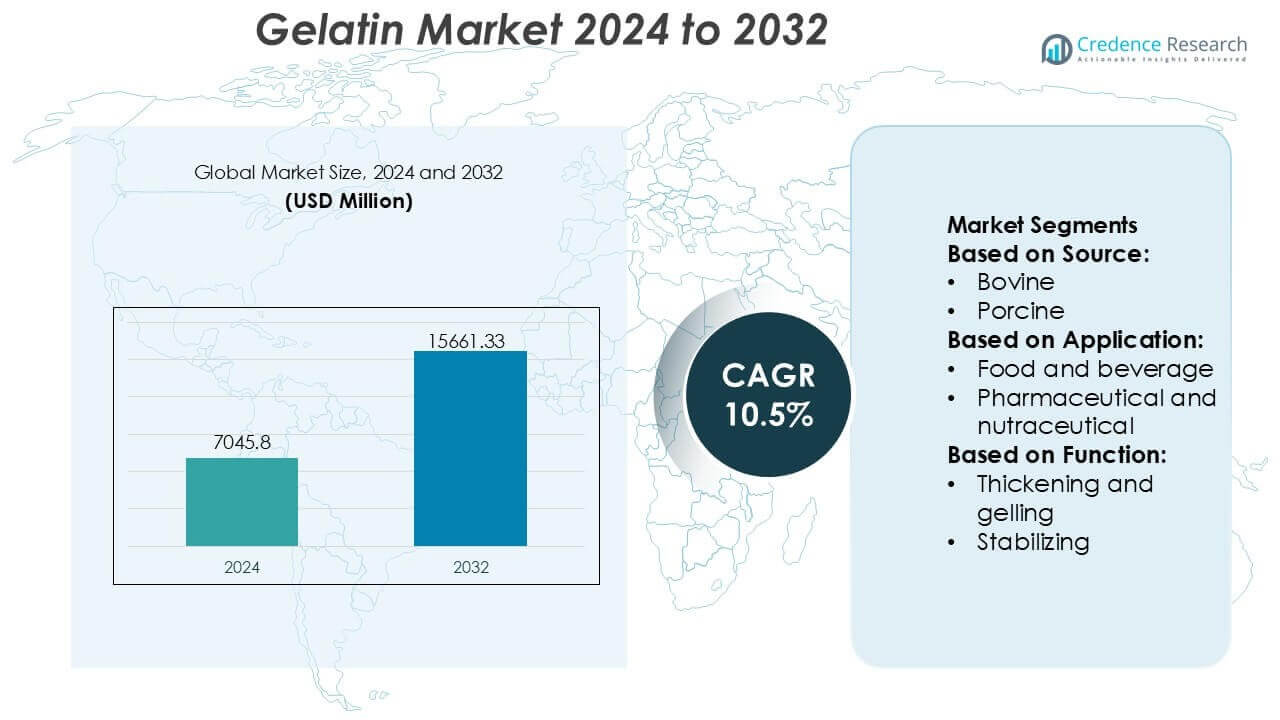
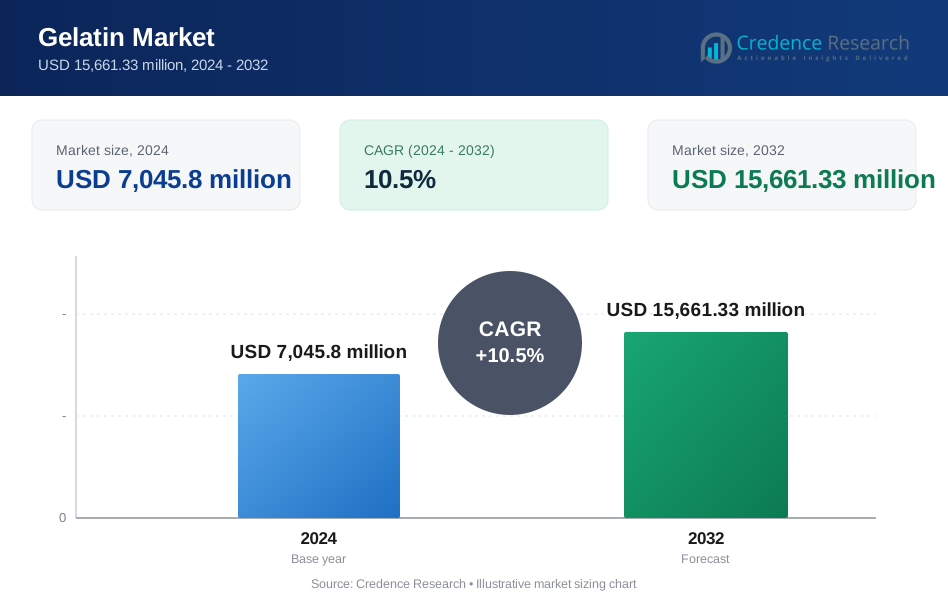
Gelatin Market size was valued USD 7045.8 million in 2024 and is anticipated to reach USD 15661.33 million by 2032, at a CAGR of 10.5% during the forecast period.
| REPORT ATTRIBUTE | DETAILS |
|---|---|
| Historical Period | 2020-2023 |
| Base Year | 2024 |
| Forecast Period | 2025-2032 |
| Gelatin Market Size 2024 | USD 7045.8 million |
| Gelatin Market, CAGR | 10.5% |
| Gelatin Market Size 2032 | USD 15661.33 million |
Gelatin Market Insights
- Market growth is primarily driven by rising demand for pharmaceutical capsules, clinical nutrition, and functional foods, with pharmaceutical and nutraceutical applications representing the dominant segment due to strict quality requirements and consistent consumption patterns.
- Key market trends include increasing focus on high-purity and application-specific gelatin grades, growing preference for clean-label ingredients, and ongoing investments in purification, traceability, and specialty formulations.
- Competitive dynamics are shaped by globally established manufacturers leveraging integrated production, regulatory compliance, and long-term supply agreements, while regional producers compete through cost efficiency and customized offerings.
- From a regional perspective, North America leads the market with an exact 38% share, supported by a strong pharmaceutical base, high processed food consumption, and stringent quality standards, followed by steady expansion in Asia-Pacific driven by manufacturing growth.
Gelatin Market Segmentation Analysis:
By Source
Within the gelatin market by source, bovine gelatin emerges as the dominant sub-segment, accounting for an estimated 42% market share, driven by its wide availability, consistent quality, and strong functional performance across food and pharmaceutical uses. Bovine gelatin benefits from well-established rendering infrastructure and broad regulatory acceptance in major markets. Porcine gelatin follows closely, supported by superior gel strength and elasticity favored in confectionery and capsule production. Marine and poultry gelatin are gaining traction, particularly in halal, kosher, and allergen-sensitive applications, but higher processing costs and limited raw material supply currently constrain their broader adoption.
- For instance, PAN Biotech GmbH supplies bovine-derived gelatin grades with Bloom strength values ranging from 80 to 300 and controlled endotoxin levels below 10 EU/g, supporting reproducible performance in cell culture, pharmaceutical excipients, and specialty food formulations without variability across production batches.
By Application
By application, food and beverage represents the leading segment with approximately 48% market share, supported by extensive use in confectionery, dairy desserts, gummies, and meat products. Gelatin’s clean-label appeal, protein content, and texturizing versatility underpin its strong demand in this segment. Pharmaceutical and nutraceutical applications form the second-largest segment, driven by hard and soft capsule manufacturing and rising nutraceutical consumption. Personal care and cosmetics continue to expand steadily, leveraging gelatin’s film-forming and moisture-retention properties, while other applications such as photography and industrial uses maintain niche but stable demand.
- For instance, Junca Gelatines SL produces food-grade and pharmaceutical gelatin with Bloom strengths reaching 320 g and viscosity values exceeding 6.0 mPa·s at 6.67% concentration, enabling precise texture control in gummies and reliable shell integrity in capsule manufacturing across high-throughput production lines.
By Function
In terms of function, thickening and gelling dominates the market with an estimated 50% share, as gelatin’s thermo-reversible gel formation and superior mouthfeel are critical in food, nutraceutical gummies, and desserts. This dominance is reinforced by its ability to deliver clarity, elasticity, and controlled melt profiles. Stabilizing functions follow, particularly in dairy and emulsified products, where gelatin improves texture stability and shelf life. Emulsifying and binding applications hold smaller shares but remain essential in meat processing, pharmaceuticals, and personal care formulations that require structural integrity and ingredient cohesion.
Key Growth Drivers
Rising Demand from Food and Confectionery Applications
The gelatin market continues to benefit from strong demand in food and confectionery products, where gelatin serves as a critical texturizing and gelling agent. Expanding consumption of gummies, marshmallows, desserts, and functional foods supports volume growth, particularly as manufacturers focus on texture enhancement and sensory appeal. Gelatin’s natural origin, protein content, and clean-label compatibility further strengthen its adoption. Growth in packaged and convenience foods, along with premium confectionery offerings, reinforces gelatin’s role as a preferred ingredient across both mass-market and specialty food formulations.
- For instance, Rousselot has developed proprietary gelatin grades delivering Bloom strengths up to 300 g and melting temperatures above 35 °C, while its confectionery solutions demonstrate gel setting times below 15 minutes, enabling faster molding cycles and consistent texture control in large-scale candy manufacturing lines.
Expansion of Pharmaceutical and Nutraceutical Uses
Pharmaceutical and nutraceutical applications represent a major growth driver, supported by increasing demand for hard and soft capsules, chewable supplements, and gummy vitamins. Gelatin’s excellent film-forming properties, rapid dissolution, and compatibility with active ingredients make it indispensable in dosage forms. Rising global healthcare expenditure, aging populations, and increased preventive healthcare adoption drive higher supplement consumption. Additionally, the shift toward nutraceutical delivery formats such as gummies enhances gelatin usage, as manufacturers prioritize bioavailability, patient compliance, and efficient encapsulation performance.
- For instance, Shanghai Al-Amin Biosource Co., Ltd. manufactures pharmaceutical-grade gelatin with Bloom strengths up to 280 g, ash content below 2.0 g per 100 g, and viscosity values exceeding 7.0 mPa·s at standard concentration, enabling consistent capsule wall thickness, dissolution times under 10 minutes, and reliable performance on high-speed capsule-filling lines.
Growth in Personal Care and Cosmetic Applications
The expanding personal care and cosmetics industry contributes steadily to gelatin demand due to its film-forming, moisturizing, and conditioning properties. Gelatin is widely used in hair care, skin care, and nail-strengthening formulations, particularly in protein-based and functional beauty products. Increasing consumer focus on beauty-from-within concepts and protein-enriched cosmetics supports ingredient innovation. Moreover, rising awareness of natural and biodegradable ingredients aligns with gelatin’s animal-derived profile, encouraging its inclusion in premium personal care formulations across emerging and developed markets.
Key Trends & Opportunities
Shift Toward Clean-Label and Natural Ingredients
A prominent trend in the gelatin market is the growing preference for clean-label, minimally processed ingredients. Food and nutraceutical manufacturers increasingly favor gelatin due to its recognizable origin and functional versatility without synthetic additives. This trend creates opportunities for suppliers to emphasize traceability, purity, and sustainability credentials. Reformulation initiatives in confectionery, dairy, and wellness products further expand gelatin usage, as brands seek to replace synthetic hydrocolloids with naturally derived alternatives that meet evolving consumer expectations.
- For instance, Weishardt Holding SA produces traceable bovine gelatin and collagen peptide solutions with Bloom strengths up to 300 g, average peptide molecular weights around 2000 Da for rapid solubility, endotoxin levels below 10 EU per g, and ISO 22000 and FSSC 22000 certified production lines, supporting clean-label formulations with consistent functional performance.
Rising Demand for Alternative and Specialty Gelatin Sources
Demand for marine, poultry, and specialty gelatin sources is increasing, driven by religious, dietary, and allergen-related considerations. Halal- and kosher-certified gelatin presents significant growth opportunities, particularly in Middle Eastern and Southeast Asian markets. Marine gelatin also attracts interest due to its non-mammalian origin and suitability for pescatarian consumers. These trends encourage innovation in extraction technologies and product differentiation, allowing manufacturers to address niche but fast-growing customer segments seeking ethical and compliant ingredient solutions.
- For instance, GELITA AG has developed specialty gelatin and collagen peptide portfolios including fish-derived gelatin with Bloom strengths exceeding 200 g, controlled odor values below defined sensory thresholds, and peptide molecular weight distributions centered around 3000 Da, enabling stable gel formation, rapid solubility, and certified halal and kosher applications across specialty food and nutrition products.
Innovation in Functional and High-Performance Gelatin Grades
Manufacturers are increasingly developing customized gelatin grades with specific bloom strength, viscosity, and solubility profiles to meet application-specific needs. This trend supports opportunities in advanced nutraceuticals, medical nutrition, and premium confectionery. Functional optimization enables better processing efficiency and improved end-product performance, strengthening long-term supplier partnerships. As end-users demand greater consistency and tailored functionality, value-added gelatin products are expected to gain prominence over commoditized offerings.
Key Challenges
Volatility in Raw Material Availability and Pricing
One of the primary challenges facing the gelatin market is dependence on animal-derived raw materials, which are subject to supply fluctuations. Variability in livestock availability, disease outbreaks, and changes in meat consumption patterns can disrupt collagen sourcing. Such volatility affects production planning and cost stability for gelatin manufacturers. Compliance with animal welfare standards and traceability requirements further adds complexity, compelling producers to manage sourcing risks while maintaining consistent quality and supply reliability.
Competition from Plant-Based and Synthetic Alternatives
Gelatin faces increasing competition from plant-based and synthetic hydrocolloids such as pectin, agar, carrageenan, and modified starches. These alternatives appeal to vegan and vegetarian consumers and are often perceived as more sustainable. Regulatory pressure and shifting dietary preferences intensify this challenge, particularly in food and pharmaceutical applications. To remain competitive, gelatin producers must focus on functional superiority, application-specific performance, and transparent sourcing to justify continued use in formulations where substitutes are readily available.
Regional Analysis
North America
North America represents a significant share of the gelatin market, accounting for approximately 28% of global demand, supported by strong consumption across food, pharmaceutical, and nutraceutical applications. The region benefits from advanced processing infrastructure, high-quality standards, and strong regulatory oversight that supports pharmaceutical-grade gelatin production. Widespread use of gelatin in capsules, gummy supplements, and functional foods drives steady demand. Additionally, rising consumer preference for protein-rich and clean-label products reinforces adoption. The presence of established manufacturers and consistent demand from the U.S. healthcare and food processing industries sustains North America’s stable market position.
Europe
Europe holds around 30% market share, making it the leading regional market for gelatin. Strong demand is driven by the pharmaceutical and nutraceutical sectors, particularly for hard and soft capsules, as well as by traditional confectionery and dairy applications. The region benefits from well-developed livestock processing industries and high technical expertise in gelatin extraction and refinement. Stringent quality, traceability, and safety standards enhance global competitiveness of European suppliers. In addition, rising demand for halal- and kosher-certified gelatin supports growth in specialty segments across Western and Central Europe.
Asia-Pacific
Asia-Pacific accounts for an estimated 25% of the gelatin market, supported by rapid expansion of food processing, nutraceutical consumption, and pharmaceutical manufacturing. Growing populations, increasing healthcare awareness, and rising disposable incomes drive demand for gelatin-based supplements and confectionery products. Countries such as China, India, and Japan are key contributors due to strong capsule manufacturing and expanding functional food industries. The region also shows rising interest in marine and alternative gelatin sources, aligned with dietary preferences and religious considerations, supporting diversification and long-term market expansion.
Latin America
Latin America holds approximately 10% share of the global gelatin market, supported by abundant availability of bovine raw materials and expanding food and pharmaceutical industries. Brazil and Argentina are key production hubs, benefiting from strong livestock sectors and growing export-oriented gelatin manufacturing. Demand is driven by confectionery, desserts, and increasing pharmaceutical capsule production. Improving healthcare access and rising supplement consumption further support market growth. While the region remains cost-competitive, ongoing investments in processing efficiency and quality upgrades are strengthening its position in international gelatin supply chains.
Middle East & Africa
The Middle East & Africa region accounts for about 7% of the gelatin market, with demand driven primarily by food, pharmaceutical, and halal-certified applications. Rising population growth, expanding healthcare infrastructure, and increasing consumption of packaged foods support gradual market expansion. Halal compliance is a critical driver, encouraging demand for bovine and poultry gelatin sources. While local production remains limited, imports play a key role in meeting regional demand. Ongoing investments in pharmaceutical manufacturing and food processing are expected to improve regional market penetration over time.
Gelatin Market Segmentations:
By Source:
- Bovine
- Porcine
By Application:
- Food and beverage
- Pharmaceutical and nutraceutical
By Function:
- Thickening and gelling
- Stabilizing
By Geography
- North America
- U.S.
- Canada
- Mexico
- Europe
- Germany
- France
- U.K.
- Italy
- Spain
- Rest of Europe
- Asia Pacific
- China
- Japan
- India
- South Korea
- South-east Asia
- Rest of Asia Pacific
- Latin America
- Brazil
- Argentina
- Rest of Latin America
- Middle East & Africa
- GCC Countries
- South Africa
- Rest of the Middle East and Africa
Competitive Landscape
The gelatin market players such as PAN Biotech GmbH, Junca Gelatines SL, Rousselot, Shanghai Al-Amin Biosource Co., Ltd., Weishardt Holding SA, GELITA AG, Tessenderlo Group, STERLING GELATIN, Nitta Gelatin, Inc., PB Leiner. The gelatin market exhibits a moderately consolidated competitive landscape characterized by strong emphasis on vertical integration, product quality, and application-specific differentiation. Leading participants compete by maintaining control over raw material sourcing, processing efficiency, and strict compliance with global food, pharmaceutical, and nutraceutical regulations. Continuous investments in purification technologies, enzymatic processing, and traceability systems enable suppliers to deliver consistent bloom strength, viscosity, and functional performance across diverse end uses. Competition also intensifies around specialty and high-value gelatin grades used in hard capsules, medical nutrition, and functional foods, where technical expertise and regulatory approvals act as key entry barriers. Regional producers strengthen their positions by offering customized specifications, faster lead times, and cost advantages to local customers. Sustainability initiatives, including responsible sourcing and waste valorization, increasingly influence competitive positioning. Overall, market rivalry is driven less by price alone and more by reliability, innovation capability, and long-term partnerships with end-use industries.
Key Player Analysis
- PAN Biotech GmbH
- Junca Gelatines SL
- Rousselot
- Shanghai Al-Amin Biosource Co., Ltd.
- Weishardt Holding SA
- GELITA AG
- Tessenderlo Group
- STERLING GELATIN
- Nitta Gelatin, Inc.
- PB Leiner
Recent Developments
- In May 2025, ACG introduced the personalized capsule machine (PCM), a patented technology for on-demand capsule formulation. In partnership with Art of You, ACG expanded portfolio in personalized nutrition solutions.
- In August 2024, Zydus Lifesciences Ltd announced that its Zydus Animal Health and Investments Ltd are both fully owned subsidiaries and acquired a 50% equity stake in Sterling Biotech Ltd from Perfect Day Inc.
- In May 2024, GELITA's OptiBar, launched is a collagen peptide ingredient for high-protein (up to 60%), sugar-free bars, providing soft texture and binding for 'clean label' health claims like 'high protein' and 'no sugar' by replacing traditional binders, meeting consumer demand for healthier, indulgent snacks with better taste and texture.
Report Coverage
The research report offers an in-depth analysis based on Source, Application, Function and Geography. It details leading market players, providing an overview of their business, product offerings, investments, revenue streams, and key applications. Additionally, the report includes insights into the competitive environment, SWOT analysis, current market trends, as well as the primary drivers and constraints. Furthermore, it discusses various factors that have driven market expansion in recent years. The report also explores market dynamics, regulatory scenarios, and technological advancements that are shaping the industry. It assesses the impact of external factors and global economic changes on market growth. Lastly, it provides strategic recommendations for new entrants and established companies to navigate the complexities of the market.
Future Outlook
- The gelatin market will increasingly focus on high-purity and specialty grades to meet rising demand from pharmaceuticals, nutraceuticals, and medical applications.
- Manufacturers will continue investing in advanced extraction and purification technologies to improve functional consistency and regulatory compliance.
- Demand for clean-label and naturally sourced ingredients will strengthen gelatin adoption in food, beverages, and functional nutrition products.
- Sustainable sourcing practices and by-product valorization will become central to competitive differentiation across regions.
- Growth in hard and soft capsule production will support steady long-term consumption of pharmaceutical-grade gelatin.
- Producers will expand customized gelatin solutions tailored to specific bloom strength, viscosity, and application performance requirements.
- Asia-Pacific will gain strategic importance due to expanding food processing, healthcare manufacturing, and export-oriented production bases.
- Strategic partnerships with end-use industries will intensify to ensure supply security and long-term volume commitments.
- Ongoing regulatory scrutiny will drive investments in traceability, quality systems, and global certification standards.
- Innovation in functional and fortified gelatin products will open new opportunities in sports nutrition, clinical nutrition, and wellness formulations.
Request a Free Sample
Fill in your details and we'll send you a free sample report.
- Sample data tables & charts
- Research methodology
Need a Custom Version of This Report?
Tailor the scope, geography, or segments to your exact requirements.
- Custom geography or segment scope
- Direct access to our analyst team
Frequently Asked Questions
What is the current market size for the Gelatin Market, and what is its projected size in 2032?
At what Compound Annual Growth Rate is the Gelatin Market projected to grow between 2024 and 2032?
Which Gelatin Market segment held the largest share in 2024?
What are the primary factors fueling the growth of the Gelatin Market?
Who are the leading companies in the Gelatin Market?
Which region commanded the largest share of the Gelatin Market in 2024?
Table of Content
Chapter 1. Report Introduction
- 1.1 Report Description & Purpose
- 1.1.1 Report Title & Market Definition
- 1.1.2 Unique Selling Propositions (USP) & Key Differentiators
- 1.1.3 Value Proposition for Stakeholders
- 1.2 Research Objectives
- 1.2.1 Market Sizing Objectives (Volume & Revenue)
- 1.2.2 Segmentation Objectives
- 1.2.3 Competitive Intelligence Objectives
- 1.2.4 Forecast & Scenario Objectives
- 1.3 Report Scope
- 1.3.1 Gelatin Scope – Types & Subtypes Covered
- 1.3.2 Geographic Scope – Regions & Countries Covered
- 1.3.3 Historical Period, Base Year & Forecast Period (2024; forecast to 2032)
- 1.3.4 Inclusions & Exclusions
- 1.4 HS Code & Classification Framework
- 1.5 Currency, Units & Pricing Basis
- 1.6 Target Stakeholders
- 1.7 Limitations & Assumptions
Chapter 2. Executive Summary
- 2.1 Global Gelatin Market Snapshot
- 2.1.1 Market Size – Historical (2024) & Forecast (2024-2032) (2024: USD 7,045.8 million → 2032: USD 15,661.33 million)
- 2.1.2 Volume & Revenue – Global Totals
- 2.1.3 Key Market Highlights – Top Five Facts
- 2.2 Gelatin Market Segmentation Snapshot
- 2.2.1 Market Split by Region – 2024 vs. 2032
- 2.3 Competitive Snapshot
- 2.3.1 Top 10 Players by Revenue Share – 2024
- 2.3.2 Top 10 Players by Volume Share – 2024
- 2.3.3 Recent Strategic Developments (18-Month Summary)
- 2.4 Key Investment Highlights & Strategic Conclusions
Chapter 3. Gelatin Market Dynamics & Industry Analysis
- 3.1 Market Overview & Context
- 3.1.1 Gelatin Market Position in the Broader Automotive Value Chain
- 3.1.2 OEM vs. Replacement Market Dynamics
- 3.1.3 Market Maturity & Development Stage by Region
- 3.2 Gelatin Market Drivers
- 3.3 Gelatin Market Restraints & Challenges
- 3.4 Gelatin Market Opportunities
- 3.5 Porter's Five Forces Analysis
- 3.5.1 Threat of New Entrants
- 3.5.2 Bargaining Power of Suppliers
- 3.5.3 Bargaining Power of Buyers
- 3.5.4 Threat of Substitutes
- 3.5.5 Competitive Rivalry – Intensity Assessment
- 3.6 Gelatin Value Chain Analysis
- 3.6.1 Upstream – Raw Material/Input Suppliers
- 3.6.1.1 Raw Material/Input 1
- 3.6.1.2 Raw Material/Input 2
- 3.6.1.3 Raw Material/Input 3
- 3.6.2 Midstream – Production/Manufacturing/Service Delivery
- 3.6.2.1 Production/Process Overview
- 3.6.2.2 Key Facility Locations & Capacity by Manufacturer
- 3.6.3 Downstream – Distribution & End Consumer
- 3.6.3.1 Primary Channel – B2B/OEM
- 3.6.3.2 Secondary Channels – Dealer, Retail, Online, Direct
- 3.6.4 Value Chain Profitability Analysis
- 3.6.1 Upstream – Raw Material/Input Suppliers
- 3.7 PESTEL Analysis
- 3.7.1 Political Factors
- 3.7.2 Economic Factors
- 3.7.3 Social Factors
- 3.7.4 Technological Factors
- 3.7.5 Environmental Factors
- 3.7.6 Legal Factors
- 3.8 Gelatin Supply Chain Analysis
- 3.8.1 Raw Material/Input Supply Risk Assessment
- 3.8.2 Manufacturing Concentration Risk (Geographic Exposure)
- 3.8.3 Trade Disruption Impact Analysis
- 3.9 Regulatory & Policy Landscape
Note: The regulatory and policy landscape section covers regulations based on their applicability to the market, Gelatin category, geography, and scope of the study. Only regulatory frameworks with a material impact on operations, compliance, trade, sustainability, or market access are analyzed in detail.
Chapter 4. Key Investment Pockets & Opportunity Analysis
- 4.1 Gelatin Market Attractiveness Analysis
- 4.1.1 By Region – Investment Attractiveness Matrix (Volume × CAGR)
- 4.2 Absolute Revenue Growth Opportunity
- 4.2.1 By Region – Absolute USD Growth Through 2032
- 4.3 Incremental Volume Opportunity
- 4.3.1 By Region – Incremental Volume Through 2032
- 4.3.2 Segment – Incremental Volume
- 4.4 Emerging Submarket Opportunity Deep Dive (Subject to Applicability)
- 4.5 Emerging Market Opportunity Scorecards
- 4.5.1 United States
- 4.5.2 Europe
- 4.5.3 Asia
- 4.5.4 Middle East & Africa
Note: Emerging Market Opportunity Scorecards will be included based on relevance and strategic importance. Regions listed are indicative and may vary depending on data availability and market dynamics.
Chapter 5. Gelatin Import-Export Analysis & Trade Flows
- 5.1 Global Trade Overview
- 5.1.1 Global Export Value by Country (2024)
- 5.1.2 Global Export Volume by Country (2024)
- 5.1.3 Global Import Value by Country (2024)
- 5.1.4 Global Import Volume by Country (2024)
- 5.1.5 Net Trade Balance by Country (2024)
- 5.2 Export Analysis – Segment
- 5.2.1 Type 1 (HS Code)
- 5.2.2 Type 2 (HS Code)
- 5.2.3 Type 3 (HS Code)
- 5.2.4 Type 4 (HS Code)
- 5.2.5 Type 5 (HS Code)
- 5.3 Import Analysis – Segment
- 5.3.1 Type 1 (HS Code)
- 5.3.2 Type 2 (HS Code)
- 5.3.3 Type 3 (HS Code)
- 5.3.4 Type 4 (HS Code)
- 5.3.5 Type 5 (HS Code)
- 5.4 Average Unit Trade Prices
- 5.4.1 Average Export Price – Segment & Country
- 5.4.2 Average Import Price – Segment & Source Country
- 5.4.3 Price Trends (2024)
- 5.5 Key Trade Route Analysis
- 5.5.1 Trade Route 1
- 5.5.2 Trade Route 2
- 5.5.3 Trade Route 3
- 5.5.4 Trade Route 4
- 5.5.5 Trade Route 5
- 5.6 Trade Policy Impact Assessment
- 5.6.1 US Anti-Dumping & Section 301 Tariffs
- 5.6.2 EU Customs Union Impact
- 5.6.3 Major Free Trade Agreements
- 5.6.4 USMCA Rules of Origin
Note: Trade policy analysis will be included only where relevant to the Gelatin market.
Chapter 6. Competitive Landscape & Company Benchmarking
- 6.1 Gelatin Market Concentration & Structure
- 6.1.1 Herfindahl-Hirschman Index (HHI) – vs. 2024
- 6.1.2 Tier 1, Tier 2 & Tier 3 Market Structure
- 6.1.3 Global, Regional & Local Player Dynamics
- 6.2 Gelatin Market Share Analysis – 2024
- 6.2.1 Global Revenue Share by Company
- 6.2.2 Global Volume Share by Company
- 6.2.3 Regional Revenue Share
- 6.2.4 Market Share Evolution ( vs. 2024)
- 6.2.5 OEM Segment Share by Company
- 6.2.6 Replacement Segment Share by Company
- 6.3 Production/Delivery Capacity & Facility Analysis
- 6.3.1 Global Installed Capacity
- 6.3.2 Capacity Utilization Rates
- 6.3.3 Production/Output Volume
- 6.3.4 Facility Locations & Capacity Map
- 6.3.5 Planned Capacity Additions
- 6.4 Gelatin Competitive Benchmarking Matrix
- 6.4.1 Revenue, Volume, CAGR & Profitability Comparison
- 6.4.2 Channel Revenue Mix
- 6.4.3 Geographic Revenue Exposure
- 6.4.4 R&D Intensity
- 6.4.5 Sustainability Maturity
- 6.5 Strategic Developments in Gelatin (Last 24 Months)
- 6.5.1 Mergers, Acquisitions & Divestments
- 6.5.2 New Gelatin Launches
- 6.5.3 Facility Expansions
- 6.5.4 Strategic Alliances, Joint Ventures & Partnerships
- 6.5.5 Distribution Expansion & Market Entry
- 6.5.6 Sustainability & ESG Initiatives
- 6.6 Competitive Strategy Mapping
- 6.6.1 Leader, Challenger, Follower & Niche Classification
- 6.6.2 Pricing Strategy Comparison
- 6.6.3 Channel Strategy Matrix
Note: Strategic developments are included based on their materiality and the availability of reliable information.
Chapter 7. Global Gelatin Market – By Distribution Channel
- 7.1 Segment Overview
- 7.1.1 Volume & Revenue Split by Channel (2024 & 2032)
- 7.1.2 Channel Mix Evolution (2024-2032)
Chapter 8. Regional Market Analysis – Global Overview
- 8.1 Global Regional Overview
- 8.1.1 Regional Volume Share
- 8.1.2 Regional Revenue Share
- 8.1.3 Regional Volume by Region
- 8.1.4 Regional Revenue by Region
- 8.1.5 Regional Forecast Through 2032
- 8.2 Cross-Regional Segment Analysis
- 8.2.1 By Distribution Channel
- 8.2.2 By Brand/Price Tier
Chapter 9. North America Gelatin Market
- 9.1 United States
- 9.2 Canada
- 9.3 Mexico
Chapter 10. Europe Gelatin Market
- 10.1 Germany
- 10.2 France
- 10.3 Italy
- 10.4 United Kingdom
- 10.5 Spain
- 10.6 Poland
- 10.7 Russia
- 10.8 Netherlands
- 10.9 Belgium
- 10.10 Sweden
- 10.11 Denmark
- 10.12 Norway
- 10.13 Rest of Europe
Chapter 11. Asia Pacific Gelatin Market
- 11.1 China
- 11.2 India
- 11.3 Japan
- 11.4 South Korea
- 11.5 Thailand
- 11.6 Indonesia
- 11.7 Vietnam
- 11.8 Malaysia
- 11.9 Australia
- 11.10 Rest of Asia Pacific
Chapter 12. Latin America Gelatin Market
- 12.1 Brazil
- 12.2 Argentina
- 12.3 Colombia
- 12.4 Chile
- 12.5 Rest of Latin America
Chapter 13. Middle East Gelatin Market
- 13.1 Saudi Arabia
- 13.2 United Arab Emirates
- 13.3 Turkey
- 13.4 Israel
- 13.5 Iran
- 13.6 Rest of the Middle East
Chapter 14. Africa Gelatin Market
- 14.1 South Africa
- 14.2 Egypt
- 14.3 Nigeria
- 14.4 Morocco
- 14.5 Rest of Africa
Chapter 15. Gelatin Company Profiles
- 15.1 [Company 01]
- 15.1.1 Company Overview
- 15.1.2 Key Management Personnel
- 15.1.3 Products & Services Portfolio
- 15.1.4 Financial Performance
- 15.1.5 Key Market Focus & Geographic Presence
- 15.1.6 Recent Developments & Strategic Initiatives
Note: The company profile list is preliminary and may change based on research findings, market developments, data availability, and client requirements.
Chapter 16. Appendices
- Appendix A – List of Abbreviations & Acronyms
- Appendix B – Industry Classification Code Reference – Full Series
- Appendix C – Production & Capacity Data Tables
- Appendix D – End-Use & Demand Base Tables
- Appendix E – Consumption & Replacement Rate Assumptions
- Appendix F – ASP Reference Tables
- Appendix G – Manufacturing & Facility Database
- Appendix H – Import-Export Data Tables
- Appendix I – Regulatory Summary Tables
- Appendix J – Primary Research Participant List (Anonymized)
- Appendix K – Primary Research Questionnaire Framework
- Appendix L – Data Sources & Bibliography
- Appendix M – Market Size Divergence & Source Comparison
Chapter 17. Research Methodology
- 17.1 Research Framework & Philosophy
- 17.2 Secondary Research – Sources, Hierarchy & Data Extraction
- 17.3 Data Modeling – Bottom-Up & Top-Down Market Sizing
- 17.4 Primary Research – Stakeholder Framework, LOI & Sample Sizes
- 17.5 Forecast Methodology – Regression, Scenario & Sensitivity Analysis
- 17.6 Quality Control – Four-Layer Validation Framework
- 17.7 Limitations & Standard Assumptions
- 17.8 Disclaimer
