
| REPORT ATTRIBUTE | DETAILS |
|---|---|
| Historical Period | 2019-2022 |
| Base Year | 2023 |
| Forecast Period | 2024-2032 |
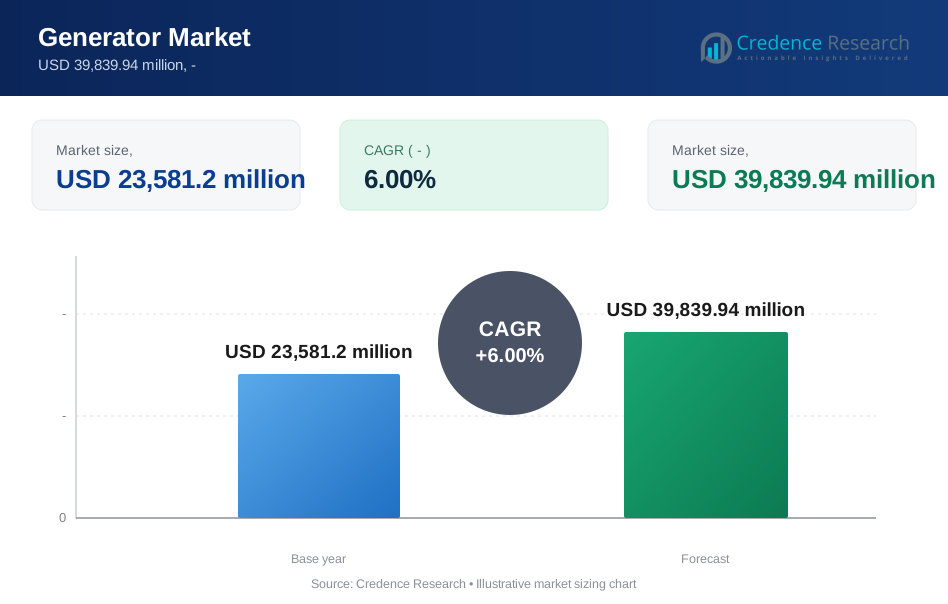
| Generator Market Size 2023 | USD 23581.2 Million |
| Generator Market, CAGR | 6.0% |
| Generator Market Size 2032 | USD 39839.94 Million |
Market Insights
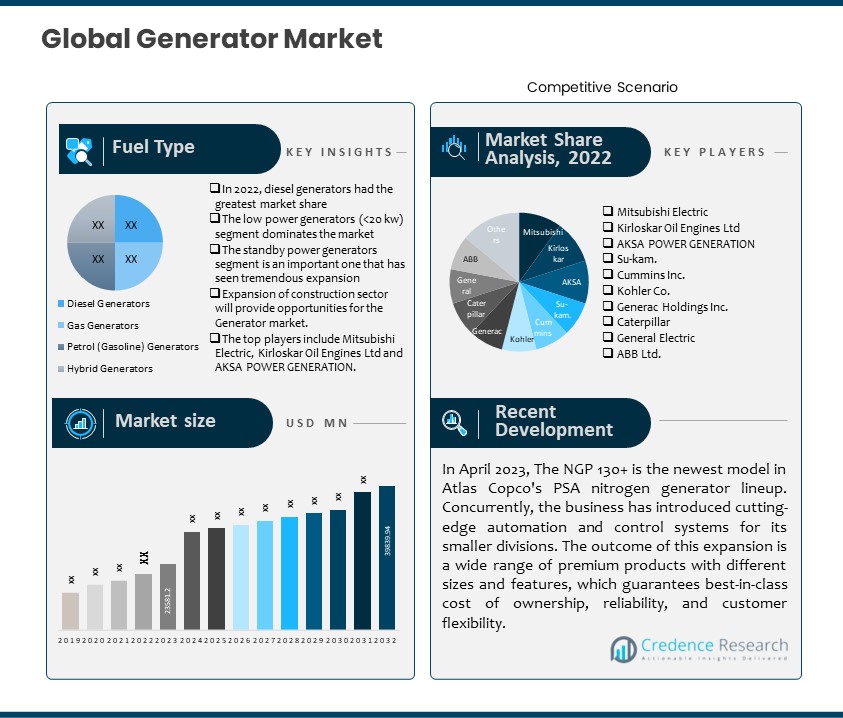
- The global generator market is expected to grow at a compound annual growth rate (CAGR) of 6.00% between 2024 and 2032, from its estimated USD 23581.2 million in 2023 to USD 39839.94 million in 2032.
- The largest category is diesel generators. Gas generators, on the other hand, are expected to grow at a strong CAGR.
- The low-power generators (<20 kW) category will expand at a rapid rate of growth.
- The CAGR for standby power generators is expected to be the highest during the projection period.
- The residential generators will have the highest CAGR throughout the prediction period.
- Asia Pacific dominated the generator market.
- Regarding the market share of generators, Europe is expected to come second.
- In the generator market, North America is anticipated to grow fastest.
- Rising power demand, an increase in the frequency of power outages, and the rise of the industrial sector are the drivers propelling the expansion of the global market.
- Expanding healthcare infrastructure, growing telecom networks, and integrating generators into microgrids for renewable energy might all affect the generator industry.
Executive Summary
Market Definition
The production, marketing, and sales of devices intended to produce electricity are all included in the generator market. Generators are machines that use electromagnetic induction to transform mechanical energy into electrical energy. In scenarios where grid electricity is inconsistent or unavailable, as well as in off-grid regions where connecting to a centralized power grid is impracticable or prohibitively expensive, they are frequently utilized as backup power sources. There are many different kinds, sizes, and fuel sources of generators available on the market to meet the needs of different end customers and applications.
Market Overview
The generator sector is estimated to develop at a 6.00% compound annual growth rate (CAGR) between 2024 and 2032, maintaining its current upward trend. The market will continue to develop, rising from its estimated USD 23581.2 million in 2023 to USD 39839.94 million in 2032.
The need for power increases as economies and populations expand. This demand is generated by a number of industries, including commercial, industrial, and residential. Increased use of electric vehicles, urbanization, and technological developments all add to the growing demand for electricity. To close the gap between supply and demand, additional power sources may be required in situations where the current power infrastructure is unable to keep up with the spike in demand. In order to meet this growing demand, generators are essential because they can supply additional or backup power when grid electricity is either unavailable or insufficient.
The industrial sector uses a lot of electricity because it needs a lot of power to run its machinery, equipment, and production processes. Reliable power sources are in more demand as economies and industrial activity grow. Industrial facilities frequently depend on a steady and unbroken power source to keep running smoothly, uphold safety regulations, and avoid expensive production downtime. For these sectors, generators are indispensable assets that can be used as primary or backup power sources to sustain vital operations and sustain productivity levels, particularly in areas where grid reliability may be a concern.
Segmentation by Fuel Type
- Diesel generators are the market leader in terms of fuel type. Diesel generators are renowned for being sturdy and dependable. They are appropriate for prime, standby, and continuous power applications because they can run continuously for extended periods. For vital operations where an uninterrupted power supply is necessary, such as hospitals, data centers, telecommunications, and manufacturing facilities, this dependability is critical.
- The gas generators category will exhibit a sizable CAGR during the projected period. Cleaner burning fuels like natural gas, propane, and biogas produce fewer emissions of harmful pollutants like carbon monoxide, nitrogen oxides, and particulate matter than diesel or gasoline. As a result, gas generators are better for the environment.
- Other fuel types, including petrol (gasoline) generators, and hybrid generators, also support the need for generator.
Segmentation by Power Rating
- Low-power generators (<20 kW) are considered the best power ratings. Low-power generators are frequently utilized in residential settings for backup power during blackouts. These generators can ensure comfort and safety during emergencies by maintaining the operation of vital appliances like lights, heating systems, and refrigerators.
- The medium power generators (20 kW - 500 kW) category will likely register a significant CAGR during forecasting. Medium power generators can be used for a wide range of purposes because of their versatility. Small companies, building sites, medium-sized facilities, events, and emergency backup systems for vital infrastructure can all be powered by them.
- Other power ratings, such as high-power generators (>500 kW), also contribute to the demand for generators.
Segmentation by Application
- The standby power generator category is projected to grow faster over the projection period. When the primary power source fails, standby generators sense it automatically and start up quickly to supply connected circuits or systems with electricity. This smooth transition guarantees the uninterrupted operation of critical appliances, machinery, or processes.
- Other applications influence the need for generators, including prime power generators, peak shaving generators, emergency power generators, and portable and mobile generators.
Segmentation by End-Use Sector
- The residential generator category will likely have the highest CAGR during the projection period. An automatic transfer switch (ATS) on a residential generator monitors utility power coming in. Upon detecting a power outage, the ATS automatically signals the generator to start up.
- Other end-use sectors, such as commercial, industrial, telecommunications, utilities, and power generation, also contribute to the demand for generators.
Segmentation by Region
- Asia Pacific leads the generator industry. Asia Pacific's population is expanding at a rapid rate, which is driving up demand for electricity, expanding industries, and developing infrastructure. This is affecting the generator market in this region.
- Europe is estimated to rank second in generator market size.
- The generator industry is predicted to flourish rapidly in North America.
- Regions such as Africa, the Middle East, and Latin America cover the remaining requirement for generators.
The market for generators has a lot of potential due to the growth of smart cities. For smart cities to remain operational, a steady supply of electricity is essential. With so many sensors, IoT infrastructure, and connected devices, any power outage has the potential to interfere with vital services. In times of emergencies or blackouts, generators serve as a backup power source, guaranteeing uninterrupted power. Though intermittent, renewable energy sources like wind and solar are what smart cities strive to integrate into their grids. When the production of renewable energy is low or when using renewable sources is impractical, generators offer a dependable backup that guarantees a steady supply of electricity. To maximize energy efficiency and minimize expenses, smart cities implement sophisticated energy management systems. These systems can be made more flexible by adding generators, which makes demand response possible.
Based on projections, Aisa Pacific is anticipated to control the generator market. The growing need for dependable power sources in the face of frequent blackouts, natural disasters, and unstable electrical grids in many Asia Pacific regions is a major driver of this trend. Because of this, organizations, individuals, and governments all understand how crucial it is to have backup power options in place. Furthermore, the industry has undergone a revolution due to the adoption of smart technologies like Internet of Things (IoT)-enabled generators. These cutting-edge generators have sensors and networking capabilities that enable remote control, predictive maintenance, and monitoring. As a result, operators can effectively monitor their generators from any location, anticipate problems before they become serious, and plan maintenance tasks ahead of time to reduce downtime.
The generator market in North America is anticipated to expand fastest throughout the forecast. Because of power outages or lack of electrical service, the US government has been aggressively encouraging people to use generators. The US government has jumped to using generators in the field. For example, the U.S. Army is using liquid pistons to create a portable power generator for the dismounted soldier on the battlefield. The USD 8.3 million contract for the introduction of the XTS-210 rotary engine with a 10 KW compact generator set is being handled by Connecticut-based LiquidPiston, Inc. The army will conduct field testing of this engine later.
Key Highlights of the Report
The global generator market is segmented by fuel type, power rating, application, end-use sector, and region. As far as the fuel type is concerned, diesel generators are the market spearhead. Low-power generators (<20 kW) are the top category. The standby power generators category is anticipated to increase at the highest CAGR throughout the projection period. The residential generators category will experience the highest CAGR during the forecast period. The generator market is expanding mostly in Asia Pacific.
The market for generators and the infrastructure needed to charge electric vehicles (EVs) have an intriguing relationship that is frequently viewed as mutually beneficial. The demand for electricity is rising significantly as more people convert to driving electric vehicles. This demand includes charging cars at public charging stations, places of employment, and homes. The current electrical grid is under strain as a result of this rising demand. During emergencies or power outages, generators give the infrastructure for charging resilience. In these circumstances, generators can power charging stations, enabling continuous operation even in the event of a grid outage, and EVs can act as temporary power storage units.
Asia Pacific is expected to account for the largest generator market globally. Asia Pacific governments and businesses are making significant investments in the development of infrastructure, particularly power generation and distribution networks. The objectives of this investment are to upgrade outdated infrastructure, increase rural areas' access to electricity, and enhance grid stability. These infrastructure projects frequently include generators to provide backup power and guarantee system resilience against blackouts, natural disasters, and unstable grids. The North American region is also assumed to have the sharpest growth in the market. The need for dependable backup power solutions has increased throughout North America as a result of aging power infrastructure and an increase in the frequency and severity of extreme weather events. Businesses, utilities, and governments are investing in resilient power systems, such as generators, to improve grid reliability overall and lessen the effects of power outages.
Which Key Factors Are Driving The Global Generator Market?
The proliferation of mobile networks and data centers requires stable backup power solutions, and hospitals and other medical facilities rely on a continuous power supply for essential activities. Due to these factors, the market for generators is expanding.
What Are The Main Challenges Confronting The Global Generator Market?
The main issues confronting the generator industry include high initial investment, pollution emissions from generators while they are operating, and restricted fuel availability in remote locations.
What Market Opportunities Exist For Generator Globally?
The generator market is growing due to several factors, including the integration of renewable energy and the development of the construction industry.
Market Drivers
Multiple factors propel the generator industry across the globe. The primary factors propelling the global generator market are as follows:
Increasing Demand for Dependable Backup Energy Sources
One of the main factors propelling the market's expansion is the requirement for a dependable backup power source. Electrical power is necessary for the operation of many different sectors in today's technologically advanced and networked world, from industrial and institutional to residential and commercial. Any disruption in the power supply may result in lost revenue, safety issues, and other problems. Because of this reliance on steady electricity, there is a growing need for backup power options like generators. The need for gensets is further increased by the rising national construction spending on energy-efficient setups. For example, according to data released by the U.S. Census Bureau in July 2022, the country spent roughly USD 353.1 billion on public buildings. Businesses mainly depend on continuous power to sustain operations, particularly those that involve vital data storage, communication, and customer support. Businesses can maintain operations during power outages with the help of a dependable backup power source, like a generator, which reduces lost productivity and possible revenue dips. For vital services like hospitals, emergency response teams, and utilities to continue performing life-saving tasks, power must always be available. For these essential facilities to continue operating in an emergency, generators are essential.
Market Restraints
There are several obstacles that the global generator market must overcome to continue growing. Among them are the following:
Growing Use of Clean Energy Technologies in conjunction with Strict Emission Regulations
The need for conventional generators that burn fossil fuels may decline as the globe moves more and more toward greener and more sustainable energy sources like solar, wind, hydroelectric, and geothermal power. Because of their longer lifespan and reduced environmental impact, clean energy technologies are frequently preferred. The shift to greener options may restrain the growth of generator sales, particularly in regions where clean energy sources are becoming more widely available and reasonably priced. Stricter emission standards and laws are being implemented by governments and international organizations in an effort to lower pollution and fight climate change. These laws frequently target particulate matter, nitrogen oxides (NOx), and carbon dioxide (CO2), which are pollutants released by conventional generators. Adherence to these standards may necessitate costly enhancements or adjustments to current generators, or it may even result in the phase-out of older, more environmentally harmful models. In order to produce generators that adhere to these emission regulations, manufacturers may also need to conduct research and development, which would raise their costs. Generator manufacturers may need to modify their approaches as the energy landscape changes in order to target sectors of the economy or geographical areas where generators are still necessary because of issues with dependability or an absence of clean energy infrastructure.
Opportunities
There are plenty of potential prospects in the global generator industry. Among these are the following:
Increasing Use of Inverter Generators, Bi-Fuel Generators, and Hybrid Generators
Innovation in the generator industry is being driven by the development of multiple alternative fuel sources to supplant conventional fossil fuels. Batteries and internal combustion engines are combined to create hybrid generators that are available from Original Equipment Manufacturers (OEMs). By using the engine during times of high load and depending on the battery during periods of low load, these hybrid generators maximize power delivery. Hybrid generators are superior to conventional gensets in that they consume less fuel, produce less noise, and have shorter running times. They are anticipated to find use in urban construction sites, mobile gensets for remote locations, and the mining industry.
Competitive Landscape
Key Players
Several major competitors exist in the fiercely competitive global generator market. The following are a few of the leading market participants and their market shares:
- Mitsubishi Electric
- Kirloskar Oil Engines Ltd
- AKSA POWER GENERATION
- Su-kam.
- Cummins Inc.
- Kohler Co.
- Generac Holdings Inc.
- Caterpillar
- General Electric
- ABB Ltd.
- Others
These companies prioritize product innovation, distribution channel expansion, mergers, and acquisitions to remain competitive.
The largest suppliers in the global generator market continuously work to stay one step ahead of the competition by developing innovative concepts and products.
In June 2023, Himoinsa offers its clients a cutting-edge diagnostic system that makes it simple and intuitive for them to perform sophisticated diagnostic and maintenance tasks on HIMOINSA generator sets. The HIMOINSA Diagnostic is a tool that helps users identify error codes, locate particular parts and where they are located, and carry out tasks that involve adjusting parameters on different ECUs. These tasks include, but are not limited to, sensor calibration, configuration of operational parameters, and DPF replacement and regeneration.
In May 2023, Caterpillar met EU stage 5 regulations by introducing two new mobile generator sets within its XQP series of mobile diesel generator sets. These newly developed generator sets correspond to the XQP spectrum's highest and lowest capacities. As a result of this development, Caterpillar is now offering five sets of prime power, ranging from 20 to 550 kVA, all of which adhere to the current European emissions regulations.
In February 2023, Cummins Inc. introduced easily accessible natural gas standby generator sets with power outputs of 175KW and 200KW for customers in North America. These recently introduced generator sets are a crucial part of Cummins' continuous innovation and sustainability efforts, which are in line with their "Zero Destination" plan to produce emissions-free goods.
How are Companies Performing in the Generator Market?
The significant performance of companies in the generator market can be attributed to some noteworthy reasons. In order to introduce innovative products, generator companies such as AKSA Power Generation, Briggs & Stratton Corporation, Caterpillar Inc., and Cooper Corporation are making significant investments in research and development. Through these technological advancements, they want to differentiate themselves from competitors, grow their market share, and reach more people.
The leading energy company, Generac Power Systems, declared in February 2021 that it would be building manufacturing, distribution, and assembly operations in Trenton, South Carolina. This move underscores the growing need for residential backup generators and related energy technology. Apart from satisfying the increasing need, this establishment serves as a central center for distribution for customers in the nation's Southeast region.
Rolls-Royce, a significant player in the industry, is strengthening its alliances to offer high-power products. In order to meet the varying demands for power ratings both domestically and globally, companies are expanding their product lines. All market participants, large and small, are focusing on certain end-user industry segments with their well-established manufacturing lines. Furthermore, companies are forming partnership agreements more frequently to expand their market share and effectively navigate the competitive landscape. One example of Rolls-Royce's commitment to innovation is the generators it provided to Bristol, UK's Testbed 108. The generators will be used in the 2.5 MW Power Generation System 1 (PGS1) demonstrator program. The company provides the generators from its facilities in Norway. This program will showcase the company's cutting-edge power generation solutions.
Summary of Key Findings
- Generator demand is driven by the need for dependable power sources to support industrial growth.
- The market is segmented by fuel type, power rating, application, end-use sector, and region.
- In the market, diesel generators are the most widely used fuel type.
- Low-power generators (<20 kW) are the foremost power rating category.
- Standby power generators are expected to grow fastest in terms of CAGR during the forecast period.
- The residential generators category will likely see the highest CAGR during the anticipated time frame.
- Asia Pacific is leading market development; the market is highly competitive with key players including Mitsubishi Electric, Kirloskar Oil Engines Ltd, AKSA POWER GENERATION, Su-kam., Cummins Inc., Kohler Co., Generac Holdings Inc., Caterpillar, General Electric, ABB Ltd., and Others.
Future Outlook
- The generator industry is expected to increase significantly in Asia Pacific, and its outlook is positive worldwide.
- Generator sales are driven by the need for continuous power supply for critical operations in hospitals and medical facilities.
- UPS systems present an economic risk to generator sales because they provide instant backup power without requiring a startup period.
- To stay ahead of the competition, key enterprises must develop new products, expand their market reach, and keep their prices competitive.
How CXOs Can Benefit from the Credence Research Generator Market Report
CXOs may get a detailed picture of the market in the Credence Research Generator Market Report, which includes:
- Market size and growth forecast: The report provides detailed estimates of the global generator market size, segmented by fuel type, power rating, application, end-use sector, and region. It also includes forecasts for the market through 2032 based on key trends and drivers.
- Market segmentation: The research report breaks down the generator market into segments based on fuel type, power rating, application, end-use sector, and region. This segmentation provides CXOs with a granular understanding of the market and the opportunities in each segment.
- Competitive landscape: The research report offers a detailed analysis of the major companies in the generator industry, including information on their business plans, product lines, and earnings. CXOs can use this information to evaluate and identify their competitors.
- Key trends and drivers: The research report identifies and evaluates the main trends and factors influencing the generator market. CXOs can use this information to make well-informed choices regarding their plans and investments.
CXOs can use the insights from the Credence Research Generator Market Report to:
- Identify growth opportunities: This analysis may help CXOs identify new growth opportunities in the generator sector. For example, the report identifies the growing demand for generators from the utilities and power generation industries as a key opportunity.
- Make informed investment decisions: The report helps CXOs choose generators wisely. For example, the research study provides information on the critical factors to consider when selecting generator solutions and evaluating suppliers.
- Develop competitive strategies: CXOs can use the research report to develop competitive strategies for their generator businesses. For example, the research paper outlines the main strategies that generator suppliers utilize to differentiate themselves from competitors.
- Track market developments: This research report may help CXOs stay ahead of the curve by tracking market developments. For instance, it offers insights into the most recent developments and trends in the generator market.
CXOs seeking to expand their industry knowledge and spot growth prospects will find the Credence Research Generator Market Report useful.
Segmentation
- By Fuel Type
- Diesel Generators
- Gas Generators
- Petrol (Gasoline) Generators
- Hybrid Generators
- By Power Rating
- Low Power Generators (<20 kW)
- Medium Power Generators (20 kW - 500 kW)
- High Power Generators (>500 kW)
- By Application
- Standby Power Generators
- Prime Power Generators
- Peak Shaving Generators
- Emergency Power Generators
- Portable and Mobile Generators
- By End-Use Sector
- Residential Generators
- Commercial Generators
- Industrial Generators
- Telecommunications Generators
- Utilities and Power Generation
- By Region
- North America
- The U.S.
- Canada
- Mexico
- Europe
- Germany
- France
- The U.K.
- Italy
- Spain
- Rest of Europe
- Asia Pacific
- China
- Japan
- India
- South Korea
- South-east Asia
- Rest of Asia Pacific
- Latin America
- Brazil
- Argentina
- Rest of Latin America
- Middle East & Africa
- GCC Countries
- South Africa
- The Rest of the Middle East and Africa
- North America
Adjacent Markets
Several adjacent markets in the generator market have high revenue growth opportunities. The key adjacent markets for the generator market -
Adjacent Markets |
||
| Energy Storage Systems | Renewable Energy Systems | Power Electronics |
| Energy Management Software | Fuel Supply Chain | Telecommunications Equipment |
| Construction Equipment | Industrial Automation | Marine and Offshore Industry |
Request a Free Sample
Fill in your details and we'll send you a free sample report.
- Sample data tables & charts
- Research methodology
Need a Custom Version of This Report?
Tailor the scope, geography, or segments to your exact requirements.
- Custom geography or segment scope
- Direct access to our analyst team
Frequently Asked Questions
How much does the global market currently hold for generators?
What is the generator market's projected growth rate between 2024 and 2032?
In terms of fuel type, which market category is leading?
Regarding power rating, which market category is in the lead?
Who are the main players in the global generator industry?
Table of Content
Chapter 1. Report Introduction
- 1.1 Report Description & Purpose
- 1.1.1 Report Title & Market Definition
- 1.1.2 Unique Selling Propositions (USP) & Key Differentiators
- 1.1.3 Value Proposition for Stakeholders
- 1.2 Research Objectives
- 1.2.1 Market Sizing Objectives (Volume & Revenue)
- 1.2.2 Segmentation Objectives
- 1.2.3 Competitive Intelligence Objectives
- 1.2.4 Forecast & Scenario Objectives
- 1.3 Report Scope
- 1.3.1 Generator Scope – Types & Subtypes Covered
- 1.3.2 Geographic Scope – Regions & Countries Covered
- 1.3.3 Historical Period, Base Year & Forecast Period (the historical period; forecast to the forecast period)
- 1.3.4 Inclusions & Exclusions
- 1.4 HS Code & Classification Framework
- 1.5 Currency, Units & Pricing Basis
- 1.6 Target Stakeholders
- 1.7 Limitations & Assumptions
Chapter 2. Executive Summary
- 2.1 Global Generator Market Snapshot
- 2.1.1 Market Size – Historical (the historical period) & Forecast (the forecast period) (base year: USD 23,581.2 million → forecast year: USD 39,839.94 million)
- 2.1.2 Volume & Revenue – Global Totals
- 2.1.3 Key Market Highlights – Top Five Facts
- 2.2 Generator Market Segmentation Snapshot
- 2.2.1 Market Split by Region – vs.
- 2.3 Competitive Snapshot
- 2.3.1 Top 10 Players by Revenue Share –
- 2.3.2 Top 10 Players by Volume Share –
- 2.3.3 Recent Strategic Developments (18-Month Summary)
- 2.4 Key Investment Highlights & Strategic Conclusions
Chapter 3. Generator Market Dynamics & Industry Analysis
- 3.1 Market Overview & Context
- 3.1.1 Generator Market Position in the Broader Automotive Value Chain
- 3.1.2 OEM vs. Replacement Market Dynamics
- 3.1.3 Market Maturity & Development Stage by Region
- 3.2 Generator Market Drivers
- 3.3 Generator Market Restraints & Challenges
- 3.4 Generator Market Opportunities
- 3.5 Porter's Five Forces Analysis
- 3.5.1 Threat of New Entrants
- 3.5.2 Bargaining Power of Suppliers
- 3.5.3 Bargaining Power of Buyers
- 3.5.4 Threat of Substitutes
- 3.5.5 Competitive Rivalry – Intensity Assessment
- 3.6 Generator Value Chain Analysis
- 3.6.1 Upstream – Raw Material/Input Suppliers
- 3.6.1.1 Raw Material/Input 1
- 3.6.1.2 Raw Material/Input 2
- 3.6.1.3 Raw Material/Input 3
- 3.6.2 Midstream – Production/Manufacturing/Service Delivery
- 3.6.2.1 Production/Process Overview
- 3.6.2.2 Key Facility Locations & Capacity by Manufacturer
- 3.6.3 Downstream – Distribution & End Consumer
- 3.6.3.1 Primary Channel – B2B/OEM
- 3.6.3.2 Secondary Channels – Dealer, Retail, Online, Direct
- 3.6.4 Value Chain Profitability Analysis
- 3.6.1 Upstream – Raw Material/Input Suppliers
- 3.7 PESTEL Analysis
- 3.7.1 Political Factors
- 3.7.2 Economic Factors
- 3.7.3 Social Factors
- 3.7.4 Technological Factors
- 3.7.5 Environmental Factors
- 3.7.6 Legal Factors
- 3.8 Generator Supply Chain Analysis
- 3.8.1 Raw Material/Input Supply Risk Assessment
- 3.8.2 Manufacturing Concentration Risk (Geographic Exposure)
- 3.8.3 Trade Disruption Impact Analysis
- 3.9 Regulatory & Policy Landscape
Note: The regulatory and policy landscape section covers regulations based on their applicability to the market, Generator category, geography, and scope of the study. Only regulatory frameworks with a material impact on operations, compliance, trade, sustainability, or market access are analyzed in detail.
Chapter 4. Key Investment Pockets & Opportunity Analysis
- 4.1 Generator Market Attractiveness Analysis
- 4.1.1 By Region – Investment Attractiveness Matrix (Volume × CAGR)
- 4.2 Absolute Revenue Growth Opportunity
- 4.2.1 By Region – Absolute USD Growth Through the forecast period
- 4.3 Incremental Volume Opportunity
- 4.3.1 By Region – Incremental Volume Through the forecast period
- 4.3.2 Segment – Incremental Volume
- 4.4 Emerging Submarket Opportunity Deep Dive (Subject to Applicability)
- 4.5 Emerging Market Opportunity Scorecards
- 4.5.1 United States
- 4.5.2 Europe
- 4.5.3 Asia
- 4.5.4 Middle East & Africa
Note: Emerging Market Opportunity Scorecards will be included based on relevance and strategic importance. Regions listed are indicative and may vary depending on data availability and market dynamics.
Chapter 5. Generator Import-Export Analysis & Trade Flows
- 5.1 Global Trade Overview
- 5.1.1 Global Export Value by Country (the historical period)
- 5.1.2 Global Export Volume by Country (the historical period)
- 5.1.3 Global Import Value by Country (the historical period)
- 5.1.4 Global Import Volume by Country (the historical period)
- 5.1.5 Net Trade Balance by Country (the historical period)
- 5.2 Export Analysis – Segment
- 5.2.1 Type 1 (HS Code)
- 5.2.2 Type 2 (HS Code)
- 5.2.3 Type 3 (HS Code)
- 5.2.4 Type 4 (HS Code)
- 5.2.5 Type 5 (HS Code)
- 5.3 Import Analysis – Segment
- 5.3.1 Type 1 (HS Code)
- 5.3.2 Type 2 (HS Code)
- 5.3.3 Type 3 (HS Code)
- 5.3.4 Type 4 (HS Code)
- 5.3.5 Type 5 (HS Code)
- 5.4 Average Unit Trade Prices
- 5.4.1 Average Export Price – Segment & Country
- 5.4.2 Average Import Price – Segment & Source Country
- 5.4.3 Price Trends (the historical period)
- 5.5 Key Trade Route Analysis
- 5.5.1 Trade Route 1
- 5.5.2 Trade Route 2
- 5.5.3 Trade Route 3
- 5.5.4 Trade Route 4
- 5.5.5 Trade Route 5
- 5.6 Trade Policy Impact Assessment
- 5.6.1 US Anti-Dumping & Section 301 Tariffs
- 5.6.2 EU Customs Union Impact
- 5.6.3 Major Free Trade Agreements
- 5.6.4 USMCA Rules of Origin
Note: Trade policy analysis will be included only where relevant to the Generator market.
Chapter 6. Competitive Landscape & Company Benchmarking
- 6.1 Generator Market Concentration & Structure
- 6.1.1 Herfindahl-Hirschman Index (HHI) – vs.
- 6.1.2 Tier 1, Tier 2 & Tier 3 Market Structure
- 6.1.3 Global, Regional & Local Player Dynamics
- 6.2 Generator Market Share Analysis –
- 6.2.1 Global Revenue Share by Company
- 6.2.2 Global Volume Share by Company
- 6.2.3 Regional Revenue Share
- 6.2.4 Market Share Evolution ( vs. )
- 6.2.5 OEM Segment Share by Company
- 6.2.6 Replacement Segment Share by Company
- 6.3 Production/Delivery Capacity & Facility Analysis
- 6.3.1 Global Installed Capacity
- 6.3.2 Capacity Utilization Rates
- 6.3.3 Production/Output Volume
- 6.3.4 Facility Locations & Capacity Map
- 6.3.5 Planned Capacity Additions
- 6.4 Generator Competitive Benchmarking Matrix
- 6.4.1 Revenue, Volume, CAGR & Profitability Comparison
- 6.4.2 Channel Revenue Mix
- 6.4.3 Geographic Revenue Exposure
- 6.4.4 R&D Intensity
- 6.4.5 Sustainability Maturity
- 6.5 Strategic Developments in Generator (Last 24 Months)
- 6.5.1 Mergers, Acquisitions & Divestments
- 6.5.2 New Generator Launches
- 6.5.3 Facility Expansions
- 6.5.4 Strategic Alliances, Joint Ventures & Partnerships
- 6.5.5 Distribution Expansion & Market Entry
- 6.5.6 Sustainability & ESG Initiatives
- 6.6 Competitive Strategy Mapping
- 6.6.1 Leader, Challenger, Follower & Niche Classification
- 6.6.2 Pricing Strategy Comparison
- 6.6.3 Channel Strategy Matrix
Note: Strategic developments are included based on their materiality and the availability of reliable information.
Chapter 7. Global Generator Market – By Distribution Channel
- 7.1 Segment Overview
- 7.1.1 Volume & Revenue Split by Channel ( & )
- 7.1.2 Channel Mix Evolution (the forecast period)
Chapter 8. Regional Market Analysis – Global Overview
- 8.1 Global Regional Overview
- 8.1.1 Regional Volume Share
- 8.1.2 Regional Revenue Share
- 8.1.3 Regional Volume by Region
- 8.1.4 Regional Revenue by Region
- 8.1.5 Regional Forecast Through the forecast period
- 8.2 Cross-Regional Segment Analysis
- 8.2.1 By Distribution Channel
- 8.2.2 By Brand/Price Tier
Chapter 9. North America Generator Market
- 9.1 United States
- 9.2 Canada
- 9.3 Mexico
Chapter 10. Europe Generator Market
- 10.1 Germany
- 10.2 France
- 10.3 Italy
- 10.4 United Kingdom
- 10.5 Spain
- 10.6 Poland
- 10.7 Russia
- 10.8 Netherlands
- 10.9 Belgium
- 10.10 Sweden
- 10.11 Denmark
- 10.12 Norway
- 10.13 Rest of Europe
Chapter 11. Asia Pacific Generator Market
- 11.1 China
- 11.2 India
- 11.3 Japan
- 11.4 South Korea
- 11.5 Thailand
- 11.6 Indonesia
- 11.7 Vietnam
- 11.8 Malaysia
- 11.9 Australia
- 11.10 Rest of Asia Pacific
Chapter 12. Latin America Generator Market
- 12.1 Brazil
- 12.2 Argentina
- 12.3 Colombia
- 12.4 Chile
- 12.5 Rest of Latin America
Chapter 13. Middle East Generator Market
- 13.1 Saudi Arabia
- 13.2 United Arab Emirates
- 13.3 Turkey
- 13.4 Israel
- 13.5 Iran
- 13.6 Rest of the Middle East
Chapter 14. Africa Generator Market
- 14.1 South Africa
- 14.2 Egypt
- 14.3 Nigeria
- 14.4 Morocco
- 14.5 Rest of Africa
Chapter 15. Generator Company Profiles
- 15.1 [Company 01]
- 15.1.1 Company Overview
- 15.1.2 Key Management Personnel
- 15.1.3 Products & Services Portfolio
- 15.1.4 Financial Performance
- 15.1.5 Key Market Focus & Geographic Presence
- 15.1.6 Recent Developments & Strategic Initiatives
Note: The company profile list is preliminary and may change based on research findings, market developments, data availability, and client requirements.
Chapter 16. Appendices
- Appendix A – List of Abbreviations & Acronyms
- Appendix B – Industry Classification Code Reference – Full Series
- Appendix C – Production & Capacity Data Tables
- Appendix D – End-Use & Demand Base Tables
- Appendix E – Consumption & Replacement Rate Assumptions
- Appendix F – ASP Reference Tables
- Appendix G – Manufacturing & Facility Database
- Appendix H – Import-Export Data Tables
- Appendix I – Regulatory Summary Tables
- Appendix J – Primary Research Participant List (Anonymized)
- Appendix K – Primary Research Questionnaire Framework
- Appendix L – Data Sources & Bibliography
- Appendix M – Market Size Divergence & Source Comparison
Chapter 17. Research Methodology
- 17.1 Research Framework & Philosophy
- 17.2 Secondary Research – Sources, Hierarchy & Data Extraction
- 17.3 Data Modeling – Bottom-Up & Top-Down Market Sizing
- 17.4 Primary Research – Stakeholder Framework, LOI & Sample Sizes
- 17.5 Forecast Methodology – Regression, Scenario & Sensitivity Analysis
- 17.6 Quality Control – Four-Layer Validation Framework
- 17.7 Limitations & Standard Assumptions
- 17.8 Disclaimer
