Market Overview:
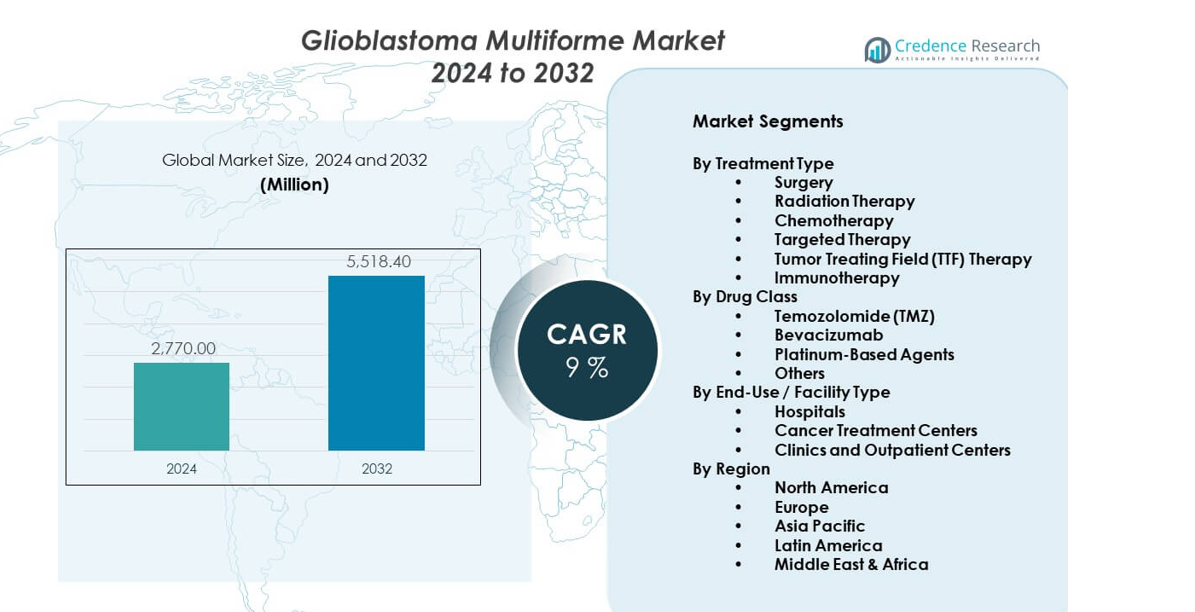
The Glioblastoma Multiforme Market shows steady growth driven by unmet medical needs. The market stands at USD 2,770 million in 2024. It is projected to reach USD 5,518.4 million by 2032, growing at a CAGR of 9% during the forecast period.
| REPORT ATTRIBUTE |
DETAILS |
| Historical Period |
2020-2023 |
| Base Year |
2024 |
| Forecast Period |
2025-2032 |
| Glioblastoma Multiforme Market Size 2024 |
USD 2,770 million |
| Glioblastoma Multiforme Market , CAGR |
9% |
| Glioblastoma Multiforme Market Size 2032 |
USD 5,518.4 million |
Rising incidence of aggressive brain tumors remains a key growth factor. Improved imaging technologies support earlier and more accurate diagnosis. Advances in neurosurgical tools improve tumor removal precision and safety. Targeted therapies and immunotherapies expand options beyond standard chemotherapy. Active clinical trial pipelines accelerate innovation in combination treatments. Faster regulatory pathways for orphan cancers support product approvals. Growing healthcare spending improves patient access to advanced neuro-oncology care.
North America leads due to strong oncology infrastructure and research funding. The United States dominates with high clinical trial activity and rapid therapy adoption. Europe follows, supported by public healthcare systems and academic research centers. Germany, France, and the UK show strong uptake of advanced treatment protocols. Asia Pacific is emerging with improving diagnostics and hospital capacity. China and India gain momentum through rising awareness and healthcare investment.
Market Insights:
- The Glioblastoma Multiforme Market is valued at USD 2,770 million in 2024 and is projected to reach USD 5,518.4 million by 2032, growing at a CAGR of 9%, driven by high unmet clinical need and sustained therapy demand.
- North America leads with about 40% share due to advanced neuro-oncology infrastructure, Europe follows with a significant share supported by public healthcare systems, and Asia Pacific holds around 18.60% driven by expanding hospital capacity.
- Asia Pacific is the fastest-growing region with nearly 18.60% share, supported by rising disease awareness, improving diagnostics, and increased oncology investment in China, India, and Japan.
- By treatment type, chemotherapy and surgery together account for nearly 60% share, reflecting their role as standard first-line interventions across care settings.
- By end-use, hospitals and cancer treatment centers collectively contribute about 70% share due to their surgical capability, advanced imaging access, and multidisciplinary care models.
Access crucial information at unmatched prices!
Request your sample report today & start making informed decisions powered by Credence Research Inc.!
Download Sample
Market Drivers:
Rising Disease Incidence And High Unmet Therapeutic Need Across Neuro-Oncology
The Glioblastoma Multiforme Market benefits from the rising global burden of aggressive brain tumors. Incidence rates continue to increase across aging populations. Survival outcomes remain poor despite standard therapy use. This gap sustains constant demand for improved treatment options. Hospitals prioritize rapid intervention for newly diagnosed patients. Neuro-oncology units expand capacity to manage complex cases. It supports steady use of surgical, radiation, and drug therapies. Clinical urgency keeps treatment demand resilient across healthcare systems.
- For instance, Mayo Clinic reports treating thousands of primary brain tumor cases annually through dedicated neuro-oncology programs. Clinical urgency keeps treatment demand resilient across healthcare systems.
Advancements In Neurosurgical Precision And Intraoperative Treatment Technologies
The Glioblastoma Multiforme Market gains support from progress in neurosurgical techniques. Image-guided surgery improves tumor margin visibility. Surgeons achieve higher resection accuracy with reduced neurological risk. Intraoperative monitoring protects critical brain functions. Advanced tools support repeat surgeries when recurrence occurs. It strengthens confidence in aggressive surgical approaches. Hospitals invest in specialized neurosurgical equipment. These factors increase procedure volumes across major treatment centers.
- For instance, Siemens Healthineers’ intraoperative MRI systems enable real-time imaging during tumor resection in leading neurosurgical centers. Hospitals invest in specialized neurosurgical equipment. These advances increase procedure volumes across major treatment centers.
Expansion Of Targeted Therapies And Novel Drug Development Pipelines
The Glioblastoma Multiforme Market grows through active development of targeted therapies. Drug developers focus on tumor-specific molecular pathways. Precision medicines address resistance seen in standard chemotherapy. Combination regimens improve response durability. It encourages broader participation in clinical trials. Pharmaceutical firms prioritize rare and high-mortality cancers. Regulatory frameworks support accelerated review pathways. These elements strengthen long-term therapeutic innovation.
Supportive Regulatory Environment And Growth In Specialized Cancer Care
The Glioblastoma Multiforme Market benefits from favorable regulatory support. Orphan drug policies encourage focused research investment. Faster approvals reduce development timelines. Public and private funding supports brain cancer research. It improves access to advanced treatments in major hospitals. Specialized cancer centers expand neuro-oncology programs. Multidisciplinary care models improve treatment coordination. These drivers reinforce consistent market demand.
Market Trends:
Shift Toward Personalized Treatment Planning And Molecular Profiling
The Glioblastoma Multiforme Market reflects a shift toward personalized care strategies. Physicians rely on genetic and biomarker testing. Treatment plans adapt to individual tumor profiles. It improves therapy selection accuracy. Precision diagnostics guide clinical decision pathways. Hospitals integrate molecular labs into oncology workflows. Research institutions refine classification standards. This trend reshapes clinical practice patterns.
- For instance, Roche-supported diagnostic platforms enable routine molecular profiling in major cancer hospitals. Research institutions refine classification standards. This trend reshapes clinical practice patterns.
Growing Focus On Combination Therapy Protocols In Clinical Practice
The Glioblastoma Multiforme Market shows increased use of combination treatments. Clinicians pair surgery with radiation and drug therapy. Multi-modal care improves disease control prospects. It reduces reliance on single-agent approaches. Treatment protocols evolve through trial outcomes. Cancer centers standardize combination regimens. Care teams coordinate across specialties. This approach defines modern treatment frameworks.
- For instance, Merck-supported temozolomide trials established combination therapy as standard care. Cancer centers standardize these regimens. Care teams coordinate across specialties.
Increased Role Of Advanced Imaging And Digital Monitoring Tools
The Glioblastoma Multiforme Market adopts advanced imaging technologies. High-resolution MRI improves tumor assessment accuracy. Functional imaging supports therapy response evaluation. It aids early detection of recurrence. Digital platforms assist treatment planning. Clinicians track disease progression more precisely. Hospitals invest in imaging upgrades. These tools enhance clinical confidence.
Rising Patient Enrollment In Clinical Trials And Research Networks
The Glioblastoma Multiforme Market benefits from strong trial participation. Patients seek access to experimental therapies. Research networks expand across regions. It supports faster data generation. Trial sponsors collaborate with academic hospitals. Enrollment criteria broaden to include diverse populations. Digital recruitment tools improve outreach. This trend accelerates therapeutic validation.
Market Challenges Analysis:
Complex Disease Biology And Limited Long-Term Treatment Effectiveness
The Glioblastoma Multiforme Market faces challenges from complex tumor biology. Tumors show high genetic variability. Treatment resistance limits long-term control. It complicates drug development efforts. Recurrence rates remain high after therapy. Clinical outcomes vary widely across patients. Predictive biomarkers remain limited. These factors constrain treatment success rates.
High Treatment Costs And Uneven Access To Advanced Care
The Glioblastoma Multiforme Market encounters cost-related barriers. Advanced therapies require significant financial resources. Specialized care centers remain limited in many regions. It restricts patient access to innovation. Reimbursement policies vary across healthcare systems. Hospitals face budget constraints for advanced equipment. Patients experience financial burden during treatment. These challenges affect market penetration.
Market Opportunities:
Expansion Of Immunotherapy And Next-Generation Therapeutic Platforms
The Glioblastoma Multiforme Market holds opportunities in immunotherapy development. Novel vaccines target tumor-specific antigens. Cell-based therapies gain research attention. It opens new treatment pathways. Combination use enhances immune response potential. Research funding supports early-stage innovation. Academic collaborations accelerate discovery. These advances create long-term growth prospects.
Growth Potential In Emerging Markets And Specialized Care Expansion
The Glioblastoma Multiforme Market shows opportunity in emerging regions. Healthcare infrastructure continues to improve. Awareness of brain cancer rises among clinicians. It supports earlier diagnosis rates. Governments invest in oncology capacity. Private hospitals expand specialty services. International partnerships transfer clinical expertise. These factors support future market expansion.
Market Segmentation Analysis:
By Treatment Type
The Glioblastoma Multiforme Market shows strong reliance on surgery as the first-line intervention. Surgeons aim to remove maximum tumor mass while preserving brain function. Radiation therapy follows surgery to control residual tumor cells. Chemotherapy remains central due to its role in suppressing tumor regrowth. Temozolomide use supports standard treatment protocols across care settings. Targeted therapy gains importance through pathway-specific action. Tumor Treating Field therapy introduces non-invasive disease control. Immunotherapy attracts interest through immune system activation potential.
- For instance, Novocure’s Optune system demonstrated median overall survival of 20.9 months in newly diagnosed patients when added to standard therapy.
By Drug Class
Temozolomide dominates drug use due to proven efficacy and oral administration. Clinicians prescribe it across initial and recurrent disease stages. Bevacizumab supports symptom control and vascular regulation. It helps manage edema and improves quality of life. Platinum-based agents serve selected treatment cases. These drugs support salvage therapy protocols. Other agents include experimental and supportive treatments. Research activity expands the drug mix.
- For instance, Roche’s Avastin showed improved progression-free survival in recurrent glioblastoma trials. Ongoing research expands the drug mix.
By End-Use / Facility Type
Hospitals lead treatment delivery due to surgical and intensive care capacity. Multidisciplinary teams manage complex treatment pathways. Cancer treatment centers play a key role in advanced therapy delivery. These centers support clinical trial participation. Clinics and outpatient centers handle follow-up care and drug administration. They improve patient convenience and continuity. It supports long-term disease management across healthcare settings.
Segmentation:
By Treatment Type
- Surgery
- Radiation Therapy
- Chemotherapy
- Targeted Therapy
- Tumor Treating Field (TTF) Therapy
- Immunotherapy
By Drug Class
- Temozolomide (TMZ)
- Bevacizumab
- Platinum-Based Agents
- Others
By End-Use / Facility Type
- Hospitals
- Cancer Treatment Centers
- Clinics and Outpatient Centers
By Region
- North America
- Europe
- Germany
- France
- U.K.
- Italy
- Spain
- Rest of Europe
- Asia Pacific
- China
- Japan
- India
- South Korea
- South-east Asia
- Rest of Asia Pacific
- Latin America
- Brazil
- Argentina
- Rest of Latin America
- Middle East & Africa
- GCC Countries
- South Africa
- Rest of the Middle East and Africa
Regional Analysis:
North America And Europe Market Performance
The Glioblastoma Multiforme Market shows strong dominance in North America, accounting for about 40% market share. The United States leads due to advanced neuro-oncology infrastructure and high clinical trial activity. Canada supports demand through wide access to specialized cancer care. Europe represents a significant regional market with stable adoption levels. Germany, France, and the UK drive demand through structured treatment protocols. Public healthcare systems support therapy continuity. It benefits from strong academic and pharmaceutical collaboration.
Asia Pacific Growth Dynamics
The Glioblastoma Multiforme Market in Asia Pacific holds nearly 18.60% market share and shows the fastest growth trend. Japan leads through advanced diagnostics and neurosurgical expertise. China expands rapidly due to hospital infrastructure upgrades. India gains momentum from rising disease awareness and oncology investment. Australia supports demand through active clinical research participation. South Korea adopts modern therapy standards. It reflects improving access to specialized care.
Latin America And Middle East & Africa Outlook
The Glioblastoma Multiforme Market in Latin America accounts for a smaller but emerging share of global demand. Brazil and Argentina lead due to expanding cancer treatment facilities. Diagnosis rates improve with better imaging access. The Middle East & Africa represents a growing segment with low base penetration. Saudi Arabia and UAE invest in advanced oncology centers. South Africa supports regional access to treatment. It gains traction through healthcare modernization efforts.
Shape Your Report to Specific Countries or Regions & Enjoy 30% Off!
Key Player Analysis:
Competitive Analysis:
The Glioblastoma Multiforme Market features a concentrated competitive structure led by global pharmaceutical and device companies. Major players focus on differentiated therapy platforms and strong clinical pipelines. Targeted drugs, biologics, and device-based therapies define competitive positioning. Companies invest heavily in trials to improve survival outcomes. Strategic partnerships strengthen research depth and geographic reach. It reflects strong emphasis on regulatory approvals and lifecycle management. Competitive intensity remains high due to limited treatment success rates. Innovation speed and clinical evidence shape long-term leadership.
Recent Developments:
- In December 2025, Pfizer announced an exclusive global collaboration and license agreement with YaoPharma, a subsidiary of Shanghai Fosun Pharmaceutical Group, for the development and commercialization of YP05002, a small molecule glucagon-like peptide 1 (GLP-1) receptor agonist. While this announcement represents cardiometabolic focus, Pfizer’s broader oncology strategy continues to advance aggressively. At ASCO 2025 in April 2025, Pfizer highlighted its diverse oncology portfolio with a stated goal of delivering eight breakthrough cancer medicines by 2030. The company showcased multiple Phase 3 data readouts and regulatory approvals across its major tumor areas, demonstrating continued expansion in cancer therapeutics research and development.
- In May 2025, Genentech announced a second multi-year strategic collaboration with Orionis Biosciences to discover small-molecule monovalent glue medicines for novel and challenging targets in oncology. This collaboration builds upon an initial partnership established in September 2023 and represents Genentech’s commitment to advancing molecular glue technology as a therapeutic modality. The partnership focuses on protein degraders and non-degraders that provide access to disease-related proteins previously considered challenging to target through traditional treatment modalities. Additionally, in July 2025, Genentech provided updates on supplemental Biologics License Application submissions for Columvi (glofitamab-gxbm) combination therapies, demonstrating the company’s ongoing commitment to expanding its oncology pipeline across multiple cancer types.
Report Coverage:
The research report offers an in-depth analysis based on treatment type, drug class, end-use facility, and regional segmentation. It details leading market players, providing an overview of their business, product offerings, investments, revenue streams, and key applications. Additionally, the report includes insights into the competitive environment, SWOT analysis, current market trends, as well as the primary drivers and constraints. Furthermore, it discusses various factors that have driven market expansion in recent years. The report also explores market dynamics, regulatory scenarios, and technological advancements that are shaping the industry. It assesses the impact of external factors and global economic changes on market gowth. Lastly, it provides strategic recommendations for new entrants and established companies to navigate the complexities of the market.
Future Outlook:
- The market will continue to rely on clinical innovation to address poor survival outcomes.
- Personalized treatment approaches will gain wider acceptance in routine clinical practice.
- Device-based therapies will expand alongside established drug regimens.
- Combination treatment protocols will shape standard care pathways.
- Emerging economies will improve access to specialized neuro-oncology services.
- Research funding will support broader and deeper therapeutic pipelines.
- Regulatory frameworks will continue to favor treatments for rare and high-mortality cancers.
- Advanced diagnostics will improve treatment planning and response monitoring.
- Multidisciplinary care models will strengthen coordination across treatment stages.
- Strategic collaborations will support global market expansion and technology transfer.



