
Market Overview:
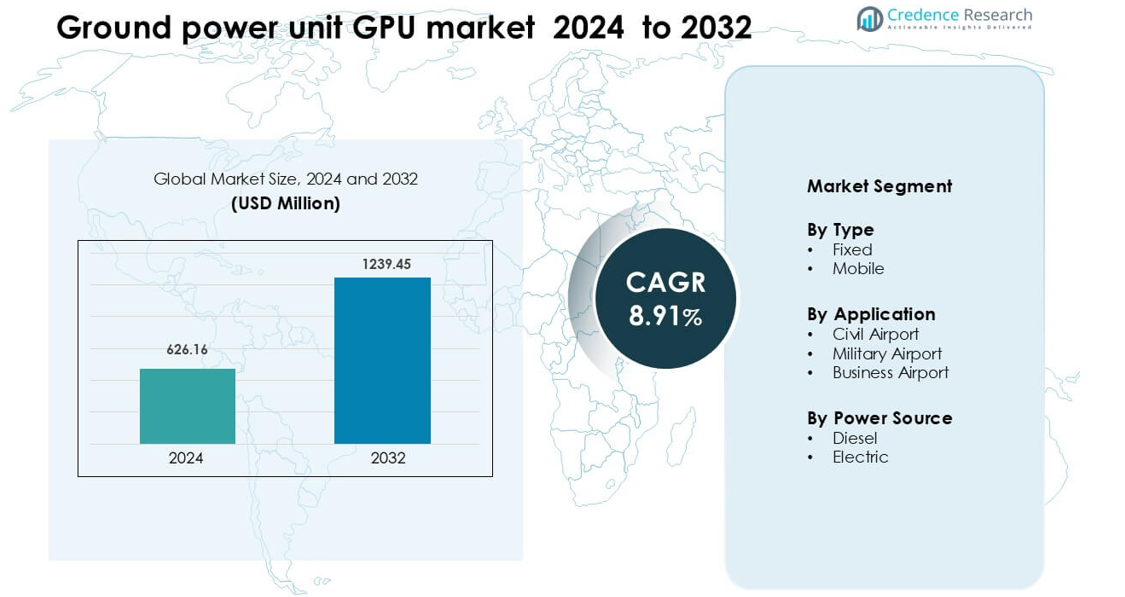
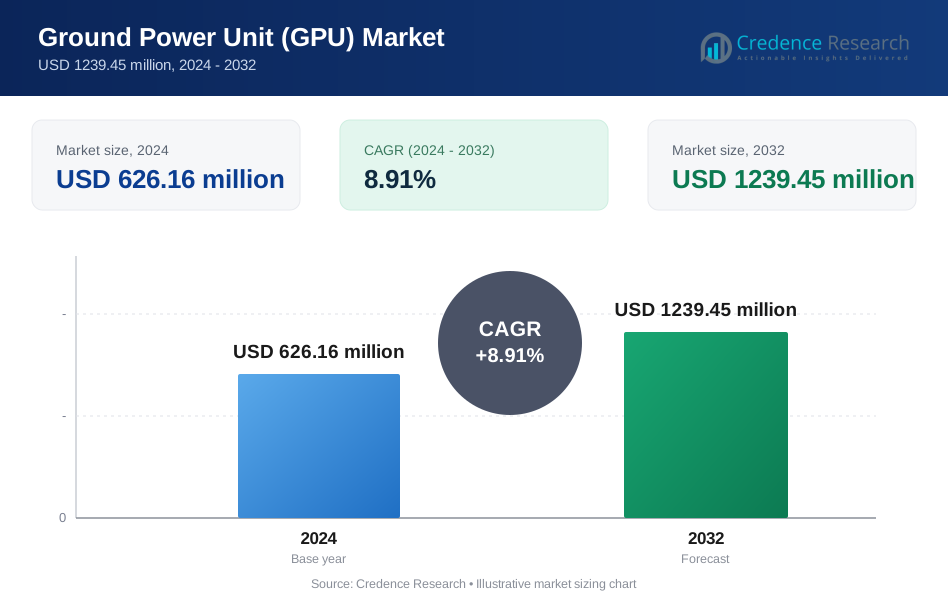
Ground Power Unit (GPU) Market was valued at USD 626.16 million in 2024 and is anticipated to reach USD 1239.45 million by 2032, growing at a CAGR of 8.91% during the forecast period.
| REPORT ATTRIBUTE | DETAILS |
|---|---|
| Historical Period | 2020-2023 |
| Base Year | 2024 |
| Forecast Period | 2025-2032 |
| Ground Power Unit (GPU) Market Size 2024 | USD 626.16 million |
| Ground Power Unit (GPU) Market, CAGR | 8.91% |
| Ground Power Unit (GPU) Market Size 2032 | USD 1239.45 million |
The Ground Power Unit (GPU) market is shaped by major players including Air+Mak, Ross, ITW GSE, Tyler Inc, AeromaxGSE, BEAK, Habenchtraiet, GB BARBERI, Red Box Aviation, and JBT, each competing through advanced mobile and fixed GPU solutions tailored for civil, military, and business aviation needs. These companies focus on energy-efficient designs, multi-voltage compatibility, and reliable power delivery to support fast aircraft turnaround. North America leads the market with about 34% share in 2024, driven by strong airport modernization programs, higher aircraft traffic, and rapid adoption of electric and hybrid GPU technologies across major commercial hubs.
Market Insights
- Ground power unit GPU market was valued at USD 626.16 million in 2024 and is anticipated to reach USD 1239.45 million by 2032, growing at a CAGR of 8.91% during the forecast period.
- Growth is driven by rising commercial air traffic, expanding airport infrastructure and upgrades, and increasing demand for mobile and fixed GPUs across applications such as civil airports, business airports, and military operations.
- Current trends include accelerated adoption of electric and hybrid power source GPUs over diesel, increasing demand for mobile units (mobile type holds approximately 62% of type share) and growing integration of smart monitoring in GPU equipment.
- Competitive intensity remains high with major players (e.g., JBT, ITW GSE, Red Box Aviation) expanding technology portfolios and aftermarket services; however, high initial costs and maintenance burdens act as significant restraints.
- Regionally, North America leads the market with more than one-third share in 2022 (approx. > 33 %), while Asia-Pacific and Europe contribute approximately 2 % and 29 % respectively; the fixed segment and civil-airport application dominate the market.
Market Segmentation Analysis:
By Type
The mobile category leads the Ground Power Unit (GPU) market with about 62% share in 2024 due to its strong use across civil and military ramps that require flexible positioning around diverse aircraft types. Mobile GPUs support fast towing, quicker gate turns, and smoother power delivery during remote stand operations. Demand rises as airports focus on higher apron mobility and wider fleet compatibility. Fixed GPUs maintain steady adoption in major hubs where operators prefer integrated gate power systems, but growth remains slower due to higher installation cost and limited layout flexibility.
- For instance, ITW GSE, a leading GSE manufacturer, reported delivering over 90,000 ground support units (including both mobile and fixed GPUs) across more than 100 countries.
By Application
Civil airports dominate this segment with nearly 68% share in 2024, driven by rising commercial passenger traffic, wider use of contact and remote stands, and strong investment in aircraft turnaround efficiency. Airport operators prefer reliable GPU systems that reduce auxiliary power unit use and support sustainability goals by cutting ramp emissions. Military airports show stable demand for rugged units that meet harsh-environment requirements, while business airports adopt GPUs at a gradual pace as private aviation ramps expand and operators seek quieter, low-maintenance ground power support.
- For instance, dnata, a major ground-handling provider at Dubai International Airport (DXB), added 14 electric 180 kVA GPUs-from ITW GSE-to its ramp operations. These now account for 33% of all GPU utilization at DXB, replacing diesel units and reducing fuel use by 550,000 litres annually.
By Power Source
Diesel-based GPUs lead this category with around 57% share in 2024 because operators rely on their high power output, long-duration operation, and suitability for varied ramp conditions. Diesel units support wide-body aircraft and remote stands where charging access remains limited. Electric GPUs gain strong momentum as airports adopt low-emission systems to meet environmental targets and reduce noise across passenger zones. Growth intensifies in hubs deploying fixed electric GPUs at gates, but overall market share remains lower as full electrification requires large-scale charging and infrastructure upgrades.
Key Growth Drivers
Rising Commercial Air Traffic and Airport Expansion
Growing global passenger volume drives strong demand for Ground Power Units (GPUs) as airports expand terminals, add remote stands, and upgrade gate infrastructure. Airport authorities aim to improve aircraft turnaround speed and reduce delays, which increases reliance on high-capacity mobile and fixed GPUs. Airlines push for efficient ground operations that minimize auxiliary power unit use and cut fuel burn during gate handling. Expansion projects in Asia-Pacific, the Middle East, and North America integrate modern GPU systems into new aprons and contact gates. This broad infrastructure growth strengthens long-term procurement of advanced, reliable GPU units.
- For instance, ITW GSE supplied 72 GPUs to Bangkok Suvarnabhumi Airport’s satellite terminal alongside 36 PCA units and 72 hose retrievers to support the expansion enabling fixed electric power at newly constructed gate infrastructure.
Shift Toward Low-Emission and Energy-Efficient Operations
Airports and airlines focus on sustainability goals that target reduced emissions and noise on the ramp. GPUs help replace onboard APU operations, lowering fuel consumption and improving local air-quality compliance. Regulatory bodies promote cleaner ground operations through emission caps and green-airport programs. Electric GPU adoption grows as operators reduce dependence on diesel systems, especially in large hubs with strong charging infrastructure. Investment in hybrid and fully electric alternatives supports energy-efficient gate systems. This environmental transition drives steady market growth for GPUs aligned with global decarbonization initiatives.
- For instance, Dnata added 14 new, 180kVA electric ground power units (eGPUs) from ITW GSE to its fleet at Dubai International Airport (DXB).
Fleet Modernization and Advanced Ground Handling Automation
Modern aircraft fleets require stable and precise ground power to support larger avionics loads, cabin systems, and real-time diagnostics. Airports respond by adopting advanced GPU systems with higher efficiency, smart monitoring, and remote control features. Integration with automated ground handling platforms boosts operational predictability and minimizes ramp downtime. Increased demand for digital connectivity during aircraft maintenance also raises the need for reliable GPU performance. As airlines digitize workflows, airports invest in GPUs with telemetry, load-management tools, and predictive maintenance capabilities. This modernization trend strengthens long-term equipment upgrades.
Key Trend & Opportunity
Rapid Growth of Electric and Hybrid GPU Solutions
Electric GPUs gain wide traction as airports prioritize decarbonization. Operators seek quieter units with lower operating costs and minimal maintenance. Government incentives for clean-energy adoption encourage airport authorities to replace diesel units with electric alternatives, especially in Europe and Asia. Hybrid models also rise as transitional solutions for airports lacking full charging infrastructure. Manufacturers respond with modular systems, fast-charging capability, and intelligent power management. The shift creates strong opportunities for suppliers offering flexible, scalable, and environmentally aligned GPU technologies.
- For instance, ITW GSE’s 7400 eGPU, a fully battery-driven ground power unit, supports 8–12 turnarounds of a narrow-body aircraft on a single charge. The unit is rated for 90 kVA, 140 kVA, and 180 kVA models.
Integration of Smart Monitoring and Predictive Maintenance
GPU manufacturers introduce digital features such as telemetry, remote diagnostics, real-time power tracking, and cloud-based analytics. These capabilities help airport teams monitor fleet health, reduce unexpected failures, and optimize ground operations. Data-driven maintenance lowers lifecycle cost and improves equipment reliability. Smart dashboards support load balancing and boost electrical efficiency when multiple aircraft require ground power. This technology shift offers major opportunities for companies developing software-integrated GPU systems that align with broader smart-airport initiatives.
- For instance, proveo, an aviation-telemetry provider, offers a platform used by over 100 GSE clients, giving live data on run hours, battery state of charge, location, and fault codes to predict maintenance cycles.
Increasing Demand for Modular and Mobile GPU Platforms
Airports seek modular, customizable GPU units that adapt to different aircraft classes and ramp layouts. Flexible mobile platforms support fast towing, quick deployment, and efficient use across remote aprons. This trend grows in regions with rising low-cost carrier activity, where fast gate rotation is essential. Modular systems also reduce maintenance downtime and simplify upgrades. Manufacturers focusing on lightweight frames, compact footprints, and multi-voltage compatibility gain strong opportunities in expanding regional and secondary airports.
Key Challenge
High Installation and Infrastructure Costs
Fixed electric GPU systems require significant investment in electrical upgrades, charging infrastructure, and gate-level integration. Smaller airports struggle to fund these large-scale improvements, slowing adoption. Diesel units remain dominant in many regions because they need lower upfront spending, even though they have higher long-term operating costs. Infrastructure limitations create operational bottlenecks, especially in older terminals with limited electrical capacity. These financial and structural barriers challenge rapid modernization and restrict wide deployment of next-generation GPU technologies.
Operational Variability and Maintenance Complexity
GPU systems face heavy usage cycles, exposure to harsh ramp environments, and fluctuating power demands. Mobile units require regular mechanical and electrical servicing, while fixed units need precise calibration to ensure compatibility with diverse aircraft platforms. Failures during peak traffic periods disrupt flight schedules and raise downtime costs. Airports with mixed fleets and older equipment struggle to maintain standardized GPU performance. This variability increases operational risk and pressures operators to adopt stronger maintenance programs, raising lifecycle expenses.
Regional Analysis
North America
North America leads the Ground Power Unit (GPU) market with about 34% share in 2024, driven by strong airport modernization programs and high aircraft traffic across major hubs in the United States. Operators invest in low-emission electric GPUs to support sustainability targets and reduce APU usage during gate operations. Expansion of regional airports and rising demand for mobile GPUs also support growth. Major airlines adopt advanced digital ground handling tools, increasing the need for reliable, high-capacity power units. Federal support for green airport initiatives further strengthens long-term GPU deployment across terminals and remote stands.
Europe
Europe holds around 29% share in 2024, supported by strict environmental rules that push airports to shift from diesel GPUs to electric and hybrid systems. Major hubs in Germany, France, the Netherlands, and the UK integrate fixed gate power units to reduce ramp emissions and meet noise-reduction goals. EU-backed green-airport programs accelerate infrastructure upgrades and encourage adoption of energy-efficient units. Growth also comes from rising commercial traffic and broader use of remote stands. European manufacturers benefit from demand for modular, eco-friendly GPUs tailored for both narrow-body and wide-body aircraft operations.
Asia-Pacific
Asia-Pacific accounts for roughly 27% share in 2024, driven by rapid airport expansion across China, India, Indonesia, and Southeast Asia. Growing domestic and regional air travel increases the need for high-capacity GPUs to manage rising aircraft movements. Large greenfield airport projects integrate modern fixed GPU systems, while busy regional airports rely on mobile units for flexible ramp operations. Governments emphasize improved ground handling efficiency and lower emissions, creating strong demand for electric GPU solutions. Fleet growth among low-cost carriers further accelerates procurement of mobile, multi-voltage GPU platforms.
Latin America
Latin America holds nearly 6% share in 2024, supported by steady airport modernization efforts in Brazil, Mexico, and Colombia. Operators focus on improving turnaround performance and reducing fuel consumption, which increases adoption of diesel and hybrid GPU units suitable for varied ramp conditions. Economic constraints slow large-scale electrification, but major international airports gradually introduce electric GPUs to meet regional sustainability targets. Growth is strongest in busy passenger hubs and cargo-focused airports that require dependable ground power for mixed fleets. Mobile GPUs remain widely preferred due to higher flexibility and lower installation cost.
Middle East & Africa
The Middle East & Africa region captures about 4% share in 2024, driven by strong aviation growth in the UAE, Saudi Arabia, and Qatar. Large airports invest in high-capacity GPUs to support wide-body fleets and long-haul operations. Sustainability programs at major Gulf airports encourage the shift toward electric and hybrid units, though diesel GPUs remain dominant in secondary airports due to infrastructure limitations. In Africa, investments focus on mobile GPU units that serve diverse aircraft types in developing aviation markets. Expansion of new terminals and cargo hubs supports steady long-term demand across the region.
Market Segmentations:
By Type
- Fixed
- Mobile
By Application
- Civil Airport
- Military Airport
- Business Airport
By Power Source
- Diesel
- Electric
By Geography
- North America
- U.S.
- Canada
- Mexico
- Europe
- Germany
- France
- U.K.
- Italy
- Spain
- Rest of Europe
- Asia Pacific
- China
- Japan
- India
- South Korea
- South-east Asia
- Rest of Asia Pacific
- Latin America
- Brazil
- Argentina
- Rest of Latin America
- Middle East & Africa
- GCC Countries
- South Africa
- Rest of the Middle East and Africa
Competitive Landscape
The Ground Power Unit (GPU) market features active competition driven by product innovation, global fleet growth, and airport modernization needs. Leading companies such as Air+Mak, Ross, ITW GSE, Tyler Inc, AeromaxGSE, BEAK, Habenchtraiet, GB BARBERI, Red Box Aviation, and JBT shape the landscape by offering mobile, fixed, diesel, and electric GPU solutions. Manufacturers focus on energy-efficient designs, smart monitoring, and higher reliability to support rapid turnaround operations at civil and military airports. Many suppliers expand portfolios with hybrid and fully electric units to meet growing environmental targets. Partnerships with airport authorities and ground handling firms enhance market presence, while digital maintenance tools strengthen long-term service value. Continuous investment in compact frames, multi-voltage systems, and modular power platforms helps companies stay competitive in a market driven by sustainability and operational efficiency.
Key Player Analysis
Recent Developments
- In October 2025, ITW GSE exhibited at inter airport Europe 2025 in Munich, presenting EcoGate with its 7400 eGPU, DC charger and Power Share solutions to show how integrated GPUs, PCAs and chargers can cut gate power use and support airside electrification.
- In 2023, the Air Force Research Laboratory collaborated with the Air Force Life Cycle Management Center, Air Force Materiel Command headquarters, and General Motors Defense to successfully power a KC-135 tanker aircraft at Edwards Air Force Base using GM Defense's Electric Ground Power Unit. The system uses GM's commercial battery electric technology and an electric drive system. The Electric Ground Power Unit and cart support both military and commercial aircraft.
Report Coverage
The research report offers an in-depth analysis based on Type, Application, Power Source and Geography. It details leading market players, providing an overview of their business, product offerings, investments, revenue streams, and key applications. Additionally, the report includes insights into the competitive environment, SWOT analysis, current market trends, as well as the primary drivers and constraints. Furthermore, it discusses various factors that have driven market expansion in recent years. The report also explores market dynamics, regulatory scenarios, and technological advancements that are shaping the industry. It assesses the impact of external factors and global economic changes on market growth. Lastly, it provides strategic recommendations for new entrants and established companies to navigate the complexities of the market.
Future Outlook
- The market will shift strongly toward electric and hybrid GPUs as airports pursue lower emissions.
- Mobile GPU demand will rise as airlines expand remote stand operations and mixed-fleet handling.
- Fixed GPUs at major hubs will gain adoption as terminals modernize and integrate smart gate systems.
- Digital monitoring and predictive maintenance features will become standard across new GPU models.
- Adoption will accelerate in Asia-Pacific as new airports and rapid fleet growth drive higher ground power needs.
- Manufacturers will focus on compact, modular designs to support faster deployment and easier servicing.
- Sustainability regulations will push operators to replace older diesel units with cleaner alternatives.
- GPU fleets will see increased integration with automated ground handling equipment and apron management systems.
- Long-term service contracts and aftermarket support will grow as operators seek lower lifecycle costs.
- Investments in high-capacity GPUs will rise to support advanced avionics and wider aircraft electrification trends.
Request a Free Sample
Fill in your details and we'll send you a free sample report.
- Sample data tables & charts
- Research methodology
Need a Custom Version of This Report?
Tailor the scope, geography, or segments to your exact requirements.
- Custom geography or segment scope
- Direct access to our analyst team
Frequently Asked Questions
What is the current market size for Ground Power Unit GPU market, and what is its projected size in 2032?
At what Compound Annual Growth Rate is Ground Power Unit GPU market projected to grow between 2025 and 2032?
Which application segment is expected to post the fast-growing CAGR during the forecast period?
Who are the major players in the global ground power unit (GPU) market?
What are the major market drivers of the ground power unit (GPU) industry?
What are the major market opportunities of the ground power unit (GPU) industry?
Who are the leading companies in Ground Power Unit GPU market
Table of Content
Chapter 1. Report Introduction
- 1.1 Report Description & Purpose
- 1.1.1 Report Title & Market Definition
- 1.1.2 Unique Selling Propositions (USP) & Key Differentiators
- 1.1.3 Value Proposition for Stakeholders
- 1.2 Research Objectives
- 1.2.1 Market Sizing Objectives (Volume & Revenue) (Volume Where Applicable)
- 1.2.2 Segmentation Objectives
- 1.2.3 Competitive Intelligence Objectives
- 1.2.4 Forecast & Scenario Objectives
- 1.3 Report Scope
- 1.3.1 Ground Power Unit (GPU) Scope – Segments & Subsegments Covered
- 1.3.2 Geographic Scope – Regions & Countries Covered
- 1.3.3 Historical Period, Base Year & Forecast Period (2024; forecast to 2032)
- 1.3.4 Inclusions & Exclusions
- 1.4 Industry Classification & Applicable Codes
- 1.5 Currency, Measurement Units & Valuation Basis
- 1.6 Target Stakeholders
- 1.7 Limitations & Assumptions
Chapter 2. Executive Summary
- 2.1 Global Ground Power Unit (GPU) Market Snapshot
- 2.1.1 Market Size – Historical (2024) & Forecast (2024-2032) (2024: USD 626.16 million → 2032: USD 1239.45 million)
- 2.1.2 Volume & Revenue – Global Totals (Volume Where Applicable)
- 2.1.3 Key Market Highlights – Top Five Facts
- 2.2 Ground Power Unit (GPU) Market Segmentation Snapshot
- 2.2.1 Market Split by Region – 2024 vs. 2032
- 2.3 Competitive Snapshot
- 2.3.1 Top 10 Players by Revenue Share – 2024
- 2.3.2 Top 10 Players by Volume Share – 2024 (Volume Where Applicable)
- 2.3.3 Recent Strategic Developments (18-Month Summary)
- 2.4 Key Investment Highlights & Strategic Conclusions
Chapter 3. Ground Power Unit (GPU) Market Dynamics & Industry Analysis
- 3.1 Market Overview & Context
- 3.1.1 Ground Power Unit (GPU) Market Position in the Broader Industry Value Chain
- 3.1.2 Demand Structure & Purchasing Dynamics
- 3.1.3 Market Maturity & Development Stage by Region
- 3.2 Ground Power Unit (GPU) Market Drivers
- 3.3 Ground Power Unit (GPU) Market Restraints & Challenges
- 3.4 Ground Power Unit (GPU) Market Opportunities
- 3.5 Porter's Five Forces Analysis
- 3.5.1 Threat of New Entrants
- 3.5.2 Bargaining Power of Suppliers
- 3.5.3 Bargaining Power of Buyers
- 3.5.4 Threat of Substitutes
- 3.5.5 Competitive Rivalry – Intensity Assessment
- 3.6 Ground Power Unit (GPU) Value Chain Analysis
- 3.6.1 Upstream – Key Inputs, Resources & Suppliers
- 3.6.1.1 Key Input/Resource 1
- 3.6.1.2 Key Input/Resource 2
- 3.6.1.3 Key Input/Resource 3
- 3.6.2 Midstream – Core Operations & Value Creation
- 3.6.2.1 Operating Model & Process Overview
- 3.6.2.2 Key Operating Locations & Capabilities by Company
- 3.6.3 Downstream – Market Channels & End Users
- 3.6.3.1 Direct Sales & Customer Engagement Channels
- 3.6.3.2 Indirect Sales, Intermediaries & Partner Channels
- 3.6.4 Value Chain Profitability Analysis
- 3.6.1 Upstream – Key Inputs, Resources & Suppliers
- 3.7 PESTEL Analysis
- 3.7.1 Political Factors
- 3.7.2 Economic Factors
- 3.7.3 Social Factors
- 3.7.4 Technological Factors
- 3.7.5 Environmental Factors
- 3.7.6 Legal Factors
- 3.8 Ground Power Unit (GPU) Supply Chain Analysis
- 3.8.1 Critical Input & Resource Availability Risk Assessment
- 3.8.2 Supplier & Operational Concentration Risk (Geographic Exposure)
- 3.8.3 Supply & Service Disruption Impact Analysis
- 3.9 Regulatory & Policy Landscape
Note: The regulatory and policy landscape section covers regulations based on their applicability to the market, Ground Power Unit (GPU) category, geography, and scope of the study. Only regulatory frameworks with a material impact on operations, compliance, trade, sustainability, or market access are analyzed in detail.
Chapter 4. Key Investment Pockets & Opportunity Analysis
- 4.1 Ground Power Unit (GPU) Market Attractiveness Analysis
- 4.1.1 By Region – Investment Attractiveness Matrix (Market Size × CAGR)
- 4.2 Absolute Revenue Growth Opportunity
- 4.2.1 By Region – Absolute Revenue Growth Through 2032
- 4.3 Incremental Demand Opportunity
- 4.3.1 By Region – Incremental Demand Through 2032
- 4.3.2 Segment – Incremental Demand
- 4.4 Emerging Submarket Opportunity Deep Dive (Subject to Applicability)
- 4.5 Priority Market Opportunity Scorecards
- 4.5.1 United States
- 4.5.2 Europe
- 4.5.3 Asia
- 4.5.4 Middle East & Africa
Note: Priority market opportunity scorecards reflect the geographic scope and strategic relevance of the study. Listed markets are indicative and may be adapted to the industry.
Chapter 5. Ground Power Unit (GPU) Cross-Border Trade & Market Access Analysis
- 5.1 International Trade & Cross-Border Activity Overview
- 5.1.1 Global Export Value by Country (2024)
- 5.1.2 Global Export Volume by Country (2024) (Volume Where Applicable)
- 5.1.3 Global Import Value by Country (2024)
- 5.1.4 Global Import Volume by Country (2024) (Volume Where Applicable)
- 5.1.5 Net Trade Balance by Country (2024)
- 5.2 Export Analysis – Segment
- 5.2.1 Category 1 (Applicable Classification Code)
- 5.2.2 Category 2 (Applicable Classification Code)
- 5.2.3 Category 3 (Applicable Classification Code)
- 5.2.4 Category 4 (Applicable Classification Code)
- 5.2.5 Category 5 (Applicable Classification Code)
- 5.3 Import Analysis – Segment
- 5.3.1 Category 1 (Applicable Classification Code)
- 5.3.2 Category 2 (Applicable Classification Code)
- 5.3.3 Category 3 (Applicable Classification Code)
- 5.3.4 Category 4 (Applicable Classification Code)
- 5.3.5 Category 5 (Applicable Classification Code)
- 5.4 Cross-Border Pricing & Transaction Benchmarks
- 5.4.1 Export Pricing – Segment & Country
- 5.4.2 Import Pricing – Segment & Source Country
- 5.4.3 Price Trends (2024)
- 5.5 Key Cross-Border Trade & Delivery Routes
- 5.5.1 Cross-Border Trade/Delivery Route 1
- 5.5.2 Cross-Border Trade/Delivery Route 2
- 5.5.3 Cross-Border Trade/Delivery Route 3
- 5.5.4 Cross-Border Trade/Delivery Route 4
- 5.5.5 Cross-Border Trade/Delivery Route 5
- 5.6 Trade Policy & Market Access Impact Assessment
- 5.6.1 Tariff & Non-Tariff Barriers
- 5.6.2 Regional Trade & Economic Integration Frameworks
- 5.6.3 Bilateral & Multilateral Trade Agreements
- 5.6.4 Cross-Border Operating, Licensing & Localization Requirements
Note: This chapter applies where cross-border trade or delivery is relevant to Ground Power Unit (GPU). Goods, services, and digital offerings are assessed using applicable classifications and transaction measures. Import-export volumes, trade balances, and route analyses are included only where meaningful to the market.
Chapter 6. Competitive Landscape & Company Benchmarking
- 6.1 Ground Power Unit (GPU) Market Concentration & Structure
- 6.1.1 Herfindahl-Hirschman Index (HHI) – vs. 2024
- 6.1.2 Leading, Mid-Sized & Emerging Player Structure
- 6.1.3 Global, Regional & Local Player Dynamics
- 6.2 Ground Power Unit (GPU) Market Share Analysis – 2024
- 6.2.1 Global Revenue Share by Company
- 6.2.2 Global Volume Share by Company (Volume Where Applicable)
- 6.2.3 Regional Revenue Share
- 6.2.4 Market Share Evolution ( vs. 2024)
- 6.2.5 Company Market Share by Key Segment
- 6.2.6 Company Market Share by Customer Group
- 6.3 Operating Scale, Capacity & Infrastructure Analysis
- 6.3.1 Global Operating Scale & Supply Capacity
- 6.3.2 Resource Utilization & Operating Efficiency
- 6.3.3 Output, Service Delivery & Activity Metrics
- 6.3.4 Operating Footprint & Infrastructure Map
- 6.3.5 Planned Operational & Capacity Expansion
- 6.4 Ground Power Unit (GPU) Competitive Benchmarking Matrix
- 6.4.1 Revenue, Growth, Profitability & Operating Metric Comparison
- 6.4.2 Channel Revenue Mix
- 6.4.3 Geographic Revenue Exposure
- 6.4.4 R&D Intensity
- 6.4.5 Sustainability Maturity
- 6.5 Strategic Developments in Ground Power Unit (GPU) (Last 24 Months)
- 6.5.1 Mergers, Acquisitions & Divestments
- 6.5.2 New Products, Services & Solutions in Ground Power Unit (GPU)
- 6.5.3 Operational & Infrastructure Expansions
- 6.5.4 Strategic Alliances, Joint Ventures & Partnerships
- 6.5.5 Distribution Expansion & Market Entry
- 6.5.6 Sustainability & ESG Initiatives
- 6.6 Competitive Strategy Mapping
- 6.6.1 Leader, Challenger, Follower & Niche Classification
- 6.6.2 Pricing Strategy Comparison
- 6.6.3 Channel Strategy Matrix
Note: Strategic developments are included based on their materiality and the availability of reliable information.
Chapter 7. Global Ground Power Unit (GPU) Market – By Sales & Delivery Channel
- 7.1 Segment Overview
- 7.1.1 Volume & Revenue Split by Channel (2024 & 2032) (Volume Where Applicable)
- 7.1.2 Channel Mix Evolution (2024-2032)
Chapter 8. Regional Market Analysis – Global Overview
- 8.1 Global Regional Overview
- 8.1.1 Regional Volume Share (Volume Where Applicable)
- 8.1.2 Regional Revenue Share
- 8.1.3 Regional Volume by Region (Volume Where Applicable)
- 8.1.4 Regional Revenue by Region
- 8.1.5 Regional Forecast Through 2032
- 8.2 Cross-Regional Segment Analysis
- 8.2.1 By Sales & Delivery Channel
- 8.2.2 By Competitive Positioning & Price Tier
Chapter 9. North America Ground Power Unit (GPU) Market
- 9.1 United States
- 9.2 Canada
- 9.3 Mexico
Chapter 10. Europe Ground Power Unit (GPU) Market
- 10.1 Germany
- 10.2 France
- 10.3 Italy
- 10.4 United Kingdom
- 10.5 Spain
- 10.6 Poland
- 10.7 Russia
- 10.8 Netherlands
- 10.9 Belgium
- 10.10 Sweden
- 10.11 Denmark
- 10.12 Norway
- 10.13 Rest of Europe
Chapter 11. Asia Pacific Ground Power Unit (GPU) Market
- 11.1 China
- 11.2 India
- 11.3 Japan
- 11.4 South Korea
- 11.5 Thailand
- 11.6 Indonesia
- 11.7 Vietnam
- 11.8 Malaysia
- 11.9 Australia
- 11.10 Rest of Asia Pacific
Chapter 12. Latin America Ground Power Unit (GPU) Market
- 12.1 Brazil
- 12.2 Argentina
- 12.3 Colombia
- 12.4 Chile
- 12.5 Rest of Latin America
Chapter 13. Middle East Ground Power Unit (GPU) Market
- 13.1 Saudi Arabia
- 13.2 United Arab Emirates
- 13.3 Turkey
- 13.4 Israel
- 13.5 Iran
- 13.6 Rest of the Middle East
Chapter 14. Africa Ground Power Unit (GPU) Market
- 14.1 South Africa
- 14.2 Egypt
- 14.3 Nigeria
- 14.4 Morocco
- 14.5 Rest of Africa
Chapter 15. Ground Power Unit (GPU) Company Profiles
- 15.1 [Company 01]
- 15.1.1 Company Overview
- 15.1.2 Key Management Personnel
- 15.1.3 Products & Services Portfolio
- 15.1.4 Financial Performance
- 15.1.5 Key Market Focus & Geographic Presence
- 15.1.6 Recent Developments & Strategic Initiatives
Note: The company profile list is preliminary and may change based on research findings, market developments, data availability, and client requirements.
Chapter 16. Appendices
- Appendix A – List of Abbreviations & Acronyms
- Appendix B – Industry Classification Code Reference – Full Series
- Appendix C – Supply, Output & Operating Capacity Data Tables
- Appendix D – End-Use & Demand Base Tables
- Appendix E – Demand, Adoption & Usage Assumptions
- Appendix F – Pricing & Revenue Metric Reference Tables
- Appendix G – Company Operations & Infrastructure Database
- Appendix H – Cross-Border Trade & Activity Data Tables (Where Applicable)
- Appendix I – Regulatory Summary Tables
- Appendix J – Primary Research Participant List (Anonymized)
- Appendix K – Primary Research Questionnaire Framework
- Appendix L – Data Sources & Bibliography
- Appendix M – Market Size Divergence & Source Comparison
Chapter 17. Research Methodology
- 17.1 Research Framework & Philosophy
- 17.2 Secondary Research – Sources, Hierarchy & Data Extraction
- 17.3 Data Modeling – Bottom-Up & Top-Down Market Sizing
- 17.4 Primary Research – Stakeholder Framework, LOI & Sample Sizes
- 17.5 Forecast Methodology – Regression, Scenario & Sensitivity Analysis
- 17.6 Quality Control – Four-Layer Validation Framework
- 17.7 Limitations & Standard Assumptions
- 17.8 Disclaimer
