Market Overview:
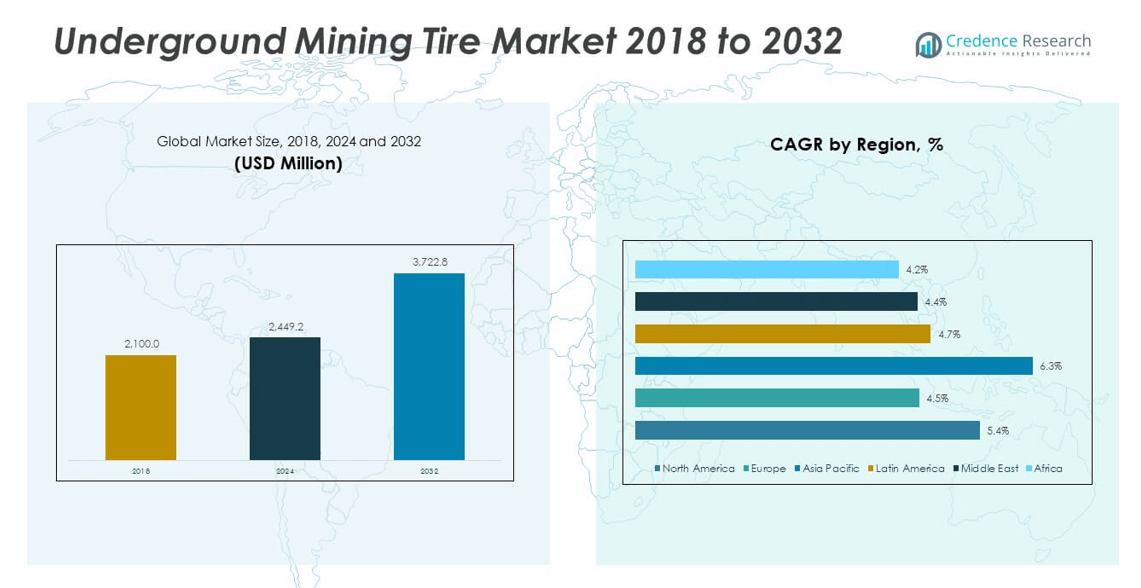
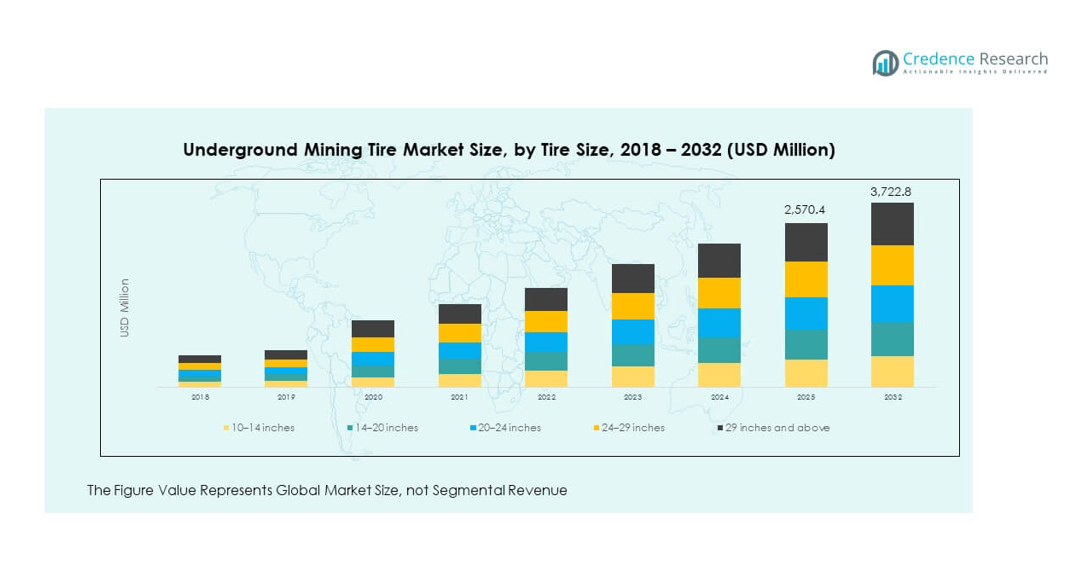
The Global Underground Mining Tire Market size was valued at USD 2,100.0 million in 2018 to USD 2,449.2 million in 2024 and is anticipated to reach USD 3,722.8 million by 2032, at a CAGR of 5.40% during the forecast period.
| REPORT ATTRIBUTE | DETAILS |
|---|---|
| Historical Period | 2020-2023 |
| Base Year | 2024 |
| Forecast Period | 2025-2032 |
| Underground Mining Tire Market Size 2024 | USD 2,449.2 million |
| Underground Mining Tire Market, CAGR | 5.40% |
| Underground Mining Tire Market Size 2032 | USD 3,722.8 million |
The market is driven by expansion in underground mining activities, increasing demand for durable and specialized tires, and growing investments in mineral extraction projects. Rising consumption of metals, coal, and industrial minerals worldwide drives the requirement for heavy-duty vehicles equipped with advanced tire technologies. Tire innovations such as cut-resistant treads, heat tolerance, and improved load-bearing capacity support productivity while reducing downtime in harsh underground conditions.
Regional growth is led by Asia Pacific, supported by large-scale mining operations in China, Australia, and India. North America and Europe remain significant due to established mining infrastructure and technology adoption. Latin America is emerging with increased mineral exploration, while Middle East and Africa display gradual uptake due to rising mining investments in precious metals and industrial minerals.
Market Insights:
- The Global Underground Mining Tire Market size was valued at USD 2,100.0 million in 2018 to USD 2,449.2 million in 2024 and is expected to reach USD 3,722.8 million by 2032 at a CAGR of 5.40%.
- Drivers include mining expansion, equipment efficiency, safety focus, and technology adoption.
- Restraints involve high costs, raw material volatility, and maintenance requirements.
- Asia Pacific leads growth due to expanding mining activities and investments.
- North America and Europe remain strong due to established mining sectors and technology use.
- Latin America shows gradual adoption with resource exploration projects.
- Middle East and Africa present future opportunities with rising mineral extraction.
Market Drivers:
Expansion of Global Mining Operations Creating Tire Demand:
The Global Underground Mining Tire Market is fueled by expanding mining operations across developing and developed economies. Rising demand for base metals, coal, and rare earth elements has pushed companies to extend underground mining capacity. This creates higher consumption of durable tires capable of handling heavy loads and extreme environments. It benefits tire manufacturers offering reinforced designs that sustain long hours of operation without compromising performance.
- For instance, In Vale underground nickel mines in Canada, Michelin X Mine D2 tires are used on loaders handling loads exceeding 80 tons, consistently lasting beyond 4,500 operating hours due to reinforced carcass designs suitable for abrasive conditions.
Increasing Focus on Equipment Efficiency and Productivity:
The Global Underground Mining Tire Market gains traction from the need to enhance productivity and reduce operational costs in underground mines. Tires play a critical role in vehicle efficiency, influencing load capacity, maneuverability, and safety. Companies are investing in high-performance radial and specialty tires that extend life cycles and reduce downtime. By lowering replacement frequency, such tires provide long-term cost savings, making them attractive for mining operators.
Rising Demand for Safety and Durability Standards:
Underground mining environments present risks such as rock cuts, abrasive surfaces, and high temperatures. The Global Underground Mining Tire Market grows with the push for safety compliance and higher durability standards. Manufacturers are developing heat-resistant, puncture-proof, and foam-filled tire variants to reduce accidents and improve worker safety. These innovations support stringent mining safety regulations, encouraging adoption of advanced tire technologies across regions.
Technological Advancements in Tire Design and Materials:
The Global Underground Mining Tire Market benefits from continuous improvements in tire compounds, tread designs, and pressure-monitoring systems. Integration of digital tire management solutions enables predictive maintenance and reduces failures. Smart tire technologies enhance operational efficiency by monitoring wear and performance in real time. Companies focusing on sustainable raw materials also gain competitive advantage, aligning with environmental standards while ensuring durability in demanding applications.
Market Trends:
Integration of Smart Tire Monitoring Systems:
The Global Underground Mining Tire Market is experiencing increased adoption of sensor-enabled monitoring systems. Real-time pressure and temperature tracking allows predictive maintenance and prevents operational breakdowns. Mining operators are integrating IoT-enabled solutions to improve fleet management and extend tire life cycles, making digitalization a defining trend.
- For instance, Goodyear’s SightLine® smart tire monitoring system was implemented at Antofagasta’s underground copper mine in Chile, which monitors tire pressure and temperature with an accuracy of ±3 psi.
Shift Toward Radial Tire Adoption in Mining Vehicles:
Radial tires are becoming a preferred choice in the Global Underground Mining Tire Market due to their superior heat dissipation, reduced rolling resistance, and longer life. Mining companies are gradually replacing bias tires with radial variants to achieve efficiency gains. This trend aligns with the broader move toward sustainability and operational cost reduction.
Emphasis on Eco-Friendly and Recyclable Tire Solutions:
Sustainability is reshaping the Global Underground Mining Tire Market, with manufacturers focusing on recyclable materials and eco-friendly tire formulations. Green initiatives encourage the development of low-emission production techniques and materials that reduce environmental impact. This aligns with global environmental standards and enhances brand reputation.
Increasing Customization for Machine-Specific Applications:
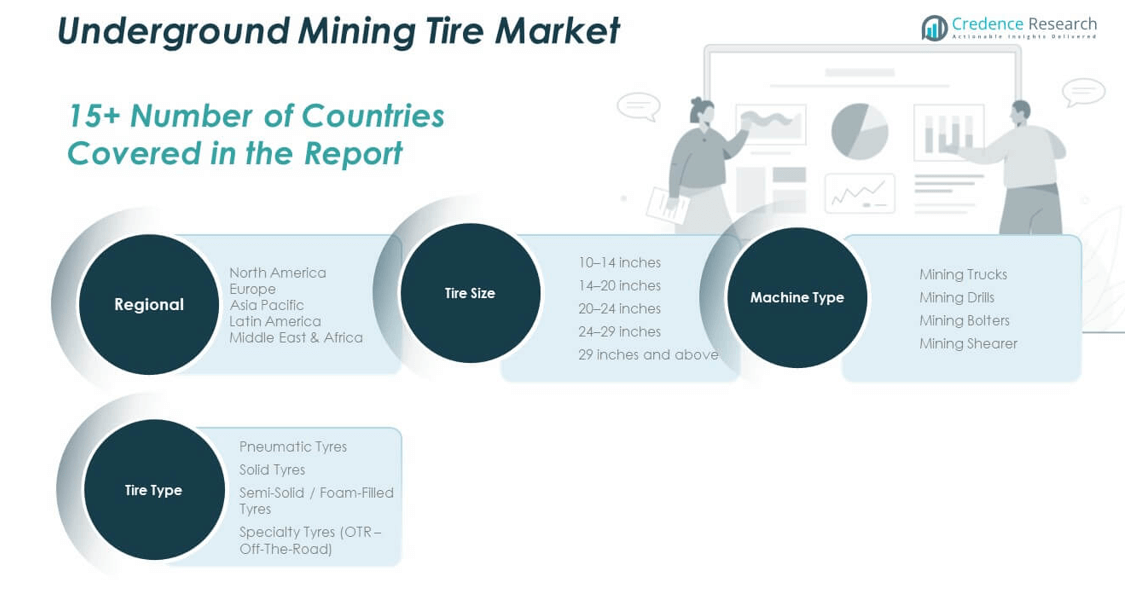
Mining companies demand tires tailored to specific equipment types such as trucks, drills, bolters, and shearers. The Global Underground Mining Tire Market reflects this trend with machine-specific tire designs delivering optimized traction, stability, and load distribution. This customization improves efficiency while meeting diverse operational requirements.
Market Challenges Analysis:
High Operational Costs and Maintenance Requirements:
The Global Underground Mining Tire Market faces challenges from the high costs of advanced tires and frequent maintenance in harsh mining conditions. Large investments are needed to equip fleets with premium tires, making affordability a barrier for small operators. Frequent exposure to abrasive surfaces and heavy loads accelerates wear, driving up replacement expenses and reducing overall profitability.
Supply Chain Volatility and Raw Material Dependence:
The Global Underground Mining Tire Market is constrained by supply chain disruptions and dependence on raw materials like natural rubber and synthetic compounds. Fluctuations in raw material costs affect pricing stability, while geopolitical tensions impact sourcing. These factors hinder consistent availability, making mining operators vulnerable to sudden cost escalations.
Market Opportunities
Growth in Emerging Economies with Expanding Mining Investments:
The Global Underground Mining Tire Market holds strong opportunities in emerging economies such as India, Brazil, and African nations. Rising demand for precious and industrial minerals encourages new underground mining projects. Companies entering these regions with affordable, durable tire solutions can gain significant market share.
Rising Adoption of Automation and Smart Mining Vehicles:
The adoption of automated underground mining vehicles creates opportunities for advanced tire solutions. The Global Underground Mining Tire Market is evolving to support automation with sensor-integrated and high-durability tires. These developments enhance safety, optimize fleet management, and align with the shift toward digitalized mining operations.
Market Segmentation Analysis:
Tire Size
The Global Underground Mining Tire Market by tire size is dominated by the 24–29 inches category, widely used in heavy-duty mining trucks and loaders. The 29 inches and above segment is expanding with large-scale mining projects requiring higher load-bearing capacity. Mid-range segments such as 14–20 inches and 20–24 inches are essential for drills and bolters, providing durability and stability under abrasive conditions. Smaller 10–14 inches tires serve compact mining machinery operating in confined spaces, ensuring operational flexibility.
- For instance, Titan International supplies large-size underground mining tires such as the 28-inch diameter tires used in coal mining loaders, with these tires routinely handling operational loads in the range of 170 kN pressure, supporting stable operations in extreme underground conditions.
Machine Type
By machine type, mining trucks represent the largest demand share, driven by their critical role in underground material transport. Mining drills generate steady demand for tires that deliver resilience and traction in harsh terrains. Mining bolters depend on specialized tires to provide stability and safety in roof support operations. Mining shearers require strong and durable tires to maintain consistent productivity during rock-cutting activities, reinforcing their importance in underground mining operations.
- For instance, Caterpillar underground mining trucks equipped with Continental OTR mining tires report operational tire lifespan averaging 5,500 hours, contributing to machine uptime in iron ore mines in Australia.
Tire Type
In terms of tire type, pneumatic tyres lead the market due to their balance of cost-effectiveness, durability, and adaptability. Solid tyres are preferred in operations where puncture resistance and extended service life are essential. Semi-solid or foam-filled tyres provide added stability and reduce downtime in high-risk areas. Specialty tires (OTR – Off-The-Road) are tailored for specific applications, offering advanced tread patterns and high-performance compounds. The Global Underground Mining Tire Market reflects a direct alignment between tire types, operational needs, and equipment efficiency.
Segmentation:
Tire Size
- 10–14 inches
- 14–20 inches
- 20–24 inches
- 24–29 inches
- 29 inches and above
Machine Type
- Mining Trucks
- Mining Drills
- Mining Bolters
- Mining Shearer
Tire Type
- Pneumatic Tyres
- Solid Tyres
- Semi-Solid / Foam-Filled Tyres
- Specialty Tyres (OTR – Off-The-Road)
Regional Segments
- North America
- U.S.
- Canada
- Mexico
- Europe
- Germany
- France
- U.K.
- Italy
- Spain
- Rest of Europe
- Asia Pacific
- China
- Japan
- India
- South Korea
- South-east Asia
- Rest of Asia Pacific
- Latin America
- Brazil
- Argentina
- Rest of Latin America
- Middle East & Africa
- GCC Countries
- South Africa
- Rest of the Middle East and Africa
Regional Analysis:
North America
The North America Global Underground Mining Tire Market size was valued at USD 541.4 million in 2018 to USD 620.6 million in 2024 and is anticipated to reach USD 941.2 million by 2032, at a CAGR of 5.4% during the forecast period. North America held 25.3% of the global market share in 2024, supported by strong mining activity in the U.S. and Canada. It benefits from mature infrastructure and rising investments in underground coal and metal mining projects. Companies prioritize advanced radial and specialty tires that improve safety, productivity, and efficiency. Tire manufacturers focus on digital monitoring solutions that enable predictive maintenance, ensuring operational continuity. Growing environmental and safety regulations also push operators toward high-quality, durable tires. The region remains a hub for technological advancements, making it a leading contributor to global demand.
Europe
The Europe Global Underground Mining Tire Market size was valued at USD 433.7 million in 2018 to USD 480.7 million in 2024 and is anticipated to reach USD 678.5 million by 2032, at a CAGR of 4.5% during the forecast period. Europe represented 19.6% of the market in 2024, with demand driven by resource-rich countries like Russia, Germany, and Poland. The region focuses on improving mining efficiency and sustainability through innovative tire solutions. Companies adopt heat-resistant and cut-resistant tires to meet harsh operational conditions. Regulatory pressure on safety and emissions encourages miners to invest in advanced tire technologies. Partnerships between European tire manufacturers and mining operators strengthen regional supply chains. The adoption of automation in underground mines further accelerates demand for specialized, high-performance tires.
Asia Pacific
The Asia Pacific Global Underground Mining Tire Market size was valued at USD 787.1 million in 2018 to USD 944.5 million in 2024 and is anticipated to reach USD 1,530.9 million by 2032, at a CAGR of 6.3% during the forecast period. Asia Pacific accounted for 38.5% of the global share in 2024, making it the largest regional market. China, India, and Australia drive demand due to extensive mining of coal, iron ore, and other industrial minerals. Rising investments in mining infrastructure and expansion of underground operations contribute significantly. Manufacturers cater to this high-growth region by introducing cost-efficient yet durable tire solutions. Increased urbanization and industrialization continue to boost mineral demand. Governments in Asia Pacific actively support resource extraction projects, further strengthening tire requirements. It remains the fastest-growing region for underground mining tires globally.
Latin America
The Latin America Global Underground Mining Tire Market size was valued at USD 163.4 million in 2018 to USD 189.1 million in 2024 and is anticipated to reach USD 270.6 million by 2032, at a CAGR of 4.7% during the forecast period. Latin America held 7.7% of the global market in 2024, led by countries such as Brazil, Chile, and Argentina. Mining of copper, gold, and lithium creates consistent tire demand in the region. Companies adopt specialty tires to handle rugged terrains and extreme operational conditions. Regional growth is supported by rising foreign investments in exploration projects. Mining operators focus on efficiency, requiring durable tires that reduce downtime. Government initiatives to expand mineral exports also stimulate market demand. The region shows steady growth potential despite economic fluctuations.
Middle East
The Middle East Global Underground Mining Tire Market size was valued at USD 104.6 million in 2018 to USD 116.1 million in 2024 and is anticipated to reach USD 163.4 million by 2032, at a CAGR of 4.4% during the forecast period. The Middle East represented 4.7% of the global share in 2024, with demand led by Turkey and GCC nations. Industrial mineral extraction and expansion of underground operations drive adoption of specialized mining tires. Companies seek durable, heat-tolerant tires to withstand regional climatic challenges. Partnerships between global tire manufacturers and local mining operators strengthen market presence. Adoption of modern underground mining technologies improves operational efficiency, further supporting tire demand. Growth remains moderate but steady, supported by ongoing diversification efforts in the region’s economy.
Africa
The Africa Global Underground Mining Tire Market size was valued at USD 69.9 million in 2018 to USD 98.2 million in 2024 and is anticipated to reach USD 138.1 million by 2032, at a CAGR of 4.2% during the forecast period. Africa accounted for 4.0% of the global share in 2024, with South Africa and Egypt being key contributors. Expansion in gold, platinum, and diamond mining sustains demand for heavy-duty tires. Operators in Africa focus on cost-effective yet durable solutions due to budget constraints. International players are entering the region to capture opportunities from ongoing resource exploration projects. Harsh mining conditions make durability and cut resistance critical features for tire adoption. Despite infrastructure challenges, Africa presents long-term potential as mining projects expand across the continent.
Key Player Analysis:
- Michelin
- Bridgestone
- Goodyear
- Continental
- Magna Tyres
- Forlander Tires
- Nokian Tyres
Competitive Analysis:
The Global Underground Mining Tire Market is moderately consolidated with major players such as Michelin, Bridgestone, Goodyear, and Continental dominating. These companies invest in R&D to develop durable, heat-resistant, and sensor-integrated tires. Regional players like Magna Tyres, Nokian Tyres, and Forlander Tires compete through cost-effective solutions. The market favors innovation, reliability, and long-term partnerships with mining operators. It remains competitive with emphasis on safety standards, tire life cycles, and sustainability practices.
Recent Developments:
- In February 2025, Bridgestone formed a strategic partnership with Komatsu to enhance underground mining operations by integrating real-time vehicle and tire data. This initiative combines Komatsu's Komtrax Plus machinery management system with Bridgestone's iTrack tire monitoring, aiming to improve fuel efficiency, extend tire life, and minimize operational downtime for mining operators.
- In February 2025, Goodyear Tire & Rubber Company completed the sale of its worldwide off-the-road (OTR) tire business-including underground mining tire assets-to Yokohama Rubber Company for $905 million.
- As of August 2025, recent public sources do not report major new product launches, acquisitions, or partnerships for Continental, Magna Tyres, Forlander Tires, or Nokian Tyres specific to the global underground mining tire market.
Market Concentration & Characteristics:
The Global Underground Mining Tire Market shows moderate concentration with global giants and regional suppliers competing. It is characterized by technology-driven product differentiation, safety-focused regulations, and high capital intensity. Strong competition among leading firms drives continuous product innovation, while smaller players fill niche demands. Growth patterns vary by region, with Asia Pacific dominating and Africa emerging gradually.
Report Coverage:
The research report offers an in-depth analysis based on tire size, machine type, and tire type. It details leading market players, providing an overview of their business, product offerings, investments, revenue streams, and key applications. Additionally, the report includes insights into the competitive environment, SWOT analysis, current market trends, as well as the primary drivers and constraints. Furthermore, it discusses various factors that have driven market expansion in recent years. The report also explores market dynamics, regulatory scenarios, and technological advancements that are shaping the industry. It assesses the impact of external factors and global economic changes on market growth. Lastly, it provides strategic recommendations for new entrants and established companies to navigate the complexities of the market.
Future Outlook:
- Rising demand for radial and specialty tires.
- Growth in Asia Pacific driven by large-scale mining projects.
- Expanding adoption of smart tire monitoring systems.
- Increased investment in sustainable and recyclable tire designs.
- Strong demand for safety-enhanced tire solutions.
- Regional opportunities in Africa and Latin America.
- Partnerships between tire manufacturers and mining operators.
- Digitalization shaping predictive maintenance strategies.
- Premiumization of tires with advanced materials.
- Long-term alignment with global mining automation trends.

Request a Free Sample
Fill in your details and we'll send you a free sample report.
- Sample data tables & charts
- Research methodology
Market Dynamics
Expansion of Global Mining Operations
Growing demand for base metals, coal, and rare earth elements is driving mining companies to expand underground operations, directly increasing the need for durable, high-performance tires capable of withstanding harsh environments and heavy loads.
Focus on Equipment Efficiency and Productivity
Mining operators are investing in advanced tire technologies, such as radial and specialty tires, to enhance vehicle efficiency, extend tire life, and reduce operational downtime, which supports cost savings and higher productivity in underground mines.
Rising Safety and Durability Standards
Stringent safety regulations and the hazardous nature of underground mining are pushing manufacturers to develop heat-resistant, puncture-proof, and foam-filled tires, reducing accident risks and improving worker safety.
Technological Advancements in Tire Design
Continuous innovation in tire compounds, tread patterns, and integration of smart monitoring systems enables predictive maintenance, reduces failures, and aligns with the industry's shift toward automation and digitalization.
Growth in Emerging Mining Regions
Emerging economies in Asia Pacific, Latin America, and Africa are increasing investments in mineral extraction, creating new opportunities for tire manufacturers to supply affordable, durable solutions tailored to local mining conditions.
Need a Custom Version of This Report?
Tailor the scope, geography, or segments to your exact requirements.
- Custom geography or segment scope
- Direct access to our analyst team
Frequently Asked Questions
What is the current market size for Global Underground Mining Tire Market, and what is its projected size in 2032?
At what Compound Annual Growth Rate is the Global Underground Mining Tire Market projected to grow between 2025 and 2032?
What are the primary factors fueling the growth of the Global Underground Mining Tire Market?
Who are the leading companies in the Global Underground Mining Tire Market?
Table of Content
Chapter 1 Market Segmentation
- 1.1 Segmentation Framework
- 1.1.1 Product and Service Classification
- 1.1.2 Application and End-Use Classification
- 1.1.3 Technology and Solution Classification
- 1.1.4 Customer and Distribution Channel Classification
- 1.1.5 Geographic Segmentation
- 1.1.6 Market Segment Definitions and Boundaries
- 1.2 By Tire Size
- 1.2.1 10–14 inches
- 1.2.2 14–20 inches
- 1.2.3 20–24 inches
- 1.2.4 24–29 inches
- 1.2.5 29 inches and above
- 1.3 By Tire Type
- 1.3.1 Pneumatic Tyres
- 1.3.2 Solid Tyres
- 1.3.3 Semi-Solid / Foam-Filled Tyres
- 1.3.4 Specialty Tyres (OTR – Off-The-Road)
- 1.4 By Machine Type
- 1.4.1 Mining Trucks
- 1.4.2 Mining Drills
- 1.4.3 Mining Bolters
- 1.4.4 Mining Shearer
Chapter 2 Introduction
- 2.1 Report Objectives and Scope
- 2.2 Product Definition and Industry Terminology
- 2.3 Market Inclusions and Exclusions
- 2.4 Research Process
- 2.4.1 Primary Research and Expert Interviews
- 2.4.2 Secondary Research and Source Review
- 2.4.3 Top-Down and Bottom-Up Estimation
- 2.4.4 Data Triangulation and Verification
- 2.5 Market Size Measurement Basis
- 2.5.1 2018: USD 2,100.0 million → 2032: USD 3,722.8 million
- 2.6 Historical and Forecast Reference Periods
- 2.6.1 Base Year: 2018
- 2.6.2 Forecast Period: 2018-2032
- 2.7 Research Assumptions and Limitations
Chapter 3 Executive Summary
- 3.1 Market Snapshot and Key Findings
- 3.2 Base-Year Market Size, 2018
- 3.3 Forecast Market Size, 2032
- 3.4 Revenue and Volume Growth Outlook
- 3.5 Key Demand and Supply Indicators
- 3.6 Leading Market Segments
- 3.7 Fastest-Growing Market Opportunities
- 3.8 Regional Performance Highlights
- 3.9 Technology and Industry Transformation
- 3.10 Competitive Landscape Summary
- 3.11 Analyst View and Strategic Implications
Chapter 4 Global Underground Mining Tire Market Trends and Developments
- 4.1 Historical Industry Development
- 4.2 Recent Market Trends and Developments
- 4.3 Demand and Customer Behavior Trends
- 4.4 Technology and Product Innovation
- 4.5 Artificial Intelligence, Automation and Digitalization
- 4.6 Local Manufacturing and Supply Chain Realignment
- 4.7 Industry Partnerships, Mergers and Acquisitions
- 4.8 Sustainability and Circular Economy Developments
- 4.9 Government and Private Sector Investment Trends
- 4.10 Emerging Business Models and Commercialization
- 4.11 Industry Developments and Announcements
Chapter 5 Global Underground Mining Tire Market Production, Supply and Demand Analysis
- 5.1 Demand Trend and Consumption Analysis
- 5.2 Demand Forecast, 2018-2032
- 5.3 Production and Output Trend
- 5.4 Production and Output Forecast, 2018-2032
- 5.5 Installed Capacity and Capacity Utilization
- 5.6 Company-Wise Production Plants and Statistics
- 5.6.1 Installed Production Capacity
- 5.6.2 Actual Production
- 5.6.3 Planned Capacity and Expansion Targets
- 5.7 Supply Chain Structure and Procurement Trends
- 5.8 Supply-Demand Gap and Bottlenecks
- 5.9 Import Dependence and Sourcing Structure
- 5.10 Contract Manufacturing and Outsourcing
- 5.11 Regional Supply and Demand Concentration
Chapter 6 Global Underground Mining Tire Market Pricing Analysis
- 6.1 Pricing Structure and Measurement
- 6.2 Historical Pricing Trends
- 6.3 Pricing Outlook, 2018-2032
- 6.4 Average Selling Price and Unit Economics
- 6.5 Pricing by Product and Market Segment
- 6.6 Geographic Pricing Differences
- 6.7 Key Input, Energy, Labor and Logistics Costs
- 6.8 Contract Pricing and Purchasing Models
- 6.9 Pricing Sensitivity and Competitive Positioning
- 6.10 Price, Margin and Profitability Implications
Chapter 7 Global Underground Mining Tire Market Dynamics
- 7.1 Market Growth Drivers
- 7.1.1 Demand-Side Drivers
- 7.1.2 Technology and Innovation Drivers
- 7.1.3 Infrastructure and Investment Drivers
- 7.1.4 Regulatory and Policy Drivers
- 7.2 Market Restraints
- 7.2.1 Cost and Affordability Constraints
- 7.2.2 Technology and Adoption Barriers
- 7.2.3 Supply Chain and Operational Constraints
- 7.3 Market Challenges
- 7.3.1 Competitive Pressure and Margin Erosion
- 7.3.2 Skills, Infrastructure and Implementation Gaps
- 7.4 Emerging Market Opportunities
- 7.5 Market Dynamics Impact and Time-Horizon Assessment
Chapter 8 Global Underground Mining Tire Value Chain Analysis
- 8.1 Industry Value Chain Overview
- 8.2 Upstream Suppliers and Critical Inputs
- 8.3 Technology and Component Providers
- 8.4 Manufacturing or Service Delivery
- 8.5 Distribution, Channel Partners and Integrators
- 8.6 Downstream Applications and End Users
- 8.7 Value Addition and Profit Pools
- 8.8 Vertical Integration and Outsourcing
- 8.9 Supplier Concentration and Risk
- 8.10 Supply Chain Localization and Resilience
Chapter 9 Global Underground Mining Tire Market Regulations and Policies
- 9.1 Relevant Laws, Standards and Compliance Frameworks
- 9.2 Product, Service, Safety and Quality Requirements
- 9.3 Government Policies, Incentives and Subsidies
- 9.4 Imports, Exports and Trade Barriers
- 9.5 Public Procurement and Local Content Requirements
- 9.6 Environmental and Sustainability Compliance
- 9.7 Upcoming Policy Changes and Market Implications
Chapter 10 Global Underground Mining Tire Market Hotspots and Opportunities
- 10.1 Market Opportunity Mapping and Growth Hotspots
- 10.2 High-Growth Applications and Customer Groups
- 10.3 Underserved Markets and White-Space Opportunities
- 10.4 Emerging Technology and Product Opportunities
- 10.5 New Capacity and Investment Hotspots
- 10.6 Market Entry and Expansion Opportunities
- 10.7 Distribution and Partnership Opportunities
- 10.8 Near-Term and Long-Term Commercial Potential
- 10.9 Opportunity Attractiveness and Execution Risks
Chapter 11 Global Underground Mining Tire Market Outlook, 2018-2032
- 11.1 Market Size and Analysis
- 11.1.1 Revenue (Market Measurement: 2018: USD 2,100.0 million → 2032: USD 3,722.8 million)
- 11.1.2 Market Volume and Quantity Sold
- 11.1.3 Historical Market Size
- 11.1.4 Base-Year Market Size, 2018
- 11.2 Market Forecast, 2018-2032
- 11.2.1 Revenue Forecast to 2032
- 11.2.2 Volume Forecast to 2032
- 11.2.3 CAGR and Year-on-Year Growth
- 11.2.4 Incremental Revenue Opportunity
- 11.3 Forecast Assumptions and Scenario Analysis
- 11.3.1 Base-Case Forecast
- 11.3.2 Optimistic and Conservative Scenarios
- 11.3.3 Technology, Pricing and Policy Sensitivities
- 11.4 Market Attractiveness and Growth Outlook
Chapter 12 Global Underground Mining Tire Market Segmentation and Outlook
- 12.1 Segmentation Summary and Market Shares, 2018
- 12.2 Largest and Fastest-Growing Segments
- 12.3 By Tire Size - Market Size and Forecast, 2018-2032
- 12.3.1 Segment Definition and Scope
- 12.3.2 Historical Market Size
- 12.3.3 Revenue Forecast, 2018-2032
- 12.3.4 Volume Forecast, 2018-2032
- 12.3.5 Base-Year Market Share, 2018
- 12.3.6 Segment CAGR and Growth Drivers
- 12.3.7 Subsegment Market Size and Forecast
- 12.3.7.1 10–14 inches
- 12.3.7.2 14–20 inches
- 12.3.7.3 20–24 inches
- 12.3.7.4 24–29 inches
- 12.3.7.5 29 inches and above
- 12.3.8 Subsegment Pricing and Adoption Trends
- 12.3.9 Leading Suppliers and Competition
- 12.3.10 Regional Demand and Opportunities
- 12.4 By Tire Type - Market Size and Forecast, 2018-2032
- 12.4.1 Segment Definition and Scope
- 12.4.2 Historical Market Size
- 12.4.3 Revenue Forecast, 2018-2032
- 12.4.4 Volume Forecast, 2018-2032
- 12.4.5 Base-Year Market Share, 2018
- 12.4.6 Segment CAGR and Growth Drivers
- 12.4.7 Subsegment Market Size and Forecast
- 12.4.7.1 Pneumatic Tyres
- 12.4.7.2 Solid Tyres
- 12.4.7.3 Semi-Solid / Foam-Filled Tyres
- 12.4.7.4 Specialty Tyres (OTR – Off-The-Road)
- 12.4.8 Subsegment Pricing and Adoption Trends
- 12.4.9 Leading Suppliers and Competition
- 12.4.10 Regional Demand and Opportunities
- 12.5 By Machine Type - Market Size and Forecast, 2018-2032
- 12.5.1 Segment Definition and Scope
- 12.5.2 Historical Market Size
- 12.5.3 Revenue Forecast, 2018-2032
- 12.5.4 Volume Forecast, 2018-2032
- 12.5.5 Base-Year Market Share, 2018
- 12.5.6 Segment CAGR and Growth Drivers
- 12.5.7 Subsegment Market Size and Forecast
- 12.5.7.1 Mining Trucks
- 12.5.7.2 Mining Drills
- 12.5.7.3 Mining Bolters
- 12.5.7.4 Mining Shearer
- 12.5.8 Subsegment Pricing and Adoption Trends
- 12.5.9 Leading Suppliers and Competition
- 12.5.10 Regional Demand and Opportunities
- 12.6 Segment Growth Comparison
- 12.7 Segment Attractiveness and Priority Matrix
Chapter 13 Global Underground Mining Tire Geographic Market Outlook, 2018-2032
- 13.1 Regional Market Size and Share, 2018
- 13.2 Regional Market Forecast, 2018-2032
- 13.3 Regional Pricing, Production and Demand Differences
- 13.4 North America
- 13.4.1 United States
- 13.4.2 Canada
- 13.4.3 Mexico
- 13.5 Europe
- 13.5.1 Germany
- 13.5.2 France
- 13.5.3 Italy
- 13.5.4 United Kingdom
- 13.5.5 Spain
- 13.5.6 Poland
- 13.5.7 Russia
- 13.5.8 Netherlands
- 13.5.9 Belgium
- 13.5.10 Sweden
- 13.5.11 Denmark
- 13.5.12 Norway
- 13.5.13 Rest of Europe
- 13.6 Asia Pacific
- 13.6.1 China
- 13.6.2 India
- 13.6.3 Japan
- 13.6.4 South Korea
- 13.6.5 Thailand
- 13.6.6 Indonesia
- 13.6.7 Vietnam
- 13.6.8 Malaysia
- 13.6.9 Australia
- 13.6.10 Rest of Asia Pacific
- 13.7 Latin America
- 13.7.1 Brazil
- 13.7.2 Argentina
- 13.7.3 Colombia
- 13.7.4 Chile
- 13.7.5 Rest of Latin America
- 13.8 Middle East
- 13.8.1 Saudi Arabia
- 13.8.2 United Arab Emirates
- 13.8.3 Turkey
- 13.8.4 Israel
- 13.8.5 Iran
- 13.8.6 Rest of the Middle East
- 13.9 Africa
- 13.9.1 South Africa
- 13.9.2 Egypt
- 13.9.3 Nigeria
- 13.9.4 Morocco
- 13.9.5 Rest of Africa
- 13.10 Regional Investment, Policy and Supply Chain Differences
- 13.11 Regional Competitive Landscape
- 13.12 Geographic Growth Hotspots
Chapter 14 Global Underground Mining Tire Technology, Innovation and Sustainability Outlook
- 14.1 Technology Landscape and Maturity
- 14.2 Product, Process and Service Innovation
- 14.3 AI, Automation and Digital Tools in the Industry
- 14.4 Technology Adoption and Performance Benchmarking
- 14.5 Innovation Pipeline and R&D Investment
- 14.6 Patent and Intellectual Property Trends
- 14.7 Energy Efficiency and Resource Management
- 14.8 Sustainability, Recycling and Circularity
- 14.9 Technology Roadmap, 2018-2032
- 14.10 Risks of Obsolescence and Technology Substitution
Chapter 15 Global Underground Mining Tire Market Key Strategic Imperatives
- 15.1 Growth and Market Entry Priorities
- 15.2 High-Return Products and Segments
- 15.3 Pricing, Profitability and Cost Optimization
- 15.4 Technology Investment and Product Differentiation
- 15.5 Supply Chain Localization and Resilience
- 15.6 Distribution and Customer Acquisition
- 15.7 Partnership, Acquisition and Capacity Strategy
- 15.8 Regional Expansion Priorities
- 15.9 Short-, Medium- and Long-Term Actions
Chapter 16 Competition Outlook
- 16.1 Industry Competition Characteristics
- 16.2 Market Structure and Concentration
- 16.3 Market Share and Competitive Positioning, 2018
- 16.4 Company-Wise Revenue and Product Benchmarking
- 16.5 Production and Service Capacity Benchmarking
- 16.6 Technology, Pricing and Differentiation
- 16.7 Regional Footprint and Distribution Strength
- 16.8 Mergers, Acquisitions and Strategic Alliances
- 16.9 New Entrants and Competitive Threats
- 16.10 Porter's Five Forces and Industry Attractiveness
- 16.11 Competitive Outlook, 2018-2032
Chapter 17 Company Profiles
- 17.1 Company Coverage and Selection Criteria
- 17.2 Michelin
- 17.2.1 Business Description
- 17.2.2 Company Ownership and Geographic Presence
- 17.2.3 Product and Service Portfolio
- 17.2.4 Manufacturing and Operating Footprint
- 17.2.5 Production Capacity and Expansion Plans
- 17.2.6 Financial Performance and Investment
- 17.2.7 Market Share and Competitive Position
- 17.2.8 Technology and Innovation Capabilities
- 17.2.9 Strategic Alliances or Partnerships
- 17.2.10 Recent Developments
- 17.2.11 Growth Strategy and Outlook
- 17.3 Bridgestone
- 17.4 Goodyear
- 17.5 Continental
- 17.6 Magna Tyres
- 17.7 Forlander Tires
- 17.8 Nokian Tyres
- 17.9 Yokohama Rubber Company
- 17.10 Titan International
- 17.11 Apollo Tyres
- 17.12 Other Relevant Market Participants
Note: Every listed company is profiled on the structure shown under the first company. The company list is preliminary and may change based on research findings, market developments, data availability and client requirements.
Chapter 18 Disclaimer
- 18.1 Research and Forecast Disclaimer
- 18.2 Data Source and Estimation Limitations
Note: The depth of individual sections depends on data availability for this market. Volume, capacity, trade and other unit-based metrics are included where applicable.