
Market Overview:
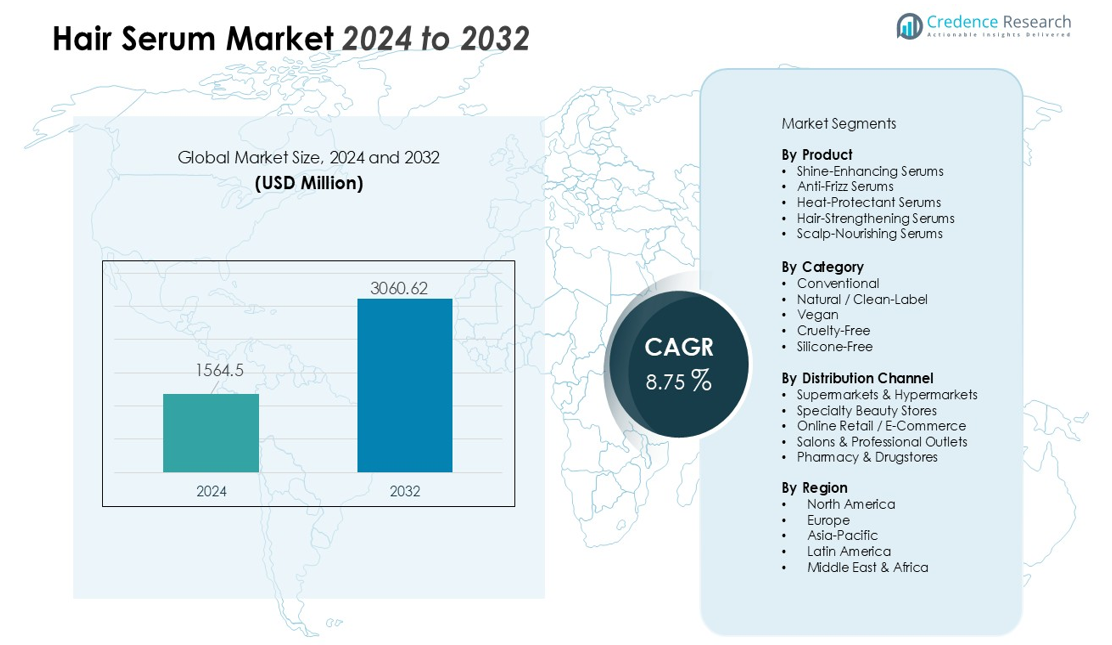
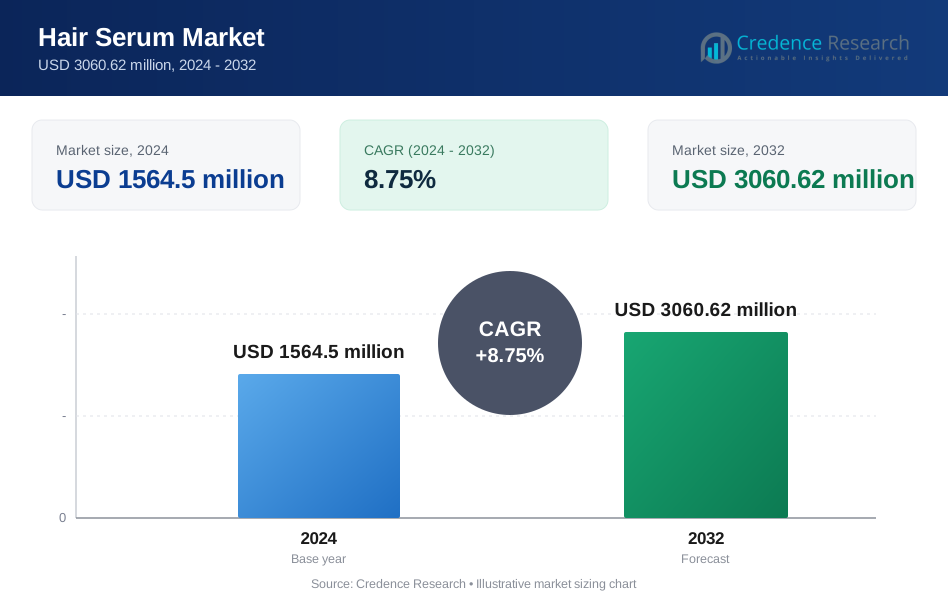
The hair serum market size was valued at USD 1564.5 million in 2024 and is anticipated to reach USD 3060.62 million by 2032, at a CAGR of 8.75 % during the forecast period.
| REPORT ATTRIBUTE | DETAILS |
|---|---|
| Historical Period | 2020-2023 |
| Base Year | 2024 |
| Forecast Period | 2025-2032 |
| Hair Serum Market Size 2024 | USD 1564.5 million |
| Hair Serum Market, CAGR | 8.75% |
| Hair Serum Market Size 2032 | USD 3060.62 million |
Key market drivers include heightened awareness of hair damage caused by pollution, UV exposure, styling tools, and chemical treatments. Consumers adopt serums as preventive and restorative solutions, boosting demand for targeted offerings such as anti-frizz, anti-breakage, heat-protectant, strengthening, and scalp-revitalization serums. The rise of vegan, sulfate-free, and silicone-free formulations aligns with evolving consumer expectations for safer, more sustainable products. Strong digital influence—driven by social media, professional hair-stylists, and e-commerce platforms—significantly shapes product discovery and purchase decisions.
Regionally, North America leads due to high spending on premium hair-care products and strong salon networks. Europe follows with robust adoption of natural and eco-certified formulations. Asia-Pacific emerges as the fastest-growing region, driven by rising beauty awareness, urbanization, and expanding middle-class spending across India, China, and Southeast Asia.
Market Insights:
- The hair serum market grows from USD 1564.5 million in 2024 to USD 3060.62 million by 2032 at a strong CAGR of 8.75%.
- Rising damage from heat styling, pollution, and chemical treatments drives demand for preventive, strengthening, and restorative serums.
- Premium, multifunctional, and clean-label formulations—such as vegan, silicone-free, and botanical blends—gain strong consumer preference.
- Digital influence from social media, salons, and e-commerce accelerates product discovery and boosts sales across demographics.
- North America leads the market, while Asia-Pacific shows the fastest growth due to rising beauty awareness and expanding middle-class consumption.
Market Drivers:
Rising Focus on Damage Repair and Preventive Hair Care
The hair serum market benefits from strong consumer demand for solutions that address damage caused by heat styling, pollution, and chemical treatments. It responds to a shift toward preventive care, where individuals seek products that protect hair structure before visible deterioration occurs. Brands develop formulations with antioxidants, amino acids, and lightweight silicones to strengthen hair fibers. Consumers show a clear preference for products that reduce breakage and restore smoothness without weighing hair down.
- For instance, Virtue Labs' Damage Reverse Serum provides a 360° approach to hair repair and claims to instantly repair 98% of split ends after just one use, showcasing its strong efficacy in damage repair technology.
Growing Preference for Premium and Multifunctional Formulations
The hair serum market gains traction from increasing interest in high-performance products that deliver multiple benefits in one application. It sees rising adoption of serums that combine shine enhancement, heat protection, humidity resistance, and nourishment. Premium brands introduce botanicals, peptides, and vitamin-rich blends to elevate product value. Consumers choose multifunctional serums to simplify routines while maintaining consistent hair quality.
- For instance, Kérastase's Première Sérum Filler protects hair from heat damage up to 450°F while providing 3 times smoother hair with anti-frizz properties, showcasing advanced multifunctional formulation technology.
Expansion of Clean Beauty and Sustainable Ingredient Demand
The hair serum market aligns with a global shift toward clean-label and eco-conscious products. It incorporates plant-based oils, toxin-free actives, and silicone alternatives to meet safety expectations. Brands emphasize transparency in ingredient sourcing and production practices to build trust. Consumers respond strongly to cruelty-free, vegan, and sustainably packaged serums.
Influence of Digital Platforms and Professional Recommendations
The hair serum market strengthens with growing digital visibility and expert endorsements. It benefits from social media tutorials, salon professionals, and beauty influencers who demonstrate proper application and highlight measurable results. Online reviews and targeted advertising increase product awareness among younger consumers. E-commerce platforms accelerate access to specialized formulations across regions.
Market Trends:
Shift Toward Natural, Lightweight, and Silicone-Alternative Formulations
The hair serum market experiences strong momentum toward natural and clean-label formulations that support healthier hair routines. It reflects rising interest in plant-derived oils, botanical extracts, and silicone substitutes that deliver smoothness without heavy residue. Brands highlight transparency, purity, and minimalism to appeal to ingredient-conscious consumers. Demand grows for serums with fast absorption, non-greasy textures, and scalp-friendly profiles. Product lines expand to address concerns linked to pollution, UV exposure, and environmental stress. Innovation centers on lighter molecular structures that enhance shine while preserving hair balance. Consumers respond well to formulations that maintain efficacy while aligning with sustainability values.
- For instance, Inolex offers LexFeel WOW DT, a 100% plant-based, partially volatile emollient that acts as a lightweight silicone alternative used to create non-greasy, fast-absorbing hair serums, with formulations containing over 80% of this ingredient for optimal lightweight performance.
Strong Growth in Personalized, Targeted, and Tech-Enabled Hair Solutions
The hair serum market advances through personalization trends that focus on specific hair types, textures, and conditions. It integrates analytics, AI-based diagnostics, and virtual consultations to support precise product recommendations. Brands release serums for curly, fine, treated, and aging hair to meet niche requirements. Demand rises for targeted solutions such as anti-frizz, anti-breakage, heat protection, and scalp renewal. Smart packaging and ingredient-optimizing technologies improve user experience and elevate premium positioning. Social commerce and influencer-led education accelerate consumer awareness of specialized serums. The trend reinforces a shift toward results-driven routines supported by technology and professional guidance.
- For instance, Inolex offers LexFeel WOW DT, a 100% plant-based, partially volatile emollient fluid that acts as a lightweight silicone alternative used to create non-greasy, fast-absorbing hair serums, with formulations containing high percentages of this ingredient for optimal lightweight performance.
Market Challenges Analysis:
Intensifying Competition and Pressure to Differentiate in a Saturated Market
The hair serum market faces strong competitive pressure due to a large number of global, regional, and emerging brands. It struggles to maintain differentiation when many products offer similar claims such as shine enhancement, frizz control, and heat protection. Consumers often shift between brands, which limits long-term loyalty. Marketing costs rise because brands must invest heavily in digital visibility and influencer partnerships. Product launches increase rapidly and shorten innovation cycles. Price-sensitive buyers challenge premium players despite strong interest in high-quality formulations. Differentiation requires continuous innovation supported by clear value communication.
Concerns Over Ingredient Safety, Performance Consistency, and Regulatory Compliance
The hair serum market experiences challenges linked to scrutiny of silicone-based and chemical-driven formulations. It encounters rising demand for clean alternatives that still deliver consistent performance on diverse hair types. Brands face difficulties when balancing natural ingredient claims with long-lasting effects. Regulatory variations across regions increase the complexity of formulation and labeling strategies. Consumer distrust grows when products cause buildup or fail to meet expectations. Supply-chain disruptions and raw material volatility also limit predictable production. These factors push brands to strengthen testing standards and adopt transparent sourcing practices.
Market Opportunities:
Expansion of Science-Backed, Problem-Specific, and High-Performance Formulations
The hair serum market gains strong opportunity through rising demand for targeted solutions that address frizz, breakage, scalp dryness, and heat damage with measurable results. It supports innovation in peptide-infused, ceramide-rich, and microbiome-friendly serums that strengthen hair structure. Brands can introduce lab-tested actives and clinically validated claims to build trust among premium buyers. Growth potential increases for serums that cater to curly, textured, and chemically treated hair. Demand rises for lightweight products that deliver long-term repair without residue. Professional salons also create opportunity for hybrid treatments that combine styling benefits with restorative care. These developments strengthen the appeal of high-performance segments.
Growing Scope for Personalization, Eco-Friendly Packaging, and Digital Integration
The hair serum market benefits from rising interest in personalized hair-care routines guided by digital diagnostics and consumer data. It encourages brands to develop customizable serums based on hair texture, lifestyle, and environmental exposure. Sustainable packaging and refill systems create scope for strong differentiation in eco-conscious markets. Global demand increases for plant-based, cruelty-free, and ethically sourced formulations. E-commerce platforms expand access to niche brands and support rapid market penetration. Virtual try-ons, AI-powered consultations, and influencer-led education enhance consumer engagement. These trends open new pathways for long-term revenue growth across emerging and mature markets.
Market Segmentation Analysis:
By Product
The hair serum market shows strong demand across shine-enhancing, anti-frizz, heat-protectant, scalp-nourishing, and hair-strengthening serums. It grows rapidly in segments that target specific concerns linked to dryness, breakage, or styling damage. Shine and anti-frizz serums hold a notable share due to high usage across diverse hair types. Heat-protectant serums gain traction with rising use of dryers, straighteners, and curlers. Scalp-focused serums expand quickly due to interest in root health and microbiome balance. Premium repair serums command higher margins with peptide and ceramide infusions.
- For Instance, Brand-led studies indicate that L'Oréal's Extraordinary Hair Serum provides shine and anti-frizz benefits, with the brand claiming "6X more shiny hair
By Category
The hair serum market divides into conventional and natural or clean-label categories. It records strong growth in natural formulations driven by demand for plant-derived oils, silicone alternatives, and toxin-free blends. Conventional serums maintain relevance due to their proven performance and broad availability. Clean-label serums attract consumers who prefer transparency and minimal ingredient lists. Growth remains strong in vegan, cruelty-free, and sulfate-free offerings. Brands leverage natural ingredients without compromising shine or smoothness.
- For instance, Vegamour's GRO Hair Serum, which is plant-based, vegan, and cruelty-free, has been shown to deliver noticeably thicker-looking hair in as soon as 90 days, leveraging botanical ingredients effectively.
By Distribution Channel
The hair serum market develops across supermarkets, specialty stores, salons, and online channels. It sees rapid expansion in e-commerce because consumers trust influencer recommendations and digital reviews. Specialty beauty stores perform well due to curated assortments and expert guidance. Salons maintain strong influence by promoting professional-grade serums with premium claims. Supermarkets continue to dominate mass-market sales through wide accessibility. Online subscription models further support repeat purchases and brand loyalty.
Segmentations:
By Product
- Shine-Enhancing Serums
- Anti-Frizz Serums
- Heat-Protectant Serums
- Hair-Strengthening Serums
- Scalp-Nourishing Serums
By Category
- Conventional
- Natural / Clean-Label
- Vegan
- Cruelty-Free
- Silicone-Free
By Distribution Channel
- Supermarkets & Hypermarkets
- Specialty Beauty Stores
- Online Retail / E-Commerce
- Salons & Professional Outlets
- Pharmacy & Drugstores
By Region
- North America
- U.S.
- Canada
- Mexico
- Europe
- Germany
- France
- U.K.
- Italy
- Spain
- Rest of Europe
- Asia Pacific
- China
- Japan
- India
- South Korea
- South-east Asia
- Rest of Asia Pacific
- Latin America
- Brazil
- Argentina
- Rest of Latin America
- Middle East & Africa
- GCC Countries
- South Africa
- Rest of the Middle East and Africa
Regional Analysis:
Strong Market Presence in North America Driven by Premiumization and High Salon Influence
The hair serum market maintains a strong foothold in North America due to high adoption of premium hair-care products and strong penetration of salon-grade formulations. It benefits from consumers who prioritize heat protection, shine enhancement, and frizz control because of frequent styling tool usage. Brands introduce multifunctional serums that suit diverse hair textures across the region. Retailers support market expansion through wide assortments in beauty specialty stores and online platforms. Demand rises for clean-label and vegan serums that align with growing ingredient awareness. Influencer-led education strengthens product visibility and reinforces preference for high-performance formulas. Innovation remains robust as brands leverage scientific claims to capture premium-spending consumers.
Europe Shows Steady Growth Supported by Clean Beauty Preferences and Regulatory Standards
The hair serum market in Europe records consistent growth driven by strong demand for eco-certified, natural, and sustainable formulations. It benefits from strict cosmetic regulations that push brands toward transparent labeling and high-quality ingredient sourcing. Consumer interest increases in silicone alternatives, botanical oils, and lightweight blends that maintain natural hair appearance. Specialty retailers and pharmacy chains expand visibility of niche and artisanal brands. Markets in Germany, France, the UK, and Italy lead consumption, supported by established beauty culture and high grooming awareness. Digital platforms reinforce adoption through reviews and expert-led content. Regional innovation aligns with sustainability priorities and premium wellness trends.
Asia-Pacific Emerges as the Fastest-Growing Region with Expanding Middle-Class Consumption
The hair serum market accelerates in Asia-Pacific due to rising disposable income, urban lifestyle shifts, and increasing interest in targeted hair-care routines. It gains traction in markets such as China, India, Japan, and South Korea where humidity, pollution, and heat exposure create strong demand for anti-frizz and protective serums. Local and international brands introduce specialized solutions for textured, chemically treated, and fine hair. Online retail drives rapid adoption, supported by high mobile commerce usage. K-beauty and J-beauty influence product innovation with lightweight, fast-absorption formulations. Salon networks expand in major cities and promote premium repair serums. The region offers strong long-term potential due to demographic diversity and rising beauty engagement.
Key Player Analysis:
- L’Oréal S.A.
- The Procter & Gamble Company (P&G)
- Unilever PLC
- Kao Corporation
- Moroccanoil Israel Ltd.
- Vogue International LLC
- Estée Lauder Companies Inc.
- John Paul Mitchell Systems
- Briogeo
- Olaplex Holdings, Inc.
Competitive Analysis:
The hair serum market features strong competition among global leaders and specialized premium brands that focus on performance, innovation, and targeted claims. Key players include L’Oréal S.A., The Procter & Gamble Company (P&G), Unilever PLC, Kao Corporation, Moroccanoil Israel Ltd., and Vogue International LLC. It reflects a landscape where companies invest in advanced formulations that address frizz control, heat protection, shine enhancement, and scalp health. Brands emphasize clean-label ingredients, silicone alternatives, and lightweight textures to meet evolving consumer expectations. Digital engagement, influencer partnerships, and salon endorsements strengthen competitive positioning and accelerate product visibility. Companies expand distribution across e-commerce, specialty stores, and professional channels to capture diverse consumer segments. Innovation pipelines focus on botanical actives, peptides, and clinically backed performance to secure long-term loyalty in a saturated market.
Recent Developments:
- In June 2025, L’Oréal announced the acquisition of the haircare brand Color Wow to enhance its premium haircare portfolio.
- In June 2025, Unilever PLC completed the acquisition of the men's personal care brand Dr. Squatch, boosting its portfolio in the fast-growing premium men's grooming market.
Report Coverage:
The research report offers an in-depth analysis based on Product, Category, Distribution Channel and Region. It details leading Market players, providing an overview of their business, product offerings, investments, revenue streams, and key applications. Additionally, the report includes insights into the competitive environment, SWOT analysis, current Market trends, as well as the primary drivers and constraints. Furthermore, it discusses various factors that have driven Market expansion in recent years. The report also explores Market dynamics, regulatory scenarios, and technological advancements that are shaping the industry. It assesses the impact of external factors and global economic changes on Market growth. Lastly, it provides strategic recommendations for new entrants and established companies to navigate the complexities of the Market.
Future Outlook:
- Demand will rise for multifunctional serums that combine shine enhancement, heat protection, and long-term repair.
- Clean-label and silicone-alternative formulations will gain stronger traction among ingredient-conscious consumers.
- Brands will invest in peptide-rich, ceramide-based, and microbiome-supportive serums that deliver measurable results.
- Growth will accelerate in targeted solutions for curly, textured, color-treated, and fine hair segments.
- E-commerce platforms will strengthen market reach through personalized recommendations and influencer-driven visibility.
- Salon partnerships will expand, with professionals endorsing premium repair and protective serums.
- Sustainable packaging, refill systems, and ethical sourcing will shape brand differentiation strategies.
- AI-enabled diagnostics and virtual consultations will drive personalized product selection and routine planning.
- Regional expansion will intensify in Asia-Pacific due to rising beauty awareness and higher middle-class spending.
- Innovation pipelines will focus on lightweight, fast-absorbing formulations that maintain performance without buildup.
Request a Free Sample
Fill in your details and we'll send you a free sample report.
- Sample data tables & charts
- Research methodology
Need a Custom Version of This Report?
Tailor the scope, geography, or segments to your exact requirements.
- Custom geography or segment scope
- Direct access to our analyst team
Frequently Asked Questions
What is the current market size for the hair serum market, and what is its projected size in 2032?
At what Compound Annual Growth Rate is the hair serum market expected to grow between 2024 and 2032?
What are the key drivers for the growth of the hair serum market?
Which is the major segment in the hair serum market by nature?
Who are the leading companies in the hair serum market?
Table of Content
Chapter 1. Report Introduction
- 1.1 Report Description & Purpose
- 1.1.1 Report Title & Market Definition
- 1.1.2 Unique Selling Propositions (USP) & Key Differentiators
- 1.1.3 Value Proposition for Stakeholders
- 1.2 Research Objectives
- 1.2.1 Market Sizing Objectives (Volume & Revenue)
- 1.2.2 Segmentation Objectives
- 1.2.3 Competitive Intelligence Objectives
- 1.2.4 Forecast & Scenario Objectives
- 1.3 Report Scope
- 1.3.1 Hair Serum Scope – Types & Subtypes Covered
- 1.3.2 Geographic Scope – Regions & Countries Covered
- 1.3.3 Historical Period, Base Year & Forecast Period (2024; forecast to 2032)
- 1.3.4 Inclusions & Exclusions
- 1.4 HS Code & Classification Framework
- 1.5 Currency, Units & Pricing Basis
- 1.6 Target Stakeholders
- 1.7 Limitations & Assumptions
Chapter 2. Executive Summary
- 2.1 Global Hair Serum Market Snapshot
- 2.1.1 Market Size – Historical (2024) & Forecast (2024-2032) (2024: USD 1564.5 million → 2032: USD 3060.62 million)
- 2.1.2 Volume & Revenue – Global Totals
- 2.1.3 Key Market Highlights – Top Five Facts
- 2.2 Hair Serum Market Segmentation Snapshot
- 2.2.1 Market Split by Region – 2024 vs. 2032
- 2.3 Competitive Snapshot
- 2.3.1 Top 10 Players by Revenue Share – 2024
- 2.3.2 Top 10 Players by Volume Share – 2024
- 2.3.3 Recent Strategic Developments (18-Month Summary)
- 2.4 Key Investment Highlights & Strategic Conclusions
Chapter 3. Hair Serum Market Dynamics & Industry Analysis
- 3.1 Market Overview & Context
- 3.1.1 Hair Serum Market Position in the Broader Automotive Value Chain
- 3.1.2 OEM vs. Replacement Market Dynamics
- 3.1.3 Market Maturity & Development Stage by Region
- 3.2 Hair Serum Market Drivers
- 3.3 Hair Serum Market Restraints & Challenges
- 3.4 Hair Serum Market Opportunities
- 3.5 Porter's Five Forces Analysis
- 3.5.1 Threat of New Entrants
- 3.5.2 Bargaining Power of Suppliers
- 3.5.3 Bargaining Power of Buyers
- 3.5.4 Threat of Substitutes
- 3.5.5 Competitive Rivalry – Intensity Assessment
- 3.6 Hair Serum Value Chain Analysis
- 3.6.1 Upstream – Raw Material/Input Suppliers
- 3.6.1.1 Raw Material/Input 1
- 3.6.1.2 Raw Material/Input 2
- 3.6.1.3 Raw Material/Input 3
- 3.6.2 Midstream – Production/Manufacturing/Service Delivery
- 3.6.2.1 Production/Process Overview
- 3.6.2.2 Key Facility Locations & Capacity by Manufacturer
- 3.6.3 Downstream – Distribution & End Consumer
- 3.6.3.1 Primary Channel – B2B/OEM
- 3.6.3.2 Secondary Channels – Dealer, Retail, Online, Direct
- 3.6.4 Value Chain Profitability Analysis
- 3.6.1 Upstream – Raw Material/Input Suppliers
- 3.7 PESTEL Analysis
- 3.7.1 Political Factors
- 3.7.2 Economic Factors
- 3.7.3 Social Factors
- 3.7.4 Technological Factors
- 3.7.5 Environmental Factors
- 3.7.6 Legal Factors
- 3.8 Hair Serum Supply Chain Analysis
- 3.8.1 Raw Material/Input Supply Risk Assessment
- 3.8.2 Manufacturing Concentration Risk (Geographic Exposure)
- 3.8.3 Trade Disruption Impact Analysis
- 3.9 Regulatory & Policy Landscape
Note: The regulatory and policy landscape section covers regulations based on their applicability to the market, Hair Serum category, geography, and scope of the study. Only regulatory frameworks with a material impact on operations, compliance, trade, sustainability, or market access are analyzed in detail.
Chapter 4. Key Investment Pockets & Opportunity Analysis
- 4.1 Hair Serum Market Attractiveness Analysis
- 4.1.1 By Region – Investment Attractiveness Matrix (Volume × CAGR)
- 4.2 Absolute Revenue Growth Opportunity
- 4.2.1 By Region – Absolute USD Growth Through 2032
- 4.3 Incremental Volume Opportunity
- 4.3.1 By Region – Incremental Volume Through 2032
- 4.3.2 Segment – Incremental Volume
- 4.4 Emerging Submarket Opportunity Deep Dive (Subject to Applicability)
- 4.5 Emerging Market Opportunity Scorecards
- 4.5.1 United States
- 4.5.2 Europe
- 4.5.3 Asia
- 4.5.4 Middle East & Africa
Note: Emerging Market Opportunity Scorecards will be included based on relevance and strategic importance. Regions listed are indicative and may vary depending on data availability and market dynamics.
Chapter 5. Hair Serum Import-Export Analysis & Trade Flows
- 5.1 Global Trade Overview
- 5.1.1 Global Export Value by Country (2024)
- 5.1.2 Global Export Volume by Country (2024)
- 5.1.3 Global Import Value by Country (2024)
- 5.1.4 Global Import Volume by Country (2024)
- 5.1.5 Net Trade Balance by Country (2024)
- 5.2 Export Analysis – Segment
- 5.2.1 Type 1 (HS Code)
- 5.2.2 Type 2 (HS Code)
- 5.2.3 Type 3 (HS Code)
- 5.2.4 Type 4 (HS Code)
- 5.2.5 Type 5 (HS Code)
- 5.3 Import Analysis – Segment
- 5.3.1 Type 1 (HS Code)
- 5.3.2 Type 2 (HS Code)
- 5.3.3 Type 3 (HS Code)
- 5.3.4 Type 4 (HS Code)
- 5.3.5 Type 5 (HS Code)
- 5.4 Average Unit Trade Prices
- 5.4.1 Average Export Price – Segment & Country
- 5.4.2 Average Import Price – Segment & Source Country
- 5.4.3 Price Trends (2024)
- 5.5 Key Trade Route Analysis
- 5.5.1 Trade Route 1
- 5.5.2 Trade Route 2
- 5.5.3 Trade Route 3
- 5.5.4 Trade Route 4
- 5.5.5 Trade Route 5
- 5.6 Trade Policy Impact Assessment
- 5.6.1 US Anti-Dumping & Section 301 Tariffs
- 5.6.2 EU Customs Union Impact
- 5.6.3 Major Free Trade Agreements
- 5.6.4 USMCA Rules of Origin
Note: Trade policy analysis will be included only where relevant to the Hair Serum market.
Chapter 6. Competitive Landscape & Company Benchmarking
- 6.1 Hair Serum Market Concentration & Structure
- 6.1.1 Herfindahl-Hirschman Index (HHI) – vs. 2024
- 6.1.2 Tier 1, Tier 2 & Tier 3 Market Structure
- 6.1.3 Global, Regional & Local Player Dynamics
- 6.2 Hair Serum Market Share Analysis – 2024
- 6.2.1 Global Revenue Share by Company
- 6.2.2 Global Volume Share by Company
- 6.2.3 Regional Revenue Share
- 6.2.4 Market Share Evolution ( vs. 2024)
- 6.2.5 OEM Segment Share by Company
- 6.2.6 Replacement Segment Share by Company
- 6.3 Production/Delivery Capacity & Facility Analysis
- 6.3.1 Global Installed Capacity
- 6.3.2 Capacity Utilization Rates
- 6.3.3 Production/Output Volume
- 6.3.4 Facility Locations & Capacity Map
- 6.3.5 Planned Capacity Additions
- 6.4 Hair Serum Competitive Benchmarking Matrix
- 6.4.1 Revenue, Volume, CAGR & Profitability Comparison
- 6.4.2 Channel Revenue Mix
- 6.4.3 Geographic Revenue Exposure
- 6.4.4 R&D Intensity
- 6.4.5 Sustainability Maturity
- 6.5 Strategic Developments in Hair Serum (Last 24 Months)
- 6.5.1 Mergers, Acquisitions & Divestments
- 6.5.2 New Hair Serum Launches
- 6.5.3 Facility Expansions
- 6.5.4 Strategic Alliances, Joint Ventures & Partnerships
- 6.5.5 Distribution Expansion & Market Entry
- 6.5.6 Sustainability & ESG Initiatives
- 6.6 Competitive Strategy Mapping
- 6.6.1 Leader, Challenger, Follower & Niche Classification
- 6.6.2 Pricing Strategy Comparison
- 6.6.3 Channel Strategy Matrix
Note: Strategic developments are included based on their materiality and the availability of reliable information.
Chapter 7. Global Hair Serum Market – By Distribution Channel
- 7.1 Segment Overview
- 7.1.1 Volume & Revenue Split by Channel (2024 & 2032)
- 7.1.2 Channel Mix Evolution (2024-2032)
Chapter 8. Regional Market Analysis – Global Overview
- 8.1 Global Regional Overview
- 8.1.1 Regional Volume Share
- 8.1.2 Regional Revenue Share
- 8.1.3 Regional Volume by Region
- 8.1.4 Regional Revenue by Region
- 8.1.5 Regional Forecast Through 2032
- 8.2 Cross-Regional Segment Analysis
- 8.2.1 By Distribution Channel
- 8.2.2 By Brand/Price Tier
Chapter 9. North America Hair Serum Market
- 9.1 United States
- 9.2 Canada
- 9.3 Mexico
Chapter 10. Europe Hair Serum Market
- 10.1 Germany
- 10.2 France
- 10.3 Italy
- 10.4 United Kingdom
- 10.5 Spain
- 10.6 Poland
- 10.7 Russia
- 10.8 Netherlands
- 10.9 Belgium
- 10.10 Sweden
- 10.11 Denmark
- 10.12 Norway
- 10.13 Rest of Europe
Chapter 11. Asia Pacific Hair Serum Market
- 11.1 China
- 11.2 India
- 11.3 Japan
- 11.4 South Korea
- 11.5 Thailand
- 11.6 Indonesia
- 11.7 Vietnam
- 11.8 Malaysia
- 11.9 Australia
- 11.10 Rest of Asia Pacific
Chapter 12. Latin America Hair Serum Market
- 12.1 Brazil
- 12.2 Argentina
- 12.3 Colombia
- 12.4 Chile
- 12.5 Rest of Latin America
Chapter 13. Middle East Hair Serum Market
- 13.1 Saudi Arabia
- 13.2 United Arab Emirates
- 13.3 Turkey
- 13.4 Israel
- 13.5 Iran
- 13.6 Rest of the Middle East
Chapter 14. Africa Hair Serum Market
- 14.1 South Africa
- 14.2 Egypt
- 14.3 Nigeria
- 14.4 Morocco
- 14.5 Rest of Africa
Chapter 15. Hair Serum Company Profiles
- 15.1 [Company 01]
- 15.1.1 Company Overview
- 15.1.2 Key Management Personnel
- 15.1.3 Products & Services Portfolio
- 15.1.4 Financial Performance
- 15.1.5 Key Market Focus & Geographic Presence
- 15.1.6 Recent Developments & Strategic Initiatives
Note: The company profile list is preliminary and may change based on research findings, market developments, data availability, and client requirements.
Chapter 16. Appendices
- Appendix A – List of Abbreviations & Acronyms
- Appendix B – Industry Classification Code Reference – Full Series
- Appendix C – Production & Capacity Data Tables
- Appendix D – End-Use & Demand Base Tables
- Appendix E – Consumption & Replacement Rate Assumptions
- Appendix F – ASP Reference Tables
- Appendix G – Manufacturing & Facility Database
- Appendix H – Import-Export Data Tables
- Appendix I – Regulatory Summary Tables
- Appendix J – Primary Research Participant List (Anonymized)
- Appendix K – Primary Research Questionnaire Framework
- Appendix L – Data Sources & Bibliography
- Appendix M – Market Size Divergence & Source Comparison
Chapter 17. Research Methodology
- 17.1 Research Framework & Philosophy
- 17.2 Secondary Research – Sources, Hierarchy & Data Extraction
- 17.3 Data Modeling – Bottom-Up & Top-Down Market Sizing
- 17.4 Primary Research – Stakeholder Framework, LOI & Sample Sizes
- 17.5 Forecast Methodology – Regression, Scenario & Sensitivity Analysis
- 17.6 Quality Control – Four-Layer Validation Framework
- 17.7 Limitations & Standard Assumptions
- 17.8 Disclaimer
