Market Overview
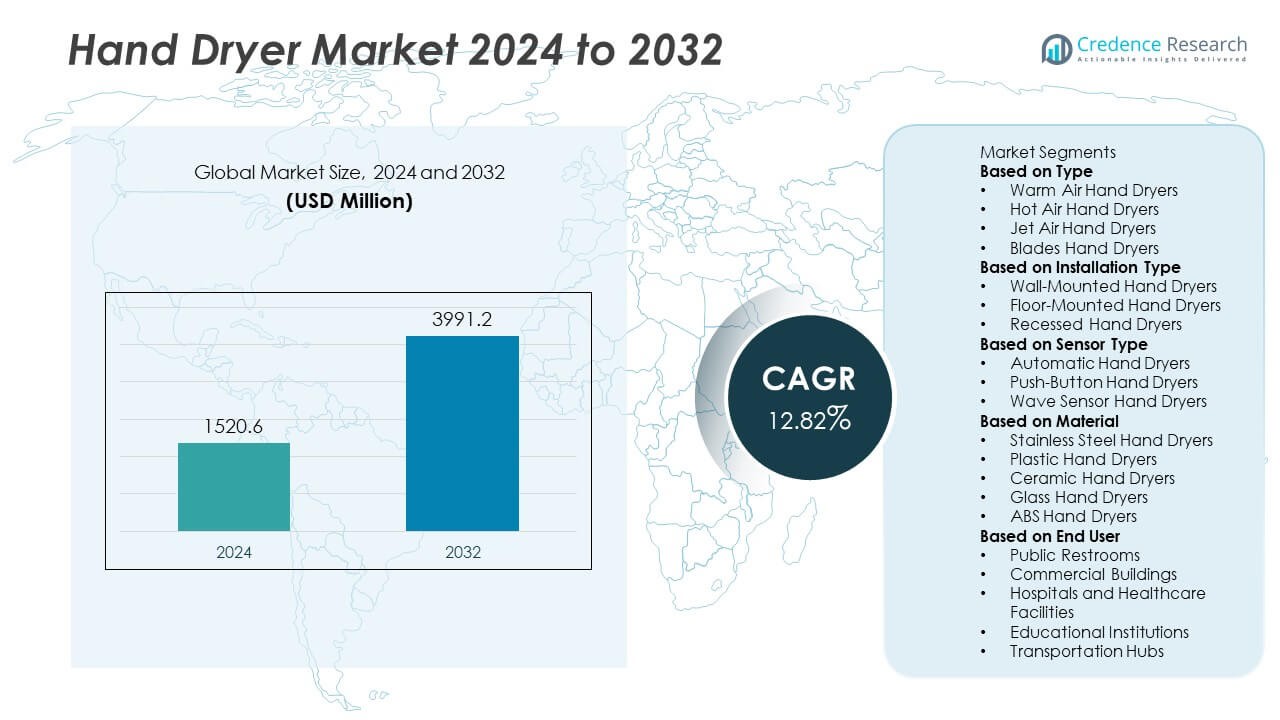
The Hand Dryer Market was valued at USD 1,520.6 million in 2024 and is projected to reach USD 3,991.2 million by 2032, growing at a CAGR of 12.82% during the forecast period.
| REPORT ATTRIBUTE | DETAILS |
|---|---|
| Historical Period | 2020-2024 |
| Base Year | 2024 |
| Forecast Period | 2025-2032 |
| Hand Dryer Market Size 2024 | USD 1,520.6 Million |
| Hand Dryer Market, CAGR | 12.82% |
| Hand Dryer Market Size 2032 | USD 3,991.2 Million |
The Hand Dryer Market grows on the back of rising hygiene awareness, stringent public health regulations, and a global shift toward sustainable restroom solutions. Demand is fueled by the replacement of paper towels with energy-efficient, touchless systems in high-traffic commercial and public facilities. Technological advancements, including faster drying times, low-noise motors, and antibacterial coatings, enhance user experience and operational efficiency.
The Hand Dryer Market spans North America, Europe, Asia-Pacific, Latin America, and the Middle East & Africa, each showing distinct adoption drivers. North America leads in implementing advanced hygiene technologies supported by mature infrastructure and green building initiatives. Europe emphasizes eco-friendly designs and strict environmental compliance, while Asia-Pacific benefits from rapid urbanization and large-scale commercial projects. Latin America and the Middle East & Africa experience steady growth through hospitality and public infrastructure upgrades. Key players shaping the market include Dyson, renowned for high-speed, low-energy models; Excel Dryer, recognized for durable, high-performance solutions; and Mitsubishi Electric, offering advanced sensor-based systems. Other notable companies such as Hokwang Industries and JVD strengthen competition with innovative designs and diverse product portfolios catering to varied commercial needs.
Market Insights
- The Hand Dryer Market was valued at USD 1,520.6 million in 2024 and is projected to reach USD 3,991.2 million by 2032, registering a CAGR of 12.82% during the forecast period.
- It continues to grow due to rising awareness of hygiene, stricter public health regulations, and the shift from paper towels to energy-efficient, touchless drying solutions across high-traffic commercial and public facilities.
- Technological trends focus on high-speed drying, low-noise operation, antibacterial coatings, and smart features such as IoT connectivity for performance monitoring and predictive maintenance.
- Competitive activity is driven by key players including Dyson, Excel Dryer, Mitsubishi Electric, Hokwang Industries, and JVD, each investing in product innovation, global distribution, and tailored solutions for diverse commercial environments.
- High initial investment costs for advanced models, ongoing maintenance needs, and lingering preference for paper towels in certain regions remain restraints to wider adoption.
- North America and Europe lead adoption through advanced infrastructure and strong environmental regulations, Asia-Pacific experiences rapid growth from urbanization and commercial expansion, while Latin America and the Middle East & Africa show steady progress in hospitality and public infrastructure projects.
- Expanding opportunities arise from emerging markets, eco-friendly product innovations, and increased integration of compact, aesthetic designs that meet both functional and architectural requirements in modern restrooms.
Market Drivers
Rising Focus on Hygiene and Public Health Standards Driving Market Demand
The Hand Dryer Market benefits from growing emphasis on hand hygiene in public spaces, commercial establishments, and institutional facilities. Governments and health agencies promote hand hygiene campaigns, reinforcing the importance of effective hand drying in reducing pathogen transmission. Businesses invest in touchless, high-speed dryers to comply with updated sanitation regulations and to reassure visitors. Hospitality, healthcare, and retail sectors prioritize devices that offer minimal contact and quick operation. Airports, malls, and educational institutions integrate them to align with modern hygiene protocols. This shift creates sustained demand across both developed and developing economies.
- For instance, Dyson’s Airblade 9kJ operates with a digital motor reaching 75,000 rpm, delivers 23 litres of air per second in Max mode, and completes a 10‑second dry, while its HEPA filter captures 99.95 % of particles down to 0.3 microns.
Increasing Environmental Awareness and Shift Away from Paper Towels
Rising concern over waste reduction supports adoption of hand dryers as a sustainable alternative to paper towels. It eliminates recurring paper disposal needs, lowering maintenance costs and landfill impact. Corporations adopt eco-friendly solutions to meet corporate social responsibility goals and align with environmental certifications. Technological improvements have led to models that consume less energy while maintaining fast drying performance. Green building standards encourage installations in new commercial projects. This transition strengthens market penetration across sectors seeking long-term operational efficiency.
- For instance, Excel Dryer’s XLERATOR® reduces energy consumption to 4.3 watt-hours per cycle and cuts carbon footprint by 94% compared to paper towels, while delivering a complete dry in 8 seconds, aligning with LEED and other sustainability frameworks. This transition strengthens market penetration across sectors seeking long-term operational efficiency.
Technological Advancements Enhancing Efficiency and User Experience
Innovations in motor design, airflow optimization, and heat control contribute to faster drying times and improved energy efficiency. The Hand Dryer Market now offers models with noise reduction features, adjustable temperature settings, and antibacterial coatings. Touchless activation through infrared sensors enhances user safety and convenience. Manufacturers invest in compact designs suitable for high-traffic and space-constrained environments. Integration with smart facility management systems allows real-time performance monitoring and maintenance alerts. These enhancements make them attractive for both retrofits and new installations.
Expanding Commercial Infrastructure and High-Footfall Venues
Rapid growth in commercial infrastructure drives installations in offices, shopping complexes, hotels, and transportation hubs. It supports continuous upgrades to restroom facilities to meet evolving visitor expectations. Rising urbanization increases foot traffic in public amenities, pushing facility managers to adopt reliable, high-capacity dryers. Construction of new airports, metro stations, and event arenas includes advanced drying solutions as standard. Competitive positioning among hospitality providers fuels investment in premium units with modern aesthetics. This infrastructure expansion ensures steady growth opportunities across regions.
Market Trends
Adoption of Touchless and Sensor-Based Technologies for Enhanced Hygiene
The Hand Dryer Market is experiencing a notable shift toward fully touchless and sensor-activated models. Infrared sensing technology reduces physical contact, minimizing the risk of cross-contamination in high-traffic restrooms. It appeals to sectors where hygiene is critical, including healthcare, foodservice, and hospitality. Advanced models activate and deactivate precisely, improving energy efficiency and extending device lifespan. Manufacturers develop compact sensor systems that operate reliably under varied lighting and usage conditions. This trend aligns with growing consumer preference for automated, contact-free restroom solutions.
- For instance, Excel Dryer’s XLERATOR® features an infrared optical sensor situated next to the air outlet, includes a 35-second lock-out period when hands remain under the nozzle, and signals filter condition via an externally visible red LED-combining convenience with maintenance efficiency
Integration of Energy-Efficient and Low-Noise Designs in Commercial Spaces
Energy efficiency remains a key focus for product development, with modern units consuming less power without sacrificing drying performance. The Hand Dryer Market offers models equipped with advanced motor systems and optimized airflow channels to reduce operational costs. Noise-reduction engineering supports installations in offices, libraries, and upscale hotels where acoustic comfort matters. It allows operators to comply with environmental building codes while enhancing user experience. Enhanced durability and lower maintenance requirements strengthen adoption in high-usage environments. These developments cater to both cost-conscious and sustainability-driven buyers.
- For instance, a federal environmental agency’s facilities manuals emphasize acoustic planning and preventive maintenance to manage sound in occupied spaces and to prevent avoidable energy draw from poorly maintained equipment, reinforcing procurement of low-noise, high-efficiency appliances in public buildings.
Growing Demand for Compact, Aesthetic, and Space-Saving Designs
Facility managers increasingly favor hand dryers that combine performance with modern aesthetics and space efficiency. The Hand Dryer Market responds with slim, wall-mounted designs that fit into compact restrooms without compromising functionality. It supports architectural flexibility in both retrofits and new constructions. Premium finishes and customizable color options help align with brand identity and interior décor. Integrated lighting and design accents enhance the visual appeal of commercial restrooms. This trend reflects the broader move toward restroom solutions that balance utility with design elegance.
Expansion of Smart and Connected Features for Maintenance Optimization
Smart technology integration is emerging as a significant trend, enabling real-time monitoring of usage patterns and maintenance needs. The Hand Dryer Market now includes models with IoT connectivity, allowing facility managers to track performance remotely. It streamlines servicing by providing alerts for cleaning schedules or component replacements. Data-driven insights help optimize placement, reduce downtime, and improve user satisfaction. Integration with broader building management systems supports centralized operational control. This digital transformation in restroom equipment signals a new phase of efficiency and service quality.
Market Challenges Analysis
High Initial Investment and Maintenance Constraints Limiting Adoption
The Hand Dryer Market faces challenges from the high upfront cost of advanced models, which can deter smaller businesses and budget-conscious facilities. Premium units with energy-efficient motors, touchless sensors, and noise-reduction features require significant capital expenditure. It often leads to slower adoption in low-margin sectors such as small hospitality outlets or public restrooms in developing regions. Maintenance demands, including periodic filter replacements and sensor calibration, add to operational expenses. In areas with unstable power supply, reliance on electric devices can hinder consistent performance. These factors create barriers for wider penetration, particularly in cost-sensitive markets.
Perception Issues and User Preference for Traditional Alternatives
Persistent concerns over hygiene, noise, and drying speed can influence user preferences toward paper towels, despite technological advancements. The Hand Dryer Market contends with studies and public perceptions that question air hygiene in shared restrooms. It faces skepticism from facility managers who prioritize immediate, disposable solutions in high-traffic environments. Loud operation, even in newer models, can discourage use in settings such as schools and offices. Some regions maintain strong cultural or regulatory preferences for paper-based drying methods. Addressing these perception challenges is essential for improving market acceptance across diverse user segments.
Market Opportunities
Rising Demand in Emerging Economies and Infrastructure Development
The Hand Dryer Market holds significant growth potential in emerging economies undergoing rapid urbanization and infrastructure expansion. New commercial complexes, airports, shopping centers, and hospitality projects create a strong demand for modern restroom solutions. It benefits from government initiatives promoting hygiene and sustainability in public facilities. Increasing disposable incomes and changing consumer expectations in these regions encourage adoption of advanced, touchless models. Partnerships with local distributors can accelerate penetration into underserved markets. Expanding sales networks in Asia-Pacific, Latin America, and the Middle East offers a substantial opportunity for long-term growth.
Innovation in Eco-Friendly and Smart Technology Solutions
Growing emphasis on sustainability presents opportunities for manufacturers to develop energy-efficient and environmentally responsible products. The Hand Dryer Market can leverage advances in low-power motors, recyclable materials, and noise-reduction technology to appeal to eco-conscious buyers. It can also capitalize on smart integration features that provide usage analytics and predictive maintenance alerts. Customization options in design, color, and branding create added value for corporate clients. The ability to combine environmental benefits with enhanced operational efficiency strengthens appeal in both private and public sectors. Continuous product innovation positions the market to capture a broader share of premium segments.
Market Segmentation Analysis:
By Type
The Hand Dryer Market is segmented into hot air dryers, jet air dryers, and hybrid models. Hot air dryers remain a common choice in cost-sensitive installations, offering reliable performance and straightforward maintenance. Jet air dryers dominate high-traffic environments with faster drying times and lower energy use, supported by advanced motor and airflow designs. Hybrid models combine heating elements with high-velocity air streams, appealing to facilities seeking comfort and efficiency in a single unit. It benefits from innovations that reduce energy consumption while maintaining consistent performance. Demand patterns vary across regions, with developed markets favoring premium models and emerging markets prioritizing affordability.
- For instance, Mitsubishi Electric’s Jet Towel Smart combines warm-air comfort with a dual-jet airflow delivering a dry in approximately 9 seconds, while maintaining a noise output of 61 dB in standard mode.
By Installation Type
Installation preferences vary between wall-mounted, recessed, and portable units, driven by space availability, building design, and usage volume. Wall-mounted dryers are widely adopted in commercial restrooms for their ease of access and efficient use of space. Recessed installations gain popularity in high-end or space-constrained environments, offering a flush finish that enhances aesthetics. Portable units cater to temporary facilities or event venues where permanent fixtures are impractical. The Hand Dryer Market adapts to these requirements through modular designs and simplified installation processes. It sees increasing interest in solutions that combine compact form factors with high-performance output, supporting both retrofit and new construction projects.
- For instance, Excel Dryer’s XLERATOR® wall-mounted model delivers an 8-second dry time using 1.7 Wh per cycle, with an adjustable speed-and-sound control that allows customization between 65 dB and 75 dB depending on the environment.
By Sensor Type
Sensor technology plays a critical role in improving hygiene, energy efficiency, and user convenience. Infrared sensors are the most prevalent, activating automatically when hands are detected, reducing the need for contact and limiting contamination risks. Some advanced models integrate dual sensors to improve detection accuracy and accommodate varying user heights and hand positions. Push-button models, while less common, remain in use in low-cost or low-traffic settings where automation is not essential. The Hand Dryer Market benefits from ongoing advancements in sensor reliability, speed, and energy optimization. It aligns with the growing preference for touchless restroom solutions across sectors such as healthcare, hospitality, and corporate facilities.
Segments:
Based on Type
- Warm Air Hand Dryers
- Hot Air Hand Dryers
- Jet Air Hand Dryers
- Blades Hand Dryers
Based on Installation Type
- Wall-Mounted Hand Dryers
- Floor-Mounted Hand Dryers
- Recessed Hand Dryers
Based on Sensor Type
- Automatic Hand Dryers
- Push-Button Hand Dryers
- Wave Sensor Hand Dryers
Based on Material
- Stainless Steel Hand Dryers
- Plastic Hand Dryers
- Ceramic Hand Dryers
- Glass Hand Dryers
- ABS Hand Dryers
Based on End User
- Public Restrooms
- Commercial Buildings
- Hospitals and Healthcare Facilities
- Educational Institutions
- Transportation Hubs
Based on the Geography:
- North America
- U.S.
- Canada
- Mexico
- Europe
- UK
- France
- Germany
- Italy
- Spain
- Russia
- Belgium
- Netherlands
- Austria
- Sweden
- Poland
- Denmark
- Switzerland
- Rest of Europe
- Asia Pacific
- China
- Japan
- South Korea
- India
- Australia
- Thailand
- Indonesia
- Vietnam
- Malaysia
- Philippines
- Taiwan
- Rest of Asia Pacific
- Latin America
- Brazil
- Argentina
- Peru
- Chile
- Colombia
- Rest of Latin America
- Middle East
- UAE
- KSA
- Israel
- Turkey
- Iran
- Rest of Middle East
- Africa
- Egypt
- Nigeria
- Algeria
- Morocco
- Rest of Africa
Regional Analysis
North America
North America holds 32% of the Hand Dryer Market, supported by strong infrastructure development, advanced hygiene standards, and high adoption of sustainable technologies. The United States leads the region, driven by strict building codes, green certification requirements, and increasing preference for energy-efficient restroom solutions. Airports, shopping malls, educational institutions, and corporate facilities continue to replace paper towels with high-speed, sensor-based dryers. It benefits from early adoption of touchless technology and a mature commercial real estate sector that frequently upgrades restroom amenities. Canada and Mexico contribute to regional growth through expanding hospitality, healthcare, and retail construction projects. Government-led campaigns promoting hygiene in public spaces further support adoption, ensuring steady replacement demand for older units.
Europe
Europe accounts for 28% of the Hand Dryer Market, with the United Kingdom, Germany, France, and Spain leading installations in both public and private facilities. Environmental regulations, such as those promoting waste reduction and energy efficiency, strongly influence purchasing decisions. It benefits from widespread implementation of eco-friendly technologies and preference for low-noise, high-performance units in premium hospitality and office environments. Airports, rail stations, and high-footfall tourist attractions across the continent increasingly rely on fast-drying, touchless systems to improve hygiene and reduce operational costs. Ongoing renovation of commercial spaces, coupled with sustainability-driven policies like the EU Green Public Procurement framework, continues to accelerate adoption. The region’s emphasis on design aesthetics also encourages demand for compact and visually appealing units.
Asia-Pacific
Asia-Pacific holds 25% of the Hand Dryer Market, fueled by rapid urbanization, infrastructure expansion, and growing awareness of hygiene standards. China, Japan, India, and Australia are key markets, with large-scale investments in airports, shopping centers, and hospitality facilities. It benefits from government initiatives that promote hygiene in public restrooms, particularly in densely populated urban areas. Japan and South Korea lead in adopting advanced, energy-efficient models with integrated hygiene features, while India sees rising demand from budget-friendly units in mid-tier commercial establishments. Growing tourism and international events, such as sports tournaments and exhibitions, also drive installations. The expanding middle-class population and corporate investment in modern commercial spaces strengthen the region’s long-term growth prospects.
Latin America
Latin America represents 8% of the Hand Dryer Market, led by Brazil, Mexico, and Argentina. Growth is supported by increasing modernization of public infrastructure, especially in airports, shopping malls, and government buildings. It faces challenges related to economic volatility, which can delay large-scale restroom upgrades, but rising demand for cost-effective, durable units supports steady adoption. Hospitality and tourism play a significant role, with hotels and resorts seeking to improve guest experience through modern amenities. Awareness campaigns about hygiene and environmental benefits are gradually shifting preferences away from paper towels. Local manufacturing and distribution partnerships help improve accessibility and affordability in key markets.
Middle East & Africa
The Middle East & Africa account for 7% of the Hand Dryer Market, with the United Arab Emirates, Saudi Arabia, and South Africa driving installations in commercial and public spaces. Mega infrastructure projects, including airports, malls, and sports stadiums, create opportunities for premium, high-speed models. It benefits from the hospitality sector’s focus on luxury and hygiene, particularly in Gulf countries. Adoption in Africa remains slower due to budget constraints, but growth is visible in urban centers with expanding retail and transport hubs. Government investment in public infrastructure, coupled with rising tourism, supports gradual market expansion. The region’s focus on modern, high-profile developments ensures continued demand for advanced, aesthetically appealing units.
Key Player Analysis
- Strongway
- Mitsubishi Electric
- Dyson
- JVD
- Hokwang Industries
- Meiko
- Starmix
- SILHOUETTE
- XUELIN
- Excel Dryer
Competitive Analysis
The competitive landscape of the Hand Dryer Market is characterized by strong product innovation, strategic global expansion, and focus on sustainability. Leading players such as Dyson, Excel Dryer, Mitsubishi Electric, Hokwang Industries, and JVD dominate through advanced technology integration and broad distribution networks. Dyson leverages its expertise in high-speed, low-energy designs, offering premium models with distinctive aesthetics and superior hygiene features. Excel Dryer emphasizes durability and customizable options, catering to diverse commercial requirements. Mitsubishi Electric delivers reliable, sensor-based systems with efficient airflow engineering, targeting both premium and high-volume applications. Hokwang Industries strengthens its position through a comprehensive product portfolio, competitive pricing, and compliance with international quality standards. JVD focuses on ergonomic, space-saving designs suitable for high-traffic environments in hospitality and public sectors. Competitive strategies include continuous R&D investment, partnerships with distributors, and adaptation to regional market needs. The ongoing shift toward eco-friendly, touchless solutions intensifies competition, encouraging players to differentiate through performance, energy efficiency, and design versatility.
Recent Developments
- In 25 December 2024, Hokwang Industries introduced the EcoPure HEPA Hand Dryer, featuring advanced HEPA filtration, plug-in convenience, high speed drying, energy efficiency, and strong hygiene credentials.
- In February 2024, JVD acquired Novven, integrating its disinfection cabinet solutions under the new brand Novven by JVD.
- In April 2023, Hokwang Industries released its EcoFast-BL brushless motor hand dryers, offering extended motor life, lower noise (~75 dB), and HEPA filtration.
Market Concentration & Characteristics
The Hand Dryer Market demonstrates moderate to high concentration, with a few global brands holding significant influence through established product portfolios, advanced technology, and extensive distribution networks. Leading companies such as Dyson, Mitsubishi Electric, Excel Dryer, Hokwang Industries, and JVD shape competitive dynamics by setting performance, design, and sustainability benchmarks. It reflects characteristics of a technology-driven market, where innovation in energy efficiency, hygiene features, and smart connectivity plays a central role in differentiation. Demand is driven by regulatory compliance, green building initiatives, and growing replacement cycles in commercial facilities. Regional players compete by offering cost-effective and locally adapted models, while multinational brands focus on premium segments with advanced specifications. The market shows steady product evolution, shorter innovation cycles, and strong alignment with environmental goals, indicating sustained opportunities for players capable of balancing price competitiveness with performance and design innovation.
Report Coverage
The research report offers an in-depth analysis based on Type, Installation Type, Sensor Type, Material, End User and Geography. It details leading market players, providing an overview of their business, product offerings, investments, revenue streams, and key applications. Additionally, the report includes insights into the competitive environment, SWOT analysis, current market trends, as well as the primary drivers and constraints. Furthermore, it discusses various factors that have driven market expansion in recent years. The report also explores market dynamics, regulatory scenarios, and technological advancements that are shaping the industry. It assesses the impact of external factors and global economic changes on market growth. Lastly, it provides strategic recommendations for new entrants and established companies to navigate the complexities of the market.
Future Outlook
- The market will expand with increasing adoption of touchless technologies in public and commercial restrooms.
- Demand will rise in emerging economies due to rapid urbanization and infrastructure development.
- Energy-efficient models will gain preference under stricter environmental regulations.
- Integration of IoT features will enhance maintenance efficiency and operational monitoring.
- Premium segments will grow with higher demand for noise reduction and aesthetic designs.
- Replacement cycles will shorten as facility managers upgrade to advanced hygiene solutions.
- Manufacturers will focus on compact designs to suit space-constrained installations.
- Sustainability goals will drive the shift from paper towels to eco-friendly drying systems.
- Competition will intensify as regional players improve technology and expand reach.
- Product innovation will continue to target faster drying times and enhanced hygiene performance.

Request a Free Sample
Fill in your details and we'll send you a free sample report.
- Sample data tables & charts
- Research methodology
Market Dynamics
Rising Focus on Hygiene and Public Health Standards
Increased awareness of hand hygiene in public and commercial spaces, along with stricter sanitation regulations, is driving the adoption of touchless, high-speed hand dryers to reduce pathogen transmission and reassure users.
Increasing Environmental Awareness and Shift Away from Paper Towels
Growing concern over waste reduction and sustainability is encouraging businesses and institutions to replace paper towels with energy-efficient hand dryers, lowering maintenance costs and supporting green building initiatives.
Technological Advancements Enhancing Efficiency and User Experience
Innovations such as faster drying times, low-noise motors, antibacterial coatings, and IoT-enabled maintenance are making hand dryers more attractive for both new installations and retrofits, improving operational efficiency and user satisfaction.
Expanding Commercial Infrastructure and High-Footfall Venues
Rapid urbanization and the construction of new commercial complexes, airports, and hospitality venues are increasing the demand for modern, reliable hand drying solutions that can handle high traffic and meet evolving visitor expectations.
Adoption of Touchless and Sensor-Based Technologies
The shift toward fully touchless, sensor-activated hand dryers is minimizing cross-contamination risks and aligning with consumer and regulatory preferences for automated, contact-free restroom solutions, especially in sectors where hygiene is critical.
Need a Custom Version of This Report?
Tailor the scope, geography, or segments to your exact requirements.
- Custom geography or segment scope
- Direct access to our analyst team
Frequently Asked Questions
What is the current market size for Hand Dryer, and what is its projected size in 2032?
At what Compound Annual Growth Rate is the Hand Dryer market projected to grow between 2025 and 2032?
Which Hand Dryer market segment held the largest share in 2024?
What are the primary factors fueling the growth of the Hand Dryer market?
Who are the leading companies in the Hand Dryer market?
Which region commanded the largest share of the Hand Dryer market in 2024?
Table of Content
Chapter 1 Market Segmentation
- 1.1 Segmentation Framework
- 1.1.1 Product and Service Classification
- 1.1.2 Application and End-Use Classification
- 1.1.3 Technology and Solution Classification
- 1.1.4 Customer and Distribution Channel Classification
- 1.1.5 Geographic Segmentation
- 1.1.6 Market Segment Definitions and Boundaries
- 1.2 By Type
- 1.2.1 Warm Air Hand Dryers
- 1.2.2 Hot Air Hand Dryers
- 1.2.3 Jet Air Hand Dryers
- 1.2.4 Blades Hand Dryers
- 1.3 By End User
- 1.3.1 Public Restrooms
- 1.3.2 Commercial Buildings
- 1.3.3 Hospitals and Healthcare Facilities
- 1.3.4 Educational Institutions
- 1.3.5 Transportation Hubs
- 1.4 By Sensor Type
- 1.4.1 Automatic Hand Dryers
- 1.4.2 Push-Button Hand Dryers
- 1.4.3 Wave Sensor Hand Dryers
- 1.5 By Installation Type
- 1.5.1 Wall-Mounted Hand Dryers
- 1.5.2 Floor-Mounted Hand Dryers
- 1.5.3 Recessed Hand Dryers
Chapter 2 Introduction
- 2.1 Report Objectives and Scope
- 2.2 Product Definition and Industry Terminology
- 2.3 Market Inclusions and Exclusions
- 2.4 Research Process
- 2.4.1 Primary Research and Expert Interviews
- 2.4.2 Secondary Research and Source Review
- 2.4.3 Top-Down and Bottom-Up Estimation
- 2.4.4 Data Triangulation and Verification
- 2.5 Market Size Measurement Basis
- 2.5.1 2024: USD 1,520.6 million → 2032: USD 3,991.2 million
- 2.6 Historical and Forecast Reference Periods
- 2.6.1 Base Year: 2024
- 2.6.2 Forecast Period: 2024-2032
- 2.7 Research Assumptions and Limitations
Chapter 3 Executive Summary
- 3.1 Market Snapshot and Key Findings
- 3.2 Base-Year Market Size, 2024
- 3.3 Forecast Market Size, 2032
- 3.4 Revenue and Volume Growth Outlook
- 3.5 Key Demand and Supply Indicators
- 3.6 Leading Market Segments
- 3.7 Fastest-Growing Market Opportunities
- 3.8 Regional Performance Highlights
- 3.9 Technology and Industry Transformation
- 3.10 Competitive Landscape Summary
- 3.11 Analyst View and Strategic Implications
Chapter 4 Global Hand Dryer Market Trends and Developments
- 4.1 Historical Industry Development
- 4.2 Recent Market Trends and Developments
- 4.3 Demand and Customer Behavior Trends
- 4.4 Technology and Product Innovation
- 4.5 Artificial Intelligence, Automation and Digitalization
- 4.6 Local Manufacturing and Supply Chain Realignment
- 4.7 Industry Partnerships, Mergers and Acquisitions
- 4.8 Sustainability and Circular Economy Developments
- 4.9 Government and Private Sector Investment Trends
- 4.10 Emerging Business Models and Commercialization
- 4.11 Industry Developments and Announcements
Chapter 5 Global Hand Dryer Market Production, Supply and Demand Analysis
- 5.1 Demand Trend and Consumption Analysis
- 5.2 Demand Forecast, 2024-2032
- 5.3 Production and Output Trend
- 5.4 Production and Output Forecast, 2024-2032
- 5.5 Installed Capacity and Capacity Utilization
- 5.6 Company-Wise Production Plants and Statistics
- 5.6.1 Installed Production Capacity
- 5.6.2 Actual Production
- 5.6.3 Planned Capacity and Expansion Targets
- 5.7 Supply Chain Structure and Procurement Trends
- 5.8 Supply-Demand Gap and Bottlenecks
- 5.9 Import Dependence and Sourcing Structure
- 5.10 Contract Manufacturing and Outsourcing
- 5.11 Regional Supply and Demand Concentration
Chapter 6 Global Hand Dryer Market Pricing Analysis
- 6.1 Pricing Structure and Measurement
- 6.2 Historical Pricing Trends
- 6.3 Pricing Outlook, 2024-2032
- 6.4 Average Selling Price and Unit Economics
- 6.5 Pricing by Product and Market Segment
- 6.6 Geographic Pricing Differences
- 6.7 Key Input, Energy, Labor and Logistics Costs
- 6.8 Contract Pricing and Purchasing Models
- 6.9 Pricing Sensitivity and Competitive Positioning
- 6.10 Price, Margin and Profitability Implications
Chapter 7 Global Hand Dryer Market Dynamics
- 7.1 Market Growth Drivers
- 7.1.1 Demand-Side Drivers
- 7.1.2 Technology and Innovation Drivers
- 7.1.3 Infrastructure and Investment Drivers
- 7.1.4 Regulatory and Policy Drivers
- 7.2 Market Restraints
- 7.2.1 Cost and Affordability Constraints
- 7.2.2 Technology and Adoption Barriers
- 7.2.3 Supply Chain and Operational Constraints
- 7.3 Market Challenges
- 7.3.1 Competitive Pressure and Margin Erosion
- 7.3.2 Skills, Infrastructure and Implementation Gaps
- 7.4 Emerging Market Opportunities
- 7.5 Market Dynamics Impact and Time-Horizon Assessment
Chapter 8 Global Hand Dryer Value Chain Analysis
- 8.1 Industry Value Chain Overview
- 8.2 Upstream Suppliers and Critical Inputs
- 8.3 Technology and Component Providers
- 8.4 Manufacturing or Service Delivery
- 8.5 Distribution, Channel Partners and Integrators
- 8.6 Downstream Applications and End Users
- 8.7 Value Addition and Profit Pools
- 8.8 Vertical Integration and Outsourcing
- 8.9 Supplier Concentration and Risk
- 8.10 Supply Chain Localization and Resilience
Chapter 9 Global Hand Dryer Market Regulations and Policies
- 9.1 Relevant Laws, Standards and Compliance Frameworks
- 9.2 Product, Service, Safety and Quality Requirements
- 9.3 Government Policies, Incentives and Subsidies
- 9.4 Imports, Exports and Trade Barriers
- 9.5 Public Procurement and Local Content Requirements
- 9.6 Environmental and Sustainability Compliance
- 9.7 Upcoming Policy Changes and Market Implications
Chapter 10 Global Hand Dryer Market Hotspots and Opportunities
- 10.1 Market Opportunity Mapping and Growth Hotspots
- 10.2 High-Growth Applications and Customer Groups
- 10.3 Underserved Markets and White-Space Opportunities
- 10.4 Emerging Technology and Product Opportunities
- 10.5 New Capacity and Investment Hotspots
- 10.6 Market Entry and Expansion Opportunities
- 10.7 Distribution and Partnership Opportunities
- 10.8 Near-Term and Long-Term Commercial Potential
- 10.9 Opportunity Attractiveness and Execution Risks
Chapter 11 Global Hand Dryer Market Outlook, 2024-2032
- 11.1 Market Size and Analysis
- 11.1.1 Revenue (Market Measurement: 2024: USD 1,520.6 million → 2032: USD 3,991.2 million)
- 11.1.2 Market Volume and Quantity Sold
- 11.1.3 Historical Market Size
- 11.1.4 Base-Year Market Size, 2024
- 11.2 Market Forecast, 2024-2032
- 11.2.1 Revenue Forecast to 2032
- 11.2.2 Volume Forecast to 2032
- 11.2.3 CAGR and Year-on-Year Growth
- 11.2.4 Incremental Revenue Opportunity
- 11.3 Forecast Assumptions and Scenario Analysis
- 11.3.1 Base-Case Forecast
- 11.3.2 Optimistic and Conservative Scenarios
- 11.3.3 Technology, Pricing and Policy Sensitivities
- 11.4 Market Attractiveness and Growth Outlook
Chapter 12 Global Hand Dryer Market Segmentation and Outlook
- 12.1 Segmentation Summary and Market Shares, 2024
- 12.2 Largest and Fastest-Growing Segments
- 12.3 By Type - Market Size and Forecast, 2024-2032
- 12.3.1 Segment Definition and Scope
- 12.3.2 Historical Market Size
- 12.3.3 Revenue Forecast, 2024-2032
- 12.3.4 Volume Forecast, 2024-2032
- 12.3.5 Base-Year Market Share, 2024
- 12.3.6 Segment CAGR and Growth Drivers
- 12.3.7 Subsegment Market Size and Forecast
- 12.3.7.1 Warm Air Hand Dryers
- 12.3.7.2 Hot Air Hand Dryers
- 12.3.7.3 Jet Air Hand Dryers
- 12.3.7.4 Blades Hand Dryers
- 12.3.8 Subsegment Pricing and Adoption Trends
- 12.3.9 Leading Suppliers and Competition
- 12.3.10 Regional Demand and Opportunities
- 12.4 By End User - Market Size and Forecast, 2024-2032
- 12.4.1 Segment Definition and Scope
- 12.4.2 Historical Market Size
- 12.4.3 Revenue Forecast, 2024-2032
- 12.4.4 Volume Forecast, 2024-2032
- 12.4.5 Base-Year Market Share, 2024
- 12.4.6 Segment CAGR and Growth Drivers
- 12.4.7 Subsegment Market Size and Forecast
- 12.4.7.1 Public Restrooms
- 12.4.7.2 Commercial Buildings
- 12.4.7.3 Hospitals and Healthcare Facilities
- 12.4.7.4 Educational Institutions
- 12.4.7.5 Transportation Hubs
- 12.4.8 Subsegment Pricing and Adoption Trends
- 12.4.9 Leading Suppliers and Competition
- 12.4.10 Regional Demand and Opportunities
- 12.5 By Sensor Type - Market Size and Forecast, 2024-2032
- 12.5.1 Segment Definition and Scope
- 12.5.2 Historical Market Size
- 12.5.3 Revenue Forecast, 2024-2032
- 12.5.4 Volume Forecast, 2024-2032
- 12.5.5 Base-Year Market Share, 2024
- 12.5.6 Segment CAGR and Growth Drivers
- 12.5.7 Subsegment Market Size and Forecast
- 12.5.7.1 Automatic Hand Dryers
- 12.5.7.2 Push-Button Hand Dryers
- 12.5.7.3 Wave Sensor Hand Dryers
- 12.5.8 Subsegment Pricing and Adoption Trends
- 12.5.9 Leading Suppliers and Competition
- 12.5.10 Regional Demand and Opportunities
- 12.6 By Installation Type - Market Size and Forecast, 2024-2032
- 12.6.1 Segment Definition and Scope
- 12.6.2 Historical Market Size
- 12.6.3 Revenue Forecast, 2024-2032
- 12.6.4 Volume Forecast, 2024-2032
- 12.6.5 Base-Year Market Share, 2024
- 12.6.6 Segment CAGR and Growth Drivers
- 12.6.7 Subsegment Market Size and Forecast
- 12.6.7.1 Wall-Mounted Hand Dryers
- 12.6.7.2 Floor-Mounted Hand Dryers
- 12.6.7.3 Recessed Hand Dryers
- 12.6.8 Subsegment Pricing and Adoption Trends
- 12.6.9 Leading Suppliers and Competition
- 12.6.10 Regional Demand and Opportunities
- 12.7 Segment Growth Comparison
- 12.8 Segment Attractiveness and Priority Matrix
Chapter 13 Global Hand Dryer End-Use and Application Market Outlook
- 13.1 End-Use Industry and Customer Demand Structure
- 13.2 Leading Applications and Customer Groups
- 13.3 End-Use Market Size, Share and Forecast
- 13.4 Major End-Use Industry Deep Dives
- 13.4.1 Customer Requirements and Use Cases
- 13.4.2 Demand and Replacement Cycles
- 13.4.3 Technical and Regulatory Considerations
- 13.4.4 Purchasing and Procurement Models
- 13.4.5 Leading Vendors and Distribution Channels
- 13.4.6 Forecast and Commercial Opportunities
- 13.5 Emerging Applications and Cross-Segment Demand
- 13.6 End-Use Industry Investment Priorities
Chapter 14 Global Hand Dryer Geographic Market Outlook, 2024-2032
- 14.1 Regional Market Size and Share, 2024
- 14.2 Regional Market Forecast, 2024-2032
- 14.3 Regional Pricing, Production and Demand Differences
- 14.4 North America
- 14.4.1 United States
- 14.4.2 Canada
- 14.4.3 Mexico
- 14.5 Europe
- 14.5.1 Germany
- 14.5.2 France
- 14.5.3 Italy
- 14.5.4 United Kingdom
- 14.5.5 Spain
- 14.5.6 Poland
- 14.5.7 Russia
- 14.5.8 Netherlands
- 14.5.9 Belgium
- 14.5.10 Sweden
- 14.5.11 Denmark
- 14.5.12 Norway
- 14.5.13 Rest of Europe
- 14.6 Asia Pacific
- 14.6.1 China
- 14.6.2 India
- 14.6.3 Japan
- 14.6.4 South Korea
- 14.6.5 Thailand
- 14.6.6 Indonesia
- 14.6.7 Vietnam
- 14.6.8 Malaysia
- 14.6.9 Australia
- 14.6.10 Rest of Asia Pacific
- 14.7 Latin America
- 14.7.1 Brazil
- 14.7.2 Argentina
- 14.7.3 Colombia
- 14.7.4 Chile
- 14.7.5 Rest of Latin America
- 14.8 Middle East
- 14.8.1 Saudi Arabia
- 14.8.2 United Arab Emirates
- 14.8.3 Turkey
- 14.8.4 Israel
- 14.8.5 Iran
- 14.8.6 Rest of the Middle East
- 14.9 Africa
- 14.9.1 South Africa
- 14.9.2 Egypt
- 14.9.3 Nigeria
- 14.9.4 Morocco
- 14.9.5 Rest of Africa
- 14.10 Regional Investment, Policy and Supply Chain Differences
- 14.11 Regional Competitive Landscape
- 14.12 Geographic Growth Hotspots
Chapter 15 Global Hand Dryer Technology, Innovation and Sustainability Outlook
- 15.1 Technology Landscape and Maturity
- 15.2 Product, Process and Service Innovation
- 15.3 AI, Automation and Digital Tools in the Industry
- 15.4 Technology Adoption and Performance Benchmarking
- 15.5 Innovation Pipeline and R&D Investment
- 15.6 Patent and Intellectual Property Trends
- 15.7 Energy Efficiency and Resource Management
- 15.8 Sustainability, Recycling and Circularity
- 15.9 Technology Roadmap, 2024-2032
- 15.10 Risks of Obsolescence and Technology Substitution
Chapter 16 Global Hand Dryer Market Key Strategic Imperatives
- 16.1 Growth and Market Entry Priorities
- 16.2 High-Return Products and Segments
- 16.3 Pricing, Profitability and Cost Optimization
- 16.4 Technology Investment and Product Differentiation
- 16.5 Supply Chain Localization and Resilience
- 16.6 Distribution and Customer Acquisition
- 16.7 Partnership, Acquisition and Capacity Strategy
- 16.8 Regional Expansion Priorities
- 16.9 Short-, Medium- and Long-Term Actions
Chapter 17 Competition Outlook
- 17.1 Industry Competition Characteristics
- 17.2 Market Structure and Concentration
- 17.3 Market Share and Competitive Positioning, 2024
- 17.4 Company-Wise Revenue and Product Benchmarking
- 17.5 Production and Service Capacity Benchmarking
- 17.6 Technology, Pricing and Differentiation
- 17.7 Regional Footprint and Distribution Strength
- 17.8 Mergers, Acquisitions and Strategic Alliances
- 17.9 New Entrants and Competitive Threats
- 17.10 Porter's Five Forces and Industry Attractiveness
- 17.11 Competitive Outlook, 2024-2032
Chapter 18 Company Profiles
- 18.1 Company Coverage and Selection Criteria
- 18.2 Dyson
- 18.2.1 Business Description
- 18.2.2 Company Ownership and Geographic Presence
- 18.2.3 Product and Service Portfolio
- 18.2.4 Manufacturing and Operating Footprint
- 18.2.5 Production Capacity and Expansion Plans
- 18.2.6 Financial Performance and Investment
- 18.2.7 Market Share and Competitive Position
- 18.2.8 Technology and Innovation Capabilities
- 18.2.9 Strategic Alliances or Partnerships
- 18.2.10 Recent Developments
- 18.2.11 Growth Strategy and Outlook
- 18.3 Mitsubishi Electric
- 18.4 Excel Dryer
- 18.5 Hokwang Industries
- 18.6 JVD
- 18.7 Strongway
- 18.8 Meiko
- 18.9 Starmix
- 18.10 SILHOUETTE
- 18.11 XUELIN
- 18.12 Other Relevant Market Participants
Note: Every listed company is profiled on the structure shown under the first company. The company list is preliminary and may change based on research findings, market developments, data availability and client requirements.
Chapter 19 Disclaimer
- 19.1 Research and Forecast Disclaimer
- 19.2 Data Source and Estimation Limitations
Note: The depth of individual sections depends on data availability for this market. Volume, capacity, trade and other unit-based metrics are included where applicable.