
Market Overview
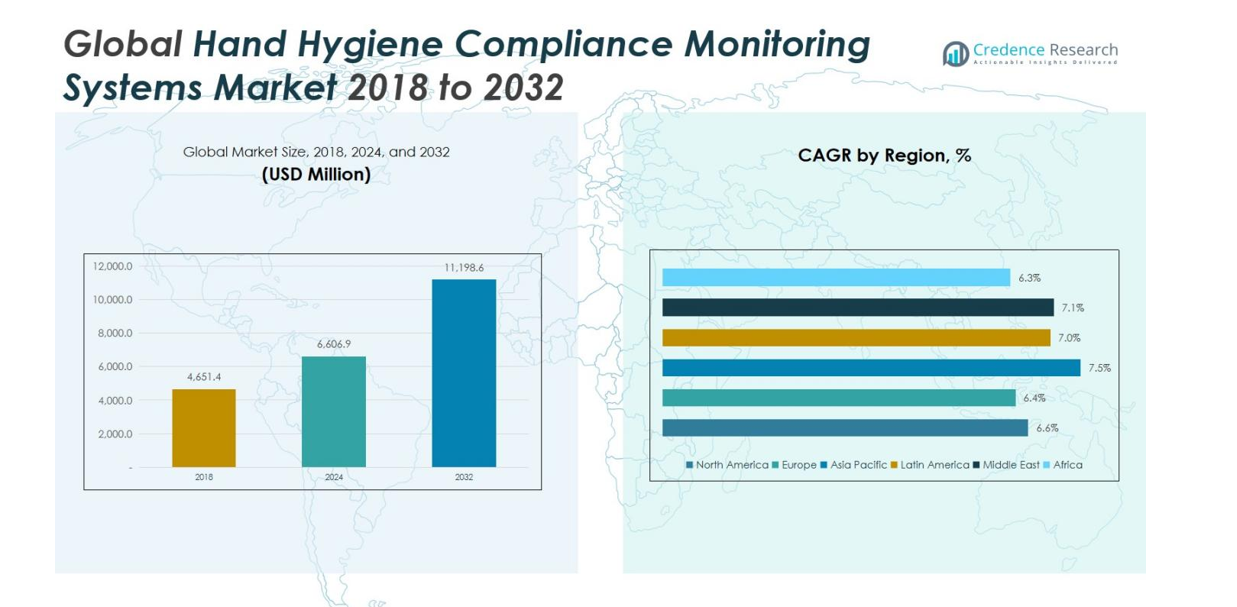
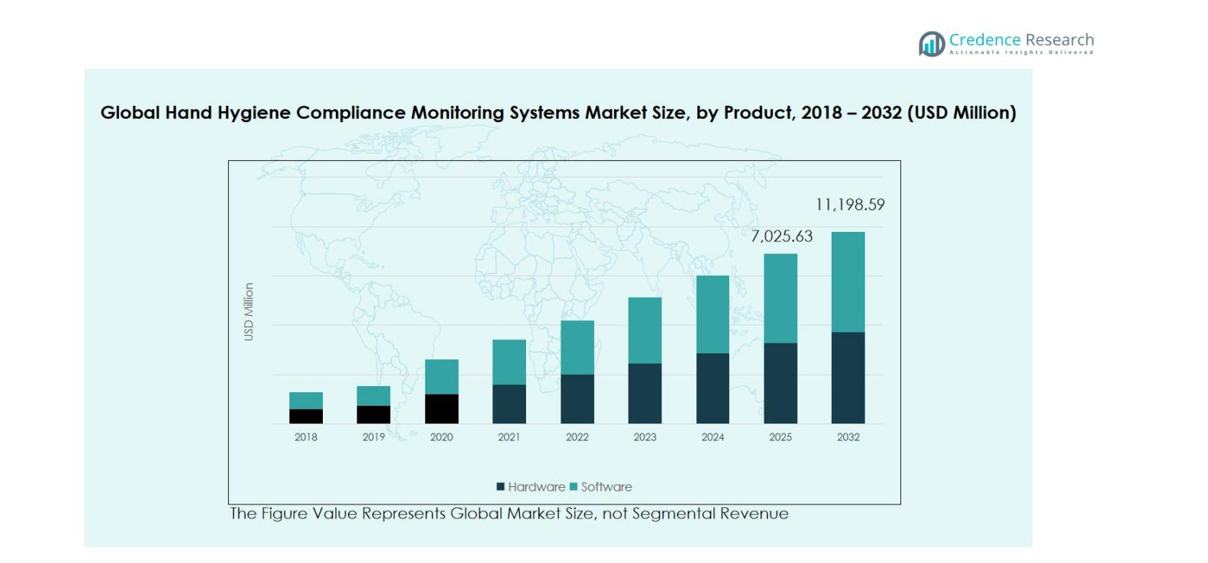
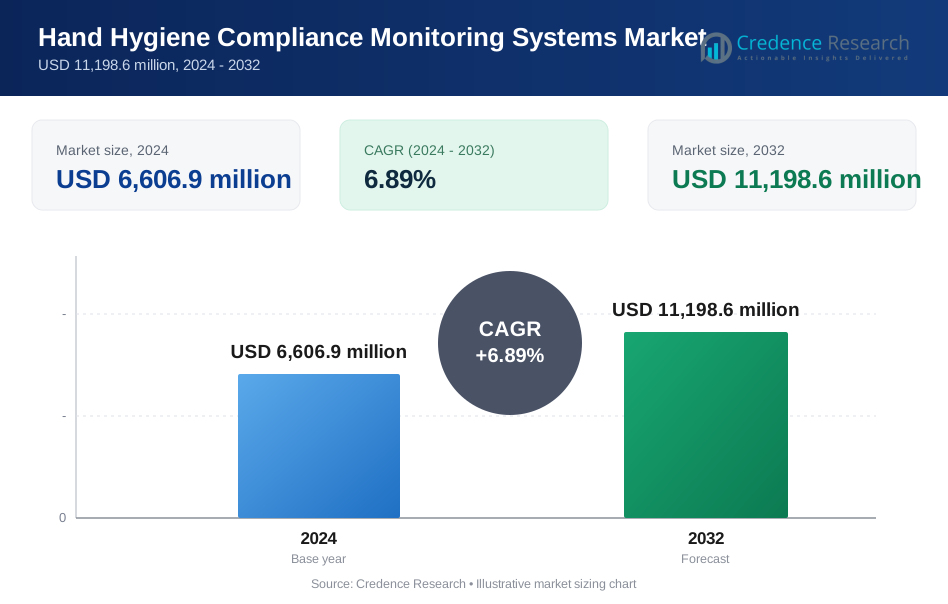
The Global Hand Hygiene Compliance Monitoring Systems Market size was valued at USD 4,651.4 million in 2018, increasing to USD 6,606.9 million in 2024, and is anticipated to reach USD 11,198.6 million by 2032, growing at a CAGR of 6.89% during the forecast period.
| REPORT ATTRIBUTE | DETAILS |
|---|---|
| Historical Period | 2020-2023 |
| Base Year | 2024 |
| Forecast Period | 2025-2032 |
| Hand Hygiene Compliance Monitoring Systems Market Size 2024 | USD 6,606.9 million |
| Hand Hygiene Compliance Monitoring Systems Market, CAGR | 6.89% |
| Hand Hygiene Compliance Monitoring Systems Market Size 2032 | USD 11,198.6 million |
The Global Hand Hygiene Compliance Monitoring Systems Market is driven by prominent players such as BIOVIGIL Hygiene Technologies LLC, Halyard Health, VIZZIA Technologies, Stanley Healthcare, DebMed, Ecolab Inc., GOJO Industries, ZulaFly, Proventix Systems Inc., and Meritech Systems. These companies focus on innovation through sensor integration, AI-based analytics, and IoT-enabled hygiene monitoring solutions to enhance compliance efficiency and patient safety. Strategic collaborations and product diversification remain central to their market positioning. North America emerged as the leading region, accounting for 29.6% of the global market share in 2024, supported by robust healthcare infrastructure, advanced technological adoption, and stringent infection control regulations across hospitals and medical facilities.
Market Insights
- The Global Hand Hygiene Compliance Monitoring Systems Market was valued at USD 6,606.9 million in 2024 and is projected to reach USD 11,198.6 million by 2032, growing at a CAGR of 6.89% during the forecast period.
- Market growth is primarily driven by rising infection prevention awareness, increasing hospital-acquired infection rates, and regulatory mandates for hygiene compliance across healthcare facilities.
- Technological advancements, including IoT-enabled monitoring systems, motion sensors, and AI-based analytics, are shaping market trends and improving real-time hygiene tracking.
- The market is moderately consolidated with major players such as BIOVIGIL Hygiene Technologies, Halyard Health, and Ecolab Inc., focusing on product innovation and strategic partnerships to expand their global presence.
- North America leads with a 6% regional share, while the hardware segment dominates with 68.4% of total market share; Asia Pacific is projected to witness the fastest growth at a CAGR of 7.5% through 2032.
Market Segmentation Analysis:
By Component:
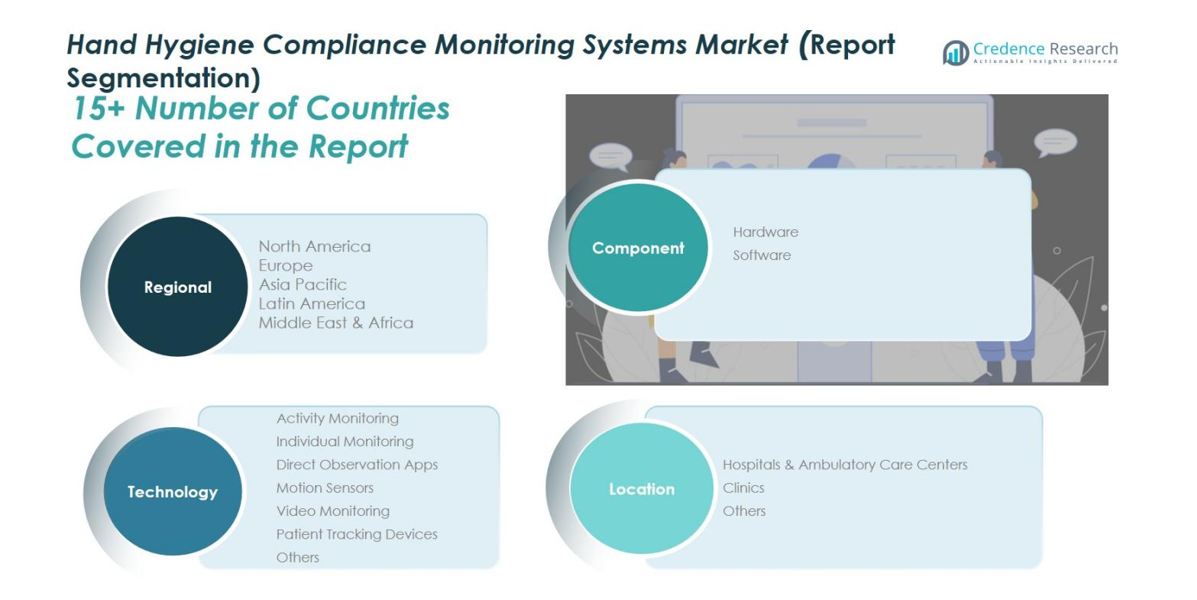
The hardware segment dominated the global Hand Hygiene Compliance Monitoring Systems Market in 2024, accounting for around 68.4% of the total market share. This dominance is attributed to the extensive use of sensors, dispensers, and wearable badges that enable real-time monitoring and compliance tracking in healthcare environments. Continuous innovation in sensor technology and integration with IoT infrastructure have further enhanced accuracy and reliability. Meanwhile, the software segment, holding 31.6% share, is witnessing steady growth driven by increasing demand for analytics platforms and cloud-based compliance management systems that support data-driven decision-making.
- For instance, CenTrak introduced an RTLS (Real-Time Location System) platform that pairs IoT sensors with staff badges to deliver precise, room-level hygiene compliance data.
By Technology:
The activity monitoring segment led the market with a 27.5% share in 2024, primarily due to its widespread adoption in hospitals for tracking staff hygiene behavior and ensuring adherence to infection control protocols. Individual monitoring and motion sensor technologies followed, collectively capturing a 34% share, fueled by the need for personalized performance tracking. Direct observation apps and video monitoring systems are gaining momentum as hospitals adopt automated surveillance tools to reduce manual audits. Patient tracking devices, though smaller in share, are expected to witness the fastest growth, supported by advancements in RFID and Bluetooth technologies.
- For instance, GOJO’s PURELL Smartlink activity-monitoring deployments have been documented to produce sustained increases in hand-hygiene performance when facilities partner with the vendor, demonstrating real-world improvement from wall-mounted dispenser monitoring to facility-wide reporting.
By Location:
The hospitals and ambulatory care centers segment accounted for the largest market share of 71.2% in 2024, driven by stringent regulatory frameworks and the critical need to minimize healthcare-associated infections (HAIs). These facilities prioritize hygiene compliance systems to ensure patient safety and maintain accreditation standards. The clinics segment, with a 19.6% share, is expanding steadily as smaller healthcare providers adopt affordable monitoring solutions. The remaining 9.2% share is held by other locations such as diagnostic centers and long-term care facilities, where growing awareness of hygiene compliance is fostering adoption across diverse medical settings.
Key Growth Drivers
Rising Focus on Infection Prevention and Control
The growing global emphasis on infection prevention and control is a major driver of the Hand Hygiene Compliance Monitoring Systems Market. Healthcare facilities are prioritizing automated hygiene monitoring solutions to reduce healthcare-associated infections (HAIs), which significantly impact patient outcomes and operational costs. Governments and health organizations are enforcing stringent hygiene compliance regulations, compelling hospitals and clinics to adopt advanced monitoring systems. This trend is especially prominent in developed regions, where patient safety standards and infection control protocols are becoming increasingly sophisticated.
- For instance, the University of Chicago Medicine Hyde Park Campus implemented the Biovigil badge-based hand hygiene monitoring system, achieving an overall accuracy of 91% in detecting hygiene compliance, which supports real-time intervention to reduce HAIs.
Technological Advancements and IoT Integration
The integration of Internet of Things (IoT) and smart sensor technologies has revolutionized hand hygiene compliance systems. Real-time data collection, wireless connectivity, and cloud-based analytics allow healthcare administrators to monitor compliance accurately and improve accountability. These technologies enable automated reporting, predictive alerts, and performance benchmarking, reducing manual intervention and human error. As IoT devices become more affordable and scalable, their deployment across hospitals and healthcare networks is expected to accelerate, driving sustained market growth over the forecast period.
- For instance, Wu et al. developed an IoT-based system using Bluetooth Low Energy (BLE) sensors and ultrasonic detectors to monitor handwashing with about 72% accuracy, providing real-time compliance data and reducing manual errors.
Increasing Healthcare Expenditure and Infrastructure Modernization
Rising healthcare investments and modernization of hospital infrastructure are fueling the adoption of hand hygiene compliance systems globally. Governments and private institutions are allocating greater budgets to infection control and patient safety technologies. In emerging economies, expanding hospital networks and digital transformation initiatives are creating opportunities for market penetration. Moreover, post-pandemic awareness has intensified the need for hygienic practices and compliance monitoring, leading to higher demand across both developed and developing regions.
Key Trends and Opportunities
Adoption of AI and Data Analytics in Compliance Monitoring
Artificial intelligence (AI) and data analytics are emerging as key enablers in optimizing hygiene compliance strategies. AI-driven platforms analyze behavioral patterns, identify non-compliance risks, and recommend corrective measures in real time. Hospitals are increasingly leveraging predictive analytics to enhance training programs and improve overall hygiene culture. The integration of AI with automated reporting systems provides deeper insights into staff performance, enabling continuous improvement and higher compliance rates across healthcare environments.
- For instance, the AI platform Censinet RiskOps™ integrates predictive analytics to perform real-time risk assessments, enabling healthcare organizations to identify compliance gaps quickly and prioritize issues effectively.
Growing Opportunities in Emerging Markets
Rapid healthcare expansion across Asia-Pacific, Latin America, and the Middle East presents lucrative opportunities for market players. Rising awareness of infection control, government-led healthcare reforms, and infrastructure investments are boosting adoption. Local partnerships and low-cost hardware solutions are helping global manufacturers establish a strong regional presence. As hospitals in these regions embrace digital transformation and patient safety initiatives, the demand for smart hygiene monitoring systems is expected to grow substantially in the coming years.
- For instance, in 2024, GE HealthCare partnered with Singapore’s Ministry of Health to enhance hospital infection surveillance through digital monitoring platforms.
Key Challenges
High Implementation Costs and Integration Complexity
The initial cost of installing hand hygiene compliance systems, including sensors, software, and connectivity infrastructure, remains a significant challenge. Smaller healthcare facilities often struggle with budget constraints and lack of technical expertise for integration. Compatibility issues with existing hospital management systems can further delay adoption. Vendors are increasingly focusing on modular and scalable solutions to mitigate these barriers, but cost sensitivity continues to restrain widespread deployment in developing regions.
Data Privacy and Compliance Concerns
As hand hygiene systems rely heavily on data collection and monitoring of healthcare staff, concerns about privacy and ethical data usage are rising. Ensuring compliance with data protection regulations such as GDPR and HIPAA is critical for market participants. Healthcare organizations must balance transparency with employee privacy to maintain trust and adherence. Addressing these concerns through secure data management frameworks and anonymized reporting will be essential for the sustainable adoption of digital hygiene monitoring solutions.
Regional Analysis
North America
North America dominated the global Hand Hygiene Compliance Monitoring Systems Market in 2024 with a 29.6% market share, valued at USD 1,958.29 million, and is projected to reach USD 3,247.59 million by 2032, growing at a CAGR of 6.6%. The region’s growth is driven by strong healthcare infrastructure, strict infection control regulations, and rapid adoption of IoT-enabled compliance systems. The U.S. leads the market, supported by government initiatives promoting hygiene monitoring to reduce healthcare-associated infections. In 2018, the market stood at USD 1,400.99 million, reflecting consistent investment in patient safety technologies.
Europe
Europe accounted for 23% of the global market share in 2024, reaching USD 1,519.97 million, up from USD 1,100.97 million in 2018, and is projected to hit USD 2,477.13 million by 2032 at a CAGR of 6.4%. The region’s growth is supported by stringent regulatory standards such as the EU infection prevention guidelines and rising adoption of automated hygiene systems across hospitals. Western European countries, including Germany, the UK, and France, lead due to higher awareness and technological readiness, while Eastern Europe is witnessing emerging adoption in public healthcare sectors.
Asia Pacific
The Asia Pacific region is the fastest-growing market, with a 26.7% share in 2024, valued at USD 1,929.69 million, and is projected to reach USD 3,434.61 million by 2032, expanding at a CAGR of 7.5%. Rapid healthcare infrastructure development, increasing hospital investments, and government initiatives for infection control are fueling growth. In 2018, the market was valued at USD 1,307.49 million. Countries such as China, Japan, and India are driving demand through large-scale healthcare digitization and enhanced focus on patient safety, supported by growing awareness of hygiene-related risks in medical facilities.
Latin America
Latin America captured 10.3% of the global market share in 2024, valued at USD 678.53 million, up from USD 474.90 million in 2018, and is expected to reach USD 1,159.05 million by 2032, registering a CAGR of 7.0%. Growth is fueled by increasing healthcare expenditure, public health awareness, and government initiatives to improve hygiene standards in hospitals. Brazil and Mexico dominate the regional market, supported by expanding hospital networks and gradual adoption of automated compliance solutions. However, budget constraints and inconsistent regulatory enforcement remain challenges across several developing economies in the region.
Middle East
The Middle East market accounted for 6.1% share in 2024, with revenue of USD 385.56 million, and is projected to reach USD 661.84 million by 2032, growing at a CAGR of 7.1%, from USD 268.85 million in 2018. The market is driven by increasing healthcare modernization, government-led infection control programs, and rising investments in smart hospital infrastructure. GCC countries such as the UAE and Saudi Arabia are leading adopters of digital hygiene monitoring systems, while Turkey and Israel are investing in AI-based healthcare safety technologies to improve compliance rates and operational efficiency.
Africa
Africa represented 4.3% of the global market share in 2024, valued at USD 134.88 million, and is forecasted to reach USD 218.37 million by 2032, expanding at a CAGR of 6.3%, up from USD 98.14 million in 2018. Market growth is supported by gradual improvements in healthcare infrastructure, growing awareness of hygiene standards, and international support for infection prevention initiatives. South Africa leads the region, followed by Egypt, as hospitals adopt affordable compliance monitoring systems. However, limited healthcare budgets and low digital adoption rates still hinder faster market penetration in several sub-Saharan nations.
Market Segmentations:
By Component
- Hardware
- Software
By Technology
- Activity Monitoring
- Individual Monitoring
- Direct Observation Apps
- Motion Sensors
- Video Monitoring
- Patient Tracking Devices
- Others
By Location
- Hospitals & Ambulatory Care Centers
- Clinics
- Others
By Region
- North America
- U.S.
- Canada
- Mexico
- Europe
- Germany
- France
- U.K.
- Italy
- Spain
- Rest of Europe
- Asia Pacific
- China
- Japan
- India
- South Korea
- South-east Asia
- Rest of Asia Pacific
- Latin America
- Brazil
- Argentina
- Rest of Latin America
- Middle East & Africa
- GCC Countries
- South Africa
- Rest of the Middle East and Africa
Competitive Landscape
The competitive landscape of the Global Hand Hygiene Compliance Monitoring Systems Market is characterized by the presence of major players such as BIOVIGIL Hygiene Technologies LLC, Halyard Health, VIZZIA Technologies, Stanley Healthcare, DebMed, Ecolab Inc., GOJO Industries, ZulaFly, Proventix Systems Inc., and Meritech Systems. These companies focus on innovation, product differentiation, and strategic partnerships to strengthen their global presence. The market is moderately consolidated, with leading players emphasizing advanced sensor technologies, cloud-based analytics, and IoT integration to enhance compliance accuracy and operational efficiency. Continuous R&D investments, mergers, and collaborations are aimed at expanding product portfolios and addressing the rising demand for automated hygiene solutions. Emerging players are targeting cost-effective, scalable technologies for small and mid-sized healthcare facilities. Meanwhile, established firms are focusing on global expansion through regulatory approvals and regional partnerships, ensuring competitive advantage in both developed and emerging healthcare markets.
Key Player Analysis
- BIOVIGIL Hygiene Technologies LLC
- Halyard Health
- VIZZIA Technologies
- Stanley Healthcare
- DebMed
- Ecolab Inc.
- GOJO Industries, Inc.
- ZulaFly
- Proventix Systems, Inc.
- Meritech Systems
- Other Key Players
Recent Developments
- In July 2024, io launched a new cloud-based Hand Hygiene solution featuring real-time monitoring, gamification tools, and automated dispenser alerts to improve hospital compliance.
- In August 2025, HID acquired Intelligent Observation, a US-based platform provider focused on hand-hygiene compliance monitoring, strengthening HID’s RTLS/health-care portfolio.
- On June 26 2023, BioVigil launched its “AccuWash Technology” hand-wash monitoring system for healthcare facilities.
- In February 2021, Ecolab Inc. launched its “Hand Hygiene Compliance Measurement (HHCM) System” in Europe.
Report Coverage
The research report offers an in-depth analysis based on Component, Technology, Location and Region. It details leading market players, providing an overview of their business, product offerings, investments, revenue streams, and key applications. Additionally, the report includes insights into the competitive environment, SWOT analysis, current market trends, as well as the primary drivers and constraints. Furthermore, it discusses various factors that have driven market expansion in recent years. The report also explores market dynamics, regulatory scenarios, and technological advancements that are shaping the industry. It assesses the impact of external factors and global economic changes on market growth. Lastly, it provides strategic recommendations for new entrants and established companies to navigate the complexities of the market.
Future Outlook
- The market will experience steady growth driven by increasing awareness of infection prevention and control across healthcare facilities.
- Integration of IoT and AI technologies will enhance automation and accuracy in hygiene compliance monitoring.
- Hospitals will continue to dominate adoption, supported by stricter regulatory requirements and accreditation standards.
- Software-based analytics solutions will gain momentum due to rising demand for data-driven decision-making.
- Emerging markets in Asia Pacific and Latin America will offer significant expansion opportunities.
- Strategic collaborations between healthcare providers and technology firms will accelerate innovation.
- The adoption of cloud-based platforms will improve scalability and real-time performance tracking.
- Cost-effective and modular systems will attract smaller healthcare facilities seeking compliance solutions.
- Ongoing advancements in sensor technology will enhance detection precision and reduce operational errors.
- Increasing government initiatives for hospital hygiene compliance will sustain long-term market growth.
Request a Free Sample
Fill in your details and we'll send you a free sample report.
- Sample data tables & charts
- Research methodology
Need a Custom Version of This Report?
Tailor the scope, geography, or segments to your exact requirements.
- Custom geography or segment scope
- Direct access to our analyst team
Frequently Asked Questions
What is the current market size for the Global Hand Hygiene Compliance Monitoring Systems Market, and what is its projected size in 2032?
At what Compound Annual Growth Rate is the Global Hand Hygiene Compliance Monitoring Systems Market projected to grow between 2025 and 2032?
Which Global Hand Hygiene Compliance Monitoring Systems Market segment held the largest share in 2024?
What are the primary factors fueling the growth of the Global Hand Hygiene Compliance Monitoring Systems Market?
Who are the leading companies in the Global Hand Hygiene Compliance Monitoring Systems Market?
Who are the major players in this market?
Table of Content
Chapter 1. Report Introduction
- 1.1 Report Description & Purpose
- 1.1.1 Report Title & Market Definition
- 1.1.2 Unique Selling Propositions (USP) & Key Differentiators
- 1.1.3 Value Proposition for Stakeholders
- 1.2 Research Objectives
- 1.2.1 Market Sizing Objectives (Volume & Revenue)
- 1.2.2 Segmentation Objectives
- 1.2.3 Competitive Intelligence Objectives
- 1.2.4 Forecast & Scenario Objectives
- 1.3 Report Scope
- 1.3.1 Hand Hygiene Compliance Monitoring Systems Scope – Types & Subtypes Covered
- 1.3.2 Geographic Scope – Regions & Countries Covered
- 1.3.3 Historical Period, Base Year & Forecast Period (2024; forecast to 2032)
- 1.3.4 Inclusions & Exclusions
- 1.4 HS Code & Classification Framework
- 1.5 Currency, Units & Pricing Basis
- 1.6 Target Stakeholders
- 1.7 Limitations & Assumptions
Chapter 2. Executive Summary
- 2.1 Global Hand Hygiene Compliance Monitoring Systems Market Snapshot
- 2.1.1 Market Size – Historical (2024) & Forecast (2024-2032) (2024: USD 6,606.9 million → 2032: USD 11,198.6 million)
- 2.1.2 Volume & Revenue – Global Totals
- 2.1.3 Key Market Highlights – Top Five Facts
- 2.2 Hand Hygiene Compliance Monitoring Systems Market Segmentation Snapshot
- 2.2.1 Market Split by Region – 2024 vs. 2032
- 2.3 Competitive Snapshot
- 2.3.1 Top 10 Players by Revenue Share – 2024
- 2.3.2 Top 10 Players by Volume Share – 2024
- 2.3.3 Recent Strategic Developments (18-Month Summary)
- 2.4 Key Investment Highlights & Strategic Conclusions
Chapter 3. Hand Hygiene Compliance Monitoring Systems Market Dynamics & Industry Analysis
- 3.1 Market Overview & Context
- 3.1.1 Hand Hygiene Compliance Monitoring Systems Market Position in the Broader Automotive Value Chain
- 3.1.2 OEM vs. Replacement Market Dynamics
- 3.1.3 Market Maturity & Development Stage by Region
- 3.2 Hand Hygiene Compliance Monitoring Systems Market Drivers
- 3.3 Hand Hygiene Compliance Monitoring Systems Market Restraints & Challenges
- 3.4 Hand Hygiene Compliance Monitoring Systems Market Opportunities
- 3.5 Porter's Five Forces Analysis
- 3.5.1 Threat of New Entrants
- 3.5.2 Bargaining Power of Suppliers
- 3.5.3 Bargaining Power of Buyers
- 3.5.4 Threat of Substitutes
- 3.5.5 Competitive Rivalry – Intensity Assessment
- 3.6 Hand Hygiene Compliance Monitoring Systems Value Chain Analysis
- 3.6.1 Upstream – Raw Material/Input Suppliers
- 3.6.1.1 Raw Material/Input 1
- 3.6.1.2 Raw Material/Input 2
- 3.6.1.3 Raw Material/Input 3
- 3.6.2 Midstream – Production/Manufacturing/Service Delivery
- 3.6.2.1 Production/Process Overview
- 3.6.2.2 Key Facility Locations & Capacity by Manufacturer
- 3.6.3 Downstream – Distribution & End Consumer
- 3.6.3.1 Primary Channel – B2B/OEM
- 3.6.3.2 Secondary Channels – Dealer, Retail, Online, Direct
- 3.6.4 Value Chain Profitability Analysis
- 3.6.1 Upstream – Raw Material/Input Suppliers
- 3.7 PESTEL Analysis
- 3.7.1 Political Factors
- 3.7.2 Economic Factors
- 3.7.3 Social Factors
- 3.7.4 Technological Factors
- 3.7.5 Environmental Factors
- 3.7.6 Legal Factors
- 3.8 Hand Hygiene Compliance Monitoring Systems Supply Chain Analysis
- 3.8.1 Raw Material/Input Supply Risk Assessment
- 3.8.2 Manufacturing Concentration Risk (Geographic Exposure)
- 3.8.3 Trade Disruption Impact Analysis
- 3.9 Regulatory & Policy Landscape
Note: The regulatory and policy landscape section covers regulations based on their applicability to the market, Hand Hygiene Compliance Monitoring Systems category, geography, and scope of the study. Only regulatory frameworks with a material impact on operations, compliance, trade, sustainability, or market access are analyzed in detail.
Chapter 4. Key Investment Pockets & Opportunity Analysis
- 4.1 Hand Hygiene Compliance Monitoring Systems Market Attractiveness Analysis
- 4.1.1 By Region – Investment Attractiveness Matrix (Volume × CAGR)
- 4.2 Absolute Revenue Growth Opportunity
- 4.2.1 By Region – Absolute USD Growth Through 2032
- 4.3 Incremental Volume Opportunity
- 4.3.1 By Region – Incremental Volume Through 2032
- 4.3.2 Segment – Incremental Volume
- 4.4 Emerging Submarket Opportunity Deep Dive (Subject to Applicability)
- 4.5 Emerging Market Opportunity Scorecards
- 4.5.1 United States
- 4.5.2 Europe
- 4.5.3 Asia
- 4.5.4 Middle East & Africa
Note: Emerging Market Opportunity Scorecards will be included based on relevance and strategic importance. Regions listed are indicative and may vary depending on data availability and market dynamics.
Chapter 5. Hand Hygiene Compliance Monitoring Systems Import-Export Analysis & Trade Flows
- 5.1 Global Trade Overview
- 5.1.1 Global Export Value by Country (2024)
- 5.1.2 Global Export Volume by Country (2024)
- 5.1.3 Global Import Value by Country (2024)
- 5.1.4 Global Import Volume by Country (2024)
- 5.1.5 Net Trade Balance by Country (2024)
- 5.2 Export Analysis – Segment
- 5.2.1 Type 1 (HS Code)
- 5.2.2 Type 2 (HS Code)
- 5.2.3 Type 3 (HS Code)
- 5.2.4 Type 4 (HS Code)
- 5.2.5 Type 5 (HS Code)
- 5.3 Import Analysis – Segment
- 5.3.1 Type 1 (HS Code)
- 5.3.2 Type 2 (HS Code)
- 5.3.3 Type 3 (HS Code)
- 5.3.4 Type 4 (HS Code)
- 5.3.5 Type 5 (HS Code)
- 5.4 Average Unit Trade Prices
- 5.4.1 Average Export Price – Segment & Country
- 5.4.2 Average Import Price – Segment & Source Country
- 5.4.3 Price Trends (2024)
- 5.5 Key Trade Route Analysis
- 5.5.1 Trade Route 1
- 5.5.2 Trade Route 2
- 5.5.3 Trade Route 3
- 5.5.4 Trade Route 4
- 5.5.5 Trade Route 5
- 5.6 Trade Policy Impact Assessment
- 5.6.1 US Anti-Dumping & Section 301 Tariffs
- 5.6.2 EU Customs Union Impact
- 5.6.3 Major Free Trade Agreements
- 5.6.4 USMCA Rules of Origin
Note: Trade policy analysis will be included only where relevant to the Hand Hygiene Compliance Monitoring Systems market.
Chapter 6. Competitive Landscape & Company Benchmarking
- 6.1 Hand Hygiene Compliance Monitoring Systems Market Concentration & Structure
- 6.1.1 Herfindahl-Hirschman Index (HHI) – vs. 2024
- 6.1.2 Tier 1, Tier 2 & Tier 3 Market Structure
- 6.1.3 Global, Regional & Local Player Dynamics
- 6.2 Hand Hygiene Compliance Monitoring Systems Market Share Analysis – 2024
- 6.2.1 Global Revenue Share by Company
- 6.2.2 Global Volume Share by Company
- 6.2.3 Regional Revenue Share
- 6.2.4 Market Share Evolution ( vs. 2024)
- 6.2.5 OEM Segment Share by Company
- 6.2.6 Replacement Segment Share by Company
- 6.3 Production/Delivery Capacity & Facility Analysis
- 6.3.1 Global Installed Capacity
- 6.3.2 Capacity Utilization Rates
- 6.3.3 Production/Output Volume
- 6.3.4 Facility Locations & Capacity Map
- 6.3.5 Planned Capacity Additions
- 6.4 Hand Hygiene Compliance Monitoring Systems Competitive Benchmarking Matrix
- 6.4.1 Revenue, Volume, CAGR & Profitability Comparison
- 6.4.2 Channel Revenue Mix
- 6.4.3 Geographic Revenue Exposure
- 6.4.4 R&D Intensity
- 6.4.5 Sustainability Maturity
- 6.5 Strategic Developments in Hand Hygiene Compliance Monitoring Systems (Last 24 Months)
- 6.5.1 Mergers, Acquisitions & Divestments
- 6.5.2 New Hand Hygiene Compliance Monitoring Systems Launches
- 6.5.3 Facility Expansions
- 6.5.4 Strategic Alliances, Joint Ventures & Partnerships
- 6.5.5 Distribution Expansion & Market Entry
- 6.5.6 Sustainability & ESG Initiatives
- 6.6 Competitive Strategy Mapping
- 6.6.1 Leader, Challenger, Follower & Niche Classification
- 6.6.2 Pricing Strategy Comparison
- 6.6.3 Channel Strategy Matrix
Note: Strategic developments are included based on their materiality and the availability of reliable information.
Chapter 7. Global Hand Hygiene Compliance Monitoring Systems Market – By Distribution Channel
- 7.1 Segment Overview
- 7.1.1 Volume & Revenue Split by Channel (2024 & 2032)
- 7.1.2 Channel Mix Evolution (2024-2032)
Chapter 8. Regional Market Analysis – Global Overview
- 8.1 Global Regional Overview
- 8.1.1 Regional Volume Share
- 8.1.2 Regional Revenue Share
- 8.1.3 Regional Volume by Region
- 8.1.4 Regional Revenue by Region
- 8.1.5 Regional Forecast Through 2032
- 8.2 Cross-Regional Segment Analysis
- 8.2.1 By Distribution Channel
- 8.2.2 By Brand/Price Tier
Chapter 9. North America Hand Hygiene Compliance Monitoring Systems Market
- 9.1 United States
- 9.2 Canada
- 9.3 Mexico
Chapter 10. Europe Hand Hygiene Compliance Monitoring Systems Market
- 10.1 Germany
- 10.2 France
- 10.3 Italy
- 10.4 United Kingdom
- 10.5 Spain
- 10.6 Poland
- 10.7 Russia
- 10.8 Netherlands
- 10.9 Belgium
- 10.10 Sweden
- 10.11 Denmark
- 10.12 Norway
- 10.13 Rest of Europe
Chapter 11. Asia Pacific Hand Hygiene Compliance Monitoring Systems Market
- 11.1 China
- 11.2 India
- 11.3 Japan
- 11.4 South Korea
- 11.5 Thailand
- 11.6 Indonesia
- 11.7 Vietnam
- 11.8 Malaysia
- 11.9 Australia
- 11.10 Rest of Asia Pacific
Chapter 12. Latin America Hand Hygiene Compliance Monitoring Systems Market
- 12.1 Brazil
- 12.2 Argentina
- 12.3 Colombia
- 12.4 Chile
- 12.5 Rest of Latin America
Chapter 13. Middle East Hand Hygiene Compliance Monitoring Systems Market
- 13.1 Saudi Arabia
- 13.2 United Arab Emirates
- 13.3 Turkey
- 13.4 Israel
- 13.5 Iran
- 13.6 Rest of the Middle East
Chapter 14. Africa Hand Hygiene Compliance Monitoring Systems Market
- 14.1 South Africa
- 14.2 Egypt
- 14.3 Nigeria
- 14.4 Morocco
- 14.5 Rest of Africa
Chapter 15. Hand Hygiene Compliance Monitoring Systems Company Profiles
- 15.1 [Company 01]
- 15.1.1 Company Overview
- 15.1.2 Key Management Personnel
- 15.1.3 Products & Services Portfolio
- 15.1.4 Financial Performance
- 15.1.5 Key Market Focus & Geographic Presence
- 15.1.6 Recent Developments & Strategic Initiatives
Note: The company profile list is preliminary and may change based on research findings, market developments, data availability, and client requirements.
Chapter 16. Appendices
- Appendix A – List of Abbreviations & Acronyms
- Appendix B – Industry Classification Code Reference – Full Series
- Appendix C – Production & Capacity Data Tables
- Appendix D – End-Use & Demand Base Tables
- Appendix E – Consumption & Replacement Rate Assumptions
- Appendix F – ASP Reference Tables
- Appendix G – Manufacturing & Facility Database
- Appendix H – Import-Export Data Tables
- Appendix I – Regulatory Summary Tables
- Appendix J – Primary Research Participant List (Anonymized)
- Appendix K – Primary Research Questionnaire Framework
- Appendix L – Data Sources & Bibliography
- Appendix M – Market Size Divergence & Source Comparison
Chapter 17. Research Methodology
- 17.1 Research Framework & Philosophy
- 17.2 Secondary Research – Sources, Hierarchy & Data Extraction
- 17.3 Data Modeling – Bottom-Up & Top-Down Market Sizing
- 17.4 Primary Research – Stakeholder Framework, LOI & Sample Sizes
- 17.5 Forecast Methodology – Regression, Scenario & Sensitivity Analysis
- 17.6 Quality Control – Four-Layer Validation Framework
- 17.7 Limitations & Standard Assumptions
- 17.8 Disclaimer
