Healthy Snacks Market Overview:
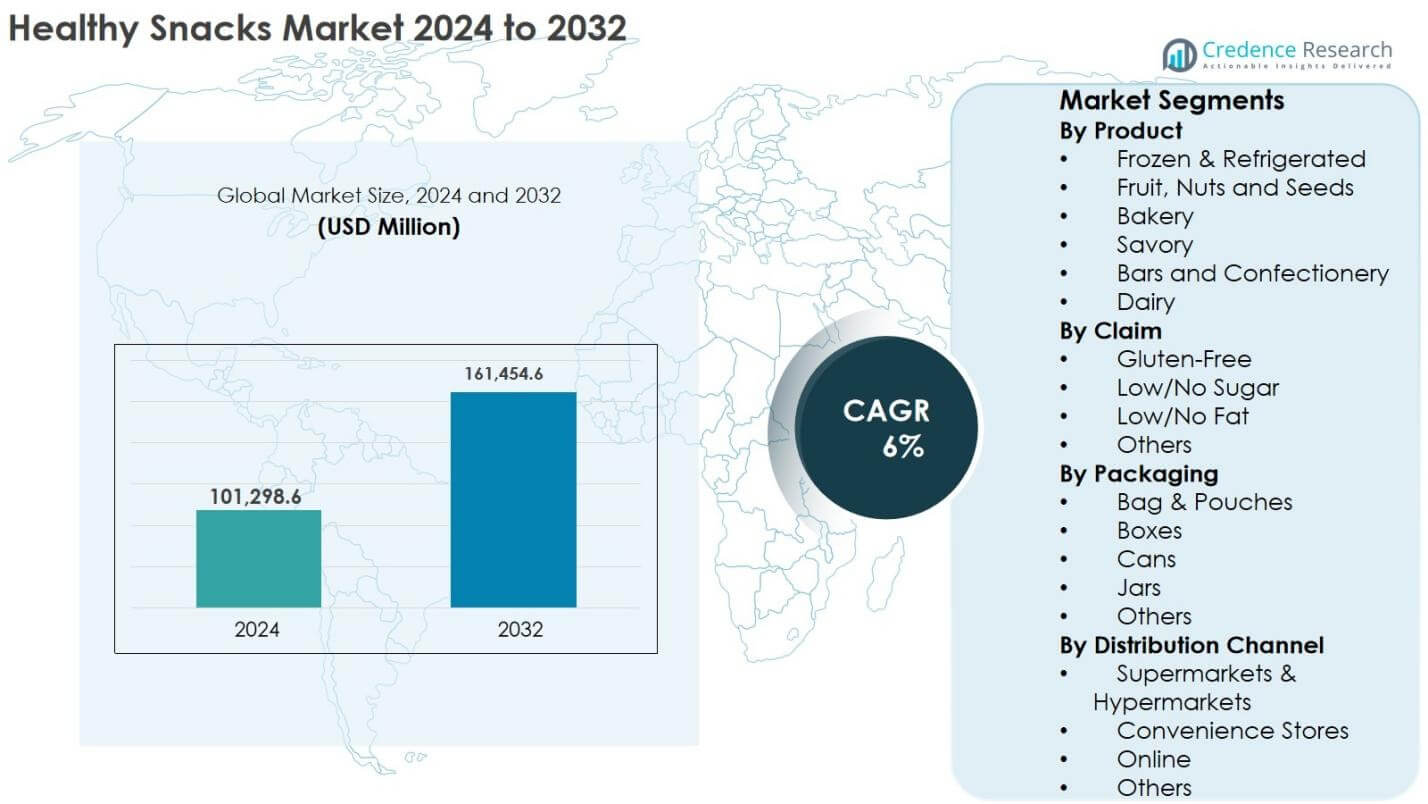
Healthy Snacks market size was valued USD 101,298.6 Million in 2024 and is anticipated to reach USD 161,454.6 Million by 2032, at a CAGR of 6% during the forecast period.
| REPORT ATTRIBUTE | DETAILS |
|---|---|
| Historical Period | 2020-2023 |
| Base Year | 2024 |
| Forecast Period | 2025-2032 |
| Healthy Snacks Market Size 2024 | USD 101,298.6 million |
| Healthy Snacks Market, CAGR | 6% |
| Healthy Snacks Market Size 2032 | USD 161,454.6 million |
Healthy Snacks Market Insights
- Market growth is driven by rising health consciousness, increasing demand for clean-label and nutrient-dense snacks, and shifting consumer lifestyles toward convenient, on-the-go eating habits supported by fitness awareness and preventive nutrition preferences.
- Key trends include strong adoption of plant-based, low-sugar, and protein-rich snack formats, along with innovation in functional ingredients, portion-controlled packs, and sustainability-aligned packaging that enhances product appeal and brand differentiation.
- Leading players expand portfolios through reformulation, premiumization, and new product launches, with major companies strengthening their presence through strategic partnerships, acquisitions, and wider distribution across retail, convenience, and e-commerce channels.
- North America leads the market with 34.2% share, followed by Europe with 28.6 percent and Asia-Pacific with 24.1%, while the Fruit, Nuts and Seeds segment remains dominant with 32.6% share.
Healthy Snacks Market Segmentation Analysis:
By Product
The Healthy Snacks market by product segment is led by Fruit, Nuts and Seeds, which accounted for 32.6% share in 2024, making it the dominant sub-segment due to rising consumer preference for natural, minimally processed nutrition and protein-rich snacking options. Demand is further supported by increasing awareness of plant-based diets, clean-label positioning, and convenience-focused on-the-go formats. Other categories such as Savory snacks and Bars and Confectionery are gaining traction as manufacturers innovate with functional ingredients, low-calorie formulations, and fortified blends, while Frozen and Refrigerated products expand through premium, indulgence-plus-health offerings.
- For instance, KIND (a Mars, Incorporated brand) has expanded its portfolio of nut-based bars and clusters made with whole almonds, peanuts, and seeds, aligning with clean-label and high-protein demands.
By Claim
In the claims-based segmentation, Low/No Sugar snacks dominated the market with a 35.4% share in 2024, driven by growing health consciousness, diabetes awareness, and nutritional transparency trends among urban consumers. The rapid shift toward reduced-sugar lifestyles, clean carbohydrate profiles, and regulatory support for sugar-intake moderation strengthens this segment’s leadership. Gluten-Free and Low/No Fat snacks continue to expand as consumers associate these formats with digestive wellness, weight management, and lifestyle-driven diet choices, while the Others category benefits from emerging claims such as high-protein, keto-friendly, organic, and functional ingredient-based offerings.
- For instance, Mondelez International’s Oreo Zero Sugar, launched in markets such as China and later extended to other regions, targets consumers seeking familiar indulgence without added sugar.
By Packaging
Across packaging formats, Bags and Pouches emerged as the dominant sub-segment with a 41.8% market share in 2024, supported by lightweight design, portability, portion-control convenience, and strong barrier properties that extend product shelf life. The rise of resealable formats and sustainable packaging materials further accelerates adoption across nuts, trail mixes, and snack bars. Boxes maintain relevance in multipack retail channels, while Cans and Jars gain traction in premium snack categories. The Others segment grows gradually with the introduction of eco-friendly alternatives and innovative packaging concepts aligned with sustainability and brand differentiation initiatives.
Key Growth Drivers
Rising Health Consciousness and Lifestyle Shifts
The Healthy Snacks market is expanding rapidly as consumers increasingly prioritize preventive health, balanced diets, and nutrition-focused lifestyles. Growing awareness of obesity, diabetes, and cardiovascular risks is encouraging a shift toward nutrient-dense snacks enriched with fiber, whole grains, plant proteins, and natural ingredients. Busy urban schedules and on-the-go eating habits are accelerating the demand for convenient yet healthier snacking alternatives. The influence of fitness culture, wellness media, and dietary tracking platforms further strengthens preference for clean-label and minimally processed products. Manufacturers are responding with reformulated snack offerings featuring reduced sugar, low sodium, and functional nutritional benefits, which is driving wider adoption across supermarkets, specialty health stores, and online retail channels in both developed and emerging markets.
- For instance, General Mills’ Fiber One and Nature Valley ranges emphasize added fiber, whole grains, and nut-based formulations targeted at heart health and weight management.
Expansion of Functional and Protein-Rich Snacking
Functional snacking has emerged as a major growth catalyst, as consumers increasingly seek snacks that deliver targeted health benefits beyond basic nourishment. High-protein, fiber-rich, immunity-supporting, probiotic, and energy-boosting snack formats are witnessing strong uptake among active lifestyle consumers, millennials, and aging populations. The rising appeal of plant-based proteins, nut and seed blends, and cereal-grain bars is reshaping product development strategies. Demand is also growing for snacks that support weight management, digestive wellness, cognitive performance, and sustained energy release. Investments in ingredient technology and R&D are enabling brands to launch fortified snack bars, high-protein baked goods, and functional beverage-snack hybrids, strengthening category differentiation and driving premium positioning across modern retail and e-commerce platforms.
- For instance, Danone’s Activia and probiotic yogurt snacks emphasize gut health and digestive wellness benefits, while Nestlé’s Yes! bars and similar launches focus on plant-based protein, nuts, and seeds.
Growth of E-Commerce and Premium Convenience Formats
The rapid evolution of digital retail ecosystems is significantly advancing the Healthy Snacks market by enhancing product accessibility, consumer engagement, and brand visibility. E-commerce platforms, subscription snack boxes, and direct-to-consumer channels enable personalized assortments, health-driven discovery, and convenient replenishment purchases. Premium convenience formats such as resealable pouches, portion-controlled packs, and travel-friendly snack units are increasingly preferred by mobile urban consumers and working professionals. Expanding distribution through supermarkets, specialty nutrition stores, gyms, cafés, and wellness partnerships further widens market reach. Strong marketing narratives focused on sustainability, ingredient transparency, and ethical sourcing enhance brand trust and loyalty, while premiumization trends support higher-value purchase behavior across domestic and international markets.
Key Trends & Opportunities
Shift Toward Plant-Based, Clean-Label, and Natural Ingredients
A prominent trend shaping the Healthy Snacks market is the accelerating transition toward plant-based, clean-label, and naturally sourced product formulations. Consumers increasingly favor snacks free from artificial additives, preservatives, synthetic sweeteners, and artificial colors, creating strong opportunities for brands offering whole-food, organic, and minimally processed options. The rise of vegan and flexitarian diets is fueling demand for nut-based mixes, seed clusters, legume chips, and plant-protein snack bars. Ingredient transparency, traceability, and sustainability certifications are becoming key purchase influencers, particularly among environmentally conscious consumers. This trend supports growth for brands that emphasize ethical sourcing, eco-friendly packaging, and health-aligned product narratives, enabling stronger competitive positioning in both premium and mainstream retail channels.
- For instance, PepsiCo’s Bare Snacks and Off The Eaten Path lines feature baked fruit chips and veggie/legume-based snacks positioned as non-GMO, plant-based alternatives with short ingredient lists.
Premiumization and Flavor Innovation in Health-Focused Snacking
Premiumization is emerging as a major opportunity as consumers increasingly seek snacks that combine superior taste, functionality, and healthier nutritional profiles. Flavor innovation, gourmet ingredient pairings, and fusion taste experiences are redefining healthy snacking from a functional necessity to a lifestyle-driven indulgence. Manufacturers are introducing dark-chocolate nut blends, fruit-and-seed bars, roasted savory mixes, and globally inspired flavor combinations to enhance sensory appeal. Limited-edition flavors, artisanal positioning, and experiential branding support consumer excitement and repeat purchase behavior. Customization trends and wellness-focused storytelling further strengthen product differentiation, enabling brands to capture value-driven segments across urban, premium, and health-conscious consumer groups.
- For instance, KIND (a Mars, Incorporated brand) offers dark-chocolate almond and sea-salt bars and nut mixes that blend premium nuts, seeds, and chocolate to position healthy snacking as an indulgent experience.
Key Challenges
High Product Costs and Price Sensitivity in Mass Markets
Despite strong demand momentum, the Healthy Snacks market faces challenges related to high production costs and price sensitivity across mass-market consumer segments. Premium ingredients such as nuts, seeds, dried fruits, specialty grains, and functional additives significantly increase sourcing and manufacturing expenses. Sustainable packaging, quality certifications, and advanced nutritional formulations further elevate price positioning relative to conventional snacks. In many emerging economies, consumers remain highly price-driven, limiting large-scale adoption of premium healthy snack brands. Manufacturers face the complex task of balancing cost optimization with nutritional authenticity, taste, and value perception while competing against lower-priced traditional snacks and aggressively positioned private-label alternatives.
Regulatory Compliance and Product Reformulation Complexity
The Healthy Snacks market also encounters challenges associated with evolving regulatory frameworks, nutritional labeling standards, and restrictions on health and nutrition claims. Companies must ensure strict compliance related to sugar limits, trans-fat reductions, allergen declarations, and ingredient disclosure across multiple markets, often increasing operational complexity. Reformulating products to reduce salt, sugar, and artificial additives without compromising flavor, shelf stability, or texture requires significant R&D investment and technical expertise. Increasing consumer scrutiny of misleading “healthy” claims intensifies the need for scientific validation and transparent communication. These regulatory and reformulation pressures can slow innovation cycles, raise cost structures, and create higher entry barriers for smaller and emerging brands.
Regional Analysis
North America
North America held the largest share of the Healthy Snacks market in 2024, accounting for 34.2 percent of the global market, driven by strong consumer awareness of nutrition, high purchasing power, and widespread availability of premium snack brands. The region benefits from well-established retail networks, rapid expansion of e-commerce, and growing demand for plant-based, protein-rich, and clean-label snack products. Rising adoption of fitness-oriented lifestyles and preference for convenient, on-the-go nutrition further strengthen market growth in the United States and Canada. Manufacturers continue to invest in product innovation, portion-controlled packs, and sustainability-focused packaging to attract health-conscious urban consumers.
Europe
Europe accounted for 28.6 percent share of the Healthy Snacks market in 2024, supported by strong regulatory emphasis on nutritional transparency, clean-label food adoption, and rising consumer preference for low-sugar and functional snack alternatives. Demand is particularly strong in the United Kingdom, Germany, France, and Nordic countries, where wellness lifestyles and ethical sourcing trends influence purchasing behavior. Growth is further driven by innovation in organic, vegan, and allergen-free snack ranges. The region also benefits from expanding supermarket private-label portfolios and sustainability-aligned packaging initiatives, while pricing sensitivity in some markets encourages balanced premium and value-driven product strategies.
Asia-Pacific
Asia-Pacific emerged as the fastest-growing regional market, holding 24.1 percent share in 2024, with demand supported by rising urbanization, expanding middle-class incomes, and increasing awareness of balanced nutrition. Countries such as China, India, Japan, and Australia are witnessing rapid adoption of convenient, portion-controlled snack options aligned with evolving dietary habits and busy lifestyles. Growth is further fueled by the penetration of modern retail and digital grocery platforms, along with youth-centric wellness and fitness trends. Manufacturers are localizing flavors, launching plant-based and fortified snacks, and expanding distribution into tier-two and tier-three cities, strengthening the region’s long-term market potential.
Latin America
Latin America accounted for 7.8 percent share of the Healthy Snacks market in 2024, with growth influenced by rising consumer interest in natural ingredients, fruit-based snacks, and affordable nutrition-focused alternatives. Markets such as Brazil, Mexico, and Chile are experiencing increasing adoption of functional, low-sugar, and baked snack formats as lifestyle patterns shift toward healthier consumption. Expansion of convenience stores and online retail channels is improving product accessibility across urban areas. However, price sensitivity and economic disparities limit premium product penetration, encouraging manufacturers to prioritize cost-efficient formulations, small-pack offerings, and value-driven product positioning.
Middle East and Africa
The Middle East and Africa region represented 5.3 percent share of the Healthy Snacks market in 2024, supported by growing health awareness, an expanding expatriate consumer base, and the development of modern retail infrastructure in GCC economies. Demand is rising for high-protein snacks, nut mixes, and low-sugar alternatives among young, urban, and fitness-oriented populations. Government wellness initiatives and preventive health campaigns further encourage healthier snacking habits. However, affordability gaps and uneven income distribution in several African markets create adoption challenges, prompting brands to focus on localized flavors, flexible pricing, smaller pack sizes, and selective market expansion strategies.
Healthy Snacks Market Segmentations:
By Product
- Frozen & Refrigerated
- Fruit, Nuts and Seeds
- Bakery
- Savory
- Bars and Confectionery
- Dairy
By Claim
- Gluten-Free
- Low/No Sugar
- Low/No Fat
- Others
By Packaging
- Bag & Pouches
- Boxes
- Cans
- Jars
- Others
By Distribution Channel
- Supermarkets & Hypermarkets
- Convenience Stores
- Online
- Others
By Geography
- North America
- U.S.
- Canada
- Mexico
- Europe
- Germany
- France
- U.K.
- Italy
- Spain
- Rest of Europe
- Asia Pacific
- China
- Japan
- India
- South Korea
- South-east Asia
- Rest of Asia Pacific
- Latin America
- Brazil
- Argentina
- Rest of Latin America
- Middle East & Africa
- GCC Countries
- South Africa
- Rest of the Middle East and Africa
Competitive Landscape
The Healthy Snacks market features a diverse and evolving competitive landscape characterized by the presence of global food conglomerates, specialized nutrition brands, and emerging regional players focused on clean-label and functional product innovation. Leading companies such as Nestlé S.A., Kellanova (The Kellogg Company), PepsiCo, Mondelēz International, Danone, Unilever, Hormel Foods Corporation, and Del Monte Foods, Inc. continue to strengthen their portfolios through reformulation of legacy snack lines, strategic acquisitions, and expansion into plant-based, low-sugar, and protein-rich categories.
Regional and niche players including Select Harvest and Monsoon Harvest are gaining traction by targeting health-conscious consumer segments with natural ingredients, transparent sourcing, and premium artisanal positioning. Competition is increasingly influenced by innovation in flavor profiles, portion-controlled packaging, and sustainability-aligned branding, while companies also expand distribution across e-commerce, convenience retail, and specialty nutrition channels. Overall, the market is shifting toward value-added, wellness-driven snack offerings supported by continuous product differentiation and brand positioning strategies.
Key Player Analysis
- Monsoon Harvest
- Nestlé S.A.
- PepsiCo
- Del Monte Foods, Inc.
- Hormel Foods Corporation
- Mondelēz International
- Select Harvest
- Danone
- Unilever
- Kellanova (The Kellogg Company)
Recent Developments
- In December 2025, Mars, Inc. completed its acquisition of Kellanova, bringing major snack brands such as Pringles®, Cheez-It®, and Kellogg’s® into its snacking portfolio and strengthening its position in the global snack and healthy snacking categories.
- In August 2025, SnackPure launched desi-inspired healthy chips in India tailored toward mindful munching, tapping into growing consumer demand for clean-label, nutrient-dense snacks.
- In May 2025, KIND announced the launch of a fully recyclable paper wrapper for its snack bars, available at select Whole Foods Market stores in the U.S., advancing sustainable healthy snack packaging initiatives.
Report Coverage
The research report offers an in-depth analysis based on Product, Claim, Packaging, Distribution Channel and Geography. It details leading market players, providing an overview of their business, product offerings, investments, revenue streams, and key applications. Additionally, the report includes insights into the competitive environment, SWOT analysis, current market trends, as well as the primary drivers and constraints. Furthermore, it discusses various factors that have driven market expansion in recent years. The report also explores market dynamics, regulatory scenarios, and technological advancements that are shaping the industry. It assesses the impact of external factors and global economic changes on market growth. Lastly, it provides strategic recommendations for new entrants and established companies to navigate the complexities of the market.
Future Outlook
- The market will continue to grow as consumers increasingly prioritize preventive health, nutrition awareness, and smarter snacking choices.
- Demand for plant-based, clean-label, and minimally processed snack products will expand across global consumer segments.
- Manufacturers will invest more in functional snacks enriched with protein, fiber, probiotics, and immunity-supporting ingredients.
- Premium and gourmet healthy snack offerings will gain traction as consumers show willingness to pay more for quality and wellness benefits.
- E-commerce, subscription snack services, and direct-to-consumer channels will play a stronger role in market expansion.
- Innovation in portion-controlled and on-the-go packaging formats will enhance convenience-led consumption.
- Regional brands will strengthen their presence by focusing on local flavors, ethical sourcing, and natural ingredient positioning.
- Sustainability initiatives and eco-friendly packaging adoption will become stronger market differentiators.
- Strategic mergers, partnerships, and brand extensions will accelerate portfolio diversification among major players.
- Rising urbanization, lifestyle changes, and youth-centric wellness trends will continue to support long-term market growth.

Request a Free Sample
Fill in your details and we'll send you a free sample report.
- Sample data tables & charts
- Research methodology
Need a Custom Version of This Report?
Tailor the scope, geography, or segments to your exact requirements.
- Custom geography or segment scope
- Direct access to our analyst team
Frequently Asked Questions
What is the current market size for the Healthy Snacks market, and what is its projected size in 2032?
At what Compound Annual Growth Rate is the Healthy Snacks market projected to grow between 2024 and 2032?
Which Healthy Snacks market segment held the largest share in 2024?
What are the primary factors fueling the growth of the Healthy Snacks market?
Who are the leading companies in the Healthy Snacks market?
Which region commanded the largest share of the Healthy Snacks market in 2024?
Table of Content
Chapter 1 Market Segmentation
- 1.1 Segmentation Framework
- 1.1.1 Product and Service Classification
- 1.1.2 Application and End-Use Classification
- 1.1.3 Technology and Solution Classification
- 1.1.4 Customer and Distribution Channel Classification
- 1.1.5 Geographic Segmentation
- 1.1.6 Market Segment Definitions and Boundaries
Chapter 2 Introduction
- 2.1 Report Objectives and Scope
- 2.2 Product Definition and Industry Terminology
- 2.3 Market Inclusions and Exclusions
- 2.4 Research Process
- 2.4.1 Primary Research and Expert Interviews
- 2.4.2 Secondary Research and Source Review
- 2.4.3 Top-Down and Bottom-Up Estimation
- 2.4.4 Data Triangulation and Verification
- 2.5 Market Size Measurement Basis
- 2.5.1 2024: USD 101,298.6 Million → 2032: USD 161,454.6 Million
- 2.6 Historical and Forecast Reference Periods
- 2.6.1 Base Year: 2024
- 2.6.2 Forecast Period: 2024-2032
- 2.7 Research Assumptions and Limitations
Chapter 3 Executive Summary
- 3.1 Market Snapshot and Key Findings
- 3.2 Base-Year Market Size, 2024
- 3.3 Forecast Market Size, 2032
- 3.4 Revenue and Volume Growth Outlook
- 3.5 Key Demand and Supply Indicators
- 3.6 Leading Market Segments
- 3.7 Fastest-Growing Market Opportunities
- 3.8 Regional Performance Highlights
- 3.9 Technology and Industry Transformation
- 3.10 Competitive Landscape Summary
- 3.11 Analyst View and Strategic Implications
Chapter 4 Global Healthy Snacks Market Trends and Developments
- 4.1 Historical Industry Development
- 4.2 Recent Market Trends and Developments
- 4.3 Demand and Customer Behavior Trends
- 4.4 Technology and Product Innovation
- 4.5 Artificial Intelligence, Automation and Digitalization
- 4.6 Local Manufacturing and Supply Chain Realignment
- 4.7 Industry Partnerships, Mergers and Acquisitions
- 4.8 Sustainability and Circular Economy Developments
- 4.9 Government and Private Sector Investment Trends
- 4.10 Emerging Business Models and Commercialization
- 4.11 Industry Developments and Announcements
Chapter 5 Global Healthy Snacks Market Production, Supply and Demand Analysis
- 5.1 Demand Trend and Consumption Analysis
- 5.2 Demand Forecast, 2024-2032
- 5.3 Production and Output Trend
- 5.4 Production and Output Forecast, 2024-2032
- 5.5 Installed Capacity and Capacity Utilization
- 5.6 Company-Wise Production Plants and Statistics
- 5.6.1 Installed Production Capacity
- 5.6.2 Actual Production
- 5.6.3 Planned Capacity and Expansion Targets
- 5.7 Supply Chain Structure and Procurement Trends
- 5.8 Supply-Demand Gap and Bottlenecks
- 5.9 Import Dependence and Sourcing Structure
- 5.10 Contract Manufacturing and Outsourcing
- 5.11 Regional Supply and Demand Concentration
Chapter 6 Global Healthy Snacks Market Pricing Analysis
- 6.1 Pricing Structure and Measurement
- 6.2 Historical Pricing Trends
- 6.3 Pricing Outlook, 2024-2032
- 6.4 Average Selling Price and Unit Economics
- 6.5 Pricing by Product and Market Segment
- 6.6 Geographic Pricing Differences
- 6.7 Key Input, Energy, Labor and Logistics Costs
- 6.8 Contract Pricing and Purchasing Models
- 6.9 Pricing Sensitivity and Competitive Positioning
- 6.10 Price, Margin and Profitability Implications
Chapter 7 Global Healthy Snacks Market Dynamics
- 7.1 Market Growth Drivers
- 7.1.1 Demand-Side Drivers
- 7.1.2 Technology and Innovation Drivers
- 7.1.3 Infrastructure and Investment Drivers
- 7.1.4 Regulatory and Policy Drivers
- 7.2 Market Restraints
- 7.2.1 Cost and Affordability Constraints
- 7.2.2 Technology and Adoption Barriers
- 7.2.3 Supply Chain and Operational Constraints
- 7.3 Market Challenges
- 7.3.1 Competitive Pressure and Margin Erosion
- 7.3.2 Skills, Infrastructure and Implementation Gaps
- 7.4 Emerging Market Opportunities
- 7.5 Market Dynamics Impact and Time-Horizon Assessment
Chapter 8 Global Healthy Snacks Value Chain Analysis
- 8.1 Industry Value Chain Overview
- 8.2 Upstream Suppliers and Critical Inputs
- 8.3 Technology and Component Providers
- 8.4 Manufacturing or Service Delivery
- 8.5 Distribution, Channel Partners and Integrators
- 8.6 Downstream Applications and End Users
- 8.7 Value Addition and Profit Pools
- 8.8 Vertical Integration and Outsourcing
- 8.9 Supplier Concentration and Risk
- 8.10 Supply Chain Localization and Resilience
Chapter 9 Global Healthy Snacks Market Regulations and Policies
- 9.1 Relevant Laws, Standards and Compliance Frameworks
- 9.2 Product, Service, Safety and Quality Requirements
- 9.3 Government Policies, Incentives and Subsidies
- 9.4 Imports, Exports and Trade Barriers
- 9.5 Public Procurement and Local Content Requirements
- 9.6 Environmental and Sustainability Compliance
- 9.7 Upcoming Policy Changes and Market Implications
Chapter 10 Global Healthy Snacks Market Hotspots and Opportunities
- 10.1 Market Opportunity Mapping and Growth Hotspots
- 10.2 High-Growth Applications and Customer Groups
- 10.3 Underserved Markets and White-Space Opportunities
- 10.4 Emerging Technology and Product Opportunities
- 10.5 New Capacity and Investment Hotspots
- 10.6 Market Entry and Expansion Opportunities
- 10.7 Distribution and Partnership Opportunities
- 10.8 Near-Term and Long-Term Commercial Potential
- 10.9 Opportunity Attractiveness and Execution Risks
Chapter 11 Global Healthy Snacks Market Outlook, 2024-2032
- 11.1 Market Size and Analysis
- 11.1.1 Revenue (Market Measurement: 2024: USD 101,298.6 Million → 2032: USD 161,454.6 Million)
- 11.1.2 Market Volume and Quantity Sold
- 11.1.3 Historical Market Size
- 11.1.4 Base-Year Market Size, 2024
- 11.2 Market Forecast, 2024-2032
- 11.2.1 Revenue Forecast to 2032
- 11.2.2 Volume Forecast to 2032
- 11.2.3 CAGR and Year-on-Year Growth
- 11.2.4 Incremental Revenue Opportunity
- 11.3 Forecast Assumptions and Scenario Analysis
- 11.3.1 Base-Case Forecast
- 11.3.2 Optimistic and Conservative Scenarios
- 11.3.3 Technology, Pricing and Policy Sensitivities
- 11.4 Market Attractiveness and Growth Outlook
Chapter 12 Global Healthy Snacks Market Segmentation and Outlook
- 12.1 Segmentation Summary and Market Shares, 2024
- 12.2 Largest and Fastest-Growing Segments
- 12.3 Segment Growth Comparison
- 12.4 Segment Attractiveness and Priority Matrix
Chapter 13 Global Healthy Snacks Geographic Market Outlook, 2024-2032
- 13.1 Regional Market Size and Share, 2024
- 13.2 Regional Market Forecast, 2024-2032
- 13.3 Regional Pricing, Production and Demand Differences
- 13.4 North America
- 13.4.1 United States
- 13.4.2 Canada
- 13.4.3 Mexico
- 13.5 Europe
- 13.5.1 Germany
- 13.5.2 France
- 13.5.3 Italy
- 13.5.4 United Kingdom
- 13.5.5 Spain
- 13.5.6 Poland
- 13.5.7 Russia
- 13.5.8 Netherlands
- 13.5.9 Belgium
- 13.5.10 Sweden
- 13.5.11 Denmark
- 13.5.12 Norway
- 13.5.13 Rest of Europe
- 13.6 Asia Pacific
- 13.6.1 China
- 13.6.2 India
- 13.6.3 Japan
- 13.6.4 South Korea
- 13.6.5 Thailand
- 13.6.6 Indonesia
- 13.6.7 Vietnam
- 13.6.8 Malaysia
- 13.6.9 Australia
- 13.6.10 Rest of Asia Pacific
- 13.7 Latin America
- 13.7.1 Brazil
- 13.7.2 Argentina
- 13.7.3 Colombia
- 13.7.4 Chile
- 13.7.5 Rest of Latin America
- 13.8 Middle East
- 13.8.1 Saudi Arabia
- 13.8.2 United Arab Emirates
- 13.8.3 Turkey
- 13.8.4 Israel
- 13.8.5 Iran
- 13.8.6 Rest of the Middle East
- 13.9 Africa
- 13.9.1 South Africa
- 13.9.2 Egypt
- 13.9.3 Nigeria
- 13.9.4 Morocco
- 13.9.5 Rest of Africa
- 13.10 Regional Investment, Policy and Supply Chain Differences
- 13.11 Regional Competitive Landscape
- 13.12 Geographic Growth Hotspots
Chapter 14 Global Healthy Snacks Technology, Innovation and Sustainability Outlook
- 14.1 Technology Landscape and Maturity
- 14.2 Product, Process and Service Innovation
- 14.3 AI, Automation and Digital Tools in the Industry
- 14.4 Technology Adoption and Performance Benchmarking
- 14.5 Innovation Pipeline and R&D Investment
- 14.6 Patent and Intellectual Property Trends
- 14.7 Energy Efficiency and Resource Management
- 14.8 Sustainability, Recycling and Circularity
- 14.9 Technology Roadmap, 2024-2032
- 14.10 Risks of Obsolescence and Technology Substitution
Chapter 15 Global Healthy Snacks Market Key Strategic Imperatives
- 15.1 Growth and Market Entry Priorities
- 15.2 High-Return Products and Segments
- 15.3 Pricing, Profitability and Cost Optimization
- 15.4 Technology Investment and Product Differentiation
- 15.5 Supply Chain Localization and Resilience
- 15.6 Distribution and Customer Acquisition
- 15.7 Partnership, Acquisition and Capacity Strategy
- 15.8 Regional Expansion Priorities
- 15.9 Short-, Medium- and Long-Term Actions
Chapter 16 Competition Outlook
- 16.1 Industry Competition Characteristics
- 16.2 Market Structure and Concentration
- 16.3 Market Share and Competitive Positioning, 2024
- 16.4 Company-Wise Revenue and Product Benchmarking
- 16.5 Production and Service Capacity Benchmarking
- 16.6 Technology, Pricing and Differentiation
- 16.7 Regional Footprint and Distribution Strength
- 16.8 Mergers, Acquisitions and Strategic Alliances
- 16.9 New Entrants and Competitive Threats
- 16.10 Porter's Five Forces and Industry Attractiveness
- 16.11 Competitive Outlook, 2024-2032
Chapter 17 Company Profiles
- 17.1 Company Coverage and Selection Criteria
- 17.2 Leading Market Participants – Standard Profile Structure
- 17.2.1 Business Description
- 17.2.2 Company Ownership and Geographic Presence
- 17.2.3 Product and Service Portfolio
- 17.2.4 Manufacturing and Operating Footprint
- 17.2.5 Production Capacity and Expansion Plans
- 17.2.6 Financial Performance and Investment
- 17.2.7 Market Share and Competitive Position
- 17.2.8 Technology and Innovation Capabilities
- 17.2.9 Strategic Alliances or Partnerships
- 17.2.10 Recent Developments
- 17.2.11 Growth Strategy and Outlook
- 17.3 Other Relevant Market Participants
Note: Every listed company is profiled on the structure shown under the first company. The company list is preliminary and may change based on research findings, market developments, data availability and client requirements.
Chapter 18 Disclaimer
- 18.1 Research and Forecast Disclaimer
- 18.2 Data Source and Estimation Limitations
Note: The depth of individual sections depends on data availability for this market. Volume, capacity, trade and other unit-based metrics are included where applicable.