Market Overview:
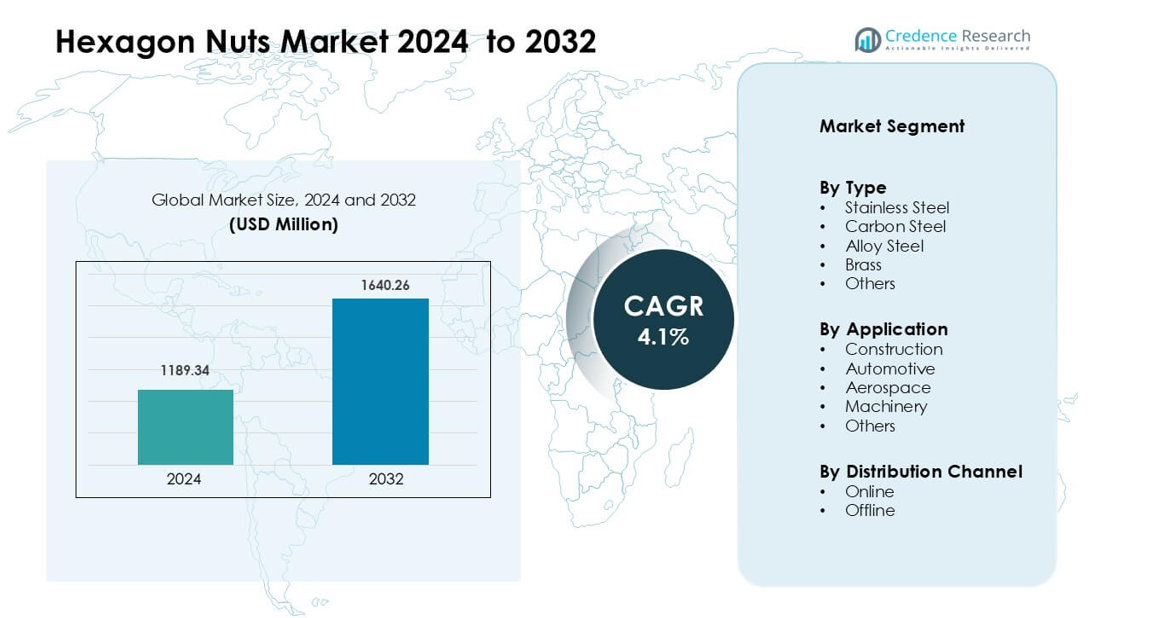
Hexagon Nuts Market was valued at USD 1189.34 million in 2024 and is anticipated to reach USD 1640.26 million by 2032, growing at a CAGR of 4.1% during the forecast period.
| REPORT ATTRIBUTE | DETAILS |
|---|---|
| Historical Period | 2020-2023 |
| Base Year | 2024 |
| Forecast Period | 2025-2032 |
| Hexagon Nuts Market Size 2024 | USD 1189.34 million |
| Hexagon Nuts Market, CAGR | 4.1% |
| Hexagon Nuts Market Size 2032 | USD 1640.26 million |
The Hexagon Nuts Market is shaped by major players including Bossard Group, Penn Engineering, Nucor Corporation, LISI Group, Würth Group, Fastenal Company, Arconic Inc., Illinois Tool Works Inc., Stanley Black & Decker Inc., and Bulten AB. These companies compete through advanced manufacturing, broad material options, and strong global distribution networks. They focus on high-strength carbon steel, stainless steel, and alloy steel nuts that meet strict industrial standards across construction, automotive, aerospace, and machinery applications. Asia Pacific leads the market with about 34% share, driven by large-scale manufacturing, rapid infrastructure expansion, and strong regional supply capabilities.
Market Insights
- Hexagon Nuts Market was valued at USD 1189.34 million in 2024 and is anticipated to reach USD 1640.26 million by 2032, growing at a CAGR of 4.1% during the forecast period.
- Construction remains the top application with 46% share because builders rely on high-strength fastening for heavy loads and structural safety.
- Stainless steel leads the type segment with 41% share as buyers prefer corrosion resistance and long service life.
- Top players such as Bossard Group and Penn Engineering compete through durable materials, wide portfolios, and global distribution, while smaller firms face margin pressure due to high product standardization.
- Asia Pacific holds the largest regional share at 34%, driven by strong manufacturing, rapid urban growth, and high-volume construction demand, while North America and Europe maintain stable consumption through automotive, machinery, and industrial upgrades.
Market Segmentation Analysis:
By Type
Stainless steel hexagon nuts lead this segment with about 41% share in 2024. Buyers prefer stainless steel due to strong corrosion resistance, long service life, and stable performance in outdoor and high-moisture settings. Construction firms and industrial plants use stainless grades to reduce maintenance and prevent joint failure. Carbon steel records steady demand because manufacturers value its strength and lower cost for general hardware needs. Alloy steel grows in heavy-duty uses, while brass and other metals serve electrical, plumbing, and decorative applications where conductivity or appearance matters.
- For instance, Arnold Umform technik is a leading supplier of innovative fastening technology, focusing on complex, cold-formed parts and intelligent fasteners.
By Application
Construction dominates this segment with nearly 46% share in 2024. Contractors rely on hexagon nuts for structural fastening, concrete anchors, and steel framework joints that require high load-bearing strength. Growth in residential and commercial projects boosts consumption across developing regions. Automotive producers adopt hex nuts for engine mounts, chassis parts, and suspension systems due to precision fit and vibration resistance. Aerospace, machinery, and other sectors maintain stable demand as equipment makers seek reliable fastening for rotating parts and safety-critical assemblies.
- For instance, Sterling Tools Ltd (STL), India’s second-largest automotive fastener manufacturer, has a production capacity of 48,000 tonnes per annum, and a major share of its fasteners (including hex nuts) are sold into OEMs across passenger and commercial vehicles.
By Distribution Channel
Offline channels hold the largest share with around 67% in 2024. Industrial buyers prefer physical distributors because they offer bulk supply, verified quality checks, and immediate availability for urgent maintenance needs. Hardware retailers and authorized dealers support sales through technical guidance and assured standards compliance. Online channels expand quickly as buyers shift to digital procurement for faster comparison, wider SKU access, and easier contract purchasing. E-commerce platforms gain traction among small workshops and distributors seeking streamlined ordering and lower sourcing time.
Key Growth Drivers
Rising Construction and Infrastructure Expansion
Global construction investment continues to surge as countries upgrade bridges, rail systems, buildings, and industrial zones. This expansion raises the need for durable fastening solutions that support heavy loads and long-term stability. Hexagon nuts benefit from this trend because builders prefer predictable torque strength, corrosion resistance, and compatibility with standard bolts. Government-backed smart city plans and housing programs increase procurement across residential and commercial projects. Large contractors also standardize stainless steel and carbon steel nuts to maintain uniform safety levels across high-rise structures. Infrastructure upgrades in Asia and the Middle East strengthen demand, while renovation activities in Europe sustain ongoing consumption. The broad use of hex nuts in beams, columns, anchors, and formwork systems keeps this market on a steady growth path.
- For instance, SFS Group AG reported CHF 3,039 million in sales in 2024, with a significant portion coming from its fastening systems business serving large infrastructure and construction accounts.
Strong Automotive and Machinery Production Growth
Automakers and machinery manufacturers increase adoption of hexagon nuts due to rising vehicle output and expanding automation. Automotive plants use precision-grade nuts in engines, suspension systems, braking assemblies, and chassis joints where vibration resistance and torque reliability are essential. Machinery producers rely on high-strength alloy and carbon steel variants that support rotating shafts, gear housings, conveyor assemblies, and industrial robots. The shift toward electric vehicles also boosts demand for lightweight fastening systems that support battery modules and thermal enclosures. Manufacturing expansions in China, India, and Eastern Europe reinforce supply-chain stability and increase bulk procurement rates. As companies automate assembly lines, they prefer standardized hex nuts that work seamlessly with robotic fastening tools and torque-controlled systems, strengthening long-term market growth.
- For instance, Sundram Fasteners Ltd secured a US$ 250 million contract from a global automaker for EV sub-assemblies; the deal involves supplying 1.5 million transmission sub-assemblies per year.
Growing Demand for Corrosion-Resistant Fasteners
End-users across marine, chemical processing, renewable energy, and outdoor equipment markets increasingly adopt corrosion-resistant hexagon nuts. Stainless steel and coated variants gain attention because these fasteners retain strength despite exposure to moisture, saltwater, chemicals, or temperature swings. Offshore wind projects require high-durability fastening to support turbine towers, nacelles, and anchoring systems, driving procurement of corrosion-resistant nuts. Chemical plants and water treatment facilities also standardize stainless steel grades to avoid joint failure and reduce maintenance costs. Rising safety regulations encourage buyers to replace traditional carbon steel with advanced alloys and protective coatings. As companies prioritize long asset life and lower lifecycle costs, corrosion-resistant hex nuts become a strategic choice in harsh operating environments.
Key Trend & Opportunity
Expansion of Digital Procurement Platforms
Online procurement platforms create new opportunities as industrial buyers shift toward faster, transparent, and cost-efficient sourcing. E-commerce channels offer broader SKU availability, real-time pricing, and direct access to global suppliers. Small workshops and mid-sized manufacturers adopt online purchasing to lower search time and compare multiple quality grades, finishes, and certifications. Digital procurement reduces supply delays and offers better stock visibility for bulk buyers. Marketplaces also integrate technical datasheets and installation guides, helping customers make informed choices. Subscription-based ordering and automated replenishment tools support maintenance teams that need consistent access to fastening products. The rise of B2B marketplaces in Asia and Europe strengthens cross-border sales and enables suppliers to reach customers who traditionally relied on local distributors.
- For instance, Bay Supply, a B2B vertical marketplace focused on fastening products, supports over 2,000 identified fastener categories and allows buyers to generate RFQs that are auto-populated with part specifications, greatly reducing manual effort.
Growth of High-Strength and Lightweight Fastener Innovations
Innovation in materials and coatings creates new opportunities as industries seek stronger and lighter fastening solutions. Alloy steel hexagon nuts gain traction in heavy machinery and automotive assemblies because these products enhance fatigue resistance and support higher torque loads. Manufacturers introduce new coatings such as zinc-nickel, ceramic, and epoxy layers to improve corrosion resistance and extend service life. The shift toward lightweight vehicles increases demand for aluminum and hybrid-metal fasteners. Aerospace suppliers also experiment with advanced alloys that match strict weight-to-strength requirements. Vendors who invest in R&D benefit from rising demand for customized nuts designed for robotic tightening, high-temperature performance, and renewable energy structures. This innovation cycle strengthens market competitiveness and expands application potential.
- For instance, Bossard has developed a line of high-strength all-metal lock nuts (DIN 980 V) with property class 8, made from carbon steel, with dimensions like M10 (17 mm across flats) and prevailing-torque performance.
Key Challenge
Volatile Raw Material Prices and Supply Chain Pressures
Hexagon nuts manufacturers face challenges due to fluctuating prices of steel, alloys, zinc, and other key inputs. Global supply disruptions, energy cost spikes, and geopolitical issues raise production expenses and reduce profit margins. Smaller manufacturers struggle to maintain stable output when raw materials become scarce or costly, affecting order fulfilment. Transportation delays and port congestion also impact lead times for bulk shipments. Buyers often push for low-cost procurement, limiting the ability of suppliers to pass on price increases. These pressures force manufacturers to optimize sourcing strategies, but unpredictability in material availability continues to pose significant risks across major regions.
Intense Competition and Product Standardization
The hexagon nuts market experiences strong competition because many global and regional producers offer similar standardized products. This high level of uniformity limits differentiation and results in price-driven bidding, especially in construction and machinery sectors. Suppliers must maintain strict compliance with ISO, DIN, and ASTM standards, leaving little room for premium pricing. Smaller firms struggle to compete against large players with advanced automation, higher production capacity, and established distribution networks. As buyers compare suppliers mainly on cost and delivery time, manufacturers face pressure to reduce prices while maintaining quality. This competitive environment restricts margins and demands continuous operational efficiency improvements.
Regional Analysis
North America
North America leads the Hexagon Nuts Market with about 32% share in 2024. Demand rises as construction, automotive, and machinery projects scale across the U.S. and Canada. Manufacturers prefer stainless steel and carbon steel nuts for their strong durability and stable torque performance. The region benefits from advanced production technology, strict safety rules, and steady infrastructure spending. Automotive plants increase procurement as EV assembly expands. Distributors maintain strong supply networks that support fast delivery and reliable stock availability. Industrial upgrades across energy, manufacturing, and transportation continue to strengthen long-term demand.
Europe
Europe holds roughly 27% share in 2024, supported by strong engineering standards and mature industrial sectors. Germany, France, and the U.K. drive usage across machinery, automotive systems, and structural components. Buyers rely on stainless steel and alloy fasteners to meet strict corrosion-resistance and performance requirements. The region’s focus on renewable energy, rail expansion, and manufacturing automation increases procurement volumes. EU regulations promote the use of certified fastening products, strengthening demand for high-precision nuts. Steady upgrades in aerospace and heavy equipment also contribute to stable long-term growth across major European markets.
Asia Pacific
Asia Pacific dominates global growth momentum and accounts for about 34% share in 2024. China, India, Japan, and South Korea drive large-scale consumption across construction, automotive production, and industrial machinery. Local manufacturers supply cost-competitive stainless steel, carbon steel, and alloy variants, supporting strong export activity. Infrastructure expansion, urban development, and rising manufacturing output boost regional demand. Automotive plants adopt precision-grade nuts for engines, EV platforms, and assembly lines. Fast industrialization and strong distribution networks make Asia Pacific the fastest-growing regional market with significant long-term potential.
Latin America
Latin America holds nearly 4% share in 2024, with demand centered in Brazil, Mexico, and Argentina. Growth improves as construction projects, mining activities, and machinery upgrades expand. Buyers prefer carbon steel and stainless steel nuts due to good strength and cost balance. Automotive plants in Mexico increase procurement as regional manufacturing grows. Import-dependent supply chains create moderate cost pressure, but expanding distributor networks support wider product access. Public infrastructure spending provides steady opportunities across commercial, industrial, and utility-scale projects, helping the region maintain a stable growth outlook.
Middle East & Africa
The Middle East & Africa region accounts for about 3% share in 2024. Demand strengthens as governments invest in large construction developments, energy plants, and industrial zones. Stainless steel nuts gain preference due to strong corrosion resistance in high-temperature and high-salinity environments. Gulf countries lead adoption for oil, gas, and infrastructure installations. Africa’s machinery and mining sectors support additional growth. Import flows remain important, but expanding local distributors improve availability. Gradual industrial expansion and ongoing megaprojects help sustain long-term market demand across major countries in the region.
Market Segmentations:
By Type
- Stainless Steel
- Carbon Steel
- Alloy Steel
- Brass
- Others
By Application
- Construction
- Automotive
- Aerospace
- Machinery
- Others
By Distribution Channel
- Online
- Offline
By Geography
- North America
- U.S.
- Canada
- Mexico
- Europe
- Germany
- France
- U.K.
- Italy
- Spain
- Rest of Europe
- Asia Pacific
- China
- Japan
- India
- South Korea
- South-east Asia
- Rest of Asia Pacific
- Latin America
- Brazil
- Argentina
- Rest of Latin America
- Middle East & Africa
- GCC Countries
- South Africa
- Rest of the Middle East and Africa
Competitive Landscape
The competitive landscape of the Hexagon Nuts Market features strong participation from global fastener manufacturers and established industrial suppliers. Leading companies such as Bossard Group, Penn Engineering, Nucor Corporation, LISI Group, Würth Group, Fastenal Company, Arconic Inc., Illinois Tool Works Inc., Stanley Black & Decker Inc., and Bulten AB compete through wide product portfolios, precision-engineered fasteners, and strong distribution capabilities. Market leaders focus on high-strength stainless steel, carbon steel, and alloy steel nuts designed for construction, automotive, aerospace, and machinery applications. Many players invest in automated production, heat-treatment technology, and corrosion-resistant coatings to enhance performance and meet global standards. Distributors strengthen their competitive edge by expanding inventory depth, improving delivery speed, and offering technical support for industrial buyers. Strategic moves such as mergers, regional expansion, and digital sales platforms help companies maintain market presence, while rising demand for certified, high-durability fasteners continues to push innovation and product differentiation across the sector.
Key Player Analysis
- Bossard Group
- Penn Engineering
- Nucor Corporation
- LISI Group
- Würth Group
- Fastenal Company
- Arconic Inc.
- Illinois Tool Works Inc.
- Stanley Black & Decker Inc.
- Bulten AB
Recent Developments
- In September 2025, Arconic commissioned a major expansion of high-purity aluminum output at its Davenport Works plant, boosting supply of advanced aluminum materials used in aerospace and defense components, including feedstock for high-performance fasteners and hex-style hardware.
- In January 2025, Bossard completed the acquisition of German fastener distributor Ferdinand Gross Group, expanding its range and regional coverage for mechanical fasteners, including hexagon nuts, in Central Europe
Report Coverage
The research report offers an in-depth analysis based on Type, Application, Distribution Channel and Geography. It details leading market players, providing an overview of their business, product offerings, investments, revenue streams, and key applications. Additionally, the report includes insights into the competitive environment, SWOT analysis, current market trends, as well as the primary drivers and constraints. Furthermore, it discusses various factors that have driven market expansion in recent years. The report also explores market dynamics, regulatory scenarios, and technological advancements that are shaping the industry. It assesses the impact of external factors and global economic changes on market growth. Lastly, it provides strategic recommendations for new entrants and established companies to navigate the complexities of the market.
Future Outlook
- Demand will rise as global construction and infrastructure projects expand.
- Automotive and EV manufacturing growth will increase the need for precision fasteners.
- Adoption of corrosion-resistant stainless steel and coated variants will accelerate.
- Manufacturers will invest more in automated production and quality-control systems.
- Digital procurement platforms will streamline sourcing and widen supplier reach.
- Renewable energy installations will boost consumption of high-strength fastening solutions.
- Lightweight and high-performance alloy nuts will gain traction in aerospace and machinery.
- Sustainability requirements will encourage the use of recyclable and eco-friendly materials.
- Supply chains will become more regionalized to reduce lead times and import risks.
- Competition will intensify as global and regional players expand product portfolios.

Request a Free Sample
Fill in your details and we'll send you a free sample report.
- Sample data tables & charts
- Research methodology
Market Dynamics
Construction and Infrastructure Expansion
Global investment in construction and infrastructure is increasing, driving demand for hexagon nuts due to their essential role in structural fastening, concrete anchors, and steel frameworks. Large-scale projects and government-backed urbanization initiatives especially in Asia Pacific and the Middle East are boosting procurement of high-strength, reliable fasteners.
Growth in Automotive and Machinery Production
Rising vehicle output and automation in manufacturing are increasing the use of hexagon nuts in engines, chassis, and industrial equipment. The shift toward electric vehicles and advanced machinery requires precision-grade, vibration-resistant fasteners, supporting steady market growth.
Rising Demand for Corrosion-Resistant Fasteners
Industries such as marine, chemical processing, and renewable energy are increasingly adopting stainless steel and coated hexagon nuts for their superior corrosion resistance and long service life. This trend is reinforced by stricter safety regulations and the need to reduce maintenance costs in harsh environments.
Expansion of Digital Procurement Platforms
The adoption of online procurement channels is streamlining sourcing for industrial buyers, offering broader product selection, faster comparison, and improved supply chain efficiency. This shift is particularly beneficial for small and mid-sized manufacturers seeking cost-effective and timely access to certified fasteners.
Innovation in High-Strength and Lightweight Fasteners
Ongoing R&D in materials and coatings is enabling the development of stronger, lighter, and more durable hexagon nuts. These innovations are meeting the evolving needs of the automotive, aerospace, and renewable energy sectors, where performance and weight reduction are critical.
Need a Custom Version of This Report?
Tailor the scope, geography, or segments to your exact requirements.
- Custom geography or segment scope
- Direct access to our analyst team
Frequently Asked Questions
What is the current market size for Hexagon Nuts Market, and what is its projected size in 2032?
At what Compound Annual Growth Rate is Hexagon Nuts Market projected to grow between 2025 and 2032?
Which segment is expected to post the highest CAGR during the forecast period?
Who are the major players in the global hexagon nuts market?
What are the major market drivers of the hexagon nuts industry?
What are the major market opportunities of the hexagon nuts industry?
Who are the leading companies in Hexagon Nuts Market?
Table of Content
Chapter 1 Market Segmentation
- 1.1 Segmentation Framework
- 1.1.1 Product and Service Classification
- 1.1.2 Application and End-Use Classification
- 1.1.3 Technology and Solution Classification
- 1.1.4 Customer and Distribution Channel Classification
- 1.1.5 Geographic Segmentation
- 1.1.6 Market Segment Definitions and Boundaries
- 1.2 By Type
- 1.2.1 Stainless Steel
- 1.2.2 Carbon Steel
- 1.2.3 Alloy Steel
- 1.2.4 Brass
- 1.2.5 Others
- 1.3 By Application
- 1.3.1 Construction
- 1.3.2 Automotive
- 1.3.3 Aerospace
- 1.3.4 Machinery
- 1.3.5 Others
Chapter 2 Introduction
- 2.1 Report Objectives and Scope
- 2.2 Product Definition and Industry Terminology
- 2.3 Market Inclusions and Exclusions
- 2.4 Research Process
- 2.4.1 Primary Research and Expert Interviews
- 2.4.2 Secondary Research and Source Review
- 2.4.3 Top-Down and Bottom-Up Estimation
- 2.4.4 Data Triangulation and Verification
- 2.5 Market Size Measurement Basis
- 2.5.1 2024: USD 1189.34 million → 2032: USD 1640.26 million
- 2.6 Historical and Forecast Reference Periods
- 2.6.1 Base Year: 2024
- 2.6.2 Forecast Period: 2024-2032
- 2.7 Research Assumptions and Limitations
Chapter 3 Executive Summary
- 3.1 Market Snapshot and Key Findings
- 3.2 Base-Year Market Size, 2024
- 3.3 Forecast Market Size, 2032
- 3.4 Revenue and Volume Growth Outlook
- 3.5 Key Demand and Supply Indicators
- 3.6 Leading Market Segments
- 3.7 Fastest-Growing Market Opportunities
- 3.8 Regional Performance Highlights
- 3.9 Technology and Industry Transformation
- 3.10 Competitive Landscape Summary
- 3.11 Analyst View and Strategic Implications
Chapter 4 Global Hexagon Nuts Market Trends and Developments
- 4.1 Historical Industry Development
- 4.2 Recent Market Trends and Developments
- 4.3 Demand and Customer Behavior Trends
- 4.4 Technology and Product Innovation
- 4.5 Artificial Intelligence, Automation and Digitalization
- 4.6 Local Manufacturing and Supply Chain Realignment
- 4.7 Industry Partnerships, Mergers and Acquisitions
- 4.8 Sustainability and Circular Economy Developments
- 4.9 Government and Private Sector Investment Trends
- 4.10 Emerging Business Models and Commercialization
- 4.11 Industry Developments and Announcements
Chapter 5 Global Hexagon Nuts Market Production, Supply and Demand Analysis
- 5.1 Demand Trend and Consumption Analysis
- 5.2 Demand Forecast, 2024-2032
- 5.3 Production and Output Trend
- 5.4 Production and Output Forecast, 2024-2032
- 5.5 Installed Capacity and Capacity Utilization
- 5.6 Company-Wise Production Plants and Statistics
- 5.6.1 Installed Production Capacity
- 5.6.2 Actual Production
- 5.6.3 Planned Capacity and Expansion Targets
- 5.7 Supply Chain Structure and Procurement Trends
- 5.8 Supply-Demand Gap and Bottlenecks
- 5.9 Import Dependence and Sourcing Structure
- 5.10 Contract Manufacturing and Outsourcing
- 5.11 Regional Supply and Demand Concentration
Chapter 6 Global Hexagon Nuts Market Pricing Analysis
- 6.1 Pricing Structure and Measurement
- 6.2 Historical Pricing Trends
- 6.3 Pricing Outlook, 2024-2032
- 6.4 Average Selling Price and Unit Economics
- 6.5 Pricing by Product and Market Segment
- 6.6 Geographic Pricing Differences
- 6.7 Key Input, Energy, Labor and Logistics Costs
- 6.8 Contract Pricing and Purchasing Models
- 6.9 Pricing Sensitivity and Competitive Positioning
- 6.10 Price, Margin and Profitability Implications
Chapter 7 Global Hexagon Nuts Market Dynamics
- 7.1 Market Growth Drivers
- 7.1.1 Demand-Side Drivers
- 7.1.2 Technology and Innovation Drivers
- 7.1.3 Infrastructure and Investment Drivers
- 7.1.4 Regulatory and Policy Drivers
- 7.2 Market Restraints
- 7.2.1 Cost and Affordability Constraints
- 7.2.2 Technology and Adoption Barriers
- 7.2.3 Supply Chain and Operational Constraints
- 7.3 Market Challenges
- 7.3.1 Competitive Pressure and Margin Erosion
- 7.3.2 Skills, Infrastructure and Implementation Gaps
- 7.4 Emerging Market Opportunities
- 7.5 Market Dynamics Impact and Time-Horizon Assessment
Chapter 8 Global Hexagon Nuts Value Chain Analysis
- 8.1 Industry Value Chain Overview
- 8.2 Upstream Suppliers and Critical Inputs
- 8.3 Technology and Component Providers
- 8.4 Manufacturing or Service Delivery
- 8.5 Distribution, Channel Partners and Integrators
- 8.6 Downstream Applications and End Users
- 8.7 Value Addition and Profit Pools
- 8.8 Vertical Integration and Outsourcing
- 8.9 Supplier Concentration and Risk
- 8.10 Supply Chain Localization and Resilience
Chapter 9 Global Hexagon Nuts Market Regulations and Policies
- 9.1 Relevant Laws, Standards and Compliance Frameworks
- 9.2 Product, Service, Safety and Quality Requirements
- 9.3 Government Policies, Incentives and Subsidies
- 9.4 Imports, Exports and Trade Barriers
- 9.5 Public Procurement and Local Content Requirements
- 9.6 Environmental and Sustainability Compliance
- 9.7 Upcoming Policy Changes and Market Implications
Chapter 10 Global Hexagon Nuts Market Hotspots and Opportunities
- 10.1 Market Opportunity Mapping and Growth Hotspots
- 10.2 High-Growth Applications and Customer Groups
- 10.3 Underserved Markets and White-Space Opportunities
- 10.4 Emerging Technology and Product Opportunities
- 10.5 New Capacity and Investment Hotspots
- 10.6 Market Entry and Expansion Opportunities
- 10.7 Distribution and Partnership Opportunities
- 10.8 Near-Term and Long-Term Commercial Potential
- 10.9 Opportunity Attractiveness and Execution Risks
Chapter 11 Global Hexagon Nuts Market Outlook, 2024-2032
- 11.1 Market Size and Analysis
- 11.1.1 Revenue (Market Measurement: 2024: USD 1189.34 million → 2032: USD 1640.26 million)
- 11.1.2 Market Volume and Quantity Sold
- 11.1.3 Historical Market Size
- 11.1.4 Base-Year Market Size, 2024
- 11.2 Market Forecast, 2024-2032
- 11.2.1 Revenue Forecast to 2032
- 11.2.2 Volume Forecast to 2032
- 11.2.3 CAGR and Year-on-Year Growth
- 11.2.4 Incremental Revenue Opportunity
- 11.3 Forecast Assumptions and Scenario Analysis
- 11.3.1 Base-Case Forecast
- 11.3.2 Optimistic and Conservative Scenarios
- 11.3.3 Technology, Pricing and Policy Sensitivities
- 11.4 Market Attractiveness and Growth Outlook
Chapter 12 Global Hexagon Nuts Market Segmentation and Outlook
- 12.1 Segmentation Summary and Market Shares, 2024
- 12.2 Largest and Fastest-Growing Segments
- 12.3 By Type - Market Size and Forecast, 2024-2032
- 12.3.1 Segment Definition and Scope
- 12.3.2 Historical Market Size
- 12.3.3 Revenue Forecast, 2024-2032
- 12.3.4 Volume Forecast, 2024-2032
- 12.3.5 Base-Year Market Share, 2024
- 12.3.6 Segment CAGR and Growth Drivers
- 12.3.7 Subsegment Market Size and Forecast
- 12.3.7.1 Stainless Steel
- 12.3.7.2 Carbon Steel
- 12.3.7.3 Alloy Steel
- 12.3.7.4 Brass
- 12.3.7.5 Others
- 12.3.8 Subsegment Pricing and Adoption Trends
- 12.3.9 Leading Suppliers and Competition
- 12.3.10 Regional Demand and Opportunities
- 12.4 By Application - Market Size and Forecast, 2024-2032
- 12.4.1 Segment Definition and Scope
- 12.4.2 Historical Market Size
- 12.4.3 Revenue Forecast, 2024-2032
- 12.4.4 Volume Forecast, 2024-2032
- 12.4.5 Base-Year Market Share, 2024
- 12.4.6 Segment CAGR and Growth Drivers
- 12.4.7 Subsegment Market Size and Forecast
- 12.4.7.1 Construction
- 12.4.7.2 Automotive
- 12.4.7.3 Aerospace
- 12.4.7.4 Machinery
- 12.4.7.5 Others
- 12.4.8 Subsegment Pricing and Adoption Trends
- 12.4.9 Leading Suppliers and Competition
- 12.4.10 Regional Demand and Opportunities
- 12.5 Segment Growth Comparison
- 12.6 Segment Attractiveness and Priority Matrix
Chapter 13 Global Hexagon Nuts End-Use and Application Market Outlook
- 13.1 End-Use Industry and Customer Demand Structure
- 13.2 Leading Applications and Customer Groups
- 13.3 End-Use Market Size, Share and Forecast
- 13.4 Major End-Use Industry Deep Dives
- 13.4.1 Customer Requirements and Use Cases
- 13.4.2 Demand and Replacement Cycles
- 13.4.3 Technical and Regulatory Considerations
- 13.4.4 Purchasing and Procurement Models
- 13.4.5 Leading Vendors and Distribution Channels
- 13.4.6 Forecast and Commercial Opportunities
- 13.5 Emerging Applications and Cross-Segment Demand
- 13.6 End-Use Industry Investment Priorities
Chapter 14 Global Hexagon Nuts Geographic Market Outlook, 2024-2032
- 14.1 Regional Market Size and Share, 2024
- 14.2 Regional Market Forecast, 2024-2032
- 14.3 Regional Pricing, Production and Demand Differences
- 14.4 North America
- 14.4.1 United States
- 14.4.2 Canada
- 14.4.3 Mexico
- 14.5 Europe
- 14.5.1 Germany
- 14.5.2 France
- 14.5.3 Italy
- 14.5.4 United Kingdom
- 14.5.5 Spain
- 14.5.6 Poland
- 14.5.7 Russia
- 14.5.8 Netherlands
- 14.5.9 Belgium
- 14.5.10 Sweden
- 14.5.11 Denmark
- 14.5.12 Norway
- 14.5.13 Rest of Europe
- 14.6 Asia Pacific
- 14.6.1 China
- 14.6.2 India
- 14.6.3 Japan
- 14.6.4 South Korea
- 14.6.5 Thailand
- 14.6.6 Indonesia
- 14.6.7 Vietnam
- 14.6.8 Malaysia
- 14.6.9 Australia
- 14.6.10 Rest of Asia Pacific
- 14.7 Latin America
- 14.7.1 Brazil
- 14.7.2 Argentina
- 14.7.3 Colombia
- 14.7.4 Chile
- 14.7.5 Rest of Latin America
- 14.8 Middle East
- 14.8.1 Saudi Arabia
- 14.8.2 United Arab Emirates
- 14.8.3 Turkey
- 14.8.4 Israel
- 14.8.5 Iran
- 14.8.6 Rest of the Middle East
- 14.9 Africa
- 14.9.1 South Africa
- 14.9.2 Egypt
- 14.9.3 Nigeria
- 14.9.4 Morocco
- 14.9.5 Rest of Africa
- 14.10 Regional Investment, Policy and Supply Chain Differences
- 14.11 Regional Competitive Landscape
- 14.12 Geographic Growth Hotspots
Chapter 15 Global Hexagon Nuts Technology, Innovation and Sustainability Outlook
- 15.1 Technology Landscape and Maturity
- 15.2 Product, Process and Service Innovation
- 15.3 AI, Automation and Digital Tools in the Industry
- 15.4 Technology Adoption and Performance Benchmarking
- 15.5 Innovation Pipeline and R&D Investment
- 15.6 Patent and Intellectual Property Trends
- 15.7 Energy Efficiency and Resource Management
- 15.8 Sustainability, Recycling and Circularity
- 15.9 Technology Roadmap, 2024-2032
- 15.10 Risks of Obsolescence and Technology Substitution
Chapter 16 Global Hexagon Nuts Market Key Strategic Imperatives
- 16.1 Growth and Market Entry Priorities
- 16.2 High-Return Products and Segments
- 16.3 Pricing, Profitability and Cost Optimization
- 16.4 Technology Investment and Product Differentiation
- 16.5 Supply Chain Localization and Resilience
- 16.6 Distribution and Customer Acquisition
- 16.7 Partnership, Acquisition and Capacity Strategy
- 16.8 Regional Expansion Priorities
- 16.9 Short-, Medium- and Long-Term Actions
Chapter 17 Competition Outlook
- 17.1 Industry Competition Characteristics
- 17.2 Market Structure and Concentration
- 17.3 Market Share and Competitive Positioning, 2024
- 17.4 Company-Wise Revenue and Product Benchmarking
- 17.5 Production and Service Capacity Benchmarking
- 17.6 Technology, Pricing and Differentiation
- 17.7 Regional Footprint and Distribution Strength
- 17.8 Mergers, Acquisitions and Strategic Alliances
- 17.9 New Entrants and Competitive Threats
- 17.10 Porter's Five Forces and Industry Attractiveness
- 17.11 Competitive Outlook, 2024-2032
Chapter 18 Company Profiles
- 18.1 Company Coverage and Selection Criteria
- 18.2 Bossard Group
- 18.2.1 Business Description
- 18.2.2 Company Ownership and Geographic Presence
- 18.2.3 Product and Service Portfolio
- 18.2.4 Manufacturing and Operating Footprint
- 18.2.5 Production Capacity and Expansion Plans
- 18.2.6 Financial Performance and Investment
- 18.2.7 Market Share and Competitive Position
- 18.2.8 Technology and Innovation Capabilities
- 18.2.9 Strategic Alliances or Partnerships
- 18.2.10 Recent Developments
- 18.2.11 Growth Strategy and Outlook
- 18.3 Penn Engineering
- 18.4 Nucor Corporation
- 18.5 LISI Group
- 18.6 Würth Group
- 18.7 Fastenal Company
- 18.8 Arconic Inc.
- 18.9 Illinois Tool Works Inc.
- 18.10 Stanley Black & Decker Inc.
- 18.11 Bulten AB
- 18.12 Other Relevant Market Participants
Note: Every listed company is profiled on the structure shown under the first company. The company list is preliminary and may change based on research findings, market developments, data availability and client requirements.
Chapter 19 Disclaimer
- 19.1 Research and Forecast Disclaimer
- 19.2 Data Source and Estimation Limitations
Note: The depth of individual sections depends on data availability for this market. Volume, capacity, trade and other unit-based metrics are included where applicable.