
Market Overview:
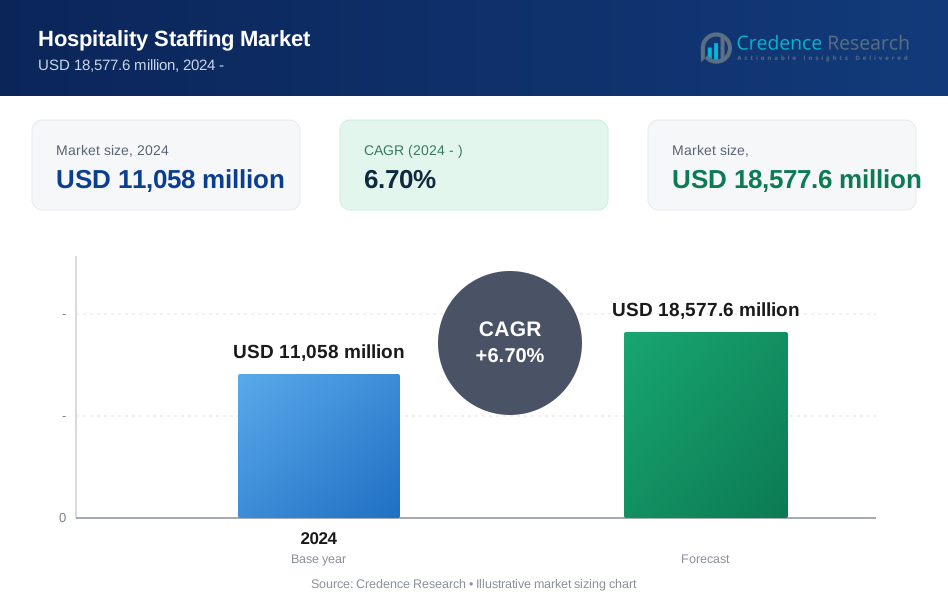
The Hospitality Staffing market size was valued at USD 11,058 million in 2024 and is anticipated to reach USD 18,577.6 million by 2032, at a CAGR of 6.7% during the forecast period.
| REPORT ATTRIBUTE | DETAILS |
|---|---|
| Historical Period | 2020-2023 |
| Base Year | 2024 |
| Forecast Period | 2025-2032 |
| Hospitality Staffing Marke Size 2024 | USD 11,058 million |
| Hospitality Staffing Marke, CAGR | 6.7% |
| Hospitality Staffing Marke Size 2032 | USD 18,577.6 million |
The hospitality staffing market is led by key players such as Hospitality Staffing Solutions, Remedy Intelligent Staffing, Alliance Recruitment Agency, The Service Companies, Inc., and Bolt Staffing Services, which offer comprehensive staffing solutions across hotels, restaurants, and event venues. These companies maintain a competitive edge through technology-driven recruitment, flexible workforce models, and strategic partnerships with hospitality brands. Additionally, specialized agencies like Luxe Hospitality Staffing and Hospitality Staffing UK focus on high-end service staffing and localized expertise. North America emerges as the leading region, accounting for approximately 36% of the global market share in 2024, driven by a robust tourism sector, widespread outsourcing of HR functions, and strong demand for seasonal staffing across the U.S. and Canada.
Market Insights
- The Hospitality Staffing market was valued at USD 11,058 million in 2024 and is projected to reach USD 18,577.6 million by 2032, growing at a CAGR of 6.7% during the forecast period.
- Market growth is driven by rising demand for flexible workforce solutions, increased outsourcing of HR functions, and expansion of the global tourism and hospitality infrastructure.
- Key trends include the adoption of digital staffing platforms, increasing demand for skilled and specialized talent, and the growing prominence of gig and on-demand employment models.
- The market is moderately fragmented, with leading players like Hospitality Staffing Solutions, Alliance Recruitment Agency, and The Service Companies competing alongside regional agencies; temporary staffing dominates by over 65% due to seasonal demand.
- Regionally, North America leads with 36% market share, followed by Europe (28%) and Asia Pacific (22%), with the Middle East & Africa and Latin America contributing 8% and 6%, respectively.
Market Segmentation Analysis:
By Service Type
The hospitality staffing market is segmented into temporary and permanent staffing, with temporary staffing emerging as the dominant sub-segment in 2024, accounting for over 65% of the market share. This dominance is driven by the seasonal and event-driven nature of the hospitality industry, where workforce demands fluctuate significantly. Temporary staffing offers flexibility and cost efficiency, enabling businesses to quickly scale operations based on customer influx, peak seasons, or special events. Moreover, rising demand for specialized skills during short-term assignments continues to boost the preference for temporary staffing solutions across hotels and restaurants.
- For instance, Hospitality Staffing Solutions deployed over 10,000 temporary associates across the U.S. in 2023 to support short-term hospitality contracts, achieving a placement rate of 97% within 48 hours for urgent hotel and resort requirements.
By End-User:
Among end-users, hotels represent the largest share of the hospitality staffing market, capturing approximately 48% of total market revenue in 2024. This is attributed to their continuous need for front desk staff, housekeeping, food services, and event management personnel to maintain consistent service quality. The expansion of hotel chains and growing tourist inflows globally are also fueling demand. Meanwhile, restaurants and event management companies are experiencing steady growth due to increased consumer spending on dining and events. These segments seek flexible staffing to handle variable workloads, especially during weekends, holidays, and peak seasons.
- For instance, The Service Companies provided staffing support to over 800 hotels and casinos across the U.S. in 2023, supplying more than 15,000 personnel annually, including culinary, housekeeping, and front-of-house roles, to maintain uninterrupted service levels during high-demand periods.
Market Overview
Rising Demand for Flexible Workforce Solutions
The increasing preference for flexible workforce models is a key driver of growth in the hospitality staffing market. Businesses in the sector face fluctuating service demands due to seasonal tourism, special events, and variable customer traffic. As a result, they increasingly rely on temporary staffing services to scale operations up or down efficiently. This flexibility allows companies to optimize labor costs while maintaining service quality, making staffing firms essential partners. The shift toward a gig-based economy further reinforces the demand for flexible labor across hotels, restaurants, and event management firms.
- For instance, GigSmart's staffing platform registered over 800,000 active workers in 2023, with more than 350,000 on-demand hospitality shifts filled through its mobile application, demonstrating the scalability and adaptability of tech-enabled flexible staffing models.
Growth in Global Tourism and Hospitality Infrastructure
The resurgence of global tourism and the expansion of hospitality infrastructure are significantly fueling staffing demand. Governments and private entities are investing in new hotels, resorts, and entertainment venues to cater to increasing tourist inflows. This expansion creates a sustained requirement for skilled and semi-skilled labor in roles such as front desk operations, food services, and housekeeping. Emerging markets in Asia-Pacific and the Middle East are particularly witnessing accelerated growth, contributing to a higher demand for staffing services to support newly built facilities and maintain high service standards.
- For instance, in 2023, EFS Facilities Services Group supported the opening of over 20 new hospitality properties in the UAE, deploying more than 4,200 skilled workers across housekeeping, concierge, and F&B functions to meet operational timelines and service benchmarks.
Increased Outsourcing of HR and Recruitment Functions
Hospitality businesses are increasingly outsourcing human resources and recruitment functions to specialized staffing firms to streamline operations and reduce administrative burdens. These agencies provide expertise in screening, training, and deploying suitable candidates quickly, improving workforce efficiency and retention. Outsourcing allows businesses to focus on core operations while ensuring compliance with labor regulations. This trend is especially prominent among mid-sized hotel chains and event companies that lack in-house recruitment capabilities. As cost pressures mount, the demand for comprehensive staffing solutions from third-party providers is expected to rise consistently.
Key Trends & Opportunities
Digital Transformation in Staffing Services
Technology adoption is reshaping the hospitality staffing landscape, with digital platforms enabling faster and more efficient talent sourcing. Staffing firms are increasingly using AI-driven tools for candidate matching, automated onboarding, and performance tracking. Mobile applications and online portals facilitate real-time communication between employers and temporary staff, reducing delays and improving job fulfillment rates. This trend creates opportunities for staffing providers to differentiate themselves by offering tech-enabled, user-friendly services, especially in competitive urban markets where speed and efficiency are critical for success.
- For instance, Indeed Flex, the digital staffing arm of Recruit Holdings, processed over 1.2 million job applications through its mobile platform in 2023, with an average job-fill time of under 8 minutes using AI-based applicant-matching technology.
Demand for Skilled and Specialized Talent
There is a growing demand for skilled and specialized personnel in niche hospitality functions such as mixology, wellness services, multilingual guest services, and event coordination. As consumer expectations rise, businesses seek staff with specific expertise to enhance customer experience and brand differentiation. This trend offers staffing firms the opportunity to expand their service portfolios and invest in targeted training programs. Providers that can consistently supply qualified professionals with hospitality certifications or multilingual skills will gain a competitive edge in both local and international markets.
- For instance, HSS (Hospitality Staffing Solutions) partnered with the American Hotel & Lodging Educational Institute in 2023 to certify over 2,500 workers in hospitality-specific training programs, including multilingual front desk services and certified housekeeping, improving placement rates by 18% for specialized roles.
Key Challenges
High Employee Turnover Rates
The hospitality industry is known for its high turnover rates, which pose a significant challenge for staffing firms. Temporary and entry-level positions often experience frequent attrition due to long hours, irregular shifts, and limited career progression. This instability increases recruitment costs and makes it difficult for staffing agencies to ensure consistent service quality. Companies must invest in retention strategies, such as offering benefits, upskilling opportunities, and positive work environments, to build a more stable and motivated workforce in collaboration with staffing providers.
Regulatory and Compliance Complexities
Navigating the varying labor laws and employment regulations across regions is a persistent challenge in the hospitality staffing market. Temporary and contract staffing arrangements must comply with local labor rights, wage standards, and safety guidelines. Frequent policy changes or differing interpretations of labor rules can lead to legal disputes and reputational risks for staffing agencies and their clients. Ensuring regulatory compliance demands constant monitoring and legal expertise, which can strain smaller staffing firms or those expanding into multiple jurisdictions.
Talent Shortage in Key Roles
Despite high demand, there is a persistent shortage of qualified candidates for certain hospitality roles, particularly in culinary arts, hotel management, and event planning. The gap is driven by a combination of low interest among young professionals, inadequate vocational training, and migration of skilled workers to other industries. This talent crunch limits the ability of staffing agencies to meet client expectations and often results in overworked employees or quality compromises. To address this issue, agencies must collaborate with training institutes and offer targeted development programs.
Regional Analysis
North America
North America dominated the global hospitality staffing market in 2024, accounting for approximately 36% of the total market share. The region benefits from a well-established hospitality sector, especially in the United States, where high tourist inflow and frequent business events fuel demand for flexible staffing solutions. Seasonal trends in travel and tourism create strong demand for temporary staff, particularly in hotels and restaurants. Moreover, increasing outsourcing of recruitment and growing use of digital staffing platforms support market expansion. Canada also contributes significantly due to its growing event management and tourism industry, further reinforcing the region’s leadership position.
Europe
Europe held around 28% of the global hospitality staffing market share in 2024, driven by strong tourism across countries like France, Spain, Italy, and the United Kingdom. The region’s mature hospitality sector, combined with seasonal tourist peaks, especially in summer, accelerates the need for temporary and skilled staff. Additionally, post-pandemic recovery in international travel and increased hiring in event and leisure industries support staffing demand. The rise of boutique hotels and luxury experiences has also created a need for specialized and multilingual talent, which staffing firms are actively addressing to meet evolving customer expectations across European markets.
Asia Pacific
Asia Pacific accounted for approximately 22% of the hospitality staffing market share in 2024 and is projected to grow at the fastest pace during the forecast period. Rapid urbanization, increasing disposable income, and expanding tourism infrastructure in countries such as China, India, Thailand, and Indonesia are major drivers. The rising number of international events, business conferences, and hotel developments are increasing staffing needs across the region. Additionally, government initiatives promoting tourism and hospitality education are helping bridge the talent gap. The region’s growing reliance on tech-driven staffing solutions is also enhancing service efficiency and labor management capabilities.
Middle East & Africa
The Middle East & Africa region captured around 8% of the global hospitality staffing market share in 2024. The Middle East, particularly the UAE and Saudi Arabia, is witnessing a surge in hospitality projects due to Vision 2030 and large-scale events like Expo and global summits. These developments have driven demand for both temporary and permanent hospitality staff. The region’s focus on luxury tourism and cultural events further accelerates specialized staffing needs. However, labor regulation and workforce nationalization policies present challenges for international staffing agencies, requiring greater local partnerships and regulatory compliance for market success.
Latin America
Latin America represented nearly 6% of the hospitality staffing market share in 2024, with Brazil and Mexico being the leading contributors. The region’s growing tourism sector, supported by cultural festivals, sports events, and beach destinations, drives the need for seasonal and event-based staffing. Rising investments in hotel chains and boutique resorts have also created opportunities for skilled hospitality personnel. However, economic volatility and political uncertainties in certain countries can hinder consistent market growth. Despite these challenges, increasing digital adoption and hospitality service training programs across the region are enhancing the efficiency and availability of the staffing workforce.
Market Segmentations:
By Service Type:
- Temporary Staffing
- Permanent Staffing
By End-User:
- Hotels
- Restaurants
- Event Management Companies
- Others
By Geography
- North America
- U.S.
- Canada
- Mexico
- Europe
- Germany
- France
- U.K.
- Italy
- Spain
- Rest of Europe
- Asia Pacific
- China
- Japan
- India
- South Korea
- South-east Asia
- Rest of Asia Pacific
- Latin America
- Brazil
- Argentina
- Rest of Latin America
- Middle East & Africa
- GCC Countries
- South Africa
- Rest of the Middle East and Africa
Competitive Landscape
The competitive landscape of the hospitality staffing market is characterized by a mix of global staffing firms, regional agencies, and specialized service providers competing to meet dynamic industry demands. Key players such as Hospitality Staffing Solutions, Remedy Intelligent Staffing, and The Service Companies, Inc. maintain strong market presence through comprehensive service portfolios, national reach, and advanced recruitment technologies. Regional firms like Hospitality Staffing UK and Alrich Hospitality Staffing Inc. offer localized expertise and personalized solutions, catering to niche markets and seasonal requirements. Emerging agencies such as Luxe Hospitality Staffing and Refugee Staffing Agency are gaining traction by focusing on diversity hiring and flexible workforce models. Companies are increasingly leveraging digital platforms, AI-driven talent matching, and mobile applications to enhance efficiency and improve client satisfaction. Strategic partnerships with hospitality chains, investment in skill development programs, and expansion into high-growth regions are key competitive strategies. Overall, the market remains moderately fragmented with rising competition across all service tiers.
Key Player Analysis
- Luxe Hospitality Staffing
- Bolt Staffing Services
- Refugee Staffing Agency
- The Service Companies, Inc.
- Hospitality Staffing UK
- Alliance Recruitment Agency
- Remedy Intelligent Staffing
- Alrich Hospitality Staffing Inc
- Hospitality Staffing Solutions
Recent Developments
- In May 2025, BOLT Staffing continues its operations in Northern California, specifically serving Sonoma, American Canyon, and Stockton. They are actively involved in the hospitality sector and other industries, offering updated job opportunities. BOLT Staffing is a family-owned agency that has been connecting job seekers with great companies since 1998.
- In March 2025, a refugee staffing agency was compelled to suspend new resettlement efforts, disrupting hundreds of planned hospitality placements across the nation. Organizations are actively advocating for the program's resumption, according to migration policy websites.
- In January 2025, Refugee Staffing Agency, an executive order paused new refugee arrivals for a 90-day review. By late February, the U.S. Department of State abruptly terminated grant agreements with all national resettlement agencies, including those providing hospitality staffing, creating funding and operational uncertainty for refugee staffing programs.
Market Concentration & Characteristics
The Hospitality Staffing Market shows a moderate to high level of market concentration, with a mix of large multinational staffing firms and regional players catering to varying business needs. It reflects a strong reliance on temporary staffing services due to the sector’s dynamic nature, where workforce demands often shift based on seasons, tourism trends, and event schedules. Large firms dominate high-volume contracts across hotel chains and international resorts, while smaller agencies serve localized or specialized roles. The market favors flexibility, rapid deployment, and skill alignment. Clients expect fast turnaround times, cost efficiency, and regulatory compliance, which places pressure on staffing providers to maintain qualified talent pools and invest in digital hiring platforms. Companies differentiate through industry-specific expertise, technology integration, and value-added services such as training and onboarding support. It continues to evolve toward digital and on-demand models, driven by the growth of gig economy structures and real-time labor matching platforms.
Report Coverage
The research report offers an in-depth analysis based on Service Type, End-User and Geography. It details leading market players, providing an overview of their business, product offerings, investments, revenue streams, and key applications. Additionally, the report includes insights into the competitive environment, SWOT analysis, current market trends, as well as the primary drivers and constraints. Furthermore, it discusses various factors that have driven market expansion in recent years. The report also explores market dynamics, regulatory scenarios, and technological advancements that are shaping the industry. It assesses the impact of external factors and global economic changes on market growth. Lastly, it provides strategic recommendations for new entrants and established companies to navigate the complexities of the market.
Future Outlook
- The market will witness steady growth driven by increasing demand for flexible and temporary staffing solutions.
- Digital staffing platforms will play a greater role in streamlining recruitment and deployment processes.
- Staffing agencies will expand their service offerings to include specialized and niche hospitality roles.
- The rise in international travel and tourism will boost staffing needs across hotels and event venues.
- Companies will invest more in workforce training and skill development to meet quality standards.
- Outsourcing of HR and recruitment functions will become more common among mid-sized hospitality businesses.
- Demand for multilingual and culturally competent staff will increase in global hospitality hubs.
- Technology integration will drive operational efficiency and improve staff-client matching accuracy.
- Regional markets in Asia Pacific and the Middle East will show strong expansion potential.
- Compliance with labor laws and workforce regulations will remain a key focus for staffing providers.
Request a Free Sample
Fill in your details and we'll send you a free sample report.
- Sample data tables & charts
- Research methodology
Need a Custom Version of This Report?
Tailor the scope, geography, or segments to your exact requirements.
- Custom geography or segment scope
- Direct access to our analyst team
Frequently Asked Questions
What is the current size of the Hospitality Staffing Market?
What factors are driving the growth of the Hospitality Staffing Market?
What are some challenges faced by the Hospitality Staffing Market?
Who are the major players in the Hospitality Staffing Market?
Table of Content
Chapter 1. Report Introduction
- 1.1 Report Description & Purpose
- 1.1.1 Report Title & Market Definition
- 1.1.2 Unique Selling Propositions (USP) & Key Differentiators
- 1.1.3 Value Proposition for Stakeholders
- 1.2 Research Objectives
- 1.2.1 Market Sizing Objectives (Volume & Revenue)
- 1.2.2 Segmentation Objectives
- 1.2.3 Competitive Intelligence Objectives
- 1.2.4 Forecast & Scenario Objectives
- 1.3 Report Scope
- 1.3.1 Hospitality Staffing Scope – Types & Subtypes Covered
- 1.3.2 Geographic Scope – Regions & Countries Covered
- 1.3.3 Historical Period, Base Year & Forecast Period (2024; forecast to the forecast period)
- 1.3.4 Inclusions & Exclusions
- 1.4 HS Code & Classification Framework
- 1.5 Currency, Units & Pricing Basis
- 1.6 Target Stakeholders
- 1.7 Limitations & Assumptions
Chapter 2. Executive Summary
- 2.1 Global Hospitality Staffing Market Snapshot
- 2.1.1 Market Size – Historical (2024) & Forecast (the forecast period) (2024: USD 11,058 million → forecast year: USD 18,577.6 million)
- 2.1.2 Volume & Revenue – Global Totals
- 2.1.3 Key Market Highlights – Top Five Facts
- 2.2 Hospitality Staffing Market Segmentation Snapshot
- 2.2.1 Market Split by Region – 2024 vs.
- 2.3 Competitive Snapshot
- 2.3.1 Top 10 Players by Revenue Share – 2024
- 2.3.2 Top 10 Players by Volume Share – 2024
- 2.3.3 Recent Strategic Developments (18-Month Summary)
- 2.4 Key Investment Highlights & Strategic Conclusions
Chapter 3. Hospitality Staffing Market Dynamics & Industry Analysis
- 3.1 Market Overview & Context
- 3.1.1 Hospitality Staffing Market Position in the Broader Automotive Value Chain
- 3.1.2 OEM vs. Replacement Market Dynamics
- 3.1.3 Market Maturity & Development Stage by Region
- 3.2 Hospitality Staffing Market Drivers
- 3.3 Hospitality Staffing Market Restraints & Challenges
- 3.4 Hospitality Staffing Market Opportunities
- 3.5 Porter's Five Forces Analysis
- 3.5.1 Threat of New Entrants
- 3.5.2 Bargaining Power of Suppliers
- 3.5.3 Bargaining Power of Buyers
- 3.5.4 Threat of Substitutes
- 3.5.5 Competitive Rivalry – Intensity Assessment
- 3.6 Hospitality Staffing Value Chain Analysis
- 3.6.1 Upstream – Raw Material/Input Suppliers
- 3.6.1.1 Raw Material/Input 1
- 3.6.1.2 Raw Material/Input 2
- 3.6.1.3 Raw Material/Input 3
- 3.6.2 Midstream – Production/Manufacturing/Service Delivery
- 3.6.2.1 Production/Process Overview
- 3.6.2.2 Key Facility Locations & Capacity by Manufacturer
- 3.6.3 Downstream – Distribution & End Consumer
- 3.6.3.1 Primary Channel – B2B/OEM
- 3.6.3.2 Secondary Channels – Dealer, Retail, Online, Direct
- 3.6.4 Value Chain Profitability Analysis
- 3.6.1 Upstream – Raw Material/Input Suppliers
- 3.7 PESTEL Analysis
- 3.7.1 Political Factors
- 3.7.2 Economic Factors
- 3.7.3 Social Factors
- 3.7.4 Technological Factors
- 3.7.5 Environmental Factors
- 3.7.6 Legal Factors
- 3.8 Hospitality Staffing Supply Chain Analysis
- 3.8.1 Raw Material/Input Supply Risk Assessment
- 3.8.2 Manufacturing Concentration Risk (Geographic Exposure)
- 3.8.3 Trade Disruption Impact Analysis
- 3.9 Regulatory & Policy Landscape
Note: The regulatory and policy landscape section covers regulations based on their applicability to the market, Hospitality Staffing category, geography, and scope of the study. Only regulatory frameworks with a material impact on operations, compliance, trade, sustainability, or market access are analyzed in detail.
Chapter 4. Key Investment Pockets & Opportunity Analysis
- 4.1 Hospitality Staffing Market Attractiveness Analysis
- 4.1.1 By Region – Investment Attractiveness Matrix (Volume × CAGR)
- 4.2 Absolute Revenue Growth Opportunity
- 4.2.1 By Region – Absolute USD Growth Through the forecast period
- 4.3 Incremental Volume Opportunity
- 4.3.1 By Region – Incremental Volume Through the forecast period
- 4.3.2 Segment – Incremental Volume
- 4.4 Emerging Submarket Opportunity Deep Dive (Subject to Applicability)
- 4.5 Emerging Market Opportunity Scorecards
- 4.5.1 United States
- 4.5.2 Europe
- 4.5.3 Asia
- 4.5.4 Middle East & Africa
Note: Emerging Market Opportunity Scorecards will be included based on relevance and strategic importance. Regions listed are indicative and may vary depending on data availability and market dynamics.
Chapter 5. Hospitality Staffing Import-Export Analysis & Trade Flows
- 5.1 Global Trade Overview
- 5.1.1 Global Export Value by Country (2024)
- 5.1.2 Global Export Volume by Country (2024)
- 5.1.3 Global Import Value by Country (2024)
- 5.1.4 Global Import Volume by Country (2024)
- 5.1.5 Net Trade Balance by Country (2024)
- 5.2 Export Analysis – Segment
- 5.2.1 Type 1 (HS Code)
- 5.2.2 Type 2 (HS Code)
- 5.2.3 Type 3 (HS Code)
- 5.2.4 Type 4 (HS Code)
- 5.2.5 Type 5 (HS Code)
- 5.3 Import Analysis – Segment
- 5.3.1 Type 1 (HS Code)
- 5.3.2 Type 2 (HS Code)
- 5.3.3 Type 3 (HS Code)
- 5.3.4 Type 4 (HS Code)
- 5.3.5 Type 5 (HS Code)
- 5.4 Average Unit Trade Prices
- 5.4.1 Average Export Price – Segment & Country
- 5.4.2 Average Import Price – Segment & Source Country
- 5.4.3 Price Trends (2024)
- 5.5 Key Trade Route Analysis
- 5.5.1 Trade Route 1
- 5.5.2 Trade Route 2
- 5.5.3 Trade Route 3
- 5.5.4 Trade Route 4
- 5.5.5 Trade Route 5
- 5.6 Trade Policy Impact Assessment
- 5.6.1 US Anti-Dumping & Section 301 Tariffs
- 5.6.2 EU Customs Union Impact
- 5.6.3 Major Free Trade Agreements
- 5.6.4 USMCA Rules of Origin
Note: Trade policy analysis will be included only where relevant to the Hospitality Staffing market.
Chapter 6. Competitive Landscape & Company Benchmarking
- 6.1 Hospitality Staffing Market Concentration & Structure
- 6.1.1 Herfindahl-Hirschman Index (HHI) – vs. 2024
- 6.1.2 Tier 1, Tier 2 & Tier 3 Market Structure
- 6.1.3 Global, Regional & Local Player Dynamics
- 6.2 Hospitality Staffing Market Share Analysis – 2024
- 6.2.1 Global Revenue Share by Company
- 6.2.2 Global Volume Share by Company
- 6.2.3 Regional Revenue Share
- 6.2.4 Market Share Evolution ( vs. 2024)
- 6.2.5 OEM Segment Share by Company
- 6.2.6 Replacement Segment Share by Company
- 6.3 Production/Delivery Capacity & Facility Analysis
- 6.3.1 Global Installed Capacity
- 6.3.2 Capacity Utilization Rates
- 6.3.3 Production/Output Volume
- 6.3.4 Facility Locations & Capacity Map
- 6.3.5 Planned Capacity Additions
- 6.4 Hospitality Staffing Competitive Benchmarking Matrix
- 6.4.1 Revenue, Volume, CAGR & Profitability Comparison
- 6.4.2 Channel Revenue Mix
- 6.4.3 Geographic Revenue Exposure
- 6.4.4 R&D Intensity
- 6.4.5 Sustainability Maturity
- 6.5 Strategic Developments in Hospitality Staffing (Last 24 Months)
- 6.5.1 Mergers, Acquisitions & Divestments
- 6.5.2 New Hospitality Staffing Launches
- 6.5.3 Facility Expansions
- 6.5.4 Strategic Alliances, Joint Ventures & Partnerships
- 6.5.5 Distribution Expansion & Market Entry
- 6.5.6 Sustainability & ESG Initiatives
- 6.6 Competitive Strategy Mapping
- 6.6.1 Leader, Challenger, Follower & Niche Classification
- 6.6.2 Pricing Strategy Comparison
- 6.6.3 Channel Strategy Matrix
Note: Strategic developments are included based on their materiality and the availability of reliable information.
Chapter 7. Global Hospitality Staffing Market – By Distribution Channel
- 7.1 Segment Overview
- 7.1.1 Volume & Revenue Split by Channel (2024 & )
- 7.1.2 Channel Mix Evolution (the forecast period)
Chapter 8. Regional Market Analysis – Global Overview
- 8.1 Global Regional Overview
- 8.1.1 Regional Volume Share
- 8.1.2 Regional Revenue Share
- 8.1.3 Regional Volume by Region
- 8.1.4 Regional Revenue by Region
- 8.1.5 Regional Forecast Through the forecast period
- 8.2 Cross-Regional Segment Analysis
- 8.2.1 By Distribution Channel
- 8.2.2 By Brand/Price Tier
Chapter 9. North America Hospitality Staffing Market
- 9.1 United States
- 9.2 Canada
- 9.3 Mexico
Chapter 10. Europe Hospitality Staffing Market
- 10.1 Germany
- 10.2 France
- 10.3 Italy
- 10.4 United Kingdom
- 10.5 Spain
- 10.6 Poland
- 10.7 Russia
- 10.8 Netherlands
- 10.9 Belgium
- 10.10 Sweden
- 10.11 Denmark
- 10.12 Norway
- 10.13 Rest of Europe
Chapter 11. Asia Pacific Hospitality Staffing Market
- 11.1 China
- 11.2 India
- 11.3 Japan
- 11.4 South Korea
- 11.5 Thailand
- 11.6 Indonesia
- 11.7 Vietnam
- 11.8 Malaysia
- 11.9 Australia
- 11.10 Rest of Asia Pacific
Chapter 12. Latin America Hospitality Staffing Market
- 12.1 Brazil
- 12.2 Argentina
- 12.3 Colombia
- 12.4 Chile
- 12.5 Rest of Latin America
Chapter 13. Middle East Hospitality Staffing Market
- 13.1 Saudi Arabia
- 13.2 United Arab Emirates
- 13.3 Turkey
- 13.4 Israel
- 13.5 Iran
- 13.6 Rest of the Middle East
Chapter 14. Africa Hospitality Staffing Market
- 14.1 South Africa
- 14.2 Egypt
- 14.3 Nigeria
- 14.4 Morocco
- 14.5 Rest of Africa
Chapter 15. Hospitality Staffing Company Profiles
- 15.1 [Company 01]
- 15.1.1 Company Overview
- 15.1.2 Key Management Personnel
- 15.1.3 Products & Services Portfolio
- 15.1.4 Financial Performance
- 15.1.5 Key Market Focus & Geographic Presence
- 15.1.6 Recent Developments & Strategic Initiatives
Note: The company profile list is preliminary and may change based on research findings, market developments, data availability, and client requirements.
Chapter 16. Appendices
- Appendix A – List of Abbreviations & Acronyms
- Appendix B – Industry Classification Code Reference – Full Series
- Appendix C – Production & Capacity Data Tables
- Appendix D – End-Use & Demand Base Tables
- Appendix E – Consumption & Replacement Rate Assumptions
- Appendix F – ASP Reference Tables
- Appendix G – Manufacturing & Facility Database
- Appendix H – Import-Export Data Tables
- Appendix I – Regulatory Summary Tables
- Appendix J – Primary Research Participant List (Anonymized)
- Appendix K – Primary Research Questionnaire Framework
- Appendix L – Data Sources & Bibliography
- Appendix M – Market Size Divergence & Source Comparison
Chapter 17. Research Methodology
- 17.1 Research Framework & Philosophy
- 17.2 Secondary Research – Sources, Hierarchy & Data Extraction
- 17.3 Data Modeling – Bottom-Up & Top-Down Market Sizing
- 17.4 Primary Research – Stakeholder Framework, LOI & Sample Sizes
- 17.5 Forecast Methodology – Regression, Scenario & Sensitivity Analysis
- 17.6 Quality Control – Four-Layer Validation Framework
- 17.7 Limitations & Standard Assumptions
- 17.8 Disclaimer
