
Market Overview
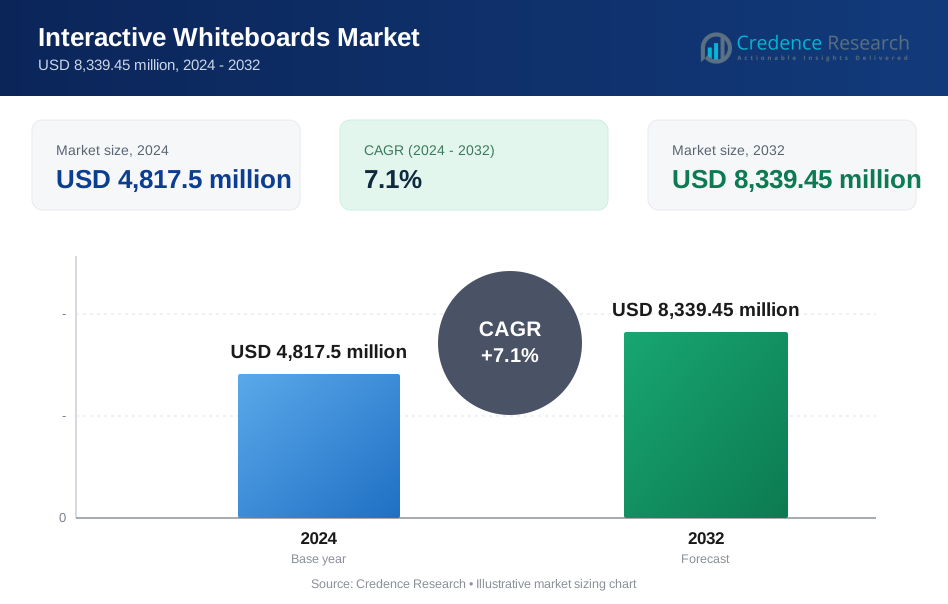
The global interactive whiteboards market was valued at USD 4,817.5 million in 2024 and is projected to reach USD 8,339.45 million by 2032, expanding at a CAGR of 7.1% during the forecast period.
| REPORT ATTRIBUTE | DETAILS |
|---|---|
| Historical Period | 2020-2023 |
| Base Year | 2024 |
| Forecast Period | 2025-2032 |
| Interactive Whiteboards Market Size 2024 | USD 4,817.5 million |
| Interactive Whiteboards Market, CAGR | 7.1% |
| Interactive Whiteboards Market Size 2032 | USD 8,339.45 million |
The interactive whiteboards market is shaped by major technology manufacturers and specialized edtech providers, including Panasonic, SMART Technologies ULC, LG Display, Foxconn, Boxlight, Promethean, PROMETHEAN LIMITED, Genee World Ltd, Xiamen Interactive Technology Co., Ltd, and I3 SOLUTIONS. These companies compete through advancements in multi-touch accuracy, display quality, AI-enabled collaboration tools, and cloud-integrated software. North America leads the market with approximately 34–36% share, driven by strong adoption in education and corporate environments, followed by Asia-Pacific with 28–30%, supported by rapid digitalization and large-scale smart classroom initiatives. Europe remains a strong contributor with 25–27% share, reinforced by structured government-led digital education programs.

Market Insights
- The global interactive whiteboards market reached USD 4,817.5 million in 2024 and is projected to hit USD 8,339.45 million by 2032, expanding at a CAGR of 7.1%.
- Strong drivers include rapid digital classroom adoption, hybrid learning expansion, and increasing corporate demand for real-time collaboration tools, with infrared technology leading the segment at around 40% market share due to its accuracy and cost efficiency.
- Trends such as AI-enhanced learning tools, cloud-connected collaboration platforms, and 4K display integration continue to elevate user experience while accelerating replacement of legacy board systems.
- The competitive landscape is shaped by Panasonic, LG Display, SMART Technologies, Promethean, Boxlight, Foxconn, Genee World Ltd, I3 SOLUTIONS, and Xiamen Interactive Technology, all focusing on touch precision, software ecosystems, and unified communication integration.
- Regionally, North America leads with 34–36% share, followed by Asia-Pacific at 28–30% and Europe at 25–27%, while Latin America and Middle East & Africa collectively represent emerging but steadily growing markets.
Market Segmentation Analysis:
By Technology
Infrared technology remains the dominant segment in the interactive whiteboards market, capturing the largest share due to its high accuracy, durability, and cost-efficient design. Its ability to support multi-touch input and operate effectively even when the surface is partially obstructed makes it preferred across education, corporate training, and government applications. Capacitive and electromagnetic solutions are gaining momentum for high-precision professional use, while resistive membrane systems continue to serve budget-sensitive institutions. The “Others” category including emerging optical and laser-based systems supports niche, high-interactivity environments but remains smaller in adoption.
- For instance, Promethean’s ActivPanel 9 supports up to 20 simultaneous touch points and integrates the company’s Vellum™ writing technology, which provides smooth pen-on-paper-style writing. The panel includes palm-rejection support and accurate object differentiation for pens, touch, and erase inputs during classroom use.
By Form Factor
The fixed interactive whiteboard segment holds the dominant market share, driven by strong adoption in K–12 and higher education classrooms requiring permanent installation and stable large-format display solutions. Schools and training centers prefer fixed units for their long operational life, integration with projectors, and consistent teaching workflows. Portable interactive whiteboards are growing steadily as institutions and enterprises seek flexible, mobile collaboration tools for multi-room usage, temporary learning environments, and hybrid work models. Their low setup time and ability to convert any surface into an interactive display continue to expand deployment across dynamic learning and corporate settings.
- For instance, SMART Technologies’ M Pro High Secure Series offers fixed panels in 55”, 65”, 75”, and 86” formats with 4K (3840 × 2160) resolution and a lifespan of over 50,000 hours, making them ideal for long-term classroom use.
By Projection Technique
Front-projection interactive whiteboards lead the market with the largest share, supported by widespread use in classrooms, meeting rooms, and training facilities where installation ease, cost efficiency, and compatibility with standard projectors are essential. Their ability to deliver large display sizes and smooth touch performance drives continued preference. Rear-projection systems, although smaller in adoption, cater to environments seeking minimized shadow interference and enhanced visual clarity. These systems are increasingly considered for high-end corporate, control room, and simulation applications where uninterrupted visibility and reduced glare provide operational advantages.
Key Growth Drivers
Rising Adoption of Digital Learning Ecosystems
The global shift toward digitally enabled classrooms continues to be the most influential driver for interactive whiteboards. Governments and school districts increasingly invest in smart-class infrastructure to enhance learning outcomes, improve student engagement, and align with modern curriculum standards. Interactive whiteboards support collaborative teaching methods, multimedia integration, and real-time annotation, enabling educators to deliver more immersive lessons. The rise of hybrid learning models combining in-person instruction with virtual participation further accelerates adoption, as schools require interactive tools that function seamlessly with video conferencing platforms and cloud-based content. In addition, national digital education policies and funding programs across the U.S., Europe, China, and the Middle East strengthen procurement of interactive classroom technologies. As education systems continue prioritizing STEM, experiential learning, and inclusive teaching, institutions increasingly adopt interactive whiteboards to modernize learning environments and meet evolving pedagogical needs.
- For instance, BenQ’s RP04 Education Panel includes a 40-point touch system, True 4K display, and Germ-Resistant Screen certified by TÜV to support safe and interactive use in high-traffic classrooms.
Expanding Use of Interactive Collaboration Tools in Corporate and Government Sectors
Interactive whiteboards are gaining strong traction across corporate boardrooms, training centers, and government facilities as organizations prioritize efficient collaboration and real-time decision-making. Businesses rely on these solutions to support hybrid work environments, offering touch-enabled ideation, visual brainstorming, and multi-location collaboration. Advanced whiteboards integrate seamlessly with unified communication platforms, cloud software, and video conferencing systems, enabling distributed teams to share data, annotate documents, and co-create content with greater accuracy. Government agencies, defense institutions, and public-sector offices increasingly deploy interactive boards for mission planning, simulation training, and digital workflows. Moreover, demand rises from consulting, engineering, financial services, healthcare, and energy sectors where visual data interpretation supports operational efficiency. As enterprises continue digital transformation and seek high-impact collaboration tools that improve productivity, interactive whiteboards play an essential role in enhancing communication and accelerating strategic decision-making.
- For instance, Promethean’s ActivPanel 9 integrates dual 15-watt speakers, while the ActivPanel 9 Premium adds dual 18-watt speakers and a 15-watt subwoofer, delivering enhanced audio clarity for hybrid meetings and training.
Technological Advancements in Touch, Display, and Software Integration
Continuous advancements in touch-sensing technology, display quality, and integrated software ecosystems significantly drive the market forward. Modern interactive whiteboards use infrared, electromagnetic, and capacitive technologies to deliver higher precision, faster response times, and seamless multi-touch interaction. Improvements in 4K and ultra-short-throw projection, along with the integration of AI-assisted tools, enhance content visibility and interactive performance in both educational and professional settings. Software platforms now offer cloud connectivity, digital lesson planning, collaborative whiteboarding, and compatibility with learning management systems, further elevating user experience. Manufacturers also incorporate wireless screen sharing, gesture recognition, and device synchronization to support BYOD (Bring Your Own Device) environments. Enhanced durability, energy-efficient components, and maintenance-friendly designs reduce total cost of ownership, encouraging wider adoption. These innovations collectively transform interactive whiteboards into more versatile, intelligent, and user-centric collaboration tools.
Key Trends & Opportunities
Integration of AI, Cloud Collaboration, and Data Analytics
AI integration is emerging as a transformative trend, enabling interactive whiteboards to deliver personalized learning insights, automated content recommendations, handwriting recognition, and real-time performance feedback. Cloud-based collaboration tools allow multiple users on-site or remote to co-author documents, share screens, and annotate content simultaneously. These capabilities align with the rapid expansion of hybrid learning and distributed workforce models. Advanced analytics embedded within interactive whiteboard ecosystems help educators track student participation and performance metrics, while enterprises leverage data for workflow optimization and project monitoring. Opportunities are increasing for manufacturers to develop AI-driven platforms with predictive learning modules, interactive assessments, and enhanced content management. As institutions emphasize data-informed decision-making, AI- and cloud-connected whiteboards become vital in delivering intelligent, interactive experiences across knowledge-driven environments.
- For instance, SMART Technologies' displays feature the proprietary Tool Explorer™ tool recognition system (available on the QX (V2) Pro and RX Series models) which works in conjunction with HyPr Touch with Advanced IR technology.
Growing Demand for Portable and Multi-Environment Interactive Solutions
Increasing preference for flexible, portable, and multi-surface interactive tools presents strong growth opportunities. Portable interactive whiteboard systems, mobile stands, and projection-based interactive kits enable institutions and companies to convert any flat surface into an interactive workspace. This flexibility supports temporary classrooms, multi-purpose halls, corporate training events, and remote field operations where permanent installations may not be feasible. Educational organizations facing space constraints or rotating classes increasingly adopt portable solutions to maximize utilization. Similarly, SMEs and coworking spaces value mobility, low upfront cost, and ease of deployment. As hybrid work and flexible learning models expand, vendors have the opportunity to introduce lightweight, wireless, and battery-efficient interactive systems that address mobility-oriented use cases. This trend also encourages ecosystem development around portable accessories, cloud sync features, and multi-device connectivity.
- For instance, Boxlight’s MimioTeach system uses infrared and ultrasonic tracking to turn any dry-erase board into an interactive workspace. The unit connects through the MimioHub wireless receiver, allowing teachers to control digital lessons directly from the board without requiring calibration for each session.
Key Challenges
High Installation and Maintenance Costs for Advanced Systems
Interactive whiteboards, particularly those using advanced touch technologies or ultra-short-throw projectors, require significant investment, posing financial challenges for budget-limited institutions. Beyond the upfront cost, expenses for installation, calibration, replacement parts, and periodic maintenance add to the total cost of ownership. Schools, small enterprises, and public institutions often struggle to justify spending on premium systems when low-cost alternatives like tablets, touchscreen displays, or collaborative software tools are available. Additionally, high-quality projection-based systems demand routine lamp replacements, filter cleaning, and environmental adjustments, extending long-term operational costs. While leasing and bundled service models mitigate some financial barriers, cost sensitivity remains a major obstacle, especially in emerging markets where digital infrastructure budgets are constrained.
Integration Compatibility Issues and User Adoption Barriers
Despite technological advancements, many institutions face challenges integrating interactive whiteboards with existing digital infrastructure, legacy devices, and software platforms. Compatibility issues with operating systems, projectors, content formats, and collaboration tools can reduce system efficiency and disrupt workflows. In education, teachers may require training to effectively use advanced features, while faculty resistance to technology-driven instruction slows adoption. In enterprise settings, inconsistent IT support, bandwidth limitations, and multi-device connectivity issues hinder seamless collaboration. Furthermore, insufficient digital literacy among users reduces utilization rates, preventing organizations from realizing full ROI. Overcoming these challenges requires ongoing training programs, improved software interoperability, and intuitive user interfaces designed for diverse skill levels.
Regional Analysis
North America
North America holds the dominant position in the interactive whiteboards market, capturing around 34–36% of global share, driven by strong adoption across K–12 schools, higher education, and corporate training environments. Government-backed digital education programs, advanced IT infrastructure, and high spending capacity support large-scale deployments. The U.S. leads regional demand due to widespread smart classroom initiatives, while Canada continues expanding investments in blended learning solutions. Enterprises in technology, consulting, and government operations increasingly use interactive systems for high-impact collaboration. Strong presence of leading manufacturers and software ecosystem providers further strengthens regional market leadership.
Europe
Europe accounts for approximately 25–27% of the global interactive whiteboards market, supported by early adoption of digital learning tools and strong regulatory emphasis on modernizing classrooms. The UK, Germany, France, and the Nordics show particularly high penetration, driven by structured national digitalization programs and standardized procurement models. European schools and training centers favor interactive whiteboards for immersive content delivery and multilingual learning support. Corporate uptake is rising in manufacturing, finance, and automotive sectors where visual collaboration enhances operational efficiency. Continuous emphasis on sustainable, energy-efficient display solutions further accelerates technology replacement and upgrades across the region.
Asia-Pacific
Asia-Pacific represents the fastest-growing region, capturing about 28–30% of global market share, fueled by rapid educational infrastructure expansion, rising digital literacy, and large-scale government investments. China, Japan, South Korea, and India drive momentum with nationwide smart classroom rollouts and increasing focus on STEM and experiential learning. The region benefits from strong local manufacturing capabilities, lowering costs and encouraging high-volume procurement by public and private institutions. Corporate adoption is also accelerating as enterprises expand hybrid work models and digital collaboration environments. Growing urbanization and large student populations continue to position Asia-Pacific as a long-term growth engine.
Latin America
Latin America holds roughly 6–7% of the global market, with adoption gradually increasing as governments prioritize digital education and remote learning capabilities. Brazil, Mexico, Colombia, and Chile lead regional demand through incremental investments in smart classrooms and teacher training programs. Limited IT budgets and infrastructure gaps constrain large-scale deployments, but improving connectivity and public–private partnerships are expanding access. Corporate uptake remains modest but is increasing across banking, telecommunications, and energy sectors seeking modern collaboration tools. Vendors offering cost-effective, durable systems gain competitive advantage as institutions seek affordable digital transformation solutions.
Middle East & Africa
The Middle East & Africa region accounts for around 4–5% of global market share, supported by selective but high-impact investments in education modernization and digital workforce development. Gulf countries-including the UAE, Saudi Arabia, and Qatar-lead adoption due to strong government funding, smart city initiatives, and advanced learning infrastructure. Africa’s adoption remains at an early stage, limited by budget constraints, though demand is rising in private schools and international institutions. Corporate adoption increases gradually as organizations digitize training and meeting environments. Growing emphasis on e-learning platforms and teacher digital readiness continues to support steady regional expansion.
Market Segmentations:
By Technology
- Infrared
- Resistive Membrane
- Electromagnetic Pen
- Capacitive
- Others
By Form Factor
- Fixed
- Portable
By Projection Technique
- Front Projection
- Rear Projection
By Geography
- North America
- U.S.
- Canada
- Mexico
- Europe
- Germany
- France
- U.K.
- Italy
- Spain
- Rest of Europe
- Asia Pacific
- China
- Japan
- India
- South Korea
- South-east Asia
- Rest of Asia Pacific
- Latin America
- Brazil
- Argentina
- Rest of Latin America
- Middle East & Africa
- GCC Countries
- South Africa
- Rest of the Middle East and Africa
Competitive Landscape
The competitive landscape of the interactive whiteboards market is characterized by a mix of global technology leaders, specialized education-technology companies, and regional hardware manufacturers competing on product innovation, ecosystem integration, and pricing. Key players focus on advanced touch technologies, AI-enabled collaboration tools, 4K display compatibility, cloud-connected interfaces, and seamless integration with learning management and enterprise platforms. Established brands maintain strong positions through extensive distribution networks, continuous software updates, and bundled solutions combining hardware, collaboration software, and training services. Emerging vendors strengthen competitiveness by offering cost-effective, portable, and hybrid-learning-ready systems tailored for schools and SMEs. Companies also invest in strategic partnerships with educational institutions, enterprise solution providers, and government digitalization programs to expand deployment. As demand rises across education, corporate, and government sectors, competition intensifies around display resolution, multi-touch responsiveness, wireless connectivity, and remote collaboration features, shaping a market defined by rapid technological enhancements and ecosystem-driven value differentiation.
Key Player Analysis
- Panasonic
- Genee World Ltd
- SMART Technologies ULC
- Foxconn
- LG Display
- Boxlight
- PROMETHEAN LIMITED
- Xiamen Interactive Technology Co., Ltd
- I3 SOLUTIONS
- Promethean
Recent Developments
- In February 2025, SMART Technologies ULC the launch of the SMART Board Mini Interactive Podium, the SMART Board M Pro High Secure Series TAA Interactive Display, and the SMART OneLaunch meeting tool at ISE 2025.
- In January 2024, Promethean introduced its new Explain Everything Whiteboard app at FETC 2024, which will be included free on all ActivPanel 9 and ActivPanel 9 Premium displays, enabling simultaneous use of the full Essential App Suite and direct cloud-drive access from the panel.
Report Coverage
The research report offers an in-depth analysis based on Technology, Form factor, Projection technique and Geography. It details leading market players, providing an overview of their business, product offerings, investments, revenue streams, and key applications. Additionally, the report includes insights into the competitive environment, SWOT analysis, current market trends, as well as the primary drivers and constraints. Furthermore, it discusses various factors that have driven market expansion in recent years. The report also explores market dynamics, regulatory scenarios, and technological advancements that are shaping the industry. It assesses the impact of external factors and global economic changes on market growth. Lastly, it provides strategic recommendations for new entrants and established companies to navigate the complexities of the market.
Future Outlook
- Adoption of interactive whiteboards will accelerate as schools and enterprises continue expanding digital and hybrid learning environments.
- AI-enabled content tools and analytics will enhance personalization, assessment, and lesson planning functionality.
- Cloud collaboration platforms will strengthen integration, enabling multi-user interaction across remote and on-site settings.
- Portable and wireless interactive solutions will see rising demand in flexible classrooms and mobile corporate environments.
- Advances in touch precision, gesture recognition, and 4K display quality will improve user experience and instructional effectiveness.
- Integration with unified communication systems will expand usage in corporate training, meetings, and workflow collaboration.
- Education modernization programs across Asia-Pacific, the Middle East, and Latin America will drive large-scale deployments.
- Sustainability-focused designs, including low-power components and longer lifespan materials, will influence procurement decisions.
- Software ecosystems will become a core differentiator as vendors enhance compatibility with LMS and productivity platforms.
- Increased competition will lead to more affordable solutions, driving adoption among budget-constrained institutions.
Request a Free Sample
Fill in your details and we'll send you a free sample report.
- Sample data tables & charts
- Research methodology
Need a Custom Version of This Report?
Tailor the scope, geography, or segments to your exact requirements.
- Custom geography or segment scope
- Direct access to our analyst team
Frequently Asked Questions
What is the current market size for the Interactive Whiteboards market, and what is its projected size in 2032?
At what Compound Annual Growth Rate is the Interactive Whiteboards market projected to grow between 2024 and 2032?
Who are the major players in the global interactive whiteboard market?
What are the major market drivers of the interactive whiteboards industry?
What are the major market restraints of the interactive whiteboards industry?
What are the major market opportunities of the interactive whiteboards industry?
Who are the leading companies in the Interactive Whiteboards market?
Table of Content
Chapter 1. Report Introduction
- 1.1 Report Description & Purpose
- 1.1.1 Report Title & Market Definition
- 1.1.2 Unique Selling Propositions (USP) & Key Differentiators
- 1.1.3 Value Proposition for Stakeholders
- 1.2 Research Objectives
- 1.2.1 Market Sizing Objectives (Volume & Revenue)
- 1.2.2 Segmentation Objectives
- 1.2.3 Competitive Intelligence Objectives
- 1.2.4 Forecast & Scenario Objectives
- 1.3 Report Scope
- 1.3.1 Interactive Whiteboards Scope – Types & Subtypes Covered
- 1.3.2 Geographic Scope – Regions & Countries Covered
- 1.3.3 Historical Period, Base Year & Forecast Period (2024; forecast to 2032)
- 1.3.4 Inclusions & Exclusions
- 1.4 HS Code & Classification Framework
- 1.5 Currency, Units & Pricing Basis
- 1.6 Target Stakeholders
- 1.7 Limitations & Assumptions
Chapter 2. Executive Summary
- 2.1 Global Interactive Whiteboards Market Snapshot
- 2.1.1 Market Size – Historical (2024) & Forecast (2024-2032) (2024: USD 4,817.5 million → 2032: USD 8,339.45 million)
- 2.1.2 Volume & Revenue – Global Totals
- 2.1.3 Key Market Highlights – Top Five Facts
- 2.2 Interactive Whiteboards Market Segmentation Snapshot
- 2.2.1 Market Split by Region – 2024 vs. 2032
- 2.3 Competitive Snapshot
- 2.3.1 Top 10 Players by Revenue Share – 2024
- 2.3.2 Top 10 Players by Volume Share – 2024
- 2.3.3 Recent Strategic Developments (18-Month Summary)
- 2.4 Key Investment Highlights & Strategic Conclusions
Chapter 3. Interactive Whiteboards Market Dynamics & Industry Analysis
- 3.1 Market Overview & Context
- 3.1.1 Interactive Whiteboards Market Position in the Broader Automotive Value Chain
- 3.1.2 OEM vs. Replacement Market Dynamics
- 3.1.3 Market Maturity & Development Stage by Region
- 3.2 Interactive Whiteboards Market Drivers
- 3.3 Interactive Whiteboards Market Restraints & Challenges
- 3.4 Interactive Whiteboards Market Opportunities
- 3.5 Porter's Five Forces Analysis
- 3.5.1 Threat of New Entrants
- 3.5.2 Bargaining Power of Suppliers
- 3.5.3 Bargaining Power of Buyers
- 3.5.4 Threat of Substitutes
- 3.5.5 Competitive Rivalry – Intensity Assessment
- 3.6 Interactive Whiteboards Value Chain Analysis
- 3.6.1 Upstream – Raw Material/Input Suppliers
- 3.6.1.1 Raw Material/Input 1
- 3.6.1.2 Raw Material/Input 2
- 3.6.1.3 Raw Material/Input 3
- 3.6.2 Midstream – Production/Manufacturing/Service Delivery
- 3.6.2.1 Production/Process Overview
- 3.6.2.2 Key Facility Locations & Capacity by Manufacturer
- 3.6.3 Downstream – Distribution & End Consumer
- 3.6.3.1 Primary Channel – B2B/OEM
- 3.6.3.2 Secondary Channels – Dealer, Retail, Online, Direct
- 3.6.4 Value Chain Profitability Analysis
- 3.6.1 Upstream – Raw Material/Input Suppliers
- 3.7 PESTEL Analysis
- 3.7.1 Political Factors
- 3.7.2 Economic Factors
- 3.7.3 Social Factors
- 3.7.4 Technological Factors
- 3.7.5 Environmental Factors
- 3.7.6 Legal Factors
- 3.8 Interactive Whiteboards Supply Chain Analysis
- 3.8.1 Raw Material/Input Supply Risk Assessment
- 3.8.2 Manufacturing Concentration Risk (Geographic Exposure)
- 3.8.3 Trade Disruption Impact Analysis
- 3.9 Regulatory & Policy Landscape
Note: The regulatory and policy landscape section covers regulations based on their applicability to the market, Interactive Whiteboards category, geography, and scope of the study. Only regulatory frameworks with a material impact on operations, compliance, trade, sustainability, or market access are analyzed in detail.
Chapter 4. Key Investment Pockets & Opportunity Analysis
- 4.1 Interactive Whiteboards Market Attractiveness Analysis
- 4.1.1 By Region – Investment Attractiveness Matrix (Volume × CAGR)
- 4.2 Absolute Revenue Growth Opportunity
- 4.2.1 By Region – Absolute USD Growth Through 2032
- 4.3 Incremental Volume Opportunity
- 4.3.1 By Region – Incremental Volume Through 2032
- 4.3.2 Segment – Incremental Volume
- 4.4 Emerging Submarket Opportunity Deep Dive (Subject to Applicability)
- 4.5 Emerging Market Opportunity Scorecards
- 4.5.1 United States
- 4.5.2 Europe
- 4.5.3 Asia
- 4.5.4 Middle East & Africa
Note: Emerging Market Opportunity Scorecards will be included based on relevance and strategic importance. Regions listed are indicative and may vary depending on data availability and market dynamics.
Chapter 5. Interactive Whiteboards Import-Export Analysis & Trade Flows
- 5.1 Global Trade Overview
- 5.1.1 Global Export Value by Country (2024)
- 5.1.2 Global Export Volume by Country (2024)
- 5.1.3 Global Import Value by Country (2024)
- 5.1.4 Global Import Volume by Country (2024)
- 5.1.5 Net Trade Balance by Country (2024)
- 5.2 Export Analysis – Segment
- 5.2.1 Type 1 (HS Code)
- 5.2.2 Type 2 (HS Code)
- 5.2.3 Type 3 (HS Code)
- 5.2.4 Type 4 (HS Code)
- 5.2.5 Type 5 (HS Code)
- 5.3 Import Analysis – Segment
- 5.3.1 Type 1 (HS Code)
- 5.3.2 Type 2 (HS Code)
- 5.3.3 Type 3 (HS Code)
- 5.3.4 Type 4 (HS Code)
- 5.3.5 Type 5 (HS Code)
- 5.4 Average Unit Trade Prices
- 5.4.1 Average Export Price – Segment & Country
- 5.4.2 Average Import Price – Segment & Source Country
- 5.4.3 Price Trends (2024)
- 5.5 Key Trade Route Analysis
- 5.5.1 Trade Route 1
- 5.5.2 Trade Route 2
- 5.5.3 Trade Route 3
- 5.5.4 Trade Route 4
- 5.5.5 Trade Route 5
- 5.6 Trade Policy Impact Assessment
- 5.6.1 US Anti-Dumping & Section 301 Tariffs
- 5.6.2 EU Customs Union Impact
- 5.6.3 Major Free Trade Agreements
- 5.6.4 USMCA Rules of Origin
Note: Trade policy analysis will be included only where relevant to the Interactive Whiteboards market.
Chapter 6. Competitive Landscape & Company Benchmarking
- 6.1 Interactive Whiteboards Market Concentration & Structure
- 6.1.1 Herfindahl-Hirschman Index (HHI) – vs. 2024
- 6.1.2 Tier 1, Tier 2 & Tier 3 Market Structure
- 6.1.3 Global, Regional & Local Player Dynamics
- 6.2 Interactive Whiteboards Market Share Analysis – 2024
- 6.2.1 Global Revenue Share by Company
- 6.2.2 Global Volume Share by Company
- 6.2.3 Regional Revenue Share
- 6.2.4 Market Share Evolution ( vs. 2024)
- 6.2.5 OEM Segment Share by Company
- 6.2.6 Replacement Segment Share by Company
- 6.3 Production/Delivery Capacity & Facility Analysis
- 6.3.1 Global Installed Capacity
- 6.3.2 Capacity Utilization Rates
- 6.3.3 Production/Output Volume
- 6.3.4 Facility Locations & Capacity Map
- 6.3.5 Planned Capacity Additions
- 6.4 Interactive Whiteboards Competitive Benchmarking Matrix
- 6.4.1 Revenue, Volume, CAGR & Profitability Comparison
- 6.4.2 Channel Revenue Mix
- 6.4.3 Geographic Revenue Exposure
- 6.4.4 R&D Intensity
- 6.4.5 Sustainability Maturity
- 6.5 Strategic Developments in Interactive Whiteboards (Last 24 Months)
- 6.5.1 Mergers, Acquisitions & Divestments
- 6.5.2 New Interactive Whiteboards Launches
- 6.5.3 Facility Expansions
- 6.5.4 Strategic Alliances, Joint Ventures & Partnerships
- 6.5.5 Distribution Expansion & Market Entry
- 6.5.6 Sustainability & ESG Initiatives
- 6.6 Competitive Strategy Mapping
- 6.6.1 Leader, Challenger, Follower & Niche Classification
- 6.6.2 Pricing Strategy Comparison
- 6.6.3 Channel Strategy Matrix
Note: Strategic developments are included based on their materiality and the availability of reliable information.
Chapter 7. Global Interactive Whiteboards Market – By Distribution Channel
- 7.1 Segment Overview
- 7.1.1 Volume & Revenue Split by Channel (2024 & 2032)
- 7.1.2 Channel Mix Evolution (2024-2032)
Chapter 8. Regional Market Analysis – Global Overview
- 8.1 Global Regional Overview
- 8.1.1 Regional Volume Share
- 8.1.2 Regional Revenue Share
- 8.1.3 Regional Volume by Region
- 8.1.4 Regional Revenue by Region
- 8.1.5 Regional Forecast Through 2032
- 8.2 Cross-Regional Segment Analysis
- 8.2.1 By Distribution Channel
- 8.2.2 By Brand/Price Tier
Chapter 9. North America Interactive Whiteboards Market
- 9.1 United States
- 9.2 Canada
- 9.3 Mexico
Chapter 10. Europe Interactive Whiteboards Market
- 10.1 Germany
- 10.2 France
- 10.3 Italy
- 10.4 United Kingdom
- 10.5 Spain
- 10.6 Poland
- 10.7 Russia
- 10.8 Netherlands
- 10.9 Belgium
- 10.10 Sweden
- 10.11 Denmark
- 10.12 Norway
- 10.13 Rest of Europe
Chapter 11. Asia Pacific Interactive Whiteboards Market
- 11.1 China
- 11.2 India
- 11.3 Japan
- 11.4 South Korea
- 11.5 Thailand
- 11.6 Indonesia
- 11.7 Vietnam
- 11.8 Malaysia
- 11.9 Australia
- 11.10 Rest of Asia Pacific
Chapter 12. Latin America Interactive Whiteboards Market
- 12.1 Brazil
- 12.2 Argentina
- 12.3 Colombia
- 12.4 Chile
- 12.5 Rest of Latin America
Chapter 13. Middle East Interactive Whiteboards Market
- 13.1 Saudi Arabia
- 13.2 United Arab Emirates
- 13.3 Turkey
- 13.4 Israel
- 13.5 Iran
- 13.6 Rest of the Middle East
Chapter 14. Africa Interactive Whiteboards Market
- 14.1 South Africa
- 14.2 Egypt
- 14.3 Nigeria
- 14.4 Morocco
- 14.5 Rest of Africa
Chapter 15. Interactive Whiteboards Company Profiles
- 15.1 [Company 01]
- 15.1.1 Company Overview
- 15.1.2 Key Management Personnel
- 15.1.3 Products & Services Portfolio
- 15.1.4 Financial Performance
- 15.1.5 Key Market Focus & Geographic Presence
- 15.1.6 Recent Developments & Strategic Initiatives
Note: The company profile list is preliminary and may change based on research findings, market developments, data availability, and client requirements.
Chapter 16. Appendices
- Appendix A – List of Abbreviations & Acronyms
- Appendix B – Industry Classification Code Reference – Full Series
- Appendix C – Production & Capacity Data Tables
- Appendix D – End-Use & Demand Base Tables
- Appendix E – Consumption & Replacement Rate Assumptions
- Appendix F – ASP Reference Tables
- Appendix G – Manufacturing & Facility Database
- Appendix H – Import-Export Data Tables
- Appendix I – Regulatory Summary Tables
- Appendix J – Primary Research Participant List (Anonymized)
- Appendix K – Primary Research Questionnaire Framework
- Appendix L – Data Sources & Bibliography
- Appendix M – Market Size Divergence & Source Comparison
Chapter 17. Research Methodology
- 17.1 Research Framework & Philosophy
- 17.2 Secondary Research – Sources, Hierarchy & Data Extraction
- 17.3 Data Modeling – Bottom-Up & Top-Down Market Sizing
- 17.4 Primary Research – Stakeholder Framework, LOI & Sample Sizes
- 17.5 Forecast Methodology – Regression, Scenario & Sensitivity Analysis
- 17.6 Quality Control – Four-Layer Validation Framework
- 17.7 Limitations & Standard Assumptions
- 17.8 Disclaimer
